Posts Tagged ‘human rights awards’

Human rights defender Ji Sizun- in jail – awarded 5th Cao Shunli Memorial Award for Human Rights Defenders

March 16, 2019

RFA reported on 14 March 2019 that jailed rights activist Ji Sizun was awarded the fifth Cao Shunli Memorial Award for Human Rights Defenders, for his contribution in promoting legal rights and education at the grassroots level in China. [see also: https://humanrightsdefenders.blog/2016/02/12/cao-shunli-a-profile-and-new-award-in-her-name/]

The award has been given to those who carry on Cao’s grassroots advocacy while facing threats and risks in promoting human rights, protecting vulnerable social groups from abuses, pushing for civil society participation in international human rights mechanisms, and monitoring the Chinese government’s implementation of its human rights obligations,” the overseas-based Chinese Human Rights Defenders (CHRD) network said in a statement on its website.

Ji, 70, is a self-taught legal activist from the southeastern province of Fujian who was detained in October 2014 for publicly supporting the pro-democracy protests in Hong Kong. He was later handed a four-and-a-half-year jail term for “gathering a crowd to disrupt public order” and “picking quarrels and stirring up trouble” for helping petitioners to organize two protests in August and September 2014. “Ji Sizun’s health has seriously deteriorated during his incarceration, and he suffered a debilitating stroke in 2016 and has not received sufficient medical treatment for a number of severe health conditions,” CHRD said. He should be released from Putian Prison in Fujian Province on 26 April, 2019.

https://www.rfa.org/english/news/china/un-calls-for-probe-into-activists-death-03142019112234.html

Gulf Center publishes 2018 survey of human rights in the Middle East

March 12, 2019
A Bahraini woman sits near portraits of jailed political activists, in the village of Sitra, 12 February 2016
A Bahraini woman sits near portraits of jailed political activists, in the village of Sitra, 12 February 2016  MOHAMMED AL-SHAIKH/AFP/Getty Images

The Gulf Centre for Human Rights (GCHR) released its seventh annual report on human rights activism in 2018, entitled Breaking Boundaries. It remembers the women and men human rights defenders imprisoned for their work across the region, particularly in Bahrain, Iran, Iraq, Kuwait, Oman, Saudi Arabia, Syria, the United Arab Emirates and Yemen.

The report features a summary and case updates of 145 women and men human rights defenders across the Gulf and neighbouring countries as well as the legal and political developments relevant to human rights in these countries. Additionally, it summarises GCHR’s research, advocacy and capacity-building activities with regional and international partners. [for my earlier post on the GCHR, see:  https://humanrightsdefenders.blog/tag/gulf-centre-for-human-rights/]

In this 2018 report, GCHR recognises that despite increased restrictions on civic space and aggressive prosecution of human rights defenders, the boundaries crumbling since 2011 are worth celebrating. In the act of breaking these boundaries, solidarity networks nationally, regionally, and internationally have been nurtured and strengthened. With continued activism of journalists, human rights defenders and civil society, GCHR foresees that governments’ disrespect for human rights and freedoms in the region will be increasingly overturned.

The main focus of the report is to shed light on human rights activism. While governments intensified their harassment and prosecution of journalists, human rights defenders, online activists, and civilians, through the advocacy efforts of civil society on different fronts, the defence of human rights in the region has been met with international recognition, including many international awards for human rights defenders from across the Gulf and neighbouring countries.

The spotlight on governments, especially in the Gulf, unveiled the extent to which governments reject accountability to their people and commitment to human rights internationally. To mention a few examples: Bahrain denied the entry of United Nations experts along with extending travel bans on human rights defenders so they continue to miss UN Human Rights Council sessions. In Iraq, peaceful assembly was met with tear gas and live bullets to disperse the protests, leaving dozens killed and hundreds arrested. In Iran, well-known lawyers were among those sentenced to prison for defending women’s rights to reject forced hijab. And notoriously, Saudi Arabia arbitrarily arrested over 20 men and women who defend and advocate for women’s rights, even after the Kingdom formally lifted the driving ban on women.

Khalid Ibrahim, Executive Director of GCHR, says: “It is hard work to support human rights defenders and ensure their safety and security. Yet a success such as having the European Parliament formally and publicly denounce human rights abuses in Saudi Arabia in May 2018 and again in February 2019 shows the importance of diligence, solidarity and commitment to research- and evidence-based advocacy in the pursuit of defending human rights. Not to mention the attention facing Saudi Arabia at the UN Human Rights Council this month, where 36 States, including all EU Member States, called on 7 March 2019 for the release of detained women human rights defenders, sending a strong message to the Saudi authorities that the Council will hold its members accountable.

GCHR presented a number of recommendations at the end of this report to governments, and the international community. Emphasis is placed on guarantees of a legal framework grounded in respect for human rights, especially for the freedom of expression and opinion, to protect the safety of journalists, media workers and online activists whom governments across the region relentlessly harassed, targeted, or prosecuted. Other recommendations are made to ensure the safety of civilians such as in conflict-zones, as well as in countries in transition where respect for freedom of association and assembly are essential for peace and justice.
To download the full report, follow the link.

https://www.ifex.org/middle_east_north_africa/2019/03/11/human-rights-activism/

Djimon Hounsou set to play Congolese Nobel Prize winner Denis Mukwege in new film

March 12, 2019
Djimon Hounsou (Left) set to play Congolese Nobel winner Denis Mukwege in new film. Pic credit: Fraternité Matin

On 9 March 2019, Mildred Europa Taylor reported for Face2FaceAfrica that Djimon Hounsou is set to play the roll of Congolese Nobel Peace Prize winner Denis Mukwege in a new film, the   biopic ‘Panzi’, based on the book “Panzi” which was published in 2014. The 63-year-old Mukwege, a renowned Congolese gynaecologist and surgeon, has helped thousands of women and girls who have been victims of rape and sexual abuse at the hands of rebel forces in the Democratic Republic of Congo since the beginning of the civil war in the early 90s. He received many human rights awards [see: https://humanrightsdefenders.blog/2018/10/05/breaking-news-see-which-other-awards-the-2018-nobel-peace-prize-laureates-won-already/]. He founded the Panzi Hospital in the South Kivu province in 1999 to provide free and comprehensive care for female victims of rape and other forms of sexual violence during the conflict. The life of the “rape surgeon” has already been documented in the film, “The Man Who Mends Women”, and a book. [see: https://humanrightsdefenders.blog/2016/04/12/profile-denis-mukwege-democratic-republic-of-congo-courageous-doctor-rape-women/]

Hounsou, a Beninese-American actor and model who is best known for his Oscar-nominated performances in “Blood Diamond,” and “In America” will headline “Panzi.” The film will be produced by Cynthia Pinet at Paris-based 1divided Films. Last October, it was announced that the film was in casting and scheduled to start shooting this summer in Central Africa.

https://face2faceafrica.com/article/djimon-hounsou-set-to-play-congolese-nobel-winner-denis-mukwege-in-new-film

Does G7 set a precedent with Sotoudeh for inviting human rights defenders?

March 11, 2019
Radio Farda on 8 March 2019 reported that France’s President Macron has decided to invite jailed Iranian Human Rights Defender Nasrin Sotoudeh to the G7 Council. This is an excellent idea that deserves follow-up in other such forums. There are quite a few laureates of human rights awards who are in detention or subject to a travel ban. An invitation from a group of important world leaders is hard to ignore!

My first suggestions are:

https://humanrightsdefenders.blog/2019/01/29/eren-keskin-mea-nominee-2019-speaks-out-fearlessly-turkey-more-oppressive-today-than-ever/

https://humanrightsdefenders.blog/2017/10/10/breaking-news-egyptian-defender-mohammed-zaree-laureate-of-the-martin-ennals-award-2017/

https://humanrightsdefenders.blog/2015/09/15/fly-emirates-if-the-emirs-let-you/


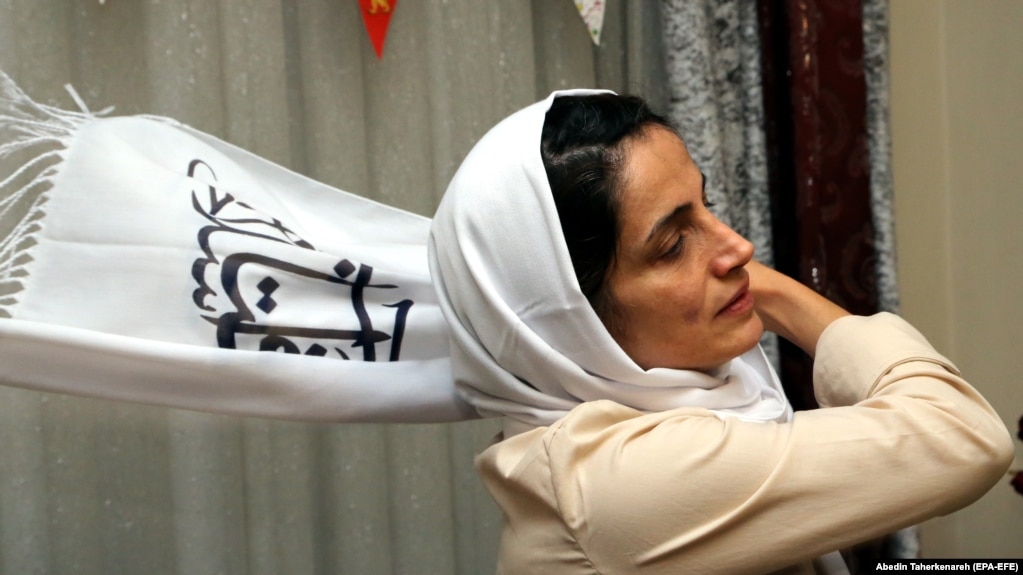
Imprisoned Iranian lawyer and human rights activist Nasrin Sotoudeh adjusts her scarf at her house in Tehran, September 18, 2013

French President Emmanuel Macron has invited jailed Iranian human rights lawyer Nasrin Sotoudeh to take part in the G7 gender equality forum. Sotoudeh’s husband Reza Khandan told Radio Farda on Friday that Macron’s invitation has been given to him in Tehran on Thursday March 7, one day before the International Women’s Day.[see also: https://humanrightsdefenders.blog/2018/06/16/iranian-human-rights-lawyer-nasrin-sotoudeh-arrested-again/]

Ms. Sotoudeh is to be a member of the consultative council for gender equality in Group 7. Khandan said Iranian women should be proud of Soutoudeh’s membership in the G7 council. Copies of the invitation have been handed to the Iranian Foreign Ministry and Bar Association.

Nasrin Sotoudeh has been in Jail since June 2018 with a five-year imprisonment sentence and is facing more charges for defending human rights activists in Iran. She is an outspoken opponent of the death penalty and compulsory hijab.  Sotoudeh, 55, is the winner of numerous international awards, including PEN/Barbara Goldsmith Freedom to Write (2011), Southern Illinois University School of Law Rule of Law Citation (2011) and Sakharov Prize (2012). On 21 September 2018, she was awarded the 23rd Ludovic-Trarieux International Human Rights Prize.

https://en.radiofarda.com/a/france-s-macron-invites-jailed-iranian-human-rights-lawyer-to-g7-council-/29811115.html

International Women of Courage Awards 2019 given out at the US State Department

March 11, 2019

On 7 March 2019, US Secretary of State Pompeo hosted the Annual International Women of Courage (IWOC) Awards at the State Department to honor 10 women from around the world. First Lady Melania Trump delivered special remarks at the ceremony.

Now in its 13th year, the Secretary of State’s IWOC Award wants to recognize women around the globe who have demonstrated exceptional courage and leadership in advocating for peace, justice, human rights, gender equality, and women’s empowerment, often at great personal risk and sacrifice. Since the inception of this award in March 2007, the State Department has recognized more than 120 women from more than 65 different countries. U.S. diplomatic missions overseas nominate one woman of courage from their respective host countries. The finalists are selected and approved by senior Department officials. For more in this and other awards for women: http://www.trueheroesfilms.org/thedigest/awards/international-women-of-courage-award.

The names of the 2019 IWOC winners are as follows:

  • Razia Sultana of Bangladesh
  • Naw K’nyaw Paw of Burma
  • Moumina Houssein Darar of Djibouti
  • Mama Maggie of Egypt
  • Colonel Khalida Khalaf Hanna al-Twal of Jordan
  • Sister Orla Treacy of Ireland
  • Olivera Lakic of Montenegro
  • Flor de Maria Vega Zapata of Peru
  • Marini de Livera of Sri Lanka
  • Anna Aloys Henga of Tanzania

Short bios of the 2019 awardees can be found through the link below.

https://www.state.gov/s/gwi/iwoc/2019/index.htm

Peter Nkanga awarded with inaugural Jamal Khashoggi Award for Courageous Journalism

March 7, 2019

Peter Nkanga, multilingual investigative journalist and former West Africa Representative of the Committee to Protect Journalists (CPJ), has been declared the laureate of the first “Jamal Khashoggi Award for Courageous Journalism” in 2019.

The award is administered by the US-based Inti Raymi Fund. For more information on this and similar awards for journalists, see: http://www.trueheroesfilms.org/thedigest/awards/jamal-khashoggi-award-for-courageous-journalism.

In a letter signed by Anas Talalqa, Human Rights Advisor at Inti Raymi Fund, the organisation congratulated Mr Nkanga for his selection for the award, noting that the “The Award honors the brave journalists who expose abuse of power and corruption, share difficult truths, discuss taboo topics, and work in hostile environments/

Today … dedicate this Award to all journalists and human rights defenders in #Africa. The struggle is real, but it is not over until We Win. #JusticeForJamal,” Peter Nkanga tweeted about the award.

Nigerian Peter Nkanga has been at the forefront of the campaign for the rights of journalists in Nigeria and across sub-Saharan Africa. Last year, he spearheaded the advocacy for the release of a journalist, Jones Abiri, publisher of Bayelsa State-based weekly paper, Weekly Source. He also coordinated the advocacy and protests in Nigeria on Jamal Khashoggi, the Saudi journalist who was murdered at the Saudi Arabian Consulate in Istanbul, Turkey, on October 2, 2018.

https://www.premiumtimesng.com/news/more-news/317920-nigerian-journalist-peter-nkanga-selected-for-2019-jamal-khashoggi-award-for-courageous-journalism.html

Aziz: thank you for the attention but now I have go back to detention…

February 18, 2019

Last Wednesday, 13 February 2019, Abdul Aziz Muhamat was awarded the 2019 Martin Ennals Award for human rights defender in Geneva. Some time earlier Behrouz Boochani was awarded the Australian Victorian Prize for Literature. What they have in common is that they are detained – for almost 6 years – on Manus Island under Australia’s off-shore refugee policy.  Their stories testify to the cruelty of this regime and the humanitarian deficiency of a country that claims a strong liberal tradition and is itself a nation based on immigration. Successive governments have defended this policy as necessary to stop trafficking although it is hard to see how forced stays of such length would attract anybody except the most desperate refugees. And anyway even those recognized as refugees would not be allowed to settle in Australia!

Aziz’ impassioned acceptance speech in Geneva, spoke of the solidarity he feels for his fellow detainees in the face of daily humiliating and degrading treatment. Therefore he vowed to return to his detention centre in the Pacific, return to be a number (“On the island, officials refer to me as QNK002. I have no identity other than that number“). See:

Read the rest of this entry »

Tang Jitian receives his French Republic Human Rights prize in Beijing

January 31, 2019

On 10 December, 2018, on the occasion of the 70th anniversary of the Universal Declaration of Human Rights and the 20th anniversary of the United Nations Declaration on Human Rights Defenders, the French National Consultative Commission on Human Rights (La Commission nationale consultative des droits de l’homme) has awarded the annual French Republic Human Rights Prize to six personalities or organizations that have distinguished themselves in their country for the defense and promotion of human rights, and Chinese human rights lawyer Tang Jitian was one of them. He was unable to travel to France to receive the prize. On January 14, 2019, the French Ambassador to China, Mr. Jean-Maurice Ripert, presented him the award in Beijing. For more on this another awards: http://www.trueheroesfilms.org/thedigest/awards/prix-des-droits-de-lhomme-de-la-republique-francaise.

Excerpts from his Acceptance Speech:

Ladies and Gentlemen: 

……Since entering the legal profession, especially after coming to Beijing in 2007, I was determined to use the law to help those who had suffered injustices. In addition to handling human rights cases, I also participated extensively in social actions, one of which was an effort in 2008-09, together with a cohort of lawyers to promote direct elections of the Beijing Lawyers’ Association. This action infuriated the Chinese government, and in April 2010, my license to practice law was revoked. Even though I suffered this blow of losing my normal legal practitioner’s identity, it didn’t stop me from engaging in rights defense work. On the contrary, I threw myself into the work even more actively, including the struggle for lawyers’ own rights and interests. And despite having suffered numerous rounds of forced disappearance and arbitrary detention, accompanied by torture, I nonetheless still had the same intention as before –– to continue to be active in the field of rights defense in China.

Although I’ve been restricted from exiting the country for nearly 10 years, making it impossible for me to fully communicate and work together with the outside world, my view was not completely limited. I still have friends from certain countries who have facilitated my work to varying degrees.

……..Contemporary mainland China has reached a critical juncture: whether to embrace civilization or choose barbarism; whether to practice universal values ​​or push the rules of the jungle; whether to preserve and strengthen the outdated totalitarianism or move toward a new democratic politics –– there is not much time left to waver.  

As a member of civil society, I look forward to China getting on the right track as soon as possible, but those selfish and greedy officials in the government are trying to pull the people back into barbarism. It is difficult to imagine what things would be like to have a China with 1.3 billion people suspended alone for a long period of time outside the civilized world: the deteriorating human rights situation in mainland China is not only a nightmare for the Chinese, but will also be a misfortune for all of humanity.

In the face of this grim situation, groups upon groups of Chinese people eager to live with dignity have fought for their rights and interests in various ways, so that future generations can live in a normal environment, and the Chinese nation will not become a burden to the world. Human rights defenders, including human rights lawyers, are to some extent shouldering a historical responsibility. As one of them, I hope they will receive more understanding, attention, support, and assistance from the international community.

……I will work together with other human rights defenders, from a new starting point, to make a due contribution to the protection of human rights and the advancement of the rule of law...


https://chinachange.org/2019/01/30/acceptance-speech-for-the-2018-french-republic-human-rights-prize/

Eren Keskin, MEA nominee 2019, speaks out fearlessly: Turkey more oppressive today than ever

January 29, 2019

Turkey‘s anti-democratic mentality has not changed since its foundation, but it has never been as oppressive as today, said Turkish human rights defender Eren KeskinOver the years, Keskin played a vital role in strengthening civil society awareness in Turkey. She became involved with the Human Rights Association (IHD) three years after its 1986 founding and headed its Istanbul branch for years. She has been arrested and imprisoned numerous times, accused of terrorist ties for defending Kurdish rights, and won several awards including the Aachen Peace Award, the Theodore Haecker Prize, the 2018 Helsinki Civil Society Award, the 2018 Anna Lindh Prize, and the 2017 Hrant Dink Award. A new travel ban is likely to stop her from coming to the Martin Ennals Award ceremony on 13 February 2019.

Turkey’s undemocratic mentality has not changed since its foundation,” said Keskin. “There is no change in the mind or understanding of the state. I have been part of the struggle for human rights for nearly 30 years. I have not experienced a period in which freedom of thought and freedom of expression have been contravened this much. Turkey is more oppressive today than ever.

Keskin said she had been brought before the courts more than 100 times and convicted on numerous occasions.

I see the struggle for the defence of human rights as respect for those who have died. It is out of respect for them that I am part of the struggle for human rights,” she said. “We experienced a lot of pressure, but our friends were killed. They were killed fighting for human dignity. I am lucky to be alive…I was assaulted twice with firearms, imprisoned and threatened with death, but never gave up.”

…Keskin became the editor-in-chief of the Kurdish Özgür Gündem newspaper from 2013 to 2016 as part of a solidarity campaign after Turkish authorities arrested its journalists. She was prosecuted for a number of articles that appeared in the newspaper as, under Turkish law, editors-in-chief can be indicted when the authors cannot be held to account. Keskin said 143 criminal cases had been brought against her for her time working at Özgür Gündem. “I have already been sentenced to 12-and-a-half years in prison, a 450,000 lira ($85,000) fine and travel ban,” she said. A court in October lifted the ban on Keskin travelling abroad, but last week she realised she had been given another one when authorities refused to issue her a passport. She had been nominated for the Martin Ennals Award for Human Rights Defenders and was planning to attend the award ceremony in Switzerland. [see: https://humanrightsdefenders.blog/2018/10/24/breaking-news-ennals-award-announces-its-3-finalists-for-2019/]

People ask, ‘How do you live? How do you endure it?’” Keskin said. “For me, the job we do is a way of life and I have never regretted it.”

https://ahvalnews.com/human-rights/turkey-more-oppressive-ever-rights-activist

Three NGOs urge you to nominate Ilham Tohti for the Rafto Prize

January 29, 2019
Photo courtesy of the Radio Free Asia

On 28 January, 2019, the Unrepresented Nations and Peoples Organization (UNPO), the World Uyghur Congress (WUC) and Norwegian Uyghur Committee (NUK) announced that they have nominated the Chinese human rights defender Ilham Tohti for the Rafto Prize. With the completion of five years of his arrest, the organisations believe his peaceful trajectory in defense of the freedom and fully enjoyment of human rights by the Uyghur population in China is deserving of this prestigious prize. See also: https://humanrightsdefenders.blog/2018/01/15/today-ilham-tohti-completes-his-fourth-year-in-chinese-detention/.

[Ilham Tohti served as a professor of economics at Minzu University in Beijing where he specialized in research focused on Uyghur-Han relations, China’s ethnic policies and East Turkistan. Alongside his scholarship and teaching, Ilham is revered for establishing and maintaining Uyghur Online, a website dedicated to promoting Uyghur human rights and improved relations between Uyghur and Han Chinese people. Professor Tohti criticised oppressive policies against Uyghurs and wrote extensively on constructive approaches to overcome unequal treatment between ethnic groups. Notably, he called for dialogue and reconciliation, using his web platform as the primary vehicle. For his efforts, he was arrested by Chinese authorities on January 15, 2014. Despite the UN Working Group on Arbitrary Detention finding his detention to be arbitrary in March 2014, Tohti was sentenced to life in prison in September of that year on charges of “separatism” after just a two-day trial. The legal process involving Tohti was met with significant issues throughout. His lawyers were unable to meet him for six months following the initial arrest, his defense team was not provided with complete evidence by the prosecutor, nor were their requested witnesses allowed to testify during the trial. Ilham has been serving his life sentence since December 2014 at Urumqi’s No. 1 Prison. Since then, he has been allowed very few visits from his family. Complicating this has been his continued detention in Urumqi, despite his family living in Beijing – a likely punitive move from Beijing. ChinaChange has noted that Tohti has been held in solitary confinement until at least early 2016 and has been denied the right to communicate with family and friends aside from minimal visits. The WUC gathered 132 scholars and 19 civil society organisations in an open letter to urge the Chinese government to release Ilham Tohti from his arbitrary detention of the five-year anniversary of his arrest in January 2019.]  

In 2014 Mr. Tohti was awarded the PEN/Barbara Goldsmith Freedom to Write Award. On October 11, 2016, Tohti was awarded the Martin Ennals Award for Human Rights Defenders. In 2017 he received the Weimar Prize (https://humanrightsdefenders.blog/2017/07/05/uyghur-human-rights-defender-ilham-tohti-wins-also-weimar-human-rights-prize/). He was also nominated for the European Parliament’s Sakharov Prize in 2016. See also: https://humanrightsdefenders.blog/2016/10/15/martin-ennals-award-2016-relive-the-ceremony-in-13-minutes-or-in-full/

The WUC,the UNPO and the NUK encourage scholars and organisations to join in nominating Ilham Tohti. The deadline for nominations is Friday, February 1st. As the situation in East Turkistan continues to deteriorate, with more than one million innocent Uyghurs arbitrarily detained in internment camps and the Uyghur people facing unparalleled repression, Ilham Tohti’s life and work stands as an inspiration to continue the peaceful struggle for peace, understanding

https://unpo.org/article/21350