Human rights awards – one of my favorite topics [https://humanrightsdefenders.blog/?s=human+rights+awards] – come in many shapes and forms. Here two special ones: the first concerns a handicapped swimmer from Syria and other refugee related recipients (in Madrid) and the second a Turkish pianist (in Bonn).
On 13 December 2016 Human Rights First convened its annual Human Rights Summit: American ideals. Universal values, at the Newseum in Washington D.C. in the context of International Human Rights Day. During the Summit Human Rights First awarded the 2016 Roger N. Baldwin Medal of Liberty to anti-slavery activist Janvier Murairi Bakihanayeof the Democratic Republic of Congo (DRC). Murairi was selected for his work on behalf of vulnerable rural populations to combat contemporary forms of slavery in the mining sector in the DRC. (The Roger Baldwin Medal is given in alternating years by the ACLU to US citizens).
It also presented the 2016 Beacon Prize, awarded annually to an individual or organization whose work embodies the best in the tradition of American leadership on human rights, to Marilyn Carlson Nelson, former CEO of Carlson Inc., in recognition of her pioneering leadership in the fight to end modern slavery.
This Bergen-based award (established in 1987) is seeking candidates for its 2017 award. Candidates should be active in the struggle for the ideals and principles underlying the United Nations Universal Declaration of Human Rights and should represent a non-violent perspective. Nominations for the Rafto Prize are received and evaluated by the Rafto Prize Committee. Recipient(s) are selected by the Board of Directors in August. For questions regarding nominations, please contact the Secretary of the Committee, Liv Unni Stuhaug, e-mail: livunni.stuhaug(at)rafto.no. For 2016 award see: https://humanrightsdefenders.blog/2016/10/01/iraqi-human-rights-defender-yanar-mohammed-laureate-of-2016-rafto-prize/
Front Line Defenders Award for Human Rights Defenders at Risk.
Established in 2005 the award is to honour the work of a human rights defender who, through non-violent work, is courageously making an outstanding contribution to the promotion and protection of the human rights of others, often at great personal risk to themselves. A cash prize of €15,000 is awarded to recipient and his/her organisation in an effort to support the continuation of this important work. Individual nominees may not play a prominent role in a political party and must be currently active in human rights work (no posthumous contribution). Nominees must not be living in exile. For 2016 award see: https://humanrightsdefenders.blog/2016/06/10/ana-mirian-romero-environmental-activist-from-honduras-wins-2016-front-line-award/
Human Rights Day was the occasion for the Indonesian Government – together with the National Commission on Violence Against Women (Komnas Perempuan) – to honor six women with posthumous Women Human Rights Defenders Awards for their fight against inequality and for the human rights of women. On 10 December 2016 officials from the Law and Human Rights Ministry and the National Development Planning Board handed the awards to the activists’ families, as part of the global 16 Days of Activism against Gender-based Violence Campaign:
Siti Latifah Herawati Diah
Lily Zakiyah Munir
Zohra Andi Baso,
Mientje DE Roembiak,
Darmiyanti Muchtar
Theresia Yuliawati Sitanggang.Komnas Perempuan chairman Azriana said the awards were presented to remind the nation that these women fought to promote gender equality. “They never once asked to be awarded, but they dedicated their lives to help Indonesian women”.
The Asian Forum for Human Rights and Development (FORUM-ASIA), together with the Martin Ennals Award and the Right Livelihood Award, will host a panel discussion on the 25th Anniversary of its founding and 10th Anniversary of its presence in Geneva, entitled ‘50 Years of the International Bill of Human Rights and 10 Years of the UN Human Rights Council – What does this mean for Asia?’, on 16 November 2016 at 18:30 at the Ivan Pictet Auditorium, Maison de la Paix, in Geneva, Switzerland.
On 26 October it was announced that Nadia Murad and Lamiya Aji Bashar are the 2016 laureates of the EU’s Sakharov Prize for Freedom of Thought although Crimean Tatar Mustafa Dzhemilev was in the lead.
Nadia Murad Basee Taha and Lamiya Aji Bashar are survivors of sexual enslavement by Islamic State (IS) and have become spokespersons for women afflicted by IS’s campaign of sexual violence. They are public advocates for the Yazidi community in Iraq, a religious minority that has been the subject of a genocidal campaign by IS militants.
On 3 August 2014, IS slaughtered all the males in the village of Kocho, Aji Bashar and Murad’s hometown in Sinjar/Iraq. Following the massacre, women and children were enslaved: all young women, including Aji Bashar, Murad and their sisters were kidnapped, bought and sold several times and exploited as sex slaves. During the Kocho massacre, Murad lost six of her brothers and her mother, who was killed along with 80 older women deemed to have no sexual value. Aji Bashar was also exploited as a sex slave along with her six sisters. She was sold five times among the militants and was forced to make bombs and suicide vests in Mosul after IS militants executed her brothers and father.
In November 2014, Murad managed to escape with the help of a neighbouring family who smuggled her out of the IS-controlled area, allowing her to make her way to a refugee camp in northern Iraq and then to Germany. A year later, in December 2015, Murad addressed the UN Security Council’s first-ever session on human trafficking with a powerful speech about her experience. In September 2016, she became the first United Nations Office on Drugs and Crime (UNODC) Goodwill Ambassador for the Dignity of Survivors of Human Trafficking, participating in global and local advocacy initiatives to raise awareness around the plight of the countless victims of trafficking. In October 2016, the Council of Europe honoured her with the Václav Havel Human Rights Prize. [https://thoolen.wordpress.com/2016/10/18/yazidi-survivor-nadia-murad-wins-vaclav-havel-human-rights-prize-2016/]
Aji Bashar tried to flee several times before finally escaping in April with the help of her family, who paid local smugglers. On her way over the Kurdish border, and while racing towards Iraq’s government-controlled territory with IS militants in pursuit, a landmine exploded, killing two of her acquaintances and leaving her injured and almost blind. Luckily she managed to escape and was eventually sent for medical treatment in Germany, where she was reunited with her surviving siblings. Since her recovery Aji Bashar has been active in raising awareness about the plight of the Yazidi community and continues to help women and children who were victims of IS enslavement and atrocities.
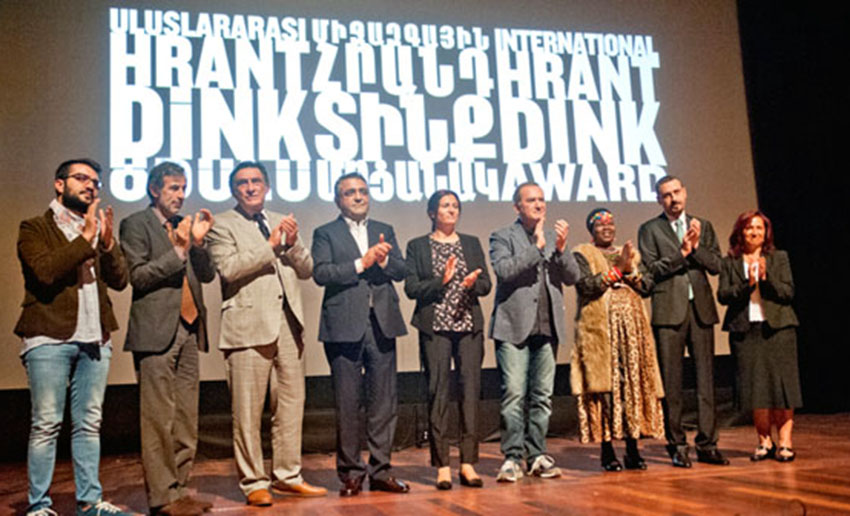
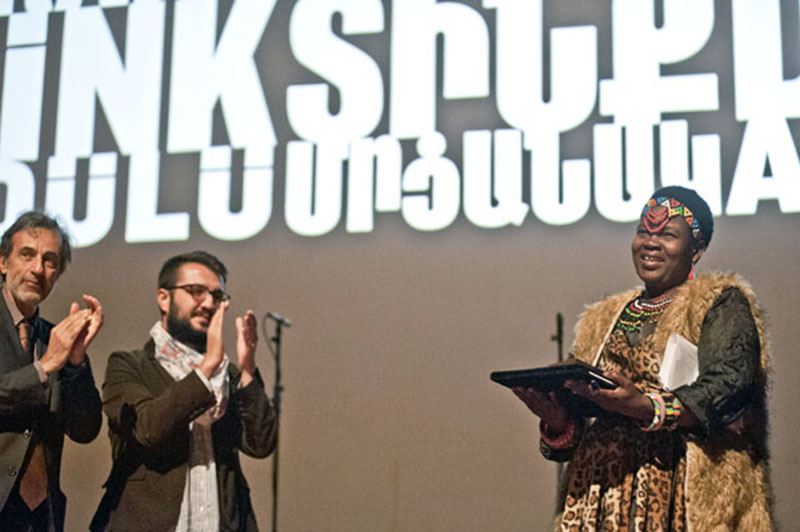
On 22 September 2016 a ceremony took place for the 8th annual ceremony of the Hrant Dink Award Granted. The laureates of the International Hrant Dink Award are the Diyarbakir Bar Association and Malawian human rights defender Theresa Kachindamoto, who works for children’s right.
Ahmet Insel, Head of the Selection Committee, made the opening speech: “It’s been almost 10 years since Hrant Dink was murdered. Nowadays, we are going through much darker times compared to 2007. The abominable coup attempt was foiled, but the state of law is completely suspended. Tens of thousands innocent people are detained without any legal procedure. Hundreds of journalists, academics, lawyers, teachers, artist and human rights defenders, meaning the usual suspects of the authoritarian regime are arrested, suspended and denied right to travel. We witnessed the arrest of Sebnem Korur Fincanci and Ahmet Altan, whose struggles were granted with Hrant Dink Award. Granted with Hrant Dink Award in 2013, Saturday Mothers (Cumartesi Anneleri) have been staging the longest civil obedience action in Turkish history; its their 600th week of protest. In times like these, the significance of the award increases. We greet the ones who struggle for creating a just and free world without violence.”
Diyarbakir Bar Association Chair Tahir Elçi was murdered on 28 November 2015 in Diyarbakir, while he was making a press statement. Deputy Chair Ahmet Özmen received the award on behalf of the association. Ahmet Özmen said inter alia: “I gratefully commemorate our dear chair Tahir Elçi, who devoted his life to the struggle for peace and freedom and sacrificed his life for this struggle….Tahir Elçi and Hrant Dink are two heroes, two human rights defenders who made history. People will remember them as intellectuals who made efforts for establishing a democratic order for the peoples of Turkey. Their only measure was rightfulness and justice. The ones who ordered their murder thought that their strong legacy will vanish and we won’t be able to follow their lead, but they are wrong.”…“Today, our most important duty and historical responsibility is to preserve and improve the legacies of Tahir Elçi and Hrant Dink. Demanding peace and speaking up for building peace is the only way.” During the ceremony, a video titled “Inspirations” was shown. People and institutions from Turkey and all around the world, who gave people hope about the future with their actions, were featured in the video. There were also people who objected to the coup and defended democracy on July 15.
Theresa Kachindamoto is the paramount chief, or Inkosi, of the Dedza District in the central region of Malawi, one of the poorest counties of Africa. For years, she has been working for preventing child marriages and defending their right to education. Becoming the chief of a tribe with 900,000 people, Kachindamoto started to struggle against child marriages, when she saw that half of the girls in the tribe are forced to marry at the ages of 12 or 13. She banned “marriage camps”, where children are abused under the name of sexual education. She managed to convince 50 tribe chiefs to abandon the traditions encouraging child marriage and to annul 850 marriages. Receiving the award from Yildiz Tar on behalf of last year’s laureate KAOS GL and Michèle Marian, Kachindamoto told the story of her struggle: “It wasn’t easy to fight against this problem. For majority of people, this practice was one of the most fundamental traditions of Malawi and encouraged by the society. We had to inform all people about the dangers and consequences of child marriage and abolish the accepted opinion which deems this practice as normal. There is no doubt that I need to push against more of the old ways of thinking to achieve my ultimate goal of removing child marriage from Malawi, and giving all girls and boys the opportunity to complete their education. I am proud of what we have achieved so far, but I am aware that there is still a long way ahead of us. I am grateful to every one who walked this way with me. I hope more people will join us and fight for the rights of Malawian girls. God bless you all.”
The Laureates of this year’s Right Livelihood Awardhave been announced today – 22 September 2016 – in Stockholm, Sweden:
SYRIA CIVIL DEFENCE (Syria)
Syria Civil Defence (The White Helmets), ‘for their outstanding bravery, compassion and humanitarian engagement in rescuing civilians from the destruction of the Syrian civil war’. It is the first time that a Right Livelihood Award goes to a Laureate from Syria.…for their outstanding bravery, compassion and humanitarian engagement in rescuing civilians from the destruction of the Syrian civil war.
On 20 September Sophie Richardson, China Director of Human Rights Watch, wrote a timely piece “China Wants You to Forget Ilam Totti“:
“It’s been two years since Ilham Tohti, [sometimes spelling Ilam Totti] a well-regarded ethnic Uyghur economist and peaceful critic of the Chinese government, was sentenced to life in prison by the Xinjiang People’s High Court for alleged “separatism” after a grossly unfair trial. Tohti and his family had already endured years of harassment and periods of house arrest by state agents, but in September 2014 Beijing evidently felt it necessary to take him off the grid permanently.”
Since then, human rights defenders and the rule of law in China have been under sustained attack from President Xi Jinping’s government. But the dynamics in Xinjiang – a region synonymous with gross discrimination against the predominantly Muslim Uyghur population, restrictions on religion and speech, economic development plans that favor Han Chinese over Uyghurs, and now a highly politicized counterterrorism campaign to stem violence – provide fertile ground for further serious human rights violations.
The signs are ominous: restrictions on observing Ramadan are now an annual reality, and some Uyghurs are now being required to give DNA samples and other biodata in order to obtain passports. China’s state media reports on counterterrorism operations when it’s politically convenient to do so, but we don’t know how many local residents die in these raids, how those detained in connection with the operations are treated, or even whether the state is responding to a credible threat. Hundreds – perhaps thousands – of Uyghurs have fled the country, some of whom have been forcibly returned under Chinese government pressure.





 Hans Thoolen on Human Rights Defenders and their awards