The event “Tackling the protection gap: Host States’ responsibility to prevent and respond to transnational repression” will bring together defenders and UN experts to discuss the international human rights law obligations of States in respect of transnational repression against individuals and groups within their territory, as well as the strengthening of international standards, and gaps arising from shortcomings in their implementation domestically.
Location: Geneva, Switzerland. Date: 09 March 2026. Palais des Nations, Room VIII. Time: 2:00PM – 3:00PM CET and livestreamed on ISHR’s YouTube channel.!
Research from international organisations, NGOs and academics shows that transnational repression (TNR) – acts by States and their proxies to deter, silence or punish dissent, criticism or advocacy outside their territory – is affecting a growing array of individuals and groups worldwide.[1] With the emergence of new surveillance and communication technologies, many actors have found new avenues to silence and punish critics and opponents. The most common targets have been exiled human rights defenders and political activists, but today broader groups such as journalists, lawyers, artists, academics and ordinary members of diaspora communities are frequently targeted. See e.g.
The immediate effect of TNR is the violation of, or constraint on the exercise of, fundamental human rights. States have obligations towards those subject to such violations taking effect within their territory. These obligations have long been recognised, but have not yet been the subject of focused discussion in relation to TNR, leaving the scope and nature of the duties of host States unclear.
This event will bring together defenders and UN experts to discuss the international human rights law obligations of States in respect of transnational repression against individuals and groups within their territory, as well as the strengthening of international standards, and gaps arising from shortcomings in their implementation domestically.
Speakers:
Sayed Ahmed al-Wadaei, Director of Advocacy, Bahrain Institute for Rights and Democracy (BIRD)
Birgit Kainz-Labbe, Coordinator of Civic Space Unit, Office of the UN High Commissioner for Human Rights
Ben Saul, UN Special Rapporteur on counter-terrorism and human rights
Hélène Tigroudja, Human Rights Committee, Vice-Chair
Moderator: Raphael Viana David, International Service for Human Rights
This event is organised by ISHR and co-hosted with Human Rights Watch, Human Rights House Foundation and the International Federation for Human Rights (FIDH).
Repressive regimes throughout the world deploy the machinery of the state to silence criticism and dissent. It is therefore hardly surprising that artists—whose creative work can expose, ridicule, and condemn in emotive and powerful ways—are common targets of political persecution. Over the past few years, there have been crackdowns on artists and performers in Russia, Belarus, Cuba, Azerbaijan, Egypt, China, and Venezuela, among other countries. The following artists dared to use their creative expression to challenge powerful systems, and have been punished with political imprisonment. From: Political Prisoners Watch February 19, 2026
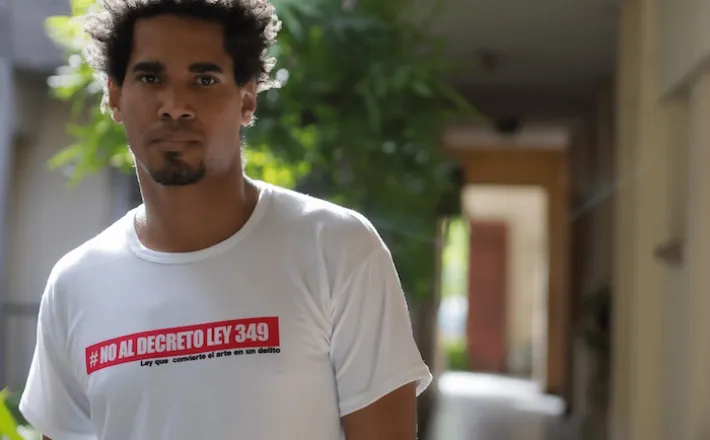
Luis Manuel Otero Alcántara is a Cuban artist and activist whose evocative performance art led to government harassment and numerous periods of detention. After the Cuban government enacted Decree 348 in 2018, which required artists to obtain advance approval for even private performances, he cofounded the San Isidro Movement to protest the increasing censorship of free expression. On July 11, 2021—the start of the historic J11 protests—he was arrested and has been detained ever since. In June 2022, he was sentenced to five years in prison for contempt, public disorder, and insulting symbols of the homeland, and remains in prison in Cuba. [https://humanrightsdefenders.blog/2024/09/19/the-rafto-prize-2024-to-cuban-artivist-luis-manuel-otero-alcantara/]
Maykel Osorbo Castillo Pérez is a Cuban musician who cofounded the San Isidro Movement with Luis Manuel Otero Alcántara. Due to his activism and vocal opposition to the Cuban regime, he was subjected to systemic harassment, including being arrested 121 times in a five-month period. He cowrote the 2021 song Patria y Vida(Homeland and Life), which inspired thousands to demonstrate against Cuba’s repressive regime and won two Latin Grammys. He was not able to accept the awards, however—in May 2021, he was arrested, forcibly disappeared for 14 days, and eventually sentenced to nine years in prison on charges of contempt, public disorder, and defamation of institutions and organizations, heroes, and martyrs.
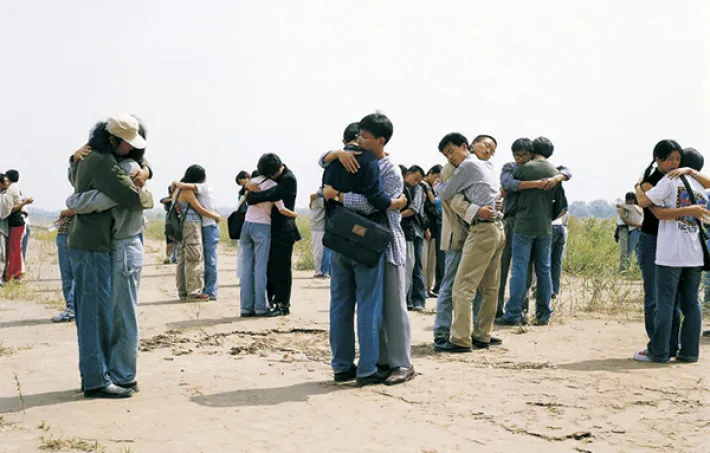
Gao Brothers, The Utopia of the 20 Minute Embrace (2000), modified image via Wikimedia Commons, used under CC BY-SA 3.0.
Gao Zhen is a Chinese artist and US permanent resident who was detained while visiting family in China in August 2024. Avant-garde works by Gao and his brother Gao Qiang—known together as the Gao Brothers—include huge, mirror-like sculptures and other works critiquing Mao Zedong and China’s Cultural Revolution. Authorities allege that Gao committed the offense of “insulting or defaming heroes and martyrs,” though the art in question had been created years before the Law on the Protection of Heroes and Martyrs was enacted. Gao’s wife Zhao Yaliang has been prohibited from leaving China, and she and their young son have remained there since his detention.
Galal El-Behairy is an Egyptian poet and singer/songwriter who has faced severe retaliation for his artistic work. He wrote the lyrics for the guitar-driven protest song Balaha, which mocked Egyptian President Abdel Fattah al-Sisi and the country’s corrupt establishment. Five days after its release in February 2018, he was arrested by the National Security Police and disappeared for a week. In July 2018, he was sentenced to three years in prison by a military court for allegedly spreading false news and rumors and insulting the Egyptian army in his poetry book The Finest Women on Earth. Although his sentence expired in 2021, he was not released, and he is now facing additional charges including disseminating fake news and joining and aiding a terrorist organization.
Freedom House announced the appointment of Jamie Fly as its Chief Executive Officer, effective 2 February, 2026.
“Jamie Fly is a transformational leader ready to advance Freedom House’s vision of a world where all are free. He has stepped forward at a consequential moment as Freedom House pivots toward a private- and public-sector funding model, while growing existing and attracting new investors in freedom and democracy. This is particularly important as our flagship Freedom in the World report has documented nearly 20 years of democratic decline and as authoritarian leaders threaten fundamental freedoms and security around the world. Jamie brings deep global experience, bipartisan credibility, and a demonstrated ability to lead complex organizations under pressure. His leadership marks the start of a new chapter in Freedom House’s fight to expand and defend freedom around the world and to champion democratic values,” said Norman Willox, chair of the Freedom House Board of Trustees.
Fly has decades of experience in government, civil society, and the private sector. He has served as President and CEO of Radio Free Europe/Radio Liberty (RFE/RL) and held senior positions on the US National Security Council staff, at the Department of Defense, on Capitol Hill, and at the German Marshall Fund of the United States. Most recently, he served as Senior Counselor at Palantir Technologies, where he supported efforts to defend Ukrainian democracy from Moscow’s illegal, full-scale military invasion. He is a recipient of the Office of the Secretary of Defense Medal for Exceptional Public Service and the Czech Foreign Ministry’s Medal for Distinguished Contribution to Diplomacy.
“I am excited and honored to join Freedom House at this critical moment for democracy and global freedom as the organization celebrates its 85th anniversary this year in the midst of significant change. Additionally, I would like to thank Norm Willox, Freedom House’s board, and its talented leadership team and staff for their tremendous efforts, resilience, and accomplishments in the face of great challenges and opportunities,” said Fly.
Freedom House is the oldest American organization devoted to the support and defense of democracy and freedom around the world. It was formally established in 1941 to promote American involvement in World War II and the fight against fascism. Lauded for its nonpartisan approach, it has grown into the world’s premier institution for supporting the democratic aspirations of societies around the world through its globally recognized convening power, coalition building, advocacy, independent research, and emergency support to human rights defenders.
On this International Day of Political Prisoners, the NGOs mentioned below stand together to affirm a simple truth: no one should be imprisoned for exercising their fundamental rights or for peacefully expressing their beliefs. Yet around the world, there are an estimated one million political prisoners, who are unjustly detained for political reasons. These individuals—journalists, human rights defenders, democratic opposition leaders, religious leaders, artists, and ordinary citizens—represent the conscience of their societies. Their imprisonment is an assault not only on their freedom, but on the shared principles of human dignity and justice.
The International Day of Political Prisoners originated in the Soviet Union in 1974, when political prisoners collectively held a one-day hunger strike. Soviet prisoners of conscience repeated this protest every October 30, supported by demonstrations of solidarity in major cities. In response to Vladimir Putin’s ongoing and deepening repression, Russian political prisoners rekindled the tradition in 2021. In the years since, it has become an international day of solidarity with political prisoners worldwide.
Political imprisonment corrodes the rule of law, silences dissent, undermines press freedom, and weakens the foundations of democracy. Authoritarian governments use it to suppress opposition, instill fear, and consolidate control. Each unjust detention sends a chilling message to others who seek to speak truth to power.
We, as organizations who advocate on behalf of those unjustly detained around the world, call on democratic governments to continue to make the release of political prisoners a global priority—to raise these cases consistently in bilateral and multilateral forums, to request information and specific actions be taken on the prisoners’ behalf, to support accountability mechanisms, and to continue to provide support to organizations that advocate on behalf of those unjustly detained and provide legal and humanitarian assistance to them and their families. Solidarity with the unjustly detained must be sustained, coordinated, and visible.
We also stand in solidarity with the families, lawyers, and civil-society organizations who continue to advocate for freedom in the face of repression. Their courage reminds us that the defense of liberty is a collective responsibility.
On this day, and every day, we reaffirm our shared commitment to the universal right to freedom of thought, expression, association, and belief. The world’s political prisoners must not be forgotten—and their freedom must remain a global cause.
Signed:
Freedom House
Free Russia Foundation
McCain Institute
National Endowment for Democracy
Abdorrahman Boroumand Center for Human Rights in Iran
Al-Tahreer Association for Development (TAD)
Amnesty International
Center for Civil Liberties
Committee to Protect Journalists
Freedom Now
George W. Bush Institute
Global Magnitsky Justice Campaign
Human Rights Center Viasna
Human Rights Defense Center Memorial
Human Rights First
Human Rights Foundation
Human Rights Watch
International Republican Institute
James W. Foley Legacy Foundation
Lantos Foundation for Human Rights & Justice
Oma Organization for Human Rights and Democracy Promotion
Organization for Community Civic Engagement
OVD-Info
Political and Governance Development Academy
Socio-Economic Rights and Accountability Project (SERAP)
Taner Kılıç, a human rights activist and the final defendant in the so-called “Büyükada Trials,” was acquitted on Tuesday, marking the end of a case widely seen as a stain on Turkey’s human rights record, Turkish media reported.
On July 5, 2017, 10 human rights advocates were detained during a workshop that was taking place in a hotel on Istanbul’s Büyükada, one of the Princes’ Islands. Among those detained were İdil Eser, then-director of Amnesty International Turkey; İlknur Üstün of the Women’s Coalition; Özlem Dalkıran, a member of the Helsinki Citizens’ Assembly; and several others. Two weeks after their detention eight were jailed after a court appearance, while the other two were released pending trial.
While the group was still in detention, pro-government news outlets published reports accusing them of being foreign agents and that the workshop in Büyükada was a “spying activity.” However, an indictment prepared by the prosecutor three months later accused the group of “membership in a terrorist organization” and “aiding and abetting a terrorist organization.” They were linked to the outlawed Kurdistan Workers’ Party (PKK) and the Gülen movement.
Taner Kılıç, Amnesty Turkey’s honorary chair, who wasn’t among those who were initially detained but had been imprisoned on June 6, 2017 for alleged involvement in the 2016 coup attempt, was added to the indictment and his case was merged with the Büyükada trials.
In 2020 he was sentenced to more than six years in prison for links to the Gülen movement.
That same year, Günal Kurşun from the Human Rights Agenda Association, along with İdil Eser and Özlem Dalkıran, were sentenced to two years in prison. Nalan Erkem from the Helsinki Citizens’ Assembly, İlknur Üstün, Iranian-Swedish writer Ali Gharavi, German human rights activist Peter Steudtner, Veli Acu from the Human Rights Agenda Association, Nejat Taştan from the Association for Monitoring Equal Rights and Şeyhmus Özbekli from the Rights Initiative were acquitted.
On October 17, 2022 the Supreme Court of Appeals overturned the sentences, and in the retrial, Eser, Kurşun, Dalkıran and Kılıç were acquitted. However, the prosecutor objected to Kılıç’s acquittal and requested a review of the decision. As a result, the case was sent back to the appeals court. Ultimately, the final ruling favored Kılıç, with his acquittal upheld. [https://humanrightsdefenders.blog/2020/07/03/will-long-running-saga-of-trial-against-the-istanbul-10-end-on-friday-3-july/]
The Büyükada trials were harshly criticized by international human rights organizations such as Freedom House and Amnesty International.
Following the initial convictions, Freedom House said it was “an assault on human rights.”
“The conviction of Taner Kılıç, Günal Kurşun, İdil Eser, and Özlem Dalkıran in this politically motivated case lays bare the Turkish authorities’ ongoing assault on human rights and the justice system’s abdication of its responsibility to protect them,” said Marc Behrendt, director for Europe and Eurasia programs at Freedom House. “We call on the Turkish courts to reaffirm the rule of law and to fulfill their obligation to uphold fundamental rights and freedoms in Turkey.”
Amnesty International called the trials “an ordeal” and said it was a “baseless trial” that “represents a shocking example of the authorities’ attempt to criminalize the defense of human rights with implications for everyone in Turkey.” “This injustice has become a stark symbol of the massive crackdown on human rights and on those who defend them,” said Amnesty International.
ISHR and Freedom House hosted a group of young defenders from the diaspora for a training on UN human rights mechanisms and joint advocacy meetings in Geneva.
Eight activists working on Uyghur, Tibetan and Hong Kong rights across six countries, including Canada, Germany, India, the Netherlands, the United Kingdom and the United States, participated in the United Nations Advocacy Training (UNAT) program to learn and strategise together on ways to hold the Chinese government accountable for its human rights violations at the international level.
Why a training for youth diaspora activists?
Young activists play a critical role in diaspora movements to address and counter the Chinese government’s persecution of peoples from the Uyghur region, Tibet, and Hong Kong. When capacity building and support are available to them, they can meaningfully engage their host governments and international institutions, like the UN, to hold the Chinese government accountable for its ongoing abuses against their communities inside the People’s Republic of China, and acts of transnational repression outside Chinese borders. Unfortunately, youth diaspora activists don’t have many opportunities to convene and collaborate in those international spaces.
Working together as allies and partners, these groups can help increase the confidence in their efforts and improve impact and sustainability. Opportunities to network, train together, and work on joint advocacy efforts will help individual diaspora groups communicate and coordinate more effectively amongst themselves and with other relevant local and international groups to amplify and sustain pressure on the Chinese government for meaningful human rights change.
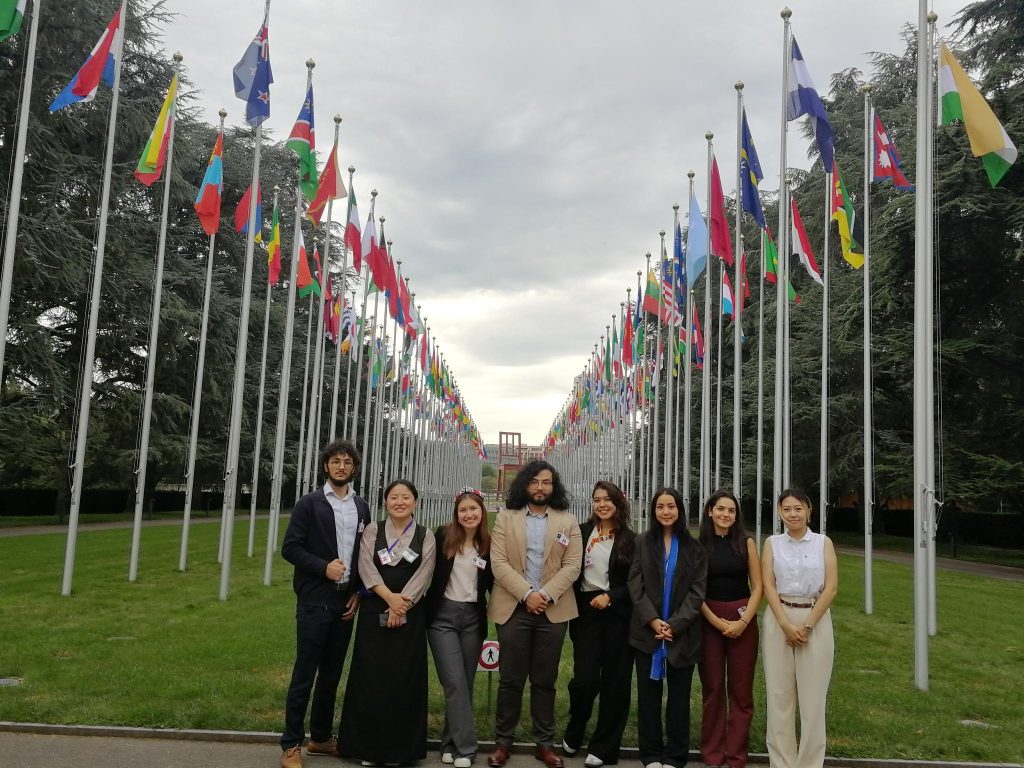
Aged between 19 and 28 years old, this was the first time that young activists from these communities came together in Geneva to work on cross-cutting community issues and build solidarity. Participants are engaged in rights advocacy through their work with established groups like the Hong Kong Democracy Council, Free Uyghur Now, and the Uyghur Human Rights Project or have founded impactful youth led organisations in their host countries, such as Students for a Free Tibet, Harvard College Students for Uyghur Solidarity, and Uyghur Youth Initiative. They are working toward better visibility and accountability towards violations outlined in the UN’s Xinjiang report published last August 2022, including the curtailment of free assembly and expression, mass surveillance, forced labour, and cultural and religious persecution.
During the interactive training programme, participants engaged with one another through peer check-in sessions, with human rights experts and advocates through live Q&As, discussions on the Human Rights Council, Special Procedures, Treaty Bodies and the Universal Periodic Review, and considered how to engage in advocacy activities at the UN in order to effect change for their communities.
The in-person training was designed to coincide with the 54th Session of the Human Rights Council so that the participants could attend the United Nations for the first time in their careers. As well as receiving additional advocacy training modules on all the UN human rights mechanisms from a range of experts, participants had the opportunity to build networks in Geneva and around the world, engage in meetings with UN member States and UN staff, and produce a powerful solidarity video statement which summarises their call to action to the UN States members.
All of the participants expressed they were satisfied with the training and increased their skills and networks to engage in advocacy at the UN. Freedom House and ISHR will continue to support these participants as they develop joint advocacy initiatives and build solidarity among their communities.
Participants in front of the flags of UN Member States, at UN Office, Geneva
On 26 June 2023 HRW called on Spain use its six-month tenure as EU Presidency to translate into concrete and bold actions commitment to protect fundamental rights and the rule of law.
Spain holds the presidency as the world marks the 75th anniversary of the Universal Declaration of Human Rights (UDHR) on 10 December 2023. In anticipation of this pivotal moment Spain should make every effort to uphold the rights and values enshrined in this historic document.
HRW calls upon the Spanish government to consider the following priority issues and recommendations:
Fundamental Rights and Rule of Law in EU member states
Two EU member states – Hungary and Poland – currently face scrutiny under Article 7 of the Treaty on European Union (TEU)…
The freezing of EU recovery and cohesion funds under the conditionality mechanism represents a welcome step but it is insufficient to address the gravity of the erosion of rule of law and human rights. While Hungary and Poland have adopted some limited measures in response to requirements under the mechanism, these have failed to address fundamental and long-standing concerns. ….We urge the Council to hold the Polish and Hungarian governments to account by using the powers conferred to it under the Treaties and to fulfil the strong mandate to act given to it by the European Commission and Parliament. The urgency of Spain’s leadership and responsibility cannot be overstated as it is one of only two remaining presidencies before Hungary and Poland in turn assume leadership of the Council. It is highly likely that during that time progress on rule of law will at best stall, and at worst Article 7 scrutiny will come to an end altogether…
Rights-Respecting and Principled EU Migration Policy
Spain’s EU Council presidency comes at a critical time for the EU’s migration policy after the Council agreed on 8 June on a negotiating position on an EU-wide reform of its asylum and migration system. Given its mandate to lead on behalf of member states the negotiations with the European Parliament on a final agreement, Spain has an opportunity to broaden the scope for a rights-respecting approach.
We call on your government to:
Support the establishment of proactive, state-led SAR operations in the Mediterranean Sea that could involve expanding the mandates and capacity of existing initiatives like EUNAVFOR MED and Frontex, funding professional rescue NGOs and ensuring predictable disembarkation.
Promote a discussion on the critical role of NGOs to ensure that they are fully able to carry out their lifesaving SAR activities, instead of facing obstruction and criminal and administrative penalties; and provide platforms for discussion of cooperation between member state rescue coordination centers and NGOs.
Advocate for independent and effective border monitoring mechanisms to document human rights violations at EU external borders, such as unlawful pushbacks, to ensure accountability for those responsible for human rights abuses and access to justice for victims.
Ensure that migration cooperation with third countries, and all provision of financial, technical, and material assistance, are contingent on clear and verifiable human rights commitments.
Enable a constructive trialogue on the asylum procedures regulation and the asylum and migration management regulation with a view to limiting the use of accelerated border procedures, the detention of asylum seekers including families with children, and discretionary use of the “safe third country” concept.
Promote a discussion on establishing more safe and legal pathways for migration as called for by EU Justice and Home Affairs Commissioner Johansson.[8]
Human Rights as a Pillar of EU’s Foreign Policy
The EU is equipped with solid instruments to ensure that human rights protection remains at the centre of its external action. The EU has shown resolve in its response to Russia’s invasion of Ukraine and has led at the United Nations to address key human rights crises.
..
During its Presidency, we call on your government to:
Continue to combat impunity for crimes committed in Ukraine, including by providing adequate resources to the International Criminal Court’s (ICC) regular budget, advocating and supporting the implementation of ICC arrest warrants, pressing Ukraine to ratify the Rome Statute and supporting independent investigations and prosecutions under universal jurisdiction.
Continue to support Human Rights Defenders (HRDs) at risk and share your experience with other EU member states. Encourage other EU member states to learn from and replicate Spain’s forward-leaning approach with the Program for Support and Protection of Human Rights Defenders at Risk that provides dedicated one-year residential visas for HRDs. Advocate with EU member states to use their discretion and facilitate access by HRDs to multi-year multi-entry Schengen visas in line with EU guidelines.
…
Recalibrate EU’s engagement with China to address the government of China’s human rights record through measurable deliverables; counter the government of China’s flawed narratives on its own human rights record; reject efforts to undermine international human rights institutions; lead the creation of a UN investigative and monitoring mechanism for crimes against humanity committed in Xinjiang; sanction or hold accountable those responsible for such crimes; and make plans to reduce dependency on a government that assaults human rights both domestically and in its foreign policy.
It seems bold to be so optimistic, but lets not forget that the assertion starts from a very low base: 2022 was probably one of the worst years with the Ukrainian war, further repression in Russia, death sentences for protesters in Iran and no let up in China.
I think we have to start with where we are with the world and we are at a very peculiar moment. We have all lived through these multiple crises. We have seen the geopolitics, the divisions, the fragmentation, and all these things that have preoccupied us at a time when you would hope that the international community would come together and craft something that would respond to the big challenges that we face.
So for me, human rights is the force that comes in and unifies us. Because it brings us back to human dignity and to what makes us all connected with each other. Let’s not forget that the Universal Declaration of Human Rights emerged out of the ashes of the Second World War. It provided the inspiration and the motivation that the world needed at that time. So, I think we need to almost counter intuitively go back to the basics of what this unifying force – this concentration on the human being – was. We need to regain the universality and the indivisibility of the human rights regime.
Secondly, we also need to look at human rights in the 21st century, for example in the digital transformation that we’re seeing. Take the letter I wrote to Twitter’s Elon Musk, for instance. Social media platforms play a very important role. We know the role Facebook played in Myanmar, for example, when the Rohinga crisis happened, in allowing disinformation and hatred to spread. So, human rights needs to look at the type of issues that we face today.
And the third area that I hope we can achieve next year, is we have to look at the human rights ecosystem as a whole. So, what is the role of the treaty bodies, of the special procedures mandate-holders, of the Human Rights Council, Universal Periodic Review process, and of my own office too – and how do we strategically deal with different situations?
Freedom House took the occasion to consider that Political prisoners and the victims of human rights abuses have taken a back seat when global summits and events occur. But it is exactly because of those events that we should be giving the victims of such abuses our full attention...
Symbolic dates like International Human Rights Day offer space to reflect on and advocate for the rights of the brave people who have been imprisoned or experienced retaliation for standing up to repressive, authoritarian rule. But political prisoners and others fighting for freedom deserve our attention for more than one day of the year. We cannot allow their plight to be sidelined because it is inconvenient to think about them during an event like the World Cup.
The World Cup is one of several events in recent months that has drawn criticism for the human rights controversies surrounding it. In what was meant to be a historic summit to discuss the imminent threats posed by climate change, the latest United Nations Climate Change Conference (COP27), held in Egypt in early November, instead became a spotlight on the host country’s abysmal human rights record. The large number of human rights defenders and activists currently detained or imprisoned in Egypt was difficult to ignore, and one case in particular stood out for its perilously high stakes. British-Egyptian democracy activist Alaa Abdel Fattah, imprisoned for his activism, endured a six-month hunger strike, now over, which resulted in the Egyptian authorities denying his family the ability to contact him as the conference took place. They desperately pleaded with the authorities for proof he was alive, and his sister Sanaa took the stage at official summit events to advocate for her brother’s release. She faced threats from Egyptian officials who accused her of calling on foreign entities to intervene in the country’s internal affairs.
Participating governments could have added to this pressure and set the stage for the release of Abdel Fattah and numerous other political prisoners, by conditioning Egypt’s hosting role on freeing political prisoners ahead of COP27. Instead, the conference’s setting appeared hypocritical, as climate justice depends in large part on respect for democracy and human rights.
Similarly, this fall’s G20 summit saw leaders of multiple countries that hold political prisoners convene for strategic discussions. The lives and freedoms of imprisoned human rights defenders, journalists, and prodemocracy activists in Saudi Arabia, China, Turkey, Russia, Mexico, India, and even the host state Indonesia, were superseded by “other priorities.” In Indonesia, human rights defender Victor Yeimo, who has spoken out on the rights abuses occurring in West Papua, was arrested in May 2021, reportedly due to his involvement in antiracism and self-determination protests two years prior. Charged with crimes including treason, he remained in detention while the G20 met. His case and others across the various member states should have been highlighted, as respect for international human rights principles and commitment to strong democracies are key to long-term national and global security and economic stability.
Scott Walker, a Researcher at the Castan Centre for Human Rights Law, a and a Research Assistant within the Faculty of Law, Monash University.decided to draw attention to an important case concerning climate justice; On 10 December 2022 the world marks Human Rights Day commemorating the adoption of the Universal Declaration of Human Rights(UDHR) in 1948. This year’s theme is dignity, freedom, and justice for all, in anticipation of the 75thanniversary of the UDHR in 2023. It gives us cause to reflect on the mobilising force that the UDHR has become in the struggle for human rights across the world. Yet, there is always more work to be done to truly achieve a world in which dignity, freedom, and justice is a lived reality for all. To do so we must utilise human rights both as a guidepost for advocacy and a tool for concrete, on the ground change to address some of the most pressing and ongoing challenges facing our world; including the immediate and catastrophic impacts of climate change.
Here in Australia, the path to domestic enshrinement of human rights has been a meandering one: only two States (Victoria and Queensland) and one Territory (the Australian Capital Territory) have Human Rights Acts. Yet, the capacity of these Human Rights Acts to achieve real and meaningful change in people’s lives is profound. Increasingly, people on the frontline of the climate crisis are also turning towards human rights to achieve justice. The potential impact of human rights-based climate litigation was recently demonstrated in the decision of the Land Court of Queensland in Warratah Coal Pty Ltd v Youth Verdict Ltd. In this case, the Court recommend against the grant of a mining lease and environmental authority to allow Warratah Coal to mine thermal coal in Queensland’s Gallilee Basin. This case deserves closer examination to illustrate the way in which human rights enshrined in law can be mobilised in claims for climate justice.
On 10 December 2022, the Human Rights Campaign Foundation (HRCF), the educational arm of the nation’s largest lesbian, gay, bisexual, transgender and queer (LGBTQ+) civil rights organization, announced this year’s recipients of 20 Global Innovation Small Grants as a part of the organization’s Global Partnerships Program. The grants range from $1,000 to $5,000 and are awarded to organizations around the world working to improve the lives of LGBTQ+ people in these countries. This announcement coincides with International Human Rights Day, which is celebrated annually around the world, marks the December 10 anniversary of the United Nations adoption of the Universal Declaration of Human Rights in 1948. The declaration was the first of its kind and recognized that “every human being is born free and equal in rights and dignity.” The grants support members of of HRC’s growing global alumni network, which now consists of some 200 LGBTQ+ advocates in close to 100 countries. All of them have participated in one of the HRC Foundation’s global programs, including the flagship annual Innovative Advocacy Summit.
The Network of Chinese Human Rights Defenders, December 9, 2022 Ahead of International Human Rights Day on December 10, CHRD celebrated the courage and bravery of human rights advocates and calls on the Chinese government to stop violating its obligations to protect human rights and free those detained for exercising their human rights. We urge the international community to keep hope alive and continue supporting defenders on the forefront.
In recent years. Xi Jinping, the General Secretary of the Chinese Communist Party, has suffocated civil society and space for free expression, jailed COVID whistleblowers, journalists, lawyers, labor organizers and feminists, LGBTQ+ activists and religious practitioners. Yet we are encouraged by the glimmers of hope that have emerged in the recent protests. The protests demanding political changes began with spontaneous gatherings to pay tribute to Uyghur victims in the Urumqi Fire. The rapidly spreading protests, led by youth, likely proved to be the last straw in forcing the Chinese Party-State to reverse course on its draconian “zero-COVID” measures.
Reasons for hope: Young people have brought new vitality to the fight for human rights
The scope of this short-lived wave of protests in cities across China was enormous, comparatively speaking. Thus far, there have been at least 68 protests across 31 cities since November 25, according to the Australia Strategic Policy Institute (ASPI). And it has largely been young people who have led the protests. The Urumqi apartment complex fire, which took the lives of at least ten Uyghur women and children, as rescue was obstructed by barriers thought to be erected for COVID lockdown but likely for “counter-terror” measures, brought people into the streets to mourn the loss of lives, to assemble and speak out against the devastating zero-COVID control and the political system that made such control possible.
A recent case study by Freedom House focuses on programming that offers holistic protection, support, and services, tailored to the needs of human rights defenders in their host country. This case study focused on the most current wave of migration of HRDs and CSOs who were forced to flee after anti-government protests in April 2018.
The Nicaraguan government continues to violate freedoms of expression, assembly and information and thwart the work of HRDs, including journalists and CSOs. Ortega-Murillo’s recent actions against potential presidential candidates and opposition figures demonstrate that the country will continue to see an outpouring of critics, activists, and HRDs to Costa Rica, among other countries. Nicaraguans continue to flee based on the attacks and harassment they face as HRDs and members of CSOs that champion democracy and human rights. See also: https://humanrightsdefenders.blog/2022/02/21/nicaragua-death-in-detention-and-sham-trial/
Of those 20 Nicaraguan HRDs who were surveyed, almost 90% stated that harassment and surveillance was a primary reason for leaving Nicaragua, followed by violence (65%) and threats (50%). Costa Rica provides comparatively ample protection for migrants, and recently launched a new asylum category for those fleeing from authoritarian regimes in Venezuela, Cuba, and Nicaragua. The flow of migration since 2018 has persisted until March 2020 when the border shut due to the COVID-19 pandemic. Yet, migrant flows have begun to increase in recent months. However, Costa Rica is struggling to recover economically from the pandemic, particularly within the tourist, service, and commercial industries where most migrants and refugees find work. Most Nicaraguan refugees find themselves in a precarious economic situation, unable to find steady work, forcing many to resort to informal work with low salaries. HRDs are often not recognized as having different needs or characteristics from the larger refugee population, either by organizations or the Costa Rican population in general. Even for those who continue to work in human rights describe their ability to continue work is difficult, and many express experiencing severe trauma as an exile, with remorse for not being able to stay and remain fighting for human rights at home. [see also: https://humanrightsdefenders.blog/2021/12/24/vilma-nunez-human-rights-defender-who-stays-in-nicaragua/] However, many Nicaraguan HRDs try to carry out their work by investigating the laws and procedures in Costa Rica, accompanying their compatriots in their efforts, sharing knowledge, and giving advice. There are support and protection options for HRDs and CSOs in exile in Costa Rica, including a network of organizations and institutions facilitated by the United Nations High Commissioner for Refugees (UNHCR) that provide access to vital services.
All available support and protection options for Nicaraguan HRDs are operating at full capacity and cannot keep pace with the growing demand. We believe that it is necessary to seek support and accompaniment mechanisms for HRDs that facilitate their subsistence and enhance the implementation of their work to defend the human rights of exiles and other Nicaraguan migrants who lack mechanisms for complaint and demand for their rights in Costa Rica.
It finds that Latin American human rights defenders and their organizations face intimidation, harassment, physical attacks, and legislation that criminalizes their work, among other threats.
Latin America was the most dangerous region in the world for human rights defenders during 2020, and according to Defending Latin American Human Rights and Democracy Activists, a new report released today by Freedom House, the ongoing COVID-19 pandemic has only made things worse. Under the guise of enforcing public health measures, governments have deployed authoritarian restrictions to inhibit movement, curtail freedoms of expression and assembly, and implement militarized security policies.
“This is a seminal study that lays the foundation for further areas of inquiry and analysis,” said Gerardo Berthin, vice president of international programs at Freedom House. “The report identifies the main needs of vulnerable activists and human rights defenders in Latin America and highlights major issues that merit regional and national attention.”
The report found that worsening human rights conditions have also spurred unprecedented levels of migration and displacement—including of human rights defenders—across the region. Growing migrant and refugee populations in Latin America have been especially vulnerable in the context of COVID-19, as border closures and lockdowns made living conditions even more precarious and curtailed mobility and access to information and services. See also: https://humanrightsdefenders.blog/2020/07/29/global-witness-2019-worst-year-ever-for-land-rights-and-environmental-defenders/
The democratic landscape in Latin America is discouraging. According to Freedom House’s Freedom in the World2021 report, fewer than 40 percent of the countries in the region are classified as Free. Against this backdrop, the new study provides a baseline review of regional efforts to protect human rights defenders and prodemocracy civil society organizations in Latin America, including through shelter and relocation programs.
Key findings:
Human rights defenders are increasingly being forced into exile in neighbouring countries, and many are unable to continue their work.
The pressure experienced by human rights defenders can push them beyond the limits of physical and psychosocial safety. This can result in some level of trauma, as well as severe psychological symptoms including anxiety, depression, feelings of isolation, and suicidal inclinations. The symptoms have also taken the form of physiological conditions such as high blood pressure and diabetes.
Human rights defenders, especially women and Indigenous people, have sought to rethink “security,” moving away from a military and policing approach toward a more comprehensive and gender-balanced understanding. For example, women human rights defenders are incorporating the body, self-care, and self-awareness when defining security, and examining how these elements can affect other types of security, including the security of the family. For them, security is not just about reacting to a threat; it is also about maintaining economic security, food security, mental or psychological security, and physical health security. Indigenous human rights defenders are proposing to include their perspective in the design of protections for activists, dissidents, journalists, and others. This has begun to shift the focus of some protection mechanisms from the individual toward a more community-based model that accounts for the collective nature of human rights defense.
State-run protection mechanisms are often prescriptive, offering a predetermined menu of services that do not necessarily address the specific needs or risks faced by human rights defenders.
International protection organizations have implemented good practices pertaining to protection and security in general, aided by the expansion of internet access. This has enabled enhanced connection and communication with civil society organizations on the ground, including continuous and more systematic meetings and planning for effective protection.
The report contains two case studies of Venezuelan and Nicaraguan human rights defenders who have been forced into exile in Colombia and Costa Rica, respectively. The cases highlight key forms of individual, collective, and contextual support that would strengthen protection and allow human rights defenders to expand their work while in exile.
Few approaches to protect human rights defenders in Latin America have been evaluated systematically. The need for systematic evaluation is a key recommendation of the report, as such analysis could be used to develop future programs and strategic plans, and would help to identify the potential security risks that human rights defenders may face at home or in exile.
There are still gaps in knowledge about how to best support human rights defenders. However, human rights defenders themselves are driving efforts to share information about effective protection approaches. Thanks to their active involvement in protection strategies, temporary relocation providers, national protection organizations, and human rights defenders are more frequently raising the notion of holistic protection or integral security, which goes beyond physical or traditional security to include services such as medical, psychosocial, and psycho-emotional support.





 Hans Thoolen on Human Rights Defenders and their awards
