Posts Tagged ‘family’

Buscarita Roa: one of the last of the Abuelas

August 10, 2025

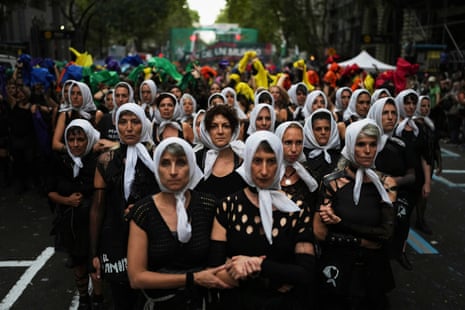
A group of women dressed in black and wearing white headscarves

Women dressed as the mothers and grandmothers of the Plaza de Mayo gather in Buenos Aires, Argentina, in March. Photograph: Rodrigo Abd/AP

On Wednesday 6 August 2025 the Guardian carried an interview with Buscarita Roa, one of the last of the Abuelas.” ..

Argentina’s 1976-83 military dictatorship tortured, killed and “disappeared” an estimated 30,000 people – political opponents, students, artists, union leaders: anyone it deemed a threat. Hundreds of babies were also taken, either imprisoned with their parents, or given to military families. The Abuelas de Plaza de Mayo have fought for almost 50 years to find these grandchildren. Buscarita Roa is one of two surviving active members.

On 28 November 1978, my 22-year-old son, José, his wife, Marta, and their baby daughter, Claudia, joined the list of those “disappeared”. A squad of Argentina’s military police stormed their home and I couldn’t find out any more. I went everywhere to look for them – police stations, courthouses, army camps, churches. I was desperate. But nobody would answer me. Every door was closed. It was a suffocating, hermetic time.

Then one day, not long after they were taken, I watched as a group of women walked in circles around the Plaza de Mayo in Buenos Aires. These mothers and grandmothers had started to gather, demanding answers about their missing relatives. I recognised one of the women. She said come with us, and I did.

We – who would become known as the Abuelas – didn’t know each other before. But we would meet every week and walk round and round the square, identifying each other with our white headscarves.

At first some of the husbands came, but we knew they risked being “disappeared” too, so then the men stayed at home and we went alone. It was still dangerous, a terrifying time, and some of the first mothers were taken themselves.

When the police ordered us to leave, and we didn’t, they charged at us on horseback. But we were younger then, so we could run.

Together we started going to the police stations and the courts, searching for answers. We cried in front of them, and they told us to go away, they didn’t want to see us. We knew the dictatorship was watching us from afar.skip past newsletter promotion

My granddaughter’s disappearance haunted my life. She was only eight months old when she was taken, and whenever I would see a little girl who looked like her, I would follow her, unable to stop until I saw her face. If there were people at my front door I would think, oh she must have come home. Other times, people would tell us they had seen a neighbour with a new baby. So we would go to their houses, trying to glimpse the child, to see if they looked like one of ours. We were doing crazy, desperate things, but it was all we had.

Many years passed before we started to receive any information. Most people didn’t believe us, and those that did thought our sons were terrorists. Still, we continued to go to Plaza de Mayo to pray for the return of our children. And when the country’s economic situation improved, we started travelling abroad to share our story too.

In 2000, I found my granddaughter, and was able to hug her again for the first time in two decades. People had come forward with their suspicions, and a judge agreed to investigate. We learned that Claudia had been taken to the clandestine detention centre “El Olimpo” with her mother, where she was kept for three days before being illegally adopted by a military family. They created a fake birth certificate, signed by a military doctor. My son and daughter-in-law were tortured and killed.

Claudia was in my heart every day that she was missing. I can’t explain what I felt when I found her. It was a pure, overwhelming joy. But I was also afraid, fearful that she would reject me. By then she was 21, and had been raised by a military family. I couldn’t invade my granddaughter’s life just like that, she needed to figure out the terrible truth and start trusting us. Slowly, over long afternoons of mate [a traditional herbal drink], we got to know each other and have built a beautiful relationship.

Belonging to the Abuelas helped me to heal. We laughed, we cried and we became friends. We were relentless too – we women have not rested once in half a century. But while some of us found our grandchildren, others only found bodies, and most of us found nothing at all. And then there is the battle of time; it is cruel and many of the Abuelas have died. There were once many of us, and now there are fewer than 10.

Estela de Carlotto, the president of the Abuelas, and I are the two last active members. But we are growing old too, and I don’t know how much further life will take us. We have found 140 of the grandchildren, with the last reunited last month, but we estimate that nearly 300 are still missing.

The ones we have found have now taken up the mantle. This is the legacy de Carlotto and I leave behind: a generation of grandchildren still looking for the others.

My lifelong work has consisted of searching for my son and daughter-in-law. I am 87 years old now, but I will never give up.

As told to Harriet Barber

https://www.theguardian.com/global-development/2025/aug/06/grandmothers-argentina-disappeared-legacy-reunited

Hong Kong: Targeting of Exiled Activists’ Families Escalates

May 16, 2025

Father of Anna Kwok Charged with National Security Crime

The Hong Kong police arrested the father of a prominent US-based activist, Anna Kwok, on April 30, 2025, and charged him with a national security crime, Human Rights Watch said today. The arrest of Kwok Yin-sang was the first such prosecution of a family member of an exiled activist. Hong Kong authorities should immediately drop all charges and release him.

The Hong Kong authorities have recently intensified their harassment of the families of 19 wanted Hong Kong activists living in exile. Punishments and harassment against individuals for the alleged actions of another person is a form of collective punishment, prohibited by international human rights law.

The Chinese government has increased its appalling use of collective punishment against family members of peaceful activists from Hong Kong,” said Yalkun Uluyol, China researcher at Human Rights Watch. “The Hong Kong authorities should immediately and unconditionally release Anna Kwok’s father and cease harassing families of Hong Kong activists.”

On May 2, national security police formally charged Kwok Yin-sang, 68, with “directly or indirectly” dealing with the finances of an “absconder” under section 90 of the Safeguarding National Security Ordinance, which carries a punishment of up to seven years in prison. Kwok Yin-sang remains in custody with a bail hearing scheduled for May 8. Anna Kwok’s brother was also arrested on April 30 but has been released on bail pending further investigation.

Anna Kwok, 28, is the executive director of Hong Kong Democracy Council, a nongovernmental organization based in Washington, DC. In July 2023, she was among a first group of eight people against whom the Hong Kong police issued arrests warrants and HK$1 million (US$129,000) bounties for violating Hong Kong’s National Security Law.

Since then, Hong Kong police have issued similar baseless arrest warrants and bounties against 11 other exiled Hong Kong activists.

Hong Kong authorities have sought to intimidate dozens of family members of the 19 “wanted” individuals, primarily by interrogating them. In the case of Ted Hui, a resident of Australia, they also confiscated HK$800,000 (US$103,000) from him and his family for having allegedly violated the National Security Law.

There has been a new wave of harassment against these families in recent months, Human Rights Watch said. After the Hong Kong police issued the third group of arrests and bounties against six exiled activists in December 2024, they began to harass their families. In January, police interrogated eight family members and former colleagues of the UK-based scholar Chung Kim-wah, and raided the office of the Hong Kong Public Opinion Research Institute, with which Chung was formerly associated.

In February the police questioned the aunts and an uncle of Carmen Lau, a UK-based activist and former district councilor. On March 18, police interrogated the stepfather of the activist Tony Chung, who is in the UK.

On April 10, national security police took the parents of the US-based activist Frances Hui into custody for questioning.

The 19 wanted activists have also faced various other forms of harassment. In June and December 2024, the Hong Kong government cancelled the passports of 13 wanted activists, including Anna Kwok. In March, Lau and Chung reported that anonymous individuals sent letters to residents in various London neighborhoods urging them to hand in the activists to the Chinese Embassy in London, citing the warrants and bounties against them. Similar letters were sent to Melbourne-based Kevin Yam, a democracy activist and an Australian citizen.

Many of the 19 activists, including Kwok and Frances Hui, have reported online harassment campaigns, including rape and death threats, since the government issued the warrants and bounties against them. The media reported that an online campaign, which exhibited signs of a previous Chinese government influence operation, sought to mobilize far-right people in the UK to attack activists on the bounty list.

The 19 wanted activists live in the UK, US, Canada, and Australia. The US government in March sanctioned six officials in Hong Kong for using the National Security Law “extraterritorially to intimidate, silence, and harass” the activists. The other three governments have issued statements condemning the arrest warrants, but have not taken action to hold Hong Kong officials accountable. The US government is also the only one that has arrested someone for allegedly harassing a Hong Kong activist on its soil, though the person was later acquitted.

The Chinese government has used two draconian national security laws, the National Security Law of 2020 and the Safeguarding National Security Ordinance of 2024, to dismantle the city’s pro-democracy movement and take away its fundamental freedoms, which are enshrined in Hong Kong’s de facto constitution, the Basic Law. Over 200,000 Hong Kongers have left Hong Kong, among them protesters and activists who have continued their activism abroad.

The AustralianUK, and US governments, the European Union, and the United Nations High Commissioner for Human Rights have all publicly expressed concerns about the two security laws.

“Beijing isn’t likely to stop abuses against the families of exiled activists unless affected governments send a strong message that such repression carries a cost,” Uluyol said. “They should fully investigate and sanction Chinese and Hong Kong officials involved, and pass strong laws to protect their residents and citizens from transnational abuses.”

https://www.hrw.org/news/2025/05/04/hong-kong-targeting-exiled-activists-families-escalates

Kenyan documentary Softie shows defenders torn between family and the struggle

October 22, 2020

Katharine Houreld writes for Reuters on 21 October 2020 a very interesting piece about a documentary that puts the focus on the difficult dilemmas facing human rights defenders.

Njeri and Boniface Mwangi are activists – they protest together and are arrested together – but as the film progresses, the focus moves from whether their crusade will succeed to whether their family will implode.

Families of human rights defenders or activists … I want people to know we exist,” Njeri, a movie buff and avid motorcyclist, told Reuters at the film’s Kenya premiere this week. “Our children really struggle.”

Softie – an award-winner at the Sundance and Durban film festivals – shows the evolution of Boniface from an activist outraged by the 2007-8 election violence into a political candidate promising his new Ukweli party will change the system from within, a decade later.

His family grapple with his absence, a house permanently full of people, and death threats targeting their three young children. Njeri, fearing for their lives, eventually takes the kids to the Unites States in 2016.

In one tense on-camera exchange before his family leaves, Boniface pleads with his wife: “you need to have an ideal that you live for, that’s worth dying for.” “You think it will be better if you die?” Njeri replies sadly.

A later scene lays out the stakes. The couple’s eldest son Nate returns from his American school with something he has made for father’s day: a loving card for his mother. When filmmaker Sam Soko asks from behind the camera why there’s no message for his father, Nate shrugs.

Moments like that forced a reckoning, said Boniface, who appeared with his family at the premiere, all in matching purple outfits. Now he’s building his party, taking a rest from protests and spending time making meals for his family. He’s finally realised he can’t – and shouldn’t – try to change everything himself.

Change is not an event… it’s not a popcorn that pops in a microwave,” he told Reuters. “It’s a very slow painful marathon – and then the marathon doesn’t end.”

The film started out as a five-minute Youtube clip about organising a protest, said Soko, who is an activist himself. It sprawled into a seven year project, now streaming on PBS in the United States and Britain’s BBC.

It’s essentially still an activist manual,” he said. “But a different kind of manual … (about) what it means to love.”

https://www.reuters.com/article/us-kenya-film/kenyan-documentary-spotlights-activist-torn-between-family-and-the-struggle-idUSKBN2761FY

Bahrain: Travails of a Family of Human Rights Defenders

September 12, 2014

On Tuesday, 16 September, Maryam Al Khawaja, the Bahraini human rights defender will return to court for her second hearing on charges of assaulting a police officer, which she denies. It’s now been nearly two weeks since Maryam was arrested at the airport following her return to Bahrain to visit her father. She was initially detained for seven days, but over the weekend a Bahraini judge ruled to extend her detention by an additional 10 days. This is a good occasion to draw your attention to a long but fascinating piece by Lawrence Weschler on Truthdig of 11 September 2014. Under the title “Terrorizing a Family of Human Rights Champions” he describes in detail what happened to the remarkable al-Khawaja family of democratic non-violent human rights defenders [it is rumored that for the first time a family as such was considered for the 2013 Nobel Peace Prize].  Read the rest of this entry »

An exceptional Egyptian family of human rights defenders

August 21, 2014

The family of MEA 2013 Final Nominee, Mona Seif, continues to be under the greatest strain in Egypt. Front Line Defenders reports that on 18 August 2014, her brother, human rights defender Mr Alaa Abd El Fattah, began a hunger strike to protest his detention [http://www.frontlinedefenders.org/AlaaAbdElFattah] and said that he will remain on hunger strike until he is released. Her sister human rights defender Ms Sanaa Seif also continues to be imprisoned. [https://www.frontlinedefenders.org/node/26336]. Her father, human rights defender Ahmed Seif El-Islam is in the Intensive Care Unit of Qasr el-Eini hospital. Her family had tried several times to visit the father, but in vain.

Emirates now start targeting families of detained human rights defenders

February 22, 2013

The Gulf Centre for Human Rights (GCHR) on 16 February 2013 reported that it had received information that authorities in the UAE are targeting family members of human rights defenders (pictured above) currently in detention. Read the rest of this entry »