Posts Tagged ‘life’

You do not stop being a human rights defender, even in exile

September 10, 2026

Almost nine months have passed since Nobel Peace Prize laureate Ales Bialiatski and human rights defender Uladzimir Labkovich were released from prison, and six months since the release and and forced deportation from the country of human rights defenders Marfa Rabkova, Valiantsin Stefanovic and Nasta Loika. In a series of interviews prepared in cooperation with the Viasna Human Rights Center, The Barys Zvozskau Belarusian Human Rights House and Human Rights House Foundation, the former political prisoners reflect on life in exile after unjust imprisonment, their return to professional life, and their hopes for the future. Here Marfa Rabkova [https://humanrightsdefenders.blog/2026/03/23/belarus-frees-250-prisoners-including-human-rights-defenders-as-us-eases-sanctions/]

When did you feel truly free again after your release?

It has been almost five months since my release, but I still have not truly felt free. I suppose freedom is a very complex and multifaceted thing. Even though I am physically free, I do not have that feeling of freedom inside me. For me, freedom is still the sum of all freedoms. And as long as people remain imprisoned, as long as repression continues in Belarus, I cannot feel free.

There is also the factor of transnational repression. There are things that stop you at a certain point. You understand that the price of any word or action can be very high, because families, loved ones, relatives and friends remain in Belarus. And this matters enormously, because it is another reason you do not feel free. You carry responsibility for so many things: not only for your loved ones, but also for those people who remain in Belarus and are in prison.

I think I will only feel free in Belarus, when the repression ends, when all political prisoners are released, and when I am surrounded by my family and friends. That is when I will finally breathe out and feel truly free.

How difficult was it for you to leave Belarus? Do you hope to return?

It was very difficult for me to leave Belarus. I would even say that for me it was a harder blow than accepting a 15-year prison sentence. At that particular moment, at that point in time and space, it was incredibly difficult. I reacted even more emotionally than I did to my sentence…..

So I believe and hope that the Universe will eventually say, “All right, that’s enough. You can breathe now. It is over. We are going home.”

Why do you continue to fight for human rights?

I continue to fight for human rights because it is already part of me, part of who I am. Wherever I am, whatever the circumstances, it just switches on naturally inside me. I do not need to direct myself somehow or force myself to do something. I do not even think about it. It is simply who I am…..

It simply cannot be any other way. It is a natural way of living, and it does not stop. You do not stop being a human rights defender, wherever you are. And now, when I see how difficult the situation is in the world and in our region, how deep the human rights crisis has become, when we are already talking about the most basic things, the unconditional right to life and the right not to be tortured… watching this regression, you realise that standing aside is simply not an option.

What gives you hope for the future?

What gives me hope for the future are moments of humanity, empathy, interaction and mutual understanding. And what impresses me most is seeing these qualities in people from whom I did not even expect them. It gives you such a powerful surge of energy, because you realise that in many people there is still a bright spark, a spark of kindness. Sometimes it is hidden or buried very deep, but it is there.

https://spring96.org/en/news/121108

Front Line’s Rest & Respite Programme for human rights defenders

March 17, 2026

The purpose of Front Line Defenders Rest & Respite Programme is to enable human rights defenders to take some time out and to recharge their batteries in a safe environment while at the same time enhancing their skills so that they can work more effectively when they return home.

The programme has a flexible approach and tries to respond to the needs of the HRD. Some human rights defenders are hosted in Ireland, others choose a destination closer to home, where they have a particular interest or existing contacts. It is generally for short stays ranging from one week to three months.

Human rights defenders can take some well-earned rest and escape the stressful and difficult circumstances in which they work for a short time. They can focus exclusively on their health and well-being or spend some quality time with their family. They can also choose to work on a specific project, learn about digital security or improve other skills relevant to their work.

Rest & Respite opportunities are offered on an invitation-only basis.

This programme is great for women human rights activists who have been subjected to stressful, tense and often dangerous and threatening situations in their work.
– HRD, Afghanistan, Rest & Respite Programme

Before the support, I had serious burnout caused by the stress from my work, especially from a domestic violence case I was working on when I was attacked and my computer and phones taken.  I had a constant headache and was very stressed, but I’m feeling well again and am back to work.
– HRD, Cameroon, Rest & Respite Programme

see also: https://humanrightsdefenders.blog/2025/03/01/guidelines-for-universities-hosting-human-rights-defenders/

as well as: https://humanrightsdefenders.blog/tag/shelter-city-network/

Barcelona Guidelines on Wellbeing & Temporary International Relocation of HRDs at Risk

https://frontlinedefenders.org/en/programme/rest-respite

Buscarita Roa: one of the last of the Abuelas

August 10, 2025

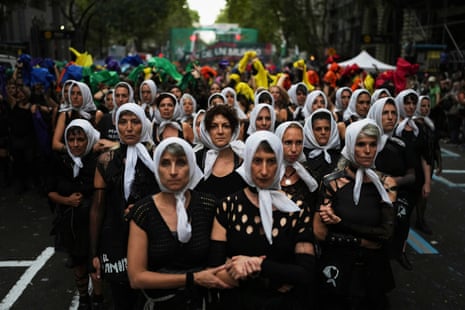
A group of women dressed in black and wearing white headscarves

Women dressed as the mothers and grandmothers of the Plaza de Mayo gather in Buenos Aires, Argentina, in March. Photograph: Rodrigo Abd/AP

On Wednesday 6 August 2025 the Guardian carried an interview with Buscarita Roa, one of the last of the Abuelas.” ..

Argentina’s 1976-83 military dictatorship tortured, killed and “disappeared” an estimated 30,000 people – political opponents, students, artists, union leaders: anyone it deemed a threat. Hundreds of babies were also taken, either imprisoned with their parents, or given to military families. The Abuelas de Plaza de Mayo have fought for almost 50 years to find these grandchildren. Buscarita Roa is one of two surviving active members.

On 28 November 1978, my 22-year-old son, José, his wife, Marta, and their baby daughter, Claudia, joined the list of those “disappeared”. A squad of Argentina’s military police stormed their home and I couldn’t find out any more. I went everywhere to look for them – police stations, courthouses, army camps, churches. I was desperate. But nobody would answer me. Every door was closed. It was a suffocating, hermetic time.

Then one day, not long after they were taken, I watched as a group of women walked in circles around the Plaza de Mayo in Buenos Aires. These mothers and grandmothers had started to gather, demanding answers about their missing relatives. I recognised one of the women. She said come with us, and I did.

We – who would become known as the Abuelas – didn’t know each other before. But we would meet every week and walk round and round the square, identifying each other with our white headscarves.

At first some of the husbands came, but we knew they risked being “disappeared” too, so then the men stayed at home and we went alone. It was still dangerous, a terrifying time, and some of the first mothers were taken themselves.

When the police ordered us to leave, and we didn’t, they charged at us on horseback. But we were younger then, so we could run.

Together we started going to the police stations and the courts, searching for answers. We cried in front of them, and they told us to go away, they didn’t want to see us. We knew the dictatorship was watching us from afar.skip past newsletter promotion

My granddaughter’s disappearance haunted my life. She was only eight months old when she was taken, and whenever I would see a little girl who looked like her, I would follow her, unable to stop until I saw her face. If there were people at my front door I would think, oh she must have come home. Other times, people would tell us they had seen a neighbour with a new baby. So we would go to their houses, trying to glimpse the child, to see if they looked like one of ours. We were doing crazy, desperate things, but it was all we had.

Many years passed before we started to receive any information. Most people didn’t believe us, and those that did thought our sons were terrorists. Still, we continued to go to Plaza de Mayo to pray for the return of our children. And when the country’s economic situation improved, we started travelling abroad to share our story too.

In 2000, I found my granddaughter, and was able to hug her again for the first time in two decades. People had come forward with their suspicions, and a judge agreed to investigate. We learned that Claudia had been taken to the clandestine detention centre “El Olimpo” with her mother, where she was kept for three days before being illegally adopted by a military family. They created a fake birth certificate, signed by a military doctor. My son and daughter-in-law were tortured and killed.

Claudia was in my heart every day that she was missing. I can’t explain what I felt when I found her. It was a pure, overwhelming joy. But I was also afraid, fearful that she would reject me. By then she was 21, and had been raised by a military family. I couldn’t invade my granddaughter’s life just like that, she needed to figure out the terrible truth and start trusting us. Slowly, over long afternoons of mate [a traditional herbal drink], we got to know each other and have built a beautiful relationship.

Belonging to the Abuelas helped me to heal. We laughed, we cried and we became friends. We were relentless too – we women have not rested once in half a century. But while some of us found our grandchildren, others only found bodies, and most of us found nothing at all. And then there is the battle of time; it is cruel and many of the Abuelas have died. There were once many of us, and now there are fewer than 10.

Estela de Carlotto, the president of the Abuelas, and I are the two last active members. But we are growing old too, and I don’t know how much further life will take us. We have found 140 of the grandchildren, with the last reunited last month, but we estimate that nearly 300 are still missing.

The ones we have found have now taken up the mantle. This is the legacy de Carlotto and I leave behind: a generation of grandchildren still looking for the others.

My lifelong work has consisted of searching for my son and daughter-in-law. I am 87 years old now, but I will never give up.

As told to Harriet Barber

https://www.theguardian.com/global-development/2025/aug/06/grandmothers-argentina-disappeared-legacy-reunited