The International Federation for Human Rights (FIDH) office in Brussels represents FIDH before the institutions of the European Union (Council, Commission, European Parliament, and other associated bodies), as well as to the representations of its member states. It ensures the visibility of FIDH’s actions and those of its member organisations to the European Union and develops advocacy strategies to effectively mobilise the EU on human rights issues worldwide, while identifying ways to strengthen its lever.
FIDH is recruiting a : REPRESENTATIVE TO THE EUROPEAN UNION IN BRUSSELS – FULL-TIME PERMANENT CONTRACT
MAIN RESPONSIBILITIES Under the responsibility of the Advocacy Director based in Paris, your main responsibilities will be :
A / Define EU advocacy strategies in consultation with internal stakeholders, to support the implementation and strengthening of EU human rights policies, including :
Supporting FIDH member organisations and the FIDH Operations Directorate teams in defining and guiding FIDH recommendations targeting EU institutions;
Developing advocacy directions, the annual activity program, and implementing specific action programs led by FIDH offices, in coordination with the Operations Directorate and member organizations, and monitoring their progress;
Analysing the effectiveness and impact of EU human rights policies and proposing ways to strengthen them;
Developing the delegation’s communication strategy towards the EU, in collaboration with the Communications Directorate.
B / Implement the delegation’s activities:
Coordinate and supervise the participation of FIDH member NGOs or partners in various EU institutions;
Coordinate and supervise the provision of information to EU institutions based on inputs from FIDH, its members, and partners;
Represent FIDH before EU institutions, member state representations, and other stakeholders (funders, NGOs, media), ensuring strong relationships;
Oversee the strategy for promoting FIDH’s activities to the public;
Ensure reporting and evaluation of delegation activities, including advocacy actions and other reporting requirements (internal monthly and annual reports, narrative reports for other funders).
C / Foster and strengthen interaction with internal and external actors, ensuring quality support for FIDH member organisations during interfaces, sharing information on delegation strategies and activities, and developing partnerships with other NGOs.
D / Manage a team (currently one staff member + one intern).
E / Oversee the delegation’s day-to-day logistical and administrative management, with the support of delegation staff.
SKILLS REQUIRED
Education & Experience:
Master’s degree in law, political science, or international relations, with at least 5 years of professional experience in a similar role, including 3 years in human rights advocacy;
Excellent knowledge of EU human rights policies, allowing you to identify and mobilise the most effective levers to achieve concrete results;
Strong understanding of international human rights standards and mechanisms.
TERMS AND CONDITIONS OF EMPLOYMENT :
Full-time permanent contract – 39 hours/week
Based in Brussels – FIDH recognises the importance of flexible working arrangements for work-life balance and offers remote work options after the probationary period.
Salary: €57,000 gross per year
FIDH contribution to health insurance: €80/month; public transport subscription reimbursement in Brussels; meal vouchers of €8/meal (employee contribution: €1.09)
Leave and RTT: 25 days of paid leave per year, 24 compensatory rest days per year
Position to be filled : As soon as possible
How to apply
Send your CV AND cover letter to recrutement@fidh.org quoting reference DOIG-UE-0126 in the subject line no later than Friday, February 6, 2026.
Interviews will take place as applications are received.
FIDH reserves the right to close the recruitment process before the deadline for applications.
Natika Kantaria is a human rights advocate with nearly a decade of experience planning and implementing advocacy campaigns in human rights. She has worked with international organizations and watchdog NGOs and collaborated with the public and private sectors. For the ISHR she wrote a piece on 26 February 2025 about a worrying trend: ‘Foreign agent’ laws have been introduced in various countries, violating international human rights law and threatening to silence human rights defenders. This pattern is particularly evident in Eastern Europe, where NGOs courageously resist and need the support of the international community. See e.g. my earlier posts:
Societies thrive when everyone can work, speak out, and organise freely and safely to ensure justice and equality for all. Legislation requiring NGOs to register as ‘foreign agents’ is a barrier to this virtuous cycle. Despite the European Court of Human Rights’ 2022 ruling that Russia’s 2012 foreign agent law violated freedom of expression and association, the governments of Hungary, Georgia, Slovakia, Serbia, and Bosnia and Herzegovina have proceeded undeterred to introduce similar laws.
These laws specifically target NGOs and not-for-profits that receive foreign funds and require them to register as foreign agents, organisations serving the interests of a foreign power, or agents of foreign influence. By doing so, they restrict the capacity of human rights defenders to organise, participate and exercise their right to defend rights by:
imposing disproportionately high fines and heavy sanctions to NGOs refusing to comply, which may ultimately lead to the termination of their operations
using vague wording, that ultimately gives too much room and power for government interpretation. For instance, the requirement for NGOs to register in official records or identify themselves as ‘agents of foreign influence’ lacks clarity and specificity.
increasing the burden of NGOs by introducing heavy reporting and auditing requirements. The State’s alleged need for transparency as their primary purpose can, therefore, be effectively addressed through existing legislation regulating NGOs.
employing a negative narrative that stigmatises and delegitimises the work of the civil society organisations and human rights defenders. This rhetoric promotes hostility and distrust toward civil society and encourages attacks against defenders.
Furthermore, such laws contradict the commitments of these countries under international human rights law. Article 13 of the 1998 UN Declaration on human rights defenders recognises the right of defenders to solicit, receive and utilise resources.
Article 10 of the Declaration +25, a supplement to the UN Declaration put forward in 2024 by civil society, human rights defenders and legal experts, addresses States’ attempts to prohibit foreign contributions or impose unjustified national security limitations. It stipulates that States should not hinder financial resources for human rights defenders and outlines measures to prevent retaliation based on the source of their funding. These laws violate rights related to freedom of expression, association, and privacy, as outlined in the European Convention on Human Rights (ECHR) and International Covenant on Civil and Political Rights. Foreign agent laws also run counter to commitments made by countries at the regional level as members of the Council of Europe (CoE) and the Organization for Security and Co-operation in Europe (OSCE), including recommendation CM/Rec(2018)11, which emphasizes the protection and promotion of civil society space and OSCE guidelines for protecting human rights defenders.
NGOs are increasingly becoming a primary target for repressive governments. According to the CIVICUS Monitor 2024 report, the countries mentioned above that have introduced ‘foreign agent’ laws have either ‘closed’ or ‘obstructed’ civil society space. In addition, the Trump administration’s rhetoric and its decision to freeze foreign aid have contributed to strengthening hostile narratives already present in ‘foreign agent laws’ in Eastern Europe and have emboldened governments in their efforts to publicly undermine these organisations.
While the silencing of NGOs has become part of the agenda for many governments, and the rise of ‘foreign agent’ laws serves as a step towards establishing authoritarian regimes, civil society actors continue to mobilise in response. Strengthening engagement with international human rights mechanisms, fostering joint global advocacy, and providing support to targeted organisations and groups are essential steps that international NGOs and the international community should take to build resistance, reinforce coalition efforts, and protect the work of human rights defenders.
International and regional human rights mechanisms have called for governments to either repeal these laws, or not to adopt them in their current forms. On 7 February 2025, three UN independent experts issued a statement in relation to Bosnia and Herzegovina, where the government reintroduced the ‘Law on the Special Registry and Publicity of the Work of Non-Profit Organisations’ after its initial withdrawal in May 2024. The statement stressed that creating a register of non-profit organisations receiving foreign funding in one of the entities of Bosnia and Herzegovina will impose severe restrictions on NGOs and would grant government control over their operation, including the introduction of an annual inspection, with further reviews of legality of CSOs receiving foreign funding possible upon requests from citizens or relevant authorities.
In this unsupportive environment, donors have a fundamental role to play. ‘As civil society actors devise strategies to push back against these repressive tactics, private philanthropy and bilateral and multilateral donors have vital support roles to play,’ writes James Savage, who leads the Fund for Global Human Rights’ (FGHR) programme on the Enabling Environment for Human Rights Defenders. ‘They can help civil society prepare for future challenges, so that it is organised not only to respond to evolving forms of repression but also to get ahead of them by tackling their root causes,’ Savage concludes.
Democracy and rule of law continued to weaken across Europe in 2023, and restrictions on the right to peaceful protest have increased significantly. That is what is shown by a new report on rule and law and human rights produced by 37 European human rights organisations. Older democracies, for example Sweden and Italy, also show signs of the gradual erosion of rule of law.
The Liberties Rule of Law Report 2024 is the most extensive independent report submitted to the EU. A group of civil liberties groups dedicated to strengthening freedoms and rights reviewed 19 EU countries and their adherence to rule of law and human rights in 2023. The report provides this information to the EU Commission, which annually assesses how EU member states uphold their commitments to rule of law.
According to this year’s report, the rule of law in the EU continued to deteriorate in 2023, as governments further weakened legal and democratic checks and balances. Balazs Denes, Executive Director of the Civil Liberties Union for Europe (Liberties), comments:
“Liberties Rule of Law Report 2024 shows that intentional harm or neglect to fix breaches to the rule of law by governments, if left unaddressed, can evolve into systemic issues over time. The growing far right, building on these abuses, will very quickly dismantle European democracy if the European Commission does not use the tools at its disposal, including infringement proceedings or conditional freezing of EU funds, in a much more assertive way. There is no need to wait until a captive state like Hungary’s emerges with an irremovable anti-democratic regime”.
In 2023, many of us worry that society is becoming more divided and less equal, and we have strong opinions about the choices government makes on our behalf, such as how to treat migrants and refugees, tackle climate crisis, or respond to global conflicts. As elected representatives, we rely on politicians to use the power and resources of their office to address our concerns.
The strength of democracy is determined not by the outcome of governments’ decisions, but the democratic environment in which decisions are made. Liberties’ fifth annual rule of law report evaluates whether governments respect the rule of law structures, such as independent media, free courts, and citizen rights groups, that hold them accountable. The most in-depth ‘shadow reporting’ exercise by an independent civil liberties network covering 19 Member States, our report identifies Europe-wide trends and provides the EU with recommendations to reverse democracy’s downward trajectory.
There was a strong uptick in restrictions on peaceful protest increased in 2023 (Bulgaria, the Czech Republic, Estonia, Germany, Hungary and Sweden), often selectively applied to pro-Palestine and climate protests. The use of surveillance technology at protests persisted (Belgium, France, and the Netherlands) and civil society organisations and human rights defenders were still subject to attacks in almost all countries observed.
Governments continued to pass laws in an accelerated fashion (Bulgaria, Greece and Sweden, Slovakia), largely bypassing input put from citizens groups and resulting in poorer quality legislation. When public consultations with civil society did take place, our members reported that they were symbolic in nature (Bulgaria, Hungary, Ireland or Croatia) or faced deadlines too short to be meaningful (Germany, Slovakia and Slovenia).
Recommendations to the EU
Once authoritarian tendencies become entrenched, they are extremely difficult to reverse. The EU has a range of tools at its disposal and should use them more readily before rule of law violations take root. If violations are blatant and deliberate, infringement proceedings should be initiated without discussion, interim measures requested, and systemic infringement proceedings should follow multiple rule of law violations. Civil society should be given more support in its role fostering rule of law dialogue. The Commission’s annual report should include targeted and specific recommendations for Member States to address rule of law shortcomings, linked to enforcement measures, and we recommend evaluating civic space as a standalone topic and broadening the scope of human rights violations.
This is the fifth annual report on the state of the rule of law, democracy and fundamental rights across the EU.
In Germany, France, Italy, Sweden, the Netherlands and the UK, authorities have responded to climate protests with mass arrests, the passing of draconian new laws, the imposing of severe sentences for non-violent protests and the labelling of activists as hooligans, saboteurs or eco-terrorists. The crackdowns have come in spite of calls by senior human rights advocates and environmental campaigners to allow civic space for the right to non-violent protest, after a summer of record-breaking heat in southern Europe that is attributed to the effects of climate breakdown.
The UK has led the way in the crackdown, experts say, with judges recently refusing an appeal against multi-year sentences for climate activists who blocked a motorway bridge in east London. The three-year jail terms for Marcus Decker and Morgan Trowland earlier this year are thought to be the longest handed out by a British judge for non-violent protest.
“Since my appointment I have been travelling to many countries in Europe and there is a clear trend,” Forst told the Guardian. “We can see an increasing number of cases by which these climate activists are brought to court more and more often and more and more severe laws being passed to facilitate these attacks on defenders.”
He added: “I’m sure that there is European cooperation among the police forces against these kinds of activities. My concern is that when [governments] are calling these people eco-terrorists, or are using new forms of vilifications and defamation … it has a huge impact on how the population may perceive them and the cause for which these people are fighting. It is a huge concern for me.”
Amnesty International said it was investigating a continent-wide crackdown on protest. Catrinel Motoc, the organisation’s senior campaigner on civil space and right to protest in Europe, said: “People all around the world are bravely raising their voices to call for urgent actions on the climate crisis but many face dire consequences for their peaceful activism.
“Peaceful protesters are left with no choice but to stage public protests and non-violent direct actions because European countries are not doing enough to tackle the climate crisis.
“There’s alarming evidence of criminalisation, harassment, stigmatisation and negative rhetoric towards environmental defenders.”
In June, Dunja Mijatović, the Council of Europe’s commissioner for human rights, also called for an end to crackdowns on environmental activists. Last December, Volker Türk, the UN’s high commissioner for human rights, appealed to governments to protect the “civic space” for young environmental activists, and “not crack down in a way that we have seen in many parts of the world”.
There was widespread outrage this summer when France’s interior minister, Gérald Darmanin, used one of the state’s most-powerful tools to order the banning of one of the country’s leading environmental protest groups. Les Soulévements de la Terre, a collective of local environmental campaigns, had staged a series of protests, with tactics including sabotage, that ended with violent confrontations with police, and Darmanin denouncing the activists as “far left” and “ecoterrorists”.
In the Netherlands, one of a series of roadblock protests on the A12 highway in The Hague in May was dispersed by police using water cannon, with more than 1,500 arrested. Seven climate activists were convicted of sedition – a charge that had never before been levelled against climate protesters – in relation to online posts calling for people to join an earlier demonstration.
In Sweden, about two dozen members of the Återställ Våtmarker [Restore Wetlands] group were convicted of sabotage for blocking highways in the capital, Stockholm. Others were held on remand for up to four weeks for taking part in protests.
In Germany in May, police staged nationwide raids against the Letzte Generation (Last Generation) group, whose supporters had glued themselves to roads on a near-weekly basis for months, as well as targeting art galleries and other cultural spaces. On a police directive, the homepage of the group was shut down and possessions belonging to members were seized.
At the most recent count, supplied by the activists, police had made more than 4,000 arrests of supporters of Last Generation taking part in road blocks in Berlin alone.
Authorities in Italy have used anti-organised crime laws to crack down on protests, where the Ultima Generazione (also Last Generation) group has staged road blocks since last year. The Digos police unit, which specialises in counter-terrorism, in April justified the use of anti-Mafia laws to target the group by saying its civil disobedience actions had not taken place spontaneously, but were organised, discussed and weighed up by an internal hierarchy. This came along with new, stiffer penalties for protests, with activists facing fines of up to €40,000 for actions targeting artworks and other cultural heritage.
Richard Pearshouse, director of the environment division at Human Rights Watch, said: “These restrictions on environmental protest across Europe and the UK are incredibly short-sighted. These governments haven’t grasped that we all have a huge interest in more people taking to the streets to demand better environmental protection and more climate action.
“Governments need to respect the rights to assembly and expression, and ramp up their own environmental protections and climate ambitions. That’s the only way we have a chance to get out of this climate crisis with our democratic institutions intact.”
A spokesperson for the UK Home Office said: “The right to protest is a fundamental part of our democracy but we must also protect the law-abiding majority’s right to go about their daily lives.
“The Public Order Act brings in new criminal offences and proper penalties for selfish, guerrilla protest tactics.”
The French interior ministry said local officials had the right to ban demonstrations with a serious risk of disturbing public order. “These one-off bans, of which there are very few in absolute terms, are not imposed because of the reason for the demonstration.”
The Italian interior ministry referred to a statement from the culture minister Gennaro Sangiuliano in April, who said attacks on monuments cause economic damage to the community that is is expensive to clean up. “Those who cause damage must pay personally.”
The German interior ministry declined to comment. The Bavarian interior ministry referred the Guardian to the public prosecutor’s office in Munich, which provided a statement from June in which it confirmed it had authorised the tapping of phones for six of seven Last Generation members under criminal investigation.
The Swedish interior ministry declined to comment. The Dutch ministry of justice did not respond to requests for comment.
Still, the message is what matters: “Rights defenders as a whole face a number of major challenges and risks in many countries, including in Europe, but those who are currently paying the highest price are precisely environmental activists and people trying to defend their land and the climate,” said Michel Frost in an interview with Lusa.
Forst was in Portugal today to take part in the international conference of the Human Rights Platform, taking place at the Gulbenkian Foundation in Lisbon, and confessed to Lusa that he didn’t understand the reasons behind this increase in pressure.
“I don’t understand why, but the fact is that more and more politicians in more countries are comparing people who are actually peaceful demonstrators with violent terrorists,” he said, noting that he sees this “in Spain, the Netherlands, Denmark, the UK, Germany and Switzerland”.
The issue worries him a lot, he recognized, not least because different ways of attacking activists are being used in various countries.
“I toured more than 20 European Union (EU) countries to meet with activists and governments, inviting them to describe the atmosphere they face in their countries, and I can assure you that the situation is becoming very, very, very tense,” he said, pointing out that governments such as those in France or Austria classify these activists as “eco-terrorists or green Taliban”.
Michel Forst explained to Lusa that he is currently working with a group of non-governmental organizations (NGOs) “to try to better understand what is happening in Europe, with a view to guiding EU governments on how to respond to civil disobedience”.
Stressing that civil disobedience is regulated by international human rights law, the UN official said he was alarmed when he met judges from Spain, France and Germany and realized that they “didn’t understand international human rights law at all”.
Activists who engage in civil disobedience “should not be penalized”, but in reality we see that “judges and governments do not comply with international obligations”, Michel Forst pointed out.
For this reason, he explained, his aim for now is to provide documents and guidelines for states to ensure better fulfilment of their international obligations.
“Some states have been very receptive, such as Ireland and Norway, but many others have not,” he denounced, naming the example of the United Kingdom and adding that, in some cases, the police infiltrate groups in order to know what is being prepared and to be able to better control the activists.
“We now have evidence that some [environmental campaigners] have been placed under strict surveillance, with their phones being hacked and their computers being tapped,” he said.
For Michel Forst, environmental campaigners are no different from those who fight for human rights.
“It’s the same thing,” he emphasised, explaining that environmental activists are just gaining more visibility.
“They are using new forms of mobilisation that others haven’t used, like sticking their hands in the ground or handcuffing themselves to a barrier or breaking down doors to cut genetically modified maize,” he listed.
Their growing visibility leads them to face what human rights defenders were already facing, namely the fact that “civic space is shrinking in Europe,” he said, noting that this is not only his assessment, but also that of the Council of Europe and the EU Agency for Fundamental Rights.
And against this, Michel Forst expects only one thing: “A strong reaction from citizens”.
With regard to the authorities, the UN Special Rapporteur also expressed his expectations.
“We need to see the results [of the guidelines that will be issued] and then ask the most receptive.
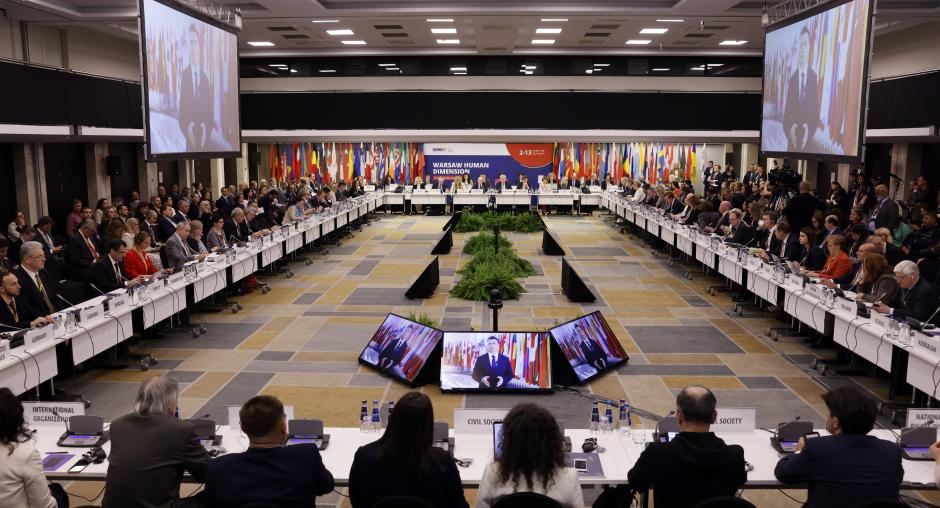
Warsaw Human Dimension Conference, Opening Plenary. 2 October 2023. (OSCE/Piotr Dziubak)
On 2 October 2023 the main message from OSCE leaders at the opening of the ten-day Warsaw Human Dimension Conference was that “at the heart of any human rights movement is the fundamental belief that every individual, regardless of their background or circumstances, possesses inherent rights and dignity.”
The OSCE’s work to achieve sustainable security throughout the 57 states of the region is only possible on the basis of democracy, human rights, and the rule of law, and in co-operation with civil society. But the work of civil society activists, whose determination to shed light on human rights abuses is so important for their societies to develop and flourish, is becoming more dangerous in the many places in which they are treated not as partners but as a political and security risk.
“The brave work of civil society activists and human rights defenders lies at the very heart of our democracies,” said ODIHR Director Matteo Mecacci. “At the OSCE we are deeply grateful for their courageous work, especially in fragile humanitarian situations resulting from conflicts across our region. We continue to learn from their experience, and we look forward to hearing proposals to improve respect for human rights, as well as their ideas for a better future. In this way, we create a unique platform for genuine dialogue between national authorities and civil society across the entire region.”
“In every region of the OSCE I have heard civil society views on how to respond to the challenges we face. Your views have helped to inform our approach in Vienna, and to guide the work of our field missions. All of our work in the Secretariat and field missions is done based on a human rights centred approach, and the OSCE is committed to working with civil society every step of the way as we advance our efforts in the human dimension. The human dimension is fundamental to the OSCE comprehensive concept of security,” OSCE Secretary General Helga Maria Schmid said.
“Media freedom is deeply rooted in the concept and principles of democracy. It is what enables and sustains democratic societies – by providing people with the information they need to be free and self-determined. Quality information and a shared sense of reality are a prerequisite for all citizens to be able to express their will and positions, to take control of their lives, to be part of the glue that holds our societies together. There can be no democracy without media freedom, as much as there can be no security without media freedom,” said Teresa Ribeiro, OSCE Representative on Freedom of the Media.
The full programme and other information about the Warsaw Human Dimension Conference are available here.
The new #PeoplePower2021 report shows where civil society conditions are improving and getting worse. A closer look at top violations & trends.
2021 global data report from the CIVICUS Monitor
9 out of 10 people live in countries where civic freedoms are severely restricted
Country downgrades include Poland, Singapore, Nicaragua, Jordan and South Africa
Detention of protesters is the top violation of civic freedoms in 2021
COVID-19 continues to be used as a pretext to restrict rights across the globe
The fundamental rights to freedom of expression, assembly and association continue to deteriorate year after year worldwide, according to a global report released by the CIVICUS Monitor, an online research platform that tracks fundamental freedoms in 197 countries and territories. The new report, People Power Under Attack 2021, shows that the number of people living in countries with significant restrictions on civic rights, including the freedoms of expression, association and peaceful assembly, amount to almost 89% of the population this year. See also: https://humanrightsdefenders.blog/2021/05/26/10th-edition-of-civicuss-state-of-civil-society-report-2021/
The CIVICUS Monitor data shows that year after year, there is significantly less space for people to exercise fundamental freedoms: only 3.1% of the world’s population lives in countries rated as ‘open’.
Nearly two billion people live in countries with the worst rating, ‘closed’, where the authorities are routinely allowed to imprison, injure and kill people for attempting to exercise their fundamental freedoms. China, Saudi Arabia, Turkmenistan and 21 other countries fall under this category – Nicaragua and Belarus joined their ranks this year.
It is nearly two years since the start of the COVID-19 pandemic and the virus is having a dire impact on civic freedoms globally, one that will have lasting impact if remedial action is not taken. Our research shows the detention of protesters and the use of restrictive laws to muzzle dissent are becoming more prevalent, as governments use the pandemic to introduce or implement additional restrictions on civic freedoms.
“Governments across the world are setting a very dangerous precedent by using the health emergency as a smokescreen to crack down on protests and enact or amend legislation that will further limit peoples’ rights. Specifically, disinformation legislation is being enacted and used to criminalise speech, a concerning practice that could become the new norm to crush dissent,” said Marianna Belalba Barreto, Civic Space Cluster Lead.
This year, 13 countries have been downgraded and only one improved their rating. The CIVICUS Monitor is particularly concerned about civic space restrictions in Europe, where four countries dropped a rating: Belarus, Belgium, Czech Republic, and Poland. Europe has the greatest number of ‘open’ countries, but year after year we continue to see signs of serious deterioration.
Also alarming is the deterioration of civic space conditions in Africa, where South Africa, Botswana, Mali and Mozambique all dropped ratings. In the Americas, Nicaragua joined Cuba in our worst category, ‘closed’. The Middle East and North Africa retained its status as the region with the worst civic rights record, with Jordan being downgraded to ‘repressed’. In Asia, Singapore also fell into the ‘repressed’ category, as a persistent clamp down on dissent and opposition voices continues.
“What we are seeing is not a proportional reaction to a health emergency, where restrictions are meant to be extraordinary measures to deal with a crisis that is temporary. On the contrary, governments are using the pandemic as a pretext to further accelerate the crackdown on human rights that we have been documenting over the past years.”
Although only one country – Mongolia – improved its rating in 2021, it is important to highlight the resilience of civil society. Governments have not been successful in silencing alternative voices or limiting their activism. Despite increasing restrictions, civil society has found ways to continue to speak up and claim their rights.
Over twenty organisations collaborate on the CIVICUS Monitor, providing evidence and research that help us target countries where civic freedoms are at risk. The Monitor has posted more than 550 civic space updates in the last year, which are analysed in People Power Under Attack 2021.
Civic freedoms in 197 countries and territories are categorised as either closed, repressed, obstructed, narrowed or open, based on a methodology that combines several data sources on the freedoms of association, peaceful assembly and expression.
As the climate crisis intensifies and the effects of the COVID-19 pandemic exacerbate social and economic inequalities, the efforts of civil society are fundamental to achieve tangible results and systematic change. However, a new report by CIVICUS shows how activists, human rights and environmental defenders face profound barriers: not only are governments and businesses failing to take urgent steps to mitigate the climate crisis; they are also actively trying to silence activists, disrupt and prevent climate actions and repress environmental, land and Indigenous rights defenders. In addition, companies play a crucial role in limiting human rights activism.
CIVICUS’ report highlights the role of companies across the world in perpetrating, contributing to, or allegedly benefiting from attacks on human rights defenders and rights groups, including: Feronia PHC, Formosa Plastics Group, SOCFIN, Newmont Mining Company, Xiang Lin SI Ltd, Great Season Ltd, Chevron Energy, Somkhele and Tendele Coal Mining, PanAust, Oxec, OCPEcuador and Petroecuador,SG Interests,Celtejo,Mineral Commodities (Ltd) (MRC) and Mineral Sands Resources,PetroTal,Enbridge,Lydian Armenia, andthe RWE Group. The report also highlights positive developments from Chevron and the Mizuho Financial Group.
The Business and Human Rights Resource Centre (BHRRC) had already asked most of these companies to respond to the allegations included in the report, previously. Responses can be found in the companies’ dashboard. BHRRC asked RWE Group to respond to the allegations; RWE’s response is included below.
On 9 November 2021 at 2pm CET, the Unrepresented Nations and Peoples Organization (UNPO) will be co-organizing with MEPs an event in the European Parliament presenting its report on third country reprisals against human rights defenders in Europe. With growing threats from China, Russia, Iran and Pakistan on European soil, UNPO wants greater action taken against their reprisals on minority rights diaspora in Europe. Our report can be found here. [see also: https://humanrightsdefenders.blog/2021/04/22/unpo-reprisals-on-the-rise/]
Event information :
Format : Webinar, with Presentation of report and testimonies
UNPO has been working hard to expose the difficulties activists for self-determination and minority rights face due to reprisals by state actors. These can range from intimidation and threats to murder. As part of our broad Compromised Spaces campaign we wanted
Schedule and Panelists :
Moderator : Shima Silavi, Program Officer, UNPO
Hosts as MEPs : Jordi Sole MEP, Heidi Hautala MEP, Ignazio Castaldo MEP, David Lega MEP.
14.00 Opening Remarks
14.20-14.40 Presenting the Report : “Compromised Space: Foreign State Reprisals against Unrepresented Diplomats in Europe” Shima Silavi.
14:40 – 14:55 Ahwazi Arab Witness – Iran. Hawra Nissi, Daughter of Ahmad Mola Nissi, an Ahwazi Arab political activist who was shot dead in front of his home in the Hague in 2017
14:50 – 15:10 Uyghur Witness – China, Dolkun Isa, President of the World Uyghur Congress
15:10 – 15:25 Crimean Tatar Witness- Russia. Ayla Bakkalli, Representative of the World Congress of Crimean Tatars, Mejlis of Crimean Tatars People – UN Permanent Forum on Indigenous Issues
15: 25 – 15:40 Expert – Oxford University Dr. Fiona McConnell, Associate Professor in Human Geography. Fellow and Tutor at St. Catherine’s College, Oxford, recipient of the Philip Leverhulme Prize for Geography in 2019.
Now (on Thursday 21 October 2021) the 46-strong group of countries across the wider European region has agreed to establish a new legally binding mechanism that would protect environmental defenders.
It takes the form of Special Rapporteur – or independent rights expert – who will quickly respond to alleged violations and take measures to protect those experiencing or under imminent threat of penalization, persecution, or harassment for seeking to exercise their rights under the Convention. As time is of the essence to buttress the safety of environmental defenders, any member of the public, secretariat or Party to the Aarhus Convention, will be able to submit a confidential complaint to the Special Rapporteur, even before other legal remedies have been exhausted. The agreement delegates setting up the new mechanism to the United Nations, or another international body. See also: https://humanrightsdefenders.blog/2019/11/28/cop25-climate-defenders-also-needed-to-be-shielded/
“I remain deeply concerned by the targeting of environmental activists”, said Secretary-General Antonio Guterres, welcoming the rapid response mechanism as “an important contribution to help advance my Call to Action for Human Rights”.
“This landmark decision is a clear signal to environmental defenders that they will not be left unprotected”, said UNECE chief Olga Algayerova. “It demonstrates a new level of commitment to upholding the public’s rights under the Aarhus Convention, as well as Parties’ willingness to respond effectively to grave and real-time challenges seen in the Convention’s implementation on the ground”.
On 10 December 2020, Human Rights Day, the OSCE Office for Democratic Institutions and Human Rights (ODIHR) issued a statement “The brave people strengthening human rights in 2020 will lead us out of adversity“. A bit belatedly. I reproduce here OSCE paying “tribute to human rights defenders and many organizations across the OSCE region that have protected our rights throughout the Covid-19 pandemic, and will have a key role to play if the global recovery is to put respect for human rights at its core“
OSCE states have long recognized the important role played by human rights defenders in ensuring full respect for human rights, fundamental freedoms, democracy and the rule of law. Throughout the pandemic, numerous organizations, initiatives and activists have worked hard to lessen the suffering caused by the health crisis. They have exposed gaps in responses to the health emergency and drawn attention to the undermining of human rights standards and democratic values in the name of public safety.
As public emergencies were introduced across the OSCE region and human rights and freedoms of millions of people were restricted, national human rights institutions (NHRIs) as well as civil society organizations were swift to hold accountable those states that were using vaguely defined regulations to bypass human rights obligations and lower standards. In addition to their regular monitoring activities, NHRIs were often quick and resourceful in developing solutions and disseminating key information to the public when it was needed.
A spirit of dialogue and compromise, the ability to combat systematic inequality and exclusion, and the will to overcome ever-deepening polarization, are hard to imagine without a strong and vibrant civil society. But in many places across the OSCE region, pressure on civic space is increasing. This takes many forms, from legislation restricting the activities of civil society to smear campaigns against human rights defenders and journalists.
Despite their commitment – or because of it – many courageous human rights defenders across the OSCE region have been the brunt of attacks in 2020. They have faced threats and intimidation, frequently initiated by national authorities, as well as funding cuts and risks to their data security and privacy.
Today, ODIHR wants to thank all those brave people across the OSCE region who are committed to safeguarding the human rights of us all. The Office will continue to support and work with them towards this ultimate goal.





 Hans Thoolen on Human Rights Defenders and their awards