This 5 minute video of the ProtectDefenders.eu 2016 Annual Beneficiaries’ Meeting, held in Brussels on the 29 November 2016 is now available on Your Tube. The motto was “Defending Human Rights is not a crime – #DefendersNotCriminals”.
share information on human rights defenders, with special focus on human rights awards and laureates
This 5 minute video of the ProtectDefenders.eu 2016 Annual Beneficiaries’ Meeting, held in Brussels on the 29 November 2016 is now available on Your Tube. The motto was “Defending Human Rights is not a crime – #DefendersNotCriminals”.

On 30 March ProtectDefenders.eu, the European Union Human Rights Defenders mechanism implemented by international civil society, launched its Index of attacks and threats against Human Rights Defenders, featuring a monitoring of alerts concerning violations perpetrated against individuals promoting Human Rights around the globe. The Index of attacks and threats against Human Rights Defenders is available on: ProtectDefenders.eu website.
It could be a most useful tool as quite a few key information providers coöperate (but not AI, HRW?). However, to be really useful as a single stop for this kind of information it is paramount that the site is as complete as possible (otherwise one would still have to go back to the websites of the individual organizations cooperating in the project). This is apparently not yet the case (or maybe definitions still differ from NGO to NGO). Front Line e.g. in its 2017 report (covering 2016) states that 281 HRDs were killed around the world [https://hrdmemorial.org/front-line-defenders-017-annual-report-highlights-killing-of-281-hrds-in-2016/], while a search on the new site shows only 39 killed in 2016 [https://protectdefenders.eu/en/stats.php?yearFilter=2016®ionFilter=&countryFilter=#mf]. That is 242 killings missing (without checking the annual reports of other cooperating partners) ! This issue is important as the announcement claims that the site wants to become “a source of reliable and updated information that should allow the identification of worrying trends and encourage the coordination of adequate responses by decision-makers and authorities to counter the violations faced by defenders”. Read the rest of this entry »
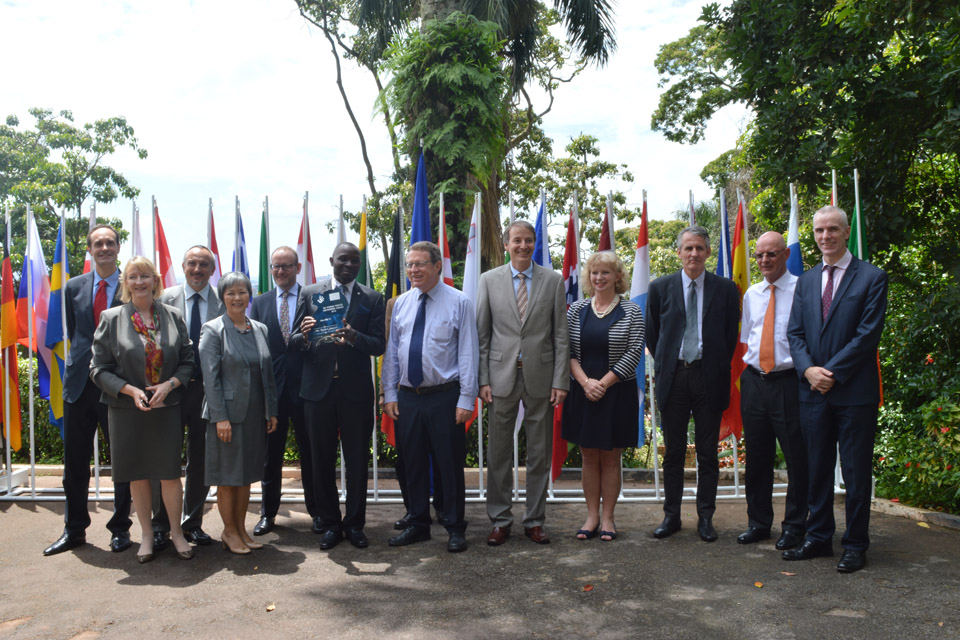
Interesting example of how governments (here the EU) can work together to protect human rights defenders in a specific country (here Uganda). Since a few years there is an annual EU HRD Award to recognise and honour the achievements of an individual Human Rights Defender active in Uganda.
Source: 2017 EU Human Rights Defenders Award: Call for nominations – GOV.UK
On 24 January 2017, thelocal.se published the English version of an opinion piece originally written in Swedish by Civil Rights Defenders executive director Robert Hårdh for newspaper Dagens Nyheter. Like my post published yesterday about the call for Canada to ‘compensate’ for Trumps election [https://humanrightsdefenders.blog/2017/01/23/2017-4-canadas-year-of-real-human-rights-action/], this piece argues that Sweden, also as a member of the EU and with its current place on the UN Security council, must step forward and take a greater responsibility to protect human rights on a global level: Read the rest of this entry »
Civis Mundi published a list of free on-line courses on human rights. I list there the 5 that are (also) in English, without knowing much about the quality: Read the rest of this entry »
On 29 November 2016 ‘ProtectDefenders.eu’ – the EU Human Rights Defenders mechanism implemented by International Civil Society – concluded its first annual meeting of beneficiaries: human rights defenders at risk from all regions of the world who have benefited from the project gathered today in Brussels. The meeting aimed at reflecting on this first year of coordinated work to support defenders worldwide and at highlighting the worrying global phenomenon of criminalisation of human rights defenders.[see: https://thoolen.wordpress.com/2015/12/04/international-cooperative-consortium-protect-the-defenders-launched-on-2-december/]
To conclude the meeting, the twelve partner organisations of ProtectDefenders.eu have issued a public statement urging all national authorities to “publicly recognise the crucial role played by human rights defenders and protect them in all circumstances from any form of judicial harassment“. As stressed by Antoine Madelin, FIDH Director for International Advocacy and Chair of the Board of ProtectDefenders.eu, “Human Rights Defenders are the pillars of democracy and of the rule of law but are too often subjected to unfair criminal prosecution, in an effort to undermine their work in the defence of human rights.”
Since the launch of the project in October 2015, ProtectDefenders.eu has witnessed an increased criminalisation of defenders worldwide in reprisal to the conduct of legitimate human rights activities.
ProtectDefenders.eu held its meeting in Brussels under the motto “Defenders are not criminals” and brought together dozens of human rights defenders at risk supported by the EU mechanism during its first year of implementation, together with prominent representatives of NGOs, European institutions and Representatives of International and Regional Protection Mechanisms, including the United Nations Special Rapporteur on the situation of human rights defenders, Michel Forst. Participating defenders, coming from more than 20 countries such as Burundi, Honduras, Egypt, Bangladesh or the Russian Federation, shared their experiences of resilience in often dangerous and challenging situations and debated on the most effective strategies to counter criminalisation and pursue their work.
This meeting has also emphasised the main achievements and highlights of the first year of ProtectDefenders.eu. In the first twelve months, the EU Mechanism has provided more than 330 emergency grants to defenders at high risk, facilitating a rapid response to their legal, medical, security or emergency relocation needs in pressing circumstances. At the same time, ProtectDefenders.eu has successfully started and run a temporary relocation programme, disbursing more than 700,000 € in support of 74 temporary relocations in favour of 150 individuals, with the collaboration of host institutions worldwide and in the framework of the EU Temporary Relocation Platform.
The Project has also provided institutional and operational support to grassroots organisations, allocating more than 300,000 € through 32 grants. 1,300 defenders worldwide were trained to improve their security and protection in difficult contexts.
Finally, ProtectDefenders.eu has expanded its advocacy and outreach dimension, by conducting fact-finding missions and monitoring trials against defenders particularly in difficult countries, as well as carrying out initiatives to assist and connect isolated and vulnerable defenders throughout the world. ProtectDefenders.eu has coordinated more than 430 urgent alerts aimed at mobilizing the attention of concerned authorities, public and media on behalf of defenders at risk.
Human Rights defenders who attended the meeting positively assessed the first year of implementation of ProtectDefenders.eu. The twelve partners praised the EU strong support through the EIDHR of a project as ambitious and comprehensive as ProtectDefenders.eu. As pointed out by Andrew Anderson, Executive Director of Front Line Defenders and member of the Board of ProtectDefenders.eu, in the closing speech, “human rights defenders in danger around the world do benefit from this strong coordination between international civil society organizations and the institutions of the European Union.”
[ProtectDefenders.eu, the European Union Human Rights Defenders mechanism, delivers emergency help and temporary relocation grants for activists at risk, who face threats due to their work and are in need of urgent support. It also provides training and capacity-building for human rights organisations. ProtectDefenders carries out monitoring, advocacy and lobbying to raise awareness about the situation of human rights defenders and their need for protection]
Source: Newsfeed – ProtectDefenders.eu

Nadia Murad Basee Taha and Lamiya Aji Bashar are survivors of sexual enslavement by Islamic State (IS) and have become spokespersons for women afflicted by IS’s campaign of sexual violence. They are public advocates for the Yazidi community in Iraq, a religious minority that has been the subject of a genocidal campaign by IS militants.
On 3 August 2014, IS slaughtered all the males in the village of Kocho, Aji Bashar and Murad’s hometown in Sinjar/Iraq. Following the massacre, women and children were enslaved: all young women, including Aji Bashar, Murad and their sisters were kidnapped, bought and sold several times and exploited as sex slaves. During the Kocho massacre, Murad lost six of her brothers and her mother, who was killed along with 80 older women deemed to have no sexual value. Aji Bashar was also exploited as a sex slave along with her six sisters. She was sold five times among the militants and was forced to make bombs and suicide vests in Mosul after IS militants executed her brothers and father.
In November 2014, Murad managed to escape with the help of a neighbouring family who smuggled her out of the IS-controlled area, allowing her to make her way to a refugee camp in northern Iraq and then to Germany. A year later, in December 2015, Murad addressed the UN Security Council’s first-ever session on human trafficking with a powerful speech about her experience. In September 2016, she became the first United Nations Office on Drugs and Crime (UNODC) Goodwill Ambassador for the Dignity of Survivors of Human Trafficking, participating in global and local advocacy initiatives to raise awareness around the plight of the countless victims of trafficking. In October 2016, the Council of Europe honoured her with the Václav Havel Human Rights Prize. [https://thoolen.wordpress.com/2016/10/18/yazidi-survivor-nadia-murad-wins-vaclav-havel-human-rights-prize-2016/]
Aji Bashar tried to flee several times before finally escaping in April with the help of her family, who paid local smugglers. On her way over the Kurdish border, and while racing towards Iraq’s government-controlled territory with IS militants in pursuit, a landmine exploded, killing two of her acquaintances and leaving her injured and almost blind. Luckily she managed to escape and was eventually sent for medical treatment in Germany, where she was reunited with her surviving siblings. Since her recovery Aji Bashar has been active in raising awareness about the plight of the Yazidi community and continues to help women and children who were victims of IS enslavement and atrocities.
Sources:
The widely-supported call to free Bahraini human rights defender Nabeel Rajab [https://thoolen.wordpress.com/tag/nabeel-rajab/]was also taken up by the Iranian Tasnim News Agency (operating in English since 2013). This of course most welcome but begs the question why other such calls for human rights defenders, e.g. in Iran, do not get such attention [https://thoolen.wordpress.com/tag/iran/] or the persist lack of cooperation with the UN is not critically reported [see yesterday’s: https://thoolen.wordpress.com/2016/09/14/un-high-commissioner-for-human-rights-states-may-shut-my-office-out-but-they-will-not-shut-us-up/]

The explanation is to be found in ‘about us’, where the agency says: Defending the Islamic Revolution against negative media propaganda campaign and providing our readers with realities on the ground about Iran and Islam, specially current wave of the Islamic Awakening in the region are top on our agenda in Tasnim News Agency. The Islamic nature of the developments in the region and similarities between the Islamic Awakening Movement, which swept the Middle East and North Africa since 2011, and Iran’s 1979 Islamic Revolution have unveiled Islamic Revolution’s inspiring role in the region. The development came despite efforts made by opponents and enemies of Iran to block the country’s growing influence in the region and in the world……Tasnim News Agency will do its best to bring to light the true aspects of events and developments in Iran and in the world, and will also cover the latest developments regarding the Islamic Awakening Movement.
That Nabeel Rajab is Shia may well be relevant.
The recent report SHACKLED FREEDOMS : WHAT SPACE FOR CIVIL SOCIETY IN THE EUROMED? depicts the obstacles and repression against civil society in the region and showcases first-hand accounts from Turkey, Egypt, Algeria, Syria, Israel and the Occupied Palestinian Territories among others. The report also features recommendations by CSOs for joint action and seeks to influence EU policies to that effect. The report also focuses on the impact of security and anti-terrorist policies and lists the growing arsenal of repressive measures – both in law and practice – that civil society organizations (CSOs) face on a daily basis: judicial harassment, surveillance, arbitrary arrests, torture and assassination.
Despite legal safeguards and the human rights “shared values” rhetoric in the EU, EuroMed Rights argues that European civil society is under increasing pressure. Austerity measures and anti-terrorism laws are increasingly used to legitimise practices that go against individual freedoms and rights of assembly, association and expression, such as in France, Spain or the UK, for instance. The report – published on 7 September 2016 – is the result of a seminar organised in April 2016 as an open dialogue between EU representatives, South Mediterranean activists and Brussels-based CSOs.