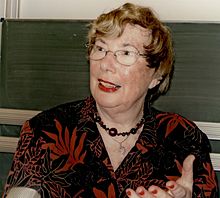
Felicia Langer (born 9 December 1930 ) died on 21 June 2018. She was a German-Israeli attorney and human rights defender known for her defence of Palestinian political prisoners in the West Bank and Gaza Strip. She authored several books alleging human rights violations on the part of Israeli authorities. She lived in Germany from 1990 and acquired German citizenship in 2008.In her writings, lectures and interviews she criticized the Israeli policy in the occupied Palestinian territories, which she considered equivalent to an annexation. Langer furthermore considered the construction of Israeli settlements in the West Bank as undermining the possibility of a two-state solution and demands the complete and unconditional retreat of Israel from the territories conquered in 1967 and a right to return for any descendant of the Palestinian refugees. In 1990, Langer received the Right Livelihood Award ” for the exemplary courage of her struggle for the basic rights of the Palestinian people.” In 1991, she was awarded the Bruno Kreisky Award. In July 2009, President of Germany awarded her the Federal Cross of Merit. The bestowal triggered a public controversy because of her attitude towards the Israeli-Palestinian conflict. For more on human rights awards see: http://trueheroesfilms.org/thedigest/
Ludwig Watzal on 23 June wrote in an Op ED in EurAsia Review “Felicia Langer is highly respected and revered by the Palestinians like no other Israeli-German citizen. Only Yasser Arafat is more adored. Both the Palestinian Authority and the city of Tübingen, where she lived in exile, should set up a memorial place for this great German-Israeli woman…Felicia Langer is one of the few outstanding Israeli-German personalities who have sacrificed themselves to the legitimate concerns of the Palestinian people to the last breath, and whose memory should remember by all three peoples. Their tireless commitment to Palestinian justice and human rights should always be considered an inspiration and a societal obligation to their political actions.”
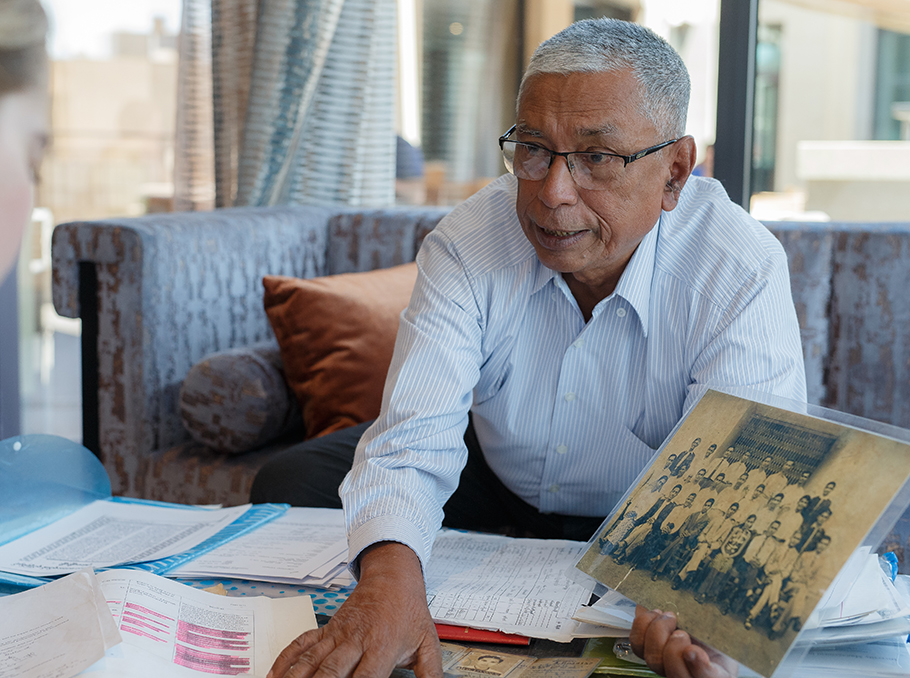
The third Aurora Prize for Awakening Humanity was awarded to Mr. Kyaw Hla Aung, a lawyer and activist recognized for his dedication to fighting for equality, education and human rights for the Rohingya people in Myanmar, in the face of persecution, harassment and oppression. The award comes with 1 million USD to be given by the Laureate to other organisations. For more on this and other awards see: http://trueheroesfilms.org/thedigest/awards/aurora-prize-for-awakening-humanity. See also: https://humanrightsdefenders.blog/2016/04/25/inaugural-aurora-prize-1-million-goes-to-marguerite-barankitse-founder-of-burundian-orphanage/Vartan Gregorian, Co-Founder of the Aurora Prize and Member of the Selection Committee, commended Mr. Aung, stating: “As we remember the horrors and violence experienced by Armenians – especially women and children – on the deportation route during the Genocide, it is with a great sense of responsibility that we stand ready to support Kyaw Hla Aung’s advocacy work that will hopefully lead one day to the enactment of national and international policies to protect and defend the vulnerable. Kyaw Hla Aung is doing tremendous work, at great risk to himself, and exemplifies the far-reaching impact one person can have to galvanize a movement, and to help individuals transform their lives.”
As the 2018 Aurora Prize Laureate, Kyaw Hla Aung will receive a $ 100,000 grant and he will donate $ 1,000,000 award to:
• Médecins Sans Frontières (London)
• Malaysian Medical Relief – MERCY Malaysia (Malaysia)
• International Catholic Migration Commission – ICMC (Switzerland, USA)
Kyaw Hla Aung has been working for decades, using his legal expertise to appeal for basic human rights for the stateless Rohingya people. His commitment to fight for justice for the hundreds of thousands of Muslim refugees in Myanmar persecuted by the government, and for the children who no longer have access to education, remains stronger than ever. He sacrificed a total of 12 years in prison as a result of his mission, at huge personal cost to his own family. On being named the 2018 Aurora Prize Laureate, Kyaw Hla Aung said: “There are severe restrictions on my people. They have lost their courage and faith in themselves, have become illiterate, and, as a result, are penniless. It has been heartbreaking to see my community suffer from such discrimination. The support of the Aurora Prize serves as important recognition for all of the Muslim victims of human rights violations, as the plight of the Rohingya people continues to become more visible to the international public.”
Kyaw Hla Aung was congratulated by Dr. Tom Catena, who was awarded the 2017 Aurora Prize for his exceptional commitment to providing urgent medical care to the 750,000 people in the war-torn Nuba Mountains of Sudan. He said: “The Aurora Prize has created a true light for our people in Nuba, and has helped rebuild the resilience of our community, ultimately to keep people alive. I am proud to share the Aurora Prize mantle with such a selfless humanitarian as Kyaw Hla Aung. I congratulate him on receiving this award and applaud his incredibly selfless efforts fighting for such a noble cause.” [see also” https://humanrightsdefenders.blog/2017/06/28/nominations-are-open-for-the-2018-aurora-prize-for-awakening-humanity/]
Guests of the Aurora Prize Ceremony also honored the contributions of the other two 2018 Aurora Prize Humanitarians: Dr. Sunitha Krishnan, women’s rights advocate and Co-Founder of Prajwala, India, and Father Tomás González Castillo, Founder of La 72, a center that supports Central American migrants in Mexico.
Yesterday, 3 May 2018, was World Press Freedom Day and many noteworthy activities took place. The Economist and many other newspapers of course paid attention with grisly statistics from the Committee to Protect Journalists and other sources. It was also a time to award courageous journalists and cartoonist; just to mention a few:
Musa Kart was announced as the 2018 laureate of the International Press Cartoon Prize by Cartooning for Peace.
The 2018 International Press Cartoon (or Drawing) Prize, presented biannually in Geneva, was awarded to the Turkish cartoonist who was recently sentenced to almost four years in prison for “aiding terrorism”. He is a 64-year-old artist working with the Turkish daily newspaper Cumhuriyet and was described as a “free spirit and a remarkable artist” by Swiss cartoonist Chappatte, a member of the jury.
It was also the day of the presentation of the first Ari Rath Prize for Critical Journalism (established to honour journalists who have rendered outstanding services to critical reporting on immigration, expulsion and asylum, committed to respect for human rights, in the spirit of the former editor-in-chief of the Jerusalem Post, who died in January 2017). Austrian journalist Alexandra Föderl-Schmid was the laureate.
The Stockholm Center for Freedom (SCF) partnered with the London-based International Observatory of Human Rights (IOHR) to commemorate World Press Freedom Day in Stockholm with an event focused on Turkey, which leads the world in the highest number of journalists in jail. According to SCF data, 258 journalists and media workers were in jail as of today, with 59 of them already convicted on dubious charges of terrorism, defamation and coup plotting. In addition, 142 Turkish journalists who were forced to go into exile or still remain at large in Turkey are wanted for arrest by authorities.
Nine NGOs wrote on World Press Freedom Day a joint letter expressing deep concern over the continued arbitrary detention of Tashi Wangchuk, a Tibetan language advocate arrested in 2016 after giving an interview to the New York Times. Tashi Wangchuk has since been tried for “inciting separatism,” a politically motivated charge that violates his rights to freedom of expression and association. [Tashi Wangchuk began raising public concern for the lack of rightful Tibetan-language education …In late 2015, he spoke with the New York Times in an interview about his attempts to promote the teaching of Tibetan; he insisted the interview be on the record. A journalist from the New York Times also accompanied him to Beijing, where Tashi Wangchuk attempted to file a lawsuit to ensure local authorities guarantee the provision of Tibetan language education. The result was an article and video documentary featured in the New York Times in November 2015.
In his article, Tashi Wangchuk insisted that his language advocacy was peaceful and non-political. His attempts to persuade the Chinese government to guarantee Tibetan language instruction were conducted through official channels and he made it clear that he was not advocating Tibetan independence. Instead, his main focus was ending the destruction of Tibetan language and culture. Despite taking these precautions, Tashi Wangchuk was arrested on 27 January 2016, held in an unknown location and later stood trial in a closed session. See also:
And then there were many smaller events all around the globe that also deserves attention, such as Amnesty International Nepal voicing support to journalists as human rights defenders (such as Charan Kumar Prasai and Subodh Pyakurel and Rajan Prasad Kuikel).
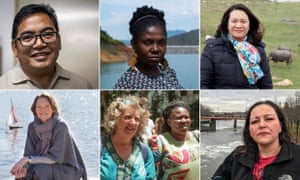
On 23 April the Guardian and other papers announced the laureates of the 2018 Goldman environmental prize and note that most of the winners are women. They are grassroots activists who have taken on powerful vested interests. For more on this award: http://trueheroesfilms.org/thedigest/awards/goldman-environmental-prize.
Goldman environment prize winners 2018: (clockwise from top left) Manny Calonzo, Francia Márquez, Nguy Thi Khanh, LeAnne Walters, Makoma Lekalakala and Liz McDaid, Claire Nouvian. Photograph: 2018 Goldman Environmental Prize
This year’s Goldman environmental prizes celebrate six remarkable success stories, five of them driven by women.
In Latin America, the winner is Francia Márquez, an Afro-Colombian community leader who led a 10-day, 350-mile march of 80 women from the Amazon to Bogotá that prompted the government to send troops to remove illegal miners who were polluting rivers with cyanide and mercury. [The dangers of environmental activism have been evident in the murder of two Goldman-prize recipients in the past two years: the 2015 winner Berta Cáceres and the 2005 winner Mexican activist Isidro Baldenegro López] “The first thing we need is to be more aware of the historical moment in which we find ourselves: the planet is being destroyed, it’s that simple, and if we do nothing to avoid it we will we will be part of that destruction,” Francia Márquez said. “Our time has come, we must act, we have a responsibility to future generations to leave a better world, in which taking care of life is more important than producing cumulative wealth.”
Three Child Rights Heroes are honoured by the World’s Children’s Prize(WCP) 2018. Learn more about them by clicking their names below.
• Gabriel Mejía Montoya for his efforts over the course of more than 30 years to support Colombia’s street children, child soldiers and children in prison. Father Gabriel has suffered repeated attempts on his life because of his work.
• Rachel Lloyd for her 20-year fight against commercial sexual exploitation, CSEC, and domestic trafficking of girls and young women in the US. Rachel is a survivor of sexual and mental abuse during her childhood in England and exploitation in the sex industry in Europe.
• Valeriu Nicolae for his tireless struggle to protect the poorest and most vulnerable children in Romania’s Ferentari ghetto. Valeriu grew up in extreme poverty and was discriminated against because he was Roma.
The candidates were selected by a jury of children from 15 different countries. Rachel Lloyd has been elected Child Rights Hero by millions of young people. Gabriel Mejía Montoya from Colombia and Valeriu Nicolae from Romania get the World’s Children’s Honorary Awards.
As part of the global Celebration of World Press Freedom Day, the winner of the “UNESCO/Guillermo Cano World Press Freedom Prize” will be announced on 3 May 2018. for last year’s award: https://humanrightsdefenders.blog/2017/05/04/eritrean-born-journalist-dawit-isaak-awarded-2017-unescos-guillermo-cano-world-press-freedom-prize/
The jury on Monday 23 April awarded the honor to Mahmoud Abu Zeid, known as Shawkan, who has been in jail since he was arrested in Cairo in August 2013 for covering a demonstration at Rabaa Al-Adawiya Square. Egypt’s Foreign Ministry strongly warned UNESCO against the move Sunday, saying that Shawkan faces terror-related charges. The U.N. Working Group on Arbitrary Detentions says Shawkan’s arrest is arbitrary and his continued detention infringes his human rights.
On 16 April 2018 the NGO-network Scholars at Risk (SAR) announced that Turkey’s Academics for Peace is the recipient of its 2018 Courage to Think Defender Award, for their extraordinary efforts in building academic solidarity and in promoting the principles of academic freedom, freedom of inquiry, and the peaceful exchange of ideas. The award, which will be presented at the Scholars at Risk Network 2018 Global Congress, will be accepted on behalf of the group by Muzaffer Kaya, of Technische Universität Berlin, and Tebessüm Yılmaz, of Humboldt-Universität zu Berlin.
Rose Anderson, SAR’s Director of Protection Services stated: “By connecting their threatened colleagues both inside and outside of Turkey to resources, opportunities, and support, they are working to ensure that Turkey’s vibrant higher education community can continue to pursue scholarship, and be free to think, question and share ideas. The solidarity of the Academics for Peace community is an inspiration for all of us who work on behalf of threatened scholars and academic freedom worldwide.”
For more information about the Courage to Think Award and the Global Congress, including registration information, the Congress program and speaker bios, visit https://www.con-gressa.de/gc2018.
On 12 April 2018 the Human Rights Foundation (HRF) announced two of the three recipients of the 2018 Václav Havel International Prize for Creative Dissent. This year’s laureates include the underground group Belarus Free Theatre and the South Sudanese hip hop musician and former child soldier Emmanuel Jal. Their efforts will be honored in a ceremony during the 2018 Oslo Freedom Forum on Wednesday, 30 May (to avoid possible travel restrictions imposed on the third laureate, the final award will be announced only in May).
For more on the this and other awards: http://trueheroesfilms.org/thedigest/awards/vaclav-havel-prize-for-creative-dissent
Belarus Free Theatre(BFT) was founded in 2005 in response to the severe censorship and repression of Alexander Lukashenko’s regime. BFT has staged powerful social and political documentary theater from secret locations (private homes, cafes, and even the woods), characterized by stripped-down performances and topics, including refugees, climate change, torture, and sexuality. According to co-founder and artistic director Natalia Kaliada, “In a country where the state seeks to control every aspect of life, everyone has the potential to rebel in their own way. And a million small acts of rebellion can chip away at even the most entrenched dictatorship.” In April 2017, the company had to postpone a premiere after several members were arrested or injured during large-scale, anti-government protests. BFT is the only theater company in Europe banned by its government on political grounds.
Emmanuel Jalis a South Sudanese hip hop artist and a former child soldier of Sudan’s brutal civil war that took place between 1983 and 2005. With five critically acclaimed albums, an autobiography, and a documentary to his name, Jal is focused on supporting South Sudanese youth with educational scholarships through his “Survivors of War” program. He founded the charity Gua Africa to work with individuals, families, and communities to help them overcome the effects of war and poverty. “Emmanuel uses powerful music as a vehicle to spread a message of freedom and hope for a better future in war-torn South Sudan. He inspires people everywhere to stand up for the freedom of others, and in so doing brings people closer together,” said Havel Prize Committee member Garry Kasparov.
The Havel Prize ceremony will be broadcast live at oslofreedomforum.com on Wednesday, 30 May. If you would like to attend the ceremony in Oslo please email info@hrf.org and follow @HRF and @OsloFF for updates.
The nomination form, and the full list of past awardees of the Baldwin Medal is available on the award webpage of Human Rights First. Deadline is 10 May 2018
Nominations can be made by an individual or an organization. Nominees will be judged based on the following criteria:
The nominee’s work is unique or particularly distinctive;
The nominee’s work has been effective in advancing human rights in a country other than the United States;
The nominee faces risk or insecurity as a result of their work; and
The nominee would benefit significantly from receiving the Baldwin Award, in the form of enhanced protection, or in any other way.
For further information about the award or the nomination process, please contact Zahava Moerdler at Moerdlerz@humanrightsfirst.org or (212)-845-5272.






 Hans Thoolen on Human Rights Defenders and their awards