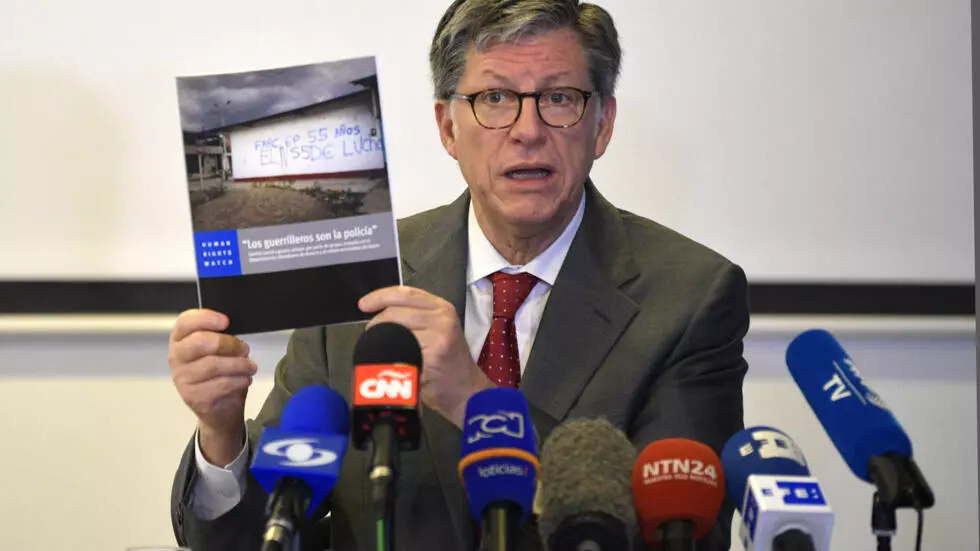
Jose Miguel Vivanco, HRW director for the Americas, accuses the Colombian government of failing to act on the murders of rights activists Raul ARBOLEDA AFP
Human Rights Watch on Wednesday 10 Febuary 2021 hit out at Colombia’s government over the rising number of human rights defenders and activists being murdered in the South American country.
Since the 2016 peace accord that ended half a century of fighting between government forces and the Revolutionary Armed Forces of Colombia (FARC), an increasing number of civil society leaders have been killed each year. But “the government has acted slowly and weakly in the implementation of policies to prevent these murders,” HRW said in a statement.
Despite Colombia suffering the largest number of such murders on the continent, “the government’s response has been more focussed on making speeches and announcements than adopting measures that will have an impact in the territories” affected by the violence, said Jose Miguel Vivanco, HRW director for the Americas.
Behind the wave of violence targeting advocates are National Liberation Army Marxist rebels, dissident FARC guerrillas and right-wing paramilitaries, as well as armed drug-trafficking groups. They are fighting each other over access to lucrative cocaine and illegal mining markets.
HRW says most victims were murdered as reprisals for opposing drug-trafficking in their territories, allegedly collaborating with the army or supporting the replacement of illegal coca plantations with legal ones. The digest of Human Rights Laureates lists 50 HRDs in Colombia. See: https://www.trueheroesfilms.org/thedigest
A Thai scholar, Vitit Muntarbhorn, has been proposed for appointment as the new Special Rapporteur on the situation of human rights in Cambodia by president of the United Nations Human Rights Council Nazhat Shameem Khan.
Muntarbhorn was listed in the candidates proposed for the six vacancies of special procedure mandate holders scheduled to be filled at the 46th session of the Human Rights Council, according to a letter from Shameem Khan on Monday.
If the 46th session of the Human Rights Council approves, Muntarbhorn will be appointed as the UN Special Rapporteur on Human Rights Situation for Cambodia, replacing Rhona Smith, whose tenure ended in January.
Cambodian Human Rights Committee (CHRC) spokesman Chin Malin said Cambodia will welcome and work with whomever is selected as the Special Rapporteur.
Muntarbhorn was designated in September 2016 as the first UN independent expert on violence and discrimination based on sexual orientation and gender identity by the Human Rights Council. He is an international law professor..
He is currently a professor emeritus of law at the Chulalongkorn University in Bangkok, having taught international law, human rights, the law of regional organisations, migration and refugee law, child rights, international humanitarian law and European Union law. He was awarded the Unesco Human Rights Education Prize in 2004. [see: https://www.trueheroesfilms.org/thedigest/laureates/DB1D6BB8-85F5-7BBA-A715-5DA728579021]
Muntarbhorn has served on many United Nations bodies. He was formally the United Nations Special Rapporteur on the situation of human rights in South Korea. He has also been Special Rapporteur of the UN Commission on Human Rights on the sale of children, child prostitution and child pornography.
On 4 February 2021 the Business and Human Rights Resource Centre published an opinion piece by Mary Lawlor, the UN Special Rapporteur on Human rights Defenders:
Human rights defenders (HRDs) all over the world face continuous harassment, threats and intimidation, with some even getting killed in response to their work protecting and defending human rights. Since the start of the COVID-19 pandemic, attacks against HRDs have continued with many facing greater risks as some governments misuse the situation to further curtail civil rights, deny participation in public decision-making, and deploy state forces to repress legitimate, peaceful protests and obstruct access to justice.
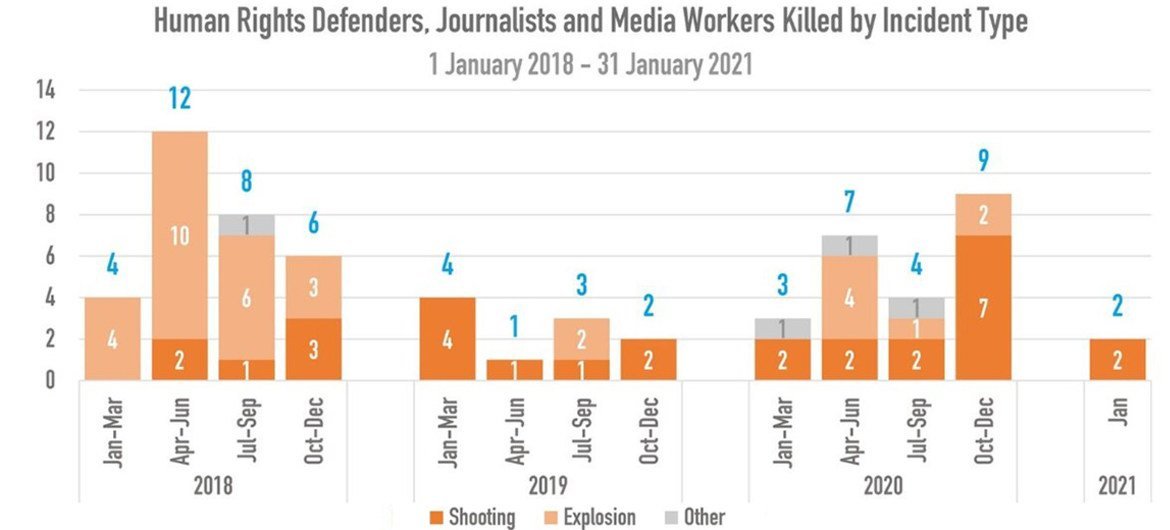
Many of these attacks are related to business activities. In 2019, the United Nations High Commissioner for Human Rights (OHCHR) documented the killing of 357 HRDs, half of whom worked on land rights, protection of the environment, minority rights and indigenous people rights. These violations are often carried out in the context of extractive industries, energy production, agro-industrial development and other business activities. When human rights are under threat from business activities, HRDs stand up and put themselves at risk to protect these rights and their communities. For an overview of all such HRDs, see: https://www.trueheroesfilms.org/thedigest
A landmark example is that of HRD Mungunkhun Dulmaa in Mongolia. In 2017, the Mongolian Government entered into a mining agreement with Steppe Gold, a Canadian gold mining company. The local community complained about the environmental impact of the agreement, the associated gold mine, and allocation of land to step-mines – lands which had been used by the community for generations. In 2018, members of the affected community staged a protest and were attacked by private security guards, hired by the company. When Ms. Dulmaa tried to video-record the assault as evidence she was detained, beaten and sexually harassed, and the video was deleted from her phone. A year later, when she attempted to report the incident to local police, Ms. Dulmaa received death threats via text, warning her to stop her work. Here, the lack of engagement by companies with potentially affected communities is blatant. In 2020, my predecessor and the UN Working Group on business and human rights sent a communication regarding Ms. Dulmaa’s case to both the Mongolian Government and the company, but neither responded. This signals a real lack of accountability. If we really want to ‘build back better’ and achieve a just recovery,human rights and HRDs need to become a priority for both states and business.
Five steps companies should take to address risks to HRDs in the context of just recovery:
Implement the UN Guiding Principles on Business and Human Rights (UNGPs) through adequate engagement with rightsholders. A recent report from Trinity College, Dublin on 50 large companies and 10 states showed that companies either don’t know or don’t care about the UNGPs. A key part of the implementation of UNGPs is engagement with potentially affected rightsholders and their representatives, including independent trade unions and other civil society organisations. So far, this is not happening: for example, in the Know the Chain benchmark, all companies scored zero on their efforts to support freedom of association. This must change if we want to ‘build back better’: from the earliest possible stage of each project and throughout their supply chains, companies need to engage with potentially affected communities, workers and HRDs representing and supporting them. This needs to include critical voices and companies must give due consideration to the possible objections of HRDs, even if these may render their work and projects more costly, less profitable or even less viable.
Free, prior and informed consent (FPIC) from affected communities, especially indigenous ones, is non-negotiable. It is an essential part of the effective due diligence called for in the UNGPs and a platform to prevent conflict. HRDs, typically leaders in their communities, can help business develop the kind of precise, contextualised understanding of local situations they need if they intend to prevent and address the potential threats to human rights arising from their activities. In assessing risk, both companies and investors, and the social auditors they hire to help them do so, should give adequate weight to independent civil society and community-level information and evidence. This is fundamental when considering actions for just recovery.
This engagement with HRDs and rightsholders must continue for the duration of any business project, because opinions can change over time. Therefore, companies need to constantly keep their door open to HRDs and their input.
Companies should create publicHRDs policies and processes. Business needs to commit to the recognition of communities, HRDs and trade unions as partners by systematically including them in human rights policies and due diligence. They need to commit to a zero-tolerance approach to violence in their supply chains, and enforceable agreements with unions, and consistently prevent, monitor and address risks HRDs face in them.
Companies should also stand with HRDs when they are attacked and release public statements denouncing threats and attacks. Such steps should be taken in consultation with HRDs themselves to increase effective actions that prevent harm and most importantly build trust with HRDs and local communities.
It must be acknowledged some private businesses are already taking positive steps when it comes to protecting HRDs, but most of them do not. This is extremely disappointing and indicates a very strong need for mandatory human rights and environmental due diligence (HREDD). As the UN Special Rapporteur on the situation of HRDs, I strongly support the growing momentum worldwide for mandatory HREDD, and advocate for an early inclusion of rightsholders and HRDs in the legislative process. These laws need to ensure access to justice and the right to an effective remedy, include a business duty to conduct effective, meaningful and informed consultations, and introduce robust safeguards for HRDs and whistle-blowers. An uncritical return to business-as-usual in the post-pandemic period would only perpetuate the deep inequalities between companies, workers and local communities, whereas we have a precious opportunity to reimagine and rebuild an economy that serves and respects the rights of all its participants.
On 9 February 2021 Hamida Giyasbayli of OC Media reports thatAzerbaijani human rights lawyer Shahla Humbatova has vowed to fight disbarment procedures against her despite what she says is a campaign of ‘harassment and threats’ from the Bar Association.
The Azerbaijani Bar Association has accused Humbatova of submitting a fake document as evidence during a civil case she was litigating, a criminal offence. They have also accused her of owing ₼460 ($270) in membership fees. The association has taken her to court in an attempt to disbar her, which would strip her of the right to practice law.
Speaking with OC Media, Humbatova said the allegation she submitted fake documents was baseless, and that her defence had submitted evidence proving this.
She confirmed that she had owed eight months of membership fees, but insisted the association did not make any effort to notify her of this. ‘I learned about this from the media the day after the Board’s decision [to take me to court]’, she said. She immediately made the payment, so when the Bar went to court with her disbarment request, there was no longer any debt. Emin Abbasov, a legal practitioner who also works on human rights cases, criticised the proceedings against Humbatova for being conducted behind closed doors and without any records. Abbasov, along with four others, is himself appealing to the European Court of Human Rights after being denied certification by the Bar Association.
Humbatova told OC Media that the move to disbar her was a continuation of the policy of dismantling human rights defenders in the country. ‘It is lawyers and human rights activists who are fighting against politically motivated arrests, torture, repression of dissidents and those who simply demand their rights, and informing the public and international organisations. Therefore, they are being neutralised’, she stated.
In December 2019, 42 member organisations of the Human Rights House, a global rights group, called on the Azerbaijani Bar Association to ‘halt reprisals against a number of human rights lawyers, including Shahla Humbatova and Elchin Sadigov’. Sadigov is Humbatova’s current lawyer.
Saudi activist Loujain al-Hathloul had been sentenced to almost six years in jail (AFP/File photo) By Ali Harb in Washington
After more than 1,000 days in detention where she endured torture and hunger strikes, Saudi women’s rights activist Loujain al-Hathloul is expected to be released on Thursday, her sister revealed in a tweet on Monday.
Her early release would come weeks into the administration of US President Joe Biden, who has vowed to “reassess” relations with Riyadh and prioritise human rights in its dealings with the kingdom. In a phone call with Saudi Foreign Minister Faisal bin Farhan last week, US Secretary of State Tony Blinken stressed “several key priorities of the new administration including elevating human rights issues and ending the war in Yemen”, according to a statement by the State Department.
With the launching of the new Digest of human rights laureates by True Heroes Films (THF) today, 2 February 2021, I have decided to centre my blog more on human rights awards and laureates. It will give the blog more focus and this will also help the Digest to stay up to date. After many years of work, True Heroes Films (THF) has made public its gateway to human rights awards and their laureates at www.trueheroesfilms.org/thedigest. The Digest is a new free online tool that gives everybody access to information on human rights awards, including the list of people who received such awards. Over the last 20 years, the human rights movement has discovered the value of awards. The Digest tells that story and makes human rights defenders more visible as an encouragement and role model for others.
Here some specialised user comments: The Digest “will help us demonstrate to the world how many human rights defenders there are in the world and the different human rights they defend and fight for” stated Guadalupe Marengo, Head of Global Human Rights Defenders Programme at Amnesty International.
“It is a useful resource that places individuals, the laureates, at the heart of the search process,” commented Eleanor Davies of the Centre of Applied Human Rights at York University.
“With a simple and straightforward way to find what you are looking for, it helps initiate partnerships,” says Friedhelm Weinberg, Executive Director of HURIDOCS, an organisation specialised in information technology.
For human rights defenders, the Digest allows finding awards and people concerned with similar causes worldwide. Award givers can quickly check their candidates. For media, the Digest means instant access to information on human rights defenders or an award announcement to complete their story.
The Digest was created during 8 years with support from the City of Geneva, Brot für die Welt and the Permanent Mission of the Netherlands to the United Nations Office.
As this blog has abundantly shown, Human Rights Awards have become an increasingly important tool in the protection of Human Rights Defenders. They give HRDs visibility and provide support and protection for those at risk. [see e.g. https://humanrightsdefenders.blog/tag/human-rights-awards/].
On February 2nd 2021 a new one-stop resource will allow to find and search human rights awards and their laureates.
The Digest of International Human Rights Awards and their Laureates, a unique centralised resource for the human rights community, gives visibility, strengthens legitimacy of human rights defenders’ work, and could influence authorities to better apply human rights. There are now 200 awards and over 2400 HRDs/laureates in the digests.
It will give researchers, students, activists, the media and the public a searchable overview on who has won which awards and their short profiles. The digest will allow people to filter (re)searches on laureates by, e.g. theme, prize, profession, country or region, gender, etc.
On February 2nd, 2021True Heroes Films will be launching the new platform to the public. See the clip below: