Posts Tagged ‘death penalty’

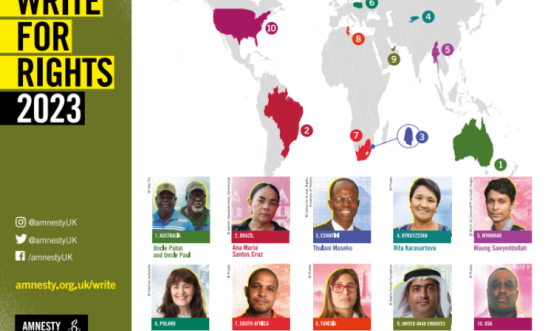
Write for Rights: Global letter writing campaign 2023 started

November 2, 2023

Amnesty International launched its flagship Write for Rights campaign to help people facing human rights abuses around the world. Millions of letters and emails will be sent to support these individuals and urge authorities to end injustices. While sending a letter may seem like a small gesture for any single one of us, the collective action of many of us has the potential to transform lives’ said Sacha Deshmukh, Chief Executive of Amnesty International UK.

Taking place across November and December, Write for Rights will see people around the world send millions of cards, emails and social media posts of solidarity to individuals whose fundamental rights are being threatened or denied, while urging those in power to put a halt to the abuses.

This year, the global Write for Rights campaign will focus on 10 cases of individuals and communities from across the world who are facing human rights violations, including:

  • Rocky Myers, a Black man, has been on death row in Alabama, USA, since 1994. A nearly all-white jury convicted and sentenced him to life without the possibility of parole for the murder of his white neighbour. The trial judge overrode their decision and imposed a death sentence – a practice now outlawed in Alabama. No evidence linked Rocky to the murder, except for a VCR stolen from the victim, which he maintains he had found abandoned in the street. In 2018, Rocky and others on death row were given 30 days to choose if they wanted to die by nitrogen gas asphyxiation or by amended lethal injection protocols. Rocky chose the former, and his execution could be reset as soon as the new protocol for execution by nitrogen gas asphyxiation is finalised and ready to be implemented, which is expected by the end of this year.
  • Rita Karasartova, a Kyrgyzstan-based human rights defender who works for the Institute of Civic Analysis – a human rights organisation and think-tank. Rita was arrested in October 2022 for joining group of activists who objected to a border demarcation agreement with Uzbekistan. After the group called for a public assembly and formed a committee to oppose the agreement, Rita and others were charged with attempting to violently overthrow the government, which carries a maximum sentence of 15 years imprisonment. Rita is now under house arrest and a strict curfew.
  • Ahmed Mansoor is a human rights defender and previously won the prestigious Martin Ennals Award for Human Rights Defenders in 2015. Ahmed has documented human rights abuses in the UAE since 2006, until he was arrested in early 2011 and March 2017, he was given a 10-year prison sentence. He has been held in solitary confinement since the beginning of his detention, and continues to be denied a mattress, access to books, and to be permitted to go out in a yard. See: https://humanrightsdefenders.blog/tag/ahmed-mansoor/ and https://www.trueheroesfilms.org/thedigest/laureates/074ACCD4-A327-4A21-B056-440C4C378A1A]
  • Justyna Wydrzyńska is a reproductive rights defender in Poland and is one of the co-founders of the Abortion Dream Team, an activist collective campaigning against abortion stigma and offering advice on accessing safe abortion in Poland, where abortion laws are among the most restrictive in Europe. In March 2023 Justyna was convicted to 8 months’ community service for helping a pregnant woman to access abortion pills in Poland, setting a dangerous precedent in a country where abortion is almost completely banned.

Amnesty International’s Write for Rights campaign dates back to the origins of Amnesty International in 1961. In the organisation’s early days, Amnesty campaigners wrote letters of support to individuals facing human rights violations. Now, Write for Rights is Amnesty’s flagship campaign, running every year to raise awareness about individuals whose rights are being seriously threatened.

Last year’s Write for Rights saw:

  • Over 5.3 million actions worldwide – of which at least 234,801 letters and cards were solidarity actions.
  • Letters were sent from around the world, from Zimbabwe to Hong Kong.
  • Amnesty’s International Secretariat digitally collected almost double the number of digital actions from 2021.

For 2021 see: https://humanrightsdefenders.blog/2021/11/08/write-for-rights-2021-launched/

https://www.amnesty.org.uk/press-releases/write-rights-global-letter-writing-movement-stands-victims-human-rights-abuses

Results of the 54th session of the UN Human Rights Council

October 15, 2023

On 13 October 2023 the ISHR and other NGOs shared their reflections on the key outcomes of the 54th session of the UN Human Rights Council [see: https://humanrightsdefenders.blog/2023/09/11/human-rights-defenders-at-the-54th-session-of-the-un-human-rights-council/:

…We firmly condemn all crimes and other grave violations under international law committed by both Israel and Palestinian armed groups. Targeted and indiscriminate attacks against civilians can never be justified. We call on the ICC Office of the Prosecutor to accelerate its investigation into serious crimes committed by all parties in Palestine and Israel. We call on Israel to ratify the Rome Statute, and for the ICC to hold both State and non-State perpetrators of international crimes accountable. We call on the Commission of Inquiry to address the situation within the context of its root causes: settler colonialism, apartheid, and denial of the fundamental rights to self-determination and return of the Palestinian people, all amounting to grave violations of international law. We call on governments to immediately stop providing political and military support to Israel, while Ministers manifest a genocidal intent against Palestinians. On 9 October 2023, Yoav Gallant, Israel’s Minister of Defense, stated: “We are imposing a complete siege on [Gaza]. No electricity, no food, no water, no fuel – everything is closed. We are fighting human animals, and we act accordingly”. We deplore the dehumanization of all people, including not mentioning  Palestinian civilians’ killings in statements in this Council. As we gear up to celebrate the 75th anniversary of the UDHR, we remind this Council that for 75 years, generations of people in Gaza and historic Palestine have not been born free and equal in dignity and rights. Until this is addressed, the cycles of violence will not end. As Israel continues to bomb the Rafah crossing, the international community has a duty to guarantee immediate humanitarian access to besieged Gaza. We call on States to establish an international protective presence in the OPT, as called for by UN Special Procedures.  For 75 years, the international community has enabled impunity and failed to fulfill the right to self-determination of Palestinian people, including through their legitimate right to resist colonialism.

The Council has shown that it does have an important role to play in addressing violations amidst multiple human rights crises. We welcome the establishment of the mechanism on Sudan and the extension of the Special Rapporteur on Russia, inter alia, in this regard. But these stand in stark contrast to its failure to renew the critical mandate on Ethiopia, particularly in light of the expert finding of the acute risk of ongoing and further atrocity crimes, as well as other Council blind spots where mounting human rights violations remain ignored. We stress the need for the Council to take a principled approach and to address situations on their merits. 

We remain deeply concerned about reprisals against civil society actors who engage or seek to engage with UN bodies and mechanisms. We call on all States and the Council to do more to address the situation, including raise concerns about specific cases of reprisals and demand that governments provide an update on any investigation or action taken toward accountability. We welcome the adoption of the resolution on cooperation with the UN, including the reference to adequately resourced dedicated civil society focal points, however we are disappointed that several proposals by States and civil society to strengthen the text were not taken on board. The Secretary General’s most recent report on reprisals notes increased physical and digital surveillance of those cooperating with the UN and application of laws aimed at punishing or deterring cooperation. While the resolution takes notes of these trends we regret that the resolution does not fully address how these should be addressed. We welcome the strong focus on prevention and emphasis given to accountability. Nonetheless, the preventative role the Council could play in regard to reprisals, as signs of deterioration in civic space conditions, is overlooked. In addition, States’ monitoring and reporting responsibilities in relation to allegations of acts of intimidation or reprisal could be addressed more fully. Also, we welcome the call to the SG for adequate resources to be allocated to OHCHR to prevent and address allegations.

We welcome the resolution on preventable maternal mortality and morbidity, which reiterates that PMMM is a human rights issue that requires a human rights-based approach response, centering inter alia the principles of accountability, meaningful participation of primarily affected people, non-discrimination and equality and transparency. The resolution aims at garnering political will to curb maternal mortality and morbidity rates that have been stagnating and failing to meet SDGs targets. The resolution rightly highlights the full realization of the right to sexual and reproductive health and the provision of comprehensive sexual and reproductive health information and services, including comprehensive sexuality education and safe abortion (with the caveat of not when against national law), as pre-conditions to lower PMMM. We welcome the call to update the technical guidance on a HRBA to PMMM. We however deplore the amendments put forward seeking to weaken the text and apply a protectionist lens to women’s rights to bodily autonomy, taking away their agency and their status of full rights holders under IHRL.

We express our support for a new resolution on the right to privacy in the digital age, which contains strong new standards under the theme of data protection. The resolution also contains stronger language on remote biometric surveillance systems, such as facial recognition, stressing that they raise serious concerns with regard to their proportionality. While we applaud that the resolution acknowledges that some applications of new and emerging technologies may not be compatible with international human rights law, we call for future iterations to take a step further in establishing “red lines” and to call for bans of such technologies. We also urge the core group to address other emerging issues for the right to privacy in the future, such as social media monitoring.

We welcome the adoption of the resolution on the question of the death penalty aimed at ensuring that criminal justice systems are consistent with international human rights obligations in relation to capital punishment, with a focus on the relation between Art 6 and Art 14 of the ICCPR, particularly on the right to seek pardon or commutation of the sentence, and the right to have one’s conviction reviewed by a higher tribunal according to law. In accordance with the safeguards guaranteeing the protection of the rights of those facing the death penalty, as set out in the annex to Economic and Social Council Resolution 1984/50. We welcome that any attempt by a number of States to undermine the aim of the resolution through a number of amendments, have been rejected.           

We welcome the adoption of the resolution from rhetoric to reality: a global call for concrete action against racism, racial discrimination, xenophobia and related intolerance’ and the mandate renewal of the Working Group of Experts of People of African Descent (WGEPAD). We welcome that the rhetoric to reality resolution, interalia, strongly condemns the discriminatory treatment, unlawful deportations, excessive use of force and deaths of African migrants and migrants of African descent, including refugees and asylum-seekers, at the hands of law enforcement officials engaged in migration and border governance. It calls on States to ensure accountability and reparations for human rights violations at borders and to adopt a racial justice approach, including by adopting policies to address structural racism in the management of international migration. However, we regret that it did not reiterate that the transatlantic trade in enslaved Africans and colonialism were grave violations of international law that require States to make reparations proportionate to the harms committed and to ensure that structures in the society that are perpetuating the injustices of the past are transformed, including law enforcement and the administration of justice. We urge all States to fully implement the Durban Declaration and Programme of Action (DDPA). We also call on States to fully cooperate with the WGEPAD and EMLER including by accepting country visits, and implementing their recommendations as well as those from the Permanent Forum and the High Commissioner’s Agenda towards Transformative Change for Racial Justice and Equality.

We welcome the adoption of the resolution on the human rights situation in the Russian Federation, and the re-mandating of the Special Rapporteur. The human rights situation in Russia has drastically deteriorated in the past year, and the Special Rapporteur needs more time to report on the general situation in the country and the Council to equally be able to scrutinize the situation.

We welcome the adoption of the resolution on a Working Group on the rights of Peasants and Other People Working in Rural Areas. The resolution recognizes the contributions of peasants and other people working in rural areas in ensuring the right to adequate food and nutrition, a clean, healthy and sustainable environment, as well as to conserving and improving biodiversity. It calls upon all States and all stakeholders to cooperate fully with the Working Group on the Rights of Peasants and Other People Working in Rural Areas. The establishment of an interdisciplinary WG with balanced geographical representation will promote the effective and comprehensive implementation of the UNDROP and provide opportunities to share and promote good practices and lessons learned on the implementation of the UNDROP.

We welcome the adoption of the resolution on Afghanistan, which extends and strengthens the mandate of the Special Rapporteur. However, we are dismayed that the HRC once again failed to establish an independent investigative mechanism, despite compelling evidence for its need. This risks the entrenchment of impunity for crimes against humanity. This body must center rights holders and survivors, and heed the call of Afghan civil society, who have consistently asked for such a mechanism. We urge States to recognise the situation of women and girls in the country as amounting to gender apartheid, and to support the codification of this crime in the draft Articles on Crimes against Humanity.

We regret that the item 10 resolution on Yemen, again fails to respond to the urgent need for accountability for past and on-going violations and abuses in Yemen.

We welcome the adoption of the resolution on the enhancement of technical cooperation and capacity-building in the field of human rights and its focus on the Universal Periodic Review. The resolution contains a number of key references to the positive role civil society plays in technical assistance, and the possible role multi-stakeholder partnerships between States, UN agencies and civil society can play in supporting the implementation of international human rights obligations by UN Member States. The establishment of an online repository of technical cooperation and capacity-building activities could help civil society identify advocacy opportunities in regards to country-specific situations, in collaboration with UN agencies, as well as opportunities to share best practices and capitalize on lessons learned in regard to technical assistance.

We welcome the renewal of the mandate of the Special Rapporteur on the situation of human rights in Cambodia. In a context defined by systematic targeting and silencing of human rights defenders, critics and political opponents, the Special Rapporteur’s independent and objective assessment of the situation is more important than ever. However, we regret that the resolution once again failed to adequately reflect the reality of the situation and attempted to justify continuing restrictions on civil and political space on the basis of the country’s political and historical particularities as well as national legislation that contradict its international obligations.

We welcome the resolution on the rights of older persons and its important focus on the right of older persons to live free from violence, abuse, and neglect. Now, more needs to be done to ensure that older persons’ rights are protected in reality, including by establishing an international treaty on the rights of older persons.

We welcome the allocation of additional resources to the OHCHR in the area of economic, social and cultural rights, with the adoption of the resolution on ESCR and inequalities.

One year after the release of the OHCHR report finding possible crimes against humanity committed by China against Uyghurs and Muslim minorities, we deplore the sustained failure of this Council to engage in dialogue on the matter, let alone prevent the continuation of abuses. We regret the absence of a joint statement on China at the Council in 2023. The CESCR, the CEDAW, the CERD, the OHCHR, the ILO, as well as Special Procedures through three joint statements, nearly 30 press releases and over 100 letters to the government since 2018, have provided overwhelming evidence pointing to systematic and widespread human rights violations across the country. So long as the Council is not able to take principled action on the basis of objective criteria, other powerful perpetrators will feel empowered to continue committing atrocity crimes, relying on the Council’s silence. We reiterate our pressing call for all Council Members to support the adoption of a resolution establishing a UN mandate to monitor and report on the human rights situation in China.

Finally, we note the outcomes of the Human Rights Council elections. We welcome that Russia’s candidacy was defeated but regret the election of other members responsible for atrocity crimes, widespread civil society repression, and patterns of reprisals.

Signatories: International Service for Human Rights (ISHR), International Federation for Human Rights (FIDH), GIN SSOGIE NPC, Cairo Institute for Human Rights Studies, FIAN International, Asian Forum for Human Rights and Development (FORUM-ASIA).

See also: https://www.jurist.org/news/2023/10/un-human-rights-council-adopts-5-new-resolutions-including-renewal-of-un-mandate-in-burundi/ 

https://ishr.ch/latest-updates/hrc54-civil-society-presents-key-takeaways-from-human-rights-council/

https://rightlivelihood.org/news/54th-un-human-rights-council-we-shed-light-on-activist-repression-indigenous-peoples-plight-in-nicaragua-environmental-degradation/

Iran: One year after uprising in Iran the international community must combat impunity says Amnesty

September 15, 2023

The international community must pursue pathways for justice at the international level to address systemic impunity for Iranian officials responsible for hundreds of unlawful killings of protesters and widespread torture, Amnesty International said on 13 September 2023, as Iran marks the one-year anniversary of the “Woman Life Freedom” uprising.

Over the past year, Iranian authorities have committed a litany of crimes under international law to eradicate any challenge to their iron grip on power. These include hundreds of unlawful killings; the arbitrary execution of seven protesters; tens of thousands of arbitrary arrests; widespread torture, including rape of detainees; widespread harassment of victims’ families who call for truth and justice; and reprisals against women and girls who defy discriminatory compulsory veiling laws.

The anniversary of the ‘Woman Life Freedom’ protests offers a stark reminder for countries around the world of the need to initiate criminal investigations into the heinous crimes committed by the Iranian authorities under universal jurisdiction. Government statements calling on the Iranian authorities to halt the unlawful use of firearms against protesters, stop torturing detainees, and release all individuals detained for peacefully exercising their human rights remain as crucial as ever. These actions show victims they are not alone in their darkest hour.

The anniversary of the ‘Woman Life Freedom’ protests offers a stark reminder for countries around the world of the need to initiate criminal investigations into the heinous crimes committed by the Iranian authorities under universal jurisdiction. Diana Eltahawy, Amnesty International’s Deputy Regional Director for the Middle East and North Africa

The Iranian authorities have waged an all-out assault on the human rights of women and girls over the past year. Despite months of protests against Iran’s compulsory veiling laws, triggered by the arbitrary arrest and death in custody of Mahsa/Zhina Amini, the authorities have reinstated “morality” policing and introduced a raft of other measures that deprive women and girls who defy compulsory veiling of their rights.

These include the confiscation of cars and denial of access to employment, education, healthcare, banking services and public transport. Simultaneously, they have prosecuted and sentenced women to imprisonment, fines and degrading punishments, such as washing corpses.

This assault on women’s rights is taking place amid a spate of hateful official statements referring to unveiling as a “virus”, “social illness” or “disorder” as well as equating the choice to appear without a headscarf to “sexual depravity.”

The authorities are also working on new legislation that will introduce even more severe penalties for defying compulsory veiling.

Mass arbitrary detentions and summons

During the uprising and in the months that followed, the authorities arbitrarily arrested tens of thousands of men, women and children, including protesters, human rights defenders and minority rights activists.  Those arrested include at least 90 journalists and other media workers and 60 lawyers, including those representing families of individuals unlawfully killed. Scores of other lawyers were summoned for interrogations. [see e.g. https://humanrightsdefenders.blog/2023/05/11/now-it-is-the-turn-of-the-iranian-journalists-who-reported-on-mahsa-amini/]

Ahead of the anniversary, the authorities have intensified their campaign of arbitrary arrests targeting, among others, family members of those unlawfully killed, and forcing thousands of university students to sign undertakings not to participate in anniversary protests.

Execution of protesters

Over the past year, the authorities have increasingly used the death penalty as a tool of political repression to instil fear among the public, arbitrarily executing seven men in relation to the uprising following grossly unfair sham trials. Some were executed for alleged crimes such as damage to public property and others in relation to the deaths of security forces during the protests. All were executed after Iran’s Supreme Court rubber stamped their unjust convictions and sentences despite a lack of evidence and without carrying out investigations into their allegations of torture. Dozens remain at risk of execution or being sentenced to death in connection with the protests.

A crisis of impunity

The authorities have refused to conduct any thorough, independent and impartial investigations into the human rights violations committed during and in the aftermath of the “Woman Life Freedom” uprising and have failed to take any steps to hold those suspected of criminal responsibility to account.

Instead, authorities have applauded the security forces for suppressing the unrest and shielded officials from accountability, including two officials who admitted raping women protesters in Tehran. They have also dismissed complaints from victims and/or their families, threatening them with death or other harm if they pursued their complaints.

Amnesty International welcomed the establishment of a Fact-Finding Mission on Iran by the UN Human Rights Council in November 2022, yet much more is needed to combat the crisis of impunity for serious crimes in Iran – and to deter further cycles of bloodshed.

Amnesty International urges all states to consider exercising universal and other extraterritorial jurisdiction in relation to crimes under international law and other serious human rights violations committed by Iranian authorities, irrespective of the absence or presence of the accused in their territory. This includes initiating adequately resourced criminal investigations aimed at disclosing the truth about the crimes, identifying those suspected of responsibility, including commanders and other superiors and issuing, when there is sufficient admissible evidence, international arrest warrants. States should also contribute to achieving reparations for the victims.

https://www.amnesty.org/en/latest/news/

https://www.hrw.org/news/2023/09/15/iran-crackdown-dissent-ahead-protest-anniversary

see also:

https://www.fidh.org/en/region/asia/iran/iran-statement-on-the-un-fact-finding-mission-s-oral-upda

https://news.un.org/en/story/2023/09/1141017

https://www.ohchr.org/en/press-releases/2023/09/iran-un-experts-denounce-crackdown-public-commemoration-jina-mahsa-aminis

Joint statement NGOs on 77th GA Third Committee

November 23, 2022

14 NGOs that closely follow and engage with the Third Committee have joined together to publish a joint statement on outcomes of this 77th session. The undersigned civil society organisations mark the conclusion of the UN General Assembly’s (GA) 77th Third Committee session with the following observations on some thematic and country-specific resolutions considered at this session. We urge all States to implement the commitments they have made in the resolutions discussed below to their full extent.

  • Joint statements

We welcome the joint statement on the human rights situation in Xinjiang, China delivered by Canada on behalf of a cross-regional group of 50 countries. This statement echoes the UN Human Rights Office’s independent, objective analysis and its findings which the UN’s human rights office determined may amount to crimes against humanity, and urges China to implement that report’s recommendations, in particular on enforced disappearance. There was an increase in State support compared to last year, signalling hope for future initiatives to debate the situation and support victims to secure accountability. Nonetheless, there is more work to ensure support from member states, in the EU and globally, as well as from Muslim-majority countries. 

We welcome the joint statement on reprisals led by Ireland and joined by a cross-regional group of countries, calling on all States and the UN to prevent, respond to, and ensure accountability for cases of intimidation and reprisals against those who engage or seek to engage with the UN. We welcome that 80 States continued to sign on to the statement but urge more States to sign on to future such statements. See also: https://humanrightsdefenders.blog/2020/11/30/75-countries-join-statement-on-reprisals-at-the-third-committee-but-more-needed/

We welcome a resolution on the right to privacy in the digital age. The resolution integrates much of the progressive language seen in the most recent Human Rights Council version of the resolution, contending with new and persisting challenges for the right to privacy worldwide, with a particular focus on the impact on human rights defenders and journalists. However, the resolution missed an opportunity to make strong recommendations on the proliferation of private surveillance technologies, including spyware, which global experts are calling to ban or suspend through a moratorium. We call on future resolutions to contain stronger language on biometric technologies, particularly recognising that these technologies should never be used for mass surveillance of public spaces. 

We welcome the adoption of the resolution on Extrajudicial, summary or arbitrary executions by a vote which aims to uphold the right to life, liberty and security and acknowledges that impunity is a major contributor to executions. We welcome the new references to freedom of religion or belief, new technologies, institutions as places of custody, as well as strengthened language on the role of civil society and human rights defenders in the protection against arbitrary deprivation of life. We also welcome that the resolution once again highlighted the targeting (including killing) of specific groups of persons belonging to national or ethnic, religious and linguistic minorities, indigenous communities, human rights defenders, lawyers, journalists or demonstrators, or because of their sexual orientation or gender identity. Critically, we welcome the rejection by a vote of an oral amendment attempting to remove the reference to ‘sexual orientation and gender identity’ in that listing.

We welcome support by an overwhelming majority of States for the resolution on a moratorium on the use of the death penalty proposed by Australia and Costa Rica (on behalf of an Inter-Regional Task Force of States). A record number of 126 States voted in favour of the text (including Ghana, Liberia and Myanmar, after abstaining in the GA plenary in 2020), while 37 voted against and 24 abstained. The text reiterates calls made in previous resolutions, including to halt executions with the view to abolishing the death penalty. It also includes additions on the importance of transparency and access to information regarding the use of the death penalty and criminal prosecutions to identify discriminatory practices, the negative impact on the rights of children and youth whose parental caregivers face the death penalty, the need to ensure that trial leading to imposition of the death penalty complies with fair trial and non-discrimination guarantees, ensuring the death penalty is not applied on the basis of laws targeting individuals for exercising their human rights, the need to improve conditions in detention for those on trial for capital crimes or on death row, ensuring respect for their inherent dignity, and complying with international standards, in evaluating, promoting, protecting and improving their physical and mental health.  

We welcome the adoption of the resolution on Inclusive development for and with persons with disabilities, that newly calls for leadership and participation of persons with disabilities in disaster risk reduction, climate change adaptation and mitigation, and other climate change policies and programmes, as well as affordable and accessible internet, and continues to emphasize non-discrimination, accessibility and inclusion in the implementation of the 2030 Agenda, including for women and girls with disabilities. In particular, we welcome the request for the Secretary-General to report on participation of persons with disabilities in COVID-19 response and recovery, and on the implementation of the UN Disability Inclusion Strategy. We regret that despite wide support, language supporting the right to the enjoyment of the highest attainable standard of sexual and reproductive health of persons with disabilities, on an equal basis with others, was not included in the final resolution.

We welcome the adoption by consensus of the resolution on the Human rights treaty body system. We regret that States were not able to ‘welcome’, but merely ‘take note’ of the biennial report by the UN Secretary-General on the state of the treaty body system and the report of the most recent meeting of treaty body chairpersons. We urge all States to follow through with their reaffirmation in the resolution of the formula contained in General Assembly resolution 68/268, and allocate corresponding financial and human resources in the Fifth Committee that the treaty bodies require to function effectively.

Gender Issues

We welcome the adoption by consensus of the resolution on Child, Early and Forced Marriage (CEFM) presented by Canada and Zambia, and for the first time co-sponsored by 125 States, including several countries with high CEFM prevalence. We welcome new references to multiple and intersecting forms of discrimination, including in the context of climate change, conflict and poverty. We particularly welcome the call to Member States to address the root causes of gender inequality, gender stereotypes and negative social norms that underlie CEFM and for participatory and adequately funded measures to address the ongoing impacts of COVID-19 including school closures; the digital divide; uninterrupted access and funding for sexual and reproductive health-care services; adolescent-centered services; and redistribution of unpaid care and domestic work. We regret that despite significant support, references to comprehensive sexuality education and intimate partner violence were omitted. 

The resolution on Intensification of efforts to prevent and eliminate all forms of violence against women and girls, presented by Netherlands and France, was adopted by a vote for the second time. We welcome the text, focused this year on eliminating gender stereotypes and negative social norms. It included commitments to prevent and eliminate violence against all women, including intimate partner violence, femicide, commitments to protect, respect and fulfill all human rights, including sexual reproductive health and reproductive rights; recognize challenges and obstacles to eliminating discriminatory attitudes perpetuating multiple and intersecting forms of discrimination against women and girls; text on migrant and indigenous women and girls, racism, xenophobia, women human rights defenders, promoting young women and adolescents’ participation and leadership in decision making positions as well as full, effective, equal and meaningful participation of all women in all their diversity. Although we are encouraged by the rejection of 9 amendments presented by Guatemala, Egypt, Iraq, Libya, Nigeria, Russia, Saudi Arabia and Yemen, we regret that consensus was not achieved on a number of important commitments, that have been previously agreed, aiming to prevent and eliminate gender stereotypes and negative social norms and take multisectoral, effective and gender-responsive measures to prevent and eliminate all forms of violence. We are also dismayed that a vote was called on the reference to the Generation Equality Forum, an initiative with wide support from diverse stakeholders globally.

We welcome the adoption of the resolution on Intensifying global efforts for the elimination of female genital mutilation (FGM) presented by Burkina Faso (on behalf of African Group) which has not been fully opened up since 2018. The resolution failed to strengthen the most pertinent and pressing areas for preventing and eliminating FGM, especially in relation to health outcomes for girls, adolescents and women including the lack of inclusion on sexual and reproductive health, comprehensive sexuality education and  multiple and intersecting forms of discrimination. Despite this, we welcome language on the cross-border and transnational practice of FGM, an important component of FGM prevention and elimination.

The resolution on Intensifying efforts to end obstetric fistula presented by Senegal (on behalf of African Group) was a  technical rollover (with no substantive changes to the respective 2018 and 2020 texts) and adopted by consensus. Given the devastating impact of Obstetric fistula on women and girls, and the exacerbation of root causes due to climate change and the COVID-19 pandemic, we are disappointed about the missed opportunity to outline global, regional and national level efforts to end this tragedy by 2030, an integral component of achieving the Sustainable Development Goals. 

We welcome the adoption of the resolution on Trafficking in women and girls presented by the Philippines, which includes references to access to justice for victims, government commitments to eliminate, prevent and respond to all forms of violence against women and girls including trafficking, and the linkage between climate change and trafficking. While encouraged that the text maintained critical elements from previous years, we regret that it did not include: progressive references to gender transformative, survivor, victim-centred and trauma-informed approaches to anti-trafficking efforts; references to women and girls in all their diversity; comprehensive sexuality education; and recognition of the importance of full, equal and meaningful participation of women and girls in addressing trafficking. 

Country Situations

We welcome the adoption of the resolution on the human rights situation in the Islamic Republic of Iran, with 50 cosponsors by a vote of 79 (80) votes in favour (Panama voted after votes were locked), 28 against and 68 abstentions. We welcome new references expressing concern on the violent enforcement of the hijab and chastity law by the Iranian morality police, ‘widespread use of force against non-violent protestors’, the proposed bill on the use of firearms during protests, and calls to release persons participating in peaceful protests, to address poor conditions of prisons, and to implement the amendment to the Nationality Law, which gives Iranian women married to foreign nationals the right to request Iranian citizenship for their children under 18. We also welcome calls to end violations of the rights to freedom of expression and opinion including internet disruption practices, and the right to freedom of thought, conscience, religion or belief against recognized and unrecognised religious minorities, particularly Baha’is being subject to increased persecution, arrest, destruction and confiscation of property.  See more: https://humanrightsdefenders.blog/2022/11/23/un-human-rights-council-holds-special-session-on-iran-on-24-november/

We welcome the resolution on the situation of human rights in the Syrian Arab Republic, cosponsored by 32 Member States. The resolution references the wide range of human rights violations and abuses perpetrated in Syria, many of which may amount to war crimes and crimes against humanity. We particularly welcome the decision to take further actions on the issue of missing people in Syria, based on the SG’s recommendation in his report on the matter, and to include survivors and their families throughout the process. We call upon the Member States to implement the SG’s recommendation by establishing an International Mechanism to reveal the fate and whereabouts of the missing persons in Syria without further delay.  

We regret that the resolution on the situation of human rights of Rohingya Muslims and other minorities in Myanmar, which was adopted by consensus, does not reiterate key elements of the 2021 UNGA resolution which followed the military coup in February 2021. We regret that it fails to comprehensively address, condemn, and call for an end to ongoing and escalating human rights violations by the military, as described in detail by the Special Rapporteur on human rights in Myanmar. However, we acknowledge that language regarding the ongoing commission of rights violations against and protection needs of the Rohingya has been retained, and the expression of solidarity with the Rohingya made by Myanmar’s Permanent Representative.

We welcome the consensus adoption of the resolution on the human rights situation in the Democratic People’s Republic of Korea (DPRK). We welcome in particular the retention of a call for the UN Security Council to resume discussions on the human rights situation in the DPRK, supplemented with a call for the OHCHR to brief it. The Security Council held formal meetings annually on the human rights situation in the country in December from 2014-2017, however in December 2020 and 2021, the subject was discussed in closed consultations under ‘Any other Business’.

We welcome the adoption of the resolution on Human rights in the temporarily occupied Autonomous Republic of Crimea and the city of Sevastopol, Ukraine. We welcome in particular the resolution’s condemnation of the ‘unprecedented wave’ of violations that Russian forces have committed in Crimea following the February 2022 invasion of Ukraine, including  arbitrary detention, forcible transfers and enforced disappearances. We also welcome the call on Russia to cease violations and abuses including those within the framework of so-called filtration procedures and forcible transfers or deportation of Ukrainian children to Russia, and to lift discriminatory regulatory barriers prohibiting or limiting the activities of religious groups.

  • Civil society access

While we welcome the action by some States to welcome civil society organisations to join informals as observers this session, it was deeply disappointing that only a few States extended this invitation. This year, civil society again faced additional challenges in even keeping abreast of information regarding informal negotiations as information on informals taking place was once again not shared in the UN journal as it previously was. This year this information was only published on the e-deleGATE platform to which civil society has no access. These critical barriers to civil society access to Third Committee negotiations, deprive the Committee of civil society’s technical expertise and mean that its outcomes fail to leverage the contributions of a crucial stakeholder in promoting the implementation of human rights.

Access Now 

Amnesty International

Association for Progressive Communications 

Center for Reproductive Rights

Fòs Feminista, International Alliance for Sexual and Reproductive Health, Rights and Justice

Global Centre for the Responsibility to Protect

Global Justice Centre

Human Rights in China

Human Rights Watch

International Disability Alliance

International Service for Human Rights

Jacob Blaustein Institute for the Advancement of Human Rights

Outright Action International

Syrian Center for Media and Freedom of Expression (SCM)

https://ishr.ch/latest-updates/joint-civil-society-statement-on-the-outcomes-of-unga-77-third-committee/
Floribert Chebeya: DR Congo policeman sentenced to death for murder

May 13, 2022
Floribet Chebeya
Floribert Chebeya, murdered in 2010, received regular threats in his 20-year career

On 12 May 2022 – via the BBC – came the welcome news that finally a Congolese military court has sentenced a high-ranking policeman to death for his role in the 2010 murder of human rights activist Floribert Chebeya, which caused national outrage. See: https://humanrightsdefenders.blog/2021/02/12/dr-congo-should-reopen-inquiry-into-murder-of-floribert-chebeya/

Commissioner of police Christian Ngoy Kenga Kenga was found guilty of murder, desertion and misappropriation of weapons and ammunition. Mr Chebeya’s body was found bound and gagged in his car in Kinshasa.

There is a moratorium on capital punishments in DR Congo. However, the death penalty has not been abolished and military courts continue to hand down such sentences.

Another policeman, Jacques Migabo, was also sentenced to 12 years during the trial. He admitted to having strangled Mr Chebeya and his driver, Fidèle Bazana.

Police commissioner Paul Mwilambwe, who had been a key witness in the trial, was acquitted, UN-sponsored Radio Okapi says.

Mr Mwilambwe, who had been a fugitive since the murder and was only repatriated last year, named ex-President Joseph Kabila and the former head of police General John Numbi, as having ordered the killing. Neither Mr Kabila nor Gen Numbi have commented publicly, but a military court has charged the general with the murder of Mr Chebeya and his driver. He has fled the country and his current whereabouts are not known.

Kenga, Migabo and Mr Mwilambwe were initially sentenced to death in 2011, with Kenga arrested in 2020 in the southern city of Lubumbashi before the case was re-opened last September. Floribert Chebeya led the Congolese charity Voice of the Voiceless, and as a prominent critic of the government received regular death threats during his career of more than 20 years. See also: https://www.trueheroesfilms.org/thedigest/laureates/BA601D45-292F-61CB-530A-17FE52D5F974

He went to the police headquarters to meet the then head of the national police force, Gen Numbi, on the day he was killed. His driver Mr Bazana also went missing that day with authorities later pronouncing him dead.

See also: https://www.news24.com/news24/africa/news/widow-of-slain-drc-human-rights-defender-urges-drc-to-try-alleged-mastermind-who-fled-20220516

https://au.news.yahoo.com/floribet-chebeya-dr-congo-policeman-112444817.html

As Iran prepares to execute Ahmadreza Djalali, the world reacts

November 26, 2020

Around the world, shock and outrage has been the reaction to the news that Iran is preparing to execute Swedish-Iranian emergency medicine specialist Dr Ahmadreza Djalali. In a call from Evin Prison on 24 November, Ahmadreza told his wife Vida, who lives in Sweden, that he believed he may be executed in less than a week. He has been transferred into solitary confinement and it has been reported that he will shortly be sent to Rajai Shahr Prison where this draconian death sentence would be delivered.

Dr Djalali has been used as a bargaining chip as part of Iran’s hostage diplomacy. A dual national, illegally detained in solitary confinement with no access to a lawyer before being sentenced to death in October 2017. The court based their sentence for “corruption on earth” on “confessions” elicited after torture, threats to kill Ahmadreza Djalali’s wife and two young children, solitary confinement and his prolonged ill treatment.

The UN, EU, Council of Europe, European governments, worldwide academic institutions, civil society and thousands of individuals have all called for Dr Djalali’s release.

UN experts Javaid Rehman, Special Rapporteur on the situation of human rights in the Islamic Republic of Iran and Agnes Callamard, Special Rapporteur on extrajudicial, summary or arbitrary executions issued a statement saying: “We are horrified by the reports that Mr. Djalali is soon to be executed by the Islamic Republic of Iran. His torture, arbitrary detention, death sentence and now reported imminent execution are unconscionable acts that should be condemned by the international community in the strongest terms. We urge the Iranian authorities to take immediate action to reverse this decision before it is too late.

Amnesty International’s Deputy Director for the Middle East and North Africa, Diana Eltahawy, said:

“We call on members of the international community to immediately intervene, including through their embassies in Tehran, to save Ahmadreza Djalali’s life before it is too late.”

Valerie Peay, Director of the International Observatory of Human Rights said: “We stand in support of Dr Djalali and his family. Ahmadreza has already suffered gross injustice, pain and the cruel separation from his wife and two children. For three years he has faced a baseless death sentence while Iran has used him as a bargaining chip and sought to gain leverage with the international community by unjustly incarcerating Dr Djalali and other dual nationals. Now is the moment for the Islamic Republic to act to cease this action to execute Dr Djalali and instead, release him to return his life in Sweden with his family.

https://researchprofessionalnews.com/rr-news-europe-universities-2020-11-academic-groups-sound-alarm-over-djalali-death-sentence/embed/#?secret=xEX33rLMOr

EU Council approves conclusions on the EU Action Plan on Human Rights and Democracy 2020-2024

November 20, 2020

The Council has approved conclusions on the EU Action Plan on Human Rights and Democracy 2020-2024. The Action Plan sets out the EU’s level of ambition and priorities in this field in its relations with all third countries.

See: https://humanrightsdefenders.blog/2020/03/27/new-eu-action-plan-for-human-rights-and-democracy-2020-2024/

The conclusions acknowledge that while there have been leaps forward, there has also been a pushback against the universality and indivisibility of human rights. The ongoing COVID-19 pandemic and its socio-economic consequences have had an increasingly negative impact on all human rights, democracy and rule of law, deepening pre-existing inequalities and increasing pressure on persons in vulnerable situations.

In 2012, the EU adopted the Strategic Framework on Human Rights and Democracy which set out the principles, objectives and priorities designed to improve the effectiveness and consistency of EU policy in these areas. To implement the EU Strategic Framework of 2012, the EU has adopted two EU Action Plans (2012-2014 and 2015-2019).

The new Action Plan for 2020-2024 builds on the previous action plans and continues to focus on long-standing priorities such as supporting human rights defenders and the fight against the death penalty.

By identifying five overarching priorities: (1) protecting and empowering individuals; (2) building resilient, inclusive and democratic societies; (3) promoting a global system for human rights and democracy; (4) new technologies: harnessing opportunities and addressing challenges; and (5) delivering by working together, the Action Plan also reflects the changing context with attention to new technologies and to the link between global environmental challenges and human rights.

https://www.consilium.europa.eu/en/press/press-releases/2020/11/19/council-approves-conclusions-on-the-eu-action-plan-on-human-rights-and-democracy-2020-2024/

New shocking report by AI re prisoners’ abuse in Iran

September 3, 2020

Iran’s police, intelligence and security forces, and prison officials have committed, with the complicity of judges and prosecutors,  a catalogue of shocking human rights violations, including arbitrary detention, enforced disappearance, torture and other ill-treatment, against those detained in connection with the nationwide protests of November 2019, said Amnesty International in a new report published today.

The report, Trampling humanity: Mass arrests, disappearances and torture since Iran’s 2019 November protests, documents the harrowing accounts of dozens of protesters, bystanders and others who were violently arrested, forcibly disappeared or held incommunicado, systemically denied access to their lawyers during interrogations, and repeatedly tortured to “confess”. They are among the 7,000 men, women and children arrested by the Iranian authorities within a matter of days during their brutal repression of the protests.

Victims include children as young as 10 and injured protesters and bystanders arrested from hospitals while seeking medical care for gunshot wounds, as well as human rights defenders including minority rights activists, journalists, and individuals who attended ceremonies to commemorate those killed during the protests. Hundreds have since been sentenced to prison terms and flogging and several to the death penalty following grossly unfair trials which were presided over by biased judges behind closed doors, frequently lasted less than an hour, and systematically relied on torture-tainted “confessions”.

“In the days following the mass protests, videos showing Iran’s security forces deliberately killing and injuring unarmed protesters and bystanders sent shockwaves around the world. Much less visible has been the catalogue of cruelty meted out to detainees and their families by Iranian officials away from the public eye,” said Diana Eltahawy, Amnesty International’s Deputy Regional Director for the Middle East and North Africa.

Instead of investigating allegations of enforced disappearance, torture and other ill-treatment and other crimes against detainees, Iranian prosecutors became complicit in the campaign of repression by bringing national security charges against hundreds of people solely for exercising their rights to freedom of expression, association and peaceful assembly, while judges doled out guilty verdicts on the basis of torture-tainted ‘confessions’. This litany of crimes and violations, committed with total impunity, has been accompanied by a wave of forced televised ‘confessions’ in state propaganda videos and grotesque statements from top officials who have praised intelligence and security forces as heroes for their role in the brutal crackdown.

Amnesty International has recorded the names and details of more than 500 protesters and others, including journalists and human rights defenders, who have been subjected to unfair criminal proceedings in connection with the protests.

Prison terms meted out to those convicted have ranged from between one month and 10 years for vague or spurious national security charges such as “gathering and colluding to commit crimes against national security”, “spreading propaganda against the system”, “disrupting public order” and “insulting the Supreme Leader”.

Of these, at least three, Amirhossein Moradi, Mohammad Rajabi and Saeed Tamjidi, were sentenced to death for “enmity against God” (moharebeh) through acts of vandalism, and another, Hossein Reyhani, is awaiting trial on a charge carrying the death penalty.

More than a dozen known to Amnesty International have received flogging sentences, in addition to prison terms, and at least two have had their flogging sentences implemented.

The organization believes that the real number of individuals prosecuted and sentenced in connection with the November 2019 protests is far higher, given the large number of arrests carried out and the patterns of prosecution and sentencing in the country in cases of arbitrary arrests and detention involving intelligence and security bodies.

Amnesty International is urging member states of the UN Human Rights Council and the Office of the UN High Commissioner for Human Rights to address the prolonged, systematic impunity for gross violations of human rights in Iran, including by supporting the establishment of a UN-led inquiry with a view to ensuring accountability and guarantees of non-repetition.

The organization is also urging all UN member states to forcefully call on the Iranian authorities to immediately and unconditionally release anyone who continues to be imprisoned solely for exercising their rights to freedom of expression, association and peaceful assembly in connection with the November 2019 protests; quash all convictions resulting from unfair trials, including those that relied on statements obtained through torture or other ill-treatment; and hold those responsible to account.

Torture epidemic

Amnesty International’s research found that there was widespread use of torture and other ill-treatment by police, intelligence and security agents and prison officials against men, women and children, both during arrest and later in detention.

Prosecution and judicial authorities failed in their legal obligations to conduct independent and impartial inspections of detention facilities, including those run by security and intelligence bodies, and to ensure that legal provisions banning the use of secret detention and torture and other ill-treatment against detainees are respected.

Torture was used to punish, intimidate and humiliate detainees. It was also routinely used to elicit “confessions” and incriminating statements, not just about their involvement in the protests, but also about their alleged associations with opposition groups, human rights defenders, media outside Iran, as well as with foreign governments.

The organization’s research found that victims were frequently hooded or blindfolded; punched, kicked and flogged; beaten with sticks, rubber hosepipes, knives, batons and cables; suspended or forced into holding painful stress positions for prolonged periods; deprived of sufficient food and potable water; placed in prolonged solitary confinement, sometimes for weeks or even months; and denied medical care for injuries sustained during the protests or as a result of torture.

Other documented methods of torture included stripping detainees and spraying them with cold water, and subjecting detainees to extreme temperatures and/or bombardment of light or sound; forcible extraction of the nails from fingers or toes; pepper spraying; forced administration of chemical substances; using electric shocks; waterboarding; and mock executions.

Information received by Amnesty International from primary sources also reveals that interrogators and prison officials perpetrated sexual violence against male detainees, including through stripping and forced nakedness, sexual verbal abuse, pepper spraying the genital area, and administering electric shocks to the testicles.

One victim from Khorasan Razavi province who was subjected to waterboarding told Amnesty International:

“They [my interrogators] would drench a towel in water and place it over my face. Then they would pour water slowly over the towel, which made me feel like I was suffocating… They would stop… until I started to feel better and then they would start torturing me this way again. They also punched, kicked and flogged me on the soles of my feet with a cable.”

One man who was subjected to electric shocks recounted:

“The electric shocks were the worst form of torture… It felt like my entire body was being pierced with millions of needles. If I refused to answer their questions, they would raise the voltage levels and give me stronger electric shocks. I would shake violently and there would be a strong burning sensation coursing through my whole body…. The torture has had lasting effects on my mental and physical health. To this day, I still can’t sleep at night.”

A victim from Tehran province who was suspended from his hands and feet from a pole in a painful method his interrogators referred to as “chicken kebab” told the organization:

“The pain was excruciating. There was so much pressure and pain in my body that I would urinate on myself… My family know that I was tortured, but they don’t know how I was tortured. I feel choked with tears because there is no one here I can speak to.”

In all cases documented by Amnesty International, victims reported various forms of psychological torture to give forced “confessions”, including the use of degrading verbal insults and profanities; the intimidation and harassment of their family members; threats to arrest, torture, kill or otherwise harm their family members, including elderly parents or spouses; and threats to rape detainees or their female family members.

Enforced disappearances

Amnesty International’s research shows that many detainees were subjected to enforced disappearance for weeks or even months while held in undisclosed locations run by the security and intelligence bodies including the ministry of intelligence or the Revolutionary Guards. Other detainees were held in overcrowded prisons or police stations, military barracks, sports venues and schools.

Distressed relatives told the organization that they visited hospitals, morgues, police stations, prosecution offices, courts, prisons and other known detention centres to enquire about the fate or whereabouts of their loved ones, but the authorities refused to provide them with information and threatened them with arrest if they kept seeking information or publicly spoke out about them.

In one case documented by Amnesty International, the authorities arrested a family member of two people who were forcibly disappeared for enquiring about their fate and whereabouts.

Amnesty International is aware of three ongoing cases of enforced disappearance, where the authorities continue to conceal their fate and whereabouts from their families. They include brothers Mehdi Roodbarian and Mostafa Roodbarian from Mahshahr, Khuzestan province.

On 11 September followed this: https://en.radiofarda.com/a/human-rights-organizations-call-for-un-investigation-into-suppressing-iranian-protesters/30833918.html

https://www.amnesty.org/en/latest/news/2020/09/iran-detainees-flogged-sexually-abused-and-given-electric-shocks-in-gruesome-post-protest-crackdown-new-report/


Four Yemeni journalists under Houthi death sentence

July 21, 2020

As four Yemeni journalists continue to wonder when or whether the Houthi authorities will execute the death sentences they received in April on spying charges, Reporters Without Borders (RSF) calls for international pressure to make the Houthis understand that they will suffer international opprobrium if they do not overturn the sentences.

Before being abducted by the Houthis in 2015, the four journalists played leading roles in a Sanaa-based network of media outlets and Facebook, Twitter, YouTube, Telegram and WhatsApp pages linked to Al-Islah, the Yemeni branch of the Muslim Brotherhood and ruling party in regions controlled by Yemen’s internationally recognized government.

Abdul Khaleq Amran edited the Al-Islah Online website and ran Yemen Revolution Press, a news agency created from several media outlets in 2011. His staff covered the Yemeni civil war, documented crimes committed by the Houthis and interviewed the Houthis’ opponents.

Akram Al-Walidi supervised the staff of the Alrabie-ye.net news website and the government news agency SABA. He gathered information about developments in the fighting from the Al-Islah side, on the basis of reliable sources and with the help of a network of senior political and administrative officials then based in Ma’rib, which was established as the new capital after the Houthi rebels seized Sanaa.

Hareth Humaid, the head of news at Yemen Revolution Press, covered Houthi human rights violations, including abductions and bombardments of civilians. He produced a daily news bulletin with the latest violations. Its last issue was No. 54.

Tawfiq Al-Mansouri worked for the daily newspaper Al-Masdar until it stopped publishing when the Arab coalition intervened in 2015. He then joined Yemen Revolution Press doing layout and graphic design and helping to give form to the various media outlets linked to the agency.

After their abduction in 2015, the four journalists were secretly moved from one prison to another in Sanaa and were subjected to violent interrogations. Torture and repeated blows left all of them with severe physical and psychological aftereffects, according to the Association of Abductees’ Mothers. Amran has a slipped disc. Humaid has suffered loss of vision and has constant migraines. Walidi has chronic digestive problems.

“Every year the world moves one step closer to the universal abolition of the death penalty, but these four veteran journalists are facing the worst of all sentences just for doing their job,” RSF secretary-general Christophe Deloire said.

“Efforts are urgently needed to end their nightmarish plight and return to humanitarian principles in a country where journalists have already paid a heavy price in the war. The Houthis must overturn this decision or face international opprobrium. We ask all those who may have any influence, direct or indirect, on the Houthis to use it to help bring this madness to an end.”

The four were among a total of ten journalists abducted by the Houthis in Sanaa in 2015 on the absurd grounds that they could potentially provide the Arab coalition with information for use in its air strikes. Accused of “collaborating with the enemy,” they were tried by a Houthi Special Criminal Court that is not recognized by the international community.

In its latest annual round-up, RSF reported that a total of 15 journalists were being held hostage in Yemen, most of them by the Houthis. The others were either being held in provinces controlled by the so-called “legitimate government” (such as Muhammad Ali Al-Moqri) on in areas controlled by separatists (such as Saleh Musawa, who has since been released).

As RSF also reported in the 2019 round-up, the conditions in Yemen are nowadays so bad that many journalists have abandoned journalism and have switched to other forms of work. Yemen is ranked 167th out of 180 countries in RSF’s 2020 World Press Freedom Index. See also: https://humanrightsdefenders.blog/2020/05/04/world-press-freedom-day-2020-a-few-more-links/

https://rsf.org/en/news/who-are-four-yemeni-journalists-under-houthi-death-sentence

Saudi Arabia ends death penalty for minors and flogging but Abdullah al-Hamid dies in detention

April 27, 2020
Many media reported on Saudi Arabia‘s King Salman having ordered an end to the death penalty for crimes committed by minors and to floggings, which should indeed be considered progress. King Salman’s son and heir, Crown Prince Mohammed bin Salman, has sought to modernize the country, attract foreign investment and revamp Saudi Arabia’s reputation globally. He’s also overseen a parallel crackdown on liberals, women’s rights activists, writers, moderate clerics and reformers. The 2018 killing of Saudi writer Jamal Khashoggi in Turkey by agents who worked for the crown prince drew sharp criticism internationally. [for some ealrier posts on Saudi Arabia, see: https://humanrightsdefenders.blog/tag/saudi-arabia/]

The latest royal decree could spare the death penalty for at least six men from the country’s minority Shiite community who allegedly committed crimes while under the age of 18, including Ali al-Nimr, who had participated in anti-government protests. Such activity carries terrorism-related charges in the kingdom for disturbing order and disobeying the ruler. Amnesty International and Human Rights Watch have long called on the kingdom to abolish the use of the death penalty, particularly for crimes committed by minors. The president of the Saudi government’s Human Rights Commission, Awwad Alawwad, confirmed the latest decision in a statement Sunday, saying it helps the kingdom establish “a more modern penal code and demonstrates the kingdom’s commitment to following through on key reforms.” He said “more reforms will be coming,” and that the two decisions “reflect how Saudi Arabia is forging ahead in its realization of critical human rights reforms even amid the hardship imposed by the COVID-19 pandemic.”

Five years ago, prominent Saudi blogger Raif Badawi was given 50 lashes before hundreds of spectators in the metropolitan city of Jiddah. [see also: https://humanrightsdefenders.blog/2015/10/29/saudi-blogger-raif-badawi-awarded-europes-sakharov-prize/]. It drew outrage and condemnation from around the world, including from many of Saudi Arabia’s Western allies.

In the meantime long prison sentences carry their own risk as seen in the case of Saudi human rights defender Abdullah al-Hamid, 69, has died in custody in a hospital in Saudi Arabia, according to the Right Livelihood Foundation, which awarded a prize [https://humanrightsdefenders.blog/2018/11/14/right-livelihood-award-urges-freedom-for-3-saudi-laureates/]. It said on Friday that al-Hamid, who was serving an 11-year prison sentence, was taken to hospital after suffering from ill-health in a Riyadh prison earlier this year. He subsequently had a stroke and fell into a coma in early April, according to rights groups including Amnesty International. “Dr al-Hamid was a fearless champion for human rights in Saudi Arabia,” Lynn Maalouf, Amnesty’s Middle East research director, said in a statement.

The Right Livelihood Foundation said al-Hamid was repeatedly denied crucial medical care and “paid the ultimate price for his convictions”. Ole von Uexkull, head of the foundation, blamed Saudi authorities for his death, saying that al-Hamid’s “unlawful imprisonment and inhumane treatment … led to his death“.