Posts Tagged ‘conflict and peace’

Human Rights Defenders crucial in conflicts and crises

March 16, 2024

Effectively realising human rights for everyone, everywhere is the pathway to free, fair and just communities and a more peaceful and sustainable world“, write ISHR Director Phil Lynch and Board Chair Vrinda Grover on 8 March 2024. Here some excerpts from a piece worth reading:

We face a global climate emergency. We witness atrocity crimes being perpetrated with apparent impunity, from Afghanistan to Sudan, Palestine to Ukraine, and Nicaragua to Xinjiang. We confront rising populism and propaganda, with artificial intelligence misused to fuel disinformation and discrimination, and democracy facing a ‘make-or-break year’ in 2024, with over 70 national elections.  Each of these crises and conflicts are complex, yet they are also interconnected in four fundamental ways.

First, repression and rights violations are among the root causes of all these crises and conflicts

Second, respect for human rights, and accountability for violations, is essential to address and resolve these crises and conflicts. ..

Third, very few States, if any, have been prepared to treat human rights as paramount and apply human rights standards in a principled, consistent way to each crisis and conflict. ..The selective and inconsistent application of international human rights law undermines the integrity of the framework, as well as the credibility, legitimacy and influence of States and other actors who engage in such double standards. 

Fourth and finally, the work of human rights defenders at the national level, as well as their engagement and advocacy at the international level, is essential to address and resolve each of these conflicts and crises. Defenders prevent rights violations, document abuses, promote accountability, and propose solutions that are grounded in community priorities and needs. Indigenous rights defenders carry the knowledge that is necessary to live sustainably and to respect and protect the environment. Digital rights activists are pushing for rights-based regulation of artificial intelligence to ensure that humanity benefits from its innovations and efficiencies. Whistleblowers are exposing government wrongdoing and corporate misfeasance, working to safeguard democracy, while corporate accountability activists are campaigning for an international treaty on business and human rights. Women human rights defenders from Afghanistan are leading the campaign to hold the Taliban accountable for the crime of gender apartheid, while also ensuring that humanitarian aid reaches the most vulnerable populations. In Sudan, women defenders are leading peace movements and protests at the local level, as well as international advocacy, which was instrumental in the establishment of a UN investigative mechanism, further adding to the pressure on the Sudanese Armed Forces and the Rapid Support Forces to end the war. Despite the challenges, complexities and uncertainties we collectively face, we remain convinced that, with international human rights laws and standards providing a compass, human rights defenders can chart a course to a more peaceful, just and inclusive world…. 

Despite the challenging times, exacerbated by declining funding for international human rights advocacy and organisations by some States and foundations, ISHR continues to pursue a positive and forward-looking agenda.

We’re pleased that in 2023 the Democratic Republic of Congo enacted a specific national law on the protection of defenders, the culmination of years of work by ISHR and national partners. With this development, the DRC joins the ranks of countries like Côte d’Ivoire, Niger, Burkina Faso, Mali, and Mongolia amongst the countries where we have worked alongside national partners to strengthen legal frameworks for defenders and establish specific defender protection laws and will continue to work to ensure effective implementation.

In the area of women’s rights, we are working with defenders from Afghanistan and Iran, together with international legal experts, to push for the explicit recognition and codification of the atrocity crime of gender apartheid. This would fill an international protection gap for women and girls, as well as impose responsibilities on third States and non-State actors to take concrete steps to prevent and end gender apartheid. 

With 2023 marking the 25th anniversary of the Declaration on Human Rights Defenders, we are coordinating a broad coalition to develop an authoritative baseline document of international and regional jurisprudence in relation to the protection of defenders, which will be launched in 2024.  

And throughout 2024 we’ll continue allying with Black-led organisations to promote racial justice, with feminist and LGBTIQ+ organisations to resist anti-rights narratives and movements, with corporate accountability activists to strengthen laws on business and human rights, and with Global South defenders to ensure that key multilateral fora are relevant, accessible and responsive to them.

Reflecting on our collective wins over 2023, we identified one golden thread: human rights defenders working in dynamic coalitions, movements and networks to strategically leverage international law and mechanisms to contribute to positive change. With 2023 marking both the 75th anniversary of the Universal Declaration of Human Rights and the 25th anniversary of the Declaration on Human Rights Defenders, and 2024 marking ISHR’s own 40th anniversary, it is apt to recall that the work of defenders and the integrity of the international framework are essential to the realisation of human rights on the ground

The promise of the Universal Declaration will only be fulfilled when we work in coalition to ensure that defenders are protected and that standards are consistently respected and applied. 

https://ishr.ch/latest-updates/human-rights-for-everyone-everywhere-without-double-standards-or-discrimination

Women human rights defenders and climate: a treasure of references

February 5, 2020
14961626755_df9d75d853_c

On 4 February 2020 wrote in the New Security Beat an informative pieceUnsung Sheroes, Climate Action, and the Global Peace and Security Agendas“.

The December 2019 workshop on Gender, Peace and the Environment convened by the London School of Economics’ Centre for Women, Peace and Security and the University of Rosario’s Law School in Bogotá, Colombia, brought all of these interrelated perspectives together. Among other conclusions, the workshop acknowledged that indigenous women and girls are vital to more effective climate solutions, including building climate resilience in communities affected by violent conflict. However, their work is becoming increasingly fraught with danger. Criminal gangs, paramilitary groups, and private security forces from industries like mining, logging, dam construction, and agribusiness often target these indigenous environmental and human rights activists……

London School of Economic’s Keina Yoshida, one of the participants in the workshop on Gender, Peace and the Environment, reminded us of the “gender power structures, which result in violence against environmental, indigenous and women’s rights defenders such as Berta Cáceres.” Yet, as Ambassador Melanne Verveer notes in her Foreword to the Georgetown Institute for Women, Peace and Security’s report on Women and Climate Change, women are contributing to both adaptation and mitigation efforts and are creating innovative and localized solutions to build resilient communities. There is a reason for hope.

The article contains a helpful listing of relevant reports and documents on the role of women human rights defenders and climate change:

For some of my earlier posts: https://humanrightsdefenders.blog/tag/women-human-rights-defenders/


Unsung Sheroes, Climate Action, and the Global Peace and Security Agendas


116 Iranian Human Rights Defenders speak out against US-Iran military conflict

June 28, 2019
On 26 June 2019 th Center for Human Rights in Iran informed us that in response to soaring tensions between Iran and the United States, 116 Iranian human rights defenders and groups based inside and outside the country have signed a statement warning of the “devastating” consequences of a military conflict.

The impact of military action on Iran would “lead to an accelerated human rights and humanitarian crisis and would only serve to destabilize an already troubled region,” said the statement co-organized by United for Iran and the Center for Human Rights in Iran. The names of the signatories, including activists, lawyers, journalists, and lawyers, are to be found in the link below.

Following is the letter:

We, the undersigned Iranian and international human rights organizations and advocates, express grave concerns over the rising tensions between the United States and the Islamic Republic of Iran, which risks a military confrontation that would cause massive human rights harms. We urge all parties and international actors to take immediate and clear steps to prevent a conflict.

The impact of any military action in Iran, as we have seen in neighboring countries, would be devastating. It would likely lead to an accelerated human rights and humanitarian crisis and could only serve to destabilize an already troubled region. Only peace-focused policies that prioritize the rights and well-being of ordinary people in Iran and the region can provide meaningful, long-term benefits.

We have a deep understanding of the problems in Iran, including human rights challenges and corruption within some government sectors. We have dedicated our lives to strengthening the rights of women and girls, ethnic minorities, religious minorities, workers, journalists, university students, LGBTQ people, artists, and political prisoners in Iran. We have fought for the freedom of speech, freedom of religion, the right to a fair trial, socio-economic rights of the Iranian people, and an end to discrimination. We have consistently opposed Iranian authorities in their abuse of power and oppressive policies. It is from this perspective that we warn against the threat posed by military conflict.

We also fear that military action against Iran will be disastrous for millions of ordinary people and could lead to the type of violent sectarian civil conflict seen in neighboring countries. The instability of these conflicts and the extent to which they pit groups of people against each other has led to immeasurable human rights abuses.

Many Iran-based human rights defenders have expressed dismay that broad economic sanctions imposed by the US and the specter of war have already made their work more difficult. Many of them are struggling to make ends meet in a depressed economy, while their activities have become increasingly risky in a heightened security environment. The threat of war has strengthened support for the Iranian state’s security approaches and has been used as a pretext to crack down on activists. Minority communities, who have little space for civic activism, suffer the brunt of crackdowns at such times. Many Iranian human rights defenders fear that an actual military conflict would give the Iranian security forces an opportunity to finally put a complete stop to their advocacy efforts.

These concerns reflect some of the likely outcomes of any military confrontation in Iran, underscoring the need for peaceful and legal solutions to any tensions between states.

We urge all parties to show maximum restraint. We ask that the United Nations Secretary-General, the European Union, and the government of Japan, as well as countries in the region that have stepped in the past to foster peace, to intervene to prevent the outbreak of war and deepening human rights and humanitarian crisis.

Sincerely,

116 Iranian Rights Defenders Warn of “Devastating” Consequences of US-Iran Military Conflict

The Geneva Academy of International Humanitarian Law and Human Rights upgrades it armed conflict portal

February 18, 2017

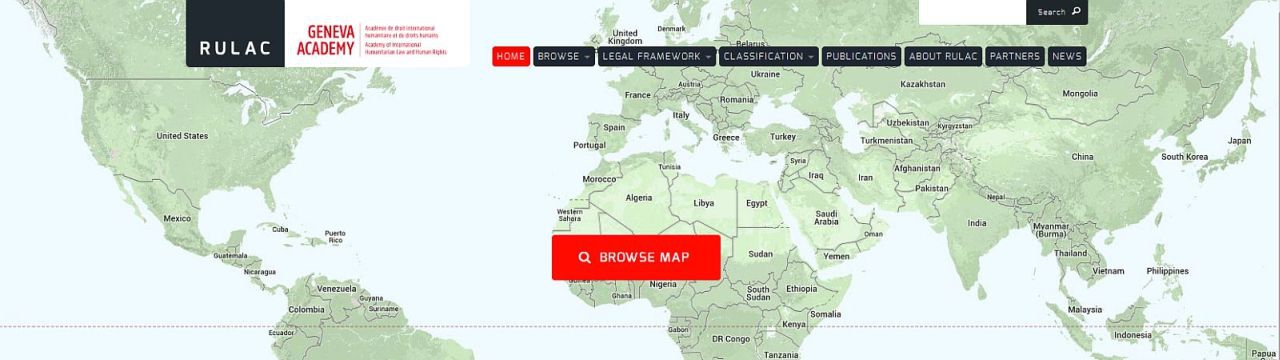
Homepage of the Rule of Law in Armed Conflict Portal

This version entails new and updated armed conflicts, as well as a map allowing visitors to search armed conflicts and parties to these conflicts via multiple filters. ‘The map offers visitors a more intuitive approach: they can visualize where conflicts take place and where parties to these conflicts are’ underlines Sandra Krähenmann, Research Fellow at the Geneva Academy. ‘We clearly see, via the map, that while most armed conflicts are taking place in the Middle East and on the African continent,, parties to these conflicts are from across the world’ she adds.

As a legal reference source for a broad audience, RULAC is regularly updated to integrate new armed conflicts and developments. Today, RULAC monitors more than 13 situations of armed conflicts: 2 military occupations, 2 situations of international armed conflicts and 9 situations of non-international armed conflicts. These conflicts are taking place in 9 countries: Central African Republic, Egypt, Iraq, Libya, South Sudan, Syria, Turkey, Ukraine and Yemen.

For each armed conflict, RULAC provides the factual and methodological basis for its classification, and identifies the parties and the applicable international law. The portal also includes sections on the definition and categories of armed conflict under IHL and the legal framework governing armed conflicts.

Armed Conflict in Syria

While there are many different definitions of armed conflict used for different purposes, the question whether a situation of armed violence amounts to an armed conflict under IHL has important consequences. States involved in armed conflicts have rights and duties that do not exist in times of peace. The classification of situations of armed violence is fraught with difficulties. Many states deny that they are involved in armed conflicts, arguing instead that they are engaged in counter-terrorism operations. Others apply IHL to situations that do not amount to an armed conflict. Moreover, contemporary armed conflicts are increasingly complex due to the multitude of state and non-state parties involved. Based on open source information, RULAC provides an independent and impartial assessment that identifies situations of armed conflict under IHL. It is intended to assist other actors that may want to classify situations of armed violence for their purposes. By making such information available to a broad, non-specialist audience, including by using visual tools, the RULAC project strives to promote a more coherent approach classifying conflicts, and, ultimately, to foster implementation of the applicable legal framework, a key element for accountability and the protection of victims.

Source: Detail – The Geneva Academy of International Humanitarian Law and Human Rights

Nobel Peace Prize 2016 has strong peace content

October 8, 2016

The Nobel Peace Prize for 2016 is very much a traditional and clear ‘peace’ award. The news can be found in all mainstream media. So for the record, and in the words of the Norwegian Nobel Committee: “The Norwegian Nobel Committee has decided to award the Nobel Peace Prize for 2016 to Colombian President Juan Manuel Santos for his resolute efforts to bring the country’s more than 50-year-long civil war to an end…” That the referendum rejected the proposal does not diminish the serious effort made (and perhaps shows the risk of calling referendums where ‘anger’ of different kinds tends to favor any response that has a NO element in it).

For last year’s see: https://thoolen.wordpress.com/2015/10/13/more-on-the-tunisian-winners-of-the-nobel-peace-prize/

Source: The Nobel Peace Prize 2016 – Press Release

“Writing Human Rights and Getting It Wrong” – revealing piece by Alex de Waal

June 10, 2016

Alex de Waal {https://en.wikipedia.org/wiki/Alex_de_Waal} published on 6 June 2016 a long piece entitled “Writing Human Rights and Getting It Wrong” in the Boston Review. There is no way I can give you a summary but reading the whole article is certain worth the time. It is bound to be controversial – especially within the international human rights movement – and stands out by being critical and mostly self-critical about the role of human rights monitors. The focus of the narrative is on Africa (Sudan, Rwanda) and genocide but the former HRW staff reaches out to the general questions of context and impartiality that human rights defenders struggle with, still today.  READ IT!

Read the rest of this entry »

Chechnya, War Without Trace, a film worth seeing

March 28, 2016

https://vimeo.com/127696619%5B/embed%5D

The difficult work of human rights defenders in Russia, and Chechnya in particular, has been demonstrated time and again in the social media including this blog (https://thoolen.wordpress.com/2016/03/17/russia-defenders-attack-closing-office-un-joint-mobile-group-chechnya/). In the film “Chechnya, War Without Trace” award-winning journalist Manon Loizeau, who spent the past 20 years covering the Chechen conflict, returns to the places she knew well, filming undercover, to examine the lasting effects of conflict with Russia. Gone are the minefields and piles of rubble, replaced with broad avenues, luxury boutiques and glass-fronted skyscrapers. It’s virtually impossible to see there was ever a war. But under the surface problems persist. The few lawyers working on torture issues proudly display their Martin Ennals Award. The link above is just the trailer; for the full film: contact Java Films; contact@javafilms.fr; +33 174713313; www.javafilms.fr.


Israeli journalist and Palestinian pastor win Olof Palme award 2015

January 8, 2016

On 7 January 2016 it was announced that Israeli journalist Gideon Levy and Palestinian pastor Mitri Raheb have won the 2015 Olof Palme human rights prize. Levy, a journalist at the left-leaning Israeli daily Haaretz, and Raheb, a preacher and pastor in the Lutheran church in Bethlehem, were honoured for their “courageous and indefatigable fight against occupation and violence, and for a future Middle East characterised by peaceful coexistence and equality for all,” the Olof Palme Memorial Fund said in a statement. Read the rest of this entry »

Voice of Libyan Women founder on how to break the cycle of violence

June 4, 2015

Canadian-born Libyan activist Alaa Murabit speaking at 2015 Oslo Freedom Forum (26 May) shows how ongoing conflict has affected daily life in Libya. She stresses the importance of acknowledging and integrating local communities in peaceful solutions, and focuses on the key role women in particular should play in peacebuilding. Murabit shares how her organization, the Voice of Libyan Women, organized the largest grassroots campaign in the country to address security issues, the cycle of violence, and the rights of women. She emphasizes that by creating cohesive and cooperative societies, rather than ones divided into factions, Libya can achieve peace and stability.

Reporters Without Borders published its 2014 World Press Freedom Index

February 14, 2015

couverture classement 2014

Reporters Without Borders recently published its 2014 World Press Freedom Index. It has a nice easy-to-use and colorful map. The accompanying text spotlights the negative correlation between freedom of information and conflicts, both open conflicts and undeclared ones. In an unstable environment, the media become strategic goals and targets for groups or individuals whose attempts to control news and information.

The ranking of some countries has also been affected by a tendency to interpret national security needs in an overly broad and abusive manner to the detriment of the right to inform and be informed. This trend constitutes a growing threat worldwide and is even endangering freedom of information in countries regarded as democracies. Finland tops the index for the fourth year running, closely followed by Netherlands and Norway, like last year. At the other end of the index, the last three positions are again held by Turkmenistan, North Korea and Eritrea, three countries where freedom of information is non-existent. Despite occasional turbulence in the past year, these countries continue to be news and information black holes and living hells for the journalists who inhabit them. This year’s index covers 180 countries.

Reporters Without Borders.