Posts Tagged ‘conflict and peace’
February 14, 2015

Reporters Without Borders recently published its 2014 World Press Freedom Index. It has a nice easy-to-use and colorful map. The accompanying text spotlights the negative correlation between freedom of information and conflicts, both open conflicts and undeclared ones. In an unstable environment, the media become strategic goals and targets for groups or individuals whose attempts to control news and information.
The ranking of some countries has also been affected by a tendency to interpret national security needs in an overly broad and abusive manner to the detriment of the right to inform and be informed. This trend constitutes a growing threat worldwide and is even endangering freedom of information in countries regarded as democracies. Finland tops the index for the fourth year running, closely followed by Netherlands and Norway, like last year. At the other end of the index, the last three positions are again held by Turkmenistan, North Korea and Eritrea, three countries where freedom of information is non-existent. Despite occasional turbulence in the past year, these countries continue to be news and information black holes and living hells for the journalists who inhabit them. This year’s index covers 180 countries.
Reporters Without Borders.
Posted in human rights, Human Rights Defenders, RSF | 1 Comment »
Tags: annual report, conflict and peace, digital security, Eritrea, freedom of expression, freedom of information, Human Rights Defenders, journalists, media, North Korea, Reporters without Borders, RSF, Turkmenistan, World Press Freedom Index
January 23, 2015
On 16 February 2015, the York Press carried a feature story by Stephen Lewis about 5 human rights defenders in the temporary shelter programme at York University. The aim of the placements is to give those fighting for human rights around the world a breather, as well as the chance to forge contacts with other human rights workers and organisations around the world.
Ahmed Al-Kolaibi grew up in a mountain village in Dhamar in rural Yemen where the law counts for little, and what matters is tradition and custom. For more than 30 years, there have been ‘revenge’ wars between neighbouring villages. When he was seven, Ahmed lost his own father in one of these revenge killings. An uncle was also badly hurt As he grew older, Ahmed, now 27, began trying to persuade other young men in his village that the killings were senseless. The village elders, incensed that he didn’t want to fight for the ‘honour’ of his village, decided to make an example of him.
í
Ahmed Al-Kolaibi
“They punished me. They took my house, they took my land, because they wanted me to be an example,” he says. He went to Sana’a, the Yemeni capital, where he began to work for a peace-keeping organisation, the Dar Al-Salam Organisation. He works as a mediator in the warring villages, trying to arrange truces between rival sheikhs. He has helped train 360 other mediators – and has even secured the release of abducted foreigners. But being a mediator is very dangerous. “We have lost 15 people,” he says quietly.
It can also be deeply frustrating. Once, trying to negotiate a peace between two villages, he was told that 25 people had been killed in one, and ‘only’ 23 people in the other. Before the fighting could be resolved, he was told, ‘we have to kill two people from that village so it is 25/25′.
5 human rights defenders in York tell their incredible stories (From York Press).
Posted in Human Rights Defenders | Leave a Comment »
Tags: Ahmed Al-Kolaibi, Centre for Applied Human Rights at York University, conflict and peace, Human rights defender, mediation, risk, social custom, Yemen, York Press
November 12, 2014

(Fartuun Adan, Director of the Elman Peace and Human Rights Center, Mogadishu/Somalia. Photo: Fartuun Adan)
The Friedrich-Ebert-Foundation’s human rights award 2014 recognizes Fartuun Adan’s long-standing and persistent commitment to the human rights of women in the complex political context of a society shaped by decades of civil war in Somalia. Bestowing the human rights award on the director of the Elman Peace and Human Rights Center also acknowledges that women are no mere victims of violence and discrimination, but socio-political actors, who actively contribute to peace and reconciliation.
[Fartuun Adan is the director of the Elman Peace and Human Rights Center. She founded the organization in 1991 with her husband Elman Ali Ahmed, who was murdered five years later and after whom the center is named today. After his death, Fartuun Adan immigrated to Canada with her daughters. In spite of ongoing conflicts, she returned to Mogadishu in 2007 to continue her work for peace and reconciliation. The Elman Peace and Human Rights Center advocates for women’s and children’s rights under difficult political circumstances. It was the first non-governmental organization providing survivors of gender-based violence and vulnerable women with legal and psychological support, health care and shelter. Furthermore, it advocates for long-term reconciliation and development, and cooperates with OXFAM, ILO and others to support the social reintegration of former child soldiers.]
The award ceremony will take place on 4 December, 2014, 15:00 h, at Friedrich-Ebert-Stiftung, Hiroshimastr. 28, 10785 Berlin. The laudation will be held by Christoph Strässer, Federal Government Commissioner for Human Rights Policy and Humanitarian Aid.
For more information on the Ebert award, see: http://www.brandsaviors.com/thedigest/award/friedrich-ebert-foundation-human-rights-award.
Human Rights Award of the Friedrich-Ebert-Stiftung.
Posted in awards, human rights, Human Rights Defenders | 2 Comments »
Tags: awards, Berlin, Christoph Strasser, conflict and peace, digest of human rights awards, Elman Peace and Human Rights Center, Fartuun Adan, Friedrich Ebert Human Rights Award, human rights award, human rights awards, Human Rights Defenders, human rights of women, Mogadishu, rights of children, Somalia, woman human rights defender
October 12, 2014
 will honor Ryan Boyette, a human rights advocate based in Sudan, with its 2014 Human Rights First Award. Boyette is recognized for his courageous work documenting and drawing international attention to the ongoing attacks against civilians by the Sudanese government in conflicts largely hidden from worldview. The organization will present the Award at its annual gala on 22 October in New York. Human Rights First’s CEO Elisa Massimino stated: “We are inspired by Ryan’s commitment to keep the eyes of the world on the human rights crisis in southern Sudan.” Read the rest of this entry »
Posted in awards, HRF, human rights, Human Rights Defenders | Leave a Comment »
Tags: awards, conflict and peace, digest of human rights awards, Elisa Massimino, HRF, human rights award, Human rights defender, Human Rights First, journalists, media, monitoring, New York, reporting, Ryan Boyette, Sudan, THF
October 11, 2014
More on awards: The winner of the 2014 Raw in War Anna Politkovskaya award is Kurdish Yazidi member of Iraq parliament Vian Dakhil .On Monday 6 October, RAW in WAR (Reach All Women in WAR) selected Vian Dakhil who has courageously spoken out and campaigned to protect the Yazidi people from the terror of Islamic State. She is the only ethnic Yazidi in the Iraqi Parliament and, despite being injured in a helicopter crash while delivering aid to survivors on Mt Sinjar, she continues to advocate and to mobilize support for her people, for the refugees and for those trapped in towns and villages under the regime of Islamic State. “I make no secret of the fact that I’m proud to be honored with your esteemed award, but the real way to honor someone is by protecting their freedom and rights. It is by bringing our prisoners back,’ said Dakhil in her speech while receiving the award.
Previous women human rights defenders who received this award: Malala Yousafzai 2013, Marie Colvin 2012, Razan Zaitouneh 2011, Dr. Halima Bashir 2010, Leila Alikarami on behalf of the One Million Signatures Campaign for Equality in Iran 2009, Malalai Joya 2008 and Natalia Estemirova 2007. See also: http://www.trueheroesfilms.org/thedigest/awards
via Kurdish Yazidi Woman Wins International Award | BAS NEWS.
Posted in awards, human rights, Human Rights Defenders | 1 Comment »
Tags: Anna Politkovskaya, conflict and peace, digest of human rights awards, human rights awards, Iraq, ISIS, islamic fundamentalists, Islamic State, Kurdish cause, Kurdish Yazidi, Malala Yousafzai, RAW in WAR, terrorism, Vian Dakhil, woman human rights defender, women human rights defenders, Yazidi
December 26, 2013

(Deputy Secretary-General Jan Eliasson. UN Photo/Paulo Filgueiras)
Still haunted by its failure to forestall genocide in Rwanda and Srebrenica nearly 20 years ago and confronted by ongoing bloodshed in Syria and the Central African Republic (CAR), the United Nations is revamping its preventive strategies under a new initiative called ‘Rights up Front.’ “The need for early action, and the crucial role of responding early to human rights violations, is at the heart of the ‘Rights up Front’ initiative,” Deputy Secretary-General Jan Eliasson told an informal session of the General Assembly on 17 December 2013 – as he presented a six-point action plan.
It includes training UN staff on the world body’s core purpose of promoting respect for human rights; providing Member States with the information needed to respond to human rights violations; and ensuring that UN personnel around the world are more attuned to situations where there is a risk of serious human rights abuses and are equipped for the responsibilities that such potential crises entail.
The strategy, initiated by Secretary-General Ban Ki-moon, also includes achieving a more coherence by strengthening engagement with the General Assembly, the Security Council and the Geneva-based UN Human Rights Council and providing earlier and more coherent support to teams on the ground before a crisis emerges; and better organization of human rights staff so that they can identify risks of serious violations of human rights that could lead to atrocities.
Finally, underpinning all these activities will be better information management on threats and risks to populations for planning operational activities and for sharing with Member States.
“. ..It is irrefutable, and needs repeating, that serious human rights violations are the best early warning of impending atrocities.” Eliasson said. “If we fail to act early, the human, political and economic costs can be devastating as we know far too well. This calls for a more alert, flexible and coordinated UN System, both on the ground and at headquarters.”
Horrendous events led us all to say ‘never again’, Mr. Eliasson said. “We said we would have to do more to prevent serious violations of international human rights and humanitarian law. Despite much effort, since 1995 hundreds of thousands of people have died as a result of mass atrocities and tens of millions have been displaced.” But steps forward have been taken. “World leaders endorsed the ‘responsibility to protect in 2005. And Member States have over the years articulated an increasingly detailed agenda for the protection of civilians,” he said. Yet, the crises in Syria, where over 100,000 people have now been killed and 8 million driven from their homes in the nearly three-year civil war, and in CAR, where thousands have been killed and over 600,000 displaced in a conflict increasingly marked by inter-communal clashes between Christians and Muslims, are reminders that serious human rights abuses are often the clearest early warning of emerging conflict, he added.
“When people in today’s world are at risk or subject to serious violations, they expect and request the United Nations to act – and we do,” Mr. Eliasson declared. “However, in practice, our response to crisis often comes when a situation has deteriorated to the point where only a substantial political or peacekeeping mission can deal with the problems.”
via United Nations News Centre – New UN ‘Rights up Front’ strategy seeks to prevent genocide, human rights abuses.
Posted in human rights, UN | 1 Comment »
Tags: atrocities, Ban Ki-moon, Central African Republic, conflict and peace, early warning, Eliasson, genocide, human rights, human rights abuses, human rights violations, internally displaced, Jan Eliasson, large scale violations, massacres, prevention, refugees, Rights up Front, Rwanda, Srebrenica, strategy, Syria, UN, United Nations
October 16, 2013
On 16 October Scoop News reports on a consultation, held on 25 September 2013 in Geneva, entitled Isolating Papua which highlighted the increasing practice of limiting access to the Papuan provinces of Indonesia. Read the rest of this entry »
Posted in human rights, Human Rights Defenders | Leave a Comment »
Tags: arbitrary arrest, arrrest, Asian Human Rights Commission, Coalition for Papua, conflict and peace, freedom of expression, Geneva, harassment, human rights, Human Rights Defenders, human rights violations, Indonesia, Jakarta, journalists, Lukas Enembe, meeting, Non-governmental organization, Papua, police brutality, side event, Special Procedures, UN, WCC, West Papua, World Council of Churches
February 22, 2013
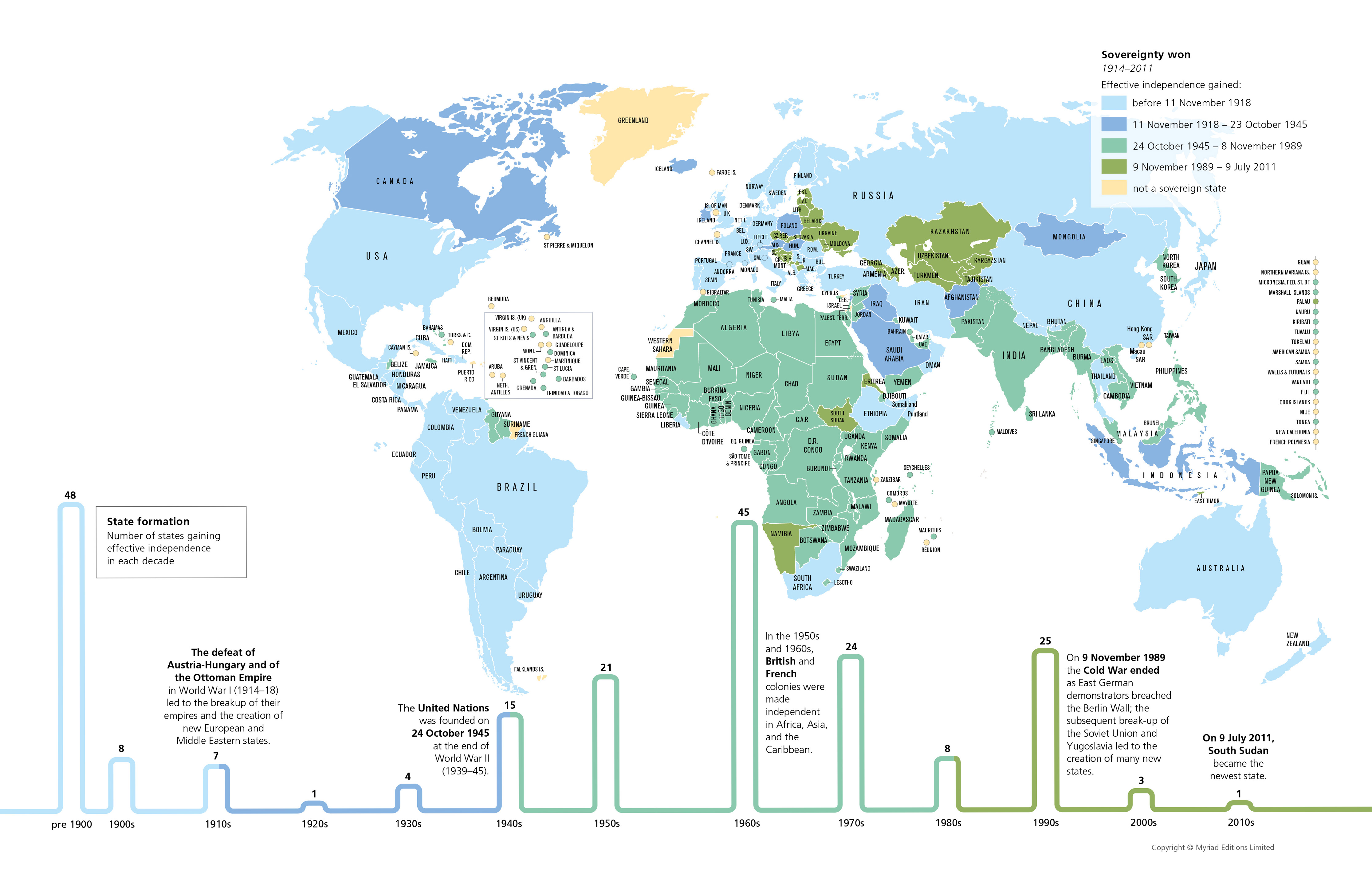
On 22 February 2013 Dan Smith published a post on his blog on the ‘state of States’. While not directly touching on human rights defenders, it gives in few words an excellent overview of the formation and deformation of States which provide much of the power and abuse that human rights defenders struggle against. I summarize some of the main issues here, but urge you to read the full text:
First he points out that most states are relatively new. By 1900 there were just 48 states in our modern sense of the term. In the years either side of World War I, with the break-up of the Ottoman and Habsburg Empires, there was considerable state-making. Even so, the UN was founded by just 51 states. Today, 193 states make up the UN, the newest being South Sudan in July 2011.

- From 48 to 193 (recognised states, that is) – from The State of the World atlas Read the rest of this entry »
Posted in human rights | Leave a Comment »
Tags: Afghanistan, conflict and peace, Dan Smith, Failed state, Fragile state, fragile states, historical perspective, Human Rights Defenders, Nigeria, non-state actors, Pakistan, politics, Somalia, South Sudan, sovereignty, state power, States, UN, ungoverned spaces, United Nations