Joseph Menn reported on 16 April 2018 in kfgo.com about Microsoft rejecting a California law enforcement agency’s request to install facial recognition technology in officers’ cars and body cameras due to human rights concerns. Microsoft concluded it would lead to innocent women and minorities being disproportionately held for questioning because the artificial intelligence has been trained on mostly white and male pictures. AI has more cases of mistaken identity with women and minorities, multiple research projects have found.
“Anytime they pulled anyone over, they wanted to run a face scan” against a database of suspects, company President Brad Smith said without naming the agency. After thinking through the uneven impact, “we said this technology is not your answer.” Speaking at a Stanford University conference on “human-centered artificial intelligence,” Smith said Microsoft had also declined a deal to install facial recognition on cameras blanketing the capital city of an unnamed country that the nonprofit Freedom House had deemed not free. Smith said it would have suppressed freedom of assembly there.
On the other hand, Microsoft did agree to provide the technology to an American prison, after the company concluded that the environment would be limited and that it would improve safety inside the unnamed institution. Smith explained the decisions as part of a commitment to human rights that he said was increasingly critical as rapid technological advances empower governments to conduct blanket surveillance, deploy autonomous weapons and take other steps that might prove impossible to reverse….
Smith has called for greater regulation of facial recognition and other uses of artificial intelligence, and he warned Tuesday that without that, companies amassing the most data might win the race to develop the best AI in a “race to the bottom.”
He shared the stage with the United Nations High Commissioner for Human Rights, Michelle Bachelet, who urged tech companies to refrain from building new tools without weighing their impact. “Please embody the human rights approach when you are developing technology,” said Bachelet, a former president of Chile.
The World Economic Forum Annual Meeting in Davos is going on and has this year a strong humanitarian element as shown inter alia in the article “Why businesses are nothing without strong human rights” published on 16 January 2019 by 3 authors, who have earned their reputation:
Profit depends on a rule of law maintained by courageous campaigners. Image: Reuters/Ivan Alvarado
This article summarizes many aspects of the debate on ‘business and human rights’, some of which were referred to in earlier posts [see e.g. https://humanrightsdefenders.blog/tag/business-and-human-rights/]. To do honor to the scope of the article, here is the full text:
Let’s start with a seemingly unconventional proposition: civil society and business share the same space, and therefore should share an interest in defending what unites them. How controversial is that proposition, really? This “shared space” is anchored in accountable governance. Civil society actors and companies both depend on the same legal and institutional frameworks that define the shared space to operate. Civil society cannot flourish, and business will struggle to thrive, without the rules and standards that hold public and private powers accountable.
Civic freedoms – freedoms of expression, association, information and assembly – allow citizens to expose abuses related to corruption, workplace safety, public health, toxic pollution and gender discrimination. These rights support stable, predictable legal and regulatory environments. At the same time, they enable the free flow of information, investment and entrepreneurial innovation. When these civic freedoms are undermined, business and civil society alike are subject to the law of the jungle instead of the rule of law. Companies should recognize the positive role that civil society organizations and human rights defenders play in protecting this space. Moreover, where reasonably possible, they have a responsibility to support these crucial actors when under pressure or threat.
From the murder of the Honduran environmentalist Berta Cáceres and the Saudi journalist Jamal Khashoggi to politically motivated charges against Cambodian trade unionists, attacks on human rights defenders and civic freedoms around the world should and do concern the business community. These freedoms are being eroded as authoritarian governments act with impunity and democracies embrace illiberal populism and nationalism. Nearly six in 10 countries are seriously restricting people’s fundamental freedoms of association, peaceful assembly and expression, according to the global civil society alliance CIVICUS. Sometimes, companies are complicit in this repression. Since 2015, there have been close to 1,400 recorded attacks against citizens and organizations working on human rights issues related to business.
Image: Business and Human Rights Resource Centre
Multinational corporations and their investors can no longer afford to be bystanders with so much at stake. All too often, companies take the rule of law, accountable governance and stable environments for granted. Recent research by the B Team, a leading non-profit initiative formed by a global group of business leaders, has found clear evidence that limits on important civic freedoms may produce negative economic outcomes. Countries with higher degrees of respect for civic rights experience higher economic growth rates and higher levels of human development. Issues and incidents in and out of the headlines are presenting inescapable challenges to business leaders. A growing number of corporate leaders are recognizing that they must defend the interests and values that they share with civil society around the world. Some are making public statements; others are registering their concerns privately. Increasing awareness of the “shared space” in which companies and civil society operate, and expectations of the responsibilities of businesses, are compelling shareholders and employees to take sides and pressure companies, however difficult the choices and trade-offs may be.
The rise of corporate activism
Five prominent examples from 2018 demonstrate this trend:
• Eight multinational corporations and investors issued a call to protect civic freedoms, human rights defenders and rule of law in a landmark joint statement developed through the Business Network on Civic Freedoms and Human Rights Defenders. The statement is the first of its kind, with supporters ranging across the consumer goods, mining, apparel, banking, jewellery and footwear sectors, and stresses that when human rights defenders are under attack, so is sustainable and profitable business. [see also: https://humanrightsdefenders.blog/2018/12/13/first-time-major-companies-say-that-human-rights-defenders-are-essential-for-profitable-business/]
• Adidas and Nike were among global apparel brands that urged the Cambodian government to drop politically motivated criminal charges against labour rights activist Tola Moeun and others – and have publicly supported freedom of association.
• In the US, companies have spoken out in unprecedented tone and numbers against the current administration’s immigration policies: Microsoft, Cisco, Airbnb, Apple, Salesforce, and the US Chamber of Commerce, among others, challenged the travel ban imposed on citizens from half a dozen Muslim-majority countries and opposed the separation of migrant families at the US-Mexico border.
• In Germany, BMW and Daimler engaged with their employees to combat xenophobia and racism following far-right riots against immigrants; Siemens even urged employees to speak out and emphasized that tolerance and respect are important business values (as its CEO, Joe Kaeser, has made explicitly clear in public statements).
• A group of 14 human rights organizations and more than 1,400 Google employees called on Google to refrain from launching a censored search engine in China (known as “Project Dragonfly”), and partly as a result, the company has discontinued the project. These advocacy efforts illustrate that employees too are leading movements within companies, especially within the tech sector, to respect human rights. Companies will need to be mindful of rising employee expectations, or risk reputational damage and the loss of valuable talent, as younger workers seek to align their values with those of their employers.
Protesters remember Berta Cáceres, an environmental and indigenous rights campaigner murdered in 2016. Image: Reuters/Jorge Cabrera
Inescapable challenges
“Corporate activism” – whether reluctant or deliberate – is not easy. New guidance published by the Business and Human Rights Resource Centre and the International Service for Human Rights anticipates these inescapable challenges for companies and their leaders. The guidance, titled Shared Space Under Pressure: Business Support for Civic Freedoms and Human Rights Defenders, provides an analytical and operational framework, with specific examples from different countries, sectors and initiatives, to inform companies as they decide whether and how to act. It highlights five specific decision factors that companies should consider:
1. Whether the company has a normative responsibility to act, based on the UN Guiding Principles for Business and Human Rights. All companies must ensure – through the application of the UN Guiding Principles – that their operations do not cause, contribute and are not linked to attacks on activists and civic freedoms. If they do, they must address the causes and consequences.
2. Whether the company has a discretionary opportunity to act. If so, whether there is a compelling business case to support civic freedoms and human rights defenders and/or a willingness to make a moral choice to do so. Besides defending the core elements of the shared space, the business case rests on managing operational and repetitional risks; building competitive advantage; and overcoming mistrust and securing the social licence to operate. Companies can also make a moral choice to act, both to do no harm anywhere and to do good where possible.
Image: Business and Human Rights Resource Centre
3. How the company will act in a particular situation or on a certain issue.There is no one type of action that applies to all circumstances: a spectrum of actions (individual and collective, public and private) may be combined to address an issue or situation. In some situations, such as the increasing restrictions on Hungarian civil society, companies prefer to raise concerns individually and privately with the government. In others, such as Cambodia’s crackdown on striking workers, companies choose to make collective and public statements. Companies should be guided by pragmatic flexibility as they consider circumstances, relationships and opportunities to make a positive difference.
4. Who within the organization decides whether and how, a company will act. it is essential that these decisions are involving corporate headquarters and in-country executives and staff. It is important to integrate legal counsel, human rights and corporate responsibility experts, government, public affairs and (in certain circumstances) security and human resources staff into the deliberative process. Equally, local civil society and other stakeholders with which the company should maintain steady engagement should be consulted. CEO-level decisions are essential when a company’s core values, reputation, operations and relationships are at stake.
5. Whether the risks of inaction outweigh the risks of action. Responsible companies should evaluate both the risks of action and inaction. Companies may perceive that taking critical positions, especially in public, may put relationships with host country governments at stake. But often companies will conclude that the risks and potential costs of inaction are more difficult to anticipate, mitigate and manage over the long-term than the risks of action. It is unwise to be on the wrong side of history based on a shortsighted cost-benefit analysis.
These decision factors provide practical steps that companies can and should take to be allies of civil society and not just bystanders – or worse, casualties – in the global crackdown against the “shared space”. It is not the business of companies to pick fights, but fights are already coming to companies that could make or break them. Companies should engage carefully but deliberately – in their own interest – to support and defend this invaluable but fragile shared space.
On 11 November 2018, Phil Bloomer Phil Bloomerof the Business & Human Rights Resource Centre assesses the results of the 2018 Corporate Human Rights Benchmark and finds that while there has been welcome progress among a small group of leaders, the vast majority of companies are content to under-perform. [for some of my earlier posts on business and human rights see: https://humanrightsdefenders.blog/tag/business-and-human-rights/]
The first full version of the Corporate Human Rights Benchmark was published yesterday, with key findings on companies in the apparel, agricultural products and extractives sectors. The results reveal that there is a race to the top in business and human rights performance, but only amongst a welcome but small cluster of leaders. The great majority have barely left the starting line, with 40 of the 101 companies surveyed failing to show any evidence of identifying or mitigating human rights issues in their supply chains.
CHRB measures how companies perform across 100 indicators based on the UN Guiding Principles on Human Rights. It uses publicly available information on issues such as forced labour, protecting human rights activists and the living wage to give companies a maximum possible score of up to 100%. In this year’s ranking, two-thirds of companies scored less than 30% overall. However, members of the small leadership group from the 2017 Pilot Benchmark have continued to compete to be the “best in class”, and each has made progress to ensure they do not fall behind direct competitors.
……..
The most challenging news from this benchmark is the lack of significant progress on last year by the majority. There is an unacceptably large group of companies who are not doing enough and appear content to hide in the pack of under-performers. …..First, leading companies are beginning to gain greater access to cheaper capital, based on their lower human rights risks. The fact that sustainable investment funds have effectively doubled in size each year since 2012 demonstrates the growing appetite for companies that manage their environmental and social risks. And this year Danone successfully pioneered a $300m social bond that attracted investors focused on ESG risks.
Second, faced with the collapse of public trust in global markets, governments are beginning to exert themselves with increasingly bold steps toward regulation for mandatory transparency and due diligence. Good practice by leading companies emboldens timid governments to raise the minimum floor of corporate behaviour through regulation and incentives. This should be welcomed as it outlaws the reckless cowboys in every high-risk sector.
Third, we see civil society and investors using the results of the benchmarks to exert pressure on laggard companies and recently a number of investors have teamed up, privately, with campaign groups to ensure that harder-hitting shareholder resolutions are raised at the AGMs. These pressures look set to grow and spread over the coming years. This is essential.
With humankind facing extraordinary transitions – to zero-carbon economies, to automation and gig economies, to mass migration, all amidst the challenges to democracy and open societies – the Corporate Human Rights Benchmark will be one key assessment to press companies to play their full role in helping create a more sustainable and prosperous future for all. Equally our association now with the World Benchmarking Alliance will ensure that human rights in business is unavoidable if companies want their operations to be recognised as playing a part in delivering the Sustainable Development Goals.
Phil Bloomer is executive director of the Business & Human Rights Resource Centre
Independent Catholic News of 4 October 2018 carries the following story on the London Mining Network 12-20 October 2018:
“I am Misael Socarras Ipuana, of the Wayuu People. I live in the north of Colombia, in the peninsula of La Guajira, in the community of La Gran Parada. I am a human rights defender, indigenous communicator, director, cultural expert and leader of my community. I am 48 years old, married according to the traditions of my people to Moncia Lopez Pushaina. I have six children, for whom I struggle daily to give them a better future, free of contamination and mining. We want to be autonomous in our territories, free and able to enjoy Mother Nature without restrictions or fear.”
Misael is one of the five human rights and environmental defenders joining the London Mining Network for a week of action 12-20 October around the annual shareholder meeting of BHP Billiton, the world’s largest mining company. He will be speaking at events, meeting anti-coal campaigners in County Durham and holding BHP executives to account.
The London Mining Network, which highlights justice, peace and environmental issues related to extractive industries, is supported by religious and missionary groups with experience of the problems in countries where they work. Most of the world’s biggest mining companies, and many smaller mining companies, are listed on the London Stock Exchange, and on its Alternative Investment Market (AIM).
Communities all over the world are rising against mining violence and building alternatives that offer truly-sustainable futures, assert people’s rights and are deeply rooted in custodianship of land and water. This week of action will be an opportunity to explore this resurgence. They call for the UK government to commit to a Binding Treaty on Business and Human Rights to end corporate impunity.
As the world’s largest multinational mining company, Anglo-Australian-owned BHP’s AGM is an important moment to build these arguments. BHP’s record of forced displacement, dispossession and catastrophic environmental damage stretches back decades. The company is so powerful it is seldom held to account for this devastation, while indigenous, Afro-descendant and peasant communities are hardest hit.
Looking ahead to next month’s UN Forum on Business and Human Rights, ISHR featured this profile ISHR trainee and Thai lawyer Sor Rattanamanee Polkla. Sor describes her work improving access to justice for those affected by development projects in rural Thailand, and explains how she plans to use the connections she made with ISHR and others at the Forum to expand her network and support her community on the ground.
Published a few days ago by the Business & Human Rights Resource Centre and the International Service for Human Rights, this new guidance was commissioned by the Business Network on Civic Freedoms and Human Rights Defenders, seeking to encourage companies to focus on an increasingly inescapable agenda.
‘Shared space’ under pressure
..Data from around the world shows there is a concerted attack in many countries on the essential freedoms and the rule of law on which business and civil society depend. And the defenders and organisations who expose the risk of abuse by companies in their operations and supply chains are under particular attack. Business and civil society operate in and benefit from a ‘shared space’ defined by common, fundamental elements. The rule of law and freedom of expression, association and assembly are essential to the realisation of all human rights, to good governance and accountable institutions. These elements are also critical to stable, profitable and sustainable business environments in which companies thrive and economies prosper. Yet this shared space is as much an ideal as it is a reality.
The strength of the shared space is tested by a history and legacy of mistrust between elements of civil society and business, especially between multinational corporations in certain industries and local communities in the Global South. This mistrust is reflected in actions, whether intentional or inadvertent, by individual companies and even entire industries to undermine civic freedoms and to undercut human rights defenders. It shows up in conflicts and confrontations in almost every region. Yet standards and practices have evolved over the last two decades to encourage or require companies to respect human rights – however incompletely and inconsistently. Moreover, engagement and consultation of companies with local communities and stakeholders are leading to solutions in conflicts in ways that encourage further progress. ‘The time is now for responsible business to act to defend civic freedoms and protect human rights defenders’, said Michael Ineichen, Programme Director at ISHR…
Guidance for companies
But why, when and how should business engage on this urgent agenda? This guidance represents a major step forward towards business action. It is a practical guide to realistic action by responsible companies, investors, industry associations and business leaders. It is informed by pragmatism and the principles of freedom and fair play. It is also the result of over 90 interviews with business leaders, investors, civil society advocates and other international experts who gladly offered their insights.
The document elaborates on why business should be compelled to join civil society and human rights defenders in resisting the crackdown on their work by:
Providing the complementary normative framework, business case and moral considerations which all encourage companies to support civic freedoms and defenders under threat;
Elaborating on the main elements of the business case to protect defenders, namely the business interest to secure the shared space, to manage operational and reputational risks, to build competitive advantage, and to secure a social license to operate;
Outlining a decision framework that is both analytical and operational to determine whether and how to act in various circumstances.
Authored by Bennett Freeman, a leader and innovator in the business and human rights field for two decades, the guidance intends to further push the thinking and debate on how we can forge new alliances to counter the attacks on civic freedoms and human rights defenders and hold open these precious shared spaces. The Business & Human Rights Resource Centre and the International Service for Human Rights look forward to deeper and more powerful collaboration with business and stronger alliances with civil society partners through the publication of this guidance.
On Monday 26 February2018 – from 11h00 – 13h00 – (Tiensestraat 41, Leuven) Dr. Kasey McCall-Smith will speak about “Human Rights Accountability of Non-State Actors (MNEs, NGOs, …): the Next Frontier”.
[The negative impact on human rights by business activity has been the focus of much academic and public policy debate. In no other field of law has the stubbornness of the public and private international law divide been exposed more starkly and with such devastating effects for individuals. Human rights law discourse has spent the last two decades debating the impact of business activity on human rights and the UN Guiding Principles on Business and Human Rights was hailed as a great victory. But, as rightly noted by the Special Rapporteur on Business and Human Rights, the UN Framework and Guiding Principles was simply the end of the beginning of the debate. International law has yet to catch up with the realities of business activity and its impact on human rights and the environment. This lecture will look at the key soft law developments of the past decade, the push to ‘harden’ these soft law initiatives, and examine a case study on smartphone supply chain management to elaborate the difficulties of reconciling human rights accountability and abuse by non-state actors. The legal issues raised in respect to multinational enterprises will also be considered in light of increasing pressure to hold other non-state actors to account, such as international organisations and NGOs. Ultimately, the lecture will contribute ideas about how to move forward on the next human rights frontier.]
Dr. McCall-Smith is a lecturer in Public International Law and programme director for the LLM in Human Rights. She is a US qualified lawyer and holds a BA in Architectural Studies (1998) and Juris Doctor (2001) from the University of Arkansas. Dr McCall-Smith was awarded an LLM (2002) and a PhD (2012) for her thesis on ‘Reservations to Human Rights Treaties’ by the University of Edinburgh. She is currently the Chair of AHRI, the Association of Human Rights Institutes. McCall-Smith’s research focuses primarily on treaty law and how treaties are interpreted and implemented at the domestic and supranational levels. Ensuring clarity in the law of treaties, specifically in reference to reservations to human rights treaties, is a major theme that she has pursued. She interested in the role of the UN human rights treaty bodies as generators of law. The increasingly blurred distinction between public and private international law in terms of human rights protection is another of her research interests.
Participation is free, but register by Friday 23 February at the latest
This side event will take place during the UN Forum on Business and Human Rights. The event will bring together multiple stakeholders to discuss how to remedy, redress and prevent attacks against human rights defenders working on business and human rights.
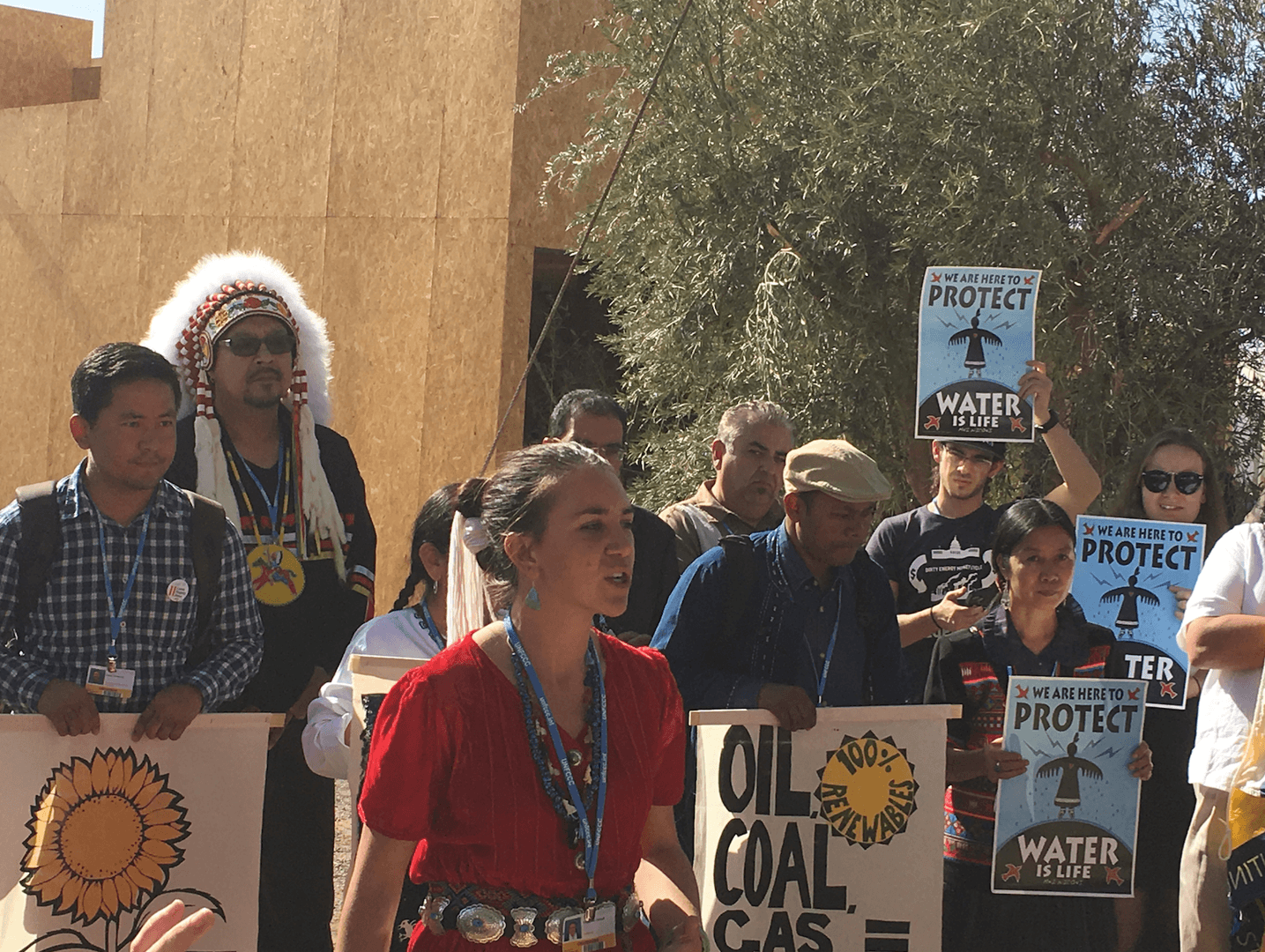
The talks wrapped up on Friday, and during the last two weeks, advocates for gender equality and indigenous peoples made their voices heard and won hard-fought battles to better respect their rights. Notably, governments agreed to create a platform to promote the participation of indigenous peoples in United Nations climate responses, and adopted a Gender Action Plan that aims to better integrate gender equality in climate change policies.
Just when the talks were nearing their end, human rights were pushed to the fore when Fijian prime minister and president of the climate talks, Frank Bainimarama, convened a high-level event about the importance of rights in climate negotiations. Why was this such a big deal? Because never before has any government presiding over the talks hosted an official event on human rights.
Bainimarama has also long been among those who have been silent on human rights issues. But on Thursday, he announced that integrating human rights in the implementation of the Paris Agreement was an important element of Fiji’s presidency, which will continue through the coming year. Costa Rica’s environment minister, Edgar Gutiérrez-Espelata, also proposed concrete ways to integrate rights into the current negotiations about the so-called Paris Rulebook. For example, governments could reference human rights obligations in climate change action plans and climate negotiators could agree to build capacity among states on promoting human rights in climate action.
The authors realize that of course, “such commitments are worth little unless governments are willing to turn rhetoric into reality. If they are serious about fighting climate change, governments should also do more to integrate the protection of human rights in climate policies, while defending the rights of people working to protect the environment.”
Similar ideas are to be found in the “Opening speech at seminar on human rights defenders” given the the Norwegian State Secretary Audun Halvorsen in Oslo, on 30 October for a seminar on “Environmental human rights defenders under threat from business operations“. The seminar was organised by Amnesty International Norway and Rainforest Foundation Norway.
Otto Saki of the Ford Foundation contributed a piece “How companies are using law suits to silence environmental activists—and how philanthropy can help”. On 30 June 2017, the Business and Human Rights Resource Centre provided the following summary:
…While extrajudicial killings…[of human rights defenders] attract immediate condemnation, corporate interests are using other, less obviously violent means to undermine the important work of these activists: Strategic Lawsuits Against Public Participation (SLAPPs) are used to intimidate, harass, and silence activists who are working to expose corporate injustices and human rights violations. As intended, such lawsuits have a clear chilling effect on activism, silencing critical voices and stifling accountability…
…While there are strong laws aimed at protecting people’s rights, those laws too often fail to be applied. At the same time, big businesses have amassed great power and influence; they are armed literally and figuratively with high-value law firms, auditors, security experts, and investigators to defend their interests. Facing that kind of arsenal, it is difficult for individuals and organizations to fight back.
The use of SLAPP suits in South Africa is becoming a trend…
…South Africa needs to revise court procedures to make it easier for judges to scrutinize frivolous lawsuits without dragging the defendants into court. Second, civil society must recognize that SLAPP lawsuits are not isolated, but are part of a broad and purposeful strategy to distract and disable environmental activists and empower corporate interests.
…As philanthropy considers how to best support and build resilience for social justice activists and institutions, it is critical to consider their ability to withstand this kind of legal pressure…As funders, we need to have open conversations with our grantees about how they can be prepared before a crisis erupts…