Posts Tagged ‘Business and human rights’

Policy response from Human Rights NGOs to COVID-19: the Business and Human Rights Resource Centre

April 9, 2020

COVID-19 (Coronavirus) Outbreak: Human rights defenders & civic freedoms

Public health measures and expanded government powers amid global pandemic pose added threats to freedoms and rights of human rights defenders, including those focusing on business-related human rights impacts. Some governments, and other actors, are using this crisis to attack defenders in new ways, stifle civic freedoms, and push through restrictive measures. Defenders become easier to target, when they isolate, which is compounded by the loss of protective accompaniment and the lack of media attention to their situation. In several countries, rural and indigenous defenders have lost their livelihoods and are experiencing lock-downs – including those in conflict zones – and are less able to raise concerns about harmful business projects as a result. There are also reports of factories using the pandemic to justify dismissal of labour rights defenders. Tech companies may also violate the right to privacy of defenders, as they cooperate with governments to help stop the spread of COVID-19. Some companies are keeping their businesses active, for example in Peru and Colombia, despite the local opposition – and some sectors are likely to use the crisis to lobby for lower regulations, as we are already seeing in Indonesia and the United States, which could lead to more tension and violence in the future. This crisis also underlines that businesses benefit from defenders being able to work freely: this is now more evident than ever, as silencing of health professionals that tried to raise alarm on COVID-19 early, helped turn this ‘potentially containable threat into a global calamity‘, with enormous consequences for businesses and the economy.

The Centre has a section that features the latest news on how the pandemic and the response to it is affecting human rights defenders that raise concerns about businesses, and their impacts on the rights to food, access water, labour rights, environment, housing and health. It also highlights impacts on fundamental freedoms, such as freedoms of expression, association, and assembly, that these defenders need to be able to organize and work. Finally, it will be tracking new ways of protesting and organizing by these defenders and groups amidst the pandemic, and new demands in response to it.

—-

See  In Depth Area for more on COVID-19’s implications for business & human rights


Compilation of recommendations to companies and investors on HRDs and civic freedoms

February 1, 2020

Several national and international non-governmental organizations, think-tanks, coalitions and UN bodies and experts have made recommendations to businesses and investors about how to ensure respect for human rights defenders and civic freedoms. This non-exhaustive list brings together these recommendations.

Recommendations for companies and investors:

Name / Title:

Description:

Business sector:

Authors – type of organization(s): 

Date and Year:

Zero Tolerance InitiativeThe Geneva Declaration Declaration made by defenders of human rights and environment and supporting NGOs, with recommendations for states, companies and investors  All sectors Affected communities’ representatives, national and international NGOs November 2019
Action plan from the World HRDs Summit  Action plan made by defenders of human rights and environment and supporting NGOs, with recommendations for states, companies and investors  All sectors Affected communities’ representatives, national and international NGOs December 2018
Situation of human rights defenders – A/72/170 UN Special Rapporteur on HRDs’ report on HRDs working on business and human rights, with recommendations to states, companies and investors All sectors UN Expert July 2017

Recommendations for companies:

Human rights defenders and civic space – the business and human rights dimension Working Group on Business and Human Rights, as part of its mandate to promote the UN Guiding Principles, decided to give focused attention to the issue of HRDs and civic space – this is the summary of UNWG’s efforts on this issue to date and includes draft guidance for companies  All sectors  UN Working Group Ongoing
Shared Space under pressure: Business Support for Civic freedoms and HRDs Guidance document on business support for civic freedoms and HRDs All sectors International NGOs (informed by interviews with business representatives, HRDs, national and international NGOs) August 2018
Thematic overview: Civil society and the private sector CIVICUS’ 2017 State of Civil Society Report addressed the theme of civil society and the private sector, gathering a range of informed views from 27 different stakeholders that wrote about different aspects and produced a set of recommendations for the private sector  All sectors  National and international NGOs January 2017
Cross-regional group of human rights defenders called on business to take action for their engagement and protection Joint statement from 40+ civil society organizations, with guidance for businesses All sectors National and international NGOs 2016
Human Rights Defenders and Business: Searching for Common Ground Report with case studies, analysis and recommendations for businesses  All sectors International NGOs (informed by HRDs and national NGOs) December 2015

Recommendations for investors and financial institutions:

 Uncalculated Risks: Threats and attacks against human rights defenders and the role of development finance Report with 25 case studies and recommendations for international financial institutions  Finance & banking International and national NGOs June 2019
Guide for independent accountability mechanisms on measures to address the risk of reprisals in complaint management Toolkit that aims to assist independent accountability mechanisms (IAMs) to address the risk of reprisals within the context of their complaint management process  Finance & banking Independent Consultation and Investigation Mechanism (IDBG) January 2019

This list will continue to be updated – please notify the NGO at zbona(at)business-humanrights.org, if there is a set of recommendations missing from it.

https://www.business-humanrights.org/en/compilation-of-recommendations-to-companies-and-investors-on-hrds-civic-freedoms

Ross LaJeunesse and human rights policy at Google

January 3, 2020
The former Google Exec said it was driven out after trying to start a human rights program

An illuminated Google logo can be seen in an office building in Switzerland on December 5, 2018. (Arnd Wiegmann / Reuters)

Several newspapers (here the BBC) wrote on 2 January 2020 about ex-Google executive Ross LaJeunesse revelations concerning the firm’s human rights policy. This matters more than usual in view of Google’s self-professed commitment to human rights, e.g. in the context of the Global Network Initiative (GNI) which brings information technology companies together with NGOs, investors and academics. Founding companies are: Google, Microsoft, and Yahoo!. GNI’s principles and guidelines provide companies with a framework for responding to government requests in a manner that protects and advances freedom of expression and privacy. Companies that join GNI agree to independent assessments of their record in implementing these principles and guidelines [see https://humanrightsdefenders.blog/2013/05/23/facebook-joins-the-global-network-initiative-for-human-rights/. Or by providing funding [see e.g. https://humanrightsdefenders.blog/2019/05/08/excellent-news-huridocs-to-receive-1-million-from-google-for-ai-work/].

A former Google executive has raised concerns about the tech giant’s human rights policies as it eyes expansion in China and elsewhere. Ross LaJeunesse, the firm’s former head of global international relations (until May last year), said he was “sidelined” after he pushed the company to take a stronger stance. Google defended its record in a statement, saying it has an “unwavering commitment” to human rights.

Mr LaJeunesse is now campaigning for a seat in the US senate. He said his experience at Google convinced him of the need for tougher tech regulations. “No longer can massive tech companies like Google be permitted to operate relatively free from government oversight,he wrote in a post on Medium.

Google’s main search business quit China in 2010 in protest of the country’s censorship laws and alleged government hacks. But it has since explored ways to return to the country, a major market, stirring controversy.bLaJeunesse said Google rebuffed his efforts to formalise a company-wide programme for human rights review, even as it worked to expand in countries such as China and Saudi Arabia. “Each time I recommended a Human Rights Program, senior executives came up with an excuse to say no,” he wrote. “I then realized that the company had never intended to incorporate human rights principles into its business and product decisions. Just when Google needed to double down on a commitment to human rights, it decided to instead chase bigger profits and an even higher stock price.

Google said it conducts human rights assessments for its services and does not believe the more centralised approach recommended by Mr LeJeunesse was best, given its different products.

View at Medium.com

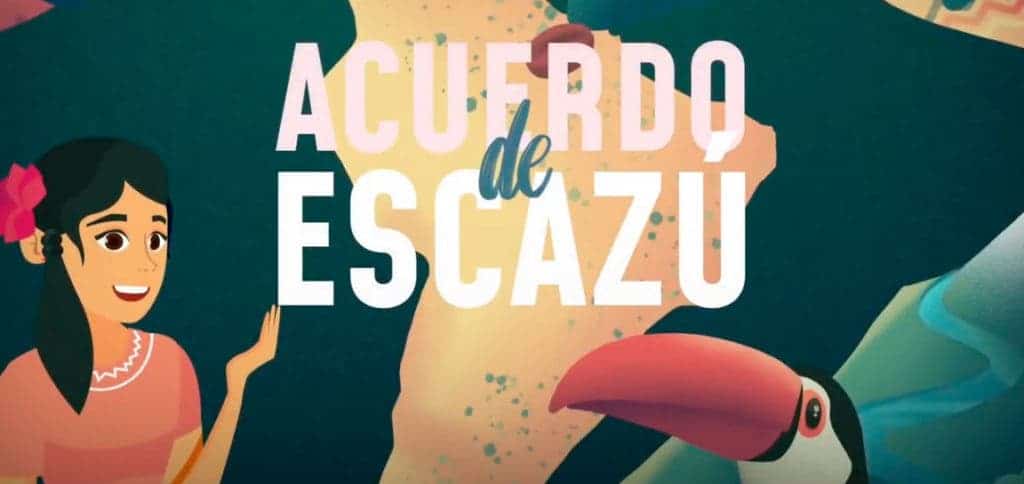
Escazú Agreement to protect environmental human rights in Latin America stalling

December 23, 2019
Credit Wikipedia Commons

Despite being signed a year ago, the agreement hasn’t entered into force yet as it requires 11 of Latin America and the Caribbean’s 33 countries to ratify it. Only five have done that so far: Bolivia, Guyana, Saint Kitts, and Nevis, Saint Vincent and the Grenadines, and Uruguay. A group of 16 countries have signed it but not ratified it: Colombia, Antigua and Barbuda, Argentina, Brazil, Costa Rica, Ecuador, Granada, Guatemala, Haiti, Jamaica, Mexico, Nicaragua, Panama, Paraguay, Peru, Dominican Republic and Saint Lucia. Another group of 10 countries has not signed it: Bahamas, Barbados, Belize, Cuba, Dominica, El Salvador, Honduras, Suriname, Trinidad and Tobago, Venezuela and Chile.

The NGO Global Witness tracks every year the number of people killed because of standing up for their rights and defending the environment. In 2018, the figure reached 164 people, with more than half taking place in Latin America – the most violent region for environmental defenders in the world. [https://humanrightsdefenders.blog/2019/07/30/in-2018-three-murders-per-week-among-environmental-human-rights-defenders/]

A recent journalistic project called Land of Resistants, looked at the situation faced by environmental defenders in Latin America. They were subject to 1.356 attacks and incidences of violence between 2009 and 2019, according to the findings. Up to 50% of the attacks were targeted at people from ethnic minorities.

https://www.zmescience.com/science/escazu-agreement-16122019/

Al-Haq named 2019 recipient of Human Rights and Business Award

November 27, 2019

On 26 November 2019 in Geneva, at the annual United Nations Forum on Business and Human Rights, the Human Rights and Business Award Foundation named Al-Haq as recipient of the 2019 Human Rights and Business Award.  An independent Palestinian organization based in Ramallah (West Bank), Al-Haq “Law in the Service of Man” was founded in 1979 “to protect and promote human rights and the rule of law in the Occupied Palestinian Territory”.  Al-Haq documents and monitors violations of international humanitarian law and international human rights law in Occupied Palestinian Territory and works to stop violations against Palestinians whether by Israel, by the Palestinian Authority, or by others including companies.

For more on the award, started in 2018, see: http://www.trueheroesfilms.org/thedigest/awards/human-rights-and-business-award

In recent years Al-Haq has done ground-breaking work drawing attention to how certain companies operating in Occupied Palestinian Territory, including firms doing business with or in Israeli settlements, are involved in human rights abuses and breaches of international humanitarian law, notably the Hague Regulations and the Fourth Geneva Convention. The Board members of the Human Rights and Business Award Foundation – Christopher Avery, Regan Ralph and Valeria Scorza – said in a joint statement today: “Al-Haq does exceptional work in difficult circumstances, using international law as the basis of its research and advocacy.  It is encouraging that an increasing number of human rights defenders in the Middle East are giving attention to the behavior of companies – Al-Haq is a recognized leader in this development.”

The foundation’s Advisory Network members who nominated Al-Haq for the award praised the organization for:

  • its professionalism, meticulous research and resolute advocacy;
  • its wide network of field researchers in communities across Occupied Palestinian Territory who closely monitor business activities and their impact on people;
  • its contributions to the treaty on business and human rights being drafted at the UN; and
  • its capacity-building activities – helping other NGOs in the Middle East develop their work on human rights concerns relating to business.

Al-Haq has previously received awards for its work, including:

1989   Carter-Menil Human Rights Prize

1990   Reebok Human Rights Award

2009   Geuzenpenning

2011   PL Foundation Prize (Poul Lauritzen Award)

2018   Prix des droits de l’homme de la Republique Francaise

Al-Haq and its staff have been targeted for their human rights work.  The Observatory for the Protection of Human Rights Defenders [Observatory] has repeatedly raised concerns about attacks and threats against Al-Haq, including multiple death threats against Al-Haq’s General Director Shawan Jabarin and against its representative before the International Criminal Court.  In July 2019 the Observatory issued an urgent appeal after 4IL – the official site of Israel’s Ministry of Strategic Affairs – published an article accusing Shawan Jabarin of “terrorism”, which led to death threats against him on its public platforms.  “4IL platform’s online visitors launched into an incitement to violence and hate speech against Al-Haq, including calling for Mr. Shawan Jabarin’s killing.  These comments were not filtered nor regulated by 4IL moderators.”  The Observatory has also called attention to cyber-attacks against Al-Haq; the hacking of Al-Haq staff e-mail, land-line phones and mobile phones; and a smear campaign sending to Al-Haq’s European donors false allegations against the organization, allegations purported to have been from Ernst & Young and an alleged official of the Palestinian Authority (PA) – the firm and the PA confirmed that these allegations were false and unfounded.  It should be noted that Shawan Jabarin was banned from international travel by Israel between 2006 and 2012. [see also: https://humanrightsdefenders.blog/2011/11/30/israel-refuses-to-let-hrd-shawan-jabarin-travel-to-receive-award-in-denmark/]

Al-Haq’s research and advocacy on concerns about business involvement in abuses of human rights and breaches of humanitarian law, listed on its website particularly in this section, has included:

  • Al-Haq has called on companies to pull out of the Jerusalem Light Rail project insofar as it runs through Occupied Palestinian Territory, connects Israeli settlements built on Palestinian land, fragments Palestinian land, and restricts free movement of Palestinians. For example, see Al-Haq’s Feb 2019 and May 2019 statements about Canadian company Bombardier.  Companies that withdrew from bidding for the Light Rail project include Bombardier, French firms Alstom and Systra, German firm Siemens, and Australian firm Macquarie.  In 2012, the UN Human Rights Council had expressed its “grave concern” at “The Israeli decision to establish and operate a tramway between West Jerusalem and the Israeli settlement of Pisgat Zeev, which is in clear violation of international law and relevant United Nations resolutions” (Resolution 19/17, paragraph 4e).
  • A 2019 submission to the UN working group developing a draft treaty on business and human rights, and continued advocacy and analysis in that regard.
  • A 2019 submission to the UN Human Rights Council Advisory Committee in support of a treaty on the right to development.
  • Raising concerns in a 2019 statement about Airbnb and a 2019 letter to Booking.com, that by listing properties in Israeli settlements in Occupied Palestinian Territory, these firms are transgressing international law.
  • 2018 advocacy and research on Ireland’s Control of Economic Activities (Occupied Territories) Bill 2018, to prohibit the import of settlement products and services to Ireland.
  • Al-Haq’s advocacy, including a 2018 joint briefing paper, calling for corporate accountability in situations of armed conflict to be included in the International Law Commission’s (ILC’s) draft principles on the protection of the environment. The principles adopted by the ILC in 2019 did include such a principle.
  • A 2018 joint communication to the International Criminal Court about the alleged pillage of Palestinian natural resources by private actors including Israeli and multinational corporations.
  • A 2018 letter to Honda Motor Co., highlighting Honda’s complicity (through its Israeli affiliate Mayer) in violations of international humanitarian law perpetrated in Israeli settlements in Occupied Palestinian Territory. Honda failed to respond to these concerns when invited to do so by Business & Human Rights Resource Centre.
  • Raising concerns in 2018 about Chinese company Hubey Pengdun Group, in relation to its partnership with a winery based in an Israeli settlement in Occupied Palestinian Territory: “Grapewashing the Occupation: The Case of the Chinese Hubey Pengdun Group”.
  • Responding to German multinational HeidelbergCement in 2017 about its quarries in Occupied Palestinian Territory, expropriating natural resources in contravention of international law. In June 2015 Norway’s largest pension fund KLP had excluded HeidelbergCement from its investment portfolio, due to its operations in the occupied West Bank.
  • A 2015 letter calling on the Dutch Government to prevent the export of dogs by Dutch firms to the Israeli security forces, given their use to attack and intimidate Palestinian civilians. The letter includes links to videos of dogs attacking a 53-year old woman and a 20-year-old boy.
  • A 2013 report on the discriminatory appropriation of water in the occupied West Bank (for sale to Israeli settlers) by Mekorot, the national water company of Israel: “Water For One People Only: Discriminatory Access and ‘Water-Apartheid’ in the OPT [Occupied Palestinian Territory]”.

Al-Haq

Celebrity endorsements and the Dubai Expo: on the one hand and the other

October 26, 2019
Why will.i.am and Mariah Carey should say 'no' to Dubai Expo 

Serial sinner, Mariah Carey [see e.g.: https://humanrightsdefenders.blog/2019/07/10/nicki-minaj-did-the-right-thing-and-cancelled-her-performance-in-saudi-arabia/] performed this week at the one-year countdown to Dubai Expo 2020.  Lyndon Peters argues that celebrities, businesses and governments still have time to take a stand against UAE’s human rights record, and pull their support from Dubai Expo 2020.

Sheikh Khalifa bin Zayed Al Nahyan proclaimed 2019 as the ‘Year of Tolerance’, but for many it has been the Year of Intolerance. So far this year, the situation for human rights defenders and political prisoners in the UAE has deteriorated. Over 135 human rights organisations issued a joint call last week for the release of human rights defender Ahmed Mansoor in solitary confinement at Al-Sadr prison, Abu Dhabi [https://humanrightsdefenders.blog/2019/10/01/ahmed-mansoor-goes-on-second-hunger-strike-after-severe-prison-beating/ ].

Nevertheless it seems “The World’s Greatest Show” will go on and with the help of Mariah Carey, will.i.am and Lionel Messi; Dubai Expo 2020 is not short of celebrity endorsements!

That the issue of celebrity endorsements is not an easy is clear [see also: https://humanrightsdefenders.blog/2019/07/11/star-power-and-human-rights-food-for-thought-by-kate-allen/] is clear considering that:
The rapper will.i.am provides the voiceover on an Expo 2020 promotional video in which he reels off a series of great accomplishments in the history of human civilisation. On the other hand, in 2007 ‘will.i.am’, as part of the Black Eyed Peas, recorded a song for a charity album called Instant Karma: The Amnesty International Campaign to Save Darfur. Darfuris suffered massacres at the hands of Janjaweed militias. Rebranded as the RSF, former Janjaweed militias, are now a key ally of the UAE within Sudan itself, and have fought as mercenaries for the UAE and Saudi Arabia in Yemen and Libya.

– Meanwhile Lionel Messi is “Proud to be an Expo 2020 Dubai ambassador” and he features in a promotional video for the event. Still, in 2016 he donated $72,000 to the NGO Medicins Sans Frontieres (MSF). MSF have provided medical services in various parts of Yemen during the ongoing conflict, and their hospitals have been hit by the airstrikes of the Saudi coalition of which the UAE is a member.That Lionel Messi and will.i.am would promote an event on behalf of the UAE government is unfathomable, especially considering their previous support for Medecins Sans Frontieres and Amnesty International respectively, states Peters.

….

With one year until Dubai Expo 2020, there is still time for trade delegations to reconsider their attendance and for businesses to consider their human rights policies. There is also time for the UAE to stop violating the rights of their own citizens, enforce protections for migrant workers and cease the harmful interventions in Yemen, Libya and Sudan.

https://www.alaraby.co.uk/english/comment/2019/10/24/will-i-am-mariah-carey-should-say-no-to-dubai-expo

Business association amfori publishes statement in support of human rights defenders

June 21, 2019
 amfori is the leading global business association for open and sustainable trade, it brings together over 2,000 retailers, importers, brands and associations from more than 40 countries. On 20 June 2019 it announced that it had recently released a statement in support of human rights defenders. With the space for civil society to operate shrinking, and defenders of human rights increasingly under threat, amfori is taking steps to proactively advocate for the support of these actors. As a business association with a mission to support its member organisations ‘Trade with Purpose’, addressing human rights concerns linked to business operations and supply chains is a vital part of our work.

Its purpose is to express the collective support for the important work being done by human rights defenders, raise awareness on the growing challenges they face, and push both public and private authorities to protect and back human rights defenders. Amfori also continues to advance advocacy on related issues including child labour, due diligence, gender equality and climate change and build relations and engagement with state and non-state actors in this space.

See also my: https://humanrightsdefenders.blog/2019/01/21/davos-businesses-need-strong-human-rights-defenders/

https://www.amfori.org/news/supporting-human-rights-defenders

International Civil Society Week: 3 human rights defenders engaging business

May 4, 2019

Sutharee Wannasiri (Thailand)

Sutharee Wannasiri

Sutharee has been supporting the 14 Myanmar workers that have denounced labour rights abuses at the Thammakaset Farm in Thailand. She has actively engaged in public advocacy to demand business accountability on labour rights abuses, and an end to the judicial harassment workers are facing in retaliation for reporting these. To date, Thammakaset Farm has filed more than 13 criminal and civil complaints against the workers and the local CSO staff from Migrant Worker Rights Network and the journalists supporting them, including her – many of them are ongoing. The majority of the cases have been dropped by the courts.

Sutharee said:

“It is also the responsibility of international brands that buy from Thailand to make sure the companies they are sourcing from are not engaged in judicial harassment that creates a chilling effect on whistleblowers and other defenders. They should establish mechanisms that allow workers and defenders to communicate with the brands directly and ensure that they are protected from any retaliation from suppliers during the investigation. The results should be made public and bring accountability for the abuses.”


Amanda Segnini (Brazil)

Amanda Segnini

The organization engajamundo focuses on youth empowerment in Brazil, with a particular focus on climate change. Its main goal is to make young people ware of their power to transform their communities. The organization is concerned about how civic freedoms will be negatively affected under the new government of President Jair Bolsonaro. Engajamundo is open to dialogue and ongoing engagement with companies if there is an alignment in values. Amanda believes that companies and civil society could engage more with one another if they find a shared purpose.

Amanda said:

It might be right for companies to say something in support of activists that are under attack – but only if they have been working with the community long-term and have an ongoing relationship with them: for example, if they work with local producers and source responsibly from them. If such a community is under attack, a brand should say or do something in their support. But if they only say something without having that relationship, it’s like they are just ‘riding on the wave’, taking advantage of the buzz. Companies also should not censor civil society they engage with. For example, once we were invited to take part in a corporate event, but they tried to censor what we wanted to say. We decided not to participate in the end.”


Sasa Uzelac (from Serbia)

Sasa Uzelac

Sasa is the Solidarity Center‘s Regional Coordinator for South East Europe. Solidarity Center was established by AFL-CIO, and is the biggest international organization supporting trade unions and associations working to protect labour rights in South East Europe. He says trade unions and workers’ associations are increasingly under attack from governments, companies, and far-right political organizations and movements. Sasa says the tide of far-right populism is creating additional problems for organizations and people advocating for labour rights. Workers’ rights are being endangered on a daily basis by “ruthless” employers and “mindless” government officials. Freedom of association, decent working conditions, and human rights in the field of work are at risk due to governments’ failure to sanction unlawful activities by employers.

Sasa said:

“The best thing brands can do is to introduce union practices from their country of origin, rather than exploiting the weaknesses of the local system and local practices in their operations. But sadly they are not doing that to a high enough standard in this region. When big international companies enter the market, they should also make sure that the health and safety standards are brought to the levels of their countries of origin.”

https://www.business-humanrights.org/en/human-rights-defenders-discuss-engaging-with-business-at-international-civil-society-week-in-serbia

Applications open for RAFTO’s Business and Human Rights Course in Norway

May 1, 2019
You can apply now for the 2019 autumn course in Bergen, Norway.  The Business and Human Rights Course explores the links between human rights violations and corporate activity, and the importance of international standards such as the UN Guiding Principles on Business and Human Rights, in strengthening respect and protection of human rights, by states and businesses alike.

The course will focus on what corporate human rights due diligence means in practice, including how companies can effectively address human rights dilemmas across their global operations and throughout their supply chains. Participants will explore emerging sector-specific and thematic issues on the human rights and business agenda, and assess the effectiveness of existing efforts of relevance in Norway and globally.

The course will provide participants with a deeper understanding of how human rights concerns relate to a range of industry sectors. It will also provide practical guidance for developing corporate strategies that are consistent with international human rights standards.

For further information and application form: https://www.uib.no/en/course/S…

Application deadline for the 2019 autumn course is 19.08.2019


Course information

  • Available to masters students, professionals and individuals interested in business and human rights.
  • A bachelors degree or the equivalent and a minimum of two years’ work experience is required.
  • The course counts 15 credit points and will be offered in English as part-time study.
  • Classes held over three weekends
  • The fee will be NOK 19.000.
  • Course code SAMPOL610.

Upon completion of the course, students will:

  • have a deeper understanding of international human rights standards and how they apply to companies.
  • be able to assess human rights risks associated with business activity and understand steps needed to prevent, mitigate, and remediate adverse impacts.
  • be familiar with the UN Guiding Principles on Business and Human Rights and what they require from governments and corporations.
  • have working knowledge of available guidance and practical tools to analyse human rights challenges relating to business and align companies’ policies and practices with international standards.

The course will be offered by the Department of Comparative Politics at the University of Bergen in co-operation with the Rafto Foundation for Human Rights and the Institute for Human Rights and Business.

Contact

Picture of Therese Jebsen

Therese Jebsen

The Rafto Foundation, Senior Advisor

Means of contact Contact details
Phone: 415 11 390
E-mail: therese.jebsen@rafto.no


https://www.rafto.no/our-work/business-and-human-rights/masters-course-business-and-human-rights

Microsoft exercising human rights concerns to turn down facial-recognition sales

April 30, 2019
FILE PHOTO: The Microsoft sign is shown on top of the Microsoft Theatre in Los Angeles, California, U.S. October 19,2018. REUTERS/Mike Blak
REUTERS/Mike Blak

Joseph Menn reported on 16 April 2018 in kfgo.com about Microsoft rejecting a California law enforcement agency’s request to install facial recognition technology in officers’ cars and body cameras due to human rights concerns. Microsoft concluded it would lead to innocent women and minorities being disproportionately held for questioning because the artificial intelligence has been trained on mostly white and male pictures. AI has more cases of mistaken identity with women and minorities, multiple research projects have found.

Anytime they pulled anyone over, they wanted to run a face scan” against a database of suspects, company President Brad Smith said without naming the agency. After thinking through the uneven impact, “we said this technology is not your answer.” Speaking at a Stanford University conference on “human-centered artificial intelligence,” Smith said Microsoft had also declined a deal to install facial recognition on cameras blanketing the capital city of an unnamed country that the nonprofit Freedom House had deemed not free. Smith said it would have suppressed freedom of assembly there.

On the other hand, Microsoft did agree to provide the technology to an American prison, after the company concluded that the environment would be limited and that it would improve safety inside the unnamed institution. Smith explained the decisions as part of a commitment to human rights that he said was increasingly critical as rapid technological advances empower governments to conduct blanket surveillance, deploy autonomous weapons and take other steps that might prove impossible to reverse….

Smith has called for greater regulation of facial recognition and other uses of artificial intelligence, and he warned Tuesday that without that, companies amassing the most data might win the race to develop the best AI in a “race to the bottom.”

He shared the stage with the United Nations High Commissioner for Human Rights, Michelle Bachelet, who urged tech companies to refrain from building new tools without weighing their impact. “Please embody the human rights approach when you are developing technology,” said Bachelet, a former president of Chile.

[see also my older: https://humanrightsdefenders.blog/2015/11/19/contrasting-views-of-human-rights-in-business-world-bank-and-it-companies/]

https://kfgo.com/news/articles/2019/apr/16/microsoft-turned-down-facial-recognition-sales-on-human-rights-concerns/