Burundian human rights activist Germain Rukuki was freed on Wednesday afternoon after spending four years in prison, his lawyer told the BBC Great Lakes.
Mr Rukuki was sentenced in 2018 to 32 years in jail on charges that included threatening state security and being part of an insurrection during protests in 2015 against former President Pierre Nkurunziza. He denied the charges.
Last week, a court of appeal in the city of Bujumbura reduced the sentence to one year – opening the path to his release.
Last December, President Evariste Ndayishimiye pardoned four journalists who had spent a year in prison for ‘undermining state security’ under his predecessor, charges that they denied.
After a year in power, President Ndayishimiye has been praised for positive moves toward human rights, freedom of press and reviving the country’s international relations.
But opposition in the country and international rights defenders deplore ongoing rights violations and political intolerance.
According to the Bureau minutes of 2 and 4 June 2021, the extraordinary modalities for the 47th session should be similar to the modalities applied during the 46th session.
Thematic areas of interest:
Sexual orientation and gender identity
The Independent Expert on protection against violence and discrimination based on sexual orientation and gender identity will present his report, followed by an interactive dialogue on 24 June. The report seeks to document how particular narratives on gender are being used to fuel violence and discrimination based on sexual orientation and gender identity. In the report, the Expert examines how the incorporation of comprehensive gender theory enables more accurate and appropriate consideration of dynamics of negation and stigma, and the key role of law, public policy and access to justice in promoting either continuity of injustice or social change.
The report highlights the mandate’s position in relation to current narratives and constructions through which the application of gender frameworks, especially its promise for gender equality across diverse persons, is challenged; and build on gender concepts and feminist analysis to further substantiate the mandate’s understanding of root causes and dynamics of violence and discrimination based on sexual orientation and gender identity.
This report will be presented in the context of high levels of violence against trans and gender nonconforming people and those defending their rights. Beyond this, the COVID-19 pandemic has disproportionately impacted trans and gender nonconforming people and those defending their rights worldwide, especially those most marginalised.
Systemic racism, police brutality and violence against peaceful protests in the United States and globally
The High Commissioner will present the comprehensive report of Resolution 43/1 to the Council on 12 July followed by an interactive dialogue. ISHR previously joined 171 families of victims of police violence in the United States and over 270 civil society organisations from more than 40 countries in calling on the Council to establish an independent commission of inquiry into police killings of Black men and women, as well as violent law enforcement responses to protests in the United States….
The Council should ensure the establishment of robust international accountability mechanisms which would further support and complement, not undermine, efforts to dismantle systemic racism in the United States and globally, especially in the context of police violence against Black people.
Business and human rights
June 2021 marks the tenth anniversary of the unanimous endorsement by the Council of the United Nations Guiding Principles on Business and Human Rights (UNGPs). The Guiding Principles have become one of the key frameworks for private business to carry out their responsibility to respect human rights, for States to discharge their obligations under international law in relation to business activities, and for civil society and human rights defenders to utilise the UNGPs to demand structural changes in the way companies operate internationally. Human rights need to be an essential element of how businesses design their operations. After 10 years, we have the chance to look back and into the future with a critical eye. In that regard, a ‘Roadmap for the Next Decade’ will be presented by the UN Working Group on Business and Human Rights this month. ISHR continues to work with the UN, civil society and progressive companies to protect and promote the work of human rights defenders.
In tandem with its annual report, the UN Working Group will also present in June a long-awaited guidance document on business and human rights defenders based on the UNGPs. The ‘United Nations Guidance on the role of the Guiding Principles for engaging with, safeguarding and ensuring respect for the rights of human rights defenders’ was supported and informed by ISHR and partners, and builds on the experiences gathered through the Business Network on Civic Freedoms and Human Rights Defenders, an initiative ISHR co-founded with the Business and Human Rights Resource Centre. This document will become a key instrument for civil society, businesses and States in ensuring that human rights defenders are protected and recognised as essential actors in maintaining rule of law and a functioning shared civic space.
During the 42nd session, the Council adopted a resolution which listed key trends such as the patterns of reprisals, increasing self-censorship, the use of national security arguments and counter-terrorism strategies by States as justification for blocking access to the UN. The resolution also acknowledged the specific risks to individuals in vulnerable situations or belonging to marginalised groups, and called on the UN to implement gender-responsive policies to end reprisals. The Council called on States to combat impunity and to report back to it on how they are preventing reprisals, both online and offline.
Item 5 of the Human Rights Council’s agenda provides a key opportunity for States to raise concerns about reprisals, and for governments involved in existing cases to provide an update to the Council on any investigation or action taken toward accountability to be carried out.
During the organisational meeting held on 7 June, the President of the Council stressed the importance of ensuring the safety of those participating in the Council’s work, and the obligation of States to prevent intimidation or reprisals.
ISHR recently launched a study analysing 709 reprisals cases and situations documented by the UN Secretary-General between 2010 and 2020 and looked at trends and patterns in the kinds of cases documented by the UNSG, how these cases have been followed up on over time, and whether reprisal victims consider the UN’s response effective. Among other things, the study found that nearly half the countries serving on the Council have been cited for perpetrating reprisals. The study also found that the HRC Presidency appears to have been conspicuously inactive on intimidation and reprisals, despite the overall growing numbers of cases that are reported by the UNSG – including on individuals’ or groups’ engagement with the HRC – and despite the Presidency’s legal obligation to address such violations. The study found that the HRC Presidency took publicly reported action in only 6 percent of cases or situations where individuals or organisations had engaged with the HRC. Not only is this a particularly poor record in its own right, it also compares badly with other UN actors.
In line with previous calls, ISHR expects the President of the Human Rights Council to publicly identify and denounce specific instances of reprisals by issuing formal statements, conducting press-briefings, corresponding directly with the State concerned, publicly releasing such correspondence, and insisting on undertakings from the State concerned to investigate, hold the perpetrators accountable and report back to the Council on action taken.
Other thematic reports
At this 47th session, the Council will have dedicated debates with the mandate holders and the High Commissioner, including interactive dialogues with:
The High Commissioner on State response to pandemics
The Special Rapporteur on the right to housing
The Special Rapporteur on the right of everyone to the enjoyment of the highest attainable standard of physical and mental health
The Independent Expert on human rights and international solidarity
The Special Rapporteur on the right to education
The Special Rapporteur on extreme poverty and human rights
The Special Rapporteur on extrajudicial, summary or arbitrary executions
The Special Rapporteur on the rights to freedom of peaceful assembly and of association
The Special Rapporteur on the promotion and protection of the right to freedom of opinion and expression
The Working Group on arbitrary detention on its study on drug policies
The Special Rapporteur on the right to privacy
In addition, the Council will hold dedicated debates on the rights of specific groups including:
The Special Rapporteur on the human rights of migrants
The Special Rapporteur on the human rights of internally displaced persons
The Special Adviser on Prevention of Genocide
The Working Group on discrimination against women and girls
The Special Rapporteur on violence against women, its causes and consequences
The Special Rapporteur on trafficking in persons, especially women and children
The Special Rapporteur on the independence of judges and lawyers
The Special Rapporetur on the elimination of discrimination against persons affected by leprosy and their family members
Country-specific developments
China
One year after the UN Special Procedures issued a sweeping statement calling for the international community to take ‘decisive action’ on the human rights situation in China, much more remains to be done. Calls are growing for more clear and timely reporting from the UN, including the High Commissioner for Human Rights and her Office, on the repressive policies and practices targeting Uyghurs and other Turkic Muslims. At the same time, worrying news continues about violations of cultural rights of Tibetans, while Hong Kong’s democratic institutions – and its people – have suffered a series of blows from legislative, policy and legal decision targeting pro-democracy leaders. For the first time since 1989, peaceful public demonstrations to commemorate the massacre on Tiananmen Square were prohibited.
At the 46th session of the Council, over 30 States led by Finland urged Egypt to end its repression of human rights defenders, LGBTI persons, journalists, politicians and lawyers under the guise of countering-terrorism. The joint State statement ended years of a lack of collective action at the Council on Egypt, despite the sharply deteriorating human rights situation in the country. Egypt must answers these calls, starting by releasing the thousands arbitrarily detained, protecting those in custody from torture and other ill-treatment, and ending the crackdown on peaceful activists. The UN Working Group on Arbitrary Detention has previously concluded that arbitrary detention is a systematic problem in Egypt and the Committee against Torture has concluded that torture is a systematic practice in Egypt. To date, Egypt has failed to address all the concerns expressed by States, the High Commissioner and Special Procedures, despite repeated calls on the government, including most recently by over 60 NGOs. ISHR joined over 100 NGOs from across the world in urging the Council to establish a monitoring and reporting mechanism on Egypt and will continue to do so until there is meaningful and sustained improvement in the country’s human rights situation.
Saudi Arabia
This session will mark two years since the Special Rapporteur on extrajudicial, summary or arbitrary executions presented to the Council the investigation into the unlawful death of Saudi journalist Jamal Khashoggi, and yet no meaningful steps towards accountability have been taken by the Saudi authorities. The Special Rapporteur called on Saudi Arabia to “demonstrate non-repetition by: releasing all individuals imprisoned for the peaceful expression of their opinion and belief; independently investigating all allegations of torture and lethal use of force in formal and informal places of detention; and independently investigating all allegations of enforced disappearances and making public the whereabouts of individuals disappeared”. To date, Saudi Arabia has refused to address these key concerns, which were also raised by over 40 States at the Council in March 2019, September 2019 and September 2020, further demonstrating its lack of political will to genuinely improve the human rights situation and to engage constructively with the Council. The sentencing and subsequent release of several women’s rights activists highlights the importance of the Council’s scrutiny which must be sustained in order to secure meaningful, concrete, and systematic gains. We recall that the Special Rapporteur also called on Member States to support resolutions that seek to ensure or strengthen accountability for the execution of Khashoggi. ISHR reiterates its call on the Council to establish a monitoring and reporting mechanism on the human rights situation in Saudi Arabia.
Colombia
After more than a month of strikes and street protests in Colombia, which have seen protestors killed at the hands of law enforcement officers and civilians, and human rights defenders covering the events threatened and attacked, the Council session provides States with the opportunity to take action. States must call on Colombia to respect the human rights of its people – including the right to freedom of peaceful assembly – and address the underlying causes of the protests, including violations of economic, social and cultural rights, inequality and racial discrimination. This situation of violence and non-compliance with all standards of the use of force has had a particular impact on the Afro-descendant population. Specific calls from Colombian civil society include for OHCHR to investigate and report on the protests in the country including gather statistical data on the facts that threaten the human rights of Afro-Colombian people; for the High Commissioner to visit Colombia when possible; and for Colombia to open its doors to a range of Special Rapporteurs to allow for ongoing monitoring and reporting. The High Commissioner, who has made a statement on the situation in the country, will present her annual report at the start of the session and it is hoped and expected that Colombia will feature as a country of concern. [see also: https://humanrightsdefenders.blog/2020/01/20/colombia-21-january-2020-civil-society-begins-a-much-needed-patriotic-march/]
Nicaragua
Last March, the Council renewed its resolution on the human rights situation in Nicaragua, which strengthened the High Commissioner’s office monitoring and reporting mandate, by including an interim oral update with recommendations in the context of upcoming national elections. Despite the resolution’s clear calls on the Government to repeal recently adopted laws that harshly restrict civic space, stop targeting human rights defenders and journalists, and urgently implement reforms to ensure free and credible elections, the Nicaraguan authorities have acted in the opposite direction. While UN experts ‘deplore spate of attacks and arrests of human rights defenders’, the OHCHR publicly expressed their deep concern that ‘Nicaragua’s chances of holding free and genuine elections on 7 November are diminishing as a result of measures taken by authorities against political parties, candidates and independent journalists, which further restrict the civic and democratic space’. As the High Commissioner will present her oral update on Nicaragua on 22 June, States should call on Nicaragua to urgently reverse course and implement the recommendations from resolution 46/2, in particular to guarantee the enjoyment of the rights to freedom of information, expression, association and assembly, and the right to take part in the conduct of public affairs; and to swiftly put an end to the harassment (including the judicial harassment) and detention of journalists and ex-members of the Violeta Chamorro Foundation and Confidencial media outlet.
Venezuela
Venezuela will be back on the Council’s agenda with OHCHR providing an update on the situation of human rights in the country, including in regard to UN recommendations (5 July). Recent positive developments in the country, including the nomination to the National Electoral Council of individuals supported by a broad swathe of civil society, are offset by continuing human rights and humanitarian crises. The UN’s recommendations to Venezuela are numerous, wide-ranging and largely ignored. States must use opportunities at the Council to press home the importance of those recommendations being heeded. ISHR looks forward to making a statement during the dialogue, focusing in on levels of implementation of recommendations. Given that reprisals against Venezuelan defenders have been common over recent years – with cases cited in eight of the Secretary General’s reports on cooperation with the UN since 2010 – it is essential that States speak out in support of civil society engagement and that the UN define a preventative strategy to ensure defenders’ protection.
Burundi
On 30 June 2020, the Supreme Court of Burundi set aside the ruling by the Appeals Court to uphold the 32-year sentence in Rukuki’s case and ordered a second appeal hearing, citing violations to his right to a fair trial. This second appeal hearing took place 8 months later on 24 March 2021 in Ngozi prison, where he is currently detained. According to the Burundian Code of Criminal Procedure, following the hearing the Court has 30 days to return a verdict on the case, but this verdict is still pending nearly 60 days later. This delay clearly demonstrates a lack of due process in the case of the internationally recognised human rights defender and political prisoner. In an open letter, a group of civil society organisations denounced the dysfunctioning of judicial proceedings in the country. After confirming the 32 years sentence of defender Germain Rukuki, Burundi continues its crackdown against civil society. Germain Rukuki has now spent nearly 4 years in prison. He has already waited an additional 30 days for this final verdict to be announced without any legal reason; he should not have to wait any longer. In addition to ensuring the continued work of the Commission of Inquiry on Burundi, members of the Council need to call on Burundi to demonstrate their commitment to respect the independence of the judiciary and comply fully with the fair trial obligations of Burundi under international law and announce the verdict in this case without any further delay. [see also: https://humanrightsdefenders.blog/2019/03/29/ngo-statement-condemns-new-irregularities-in-the-case-of-germain-rukuki-burundi/]
The Council will consider reports on and is expected to consider resolutions addressing a range of country situations, in some instances involving the renewal of the relevant expert mandates. These include:
Interactive Dialogue with the SR on the situation of human rights in Eritrea
Oral update by the High Commissioner on the situation of human rights in Nicaragua
Interactive Dialogue with the SR on the situation of human rights in Belarus
Interactive Dialogue with the Commission of Inquiry on the Syrian Arab Republic
Interactive Dialogue with the High Commissioner on the human rights situation of Rohingya Muslims and other minorities in Myanmar and Interactive Dialogue with the SR on the situation of human rights in Myanmar
Interactive Dialogue with the SR on the situation of human rights in the Palestinian Territories occupied since 1967
Interactive Dialogue with the High Commissioner on Ukraine and interim report of the Secretary-General on human rights in Crimea
Interactive Dialogue with the Independent Expert on the situation of human rights in the Central African Republic
Council programme, appointments and resolutions
During the organisational meeting for the 47th session held on 7 June the President of the Human Rights Council presented the programme of work. It includes seven panel discussions. States also announced at least 22 proposed resolutions. Read here the reports presented this session.
The President of the Human Rights Council will propose seven candidates for the following sevent mandates:
The Independent Expert on the enjoyment of human rights by persons with albinism;
The Special Rapporteur on the right to privacy;
The Special Rapporteur on violence against women, its causes and consequences;
Two members of the Working Group of Experts on People of African Descent (one from Asia-Pacific States and one from Eastern European States);
A member of the Working Group on Enforced or Involuntary Disappearances, from Western European and other States;
The Independent Expert on the effects of foreign debt and other related international financial obligations of States on the full enjoyment of all human rights, particularly economic, social and cultural rights
As of 8 June, however, the recommended candidates list was only available for four of the above positions, due to challenges among the Consultative Group, the five individuals appointed from each UN region to interview and shortlist candidates. It is critical that the process overcome such delays, so as to avoid any protection gaps arising from a failure to appoint a new mandate holder.
Resolutions to be presented to the Council’s 47th session
The following resolutions were announced (States leading the resolution in brackets):
Menstrual hygiene, human rights and gender equality (Africa Group)
Elimination of harmful practices (Africa Group)
Cooperation with and assistance to Ukraine in the field of human rights (Ukraine)
Situation of human rights of Rohingya Muslims and other minorities in Myanmar (OIC)
The protection of human rights in the context of human immunodeficiency virus (HIV) and acquired immunodeficiency syndrome (AIDS) (Brazil, Colombia, Mozambique, Portugal, Thailand)
The human rights situation in the Syrian Arab Republic, on missing persons and enforced disappearances (France, Germany, Italy, Jordan, Kuwait, Netherlands, Qatar, Turkey, United Kingdom of Great Britain and Northern Ireland, United States of America)
The human rights situation in Belarus, mandate renewal (EU)
The human rights situation in Eritrea, mandate renewal (EU)
Negative impact of corruption on the enjoyment of human rights ( Austria, Argentina, Brazil, Ethiopia, Indonesia, Morocco, Poland, United Kingdom of Great Britain and Northern Ireland)
Enhancement of international cooperation in the field of human rights (Azerbaijan on behalf of NAM)
New and emerging digital technologies and human rights (Austria, Brazil, Denmark, Morocco, Republic of Korea, Singapore)
Human rights of migrants (Mexico)
Impact of arms transfers on human rights (Ecuador, Peru)
Civil society space (Chile, Ireland, Japan, Sierra Leone, Tunisia)
Realizing the equal enjoyment of the right to education by every girl (UAE, UK)
Preventable maternal mortality and morbidity (Colombia, New Zealand, Estonia)
The promotion, protection and enjoyment of human rights on the Internet (Brazil, Nigeria, Sweden, Tunisia, United States of America)
Accelerating efforts to eliminate all forms of violence against women (Canada)
Right to education (Portugal)
Adoption of Universal Periodic Review (UPR) reports
During this session, the Council will adopt the UPR working group reports on Federated States of Micronesia, Lebanon, Mauritania, Saint Kitts and Nevis, Australia, Saint Lucia, Nepal, Oman, Austria, Myanmar, Rwanda, Georgia, Sao Tome and Principe and Nauru.
ISHR supports human rights defenders in their interaction with the UPR. We publish and submit briefing papers regarding the situation facing human rights defenders in some States under review and advocate for the UPR to be used as a mechanism to support and protect human rights defenders on the ground.
Panel discussions
During each Council session, panel discussions are held to provide member States and NGOs with opportunities to hear from subject-matter experts and raise questions. Seven panel discussions are scheduled for this upcoming session:
High-level panel discussion on the multisectoral prevention of and response to female genital mutilation
Panel discussion on the tenth anniversary of the Guiding Principles on Business and Human Rights
Panel discussion on the human rights of older persons in the context of climate change [accessible panel]
Annual full-day discussion on the human rights of women, one on violence against women and girls with disabilities, and another on gender-equal socioeconomic recovery from the COVID-19 pandemic
Quadrennial panel discussion on promoting human rights through sport and the Olympic ideal [accessible panel]. Theme: The potential of leveraging sport and the Olympic ideal for promoting human rights for young people
Annual thematic panel discussion on technical cooperation and capacity-building. Theme: Technical cooperation to advance the right to education and ensure inclusive and equitable quality education and lifelong learning for all
Although I have decided to focus this blog mostly on human rights defenders and their awards, I will make an exception for the regular sessions of the UN Human Rights Council of which the46th session has started on 22 February and which will last until to 23 March 2021. This post is based on the as always excellent general overview published by the International Service for Human rights: “HRC46 | Key issues on agenda of March 2021 session”. Here’s an overview of some of the key issues on the agenda which affect HRDs directly:
Modalities for NGOs this year: According to the Bureau minutes of 4 February 2021: “Concerning the participation of NGOs in the 46th session, the President clarified that under the proposed extraordinary modalities, NGOs in consultative status with the ECOSOC would be invited to submit pre-recorded video statements for a maximum of three general debates in addition to the interactive dialogues, panel discussions and UPR adoptions as they had been able to do during the 45th session. In addition, “the Bureau agreed that events organised virtually by NGOs in consultative status with the ECOSOC could be listed on the HRC Extranet for information purposes.”
Human Rights implications of COVID-19
The pandemic – and States’ response to it – has presented various new challenges and threats for those defending human rights. The pandemic has exposed and deepened existing discrimination, violence and other violations. Governments have used COVID as a pretext for further restricting fundamental rights, including through the enactment of legislation, and specific groups of defenders – including WHRDs and LGBTI rights defenders – have lost their livelihoods, access to health services have reduced and they have been excluded from participating in pandemic responses. Action to address the pandemic must be comprehensive and systemic, it must apply a feminist, human rights-based, and intersectional lens, centred on non-discrimination, participation and empowerment of vulnerable communities. Last March ISHR joined a coalition of 187 organisations to draw the Council’s attention to the situation of LGBTI persons and defenders in the context of the pandemic.
Reports of cases of intimidation and reprisals against those cooperating or seeking to cooperate with the UN not only continue, but grow. Intimidation and reprisals violate the rights of the individuals concerned, they constitute violations of international human rights law and undermine the UN human rights system. See also: https://humanrightsdefenders.blog/tag/reprisals/
The UN has taken action towards addressing this critical issue including:
Establishing a dedicated dialogue under item 5 to take place every September;
Affirmation by the Council of the particular responsibilities of its Members, President and Vice-Presidents to investigate and promote accountability for reprisals and intimidation; and
Appointment of the UN Assistant Secretary General on Human Rights as the Senior Official on addressing reprisals.
ISHR remains deeply concerned about reprisals against civil society actors who try to engage with UN mechanisms, and consistent in its calls for all States and the Council to do more to address the situation.
During its 42nd session, the Council adopted a resolution which listed key trends such as the patterns of reprisals, increasing self-censorship, the use of national security arguments and counter-terrorism strategies by States as justification for blocking access to the UN. The resolution also acknowledged the specific risks to individuals in vulnerable situations or belonging to marginalised groups, and called on the UN to implement gender-responsive policies to end reprisals. The Council called on States to combat impunity and to report back to it on how they are preventing reprisals, both online and offline.
Item 5 of the Human Rights Council’s agenda provides a key opportunity for States to raise concerns about reprisals, and for governments involved in existing cases to provide an update to the Council on any investigation or action taken toward accountability to be carried out.
During the organisational meeting held on 8 February, the President of the Council stressed the importance of ensuring the safety of those participating in the Council’s work, and the obligation of States to prevent intimidation or reprisals.
In line with previous calls, ISHR expects the President of the Human Rights Council to publicly identify and denounce specific instances of reprisals by issuing formal statements, conducting press-briefings, corresponding directly with the State concerned, publicly releasing such correspondence with States involved, and insist on undertakings from the State concerned to investigate, hold the perpetrators accountable and report back to the Council on action taken.
Other thematic reports
At this 46th session, the Council will discuss a range of economic, social and cultural rights in depth through dedicated debates with mandate holders, and consider the annual report of the Secretary-General on the question of the realization in all countries of economic, social and cultural rights. The debates with mandate holders include:
The Special Rapporteur in the field of cultural rights, annual report on COVID-19, culture and culture rights and country visit to Tuvalu
The Special Rapporteur on the right to adequate housing, annual report on twenty years on the right to adequate housing: taking stock – moving ahead and country visit to New Zealand
The Council will discuss a range of civil and political rights through dedicated debates with the mandate holders, including:
The Special Rapporteur on freedom of religion or belief, annual report on combating anti-Muslim hatred
The Special Rapporteur on the right to privacy, annual report on artificial intelligence and privacy, and children’s privacy, and country visit reports to the United Kingdom, France, Germany, United States of America, Argentina, and Republic of Korea.
In addition, the Council will hold dedicated debates on the rights of specific groups including:
In addition, the Council will hold dedicated debates on interrelation of human rights and human rights thematic issues including:
The Special Rapporteur on human rights and the environment, annual report on human rights and the global water crisis: water pollution, water scarcity and water-related disasters
The Special Rapporteur on the promotion and protection of human rights while countering terrorism, annual report on human rights impact of counter-terrorism and countering (violent) extremism policies and practices on the rights of women, girls and the family
Country-specific developments
China
A pile of evidence continues to mount, including the assessment from the UN Committee on the Elimination of Racial Discrimination, about policies of the Chinese government targeting ethnic and religious minorities, including Uyghurs, Tibetans and Mongolians. The rule of law is being further eroded in Hong Kong, as deeply-respected principles of due process and pluralistic democracy are disappearing at an alarming rate. Human rights defenders and ordinary citizens confront ongoing crackdowns on civic freedoms, pervasive censorship and lightning-fast recourse to administrative sanction, enforced disappearance and trumped-up national security charges to silence critics. – In the face of this, inaction has become indefensible.
The UN Special Procedures issued a sweeping statement in June 2020, calling for the international community to take ‘decisive action’ on the human rights situation in the country. At the March session, ISHR urges States to convey at the highest level the incompatibility of China’s actions domestically with its obligations as a new Council member, and to continue to press for transparency, actionable reporting and monitoring of the situation. Statements throughout the Council are key moments to show solidarity with individual defenders – by name – , their families, and communities struggling to survive. And finally, States should take every opportunity to support efforts by China that meaningfully seek to advance human rights – while resolutely refuting, at all stages of the process, initiatives that seek to distort principles of human rights and universality; upend the Council’s impressive work to hold States up to scrutiny; and weaken the effectiveness and impact of the Council for victims of violations and human rights defenders. Furthermore, other Council members should step up their commitments to the body’s mandate and purpose, and reject efforts by China and its partners and proxies. See also: https://humanrightsdefenders.blog/tag/china/
Egypt
The Egyptian authorities continue to systematically carry out patterns of reprisals against human rights defenders for their legitimate work, including for engagement with UN Special Procedures. These have included arbitrary arrests and detention, enforced disappearance, torture, unlawful surveillance, threats and summons for questioning by security agencies. The government’s refusal to address key concerns raised by States in its response to the UPR in March 2020 demonstrated its lack of political will to address its deep challenges and to engage constructively with the Council. ISHR reiterates its call on the Council to establish a monitoring and reporting mechanism on the human rights situation in Egypt. See also: https://humanrightsdefenders.blog/tag/egypt/
Saudi Arabia
In 2020, the Council continued its scrutiny over the human rights situation in Saudi Arabia. Yet, the Saudi government has failed the litmus test to immediately and unconditionally release the women’s rights activists and human rights defenders, instead they continued to prosecute and harshly sentence them for their peaceful activism. On 10 February 2021, it was reported that WHRDs Loujain Al-Hathloul, and Nouf Abdulaziz have been released conditionally from prison after spending over two and a half years in detention solely for advocating for women’s rights, including the right to drive and the dismantling of the male guardianship system. ALQST reported that WHRDs Nassima al-Sadah and Samar Badawi remain in detention and that “in a worrying development, the Public Prosecution has appealed the initial sentence issued on 25 November 2020 by the Criminal Court against al-Sadah of five years and eight months in prison, half of it suspended, seemingly with the aim of securing an even harsher sentence”. See: https://www.trueheroesfilms.org/thedigest/laureates/1a6d84c0-b494-11ea-b00d-9db077762c6c
The government’s refusal to address this key concern raised in the three joint statements demonstrates its lack of political will to genuinely improve the human rights situation and to engage constructively with the Council. ISHR reiterates its call on the Council to establish a monitoring and reporting mechanism on the human rights situation in Saudi Arabia.
Nicaragua
On 24 February, the Council will hold an interactive dialogue on the High Commissioner’s report on Nicaragua. Despite the renewal of Resolution 43/2, the human rights situation in Nicaragua has steadily deteriorated over the last months. Civil society space has sharply shrank, due to new restrictive laws on foreign agents and counter-terrorism, while attacks against journalists and human rights defenders -the last remaining independent human rights observers – continue. The lack of an independent judiciary or NHRI further deprives victims of the possibility to seek justice and redress. Whilst the repression deepens, State inaction in the face of the Covid-19 pandemic and the passage of hurricanes have also exacerbated the ongoing humanitarian crisis and the deprivation of economic, social, and cultural rights. In light of upcoming elections in Nicaragua, ISHR urges the Council to renew and strengthen its resolution on the human rights situation in Nicaragua, laying down a clear benchmark of key steps the State should take to demonstrate its willingness to cooperate in good faith, while clearly signaling the intention to move towards international investigation and accountability should such cooperation steps not be met within the year. States should also increase support to targeted defenders and CSOs by raising in their statements the cases of student Kevin Solís, Aníbal Toruño and Radio Darío journalists, trans activist Celia Cruz, as well as the CENIDH and seven other CSOs subject to cancellation of their legal status.
Venezuela
Venezuela will come under the spotlight several times with oral updates from OHCHR on the situation of human rights in the country (25 February, 11 March) and an update from the international fact-finding mission on Venezuela (10 March). OHCHR is mandated to report on the implementation of the recommendations made to Venezuela, including in reports (here and here) presented last June. The fact-finding mission has started work on its renewed and strengthened 2-year mandate, despite delays in the disbursement of funds and is due to outline its plans to the Council. Intensifying threats and attacks on civil society in Venezuela since November 2020, provide a bleak context to these discussions. States should engage actively in dialogue on Venezuela, urging that recommendations be implemented – including facilitating visits from Special Rapporteurs; that the fact-finding mission be granted access to the country and that civil society be promoted and safeguarded in its essential work.
Burundi
On 2 February 2021, the Supreme Court of Burundi announced its decision allegedly adopted on 23 June 2020 to sentence 12 defenders to life in prison. The date of the adoption of this decision was announced after the Court decided to defer it further to 30 June 2020 and again after that. The Court never assigned or informed the 12 concerned of the proceedings. This case was investigated and judged in the absence of all those concerned and the sentence only made public seven months after the alleged proceedings took place. Among the victims of this arbitrary procedure are renown lawyers such as Me Armel Niyongere, Vital Nshimirimana and Dieudonné Bashirahishize, who are being targeted for their engagement in the defense of victims of the 2015 repression in Burundi and for filing complaints for victims to the International Criminal Court (ICC) in The Hague. A group of civil society organisations denounced the dysfunctioning and lack of independence of judicial proceedings in the country. After confirming the 32 years sentence of defender Germain Rukuki, Burundi continues its crackdown against civil society. In addition to ensuring the continued work of the Commission of Inquiry on Burundi, members of the Council need to call on Burundi to uphold its international obligations and stop reprisals against defenders for engaging with any international mechanisms. See also: https://humanrightsdefenders.blog/2019/03/29/ngo-statement-condemns-new-irregularities-in-the-case-of-germain-rukuki-burundi/ The Council will hold an interactive dialogue with the Commission of Inquiry on Burundi on 10 March.
The High Commissioner will provide an oral update to the Council on 25 February. The Council will consider updates, reports on and is expected to consider resolutions addressing a range of country situations, in some instances involving the renewal of the relevant expert mandates. These include:
Oral update and interactive dialogue with the Special Rapporteur on Eritrea
Interactive Dialogue on the High Commissioner’s report on Sri Lanka
Enhanced Interactive Dialogue on the High Commissioner’s report on Belarus
Oral update and interactive dialogue with the Group of Eminent International and Regional Experts on Yemen
Interactive Dialogue on the High Commissioner’s report on ensuring accountability and justice in the Occupied Palestinian Territory, including East Jerusalem
Interactive Dialogue with the Special Rapporteur on the situation of human rights in the Islamic Republic of Iran
Interactive Dialogue with the Special Rapporteur on the situation of human rights in the Democratic People’s Republic of Korea
Interactive Dialogue with the Commission on Human Rights in South Sudan
Interactive Dialogue with the Commission of Inquiry on the Syrian Arab Republic
Interactive Dialogue with the Special Rapporteur on the situation of human rights in Myanmar
Interactive Dialogue with the High Commissioner on the situation of human rights in Ukraine
Oral updates and enhanced interactive dialogue with the High Commissioner on the situation of human rights in the Democratic Republic of the Congo, and the team of international experts on the situation in Kasai
High-level Interactive Dialogue with the Independent Expert on the situation of human rights in the Central African Republic
Interactive Dialogue with the Independent Expert on the situation of human rights in Mali
Council programme, appointments and resolutions
During the organisational meeting for the 46th session held on 8 February, the President of the Human Rights Council presented the programme of work. It includes seven panel discussions. States also announced at least 28 proposed resolutions. Read here the reports presented this session.
Appointment of mandate holders
The President of the Human Rights Council proposed candidates for the following mandates:
Expert Mechanism on the Rights of Indigenous Peoples (member from Africa)
Expert Mechanism on the Rights of Indigenous Peoples (member from North America)
Special Rapporteur on extrajudicial, summary or arbitrary executions
Special Rapporteur on the situation of human rights in Cambodia
Working Group of Experts on People of African Descent (member from African States)
Working Group on Arbitrary Detention (member from Asia-Pacific States).
Resolutions to be presented to the Council’s 46th session
At the organisational meeting on 8 February the following resolutions were announced (States leading the resolution in brackets):
Promotion of the enjoyment of the cultural rights of everyone and respect for cultural diversity (Cuba)
Human rights and the environment, mandate renewal (Costa Rica, Maldives, Morocco, Slovenia, Switzerland)
Prevention of torture and other cruel, inhuman or degrading treatment or punishment (Denmark)
Question of the realization in all countries of economic, social and cultural rights (Portugal)
Guarantee of the right to the health through equitable and universal access to vaccines in response to pandemics and other health emergencies (Ecuador)
Negative impacts of unilateral coercive measures (Azerbaijan on behalf of the Non-Aligned Movement-NAM)
Human rights, democracy and the rule of law (Morocco, Norway, Peru, Romania, Republic of Korea, Tunisia)
Freedom of religion or belief (EU)
Situation of human rights in the Democratic People’s Republic of Korea, mandate renewal (EU)
Situation of human rights in Myanmar, mandate renewal (EU)
Combating intolerance based on religion or belief (OIC)
Ensuring accountability and justice for all violations of international law in the Occupied Palestinian Territory, including East Jerusalem (OIC)
Right of the Palestinian people to self-determination (OIC)
Human rights situation in the Occupied Palestinian Territory, including East Jerusalem (OIC)
Israeli settlements in the Occupied Palestinian Territory, including East Jerusalem, and in the occupied Syrian Golan (OIC)
Technical assistance and capacity-building for Mali in the field of human rights (African Group)
Persons with albinism (African Group)
Impact of non-repatriation of funds of illicit origin to countries of origin (African Group)
The situation of human rights in Iran, mandate renewal (Moldova, United Kingdom of Great Britain and Northern Ireland, Iceland)
The right to privacy in the digital age, mandate renewal (Austria, Brazil, Germany, Liechtenstein, Mexico)
The human rights situation in the Syrian Arab Republic, mandate renewal (France, Germany, Italy, Jordan, Kuwait, Morocco, Netherlands, Qatar, Turkey, United Kingdom of Great Britain and Northern Ireland)
Promoting reconciliation, accountability and human rights in Sri Lanka (Canada, Germany, Montenegro, North Macedonia, United Kingdom of Great Britain and Northern Ireland)
Situation of human rights in South Sudan, mandate renewal (Albania, Norway, UK)
Adoption of Universal Periodic Review (UPR) reports
During this session, the Council will adopt the UPR working group reports on Belarus, Liberia, Malawi, Panama, Mongolia, Maldives, Andorra, Honduras, Bulgaria, the Marshall Islands, the United States of America, Croatia, Libya and Jamaica. ISHR supports human rights defenders in their interaction with the UPR. It publishes and submits briefing papers regarding the situation facing human rights defenders in some States under review and advocate for the UPR to be used as a mechanism to support and protect human rights defenders on the ground.
Panel discussions
During each Council session, panel discussions are held to provide member States and NGOs with opportunities to hear from subject-matter experts and raise questions. Panel discussions scheduled for this upcoming session:
Annual high-level panel discussion on human rights mainstreaming. Theme: The state of play in the fight against racism and discrimination 20 years after the adoption of the Durban Declaration and Plan of Action and the exacerbating effects the COVID-19 pandemic has had on these efforts
Biennial high-level panel discussion on the question of the death penalty. Theme: Human rights violations related to the use of the death penalty, in particular with respect to whether the use of the death penalty has a deterrent effect on crime rate
Meeting on the role of poverty alleviation in promoting and protecting human rights
Annual full-day meeting on the rights of the child [two accessible panels]. Theme: Rights of the child and the Sustainable Development Goals
Annual interactive debate on the rights of persons with disabilities [accessible panel]. Theme: Participation in sport under article 30 of the Convention on the Rights of Persons with Disabilities
Debate on the midterm review of the International Decade for People of African Descent. (Commemoration of the International Day for the Elimination of Racial Discrimination)
To stay up-to-date: Follow @ISHRglobal and #HRC46 on Twitter, and look out for the Human Rights Council Monitor. During the session, follow the live-updated programme of work on Sched.
Africa: Civic Rights Were Eroded Across Africa in 2020
The most common violations of civic space registered by the CIVICUS Monitor were the detention of journalists, followed by disruption of protests, censorship, intimidation and the detention of protestors. Almost half of CIVICUS Monitor updates in 28 different countries mentioned the detention of journalists. 14 December 2020. Fundamental civic rights, including freedoms of association, peaceful assembly and expression, deteriorated across Africa in 2020. [See also: https://humanrightsdefenders.blog/2016/10/24/today-civicus-launches-its-worldwide-monitor-to-track-civil-space/]
In an allAfrica.com guest column Sylvia Mbataru and Ine Van Severen– CIVICUS researchers who contributed toPeople Power Under Attack 2020 – unpack what the report says about Sub-Saharan Africa. They conclude that civic space has been reduced in four West African nations (Côte d’Ivoire, Guinea, Niger and Togo) and has improved in the Democratic Republic of Congo and Sudan.
Over the past year the CIVICUS Monitor has documented several drivers of civic space violations in Africa including mass protests that were met with violent repression, and electoral processes, mostly presidential elections. Violations in the context of elections often involve the arrest of opposition members and pro-democracy activists, internet shutdowns, detention of journalists and crackdowns on protesters.
In three of the four West African countries that were downgraded – Côte d’Ivoire , Guinea and Togo – constitutional changes were adopted in recent years, leaving incumbent presidents Alassane Ouattara, Alpha Condé and Fauré Gnassingbé all claiming that new constitutions allowed them to run for further terms. The process of changing constitutions or bypassing term limits led to mass protests that were met with excessive force, the adoption and use of restrictive legislation, and punishment for dissenters criticising those in power, in particular pro-democracy activists.
Niger has also been downgraded by the CIVICUS Monitor. Even though a peaceful political change of power seems likely in the elections later this month, serious questions remain about Niger’s democratic prospects as human rights violations continue and civil society is subjected to restrictions.
These countries in West Africa have not been alone in efforts to muzzle dissent, exclude opposition and crack down on protests in the context of elections. This bleak picture is further seen in Eastern and Southern Africa.
In Burundi, ahead of the May 2020 elections, state security forces and members of the youth league of the ruling party threatened, intimidated and killed opposition party members, and stifled the media and civil society organisations.
In Tanzania, as the country prepared for its August 2020 vote, the government embarked on a major crackdown to suppress dissent, including by enacting new laws and regulations to stop opposition members from actively campaigning, prevent civil society organisations and independent observers from observing the electoral process, weaken civil society and the media, and limit the use of online platforms by journalists and voters.
Despite this difficult picture, the year also proved the resilience of people and civil society in exercising their civic freedoms, leading to fundamental democratic changes. In Malawi, although the period surrounding the disputed May 2019 election was characterised by violations including internet shutdowns and repression of protests, civil society successfully contested the results, leading to a new election and a change of government in June 2020 .
However, many other African countries are moving away from holding free and fair elections. With several countries gearing up to hold elections in the coming months, civic rights violations are being reported in countries across the continent.
In Uganda, opposition members and their supporters are being violently prevented from holding rallies and journalists are being arrested and violently attacked while covering events held by opposition candidates and civil society; human rights defenders are being threatened by state authorities, including by having their bank accounts frozen and their operational licences withheld.
In Ethiopia, civil society groups have expressed concern at the crackdown on dissenting political views ahead of the general elections slated for 2021. Similarly, in Zambia, civil society has denounced an escalating trend of judicial harassment, repression and attacks on human rights defenders ahead of the August 2021 general elections. In Benin, electoral laws have been adopted that make it difficult for opposition candidates to stand in the 2021 presidential election, which might lead to President Patrice Talon running almost unopposed.
The situation is so bleak that for the first time in a decade, according to the 2020 Mo Ibrahim Index of African Governance, overall governance in Africa has declined. The Index highlighted that, “in terms of rights, civil society space and participation, the continent had long before embarked on a deteriorating path and the pandemic simply aggravated this existing negative trajectory.”
With even more elections on the cards in 2021 – in Djbouti, Chad and Somalia among others – governments should prioritise the respect of fundamental freedoms, including the right of people to express themselves without intimidation and to assemble peacefully to express their dissent. Africa’s leaders should adhere to the African Charter on Democracy, Elections and Government, ensuring that free and fair elections take place. 2021 must be the year in which Africa’s dismal trends are reversed.
Jamil Chade in Geneva spoke with Paulo Sergio Pinheiro, 25 years with the UN, recently as Chairperson of the Commission of Inquiry on Syria. Swissinfo published the result on 20 September 2020 under the title UN human rights veteran is a target in his native Brazil‘
swissinfo.ch: After 25 years of service at the UN, what role do you believe the international body can actually play to protect human rights?
Paulo Sérgio Pinheiro: If we think of the United Nations as a whole, from the very beginning human rights have been at its core, starting with the 1948 Universal Declaration of Human Rights. They are present in decisions at the General Assembly and the Security Council. All UN agencies protect human rights around the world. But the most important body that ensures this is the UN Human Rights Council in Geneva, with its special rapporteurs [in place] since 1979 examining the human rights situation in various countries, assisted by the UN High Commissioner for Human Rights.
Paulo Sergio Pinheiro (centre) listens to an official while visiting the Shwedagon pagoda in Yangon, Myanmar, during his visit to the Asian country in November 2007 as an independent rights investigator. Keystone / Str
Have you experienced any frustrations because of the limits of the international role?
Only the victims – whom I prefer to call survivors – of human rights violations can feel frustration. Those of us who try to bring rights violations to light and seek justice are only frustrated by UN bodies that don’t function as they should. After more than 10 years of human rights violations and war crimes [in Syria, for example], the malfunctioning of the Security Council means that these crimes are not being tried at the International Criminal Court. This is not only frustrating but also inexplicable for survivors of the war.
In Burundi, in your first assignment in 1995, there was a real expectation that progress would be made. Did it work out?
The special rapporteur has no magic wand to change the situation in a particular country. But it makes a difference that there were special rapporteurs and, after 2016, a commission of inquiry. Local civil society is stronger, and the government feels empowered in the area of human rights. My best interlocutor there was the human rights minister Eugene Nindorera, who later became a UN director of human rights for missions in Ivory Coast and South Sudan.
You also spent years dealing with Myanmar and its leader, Aung San Suu Kyi, when she was still under house arrest. What were those meetings like?
Myanmar was an exceptional case, because it was a military government that wanted to get closer to UN human rights bodies and civil society. During the first four years, I got access to all the places and institutions I requested. But neither I nor the other UN representatives in the country responded satisfactorily to this openness. The government therefore was not able to justify our presence to the military junta [which effectively ruled the country] and was eventually ousted. I did not go back until four years later, in 2007, when there was an uprising by the [Buddhist] monks and civil society.
The war in Syria is now nearly ten years old, and the inquiry you are leading has gathered an unprecedented amount of information on the crisis. What can you do with this information?
The Independent International Commission of Inquiry on the Syrian Arab Republic is not a court, and it doesn’t have any competence in political negotiations. The aim of these commissions is to investigate and document human rights violations, war crimes, and crimes against humanity. We work to address the right to truth of the Syrian people.
Our database has been used in investigations into human rights perpetrators of the conflict that were opened in several countries. Our data has also been used by the International Impartial and Independent Mechanism on Syria, which is preparing criminal cases to be brought before the courts in the future.
2020 also marks the 75th anniversary of the UN. What is there to celebrate?
There is more to commemorate than there is to regret. Let’s imagine that the UN did not exist. International conflicts would be much more intense, humanitarian crises would not be addressed, and there would be even fewer guarantees of economic and social rights. And the application, even if flawed, of the principles of the Universal Declaration and the human rights conventions would be even less effective. My assistant when I was working in Burundi, Brigitte Lacroix, said to me when she left: “Paulo, what really matters is what you will do for the victims. From the perspective of the survivors, we must be glad because they are at the centre of our actions.”
The UN and multilateralism are at a crossroads, and the response to the pandemic is showing that. Is there a real risk to the system?
The pandemic has clearly exposed the inequality, the concentration of income, and the racism that continue to prevail in almost all societies, both in the North and the South. No one has escaped. Those who were poor are getting poorer, the healthcare situation of the poor has gotten worse, not only in the lack of care for those affected by Covid-19, but in the right to healthcare in general.
I don’t think that after the pandemic there will automatically be greater solidarity […] or better care for the disenfranchised. For this to happen, UN member states, instead of denying resources to the system – as they did with the WHO – have to increase their political support and financial resources to the UN.
Has your Brazilian citizenship helped you in your international work over the last 25 years?
Latin America, as a former French ambassador to Brazil, Alain Rouquié, says in one of his books, is the “Far West”, a category apart from the western world. Because they are in this group, Brazilians are perceived as being independent. After the return to democracy in 1985 and until the Dilma Rousseff administration [in 2016], Brazil was considered an honest broker – a reliable negotiator. Because during this period we never denied serious human rights violations in Brazil. Every country wanted to be in the picture with Brazil – until the coup against President Dilma Rousseff took place. At the UN Human Rights Council, Brazil was always present for the most sensitive resolutions, such as on homosexuality, racism, and violence against women and children. I think that Brazil’s aura has certainly been of benefit to me.
You were included in a list [of so-called “anti-fascists”] prepared by the Ministry of Justice in Brazil this summer – a dossier of sorts of those who question the government.
It was a strange honour to have been included, when it would have been enough to open Google to see what I think, say and do in Brazil, in UN bodies and around the world. It was a regrettable initiative to resurrect the abhorrent political espionage dossiers of the military dictatorship.
Fortunately, the Federal Supreme Court made a historic decision – in a 9-1 vote on August 21 – to prohibit the Ministry of Justice from distributing these reports on what certain citizens think and do.
Lisa Schlein reported on 14 July 2020 that UN Investigators are skeptical of reform promises by new President, while HRW sent a letter to the new President Ndayishimiye
The U.N. Commission of Inquiry on Burundi is doubting that promises of reform made by Burundi’s newly-elected president will result in hoped-for improvements in the country’s human rights situation. The commission has submitted its report on prevailing conditions in the country to the U.N. Human Rights Council.
The three-member panel welcomes promises of political reconciliation, judicial reform and protection of the population made by President Ndayishimiye, in his inaugural address. But, the chair of the U.N. commission, Doudou Diene, says the president’s comments were full of ambiguities and contradictions.
For example, he notes the president’s remarks seemed to justify the imposition of restrictions on some public liberties such as freedom of expression, information and assembly under the guise of preserving Burundian culture.
Speaking on a video link from Paris, he said, “Such remarks are concerning, especially given that the new president’s policies will be implemented by a government composed primarily of the old guard of the late President Nkurunziza’s regime — some of whom are under sanctions for their involvement in grave human rights violations.”
FILE – Burundi’s President Pierre Nkurunziza queues at a polling station during elections, under the simmering political violence and the growing threat of the coronavirus, in Ngozi, Burundi, May 20, 2020.
President Pierre Nkurunziza died of cardiac arrest on June 8, after a brief hospitalization, while his wife was in Kenya undergoing medical treatment. A number of news outlets report he died of the coronavirus.
Commission chair Diene says gross, widespread human rights violations continue in Burundi and that it would be premature to make any pronouncements on the possible evolution of the situation under the new government.
He said, “We solemnly urge the new president of the republic to demonstrate his willingness for change by fully cooperating with the international human rights mechanisms. The immediate release of the four journalists of Iwacu, of human rights defenders … would be a significant gesture of this.” {see: https://humanrightsdefenders.blog/2020/02/05/burundi-elections-start-with-convicting-4-journalists/]
Burundi’s ambassador to the United Nations in Geneva, Renovat Gabu, rejects the commission’s report. He accuses the commission of interfering in the domestic affairs of his country and of slandering and insulting public authorities with the blessing of the U.N. council.
Letter to President Ndayishimiye: Protecting Human Rights in Burundi, 13 July, 2020
Re: Protecting Human Rights in Burundi
… We have reported on human rights concerns in Burundi since 1995. We are writing to raise important concerns and share our recommendations on steps your government should take to advance and protect human rights in Burundi. We hope that you will address these issues and make the protection and promotion of human rights a top priority throughout your presidency. We urge you to work to make systemic changes to end the violence and abuse, fueled by widespread impunity, that have plagued the country for far too long, especially since 2015.
While we regret the former administration’s withdrawal of Burundi from the International Criminal Court, which took effect in 2017, we are encouraged by the commitments stated in your inaugural speech to reform the judiciary and ensure that all government or other officials who commit offenses are held accountable. Your assurances that measures will be taken to protect victims and witnesses are critical to delivering this promise, as is your commitment to ensuring that corruption will not be tolerated….
To address these challenges and demonstrate a real commitment to promoting rights and turning the page on decades of violence, abuse, mismanagement, and impunity, we urge you to take the following steps during your first year in office:
Remove from security services posts and other executive branches, officials who have been credibly implicated in serious human rights violations, according to reports by the United Nations Commission of Inquiry on Burundi, the UN Human Rights Council, the African Commission on Human and Peoples’ Rights’ fact-finding mission report, and Burundian and international human rights organizations. Ensure that no one who may be subject to criminal or other investigation into human rights abuses is in a position to influence that investigation.
Instruct the security forces, the local administrators, and the Imbonerakure to stop extortion, the use of forced labor, beatings, arbitrary arrests, threats, harassment, and collection of contributions for state-led projects. Order the Imbonerakure and other officials to dismantle all unauthorized roadblocks.
Ensure a thorough and independent investigation into the crimes and abuses committed by the Imbonerakure. These investigations should lead to fair and transparent prosecutions, and your government should ensure that your party’s youth league is disarmed and not used for any official state security or similar duties.
Fully protect everyone’s rights to freedom of expression, assembly, and association in accordance with international standards. Lift the suspension on the operations of independent media and human rights organizations, and ensure journalists and human rights activists who are in exile can return safely. Members and supporters of political parties, Burundian and international journalists, and Burundian and international human rights defenders should be able to conduct their work freely, criticize government policies, and organize peaceful protests without fear of intimidation, reprisals, harassment, arrests, or the excessive use of force by the security forces.
Cooperate with and support regional and international human rights mechanisms and treaties, and act to ensure that Burundian law adequately reflects international human rights commitments. This should include full cooperation with the UN Human Rights Council’s special procedures, including giving the UN Commission of Inquiry on Burundi unfettered access to the country; the resumption of cooperation with the Office of the High Commissioner for Human Rights; finalization of a memorandum of understanding with the African Union’s human rights observer mission and ensuring the observers get unfettered access to the country and its detention facilities; and allow international NGOs to operate without interference.
Ratify the Rome Statute and align national legislation provisions to cooperate promptly and fully with the International Criminal Court as a court of last resort. Cooperate with the ongoing ICC investigations into alleged crimes against humanity committed in Burundi or by nationals of Burundi outside Burundi until 26 October 2017.
Ketty Nivyabandi is a Burundian activist and poet who led the first women-only demonstrations against Burundi’s president in 2015. She defied police beatings, tear gas, and a water cannon to make women’s voices heard.
In this podcast THE HUMAN RIGHTS FOUNDATION dives into Burundi’s authoritarian regime and Ketty’s resistance to Burundi’s dictatorship. What role can women play in protesting and organizing? How do you survive police brutality? How can people remain hopeful and support protestors in Burundi?
On 16 May 2020 Paula Donovan and Stephen Lewis(Co-Directors of AIDS-Free World and its Code Blue Campaign) wrote that “Burundi Threatens to Deal a Severe Blow to UN Reputation”.
It is a matter of extreme urgency that Burundi’s presidential, legislative, and local elections, scheduled for May 20, be postponed. Admittedly, it’s the eleventh hour, but the contagion of violence, and the viral contagion of COVID-19, make rescheduling imperative. Three events of the past several days make an incontrovertible argument:
On May 14, the United Nations Commission of Inquiry (COI) on Burundi—investigating alleged crimes against humanity committed by Burundian government forces since September 2016 —released an urgent statement in light of the “numerous acts of violence and human rights violations” occurring during the election campaign. The Commission made clear that accelerating violence and the “shrinking of democratic space” put the electoral process at serious risk.
On May 13, the Burundian government expelled the World Health Organization (WHO) team just as the pandemic inexorably spreads in Burundi. The government has done little to address the COVID-19 crisis. Massive campaign events are being held—making a mockery of physical distancing — in blatant defiance of WHO recommendations. And now the government, in a spasm of defensive irrationality, declares the WHO persona non grata.
And, on May 8, the Burundian government informed the East African Community that election monitors would be required to quarantine for 14 days, effectively preventing them from entering Burundi before the May 20 vote. The election will thus be held without any international monitoring to ensure that the vote is free and fair.
Pierre Nkurunziza, granted the title of “Supreme Guide of Patriotism,” heads an authoritarian regime. Nkurunziza, who is not standing for re-election, has chosen as his successor a man who is complicit in the alleged crimes against humanity now being investigated by the UN’s COI and the International Criminal Court. His name is Evariste Ndayishimiye, a retired army general who has served as minister of the interior and security. “Do not be afraid,” General Ndayishimiye said of COVID-19 during the campaign. “God loves Burundi, and if there are people who have tested positive, it is so that God may manifest his power in Burundi.”
New reports from Human Rights Watch and Amnesty International amply testify that the crisis in Burundi has been worsening as the election nears. Government forces are launching attacks against real and perceived regime opponents. The few remaining independent media outlets are being threatened and harassed. Human rights defenders have either fled the country or been intimidated into silence…………..
On 17 February 2020 the International Service for Human Rights (ISHR) published – as usual – its excellent “HRC43 | Key issues on agenda of March 2020 session”. Here some excerpts that relate directly to human rights defenders in the 43rd session of the UN Human Rights Council, which runs from 24 February to 20 March 2020. If you want to stay up-to-date: with all issues follow @ISHRglobal and #HRC43 on Twitter.
Here are some highlights of the session’s thematic discussions
Protection of human rights defenders including women human rights defenders. The Council will consider a resolution, presented by Norway, to renew the mandate of the Special Rapporteur on the situation of human rights defenders. The mandate gathers and responds to information on the situation of defenders around the world, engages constructively with governments and non-State actors and provides recommendations to promote the effective implementation of the Declaration on human rights defenders. In 2019, the Council and the General Assembly unanimously affirmed the vital work defenders play. The Council recognised the critical role of environmental human rights defenders in protecting vital ecosystems, addressing climate change, attaining the sustainable development goals (SDGs). The General Assembly passed by consensus a resolution focusing on implementation of the Declaration and some key elements of protection policy; the resolution also attracted a record number of co-sponsors. The Special Rapporteur on the situation of human rights defenders will present his report on human rights defenders operating in conflict and post-conflict situations on 4 March, and country visits to Colombia and Mongolia.
Reports of cases of intimidation and reprisal against those cooperating or seeking to cooperate with the UN not only continue, but grow. Intimidation and reprisals violate the rights of the individuals concerned, they constitute violations of international human rights law and undermine the UN human rights system. [for some of my ealrier posts on reprisals, see: https://humanrightsdefenders.blog/tag/reprisals/]. During the 42nd session, the Council adopted a resolution which listed key trends such as the patterns of reprisals, increasing self-censorship, the use of national security arguments and counter-terrorism strategies by States as justification for blocking access to the UN. The resolution also acknowledged the specific risks to individuals in vulnerable situations or belonging to marginalised groups, and called on the UN to implement gender-responsive policies to end reprisals. The Council called on States to combat impunity and to report back to it on how they are preventing reprisals, both online and offline. [see also: https://humanrightsdefenders.blog/2019/11/08/michel-forst-in-last-address-to-general-assembly-pleads-to-fight-reprisals/]. Item 5 of the Human Rights Council’s agenda provides a key opportunity for States to raise concerns about reprisals, and for governments involved in existing cases to provide an update to the Council on any investigation or action taken toward accountability to be carried out.
At this 43rd session, the Council will discuss a range of economic, social and cultural rights in depth through dedicated debates with mandate holders alongside the annual report of the Secretary-General on the realisation of economic, social and cultural rights globally. These include interactive dialogues with the following:
The Special Rapporteur on the right to adequate housing on her annual report and country visits reports to Nigeria and France.
The Special Rapporteur in the field of cultural rights on her annual report on cultural rights defenders and country visit report to the Maldives and Poland.
The Special Rapporteur on human rights and the environment on his annual report and country visits to Fiji and Norway.
The Council will discuss a range of civil and political rights through dedicated debates with the mandate holders, including interactive dialogues with:
The Special Rapporteur on torture on his annual report and visit to Comoros.
The Special Rapporteur on freedom of religion or belief on his annual report and visits to the Netherlands and Sri Lanka.
The Special Rapporteur on the promotion and protection of human rights while countering terrorism on her annual report and visit to Kazakhstan.
The Special Rapporteur on the right to privacy on his annual report.
Country-specific developments
China Confronted with mounting evidence of serious human rights violations in China, specifically the mass internment, ‘re-education’, surveillance and harassment of Turkic Muslims in the western province of Xinjiang, the view of many parts of the UN is incontrovertible. Beginning with a major UN review in August 2018, the UN High Commissioner has pressed for access, while the Special Procedures have expressed serious concerns about protection of freedom of religious belief, the impacts of counter-terrorism and counter-extremism measures, and the imposition of the death penalty in at least one case, that of university president Tashpolat Tiyip. In light of these concerns and the continued deterioration of the situation for human rights lawyers and defenders; the attacks on cultural rights and other freedoms in Tibet; and criminalisation of peaceful assembly and excessive use of police force in Hong Kong, it is high time for the Council to act. Member States should take concrete steps to call for independent, expert monitoring and reporting on the situation in Xinjiang, including access to the region, and urge accountability for actions by public authorities. [see also: https://humanrightsdefenders.blog/2019/07/12/joint-letter-by-22-states-to-human-rights-council-re-chinas-uighurs/ and https://humanrightsdefenders.blog/2019/07/20/china-coalition-anti-human-rights-un/]
Saudi Arabia The Council’s action on Saudi Arabia has contributed to the provisional release of at least seven women’s rights activists from detention. However, they are still facing trial and many remain in detention. Recent revelations of phone hacking, surveillance and possible blackmail and extortion of the owner of the Washington Post demonstrate the measures that the State is prepared to take to silence any form of criticism or dissent. The joint statement delivered by Australia in September sets out benchmarks for the Saudi government to take to demonstrate its willingness to improve the human rights situation. These benchmarks have not been met. States should ensure that Council scrutiny is maintained and in particular establish a monitoring and reporting mechanism over the situation. [for other posts on Saudi Arabia, see: https://humanrightsdefenders.blog/tag/saudi-arabia/]
Egypt The lack of action by the international community has emboldened the Egyptian government to continue to violate fundamental rights of its citizens. Special Procedures have rung the alarm bell regarding the pattern of reprisals against individuals and groups who sought to or engaged with the UN. In the last quarter of 2019 alone, more than 3,000 people were arbitrarily arrested and prosecuted under counter-terrorism laws in a nationwide crackdown against all forms of peaceful expression. The Committee against Torture has found that torture in Egypt is widespread and systematic and the situation meets all of the objective criteria for situations requiring the Council’s attention. States should initiate Council action on the situation before it further deteriorates. [see also: https://humanrightsdefenders.blog/tag/egypt/ ]
India The High Commissioner expressed concern over India’s Citizenship (Amendment) Act 2019 (CAA) for being ‘fundamentally discriminatory’ as it fails to extend protections to Muslim asylum seekers. Nationwide demonstrations and protests have been met with police brutality and arbitrary detentions. Vigilante groups allegedly affiliated with right-wing Hindu nationalist groups close to the government have physically attacked student protestors. Human rights defenders involved in organising peaceful assemblies have been detained and faced online harassment. ISHR calls on States to raise these concerns in their national statements including during the high level segment. [See also: https://humanrightsdefenders.blog/2019/06/27/ngos-come-out-in-support-of-indias-lawyers-collective/]
Burundi. At the last Council session, the Council renewed the mandate of the Commission of Inquiry on Burundi, which will present its oral briefing on 10 March at 10:00. ISHR remains highly concerned about the human rights situation in Burundi and its refusal to cooperate with the Council’s mechanisms. For more information on the situation of human rights defenders in Burundi, check ISHR Briefing Paper for the UPR here. See also: https://humanrightsdefenders.blog/2019/03/29/ngo-statement-condemns-new-irregularities-in-the-case-of-germain-rukuki-burundi/
Sri Lanka. Civil society groups are concerned over the backsliding on the commitments made by Sri Lanka in Human Rights Council Resolution 30/1. The recently elected president, Gotabaya Rajapaksa, along with his brother Mahinda Rajapaksa, who has been appointed prime minister, have been implicated in war crimes and numerous human rights violations when they were defence secretary and president respectively from 2005 to 2015. The new Government has made clear its intention to walk away from the Council process on Sri Lanka, a process that is currently the only hope for victims of human rights violations that truth, justice, reparations, and guarantees of non-recurrence are possible. [see https://www.nwaonline.com/news/2020/feb/23/sri-lanka-details-un-case-pullout/] Meanwhile, the relatively open climate for human rights defenders and journalists of the past few years seems to be rapidly closing. More than a dozen human rights and media organisations have received intimidating visits by members of law enforcement and intelligence agencies, while death threats against journalists have resumed. ISHR calls on States to urge for continued cooperation of the Government of Sri Lanka with OHCHR and the Special Procedures. The Council should reiterate the reference in Resolution 40/1 to “the adoption of a time-bound implementation strategy” for implementation of all elements of Resolution 30/1. [see also: https://humanrightsdefenders.blog/2020/01/22/sri-lankan-government-accused-of-embarking-on-process-to-silence-critics/]
Other country situations:
Interactive dialogue with the High Commissioner on the Occupied Palestinian Territories
Interactive dialogue with the Special Rapporteur on Eritrea
Interactive dialogue with the Special Rapporteur on Myanmar
Interactive dialogue with the Special Rapporteur on the Democratic People’s Republic of Korea
Interactive dialogue with the High Commissioner on Libya
High-level interactive dialogue on the Central African Republic
Interactive dialogue with the Commission on human rights on South Sudan
Interactive dialogue with the Special Rapporteur on Iran
Interactive dialogue with the Commission of Inquiry on Syria
Enhanced interactive dialogue on the High Commissioner’s report on the Democratic Republic of Congo
Interactive dialogue with the Independent Expert on Mali
Interactive dialogue on the High Commissioner’s oral report on Ukraine
High Commissioner briefings on the following countries: Guatemala, Honduras, Colombia, Nicaragua, Yemen, Venezuela, Myanmar, Cyprus, Sri Lanka, Iran, Eritrea, Afghanistan
During this session, the Council will adopt the UPR working group reports on Italy, El Salvador, the Gambia, Bolivia, Fiji, San Marino, Kazakhstan, Angola, Iran, Madagascar, Iraq, Slovenia, Egypt and Bosnia and Herzegovina. This session of the Council will provide an opportunity for Angola, Egypt and Fiji to to accept recommendations made in relation to human rights defenders, as proposed in ISHR’s briefing papers.
Council programme, appointments and resolutions
The President of the Human Rights Council will propose candidates for the following mandates:
Two members of the Expert Mechanism on the Rights of Indigenous Peoples (one from Asia and one from the Arctic);
Independent Expert on the situation of human rights in Somalia;
Special Rapporteur on adequate housing as a component of the right to an adequate standard of living, and on the right to non-discrimination in this context;
Special Rapporteur on contemporary forms of slavery, including its causes and its consequences;
Special Rapporteur on the rights of indigenous peoples;
Special Rapporteur on the sale and sexual exploitation of children, including child prostitution, child pornography and other child sexual abuse material;
Special Rapporteur on the situation of human rights defenders;
Special Rapporteur on the situation of human rights in Myanmar.
Some resolutions werealready announced (States leading the resolution in brackets):
Prevention of genocide (Armenia)
Special Rapporteur on Torture, mandate renewal (Denmark)
Freedom of religion or belief (EU)
Situation of human rights in Myanmar (EU)
Situation of human rights in the Democratic People’s Republic of Korea, mandate renewal (EU)
Mandate renewal of the Special Rapporteur on the human rights of migrants (Mexico)
Protecting the rights of human rights defenders, mandate renewal (Norway)
Technical assistance and capacity-building to improve human rights in Libya (African Group)
Combating intolerance, negative stereotyping and stigmatization of and discrimination, incitement to violence and violence against persons based on religion or belief (Pakistan on behalf of the OIC)
The human rights situation in the Syrian Arab Republic (France, Germany, Italy, Jordan, Kuwait, Morocco, Netherlands, Qatar, Turkey, United Kingdom of Great Britain and Northern Ireland)
Situation of human rights in South Sudan, mandate renewal (Albania, Norway, United Kingdom of Great Britain and Northern Ireland)
Situation of human rights in the Islamic Republic of Iran, mandate renewal (North Macedonia, Republic of Moldova, Sweden, United Kingdom of Great Britain and Northern Ireland)
Freedom of Expression, mandate renewal (Netherlands, Canada)
Officers of the Human Rights Council
Newly appointed members of the Bureau for the 14th cycle comprises of the following Ambassadors:
Ms. Elisabeth Tichy-Fisslberger (Austria), President of the Human Rights Council
Mr. Yackoley Kokou Johnson (Togo), Vice-President and Rapporteur
Mr. Nasir Ahmad Andisha (Afghanistan), Vice-President
Ms. Socorro Flores Liera (Mexico), Vice-President
Mr. Juraj Podhorský (Slovakia), Vice-President
Panel discussions
During each Council session, panel discussions are held to provide member States and NGOs with opportunities to hear from subject-matter experts and raise questions. All panel discussions will be broadcast live and archived on http://webtv.un.org. Four panel discussions are scheduled for this upcoming session:
Annual high-level panel discussion on human rights mainstreaming titled “Thirty years of implementation of the Convention on the Rights of the Child: challenges and opportunities” will take place on 24 February at 16:00
High-level panel discussion commemorating the twenty-fifth anniversary of the Beijing Declaration and Platform for Action with a particular focus on their implementation will take place on 25 February at 09:00
Annual interactive debate on the rights of persons with disabilities, titled “Article 8 of the Convention on the Rights of Persons with Disabilities, on awareness-raising”, will take place on 6 March at 16:00
Debate on the midterm review of the International Decade for People of African Descent will take place on 13 March at 16:00.
NOTE: The UN’s liquidity crisis is having a serious impact on this session and the next one (44th in June) and ISHR – jointly with 26 other NGOs – have expressed their concerns to the UNSG that in light of the special emergency measures and ongoing budget constraints, further measures may be imposed to restrict civil society participation at the Council. Despite the adoption of a number of measures by the Council over the years to address the budgetary constraints faced by the United Nations Office at Geneva (UNOG), the Director General of UNOG informed the Council’s President that the Council may not be able to carry out all its mandated activities in 2020. This is due to the special emergency measures instituted by the UNSG to respond to the UN’s liquidity crisis which prohibit all lunch-time meetings, thus making it impossible for UNOG to provide conference services to all the Council’s required meetings. The President of the Council requested the UNSG to issue an exemption of these measures to ensure that the Council can hold all its meetings. The UNSG issued an exemption for meetings during the High-level Segment and voting on resolutions, but not for other meetings in the March session. [see also: https://humanrightsdefenders.blog/2019/05/20/lack-of-funds-forces-lack-of-oversight-by-un/]
The conviction of four Burundian journalists in a flawed trial on January 30, 2020 is a clear example of the misuse of the justice system to stifle freedom of expression, Human Rights watch said on 4 February 2020.
The High Court of Bubanza, in western Burundi, convicted Christine Kamikazi, Agnès Ndirubusa, Egide Harerimana, and Térence Mpozenzi – all of whom work for the country’s last remaining independent newspaper, Iwacu – and sentenced them to two and half years in prison and a fine of approximately US$530. Although they were charged with complicity in threatening the internal security of the state, they were ultimately convicted of attempting to commit the crime, a lesser criminal offense against which, their lawyers say, they were not allowed to defend themselves in court. They will appeal the conviction.
“Reporting on issues of public interest should not result in a criminal prosecution,” said Lewis Mudge, Central Africa director at Human Rights Watch. “The authorities are leading an assault on free expression in the months before the country’s 2020 elections.” These proceedings lay out in stark terms the politicization of the judiciary in Burundi, Human Rights Watch said.
The court acquitted Masabarakiza, who had already been released from pretrial detention. The judge ordered that the phones, camera, company car, recorders, and notebooks seized from the convicted journalists should be returned to Iwacu. Neither the accused nor representatives of the diplomatic community in Burundi were present when the verdict was announced. On January 16, 2020, the European Parliament adopted a resolution calling on Burundi’s authorities to drop charges and immediately and unconditionally release the four journalists and all others arrested for exercising their fundamental rights. It also called for European diplomats in Burundi to attend trial proceedings of journalists, human rights activists, and political prisoners, and to visit them in prison, in line with the EU Guidelines on Human Rights Defenders. The diplomatic community in Burundi should publicly show its solidarity with the Iwacu journalists by attending the appeals hearings and visiting them in prison.
The convictions form part of a pattern of government repression of people attempting to expose abuse or report on sensitive issues. They take place against a backdrop of an increasing crackdown on perceived government critics, in advance of elections scheduled to begin in May. Prosecutions, threats, and intimidation have forced many activists and journalists to stop working on sensitive political or human rights issues, or leave the country. [see also: https://humanrightsdefenders.blog/2019/03/05/un-human-rights-office-in-burundi-formally-closed/]
OMCT in the meantime published on 6 February 2020 an urgent appeal re judicial harassment against twelve Burundian human rights defenders in exile (in French)


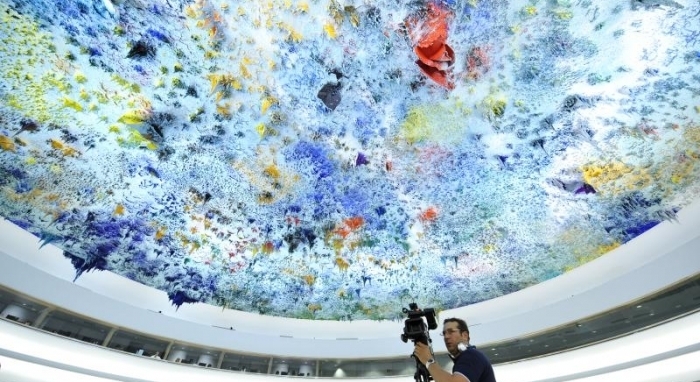
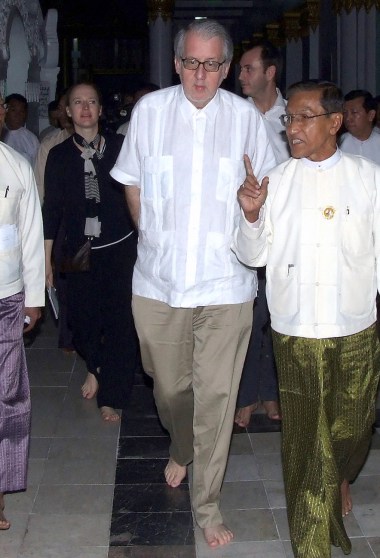 Paulo Sergio Pinheiro (centre) listens to an official while visiting the Shwedagon pagoda in Yangon, Myanmar, during his visit to the Asian country in November 2007 as an independent rights investigator.


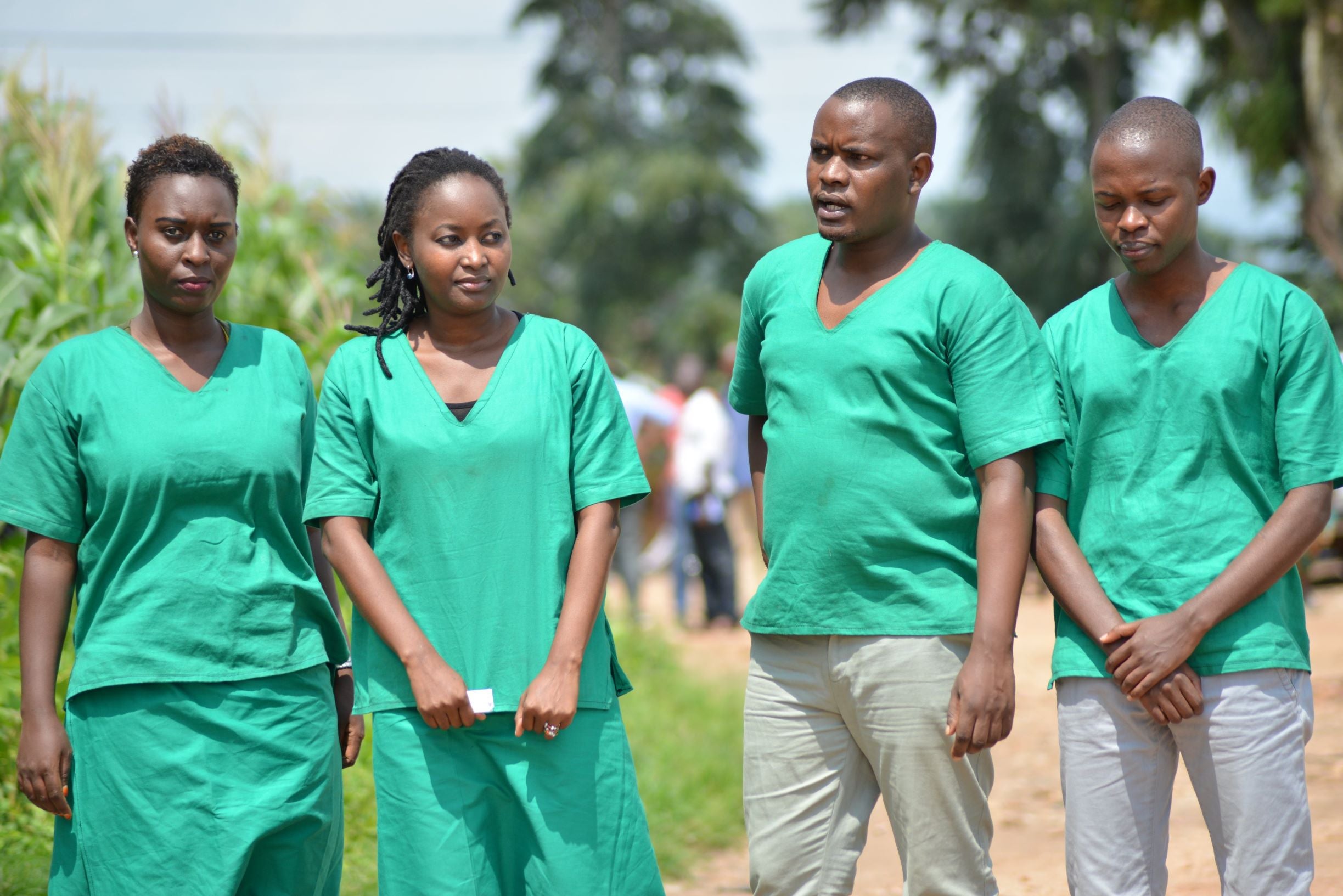
 Hans Thoolen on Human Rights Defenders and their awards