Posts Tagged ‘Brazil’

Shocking: Aluízio Palmar being sued by his torturer in Brazil

January 21, 2020

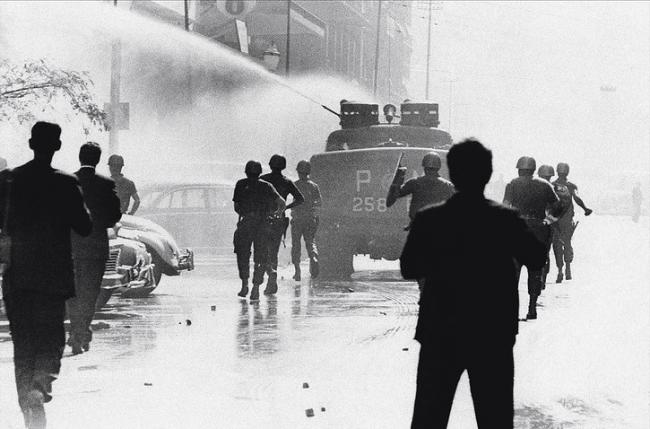
A scene in São Paulo, Brazil, on April 1, 1964, during the military coup against President João Goulart that installed a dictatorship. (Photo via Public Archive of São Paulo State)

A scene in São Paulo, Brazil, on April 1, 1964, during the military coup against President João Goulart that installed a dictatorship. (Photo via Public Archive of São Paulo State)

Jacob Blanc a history professor at the University of Edinburgh – published in Nacia of 20 January 2020 a real ‘horror story’ about Aluízio Palmar, a Brazillian human rights defender and tortutre victim being sued by a dictatorship-era torturer. He puts the blame squarely on the climate created by Bolsonaro.

The physical and psychological torture happened 40 years ago, when Palmar was imprisoned by the military dictatorship that ruled Brazil from 1964 to 1985. But it was only last month, in a climate defined by Brazil’s right-wing president Jair Bolsonaro, that Palmar’s abuser felt emboldened to file the suit….In a cruel twist, it is not a case of the victim seeking justice from his abuser. Instead, Ostrovski—who became a lawyer after his military service—has sued Palmar for defamation of character and “moral damages” over his efforts to bring public attention to Ostrovski’s crimes.

Ostrovski’s human rights abuses have been well-documented, including in the 1984 report on torture titled Brasil: Nunca Mais (Brazil: Never Again) and also in the 2014 National Truth Commission, the largest effort to-date to elucidate the repression of Brazil’s military regime. In these reports, multiple victims testified to Ostrovski’s acts of torture. Despite this evidence, Ostrovski has never stood trial. Nor, for that matter, has anyone in Brazil been held accountable for the cruelty of dictatorship. Unlike in neighboring Chile and Argentina where limited trials did take place, not a single member of the Brazilian military has faced criminal charges.

The lack of legal justice for Brazil’s human rights abusers helps explain the lawsuit against Palmar. Since the 1980s, Palmar has been an ardent human rights activist and journalist. He has co-founded a political newspaper, written a book on the forced disappearances of six Brazilian dissidents, maintained a website that publishes declassified documents, and established the Center for Human Rights and Popular Memory in the city of Foz do Iguaçu. So although there has been a concerted absence of political and institutional justice, Palmar and countless Brazilians like him have fought to keep the memory of the past alive. One of these initiatives took place in 2013 and stands as the crux of the current lawsuit.

As part of the investigations for the National Truth Commission, Palmar and three other torture victims testified in a public hearing. In the aftermath of this testimony, protestors engaged in a political action common in Latin America known as an escrache: to expose Ostrovisky—who had been living in relatively anonymity—the crowd marched to his law office and held a noisy rally to “out” him as a torturer. Palmar himself did not take part in the protest, but he did publicize the event on Facebook. And it is precisely Palmar’s act of sharing the protest on Facebook that Ostroviski is now citing in his claim for legal and financial restitution. But if the event in question took place in 2013, why is the lawsuit only now being brought forth?…The answer ties directly to Brazil’s current political landscape. Since Bolsonaro’s election in October 2018, a long-standing culture of impunity has become even more brazen. An army captain in the final years of the dictatorship, Bolsonaro has built his political career on an unapologetic nostalgia for military rule. Among his many headline-grabbing statements, Bolsonaro invoked the dictatorship’s most notorious torturer in voting to impeach the former president Dilma Rousseff—herself a torture victim—and he has stated that the regime’s murder of some 500 citizens did not go far enough.

“Since 1979, torturers have been protected by a law that is interpreted as impunity for them,” Luciana Silva, a professor of history at the State University of Western Paraná, said. “Now they are sheltered by an irresponsible president, who clearly governs for only a portion of the population. The torturer felt comfortable suing his victim as if nothing were going to happen.”

As both a journalist and a human rights defender, Palmar embodies two of the sectors of civil society most under threat in Bolsonaro’s Brazil. Between early December and early January alone, multiple journalists and media outlets in Brazil have suffered abuse, including two reporters in Rondônia receiving suspended jail time in a defamation case and a radio station’s antennae being destroyed by arson. Bolsonaro himself recently renewed his antagonism against the press: When asked in December about the growing corruption scandal surrounding his family, he deflected by verbally assaulted the journalist: “You look terribly like a homosexual.” These threats contribute to a dangerous reality where since 2010, 22 journalists in Brazil have been killed.

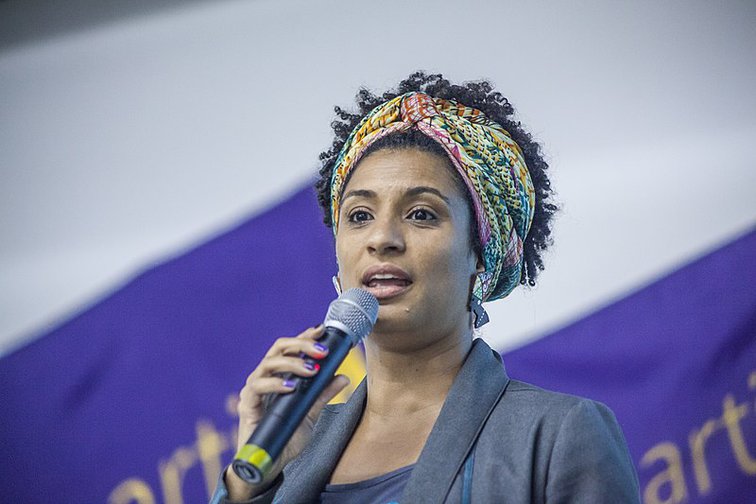
And according to the NGO Frontline Defenders, Brazil is also one of the deadliest places on earth for human rights activists, with a frightening increase in the threats, arrests, and physical attacks on activists, particularly around environmental, Indigenous, and LGBTQI+ rights. In 2019, the number of Indigenous leaders and activists killed reached the highest rate in two decades, and the Bolsonaro regime continues to skirt any responsibility to solve the 2018 assassination of Marielle Franco, a city councilwoman, gay Black feminist, and human rights activist. Bolsonaro also lashed out against the media when evidence emerged of apparent links between his family and Franco’s suspected killers.  [see also: https://humanrightsdefenders.blog/2019/03/13/marielle-franco-one-year-after-her-killing-in-rio/]

Palmar’s situation is symptomatic of how human rights are being inverted in Brazil.  “With Bolsonaro in power, [these abusers] feel free,” Palmar said. “They feel free to go around threatening us, to commit a form of terrorism. And more and more they’re putting Brazilian democracy itself in danger. There is a real enemy, and it’s going to set us back a long time.

https://nacla.org/news/2020/01/20/inversion-human-rights-brazil
CAFOD starts “messages to the brave” campaign

December 3, 2019

Send a message to the brave this Christmas, says CAFOD

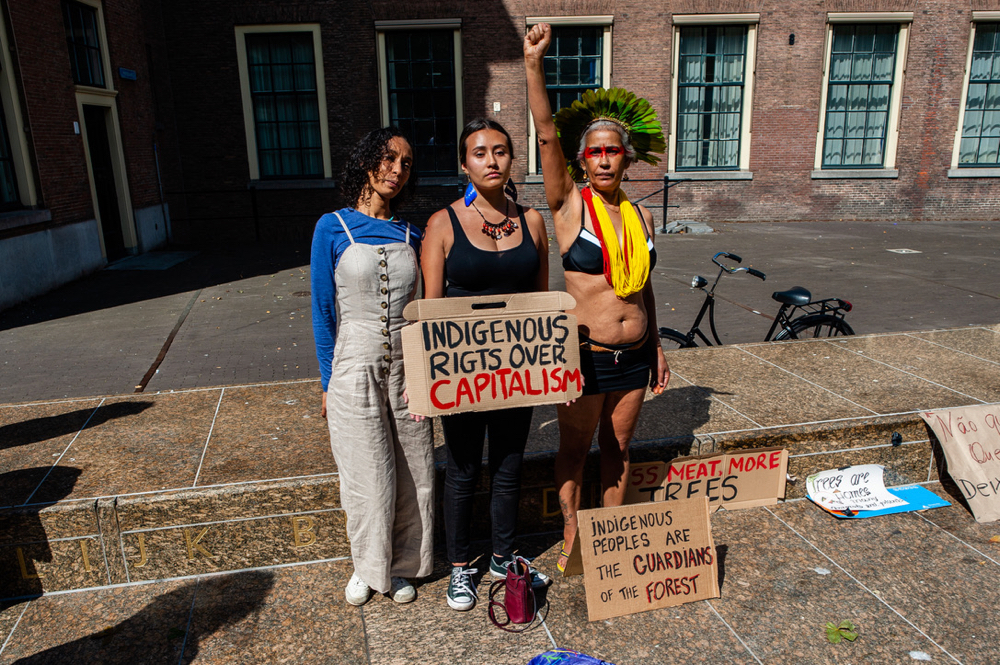
Three Brazilian women protest in the Netherlands against Brazil’s rainforest destruction Photo: Ana Fernandez / SOPA Images/Sipa USA

Samantha Aidoo – Campaigns Engagement Manager at CAFOD – explains the Messages to the Brave campaign:

Indigenous governor Cristina Bautista from Northern Cauca, Colombia, was passionate about defending the rights of the Nasa people and protecting their land and territory. But her courage and determination came at great personal cost. On 29 October, the 42-year-old and four unarmed indigenous guards who were with her were killed in a brutal attack near their Tacueyó reserve. Five other people were injured. The organisation which Cristina and her colleagues were part of, ACIN – the coordinating council for 22 indigenous reserves in the area which is supported by CAFOD – is no stranger to tragedy.

Just a few weeks earlier, Glabedy Gómez who worked alongside ACIN, her daughter, Karina, and four other people were ambushed and killed on their way back from a political event. Karina, 32, strongly believed that debate and political participation were important paths for building peace in Colombia and had been campaigning to stand in a local election. It is people like Cristina and her colleagues – known as human rights defenders – who are responding most acutely to what Pope Francis referred to in his 2015 encyclical Laudato Si’ as “the cry of the earth and the cry of the poor”.

Across the world, indigenous communities are trying to stop big businesses from fencing off their land, tearing down forests and polluting rivers in the pursuit of mining, logging or large-scale agribusiness. But community members who dare to speak out and organise others to do the same may be harassed, threatened or even killed. To anyone here who has been following the climate strikes, or perhaps even taken part in one, it may seem unfathomable that people speaking out for the environment, peace and human rights could pay with their lives, but that is exactly what is happening. [see e.g. https://humanrightsdefenders.blog/2019/01/09/global-witness-report-2018-on-environmental-defenders-bad-but-2017-was-worse/]

..

Their courage is helping to keep greenhouse gases in check and preserve key values like peace and human rights, but these communities are often left defending “our common home” on their own. In many countries, corruption, a lack of political will, or simply the fact that they live in a remote place means that communities who speak out often have no legal protection and no recourse for justice. That’s why this Advent, CAFOD is inviting people across England and Wales to send Christmas cards to those facing threats and attacks around the world in Brazil, Colombia, Uganda or the Occupied Palestinian Territory.

The Messages to the Brave campaign highlights the tireless work of men and women like Jose Batista Afonso from Brazil. Born in the countryside to rural worker parents, Jose grew up deeply connected to the land. He hadn’t planned to be a lawyer, but this changed after he saw rural leaders around him being routinely assassinated. Despite receiving death threats, for more than 20 years Batista has worked for the Pastoral Land Commission, defending the rights of landless communities in the Brazilian Amazon with support from CAFOD.

.. a simple card will show them that they aren’t alone in their fight to protect “our common home”, they have a community of people in the UK who are praying and standing with them. Perhaps members of the Fuerza Mujeres Wayuu women’s movement in Colombia, who have received more than six threats already this year, put it best when they say that together, we can “weave little by little for the future, a world more just than the one we had to live in”.

https://www.thetablet.co.uk/blogs/1/1331/send-a-message-to-the-brave-this-christmas-says-cafod

Another setback for the credibilty of the UN Human Rights Council: Venezuela wins seat

October 18, 2019

There was some hope [see: https://humanrightsdefenders.blog/2019/10/06/why-costa-rica-should-be-in-the-un-human-rights-council-rather-than-venezuela/] but in the end Venezuela won its UN human rights council seat despite being a serial violator. To make matters worse the other seat for Latin America went to Brazil, whose far-right leader has expressed contempt for the concept of human rights.

Activists have responded with outrage after Venezuela won a fiercely contested vote for a seat on the UN’s human rights council on Thursday, despite its well-documented record of human rights abuses.

Opposition activists, journalists and human rights defenders are often jailed, while security forces loyal to Maduro commit abuses with impunity. “The inclusion of Venezuela and Brazil to the human rights council marks a backwards step in the advancement of human rights in the region,” said Rodolfo Montes de Oca, a lawyer at Provea, a Venezuelan rights group.

Maduro’s regime will probably be emboldened by his country’s new post at the UN. “They can say they were elected to the human rights council and from there have a voice to push back on their critics,” said David Smilde, an analyst at the Washington Office on Latin America, a thinktank. “It’s shameful, a travesty,” said Vanessa Neumann, Guaidó’s ambassador to the UK, who added that the vote will do little to silence Maduro’s critics. “Ultimately the march of history’s harsh judgment on Maduro and his regime will not be stopped by this.”

Earlier this year, the UN human rights chief, Michelle Bachelet, issued a scathing report on Venezuela, which described widespread cases of torture, extrajudicial killings and withholding food and medicines from civilians.

https://www.theguardian.com/world/2019/oct/17/venezuela-un-human-rights-council-activists-outraged

The EU lists 3 finalists for the 2019 Sakharov Prize for Freedom of Thought

October 9, 2019

Following a joint vote by MEPs in the Foreign Affairs and Development committees of the European Parliament on Tuesday, the finalists for the 2019 Sakharov Prize for Freedom of Thought are:

The European Parliament’s Conference of Presidents (President and political groups’ leaders) will select the final laureate on Thursday 24 October. The prize itself will be awarded in a ceremony in Parliament’s hemicycle in Strasbourg on 18 December.

For more on the Sakharov Prize for Freedom of Thought and two other awards in the name of Sakharove, see: http://www.trueheroesfilms.org/thedigest/awards/sakharov-prize-for-freedom-of-thought

For last year’s award see: https://humanrightsdefenders.blog/2018/10/27/ukrainian-filmmaker-sentsov-wins-eus-sakharov-prize-for-human-rights/

Several people who spoke to RFE/RL on condition of anonymity expressed surprise that Navalny had not been shortlisted.

http://www.europarl.europa.eu/news/en/press-room/20191008IPR63719/sakharov-prize-2019-meps-choose-the-finalists

https://www.rferl.org/a/russian-activist-navalny-not-on-sakharov-prize-shortlist/30206166.html

Right Livelihood Award 2019 lauds ‘practical visionaries’

September 26, 2019

On its 40th anniversary, the Right Livelihood Award is honoring the efforts of an activist, a lawyer, a rainforest protector and Greta Thunberg. Deutsche Welle takes a closer look at the people who have inspired others.

German-Swedish writer Jakob von Uexküll thought there weren’t enough Nobel Prize categories to truly address the challenges faced by humanity. So in 1980, he founded the Right Livelihood Award [see: http://www.trueheroesfilms.org/thedigest/awards/right-livelihood-award]

This year, the recipients hail from Western Sahara, China, Sweden and Brazil. “With the 40th Right Livelihood Awards we honor four people whose leadership inspires millions of people to defend their rights and fight for a livable future on planet Earth,” said Ole von Uexküll, Jakob von Uexküll’s nephew and the current executive director of the Right Livelihood Foundation.

Aminatou Haidar speaks at a podium (Right Livelihood Foundation)

Aminatou Haidar spent four years in a secret prison, isolated from the outside world

By the time she was a teenager, Aminatou Haidar was already an activist. She has continued to campaign peacefully for the independence of her home country, Western Sahara, ever since. Haidar has become the face of a movement that is committed to Sahrawi self-determination, and fights for their fundamental human rights to be respected. She is also co-founder and president of the Collective of Sahrawi Human Rights Defenders (CODESA) humanitarian organization. Haidar has organized demonstrations, documented torture and gone on a hunger strike to draw attention to the plight of her people. These actions are often not tolerated by Moroccan authorities: Haidar has been imprisoned without being charged or tried many times. She even spent four years in a secret prison isolated from the outside world. Yet in the face of harassment, attacks and death threats — including against her children — she continues to fight tirelessly for a solution to the long-standing conflict in Western Sahara. Her enduring stamina and nonviolent protests earned her the moniker “Gandhi of Western Sahara.” The jury said she was chosen to for her “steadfast nonviolent action, despite imprisonment and torture, in pursuit of justice and self-determination for the people of Western Sahara.” [see also: https://humanrightsdefenders.blog/2013/10/30/saharawis-human-rights-defender-aminatou-haidar-awarded-bremen-solidarity-award/].


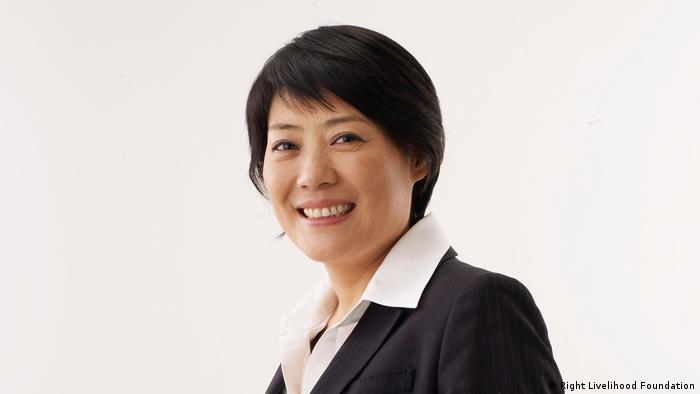
Guo Juanmei (Right Livelihood Foundation)

Guo Juanmei has been working for women’s rights in China for 25 years

It wasn’t until 2014, when official figures were released, that it became known just how endemic domestic violence is in China: one in four married Chinese women is beaten by their husbands. It was a topic that had long been hushed up. Two years later, the Chinese government passed a law against domestic violence, an achievement owing to the tireless efforts of women’s rights activists like Guo Jianmei. Guo is one of China’s most prominent women’s rights lawyers. Over the past 25 years, she and her team have provided free legal advice to 120,000 women. She is the first lawyer in the country to work full-time in non-profit legal assistance. Guo supports campaigns on issues such as unequal pay, sexual harassment and widespread employment contracts that prohibit pregnancy across the country. In rural areas, Guo helps women who are denied land rights where patriarchal systems leave women dependent on their husbands. She founded an association of more than 600 lawyers that handles cases in the country’s most remote regions. Guo received this year’s award “for her pioneering and persistent work in securing women’s rights in China.”


Davi Kopenawa Yanomami (Right Livelihood Foundation)

Davi Kopenawa Yanomami has long been committed to protecting indigenous rights and land

The Amazon is burning, and the world is worried about the effects the burning rainforest will have on the climate. But local inhabitants are feeling the immediate impact. The award organizers wanted to draw attention to the plight of the indigenous people of Brazil by jointly recognizing Davi Kopenawa Yanomami, one of Brazil’s most respected advocates for the indigenous peoples, and the Hutukara Yanomami Association, which he founded in 2015. Kopenawa belongs to the Yanomami tribe, one of Brazil’s most populous indigenous tribes with some 35,000 members. The well-known Hutukara Yanomami Association is committed to protecting the rights, culture and lands of the indigenous people of the Amazon region. Increasing destruction and deforestation for agricultural purposes poses a threat to the environment, but also to the livelihood of the indigenous people. In the 1980s and 1990s, gold miners destroyed villages, shot people and spread diseases. Now such attacks are on the increase again. In 1992, Kopenawa was instrumental in ensuring that a 96,000 square kilometer (37,000 square mile) area in Brazil became Yanomami protected area. He also plays a crucial role in bringing different indigenous groups together to protect themselves from exploitation. It was for this purpose that he founded the Hutukara Yanomami Association, which represents different Yanomami communities. Kopenawa and the Yanomami Hutukara Association have been jointly awarded “for their courageous determination to protect the forests and biodiversity of the Amazon, and the lands and culture of its indigenous peoples.”

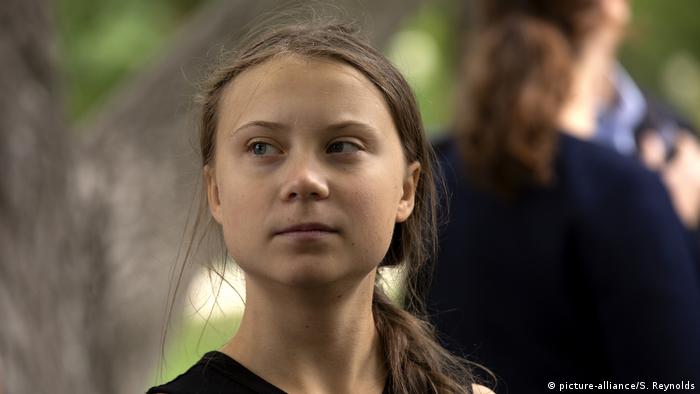
Greta Thunberg in the USA (picture-alliance/S. Reynolds)

Greta Thunberg has become the face of a generation fighting climate change

Swedish climate activist Greta Thunberg is without a doubt the most well-known of the 2019 laureates. In August 2018, the then 15-year-old started a solitary school strike in front of the parliament building in Stockholm a few weeks before elections. She has since become the face of a generation who view climate change as an enormous threat to their future. Her campaign has pushed for worldwide political action to limit global warming to 1.5 degrees Celsius (2.7 Fahrenheit). See also: https://humanrightsdefenders.blog/2019/09/17/greta-thunberg-receives-amnestys-ambassador-of-conscience-award/

Around the world, millions of young people have joined her in skipping school and taking to the streets for the “Fridays for Future” demonstrations, which culminated in a huge global climate strike last Friday. Thunberg speaks at major conferences and meets with world leaders. Her message is clear: Humanity must acknowledge climate change, the urgency of the crisis and act accordingly. Thunberg has been awarded “for inspiring and amplifying political demands for urgent climate action reflecting scientific facts.” The jury added that she is “the powerful voice of a young generation that will have to bear the consequences of today’s political failure to stop climate change,” and that her efforts have inspired millions of people to take action.”

For last year see: https://humanrightsdefenders.blog/2018/09/24/laureates-of-the-2018-right-livelihood-award-announced/

———

https://www.dw.com/en/right-livelihood-award-2019-lauds-practical-visionaries/a-50554572

International Press Freedom Awards 2019

July 17, 2019

On 16 July 2019, the Committee to Protect Journalists announced that journalists from Brazil, India, Nicaragua, and Tanzania will receive the 2019 International Press Freedom Awards amid the erosion of press freedom in democracies around the globe. The journalists have faced online harassment, legal and physical threats, and imprisonment in their pursuit of the news

CPJ’s 2019 awardees are:

Patrícia Campos Mello, a reporter and columnist at Brazil’s daily Folha de S. Paulo. During the Brazilian presidential election campaign in 2018, Campos Mello was attacked online and doxxed in response to her coverage of supporters of then presidential-candidate Jair Bolsonaro allegedly sponsoring bulk messaging in WhatsApp.

Neha Dixit, a freelance investigative journalist in India who covers human rights. She has faced legal and physical threats, as well as online harassment, after reporting on alleged wrongdoing by right-wing nationalist groups and police.

Lucía Pineda Ubau, news director, and Miguel Mora, founder and editor, of Nicaraguan broadcaster 100% Noticias. The pair was imprisoned in December 2018 in relation to their coverage of political unrest. They were freed on June 11 after six months behind bars, under surveillance and in isolation most of the time.

Maxence Melo Mubyazi, champion of online freedom of expression in Tanzania, who co-founded and is the managing director of Jamii Forums, an online discussion site and source of breaking news. Melo has been charged under the country’s restrictive CyberCrimes Act and, in 2017, appeared in court 81 times.

For more on the International Press Freedom Awards and other media awards, see: http://www.trueheroesfilms.org/thedigest/awards/international-press-freedom-awards-cpj

All of the winners will be honored at CPJ’s annual awards and benefit dinner, which will be chaired by Laurene Powell Jobs and Peter Lattman of the Emerson Collective. The event will be held at the Grand Hyatt New York in New York City on November 21, 2019.

Misconceptions about indigenous peoples and their defenders explained

May 22, 2019

In a piece of 21 May 2019, called “4 common misconceptions about indigenous peoples and local communities explained”, Lai Sanders of the Rights and Resources Initiative points to common misconceptions re indigenous peoples who have a ‘juggernaut role’ in the global fight against climate change. Why are they conspicuously absent from many national and international agendas, as well as from societal discourse at large? At the recent UN Permanent Forum on Indigenous Issues in New York, six indigenous activists and leaders from across the world spoke to the often unrecognized and under-appreciated contributions made by their communities for the betterment of society, and to address some of the most widespread and harmful misconceptions about Indigenous Peoples and local communities. The following interviews (excerpts) come with beautiful portrait pictures.

..

Indigenous Peoples and local communities customarily own over 50 percent of the world’s land, yet only have secure legal rights to 10 percent. “One of the most generalized misconceptions is that society, especially decision-makers, sees us as a people almost without rights,” says Levi Sucre, head of the Mesoamerican Alliance of Peoples and Forests (AMPB) and an indigenous native of Costa Rica

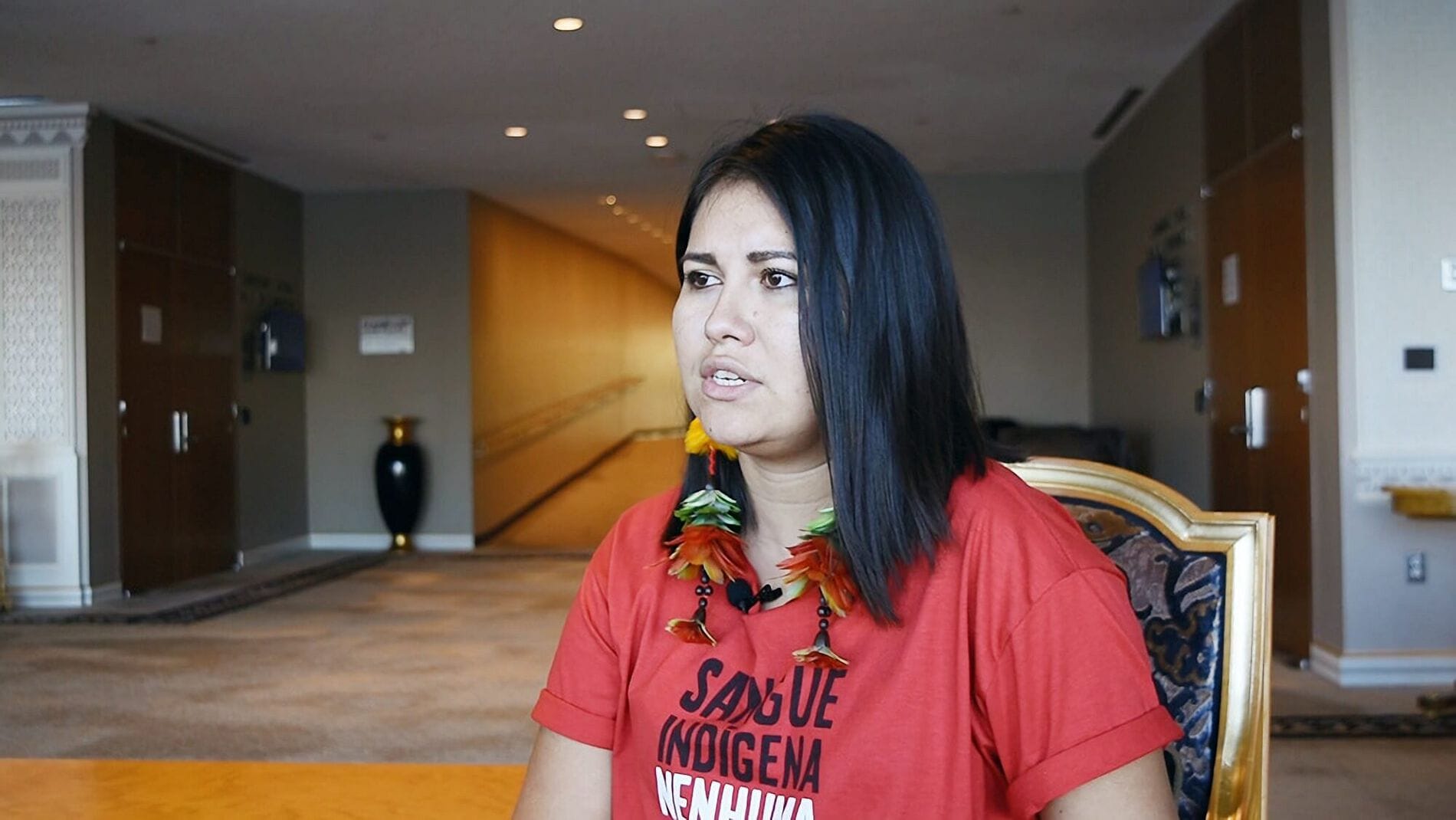
Rayanne Maximo Franca. Photo: Rights and Resources Initiative

Rayanne Maximo Franca left her community at 17 to attend college in Brasilia, where she was one of a handful of indigenous students. Now 27, she is a seasoned organizer with the Indigenous Youth Network of Brazil and a representative of the Global Indigenous Youth Caucus. “Every day, being indigenous in a society that is so prejudiced, so racist, so discriminatory,” she says, “the fact that people affirm themselves as indigenous—in the society we live in today—is already an act of activism. It is already an act of self-defense.”

For Emberá activist Dayana Urzola Domicó, youth coordinator for the National Indigenous Organization of Colombia (ONIC) the erasure of indigenous identities and narratives from mainstream culture is also a major issue. “… we are not those Indigenous Peoples who look beautiful in museums. We are not of the past. All those things that are articulated in the care of Mother Earth, of you as a person, your territory, your thought, your law of origin—those things are still alive. We are still here.

Hindou Oumarou Ibrahim, coordinator of the Indigenous Women and Peoples Association of Chad describes how Mbororo pastoralist communities, who are indigenous to Chad, use their nomadic lifestyles to conserve the natural environment: “We use one place to stay for two days, and another place for three days. That allows the natural resources to get regenerated in the natural way.”

Joan Carling, co-convener of the Indigenous Peoples Major Group for Sustainable Development, grew up in the mountains of the Philippines’ Cordillera region, where she spent her childhood playing in the forests. An indigenous Kankanaey, she has fought at the forefront of environmental justice for two decades. “Indigenous Peoples have been engaging in the climate change process because we believe we have something to contribute,” she says. “We have the solutions. We have the resilience. We have the knowledge that has been accumulated through time. Our elders know how to read the rivers, the behavior of animals. They use this to predict what’s happening in the environment.”

This traditional knowledge, explains Maximo Franca, is what has kept the world’s remaining forests standing. “It maintains biodiversity, it maintains the fauna, the flora, the animals… everything that the nature has, we are maintaining. And we are countering climate change.

..The struggle to dispel a particularly harmful narrative—that Indigenous Peoples are blindly opposed to development projects, or an impediment to economic progress—is a universal one. “The biggest misconception about Indigenous Peoples is that we are anti-development,” says Carling. “That comes from the western view of development, that mining, dams, agribusiness are good for the people. But look: It has caused a lot of inequality. It is unsustainable. It has severely destroyed nature. It has severely polluted our lands and resources.

…Echoes Sucre on environmentally destructive projects: “In the short term, it looks like a development; but in the medium and long term, it will be the destruction of humanity.”

2017 and 2018 have been among the deadliest years on record for environmental defenders, particularly indigenous and community activists, who are increasingly being targeted, harassed, criminalized, and even murdered for defending their lands from exploitation. “They are not fighting for their ego, or to get economic benefits,” says Ibrahim. “They are fighting for the identity, the survival of the peoples—the protection of the planet.

For Rukka Sombolinggi, the head of AMAN, the largest indigenous organization in Indonesia and the world, learning about the struggles of indigenous communities outside her own was like “baptism by fire,” she recalls. “Twenty years ago, I realized that Indigenous Peoples were facing criminalization. Land grabbings were happening everywhere. The eviction of Indigenous Peoples—from protected areas, from national parks, from protected forests, from wildlife sanctuaries—took place in Indonesia. Today, that is still happening.”

For Carling, the issue of criminalization is deeply personal: less than a year ago, she was falsely labeled a terrorist by the Philippine government alongside hundreds of other human rights activists. Though her name was later struck from the list, the threat remains.

….

Increasingly, governments, multilateral institutions, and other important stakeholders are heeding the urgent call to action to protect those who defend the world’s forests and lands. New campaigns, projects, and funds are underway to support initiatives to strengthen Indigenous Peoples’ and local communities’ rights to their lands. And the next generation of young indigenous leaders is joining the fight: “In Colombia, there is so much conflict that you have two options,” says Urzola Domicó. “One is that they kill your family and you are left without anything, and you die with your family. And the other option is that you go out and see how to defend your people, your nation.”

International Civil Society Week: 3 human rights defenders engaging business

May 4, 2019

Sutharee Wannasiri (Thailand)

Sutharee Wannasiri

Sutharee has been supporting the 14 Myanmar workers that have denounced labour rights abuses at the Thammakaset Farm in Thailand. She has actively engaged in public advocacy to demand business accountability on labour rights abuses, and an end to the judicial harassment workers are facing in retaliation for reporting these. To date, Thammakaset Farm has filed more than 13 criminal and civil complaints against the workers and the local CSO staff from Migrant Worker Rights Network and the journalists supporting them, including her – many of them are ongoing. The majority of the cases have been dropped by the courts.

Sutharee said:

“It is also the responsibility of international brands that buy from Thailand to make sure the companies they are sourcing from are not engaged in judicial harassment that creates a chilling effect on whistleblowers and other defenders. They should establish mechanisms that allow workers and defenders to communicate with the brands directly and ensure that they are protected from any retaliation from suppliers during the investigation. The results should be made public and bring accountability for the abuses.”


Amanda Segnini (Brazil)

Amanda Segnini

The organization engajamundo focuses on youth empowerment in Brazil, with a particular focus on climate change. Its main goal is to make young people ware of their power to transform their communities. The organization is concerned about how civic freedoms will be negatively affected under the new government of President Jair Bolsonaro. Engajamundo is open to dialogue and ongoing engagement with companies if there is an alignment in values. Amanda believes that companies and civil society could engage more with one another if they find a shared purpose.

Amanda said:

It might be right for companies to say something in support of activists that are under attack – but only if they have been working with the community long-term and have an ongoing relationship with them: for example, if they work with local producers and source responsibly from them. If such a community is under attack, a brand should say or do something in their support. But if they only say something without having that relationship, it’s like they are just ‘riding on the wave’, taking advantage of the buzz. Companies also should not censor civil society they engage with. For example, once we were invited to take part in a corporate event, but they tried to censor what we wanted to say. We decided not to participate in the end.”


Sasa Uzelac (from Serbia)

Sasa Uzelac

Sasa is the Solidarity Center‘s Regional Coordinator for South East Europe. Solidarity Center was established by AFL-CIO, and is the biggest international organization supporting trade unions and associations working to protect labour rights in South East Europe. He says trade unions and workers’ associations are increasingly under attack from governments, companies, and far-right political organizations and movements. Sasa says the tide of far-right populism is creating additional problems for organizations and people advocating for labour rights. Workers’ rights are being endangered on a daily basis by “ruthless” employers and “mindless” government officials. Freedom of association, decent working conditions, and human rights in the field of work are at risk due to governments’ failure to sanction unlawful activities by employers.

Sasa said:

“The best thing brands can do is to introduce union practices from their country of origin, rather than exploiting the weaknesses of the local system and local practices in their operations. But sadly they are not doing that to a high enough standard in this region. When big international companies enter the market, they should also make sure that the health and safety standards are brought to the levels of their countries of origin.”

https://www.business-humanrights.org/en/human-rights-defenders-discuss-engaging-with-business-at-international-civil-society-week-in-serbia

Marielle Franco: one year after her killing in Rio

March 13, 2019
A long piece in Open Democracy of 12 March provides more details and links tentatively the murder to the State:

Three moments have been key in unravelling the truth regarding this political crime. The first, the detention in December 2018 of Marcello Moares Siciliano, also a counselor in Rio de Janeiro. He was identified as the supposed intellectual author of the crime and he is being directly accused of being involved in the murder. The State Prosecutor and the Police searched his home and found material connected to the murder that also pointed towards two ex-military police officers who were also detained as possible complices.

The second, in January of this year, was the major revelation that these two military police officers have dark connections to Flavio Bolsonaro, the son of president Jair Bolsonaro, who is currently a senator. The accused are suspected to be members of the militia group ‘Escritório do Crime’, one of the most dangerous criminal groups currently in the west of Rio de Janeiro.

The third, is the unexpected arrest of a military police officer and another ex-police officer only a few days before commemorating one year since her murder. One is accused of pulling the trigger, and the other of driving the vehicle used for the attack. These appear to be the first concrete results of a complex investigation that remains plagued with uncertainty that would confirm the Brazilian state’s role in the murder…

What is certain is that the investigation has also suggested a link between Marielle’s opposition to the militarisation of Rio de Janeiro and her murder. She had discovered some worrying conexions, which could imply her death was caused by powerful mafias that wished to silence her. The complexity and the difficulty of clarifying the events surrounding her death show there are powerful interests impeding the investigation.

https://www.opendemocracy.net/en/democraciaabierta/who-killed-marielle-1-year-later-few-answers/

Human Rights Defenders in Latin America under constant attack

February 20, 2019

Some 50 human rights defenders from Latin America held a meeting at the Journalists Club in Mexico City to exchange strategies and analyse the challenges they face in the most lethal region for activists. Special rapporteurs on indigenous peoples, displaced persons and freedom of expression attended the meeting. Credit: Emilio Godoy/IPS

Some 50 human rights defenders from Latin America held a meeting at the Journalists Club in Mexico City. Credit: Emilio Godoy/IPS

We’re in a very difficult situation. There is militarisation at a regional level, and gender-based violence. We are at risk, we cannot silence that,Aura Lolita Chávez, an indigenous woman from Guatemala. (Chávez was a finalist for the European Parliament’s Sakharov Prize for Freedom of Thought in 2017, and winner of the Ignacio Ellacuría Prize of the Basque Agency for Development Cooperation that same year). She has received death threats and attacks that forced her to seek refuge in Spain in 2017.

Latin America, the most lethal region for human rights defenders according to different reports, especially activists involved in defending land rights and the environment. Some 50 activists from Brazil, Colombia, Guatemala, Honduras, Mexico, Nicaragua, the United States and Uruguay participated in the International Meeting of Human Rights Defenders and Journalists in Mexico City from 15-18 February under the slogan “Defending does not mean forgetting.”

Guests at the meeting were United Nations Special Rapporteur on the Rights of Indigenous Peoples, Victoria Tauli-Corpuz from the Philippines; UN Special Rapporteur on the Human Rights of Internally Displaced Persons, Cecilia Jiménez-Damary from the Philippines; and the Inter-American Commission on Human Rights (IACHR) Special Rapporteur on Freedom of Expression, Edison Lanza from Uruguay.

The human rights defenders identified common threats such as interference by mining and oil companies in indigenous territories, government campaigns against activists, judicial persecution, gender-based violence, and polarised societies that often fail to recognise the defence of human rights.

Evelia Bahena, an activist from the southern Mexican state of Guerrero, told IPS about “the suffering and destruction” at the hands of “companies that make profits at the cost of the lives of others.”

A number of reports have focused on the plight of human rights defenders in the region. In the report “At what cost? Irresponsible Business and the Murder of Land and Environment Defenders 2017”, published in July 2018, the international organisation Global Witness stated that of the total of 201 murders of human rights defenders in the world in 2017, 60 percent happened in Latin America. [see also: https://humanrightsdefenders.blog/2019/01/09/global-witness-report-2018-on-environmental-defenders-bad-but-2017-was-worse/]

Brazil recorded the highest number of homicides of activists of any country, 57. In Mexico, the number was 15, five times more than the year before, while Nicaragua recorded the highest murder rate of activists relative to its population, with four killings, according to the British-based organisation.

The “Global Analysis 2018”, produced by the international organisation Front Line Defenders, also depicts a grim outlook, counting 321 human rights defenders killed in 27 countries, nine more than in 2017. Of that total, 77 percent involved defenders of the land, the environment and indigenous people. [https://humanrightsdefenders.blog/2019/01/09/front-line-defenders-says-record-number-of-activists-killed-in-2018/]

For Ana María Rodríguez, a representative of the Colombian Commission of Jurists, difficult conditions persist in her country, where 20 human rights activists have been murdered so far in 2019. “There are delays and non-compliance with the peace agreement,” which have contributed to the defencelessness of human rights activists, according to the lawyer.

The rapporteurs present at the meeting, on unofficial visits to Mexico, listened to the accounts given by activists and recalled that governments in the region have international obligations to respect, such as guaranteeing the rights of indigenous people, displaced persons and journalists, as well as protecting human rights defenders…In her October report on Mexico, the special rapporteur criticised the violation of rights of indigenous people, especially the right to prior consultation on energy, land or tourism projects in their territories. [https://humanrightsdefenders.blog/2019/02/16/human-rights-defenders-journalists-in-mexico-in-1919-2-killed-2-released/]

For his part, Lanza, the IACHR special rapporteur, said the recommendations of the joint report released in June 2018 with David Kaye, UN special rapporteur on the promotion and protection of the right to freedom of opinion and expression, should be the starting point for the measures to be adopted by the Mexican government.,,