Belarusian opposition leader Svyatlana Tsikhanouskaya has condemned ongoing mass searches of homes of journalists and rights defenders across the country. At least 25 homes of journalists, rights activists, and their relatives in Minsk and other towns and cities were searched by police and security service officers on February 16. The offices of the Vyasna (Spring) human rights center in Minsk [see https://www.trueheroesfilms.org/thedigest/laureates/7b5ccf60-bf81-11ea-b6a7-3533a3c74ec1] and the headquarters of the Association of Belarusian Journalists were also searched.
Tsikhanouskaya issued a statement on Telegram, saying that those who are looking for “criminals” among journalists and rights defenders should look for criminals among themselves.
“This is the real crisis. In its attempt to cling to power, the regime is repressing those who are defending human rights. As long as this continues, all Belarusians are in danger,” Tsikhanouskaya’s statement says, adding, “Belarusians know how to solve this crisis.“
“With such measures [Belarusian President Alyaksandr] Lukashenka is gathering material for his own trial in an international court together with his associates. We have already forwarded information to the European Union and the United Nations Human Rights Council, asking them to undertake corresponding measures,” Tsikhanouskaya continued.
Speculating about the Nobel Peace Prize is a sport that keeps some media busy most of the year.
Although thousands of people, from members of parliaments worldwide to former winners, are eligible to propose candidates (see list in link), it is the group of Norwegian parliamentarians that has nominated the eventual laureate every year since 2014 (with the exception of 2019), according to Henrik Urdal, Director of the Peace Research Institute Oslo. And for this year Russian dissident Alexei Navalny, the World Health Organization and climate campaigner Greta Thunberg are among those nominated by backed by Norwegian lawmakers.
The Norwegian Nobel Committee, which decides who wins the award, does not comment on nominations, keeping secret for 50 years the names of nominators and unsuccessful nominees. But the nominators themselves can choose to reveal their choice and often do.
On 31 January 2021 Gwladys Fouche and Nora Buli started off the guessing season by reporting that, according to a Reuters survey of Norwegian lawmakers, nominees include Thunberg, Navalny, the WHO and its COVAX programme to secure fair access to COVID-19 vaccines for poor countries.
Other names are Belarusian activists Sviatlana Tsikhanouskaya, Maria Kolesnikova and Veronika Tsepkalo for their “fight for a fair election and inspiration for peaceful resistance”, one nominator, Geir Sigbjoern Toskedal, said. Another, Jette Christensen, also named the Hungarian Helsinki Committee, a human rights group, and IUSTITIA, a group of Polish judges defending civil rights. “My nomination this year is … for the fight to preserve democracy as a form of government in Europe,” Christensen said.
Freedom of information is a recurring theme with nominees including the U.S.-based Committee to Protect Journalists; former Charlie Hebdo journalist Zineb el Rhazoui; news website Hong Kong Free Press, the U.S.-based International Fact-Checking Network and Paris-based Reporters without Borders (RSF). Also mentioned are: the Black Lives Matter movement and Stacey Abrams, the former Georgia gubernatorial candidate who has become a leading voting rights advocate.
Other nominees include former U.S. President Donald Trump (by Jaak Madison, a member of the right-wing populist EKRE party) as well as Kushner and Berkowitz for negotiating deals between Israel and the United Arab Emirates, Bahrain, Sudan and Morocco), .
Also on the list are NATO and again the U.N. refugee agency (UNHCR) as well as Aminatou Haidar, for her peaceful campaigning towards an independent Western Sahara, the International Space Station and the International Scout Movement.
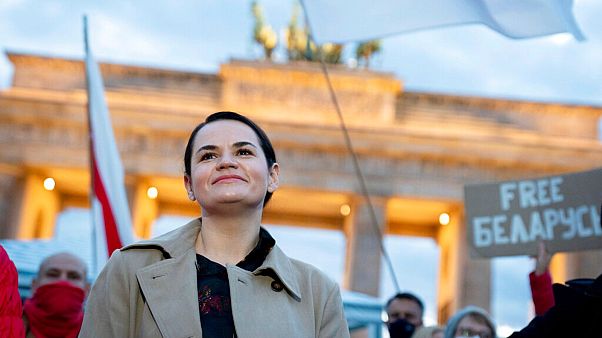
Belarusian opposition leader Svetlana Tikhanovskaya is welcomed by supporters, during a rally, by the Brandenburg Gate in Berlin, Monday, Oct. 5, 2020. – Copyright Kay Nietfeld/dpa via AP
The European Parliament (EP) has chosen Belarus’ opposition movement as the winners of this year’s Sakharov Prize for Freedom of Thought. EP President David Sassoli recognised an “initiative of brave women” in his speech including opposition leader Svetlana Tikhanovskaya, Nobel Laureate Svetlana Alexievich, musician and political activist Maryia Kalesnikava, and political activists Volha Kavalkova and Veranika Tsapkala.
He also gave honourable mentions to political and civil society figures and the founder of the Telegram channel NEXTA, Stsiapan Putsila, among others.
The ongoing political demonstrations in Belarus against the government and Alexander Lukashenko were sparked in the wake of the country’s presidential election in August.
The prize will be awarded in a ceremony at the European Parliament on 16 December.
Ryan Kaminski and Grace Anderson wrote in Just Security of 14 October 2020 a scathing assessment of US human rights policy under Trump, Here some large extracts, but it is worth reading in full:
At the launch of the first virtual session of the United Nations General Assembly last month, Secretary of State Mike Pompeo sought center stage to question one of the most historic documents put forward by the U.N. shortly after its inception: the Universal Declaration of Human Rights. Pompeo presented the findings of the State Department’s Commission on Unalienable Rights via videotape during a U.N. event that took place the same week [see: https://humanrightsdefenders.blog/2019/07/11/trump-marches-on-with-commission-on-unalienable-rights/]
Although jarring, the Commission’s conclusions should have come as no surprise: They are simply the culmination of the Trump administration’s downward trajectory on protecting human rights and engaging on these issues specifically at the U.N.
Just this month, for example, the U.S. microphone at the U.N. Human Rights Council was silent on the situation in Belarus, where massive protests have taken place against the country’s authoritarian leader. Nor did the United States take the floor when the Human Rights Council discussed combating global racism during an urgent debate requested by hundreds of U.S. non-governmental organizations (NGOs) and human rights advocates, as well as the family of George Floyd. Moreover, the Trump administration’s recent self “report card” on human rights in the United States, posted online by the U.N. in September, is the shortest ever submitted from the United States, and it is unnecessarily combative, and conspicuously cherry-picked.
The practice of the Trump administration turning its back on rights at the U.N. goes well beyond the Human Rights Council.
Last December, the administration torpedoed a U.N. Security Council session on human rights in North Korea for a second year in a row. Its actions broke with years of precedent in which U.S. ambassadors of varying political stripes lobbied Security Council members to debate Pyongyang’s atrocious rights record. In 2019, the United States effectively kneecapped its own effort, despite having support from key allies and partners on the Security Council to move forward.
Recent budgetary moves by the Trump administration are another example of this worrying trend. In September, the State Department again served notice that it would be flouting the will of Congress by “reprogramming” $28 million for the U.N. Human Rights Council and the Office of the High Commissioner for Human Rights (OHCHR). Over the past three years, the Trump administration has unilaterally withheld nearly $60 million in assessed contributions to OHCHR, an especially disdainful action given the bipartisan congressional support for the office.
Another area of concern is the Trump administration’s absentee track record of filling openings on U.N. human rights treaty bodies. These treaty bodies are official assemblies of international rights experts tasked with holding governments accountable for implementing the human rights accords they have ratified. They are effectively incubators and accelerators for the maintenance of international law and norms central to fundamental freedoms and human dignity. Yet, in a break with precedent from the George W. Bush and Obama administrations, Trump has not even nominated a candidate to sit on the Committee on the Elimination of Racial Discrimination. The absence of American presence on the Committee, as well as other unsung, yet influential, bodies, represents a sorely missed opportunity.
The Committee, for example, works to ensure compliance among its 182 State parties and has taken decisive action on issues at the heart of bipartisan U.S. foreign policy priorities, such as grilling China on atrocities committed against ethnic Uyghurs in its territory….
Worse than stonewalling special procedures and limiting visits, Trump administration officials have in certain cases even gone on the offensive against these U.N. watchdogs. After an official U.S. visit by the U.N. Special Rapporteur on extreme poverty, originally authorized by the Obama administration, then-U.S. Permanent Representative to the United Nations Nikki Haley claimed the expert’s findings were inaccurate, offensive and wasteful. This was a missed opportunity for the United States to constructively address scrutiny of its rights record like any other advanced democracy; instead the administration reflexively attacked an independent rights watchdog.
Constructive U.S. engagement with U.N. special procedures helps set a positive example and bolsters U.S. credibility, especially when the United States calls on regimes violating rights to not hide from these exact same investigations. This year, for instance, Pompeo called out Cuba, via Twitter, for not responding to communications from the U.N. special rapporteurs on combating trafficking and modern slavery.
The picture is not entirely gloomy, however.
One potential bright spot for the Trump administration’s human rights engagement at the U.N. is the State Department’s prioritization of U.N. Human Rights Council reform…butt reform is a function of engagement, not withdrawal. Thus, the administration’s 2018 decision to give up its seat on the Human Rights Council has proven ineffective, unsurprisingly, in accomplishing meaningful reform. In fact, research from the Jacob Blaustein Institute for the Advancement of Human Rights found active U.S. membership on the Human Rights Council was a “game-changer,” resulting in a significant drop in anti-Israel resolutions and “scrutiny of many of the world’s worst human rights violators.”
Conversely, the U.S. absence from the Council, together with attempts to strong-arm U.N. institutions through funding cuts, has abetted China’s growing assertiveness in the U.N. system. Even the Heritage Foundation has acknowledged the “concerning” trend of China’s upward trajectory in the U.N. system.
The Trump administration also acknowledged this new reality when the State Department established an unusual new envoy posting charged with countering Chinese influence at the U.N. and other international organizations. But this move falls well short of the United States adopting an overarching strategic policy on China’s growing U.N. influence. This month, the Trump administration awkwardly tweeted support for action by the U.N. Human Rights Council on China, all the while warming the bench in its ongoing boycott.
Overall, sustained pushback against human rights work at the U.N. by the United States has become yet another cornerstone of the Trump administration’s “America First” doctrine. As Pompeo stated unequivocally at the launch of the Commission on Unalienable Rights: “Many [human rights] are worth defending in light of our founding; others aren’t.”
Critics of the Commission are right to be concerned. Whether leaving critical human rights positions unfilled, undercutting U.N. human rights bodies by withholding funds, or attacking U.N. independent rights advocates, Eleanor Roosevelt’s warning more than 60 years ago is more salient than ever: “Without concerted citizen action to uphold [universal human rights] close to home, we shall look in vain for progress in the larger world.”
Indigenous rights and environmental activist Lottie Cunningham Wren of Nicaragua “for her ceaseless dedication to the protection of indigenous lands and communities from exploitation and plunder.”
“This year’s Laureates are united in their fight for equality, democracy, justice and freedom,” said Ole von Uexkull, Executive Director of the Right Livelihood Foundation. “Defying unjust legal systems and dictatorial political regimes, they successfully strengthen human rights, empower civil societies and denounce institutional abuses. This year’s selection of recipients highlights the increasing threats to democracy globally. It is high time that all of us in favour of democracy around the world stand up and support each other.”
The four Laureates, selected by an international Jury, will each receive a prize money of 1 million SEK. As in previous years, the Laureates were nominated in an open process where anyone could submit individuals and organisations for consideration. The Laureates will be honoured during a virtual Award Presentation on December 3, 2020.
In Newsweek of 21 September 2020 Basit Mahmood did an interview with Kenneth Roth who has spent 27 years as the executive director of Human Rights Watch (HRW) in which he warns that China poses a threat to the global human rights system, that U.S. is no longer to be relied on as a supporter of human rights and how this has left a void, emboldening autocrats who have used the pandemic to undermine democratic societies.
“China and the threat it poses to human rights both at home and around the world is a huge issue,” he says, identifying the current period as the darkest in China’s history when it comes to human rights since the Tiananmen Square massacre in 1989. More than a million Uighur Muslims have been put in internment camps in the country’s Xinjiang province, According to the United Nations (U.N.). China says the camps serve as “re-education” centers designed to combat extremism, but those who have managed to escape share stories of forced labor, torture, medical experiments and rape. Roth says: “The Uighurs are the most severe example of worsening repression under Xi Jinping (China’s prime minister). It’s quite clear that this is the darkest moment in China in human rights terms since the massacre of Tiananmen Square protesters in 1989, the Uyghurs have been the most grievous sufferers of that where a million or more have been detained essentially to force them to abandon Islam and their culture.” The worsening repression doesn’t just extend to minorities, it’s something Roth says we can see also occurring in Hong Kong and Tibet as well as against China’s own population more widely.
“There is no independent civil society,” he says. “There is no independent media, human rights defenders are routinely imprisoned. There is a complete lockdown on any organized public dissent and that is just across the board, not just minority population areas. China’s also building this so-called social credit system which is designed to condition access to various governmental benefits on one’s social reliability. So it’s using high-tech tools to control the population.“…
….
On the human rights challenges facing Europe, Roth expresses particular concern about the situation in Belarus, where the man dubbed “Europe’s last dictator“, Alexander Lukashenko, is facing widespread protests over a disputed election. Lukashenko has been in power since 1994, with the government frequently accused of repressing the opposition….
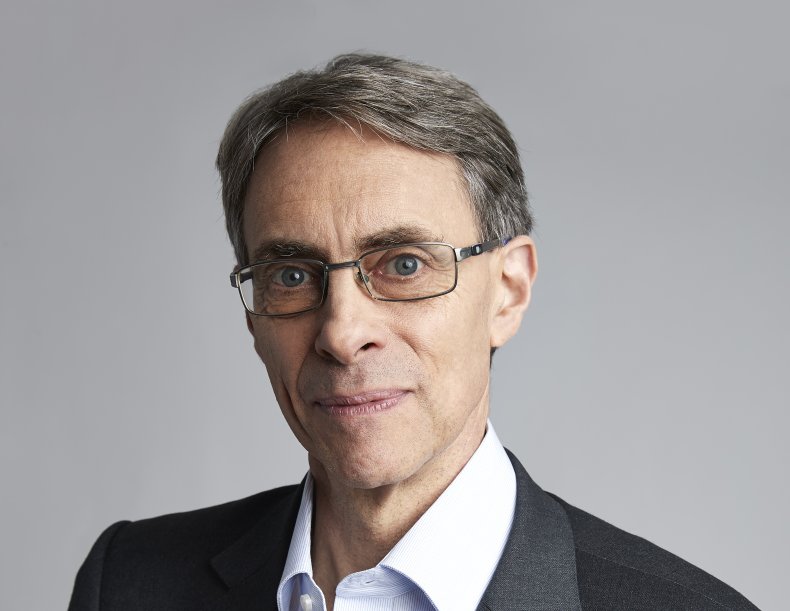
Kenneth Roth, executive director of Human Rights Watch
He also thinks India‘s Prime Minister Modi has got away with what he calls his systematic discrimination against the country’s 172 million Muslims because of the West’s desire to tap into Indian markets and use it as a counterweight against China, which Newsweek will be reporting on in the coming days.
Roth is highly critical of the Trump administration, accusing the president’s foreign policy of being driven by the guiding principle of “self-glorification” and only speaking out in defense of human rights when the offending country is a perceived adversary.
“Trump is utterly uninterested in calling out any human rights violation by anybody other than a handful of perceived adversaries, China, Venezuela, Iran, Nicaragua and Cuba and that’s about it, which is a completely unprincipled approach to human rights which does not attract any adherence and greatly weakens the force of US intervention,” he says. “Human Rights Watch has been living with Trump for four years now and we have already stopped relying on the U.S. as anything like a principled supporter of human rights.”
With the U.S. increasingly withdrawing from the world stage and with the European Union not really filling the void, as he says, is there a new approach to the defense of human rights emerging?
AFP reports from Geneva on 19 September how Belarus and several allies tried Friday to block a video message from opposition leader Svetlana Tikhanovskaya at the UN Human Rights Council, where she urged “the strongest” international response to Minsk’s abuses. Her short video message, in a rare urgent debate at the council, had barely begun before Belarus Ambassador Yuri Ambrazevich demanded it be switched off. He repeatedly interrupted the screening, raising procedural objections and insisting her words had “no relevance on the substance… on the events that are taking place today.”
Lukashenko, who has ruled the ex-Soviet state for 26 years and on Thursday warned of a possible “war” with some neighbouring countries, has turned to Russia for support.
“We have witnessed a brutal crackdown on peaceful protests,” said German ambassador Michael Freiherr von Ungern-Sternberg on behalf of the EU. He raised concerns at “reports of attacks on — and torture and cruel, inhumane or degrading treatment of — peaceful protesters as well as harassment, intimidation and detentions of opposition leaders.”
Minsk’s envoy Ambrazevich meanwhile slammed the “lopsided picture of reality presented by the losers in the election,” rejecting allegations of abuse by authorities. He insisted that protesters had been violent and had injured numerous police officers. Ambrazevich and his counterparts from Russia, Venezuela and China also voiced multiple objections to statements by the UN deputy rights chief Nada Al-Nashif and Anais Marin, the UN special rapporteur on the rights situation in Belarus, saying they had no place in the debate.
Marin told the council that more than 10,000 people had been “abusively arrested for taking part in peaceful protests”, and lamented that “over 500 cases of torture, committed by state agents, have been reported to us.” “I have been informed of allegations of rape, electrocution, and other forms of physical and psychological torture,” she told the council via video link, adding that the perpetrators appeared to be acting with “impunity“.
Friday’s debate ended with a vote approving a resolution submitted by the EU insisting that the vast array of serious abuses urgently require “independent investigation.”
The voting process was slowed down by Russia, which proposed 17 amendments to the text, all of which were rejected, and in the end the resolution was adopted unchanged by the 47-member council, with 23 in favour, 22 abstentions and only Venezuela and Eritrea voting against. The text calls on Belarusian authorities to “enable independent, transparent and impartial investigations into all allegations of human rights violations in the context of the election.” It also calls on Minsk to “guarantee access to justice and redress for victims as well as full accountability of the perpetrators.” And it calls on the office of UN rights chief Michelle Bachelet to closely monitor the situation in the country and to present her conclusions in a report during the next council session in March 2021.
The discussions mark only the sixth time in the council’s 14-year history that it has agreed to hold an “urgent debate” — a special debate within a regular session of the council.
An open letter has been signed by: Article 19, Assembly of Pro-Democratic NGOs of Belarus, Barys Zvozskau Belarusian Human Rights House, Belarusian Association of Journalists, Belarusian Helsinki Committee, Civil Rights Defenders, Human Constanta, Human Rights House Foundation, Human Rights Watch, International Federation for Human Rights (FIDH), La Strada International, Legal Initiative, Legal Transformation center (Lawtrend), Viasna Human Rights Center and World Organisation Against Torture (OMCT).
The UN Human Rights Council must urgently convene a special session to address the human rights crisis in Belarus. The joint letter expresses the organisations’ “utmost concern” over “widespread violations of human rights, including arbitrary arrests, prosecutions under trumped-up charges, and torture and other ill-treatment”.
The letter calls on the council to adopt a resolution requesting the UN High Commissioner for Human Rights to monitor and report on human rights abuses in Belarus with “a view to ensuring full accountability”.
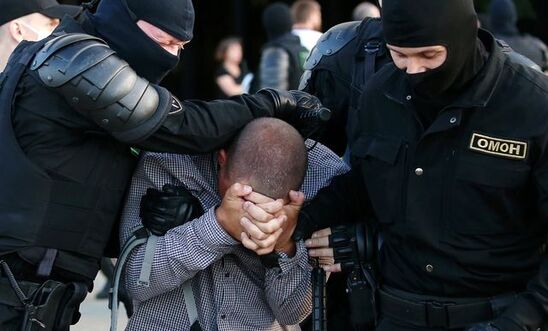
[In the three days after the 9 August presidential election, the authorities in Belarus confirmed the arrest of at least 6,700 protesters. According to Viasna Human Rights Center, at least 450 of the detainees reported being tortured or otherwise ill-treated – including through severe beatings, being forced to perform humiliating acts, being threatened with rape and other forms of violence – while held in incommunicado detention for up to ten days.
Since 12 August, the authorities have taken steps to de-escalate the situation, refraining from mass arrests and releasing those detained. However, the threats against peaceful protesters recently made by President Alyaksandr Lukashenka and his subordinates together with the recent deployment of the armed forces in the country’s capital Minsk and elsewhere, signal a possible new spiral of violence and accompanying human rights violations.]
The Human Rights House Foundation, in partnership with Barys Zvozskau Belarusian Human Rights House, will host on THURSDAY, AUGUST 13, 2020 AT 14 PM an on -line panel discussion with individuals closely following events on the ground. It will investigate what the European Union, United Nations, and individual states must do immediately to prevent further violence and seek a political solution to this growing crisis and how the international community should continue to occupy this space once this crisis moves off of the front pages.
On August 9, Belarusian President Alyasandr Lukashenka claimed a landslide re-election victory. This claim was widely anticipated, condemned by the political opposition, and met with large-scale peaceful protests across the country. Belarusian authorities responded with what international organisations label disproportionate violence against protesters. Since Monday, local human rights organisations report thousands detained, many of them arbitrarily, and facing further violence and abuse while in detention. More than 60 journalists – both domestic and foreign – have been arrested with the whereabouts of several unknown. In many ways, these early days of the post-election environment point towards a more violent crackdown than the country faced following the last presidential elections in 2010.
What can and should the international community do to pressure Belarusian authorities to cease their violent attacks on protesters and human rights defenders?
Speakers:
Anaïs Marin
UN Special Rapporteur on the human rights situation in Belarus
Oleg Kozlovsky
Amnesty International
Franak Viačorka
Vice President of the Digital Communication Network
Hanna Liubakova
Journalist, Outriders
Valiantsin Stefanovic
Viasna. Human rights in Belarus
and
Tanya Lokshina
Associate director, Europe and Central Asia, Human Rights Watch
Moderation by Dave Elseroad, Human Rights House Foundation.
Also today, 13 August 2020, 5 UN human rights experts strongly criticised Belarus for police violence against peaceful protesters and journalists and large scale detention following a controversial presidential election, and called on the international community to put pressure on Belarus to stop attacking its own citizens: https://yubanet.com/world/belarus-must-stop-attacking-peaceful-protesters-un-human-rights-experts-say/
In 6 August, 2020 HRF’s President sent a letter to the American hip hop artist Tyga pointing out that his performance is part of a plan to distract from the electoral fraud in the imminent election and prevent protesters from gathering at opposition rallies. The concert is organized and funded by the Belarusian dictatorship, led by Alexander Lukashenko. Under this regime, there is no freedom of speech, no freedom of assembly, and no freedom of association.
“This performance, scheduled for the day before Belarus’ elections, is no coincidence. It is an excuse to cancel the opposition’s final electoral rally, and prevent ordinary Belarusians from showing their support for freedom and democracy,” said HRF president Thor Halvorssen. “It is also a deliberate attempt to turn attention away from the massive electoral fraud that is already taking place across the country.” Belarus’ elections, which haven’t been free or fair since 1994, have been met with extreme repression. As HRF recounted in its letter to the performer: “Protestors are grabbed off the street at random, and many are beaten bloody. The two most popular candidates in the upcoming presidential election, Viktor Babryka and Sergei Tikhanouvsky, were both arrested on trumped up charges. Many opposition activists have had to flee the country, along with their children, after receiving threats from the government.” “Tyga has been an outspoken advocate of the Black Lives Matter movement. He has urged followers to vote in local elections and take to the streets in protest. His support for Lukashenko’s regime will greatly undermine the activism he has encouraged in the United States,and provide the Belarusian dictator a useful propaganda stunt,” said Halvorssen. “We hope he will stand on the side of the people of Belarus as opposed to their oppressor. He must decline the invitation to perform for the dictator.” HRF requested that Tyga cancel his concert and use this media opportunity to send an urgent and categorical message of encouraging support to protestors in Belarus.