A regional update on Asia is based on a submission to United Nations’ Human Rights Council by the Asian Legal Resource Centre (15 February) and a report of the Regional Consultation of Citizens’ Voices held in Kathmandu (25/26 February) held under the aegis of South Asians for Human Rights (SAHR).
The Asian Legal Resource Centre directs the attention of the Human Rights Council to the critical situation of human rights defenders in China, Bangladesh, and Thailand, who are facing dire threats to their person and profession: Read the rest of this entry »
I have not referred to this excellent initiative for a while. The Asian Human Rights Commission (AHRC) continues it visual reporting, Now already episode 106!: Read the rest of this entry »
The Asian Human Rights Commission(AHRC) in a press release of 18 December gave a short report of a meeting held on 12-14 December 2015, where 8 laureates of the Gwangju Prize for Human Rights, and human rights defenders from the Asian region participated in an international workshop on“Torture, Violence, and Enforced Disappearances in Asia” organized by Imparsial, IKOHI, and the May 18 Memorial Foundation, (Gwangju, South Korea). The speakers and the victims discussed the realities of human rights issues including torture and enforced disappearances and the implications for the justice institutions to address the problems: Read the rest of this entry »
On 27 February bdnews24.com in Bangladesh reported that the EU delegation said – at the end of three sub-groups meetings with the government – that victims of violence must get justice. The meetings discussed issues of governance, human rights and migration, trade and development cooperation under the framework of the 2001 Cooperation Agreement.
“Victims of violence deserve proper justice,” the EU said, pointing out that human rights’ is the “corner stone” of the EU-Bangladesh relations.
The EU delegation said the discussions between the Dhaka and Brussels were “open and constructive”. They exchanged views on a wide range of issues.
In particular, the need to protect the fundamental democratic rights of the people of Bangladesh was discussed, in view of the recent incidents of violence…The EU delegation also addressed the need to strengthen cooperation on democracy, governance and human rights, in particular, the implementation of the international human rights standards relating to the judiciary and freedom of expression.
Recent developments on rule of law, good governance, transparency, accountability for extrajudicial killings, freedom of the media, freedom of assembly and civil society were some of the issues of “mutual interest and concern” they discussed.
The focus of one sub-group meeting was labour rights, the rights of ethnic and religious minorities, the Chittagong Hill Tracts Peace Accord, the situation of the Rohingyas, women and children’s rights, the death penalty and migration issues. The EU reiterated the importance of protecting human rights defenders. Bangladesh’s membership of the UN Human Rights Council should be an opportunity to work more closely with the EU on promoting and protecting human rights.
“The EU and Bangladesh agreed to continue their dialogue on these issues.”
Recipients of the honorary awards given by Manusher Jonno Foundation, standing behind, with the guests sitting in front, in the capital’s Bangla Academy yesterday, at the award giving ceremony marking Human Rights Day. Photo: Star
A nice little item left-over from Human Rights Day 2014. How human rights awards play at the local level:
Ten human rights defenders from the grassroots level, two eminent social workers with international recognition, and a female football player were given honorary awards by Manusher Jonno Foundation (MJF) yesterday. The works of the activists focused on land rights, prevention of violence against women, child rights, and the rights of the indigenous people. The 10 grassroots activists were Jharna Ray, Madhobilata Chakma, and Nomita Chakma of Khagrachhari, Birendra Sangma of Mymensingh, Shafique Ullah of Noakhali, Kachhim Uddin of Tangail, Kananbala Gupta of Narail, Umme Kulsum Ranjana of Bogra, Kalpana Tirki of Rajshahi, and Rahela of Dinajpur.
Two social workers Jharna Dhara Chowdhury, chief of Noakhali’s Gandhi Ashram, and Angela Gomes, executive director of Bachte Shekha, were also honoured along with Bipasha Mali, a young footballer who was recently called to play on the national women’s football team.
Speaker Shirin Sharmin Chaudhury said, “They don’t work for recognition. Yet when we value their contributions, it makes us proud and we get inspiration to work.”
“I call on states to honour their obligation to protect human rights every day of the year. I call on people to hold their governments to account. And I call for special protections for the human rights defenders who courageously serve our collective cause,” UN Secretary-General stated in his message for Human Rights Day. There is so much to report on this day, that I decided to focus on stories from 4 Asian countries (China (Hong Kong), India, Thailand, Bangladesh) which give an impression (not more than that) of how Human Rights Day is reflected in the media.
The first article “Responsibility for the protection of human rights is in our hands” appeared in the South China Morning Post of Tuesday, 09 December, 2014
Coinciding with the 30th anniversary of the UN Convention against torture, the OMCT HAS launched its Campaign “10 Days of Activism against torture and ill-treatment” from the 1st to the 10th of December 2014. This is the first episode figuring human rights defender Adilur Rahman Khan, from Bangladesh. He was one of the 3 final nominees of the MEA 2014.
Adilur Rahman Khan addresses IBA annual conference in Tokyo, Japan. Photo: AHRC Press Centre
Bangladesh human rights defender Adilur Rahman Khan, of the human rights organisation Odhikar, has won the 2014 International Bar Association (IBA) Human Rights Award.
Adilur received the award from IBA President Michael Reynolds at the Rule of Law Symposium held at the conclusion of the IBA Annual Conference in Tokyo, which finished on 24 October. In October 1994, he founded the human rights organisation Odhikar, which has undertaken extensive fact-finding and reporting of human rights violations in Bangladesh. During the presentation of the award, Reynolds said, “Let us be reminded that lawyers play a vital role in promoting justice, human rights and upholding the rule of law, both at home and abroad. May Mr Khan’s courage, determination and resilience be an inspiration to lawyers everywhere.”In his acceptance speech, Adilur told the 200 delegates gathered at the Symposium, ‘The Rule of Law is under serious threat in my country. Justice for all the ongoing gross human rights violations is inaccessible for victims and their families. Their right to access to complaint mechanisms is denied, regardless of whatever is written in the laws or the Constitution of the country”. Repressive laws are in force and the independence of the judiciary is under attack in a spree of politicisation of institutions of the state, he added.
On 16 October 2014 the Inter-Parliamentary Union [IPU] announced that a former “prisoner of conscience”, the Bangladeshi Saber Hossain Chowdhury, was elected as new IPU president.
A former businessman with an education in law, politics and economics in the UK, President Chowdhury first became an MP in 1996 at the age of 35. He was also the youngest member of the government when he held two deputy ministerial posts in succession between 1999 and 2001. A political prisoner in the early 2000’s, he is described as a firm believer in the rule of law and human rights. He was involved in ground-breaking legislation to criminalize custodial torture in Bangladesh and to address domestic violence.
The ceremony of the Martin Ennals Award 2014 is over (7 October 2014). It was again very impressive to hear and see 3 courageous Human Rights Defenders being honored. Some 450 people (my estimate) gave standing ovations to the 3 nominees whose work was shown in impressive films produced for the occasion. The film portraits are already available on the website: http://www.martinennalsaward.org where there is also a short summary of the whole evening.
Martin Ennals Award for Human Rights Defenders
Especially the film on Chinese HRD Cao Shunli is a masterpiece given that the film makers had almost no images to work with due to the modesty of the human rights defender as well as her untimely death in detention only 2 days after her nomination in March 2014.
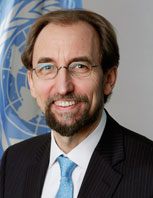
One of the nicest surprises was the address by Zeid Ra’ad Al Hussein, the United Nations High Commissioner for Human Rights at one of his first public appearances outside the UN. The High Commissioner gave a moving and almost poetic description of the sorry state of affairs left to human rights defenders to correct: He said inter alia: Read the rest of this entry »