International Human Rights Day 2017was celebrated all over the world by governmental and non-governmental entities alike. Here some cases of MIND THE GAP as reported in the media in Asia:
Cambodia:
The government celebrated Human Rights Day under the theme of ‘peace’, but 103 civil society groups spoke out against state ‘attacks’. KT/Mai Vireak
The government yesterday celebrated the 69th anniversary of International Human Rights Day under the theme of peace, while 103 civil society groups called for more protection for human rights defenders. Prime Minister Hun Sen posted on his Facebook page to say how the rights and freedoms of Cambodian people have been restored since the end of the Khmer Rouge regime in 1979: “December 10 is International Human Rights Day, which people all over the world celebrate. On January 7, 1979, the rights and freedoms of the Cambodian people were restored and have been until this day.”
Civil society meanwhile marked the day at different locations around Phnom Penh and in other provinces. A group of 103 civil society organisations issued a joint statement calling for justice and respect for human rights from the government. “On the occasion of International Human Rights Day, we, the undersigned members of Cambodian civil society, call for an end to government attacks on human rights defenders and civil society groups and the lifting of unjustifiable restrictions on fundamental freedoms,” the statement said.
Philippines:
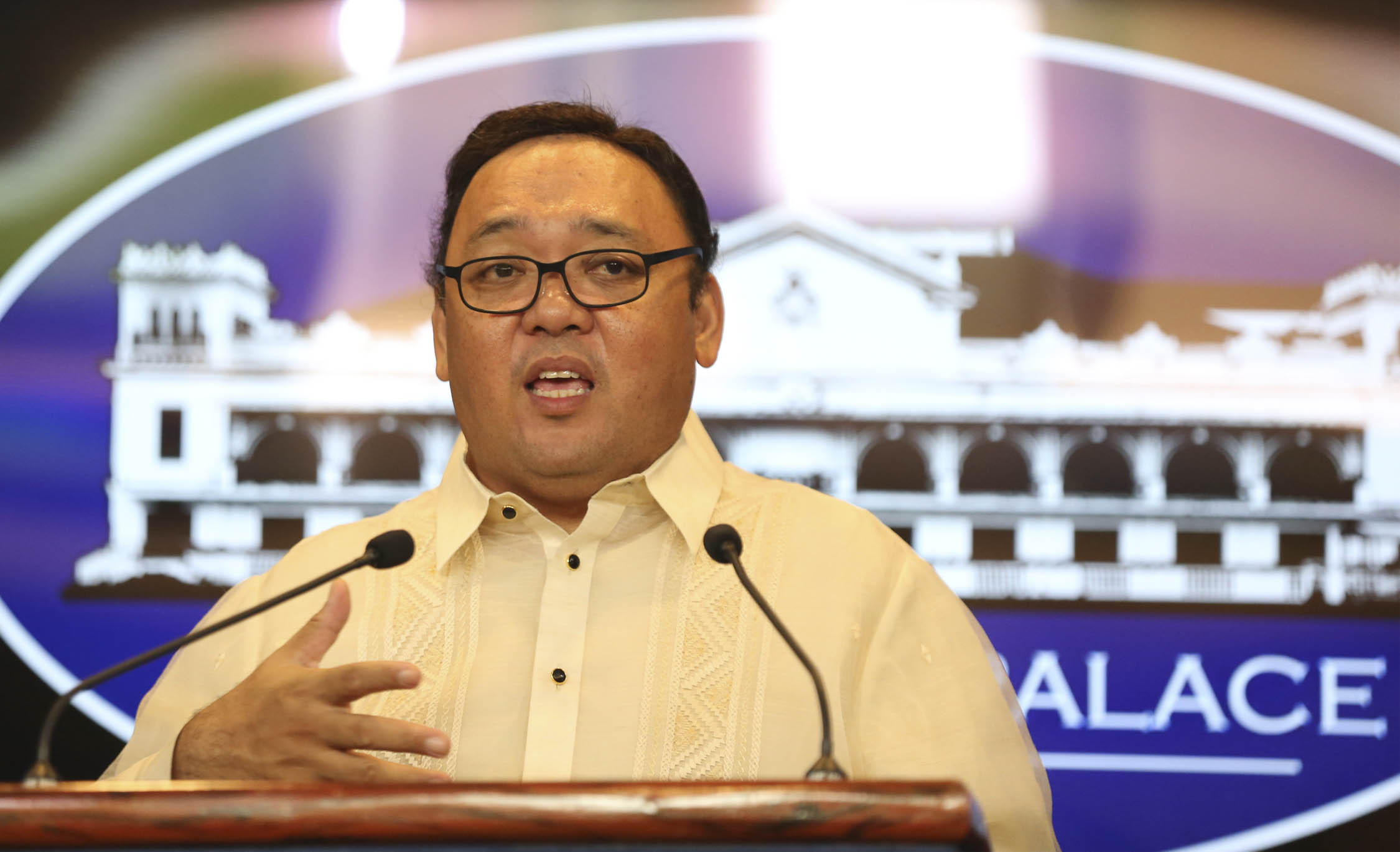
Presidential spokesperson Harry Roque INQUIRER PHOTO/JOAN BONDOC
On the observance of the International Human Rights Day, Presidential Spokesperson Harry Roque reiterated President Rodrigo Duterte’s commitment to uplift the lives of Filipinos, especially the poor, marginalized and vulnerable. Noting that the Philippines is an active member of the United Nations Human Rights Council and that respect for human rights is enshrined in the 1987 Constitution, Roque assured that the Duterte administration “works hard with the best interest of every Filipino.” ..“That direction is what inspires the government’s compliance with its human rights obligations. As a Nobel Peace Prize winner once said, ‘poverty is the absence of human rights” .
The Philippines has experienced a precipitous drop in basic human rights standards since President Rodrigo Duterte came to power last year, resulting in large, mass mobilizations across the country for the occasion of December 10, Human Rights Day. At least 12 rallies were held across the archipelago on Sunday, with human rights group KARAPATAN and progressive alliance BAYAN taking the lead alongside a range of like-minded groups calling for an end to what they describe as the U.S.-Duterte regime. In addition to over 13,000 small-time drug dealers and addicts killed during Duterte’s “war on drugs,” Karapatan has documented 113 victims of political killings, 81 victims of torture, 54,573 victims of threat, harassment, and intimidation, 364,617 who have suffered due to indiscriminate firing and aerial bombing, and 426,170 internally displaced who were subject to forced evacuation.
Turkey:
Turkish President Recep Tayyip Erdogan. Photo: AA
“Respect for human rights based on the principles of equality and non-discrimination of individuals before the law is the irreplaceable nature of the Republic of Turkey,” said Erdogan, according to state-run Anadolu Agency, on the occasion of Human Rights Day on Sunday. Erdogan specifically referenced Turkey’s commitment to “all oppressed people and victims from Palestine to Syria and Asia to Africa.”
National Human Rights Commission (NHRC) commissioner and human rights defender Angkhana Neelaphaijit said that despite the government’s claim that it cherished human rights and had made them a priority, in reality it had done nothing to do so.
Angkhana Neelaphaijit
Thailand is still far from its goal of valuing human rights since the junta’s policies and actions have eroded rights, while many people do not even understand the principle. Prominent Thai campaigners marked Human Rights Day yesterday to lament that the country was still far from its professed goal of ensuring everyone was accorded the freedoms they deserve. The nation’s most severe human rights violation was the lack of freedom of expression, they said in an appeal to the National Council for Peace and Order (NCPO) to restore democracy to truly guarantee human rights for every citizen. They also said Thailand faced many serious human rights crises. For instance, social movements across the country continued to be suppressed by authorities, the justice system was being used against human rights defenders, and many people in society still did not understand human rights and harmed others. National Human Rights Commission (NHRC) commissioner and human rights defender Angkhana Neelaphaijit said that despite the government’s claim that it cherished human rights and had made them a priority, in reality it had done nothing to do so. On the contrary, Angkhana said the government was doing the very opposite, enforcing many laws and regulations that violated human rights and curbing the activities of campaigners, both through law enforcement and by force. In effect, the regime was deepening Thailand’s human rights crisis, she said.
Pakistan:
Message by Foreign Minister of Pakistan : ”On behalf of the people and Government of Pakistan, I wish to reiterate our strong commitment to promote and protect human rights and fundamental freedoms, as well as needs. Pakistan has demonstrated its resolve by enacting wide ranging legislation, establishing strong institutional machinery and putting in place robust policy measures in the field of human rights. Pakistan’s Constitution serves as an anchor and guarantor of fundamental freedoms and human rights of all Pakistanis. The Government of Pakistan accords high priority to advancing mutually reinforcing objectives of development, human rights and democracy…This year is also significant for Pakistan in the field of human rights. Pakistan actively engaged with the UN human rights institutions and partners through regular submission of national reports, participation in review processes and implementation of recommendations arising from such mechanisms. Pakistan filed reports and participated in the review mechanism of three international treaty bodies, namely CAT, ICESCR and ICCPR. Pakistan also successfully presented its third national report on Universal Periodic Review (UPR) on 13 November 2017. This level of engagement, participation and contribution demonstrates Pakistan’s commitment as well as actions to advance the cause of human rights. Pakistan’s success as the newly elected member of the Human Rights Council (HRC) this year is a testimony to the confidence reposed in Pakistan by the international community as a consensus builder within the international human rights policy framework.
The struggle against enforced disappearance was seen in Sindh alone while though there have been cases of missing persons in other provinces but Sindh has dared to raise voice against such violations of human rights. These views were expressed at a seminar on occasion of Human Rights Day organized here by SAFWCO and Social Change. Noted Human Rights activist and lawyer Faisal Siddiqui said only voice against forced disappearances was being heard from Sindh while voice of Balochistan has been crushed with force. Though many persons were missing in KPK and Punjab but from there no voice is heard. He said our judiciary has come out of colonization era and was giving right decisions. He said it was he who had filed petition in SHC for IG Sindh A.D.Khwaja. He said he was harassed for being advocate against Baldia Factory burning of 258 persons, Shahzeb Jatoi case and other cases for which he was harassed and could not open his office for many months. He said now powerful forces were active human rights. The gathering paid tributes to Pubhal Saryo, convener of missing persons forum who was whisked away by agencies and released after more than 2 months. Punhal Saryo said it has become very difficult to work for human rights in situation where human rights defenders were also not safe.
—————–
The Asian Federation Against Involuntary Disappearances (AFAD) has won the Asia Democracy and Human Rights Award 2016 for its efforts to resolve the problem of forced disappearances in Asia.
“AFAD has made indelible contributions in pushing states to address the rights of families of the disappeared and in seeking justice for the victims,” said Legislative Speaker Su Jia-chyuan, chairman of the Taiwan Foundation for Democracy. He said that AFAD was a major force behind the UN’s adoption in 2006 of the International Convention for the Protection of All Persons from Enforced Disappearances, and has in recent years been active in lobbying Asian governments to sign and ratify the convention.
[Su said that many instances of politically motivated disappearances also occurred in Taiwan when the nation was under authoritarian rule. As someone who took part in rescue missions for missing people at that time, Su said he could deeply empathize with the fear experienced by the victims’ families and the hardships faced by human rights organizations in authoritarian nations.]
Founded in 1998 in Manila, AFAD facilitates searches for people who are abducted or imprisoned by a state or political organization, and works to ensure the attainment of truth, justice, redress and the reconstruction of the collective memory of the missing. Recipients of the award include Reporters Without Borders, Rescue Foundation of India, End Child Prostitution, Child Pornography and Trafficking of Children for Sexual Purposes International, as well as Kim Seong-min, founder and director of Free North Korea Radio. The award comes with a prize of US$100,000.
The Asian Forum for Human Rights and Development (FORUM-ASIA), together with the Martin Ennals Award and the Right Livelihood Award, will host a panel discussion on the 25th Anniversary of its founding and 10th Anniversary of its presence in Geneva, entitled ‘50 Years of the International Bill of Human Rights and 10 Years of the UN Human Rights Council – What does this mean for Asia?’, on 16 November 2016 at 18:30 at the Ivan Pictet Auditorium, Maison de la Paix, in Geneva, Switzerland.
Nathalie Margi writes in Open Democracyof 6 December 2015 that throughout Southeast Asia, hundreds of women environmental human rights defenders have been jailed, attacked and defamed as threats to “national security”. They remain without adequate resources, protection and funding for their work. In the piece entitled “Defending land and community: women on the frontlines of climate justice”, she says inter alia: Read the rest of this entry »
In a few recent posts I drew attention to the trend of shrinking space for NGOs in countries such as Russia, Kyrgyzstan and Cambodia [https://thoolen.wordpress.com/2015/05/21/draft-laws-on-civil-society-restrictions-also-pending-in-kyrgyzstan-and-cambodia/]. On 9 May 2015, The Economist’s column on Asia (Banyan) was devoted to the same issue, concluding that “Democratic Asian governments as well as authoritarian ones crack down on NGOs“. Under title “Who’s afraid of the activists?” it mentions China, Cambodia, India, Pakistan, Sri Lanka, Bangladesh, Kyrgyzstan and Tajikistan.
It lists the usual ‘complaints’ that both authoritarian and democratic leaders use against the activities of NGOs, which range from:
threats to national sovereignty
promotion of ‘Western’ values
hidden agenda (such as conversion to Christianity)
blocking development through environmental objections.
E.g. the Indian home ministry claims that 13 billion $ in foreign money has gone to local charities over the past decade and that 13 of the top 15 donors were Christian outfits. Interestingly, similar complaints come from the biggest Indian NGO, Rashtriya Swayamsevak Sangh (RSS), which itself has “strong foreign links, draws on an Indian diaspora in America and elsewhere for support, and dishes out help across borders, such as in Nepal following last month’s earthquake”.
Quite rightly the article concludes that in the long run, such limitations only rally political opponents, while (local) NGOs may face close scrutiny themselves one day (when the Government has changed hands): “Battering-rams, after all, have two ends.”
encouraging new legislation in Sindh Province in Pakistan, banning child marriage under 18-years of age.
disturbing footage of police torture in Jammu and Kashmir with a report of India’s “gangsters in uniform”.
talk with prominent Indian social activist Harsh Mander about the serious violence that rocked western Assam earlier this month including some shocking footage shot by a survivor in one of the worst affected villages.
Back in Pakistan’s Punjab province, fake police encounter killings continue. This time, however, one of the victims was still alive and desperately crying for help when he was dumped at the morgue.
Trigger-happy security personnel in Papua, Indonesia, have injured several civilians when police opened fire on protesters.
Rule of Law in Bangladesh, as the notorious Rapid Action Battalion is accused of further abductions and murders.
Finally, in Voices of Survivors this week, courageous journalist Tongam Rina from Arunachal Pradesh, India. Tongam Rina was shot and critically injured in 2012.
The AHCR welcomes both human rights feeds to be considered for weekly news bulletin and your suggestions to improve the news channel. Please write to news[at]ahrc.asia.
The 24th Episode of the Human Rights Asia Weekly Roundup by the AHRC covers the encouraging peace agreement which has been signed in Mindanao, putting an end to a 40-year-old conflict between the Moro Islamic Liberation Front and the Philippine government.
In Qatar, hundreds of migrant workers have died in the slavery-like labour conditions on FIFA World Cup construction projects.
Indonesian, MP candidates for the upcoming elections met with Hong Kong’s domestic helpers to discuss improving protections and rights.
In India, the Supreme Court ordered for a time-bound adjudication of all trials involving legislators within a year. This is the first of a series of reports on court delays and what it means for justice in India.
India is the biggest importer of arms in the world while millions still lack basic health care. AHRC calls for the country to reconsider its priorities.
Voices of Survivors: this week hears from Hechin Haokip who was displaced from her mountain village in Manipur because of the on-going conflict but has managed to get back on her feet and help many vulnerable people in her community through human rights activism.
Teenager in Pakistan who set herself on fire when the men who gang raped her were released after bribing the police.
Manipuri hunger striker Irom Sharmila, who has spent 14 years protesting the Armed Forces Special Powers Act (AFSPA), is released and re-arrested in what is now an annual ritual; Manipuri human rights defender Babloo Loitongbam further discusses the AFSPA in relation to the upcoming elections in India.
Basil Fernando talks about the arrests of human rights defenders in Sri Lanka, just as the UN Human Rights Council has proposed a new landmark resolution to investigate war crimes committed by both sides during the end of the war in Sri Lanka.
Kerala lawyer R.K Asha describes her police torture ordeal from her hospital bed.
A disturbing report from Thar district in Pakistan, where children are starving to death while the relief wheat meant for them remains unused and is rotting in storage.
In Voices of Survivors: this week we hear from Biman Bose in Assam, India, who has fought a decades-long battle for justice after brutal torture costing him his livelihood.
The bulletin can be watched online at AHRC YouTube. The AHRC welcomes both human rights feeds to be considered for weekly news bulletin and suggestions to improve the news channel: news[at]ahrc.asia.



 The struggle against enforced disappearance was seen in Sindh alone while though there have been cases of missing persons in other provinces but Sindh has dared to raise voice against such violations of human rights. These views were expressed at a seminar on occasion of Human Rights Day organized here by SAFWCO and Social Change. Noted Human Rights activist and lawyer Faisal Siddiqui said only voice against forced disappearances was being heard from Sindh while voice of Balochistan has been crushed with force. Though many persons were missing in KPK and Punjab but from there no voice is heard. He said our judiciary has come out of colonization era and was giving right decisions. He said it was he who had filed petition in SHC for IG Sindh A.D.Khwaja. He said he was harassed for being advocate against Baldia Factory burning of 258 persons, Shahzeb Jatoi case and other cases for which he was harassed and could not open his office for many months. He said now powerful forces were active human rights. The gathering paid tributes to Pubhal Saryo, convener of missing persons forum who was whisked away by agencies and released after more than 2 months. Punhal Saryo said it has become very difficult to work for human rights in situation where human rights defenders were also not safe.


 Hans Thoolen on Human Rights Defenders and their awards