Hans Thoolen on Human Rights Defenders and their awards

share information on human rights defenders, with special focus on human rights awards and laureates


Posts Tagged ‘Algeria’

« Older posts
Newer posts »

Results 49th session Human Rights Council as seen by NGOs

April 15, 2022

13 organisations – including the ISHR – have shared reflections on the key outcomes of the 49th session of the UN Human Rights Council, as well as the missed opportunities to address key issues and situations. . Full written version below [see also: https://humanrightsdefenders.blog/2022/02/21/guide-to-49th-session-of-human-rights-council-with-human-rights-defenders-focus/:

We stand in solidarity with human rights defenders in Ukraine, as well as those in Russia and around the world striving for peace, justice and accountability.

We welcome the Council’s swift response to the devastating human rights consequences of Russia’s aggression against Ukraine, setting up a strong accountability mechanism. The war in Ukraine represents the latest in a growing regional human rights crisis and the action taken by the Council to establish this accountability mechanism is an important step. 

Since the Council took action in response to Russia’s invasion of Ukraine, Ukrainian human rights defenders have documented evidence of violations that may amount to war crimes, including indiscriminate attacks, forced deportation of Ukrainians to Russia, abductions and disappearances of political activists and human rights defenders, and the intentional targeting of local political figures, journalists, civilians, and civilian infrastructure. While we welcome the Council’s initial response, it is imperative that the Council remain diligent and responsive to situational needs, including a potential special session prior to HRC50 should the situation in Ukraine continue to deteriorate.

Every human rights situation must be dealt with on its merits, with Council members ensuring a principled and consistent application of international law and standards, including in all situations of occupation. It is imperative that the Council uses all available tools to ensure the fulfilment of the inalienable right to self-determination of the Palestinian people as a whole struggling against Israel’s apartheid,  and to act with urgency to support Palestinian civil society in a context of mounting repression.

We recall the mounting recognition of Israel’s imposition of an apartheid regime over the Palestinian people, including by the UN Special Rapporteur Michael Lynk, but also prior to his historic report, in a joint statement by 47 UN Special Procedures which stated that “above all, the Israeli occupation has meant the denial of the right of Palestinian self-determination.” In a joint statement at this session,  90 organisations reiterated that “Double standards on this matter, including those propagated by Europe and the United States, severely undermine the effectiveness and legitimacy of international human rights and humanitarian legal standards. For 73 years, the international community has enabled Israeli impunity and failed to hold Israeli perpetrators accountable for serious crimes against Palestinians.  Accountability is long overdue.”

This Council must also urgently act to dismantle systemic racism in border control and migration governance and play its role in upholding all human rights for all at international borders, including the right to seek asylum. All human beings crossing European borders from Ukraine are fleeing the same dangers. We deplore the discrimination and violence against Africans and other racialized groups fleeing Ukraine, as well as the different approach taken towards refugees fleeing other conflicts.

We welcome the Council’s decision to extend the mandate of the OHCHR Examination on Belarus. We remind the Council that the original Examination did not start its work for a number of months which resulted in delays in documenting and analysing evidence of human rights violations committed in the context of Belarus’s 2020 presidential elections. We are concerned by reports that the Examination will be moved from Geneva to Vienna and delays which could result from such action. We encourage the Council to engage with OHCHR to ensure that the Examination rolls over without delay.

We welcome attention paid to the issue of transitional justice in the Democratic Republic of Congo in the context of the interactive dialogue at this session, and stress that any meaningful transitional justice process must include a judicial mechanism with a strong international component to hold perpetrators to account.

While we welcome the renewal of the Special Rapporteur on Iran, we urge the Council to revisit its business as usual approach to the human rights situation in Iran. We regret that the resolution fails to contain any substance on the situation of human rights in the country, a situation that is unique for country resolutions under item 4. As noted by the Special Rapporteur in his report to this Council, “institutional impunity and the absence of a system for accountability for violations of human rights permeate the political and legal system of the Islamic Republic of Iran.” We furthermore urge the Council to answer the Special Rapporteur’s appeal for “the international community to call for accountability with respect to long-standing emblematic events that have been met with persistent impunity”.

It is clear from its interim report to this Council that the Fact-finding Mission for Libya must be renewed in June, ideally for a period of two years.  Much more work needs to be done to promote the institutions necessary for accountability in the country. 

We welcome the adoption of the resolution on Myanmar – by consensus – maintaining enhanced monitoring and reporting on the ongoing crisis, and with calls for suspension of arms transfers to Myanmar as a necessary step towards preventing further violations and abuses of human rights.

We celebrate the establishment of a Group of Human Rights Experts on Nicaragua, as the repression intensifies, and the government does not show any willingness to cooperate with the UN. The Group’s mandate to investigate human rights violations since April 2018, including root causes and intersectional forms of discrimination, identify perpetrators, and preserve evidence, will pave the way for future accountability processes, putting victims at the heart of the Council’s response.

We welcome the adoption of the resolution on human rights defenders and we stress that recognizing and protecting human rights defenders involves not only their holistic and security protection but also recognition of the important work they do in conflict and post-conflict situations. We also welcome the reference of the impact of arms transfers in this resolution, but regret a more substantive reference could not be made in the operational paragraphs. We also regret that child human rights defenders have not been included in the resolution despite the strong request from many States.

We welcome the leadership of Uruguay, on behalf of GRULAC, and the EU on the resolution on the rights of the child and family reunification in the context of migration and armed conflict, ensuring a strong focus on children as rights holders, prevention of family separation and the establishment of effective and accessible family reunification procedures. We are concerned once again, by the attempt to weaken the text on child participation through amendments. Finally, we regret that the resolution does not include a clear reference to the existing standards on prohibition of child immigration detention, and that the important recognition, especially in the context of the resolution, that various forms of family exist was not retained in the text. 

We welcome the extension of the mandate of the Special Rapporteur for the promotion and protection of human rights while countering terrorism, although we regret that the resolution does not clearly stress the need for additional resources to the mandate due to its necessary focus on activities of UN on counter-terrorism in New York. We recognise the important analysis on states of emergency that was very relevant during the pandemic.

We welcome the adoption of the resolution on disinformation. The resolution reaffirms the central role of the right to freedom of expression in countering disinformation and stresses that censorship cannot be justified to counter disinformation, including through Internet shutdowns or vague and broad laws criminalising disinformation.  It also draws attention to the role of algorithms and ranking systems in amplifying disinformation. We urge States to follow the approach of the resolution and counter disinformation through holistic measures, including by ensuring a free, independent, plural and diverse media, protecting the safety of journalists, and promoting access to information held by public bodies.

Whilst underlining the importance of protecting the independence of the OHCHR and ensuring there is no state interference in its work, we welcome the resolution on promoting and protecting economic, social and cultural rights within the context of addressing inequalities in the recovery from the COVID-19 pandemic, its emphasis on austerity measures and policies imposed by International Financial Institutions (IFIs) and its impact on economic, social and cultural right. We regret the language calling out IFIs was not stronger and in this regard encourage the workshop that will be convened by the High Commissioner to address the specific impacts of austerity measures imposed by IFIs on human rights specifically on recovery from COVID 19 Pandemic. 

We welcome reports 49/68 on […] prevention and technical assistance and capacity-building, and 49/88 on the contribution of […] all human rights […] to achieving the purposes and upholding the principles of the UN Charter – they emphasized how the Council and the broader human rights community can work more effectively and coherently across all UN pillars to sustain peace – including through systematically integrating human rights in UN common analysis and programming, and increasing synergies between UN pillars; and ensuring human rights are at the centre of a new social contract.

We regret that the Council failed to respond to several human rights situations.

In the context of new heights of repression threatening the survival of independent civil society in Algeria, we welcome the High Commissioner’s call on the Government of Algeria to take all necessary steps to guarantee its people’s rights to freedom of speech, association and peaceful assembly, to which we add the right to freedom of religion or belief. Special Procedures have repeatedly warned about increasing crackdown on religious minorities, in the context of a sustained crackdown on civil and political freedoms.

We note the High Commissioner’s announced visit to China, while expressing concerns at the lack of transparency over agreed terms for unfettered access. We recall precedents that cast shadow over the possibility that the Chinese authorities indeed allow genuine unrestricted access and inquiry, across the country. We deplore her Office’s lack of coherence in responding to serious human rights violations in China, as this Council still awaits a long-promised report on grave violations in Xinjiang, the Uyghur region, with no further indication on its protracted release.

We express deep disappointment in a lack of follow up by States to the joint statement condemning widespread violations in Egypt delivered last March.   The Egyptian human rights movement and independent rights NGOs continue to face a real and imminent threats to their existence.  The authorities continue to misuse counterterrorism laws to arbitrarily detain thousands, including hundreds of human rights defenders, activists, political opponents and journalists, while systematically resorting to enforced disappearances and torture. Judges continue to sentence hundreds of defendants following their convictions as a result of unfair criminal trials, including to death, amid an alarming spike in executions since late 2020.  Given the failure of the Egyptian authorities to meaningfully address the on-going human rights crisis and tackle impunity for crimes under international law and other serious human rights violations, we strongly urge follow up action at this Council.  The price of silence is too high.

It is unfortunate that the Council did not take steps to respond to the substantial and growing attacks on human rights on the territory of the Russian Federation. Since Russia launched its war against Ukraine, the authorities have further clamped down on the freedoms of assembly, association, and expression and made legitimate human rights work increasingly difficult. Peaceful protest is effectively forbidden. Independent media are forbidden from printing facts and required to solely report government narratives. Two decades of repression against independent civil society, journalists, and human rights defenders laid the groundwork for the authorities to be able to launch an unprovoked attack against Ukraine and the Council has a responsibility to respond accordingly. We demand that the Council establish a Special Rapporteur on the situation of human rights in Russia at its soonest opportunity.

Finally, we call on the UN General Assembly to suspend Russia’s rights of membership of the Council for committing widespread, gross and systematic human rights violations, some amounting to war crimes.

Signatories: International Service for Human Rights, Asian Forum for Human Rights and Development, Cairo Institute for Human Rights Studies, Human Rights House Foundation, Centro de Estudios Legales y Sociales, CIVICUS: World Alliance for Citizen Participation, International Commission of Jurists, International Bar Association’s Human Rights Institute (IBAHRI),  Women’s Centre for Legal Aid and Counselling, Gulf Centre for Human Rights, child rights connect, Habitat International Coalition, FIDH.

https://ishr.ch/latest-updates/hrc49-civil-society-presents-key-takeaways-from-human-rights-council/

Posted in human rights | 2 Comments »
Tags: 49th session of the UN Human rights council, Algeria, apartheid, Egypt, Human Rights Defenders, ISHR, Israeli–Palestinian conflict, Russia, special rapporteurs, suspension membership Council, Ukraine

Shocking case of refoulement from Spain

March 31, 2022

On 30 March 2022, Statewatch along with 13 other human rights organisations condemned the deportation from Spain to Algeria of Mohamed Benhalima, a human rights activist who faces a serious risk of torture and other ill-treatment in the North African state.

The organisations strongly condemn the deportation by Spain of Algerian activist Mohamed Benhalima, in the evening of 24 March 2022, despite the risks of torture and serious human rights violations he faces in Algeria, and therefore in blatant violation of Spain’s international obligations on non-refoulement. The authorities had been made aware, through civil society and legal appeals, that Mr Benhalima faces a high risk of torture, arbitrary detention and unfair trial in Algeria, where such violations are increasingly common against prisoners of opinion and peaceful activists.

Mohamed Benhalima is an Algerian citizen and a former Army corporal turned whistleblower, who exposed corruption among Algeria’s high-ranking military officials in 2019. He left Algeria after receiving information that his name was on a list of wanted military officials at risk of detention by the Algerian army for their participation in the Hirak, a mass pro-democracy protest movement.

He sought asylum in Spain on 18 February 2020 and again on 18 March 2022; Spain refused him asylum both times. On 14 March 2022, authorities opened an administrative file of expulsion for infringement of Art. 54.1.a. of Immigration Law 4/2000, alleging that Mr. Benhalima took part in “activities contrary to public security or which may be harmful for Spanish relationships with foreign states”.

Spanish authorities justified the opening of an expulsion file based on Mr. Benhalima’s alleged association with political opposition group Rachad, which was listed as a terrorist group by Algeria on 6 February 2022. Spanish authorities claimed that Rachad’s objective was to infiltrate radical youth into Algerian society to protest against the Algerian government, and concluded that the activist was a member of a terrorist group.

Authorities did not provide any proof of violent action or speech or any other action taken by the activist that would fall under a definition of terrorism in accordance with the definition proposed by the UN Special Rapporteur on the protection of human rights while countering terrorism. Authorities also do not appear to have considered a context in which Algerian authorities have been increasingly levelling bogus terrorism and state security charges against peaceful activists, human rights defenders and journalists since April 2021. On 27 December 2021, UN Special Procedures warned that the definition of terrorism in the Algerian Penal Code was too imprecise and undermined fundamental rights. They stated that the procedure for registration on the national terrorist list did not comply with international human rights standards and expressed concern that it could give rise to abuse.

On 24 March around 7pm, Mr. Benhalima’s lawyers were notified of the resolution of expulsion and promptly filed a request for an interim suspensive measure at the National Court of Spain, which was rejected; however, it was revealed later that the activist was already on his way to Algeria at the time.

On 21 March 2022, the UN High Commissioner for Refugees (UNHCR) submitted a non-public report to the Spanish government stating that Mr. Benhalima’s asylum request should be studied thoroughly in a regular procedure and not rejected expediently, arguing that the fear of torture was credible and that Algeria’s criminalisation of peaceful opposition was internationally recognised.

On 27 March, Benhalima appeared in a video broadcasted on Ennahar TV, in which he “confesses” to the crimes of conspiracy against the state, and states that he was not treated badly in custody. However, the undersigned organisations call into question the reliability of such statements which might be the result of duress. In addition, Benhalima had himself released a video from the retention centre in Valencia, before his deportation to Algeria, in which he warns that such videos would not be genuine and would show that he “was subjected to severe torture at the hands of intelligence services.”

In January and March 2021, in Algeria, Mohamed Benhalima was sentenced in absentia to a total of 20 years in prison for charges including “participation in a terrorist group” (Article 87bis 3 of the Penal Code) and “publishing fake news undermining national unity” (Art.196 bis) among other charges. The overly broad formulation of both articles has been used by Algeria repeatedly to criminalise fundamental freedoms. In one of the verdicts, issued on 9 March 2021, the judge sentenced Benhalima to 10 years in prison for his online publications, including videos exposing corruption in the army, a form of peaceful expression, which is protected under the right to freedom of expression.

Spanish authorities additionally motivated the expulsion based on Mr. Benhalima’s close relationship with Mohamed Abdellah, another Algerian whistleblower and former member of the military, who also sought refuge in Spain in April 2019 and was forcibly returned on 21 August 2021 using Art. 54.1.a. of Law 4/2000, in similar circumstances and for the same motives.

Mohamed Abdellah, currently detained in the military prison of Blida, stated in court on 2 January 2022 that he had been subjected to various forms of torture and ill-treatment upon his return to Algeria, including prolonged solitary confinement in a cell with no light and physical abuse, according to a witness who attended the hearing. He was also deprived of access to a lawyer.

Despite the strong similarities between both cases providing a compelling precedent about the actual risk of torture and ill treatment of activists and whistleblowers, notably former members of the military, in Algeria, the Spanish government showed its determination to forcibly return someone where their physical and psychological integrity was not guaranteed. In doing so, Spain flouted critical international law obligations under which nobody should be returned to a country where they would be in danger of suffering torture or other cruel, inhuman or degrading treatment.

Signatures

  • MENA Rights Group
  • Justitia Center for legal protection of human rights in Algeria
  • World Organisation Against Torture
  • Red Jurídica
  • CIHRS
  • Amnesty International
  • Irídia, Center for Human Rights
  • Collectif des familles de disparus en Algérie
  • Al Karama
  • Statewatch
  • Spanish Commission for Refugees – CEAR
  • Euromed Rights
  • Alianza
  • ActionAid

https://www.statewatch.org/news/2022/march/spain-forsakes-international-obligations-in-appalling-refoulement-of-algerian-whistleblower/

https://www.aljazeera.com/features/2022/4/6/rights-defenders-slam-spains-deportation-of-algerian-dissident

Posted in AI, human rights, Human Rights Defenders, OMCT | Leave a Comment »
Tags: Algeria, asylum, expulsion, forced confession, Mohamed Benhalima, non-refoulement, Spain, Statewatch, terrorism and human rights, torture, whistleblower

Results of 47th session of the Human Rights Council

August 7, 2021

The ISHR and 17 other organisations (see below for their names) share reflections on the key outcomes of the 47th session of the UN Human Rights Council, as well as the missed opportunities to address key issues and situations. See also: https://humanrightsdefenders.blog/2021/06/22/key-issues-affecting-hrds-in-47th-session-of-un-human-rights-council-june-2021/

CIVIL SOCIETY PARTICIPATION

We deplore the systemic underfunding of the UN human rights system and the drive for so-called efficiency, including the cancellation of general debates in June, which are a vital part of the agenda by which NGOs can address the Council without restrictions. We call for the reinstatement of general debates at all sessions, with the option of civil society participation through video statements.  We welcome the focus of the civil society space resolution on the critical role played by civil society in the COVID-19 response, and the existential threats to civil society engendered or exacerbated by the pandemic. For the resolution to fulfil its goal, States must now take action to address these threats; while we welcome the broad support indicated by a consensus text, this cannot come at the cost of initiatives that will protect and support civil society.

HUMAN RIGHTS ONLINE

We welcome a resolution on the promotion, protection and enjoyment of human rights on the Internet and its thematic focus on bridging digital divides, an issue which has become ever-important during the COVID-19 pandemic. We urge all States to implement the resolution by taking concrete measures to enhance Internet accessibility and affordability and by ceasing Internet shutdowns and other disruptions, such as website blocking and filtering and network throttling. In future iterations of the text, we encourage the core group to go further in mentioning concrete examples that could be explored by States in adopting alternative models for expanding accessibility, such as the sharing of infrastructure and community networks.  We welcome the resolution on new and emerging digital technologies and human rights, which aims to promote a greater role for human rights in technical standard-setting processes for new and emerging digital technologies, and in the policies of States and businesses. While aspects of the resolution risk perpetuating “technology solutionism”, we welcome that it places a stronger focus on the human rights impacts of new and emerging digital technologies since the previous version of the resolution, such as introducing new language reiterating the importance of respecting and promoting human rights in the conception, design, use, development, further deployment and impact assessments of such technologies.

GENDER EQUALITY AND NON-DISCRIMINATION

We are concerned by the increasing number of amendments and attempts to weaken the texts. We are particularly concerned by the continued resistance of many States to previously adopted texts and States’ willful misinterpretation of key concepts related in resolutions on human rights in the context of HIV and AIDS, accelerating efforts to eliminate all forms of violence against women and girls: preventing and responding to all forms of violence against women and girls with disabilities and preventable maternal mortality and morbidity and human rights on maternal morbidities. We deplore the instrumentalising of women’s rights and sexual and reproductive health and rights. We encourage States to center the rights of people most affected and adopt strong texts on these resolutions. We welcome the resolution on menstrual hygiene management, human rights and gender equality as the first step in addressing deep-rooted stigma and discrimination. We urge all States to address the root causes for the discrimination and stigma on menstruation and its impact.

RACIAL JUSTICE AND EQUALITY

The High Commissioner’s report highlighted the long-overdue need to confront legacies of slavery, the transatlantic trade in enslaved Africans and colonialism and to seek reparatory justice. We welcome the historic consensus decision, led by the Africa Group, to adopt a resolution mandating an independent international expert mechanism to address systemic racism and promote racial justice and equality for Africans and people of African descent. The adoption of this resolution is testament to the resilience, bravery and commitment of victims, their families, their representatives and anti-racism defenders globally. We deplore efforts by some Western States, particularly former colonial powers, to weaken the text and urge them to now cooperate fully with the mechanism to dismantle systemic racism, ensure accountability and reparations for past and present gross human rights violations against Black people, end impunity for racialized State violence and address the root causes, especially the legacies of enslavement, colonialism, and the transatlantic trade in enslaved Africans.

MIGRANTS RIGHTS

Whilst we welcome the return of a resolution on human rights of migrants, we deplore the continued failure of the Council to respond meaningfully to the severity and global scale of human rights violations at international borders including connected to pushbacks. International borders are not and must not be treated as places outside of international human rights law. Migrants are not and must not be treated as people outside of international human rights law. Expressions of deep concern in interactive dialogues must be translated into action on independent monitoring and accountability.

ARMS TRANSFERS AND HUMAN RIGHTS

We welcome the resolution on the impact of arms transfers on human rights and its focus on children and youth. However, we note with concern the resistance of the Council to meaningfully focus on legal arms transfers beyond those diverted, unregulated or illicitly transferred. The Council should be concerned with all negative human rights impacts of arms transfers, without focusing only on those stemming from diversion and unregulated or illicit trade.

CLIMATE CHANGE

We are disappointed that the resolution on human rights and climate change fails to establish a new Special Rapporteur. However, we welcome the increasing cross regional support for a new mandate. It is a matter of urgent priority for the Council to establish it this year.

COUNTRY SPECIFIC SITUATIONS

ALGERIA

While special procedures, the OHCHR and multiple States have recognized the intensifying Algerian authorities’ crackdown on freedom of association and expression, the Council failed to act to protect Algerians striving to advance human rights and democracy.

BELARUS

We welcome the renewal of the mandate of the UN Special Rapporteur on Belarus. Given the ongoing human rights crisis in Belarus, the mandate complements the OHCHR Examination in ensuring continuous monitoring of the situation, and the mandate remains an accessible and safe channel for Belarusian civil society to deliver diverse and up-to-date information from within the country.

CHINA

The Council has once again failed to respond meaningfully to grave human rights violations committed by Chinese authorities. We reiterate our call on the High Commissioner and member States to take decisive action toward accountability.

COLOMBIA

We are disappointed that few States made mention of the use of excessive force against protestors in a context of serious human rights violations, including systemic racism, and urge greater resolve in support of the right to freedom of peaceful assembly in the country and globally

ETHIOPIA

The resolution on Ethiopia’s Tigray region, albeit modest in its scope and language, ensures much-needed international scrutiny and public discussions on one of Africa’s worst human rights crises. We urge the Ethiopian government to engage ahead of HRC48.

ERITREA

We welcome the extension of the mandate of the Special Rapporteur on Eritrea, as scrutiny for violations committed at home and in Tigray is vital.

NICARAGUA

We warmly welcome the joint statement delivered by Canada on behalf of 59 States, on harassment and detention of journalists, human rights defenders, and presidential pre-candidates, urging Nicaragua to engage with the international community and take meaningful steps for free and fair elections. States should closely monitor the implementation of resolution 46/2, and send a strong collective message to Nicaragua at the 48th session of the Council, as the Council should ‘urgently consider all measures within its power’ to strengthen human rights protection in the country.

PALESTINE

We welcome the Special Rapporteur’s report that “Israeli settlements are the engine of this forever occupation, and amount to a war crime,” emphasizing that settler colonialism infringes on “the right of the indigenous population […] to be free from racial and ethnic discrimination and apartheid.” We also reiterate his recommendation to the High Commissioner “to regularly update the database of businesses involved in settlements, in accordance with Human Rights Council resolution 31/36.”

THE PHILIPPINES

While acknowledging the signing of the Joint Human Rights Programme with the UN OHCHR, the Government of the Philippines fails to address the long-standing issues on law enforcement and accountability institutions, including in the context of war on drugs. We continue to urge the Council to launch the long-overdue independent and transparent investigation on the on-going human rights violations.

SYRIA

We welcome mounting recognition for the need to establish a mechanism to reveal the fate and whereabouts of the missing in Syria, including by UN member states during the interactive dialogue on Syria, and the adoption of the resolution on Syria addressing the issue of the missing and emphasizing the centrality of victim participation, building on the momentum created by the Syrian Charter for Truth and Justice.

VENEZUELA

In the context of the recent arbitrary detention of 3 defenders from NGO Fundaredes, we welcome the denunciation by several States of persistent restrictions on civil society and again for visits of Special Rapporteurs to be accepted and accelerated.

*American Civil Liberties Union, Association for Progressive Communications, Cairo Institute for Human Rights Studies, Centro de Estudios Legales y Sociales (CELS), Center for Reproductive Rights, Child Rights Connect, CIVICUS: World Alliance for Citizen Participation, Commonwealth Human Rights Initiative, Conectas Direitos Humanos, Egyptian Initiative for Personal Rights, FIDH, Franciscans International, Human Rights House Foundation, International Bar Association’s Human Rights Institute, International Commission of Jurists, International Lesbian and Gay Association, International Service for Human Rights, US Human Rights Network

https://ishr.ch/latest-updates/hrc47-civil-society-presents-key-takeaways-from-human-rights-council/

Posted in human rights, Human Rights Council, Human Rights Defenders, UN | Leave a Comment »
Tags: 47th session of the UN Human Rights Council, Algeria, Belarus, China, Civil society, Colombia, Eritrea, Ethiopia, ISHR, joint statement, NGOs, Nicaragua, Philippines, Syria, Venezuela

The 3 human rights lawyers shortlisted for the L4L award

July 12, 2021

Lawyers from Myanmar and Belarus, and a lawyers’ collective from Algeria are shortlisted as finalists for the 2021 Lawyers for Lawyers Award. The 2021 Award will be presented to the laureate during a seminar hosted by Lawyers for Lawyers and the Amsterdam Bar Association in Amsterdam on 18 November 2021. The ceremony will also be live-streamed.

For more on the Lawyers for Lawyers Award and other awards for lawyers see: https://www.trueheroesfilms.org/thedigest/awards/B40861B3-0BE3-4CAF-A417-BC4F976E9CB0 .

The expert jury selected U Khing Maung Zaw from Myanmar, the Collective for the Defence of Hirak Detainees from Algeria and Maksim Znak and Liudmila Kazak from Belarus as finalists for the Award. The laureate of the Award will be announced later this year.

About the finalists

  • In Myanmar, U Khing Maung Zaw has courageously upheld the rule of law for more than five decades. He is currently representing leaders of the recently deposed Myanmar government and a number of other persons who have been arbitrarily detained on politically motivated criminal charges associated with the military coup in Myanmar beginning 1 February 2021. In this context of repression and danger, U Khin Maung Zaw remains committed to representing his clients.
  • Since February 2019, grassroots peaceful protests (the “Hirak”) have called for genuine democratic reform and rule of law in Algeria. In response, the government launched a campaign of arrests and judicial harassment against all those associated with this movement. The Collective for the Defence of Hirak Detainees, formed in July 2019 after the first wave of arrests, voluntarily and tirelessly defends those arbitrarily prosecuted, especially from marginalised backgrounds who cannot afford legal support.
  • In the aftermath of the 2020 presidential elections in Belarus, lawyers working on politically sensitive cases or cases of human rights violations were subjected to pressure, harassment and intimidation in connection to their professional activities. Maksim Znak and Liudmila Kazak represented human rights defenders and opposition leaders, and are paying a high price for their work. On 9 September 2020, Maksim Znak was taken into custody and is still being detained. On 19 February 2021, Liudmila Kazak was disbarred.
Lawyers from Algeria, Belarus and Myanmar shortlisted for the 2021 Award

Posted in human rights, Human Rights Defenders, L4L | Leave a Comment »
Tags: Algeria, Belarus, digest of human rights awards and laureates, finalists, Hirak protests, L4L, lawyers for lawyers award, Liudmila Kazak, Maksim Znak, Myanmar, U Khing Maung Zaw

UN SG Antonio Guterres rebukes Polisario for human rights violations

October 5, 2020

In a strong worded report, Guterres recalled that the Office of the High Commissioner for Human Rights (OHCHR) has pointed out in multiple reports this year to the surge of “harassment, arrests and ill-treatment of bloggers, doctors and nurses” by the Polisario militias.

The Polisario used the Covid-19 pandemic to crackdown on dissent in a new wave of repression to silence critical bloggers, journalists, activists and anyone who challenges the authoritarian status quo in the camps.

Repression did not spare the medical staff and human rights activists in the Camps who exposed the cover up by the Polisario of the real scale of Covid-19 outbreak.

Last May, the UN Working Group on Arbitrary Detention said in a response to a complaint submitted by polisario opponent El Fadel Breica against the Algerian State, following his abduction by the polisario, that Algeria is responsible for the violations committed in its territory.

Similarly, the Human Rights Committee reaffirmed in its findings, in March 2020, the full responsibility of Algeria in the abduction and enforced disappearance of the Polisario dissident, Khalil Ahmed, whose case was raised in the Secretary-General’s report of 2019.

International rights watchdogs, including Human Rights Watch and Amnesty International, have on multiple reports drew attention to the plight of the population held against their will in Tindouf where the Algerian state has relegated the destiny of thousands of Sahraouis to the mercy of a separatist militia that trades in their suffering.

From humanitarian aid embezzlement by the Polisario officials to slavery and forced disappearances in the Tindouf camps, Algeria has abdicated its responsibilities and forsaken a civilian population to the mercy of a separatist militia.

The UN Security Council has repeatedly called on Algeria to uphold its responsibility and allow a census of the population held in the camps to enable them to enjoy full refugee rights including having the choice to return to their homeland Morocco.

https://northafricapost.com/44289-antonio-guterres-rebukes-polisario-for-human-rights-violations.html

Posted in Amnesty international, HRW, Human Rights Council, Human Rights Defenders, UN | Leave a Comment »
Tags: Algeria, António Guterres, Covid-19, Human Rights Defenders, Khalil Ahmed, Morocco, Polisario, Tindouf, UN SG, western Sahara

8 UN experts join in letter to Algeria about Khaled Drareni

September 18, 2020

A journalist jailed for his coverage of mass protests in Algeria must be released, United Nations independent experts said on Wednesday. Khaled Drareni was jailed for two years on Tuesday as a crackdown on dissent intensifies after a year of anti-government demonstrations. He was jailed for his coverage of the protest movement that toppled the North African country’s longtime president Abdelaziz Bouteflika last year. Drareni was initially handed three years but his sentence was reduced by a year on appeal. However, his lawyers were shocked that he was not handed a more lenient judgment or an acquittal.

See also: https://humanrightsdefenders.blog/2020/05/03/world-press-freedom-day-2020-a-small-selection-of-cases/

“We condemn in the strongest possible terms this two-year prison sentence imposed on a journalist who was simply doing his job, and call on the Algerian authorities to reverse it and set Mr Drareni free,” the experts said. The experts do not speak for the UN but report their findings to it. Although his sentence was reduced, “it is still grossly inappropriate because the charges brought against him are a blatant violation of freedom of expression, peaceful assembly and of association”, they said.

The eight signatories included the special rapporteurs on peaceful assembly, freedom of opinion and human rights defenders, along with members of the UN working group on arbitrary detention. They said they were alarmed that the Algerian authorities were increasingly using national security laws to prosecute people who were exercising their rights. “Drareni, and all the others currently in prison, or awaiting trial simply for doing their job and defending human rights must be immediately released and protected,” they said.

http://north-africa.com/2020/09/algeria-united-nations-independent-experts-pressuring-algeria-to-release-wrongly-jailed-journalist/

Posted in human rights, Human Rights Council, Human Rights Defenders | Leave a Comment »
Tags: Algeria, detention, freedom of the press, joint statement, Journalist, Khaled Drareni, prison sentence, UN Special Rapporteurs

World Press Freedom Day 2020: a small selection of cases

May 3, 2020

World Press Frreedom Day was ‘celebrated’ on Sunday 3 May 2020. Many media items referred to this day [for last year’s see: https://humanrightsdefenders.blog/2018/05/04/world-press-freedom-day-a-good-time-for-honoring-journalists/]. Here a small selection:

On 30 April, 2020 the Geneva Support Group for the Protection and Promotion of Human Rights in Western Sahara denounced the systematic violation of freedom of opinion and expression and the serious breaches of the International Humanitarian Law by the Moroccan Occupying Power of Western Sahara. In this context, the Geneva Group, with more than 200 human rights organizations, has renewed its call to the United Nations Security Council to set up a mechanism for monitoring and reporting human rights within the mandates of the United Nations Mission for the Referendum in Western Sahara……The Geneva Support has called upon the Working Group on Enforced Disappearances and the Arbitrary Detention, to pay special attention, each within the framework of its mandate, to violations of human rights and international humanitarian law committed by the Moroccan Occupation State against journalists and human rights activists in Occupied Western Sahara.

—-

The Blamfluie of 2 May 2020 states that freedom of the press and expression is deteriorating in Algeria, against the backdrop of the suspension of the anti-regime popular movement (“Hirak”) and of the health crisis, with journalists in detention and censorship of online media, worry human rights defenders. “It is not normal for journalists to be in prison. There has been a Revolution (Editor’s note: the “Hirak”) for a state governed by the rule of law and freedoms, including freedom of expression, but the political system is prosecuting journalists who have an editorial line that displeases ”, deplores the lawyer Mustapha Bouchachi. On World Press Freedom Day several human rights NGOs urged the Algerian authorities to end the legal proceedings and to release the imprisoned journalists, including Khaled Drareni, having become a forbidden symbol of the fight for press freedom. “At a time when all eyes, nationally and internationally, are scrutinizing the management of the COVID pandemic – 19, Algerian authorities devote time to speeding up prosecutions and trials against activists, journalists and supporters of the Hirak movement,“ said Heba Morayef, director of Amnesty International for the Middle East and North Africa, in a press release. …..Algeria is in 146 th place (on 180) of the world press freedom ranking 2020 established by RSF. She tumbled by 27 places compared to 2015 (119 e). For Me Bouchachi, a former president of the Algerian League for Human Rights (LADH), there is “no real desire to move towards change, openness and the rule of law”. “The government in power does not have the will to reconcile the Algerians and to go to another Algeria. On the contrary, it is the status quo, “he told AFP.

—–

Many newspapers reported on the Chinese Journalist, Chen Jieren, who was sentenced to 15 Years in prison for publishing negative information about the Party. Here Matthew Impelli on 1 May 2020 in Newsweek: Chinese journalist Chen Jieren was found guilty and sentenced to 15 years in prison Thursday, for publishing negative information about China’s Communist Party. According to the South China Morning Post, a court in the central Hunan province released a statement which said that Chen was convicted for “picking quarrels and provoking trouble, extortion, illegal business operations and bribery.” Chen previously worked for People’s Daily, the official newspaper of the country’s Communist Party, but was detained in 2018 after posting false and negative information about the party online, the court’s statement said, according to SCMP. “The defendant published false information on blogs, WeChat public accounts, WeChat moments and other We-media to hype relevant cases under the guise of providing legal advice,” the court’s statement said.

The court added that Chen “attacked and vilified the Communist Party and government,” while also accusing him of being a part of an “evil force,” along with his ex-wife and three others that illegally accumulated 7.3 million yuan (over $1 million) from their illegal activities. Following Chen’s conviction, the Hong Kong-based non-profit organization Chinese Human Rights Defenders (NCHRD) released a statement urging Chinese authorities to release the journalist…..

While Chen’s conviction does not relate to the coronavirus, it comes as China has received criticism for its handling of the outbreak and its media censorship during the crisis. Prior to Chen’s conviction, in March, China had expelled journalists from The New York Times, The Washington Post and The Wall Street Journal. The moves came in response to President Donald Trump’s administration placing a limit on the number of Chinese journalists allowed to be employed by Chinese-run media outlets inside the U.S. According to Reporters Without Borders (RSF), a non-profit organization defending journalism and freedom of information, China is the biggest jailer of journalists in the world, with more than 109 of them behind bars in 2020.

——–

“East Africa’s free press under threat, global survey finds” wrote Mwangi Maina  on 3 May 2020 in the Standard (digital):

Police officers push a journalist away from the scene of an explosion on Tom Mboya Street, Nairobi. [File]

Today is World Press Freedom Day, and this year’s focus is on ‘Journalism without fear or favour’. It is an important day for media professionals and citizens who believe in a free press. The article then looks at the east-african countries (based on the RSF report, see: https://humanrightsdefenders.blog/2020/04/21/2020-world-press-freedom-index-is-out/)

Kenya The country dropped three positions from 100 in 2019, but despite it experiencing a steady decline in media freedoms, Kenya, which is classified ‘orange’, has long been viewed the region’s best country to practice journalism. However, Kennedy Wandera, an international correspondent working for VOA News in Nairobi, notes that Kenya has a “slightly improved working environment for journalists but it is also worse compared to the rest of the EAC states”. According to RSF: “Kenya has seen a slow erosion of media freedom in recent years. The political situation and security concerns have been used since 2016 as grounds for restricting the freedom to inform. During election campaigns, the media are routinely subjected to physical attacks by the security forces and the public, as well as to threats and intimidation by politicians, confiscation of equipment, and censorship of journalistic content.” But according to Kenya Union of Journalists Secretary General Eric Oduor, Kenya enjoys a fair press media compared to other countries in the region: “Factors threatening press freedom at the moment are largely economic factors that make the working environment difficult for journalists,” he said. “The immediate challenge that needs attention is media sustainability. Without a proper business model to confront and improve revenue streams, media houses and journalists become vulnerable.”

The situation in Tanzania continues to worsen as the nation drops six positions. RSF’s Arnaud Froger noted that no other nation in the world has experienced such a drastic decline in press freedom in the past four years. Committee to Protect Journalists’ (CPJ) sub-Saharan Africa representative Muthoki Mumo said Tanzania has been a country of grave concern for CPJ over the last few years. CPJ has documented the use of media shutdowns, arrests, intimidation, judicial harassment and restrictive regulations to muzzle the free press. Mwananchi, Star Media, MultiChoice Tanzania and Azam Digital have been on the receiving end of the State’s big stick. The latter three outlets were fined 2,000 euros (Sh238,000) by the Tanzania Communication Regulatory Authority and forced to issue a public apology over seven days for carrying a report by Kenya’s Citizen TV that described President John Magufuli as stubborn. The latest blow to press freedom was the arbitrary arrest and detention for seven months of journalist Erick Kabendera. Mr Froger said the charges brought against Mr Kabendera changed three times in the first weeks of prosecution. Aurelia Gabriel works for Radio Kwizera that broadcasts from Ngara in northwestern Tanzania. She said apart from media violations, the government has declined to offer information regarding Covid-19, and halted daily updates. According to Ms Gabriel, media outlets are also limiting their employees on what they report.

Uganda The nation has maintained the same position since 2019. Acts of intimidation and violence against journalists are an almost daily occurrence. Security services are the leading press freedom predators. Reporters are facing an increasing number of challenges covering coronavirus, with rights groups warning the pandemic could kill the truth. African Centre for Media Excellence Executive Director Peter Mwesige says journalists “have been reduced to praise singers, tweeting all manner of hallelujahs about Uganda’s exceptionalism, and very few are asking hard-hitting questions.” The RSF Africa desk has documented assaults against journalists for allegedly not respecting a Covid-19 lockdown. Uganda leads the RSF’s press freedom violations barometer in relation to the pandemic in sub-Saharan Africa. Last year, security forces raided three commercial radio stations to stop interviews that were ongoing with opposition leaders. The regulator also ordered media outlets to suspend 39 reporters and producers for covering a protest held by opposition figure Bobi Wine. “With the 2021 general elections nearing, the tougher the regime will be against the free press,” warns Froger.

South Sudan In a notable improvement for South Sudan, no journalist was killed last year for the second year in a row, but the press environment remains hostile. According to RSF, close surveillance and intimidation are part of the regime’s predatory methods. Security forces often go directly to printing presses to censor content. Foreign journalists have also been subjected to the regime’s harassment. Last year, two journalists, one working for AP and the other for France 24, were expelled. The United Nations and peace monitors have been asking the South Sudanese government to respect press freedoms and free speech.

Rwanda The situation remains unchanged as the nation stagnates on press freedom. Journalists know the red lines they are not allowed to cross as far as reporting is concerned. Four bloggers were arrested in early April for violating a government directive as they tried to cover coronavirus lockdown measures, according to Human Rights Watch. But Oswalidi Niyonzima, a journalist working with a community radio, says compared to previous years, the situation has improved. “Questioning the government no longer puts a journalist in danger or fear as long as they have their facts.” Media High Council Executive Secretary Peacemaker Mbungiramigo dismissed RSF’s findings as “not scientific but politically oriented”. He notes that media freedom and freedom of expression and independence “have deepened and the profession is now fully liberalised”.

Burundi The situation has been precarious for journalists since a May 2015 coup attempt, with most independent radio stations off air. VOA and BBC have been banned indefinitely. Journalists have paid dearly for trying to cover subjects that the government would prefer ignored, so independent information is very often produced clandestinely. The RSF has documented dozens of violations by security forces and pro-government militias encouraged by an official discourse that associates non-aligned media with enemies of the state. The RSF says four reporters working with Iwacu Media Group are kept arbitrarily behind bars, and that President Pierre Nkurunziza previously organised “moralisation sessions” in which journalists were taught how to “behave and report”. “Burundi used to have independent media houses but the 2015 political crisis changed everything. Knowing a story might cost you dearly, you have to analyse the risks involved before doing it,” said a journalist who requested anonymity. The few remaining independent media houses have been financially crippled through withdrawal of ads, leading to self-censorship and biased reporting.

——

On 3 May 2020 Mia Jankowicz wrote in the Insider about Azimzhan Askarov, a reporter in Kyrgyzstan, who has been in prison since 2011 after reporting on ethnic violence. If an upcoming appeal fails, he could be locked up until he dies.

 Azimzhan Askarov pictured before and during his imprisonment. His health is failing in harsh conditions.

Azimzhan Askarov pictured before and during his imprisonment. His health is failing in harsh conditions. Supplied by Sherzod Askarov. Azimzhan Askarov is a reporter and human rights activist who was convicted, beaten, and given a life sentence in apparent retribution for his work.The 68-year-old has been jailed for 9 years and his health is deteriorating, prompting numerous human rights groups to fear for him in the coronavirus crisis.In June 2010 he set out to report on the death of a police officer, but was instead accused of inciting the crime, in a case that the UN has determined was completely unjust. Kyrgyzstan broke ties with the US after the State Department gave him a prestigious bravery award in 2015, Radio Free Europe reported. He is now the only imprisoned journalist in the country, according to the Committee to Protect Journalists. His final appeal is May 11.

The charges he was convicted on in September 2010, which included incitement to ethnic hatred and complicity in the murder of a police officer, were described as being unfounded in 2016 by the UN Human Rights Committee. His case has led to the breakdown in relations between Kyrgyzstan and the US, where the State Department awarded him a prestigious human rights prize in 2015.  [https://humanrightsdefenders.blog/2015/07/23/fury-about-us-award-for-askarov-in-kyrgyzstan-backlash-or-impact/]

……Askarova, who met her husband at art school in 1974, is only allowed two phone calls with him per year, and six prison visits. His health is deteriorating, she told the CPJ in 2019. At that time, he had hypotension and tachycardia, and now has painful joint condition osteochondritis, according to his wife. “His health is deteriorating and causing more and more concern,” wrote Askarova in her letter to the president. “I bring him painkillers and medicinal herbs. He prepares infusions and is alone in his fights against his pain and ailments.” The prison has denied him medication…..In the context of the emergency, 68-year-old Askarov is at high risk of contracting the virus. A coalition of human rights groups, including Amnesty International and Human Rights Watch, wrote to President Jeenbekov in March highlighting their concern and requesting medical care for the journalist.


http://spsrasd.info/news/en/articles/2020/04/30/25725.html

http://blamfluie.com

https://www.newsweek.com/chinese-journalist-sentenced-15-years-prison-publishing-negative-information-about-communist-1501485

https://www.standardmedia.co.ke/article/2001369938/east-africa-s-free-press-under-threat-global-survey-finds

Posted in human rights, Human Rights Defenders | 7 Comments »
Tags: Algeria, Azimzhan Askarov, Chen Jieren, China, critical journalists, east africa, Khaled Drareni, Kyrgyzstan, western Sahara, World Press Freedom Day (3 May)

TrialWatch finds its feet in 2019

February 15, 2020

TrialWatch logo

Photo courtesy of the Clooney Foundation for Justice.

Kyle Delbyck, the director of TrialWatch at the ABA Center for Human Rights, wrote in ‘ABA Abroad ‘of 13 February 2020, about the work in the first year [see: https://humanrightsdefenders.blog/2019/09/10/progress-with-the-trialwatch-app-of-the-clooney-foundation/].

A year ago this January, I flew out of Sarajevo to join the ABA Center for Human Rights (CHR), ready to start work on CHR’s new program, TrialWatch. ….Since the TrialWatch program was new, I did not know what to expect. In Bosnia, I had dedicated the past several years to advocating for wartime victims seeking justice. Many of these men and women had spent decades pounding on the doors of institutions that had long consigned them to oblivion. As I entered the ABA lobby on my first day, I wondered what it would be like to instead focus on defendants vulnerable to abuse of their rights. What I found was that the experience and ethos of TrialWatch were uncannily similar to those of my work in Bosnia. We aim to ensure that people are not forgotten.

…..

Criminal prosecutions are one weapon in the ever-expanding arsenal of those who seek to derail human rights. Through TrialWatch, CHR sends monitors to proceedings at which they are often the only independent observers. These are remote, dilapidated courtrooms outside the capitals, places where no one would expect a monitor to show up. Our presence can make a significant difference.

In Algeria, for example, CHR sent a monitor to observe the trial of Ahmed Manseri, a human rights defender prosecuted for defamation for claiming that he had been tortured by the authorities. The monitor traveled through multiple checkpoints to reach the city of Tiaret in northern Algeria, some 300 kilometers from the capital of Algiers. The judge, aware of CHR’s interest in the case, treated Manseri differently from all others in court that day, giving Manseri’s lawyers adequate time to conduct questioning, providing Manseri himself with an opportunity to speak, spending several hours on the hearing (as opposed to the five to 15 minutes afforded other defendants), and ultimately acquitting Manseri. When we spoke to Manseri and his lawyer after the trial, they relayed that Manseri may not have gone home that day if the monitor had not been in court. This is CHR’s work: ensuring that people facing the greatest risks are not forgotten, that their voices are heard, and that relevant institutions take their experiences and claims seriously. In some cases, as in Algeria, making an appearance is just as important as the final report.

Prisoners
More than 100 defendants were convicted as part of a mass trial with respect to an alleged coup plot in Equatorial Guinea. Photo provided by the ABA Center for Human Rights.

In other cases, documentation is critical. If we do not record the abuses that occur in the courtroom, they will be lost in a labyrinthine system with no recourse for defendants. In Equatorial Guinea, CHR monitored the trial of over a hundred individuals prosecuted in connection with an alleged coup attempt. In court, our monitors observed egregious fair trial violations, such as the repeated use of confessions induced by torture, the intervention of military officials in the judicial process, and the imposition of time limits on defense questioning. The defendants were ultimately convicted—some to what were functionally life sentences.

As Equatorial Guinea is a relatively closed country—its doors wide open to oil behemoths but shut to most others—CHR was the only outside entity to send observers to the trial. The information we acquired proved helpful for embassies and other organizations tracking the proceedings. Human Rights Watch, for example, employed CHR’s report to produce a video on the trial that was widely disseminated in Equatorial Guinea via WhatsApp. Meanwhile, CHR’s report was raised before the United Nations Human Rights Committee, after which the committee condemned military interference in civilian trials. Correspondingly, defense lawyers have used the report’s conclusions in advocating for their imprisoned clients. Without the valuable data gained from simply sitting in the courtroom, these various opportunities for impact would have been lost and—again—the defendants forgotten.


TrialWatch followed a case in Guatemala of a human rights defender named Abelino Chub, shown here with an unidentified woman. Chub was held in pretrial detention for two years. Chub was being prosecuted on allegations he had burned down trees and fields on a plantation operated by Cobra Investments, a banana and palm company. He was ultimately acquitted. Photo provided by the ABA Center for Human Rights

The overarching goal of ensuring that defendants receive the necessary support motivates the TrialWatch team to grapple with these challenges, as do the inspiring monitors with whom we work. One of TrialWatch’s objectives is to democratize trial monitoring—to place the tools to observe trials in the hands of affected communities. Dedication and a willingness to learn are the only requirements. In a recent case, two different entities within the prosecution appeared to be at odds. One entity had withdrawn the charges, and the other seemed to still be pursuing the case. CHR’s enterprising trial monitor brought a copy of the withdrawal document across town to the latter entity’s office. The office claimed to have never seen this document—or at least to have never been directly confronted with it—and stated that it would cease work on the case. At the moment, the office no longer appears to be pursuing the charges.

In another example, a CHR monitor who is not a lawyer but passionate about press freedom issues agreed to travel to a remote province in Cambodia—a nine-hour bus ride—on Christmas day to observe the start of a trial in which two journalists were being prosecuted for incitement. Though the trial did not in fact proceed that day, the monitor was able to document valuable information, such as the judge ordering defense counsel not to contact the U.S. embassy: a troubling and noteworthy development. That my job entails working closely with these monitors—such a perseverant, diverse group of individuals—makes it all the more worthwhile.

Lastly, one of the most ironic features of trial monitoring is that there is frequently no trial to monitor. In many countries, authorities use criminal charges and detention as a punishment in itself: the trial in such cases is not of consequence. By imprisoning defendants pending trial, deferring substantive proceedings in the vein of Godot, states can avoid scrutiny while still harassing defendants and stifling their work. Through TrialWatch, we have been able to document and respond to this phenomenon.

In India, for example, CHR monitored habeas corpus proceedings brought by journalist Kishorechandra Wangkhem, who had been arrested on sedition charges for posting Facebook videos in which he criticized the ruling party. When the judge presiding over the case released Wangkhem on bail, the authorities rearrested and imprisoned him on national security grounds. CHR subsequently issued a preliminary report concluding that Wangkhem’s detention was inconsistent with international law. Soon thereafter, he was released, having spent 132 days behind bars.

Similarly, in Nigeria, CHR monitored proceedings against Omoyele Sowore, a journalist who had been charged with treason. Awaiting trial, Sowore remained imprisoned by the state security services despite the presiding court’s order to release him. Amal Clooney, the co-founder of TrialWatch, made a public statement calling for Sowore’s release, bolstering the international uproar and placing pressure on the state. Approximately a month later, Sowore was released.

Defendants languishing in detention, sometimes for years on end, are the most at risk of being forgotten. Seeing these individuals go free in part because of our work is one of the most rewarding aspects of TrialWatch. I am proud to lead the program at the ABA Center for Human Rights and look forward to my second year.

If you are interested in signing up to be a TrialWatch monitor, please fill out this form.


http://www.abajournal.com/news/article/volunteer-trial-monitors-are-helping-secure-human-rights-around-the-globe

Posted in human rights | 1 Comment »
Tags: ABA, ABA Abroad, Abelino Chub Caal, Ahmed Manseri, Algeria, Clooney Foundation for Justice, Equatorial Guinea, Fair Trial Watch, Guatemala, human rights lawyers, impunity, Kyle Delbyck, monitoring, trial observation, TrialWatch

Algerian human rights defender Halim Feddal sent to preventive detention

November 26, 2019
Front Line Defenders reports that on 20 November 2019, the Public Prosecution in Chlef ordered the preventive detention of human rights defender Halim Feddal, after he was arbitrarily arrested on 17 November 2019. He had been taking part in a peaceful demonstration demanding the release of a number of Algerian political prisoners.

Halim Feddal is the founder and secretary general of the Algerian National Association Against Corruption (ANLC) which works on exposing and fighting corruption in Algeria. He is also a member of the Hirak Movement, which is a grassroots human rights movement that calls for the promotion of civil and political rights in Algeria. The human rights defender frequently participates in peaceful demonstrations in the city of Chlef.

On 17 November 2019, Halim Feddal was arrested by security forces in plain clothes from a peaceful demonstration that he was attending in front of the court in Chlef. The protesters were demonstrating against the politically motivated detention of some members of the Hirak movement. Halim Feddal was taken to a local police station where he spent three days under interrogation and was not allowed to contact his lawyer or his family. On 20 November 2019, the Public Prosecution charged him with “threatening the unity of the country” and “incitement of an illegal gathering”. The Public Prosecution ordered preventive detention for Halim Feddal without scheduling a date for his court hearing.

Human rights defenders in Algeria are continually harassed and arbitrarily detained by the authorities. Halim Feddal has frequently been called to the police station and interrogated about his human rights work. Front Line Defenders is deeply concerned about the detention and harassment of Halim Feddal, and finds the general crackdown on human rights defenders in Algeria increasingly worrying. Front Line Defenders believes that Halim Feddal is being detained solely as a result of his peaceful and legitimate human right work.

Download the Urgent Appeal

https://www.frontlinedefenders.org/en/case/halim-feddal-sent-preventive-detention

Posted in Front Line, Human Rights Defenders | Leave a Comment »
Tags: Algeria, Algerian National Association Against Corruption, arbitrary arrest, detention, Front Line (NGO), Halim Feddal, Human rights defender, judicial harassment

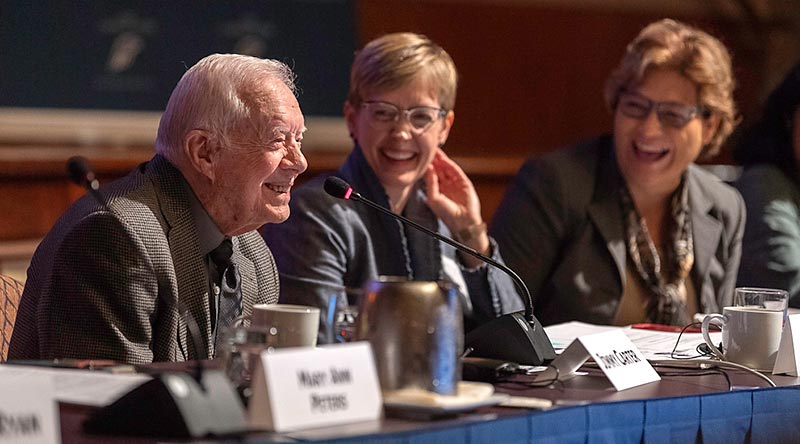
Carter Centre holds 2019 Human Rights Defenders Forum as from 12 October

October 7, 2019

Former U.S. President Jimmy Carter speaks at the 2018 Human Rights Defenders Forum in Atlanta, GA, the theme of which was “Restoring Faith in Freedom.”

“Building Solidarity toward Equality for All” Dozens of activists, peacemakers, and community leaders from 28 countries will come together from 12-15 October for the Carter Center’s 12th Human Rights Defenders Forum. Three sessions, including a 15-minute Q&A with former U.S. President Jimmy Carter, will be livestreamed on Tuesday, 15 October. Session topics include global protection for human rights defenders, challenges for women defenders and peacemakers, and the importance of mutually supporting civil, economic, political, and social rights.

The forum this year include:

  • Hafida Benchehida, an Algerian senator since 2013 and a founding member of both the Algerian and Arab women parliamentarian networks. She is also a member of Mediterranean Women Mediators and a specialist in women’s roles in peace.
  • Mohna Ansari, a journalist-turned-attorney and a member of Nepal’s Human Rights Commission. Much of her work involves women’s rights, representation, and protection.
  • Ijam Alaz Augustine, minister for human rights and minorities affairs in Pakistan’s Lahore province, whose political career has been devoted to protecting the rights of religious minorities.
  • Fernando Carrillo Flórez, a former ambassador, minister of justice, and minister of the interior from Colombia who has published more than 14 books and 80 articles on democracy, governance, and reform of justice.
  • Maati Munjib, a journalist, professor, and president of Freedom Now, an organization devoted to protecting journalists and freedom of expression in Morocco. Because of his activism and writings, he faces a possible five years in prison. Amnesty International and other human rights groups have called for charges against him to be dropped.

Tuesday, October 15 webcast:
11:30 a.m. – 12:45 p.m.  Remarks by President Carter  Summary of the previous days’ workshops
Testimonies by human rights defenders and moderated discussion
2:15 ̶ 3:15 p.m. Discussion: “How Do We Build True Solidarity in the Struggle for Equality?”
3:50 ̶ 5 p.m.  Continued: Moderated discussion  Livestream Q&A with President Carter (4:35 to 4:50 p.m.)

During the webcast: Twitter @CarterCenter with hashtag #BuildingSolidarity.

https://www.cartercenter.org/news/upcoming_events/promo/hrd-forum-2019.html

Posted in Human Rights Defenders | Leave a Comment »
Tags: Algeria, Atlanta, Colombia, Fernando Carrillo Flórez, Hafida Benchehida, Human Rights Defenders, Human Rights Defenders Forum (Carter), jam Alaz Augustine, Jimmy Carter, Maati Munjib, Mohna Ansari, Morocco, Nepal, Pakistan

« Older posts
Newer posts »
  • Enter your email address to subscribe to this blog and receive notifications of new posts by email.

    Join 1,786 other subscribers
  • Recent Posts

    • Ales Bialiatski free but more human rights defenders must be released in Belarus
    • New study shows that on-line attacks against women human rights defenders doubled
    • International Federation for Human Rights keeps growing
    • Human rights defender: Cressida Kuala from Papua New Guinea
    • Human Rights Defenders in Greece on trial for baseless charges for assisting people on the move
    • 10 NGOs Taking Action for Transitional Justice
    • UN experts concerned by Interpol red notices against human rights defenders from El Salvador
    • NGOs call on Malaysian authorities to stop intimidating human rights defenders
Blog at WordPress.com.
Entries and comments feeds.Valid XHTML and CSS.
  • Subscribe Subscribed
    • Hans Thoolen on Human Rights Defenders and their awards
    • Join 441 other subscribers
    • Already have a WordPress.com account? Log in now.
    • Hans Thoolen on Human Rights Defenders and their awards
    • Subscribe Subscribed
    • Sign up
    • Log in
    • Report this content
    • View site in Reader
    • Manage subscriptions
    • Collapse this bar
 

Loading Comments...