The 2024 Asia Democracy and Human Rights Award (ADHRA) will be awarded to Odhikar in recognition of “the civil and political rights advocacy they have carried out and expanded in Bangladesh for three decades, despite challenges such as harassment, imprisonment, and surveillance,” TFD said in a press release.
It is hoped that the award will “encourage their work and those in the same field” so they “realize their efforts and perseverance have not gone unnoticed,” said the TFD, a nonprofit organization funded by Taiwan’s government.
Founded in 1994, the group has “deepened democracy and human rights in Bangladesh” through research, advocacy, and training, as well as government oversight efforts, the foundation said.
Odhikar, which means “rights” in Bengali, was founded by human rights activist Adilur Rahman Khan, who currently serves as the group’s secretary.
According to its website, Odhikar’s principal objectives include raising awareness of human rights and its various abuses, and promoting a vibrant democratic system through election monitoring in Bangladesh.
The Bengali group has issued annual reports since 1996 that document human rights abuses, extrajudicial killings, involuntary disappearances and other violations, the TFD said.
The TFD also highlighted Odhikar’s role in urging the Bengali government to ratify the Rome Statute for the International Criminal Court in 2010, which subsequently led the country to contribute to investigations into the persecution of the Rohingya people.
TFD’s award ceremony will be held in Taipei on Dec. 10, the foundation said, adding that the award winner would receive a trophy and a grant of US$100,000.
On 14 September 2023 the Cyber Tribunal, Dhaka sentenced to two years imprisonment Odhikar’s Secretary Adilur Rahman Khan and Director ASM Nasiruddin Elan for allegedly breaching Section 57 of the Information and Communication Technology Act 2006. They were charged for releasing a report on extrajudicial killings committed on 5 and 6 May 2013, centering around the Hefazat-e-Islam protests.
Immediately, 39 organizations in a joint call said that Bangladesh should quash their convictions, and end all reprisals against them and other human rights defenders for their legitimate human rights work. The Bangladesh Government has persistently targeted and launched a smear campaign against Khan and Elan, the secretary and director, respectively, of prominent Bangladesh human rights organization Odhikar. Following the 2013 publication of Odhikar’s fact-finding report documenting extrajudicial killings during a protest, both defenders were arbitrarily detained; Khan for 62 and Elan for 25 days. After being released on bail, they continued to face prosecution and judicial harassment on trumped-up allegations that their 2013 report was “fake, distorted, and defamatory.”
After the Government reopened the examination of witnesses and presented additional prosecution witnesses in July and August 2023, the judge convicted Khan and Elan to two years in prison and a fine of 10,000 Bangladeshi Taka (equivalent of USD$91.17).
Human rights defenders should be allowed to conduct their necessary and important work without fear of harassment, intimidation, and reprisals. Instead of prosecuting and punishing those who document and expose human rights violations, the Government should investigate and hold the perpetrators of these violations accountable.
List of signatories:
Advocacy Forum Nepal
Amnesty International
Anti-Death Penalty Asian Network (ADPAN)
Asian Federation Against Involuntary Disappearances (AFAD)
Asian Forum for Human Rights and Development (FORUM-ASIA)
Asian Network for Free Elections (ANFREL)
Association of Family Members of the Disappeared, Sri Lanka
Capital Punishment Justice Project, Australia
Citizens’ Alliance for North Korean Human Rights (NKHR)
CIVICUS: World Alliance for Citizen Participation
Defence for Human Rights Pakistan (DHR)
Desaparecidos – Philippines
Eleos Justice, Monash University, Australia
Families of Victims of Involuntary Disappearance (FIND)
FIDH (International Federation for Human Rights), within the framework of the Observatory for the Protection of Human Rights Defenders
Forum ONG Timor-leste
Free Jonas Burgos Movement
HAK Association, Timor-leste
Human Rights First
Human Rights Hub
Human Rights Watch
Indonesian Association of Families of the Disappeared Families (IKOHI)
International Coalition Against Enforced Disappearances (ICAED)
International Federation of ACATs (FIACAT)
International Service for Human Rights (ISHR)
Karapatan Alliance Philippines (KARAPATAN)
KontraS (the Commission of the Disappeared and Victims of Violence)
Latin American Federation of Associations of Relatives of Disappeared-Detainees (FEDEFAM)
Legal Literacy – Nepal
Liga Guatemalteca de Higiene Mental
Madres de Plaza de Mayo – Linea Fundadora, Argentina
Martin Ennals Foundation
Nonviolence International Canada
Robert F. Kennedy Human Rights
Sindhi Foundation
The Asian Alliance Against Torture (A3T)
Torture Abolition and Survivors Support Coalition, Washington DC
We Remember-Belarus
World Organisation Against Torture (OMCT), within the framework of the Observatory for the Protection of Human Rights Defenders
Odhikar itself denounces the arrest, trial and imprisonment of these two human rights defenders and added that “It believes that justice has not been served. As an organisation Odhikar has drawn the sustained wrath of the establishment for becoming the voice of the victims of human rights violations, including those of enforced disappearances, extrajudicial killings, torture, arbitrary detention and against the suppression of free expression and assembly; and for its engagement with the United Nations Human Rights Mechanisms. Earlier the government arbitrarily deregistered the organisation. Today’s judgement is likely to have a chilling effect on human rights defenders and civil society organisations around the country.“
On 14 December 2021 a Statement “Bangladesh: Stop Harassment of Human Rights Defenders” was published by Forum Asia, FIDH and other NGOs: “Bangladesh authorities must end the harassment of Adilur Rahman Khan and ASM Nasiruddin Elan, respectively Secretary and Director of the human rights group Odhikar, who have been targeted through the misuse of the criminal justice system”, eleven rights groups said.
On December 15, 2021, the Cyber Tribunal of Dhaka will continue the examination of prosecution witnesses in the case brought against Adilur Rahman Khan, also a member of OMCT General Assembly and FIDH Secretary-General, and ASM Nasiruddin Elan, for charges brought against them in Case No. 1 of 2013 under the notorious Section 57 of the Information and Communication Technology (ICT) Act, 2006 (amended in 2009), in relation to a fact-finding report issued by Odhikar on the killing of at least 61 people by security forces and law-enforcement agencies in May 2013. Khan and Elan face up to ten years in prison. See also; https://www.trueheroesfilms.org/thedigest/laureates/88F17E2F-F919-580F-2FDA-59B8E24ACBF6
“The government should stop using vague laws to silence human rights defenders and start holding perpetrators of abuses to account, ” said Kerry Kennedy, President of Robert F. Kennedy Human Rights. “Odhikar’s findings not only should have led to investigations and reforms, but also should have been welcomed by the government as an opportunity to strengthen their commitment to upholding human rights.”
Following Odhikar’s 2013 report, Khan and Elan were arbitrarily detained for respectively 62 and 25 days until they were both released on bail. On February 14, 2021, the Appellate Division of the Supreme Court of Bangladesh rejected Odhikar’s appeal to quash the case on its legal merits. On September 12, 2021, the Cyber Tribunal of Dhaka resumed the trial in the case against the two while their review petition is still pending hearing before the Appellate Division of the Supreme Court, contravening the right to a fair trial. On October 5, November 9, and November 24, 2021, the Cyber Tribunal of Dhaka started to examine prosecution witnesses in the case.
We express our deepest concern over the ongoing harassment of Adilur Rahman Khan and ASM Nasiruddin Elan, which is manifestly a form of reprisals against Odhikar for their legitimate human rights work, including for cooperating with UN human rights mechanisms in documenting enforced disappearances, extra-judicial executions and torture in Bangladesh.
It is further a matter of great concern that since 2013, attacks, unlawful surveillance, smear campaigns and harassment against Odhikar and its staff and management have been incessant. Odhikar is also facing serious difficulties to conduct its work due to violations of the right to freedom of association, since its registration has not been renewed by the NGO Affairs Bureau of the Government of Bangladesh and is still pending since 2015. Moreover, all of its bank accounts have been frozen and the organization has been forbidden from receiving funding from foreign or international sources, impacting its operations considerably.
The trial against Khan and Elan resumes in a context where human rights in Bangladesh are under attack from all sides. Human rights violations committed by security forces, including enforced disappearances, extrajudicial executions, and torture remain pervasive throughout the country, with absolute impunity. Authorities regularly crackdown on human rights defenders and journalists who speak out against these violations, including through the use of the Digital Security Act – 2018, the Special Powers Act – 1974, and other draconian laws. See also: https://humanrightsdefenders.blog/2014/12/02/adilur-rahman-khan-speaks-out-against-torture/
Cases such as these question the Bangladeshi government’s commitment to protecting human rights. The international community, including the United Nations and the diplomatic corps in Bangladesh, should monitor the case against Adilur Rahman Khan and ASM Nasiruddin Elan and take a clear stand to ensure that the government of Bangladesh respects the rights of the two defenders to a fair and public trial and, more generally, guarantees the right to defend human rights and puts an end to all acts of harassment against all human rights defenders in Bangladesh.
Our organisations call on the authorities of Bangladesh to immediately and unconditionally drop all charges against Adilur Rahman Khan and ASM Nasiruddin Elan, and to ensure in all circumstances that human rights defenders in Bangladesh are able to carry out their legitimate activities without any hindrance and fear of reprisals.
“This trial is in reality an indictment of the authorities and a crucial test case for the country’s judiciary to be closely watched by the international community,” said Gerald Staberock, OMCT Secretary General, speaking on behalf of the Observatory. “The true culprits are those responsible for extra-judicial killings not those who report on it. Prosecuting human rights activists will not stifle dissent but will isolate Bangladesh from the international community.”
The NGOs:
Amnesty International
Anti-Death Penalty Asia Network (ADPAN),
Asian Human Rights Commission (AHRC),
Asian Network for Free Elections
Capital Punishment Justice Project (CPJP)
CIVICUS: World Alliance for Citizen Participation,
Eleos Justice, Monash University, Associate Professor
FIDH, within the framework of the Observatory for the Protection of Human Rights Defenders, i
FORUM-ASIA
Robert F. Kennedy Human Rights
World Organisation Against Torture (OMCT), within the framework of the Observatory for the Protection of Human Rights Defenders
Kjell Magne Bondevik (former Prime Minister of Norway and currently President of the Oslo Centre for Peace and Human Rights) wrote a thoughtfull piece on a thorny issue: “The UN Must Take the Lead in Kashmir”.
...After more than 70 years of terror, killings, torture, and disappearances, the international community must renew its efforts to end the conflict in Kashmir. In 2018 and 2019, the Office of the United Nations High Commissioner for Human Rights released reports that documented a wide range of abuses – including kidnappings, the killing of civilians, and sexual violence – perpetrated by both sides in the conflict. The UN needs to take the lead in stopping Kashmir’s torment. ……The conflict has consumed resources that should have been used for development; instead, they were channeled to arms purchases or a regional race to develop weapons of mass destruction. Everyone, regardless of age, religion, or ethnicity, has suffered, whether as a result of displacement, family separation, loss of property, the death or disappearance of friends and close relatives, grinding poverty, or simply the prospect of a future as bleak and constricted as the present.The international community has, at times, attempted to mediate between India and Pakistan. The UN has adopted resolutions demanding a referendum on Kashmir’s future status. But, even though it has long been evident that there is no military solution to the conflict – temporary ceasefire initiatives have never resulted in a lasting agreement – India to this day has resisted a plebiscite. In 2003, Pakistan’s then-president, Pervez Musharraf, formulated a four-step approach to a political solution. Without insisting on a referendum, India and Pakistan would begin a dialogue; recognize Kashmir as the main source of bilateral hostility; identify and eliminate what was unacceptable to each side; and strive for a solution acceptable to both countries – and especially to the people of Kashmir. Subsequently, a ceasefire was declared, and high-level meetings took place, but, following a terrorist attack, India terminated the talks. In 2012, Pakistani President Asif Ali Zardari and Indian Prime Minister Manmohan Singh tried unsuccessfully to revive the process.
I have been personally engaged with the Kashmir issue for some time. Last year, I held meetings with senior politicians in Pakistan and India. I am well aware that India wants to treat the Kashmir conflict solely as a bilateral issue. But in that case, it should take the initiative in starting talks with Pakistan. If that does not happen, the international community must demand that the parties come together to negotiate a peaceful solution.
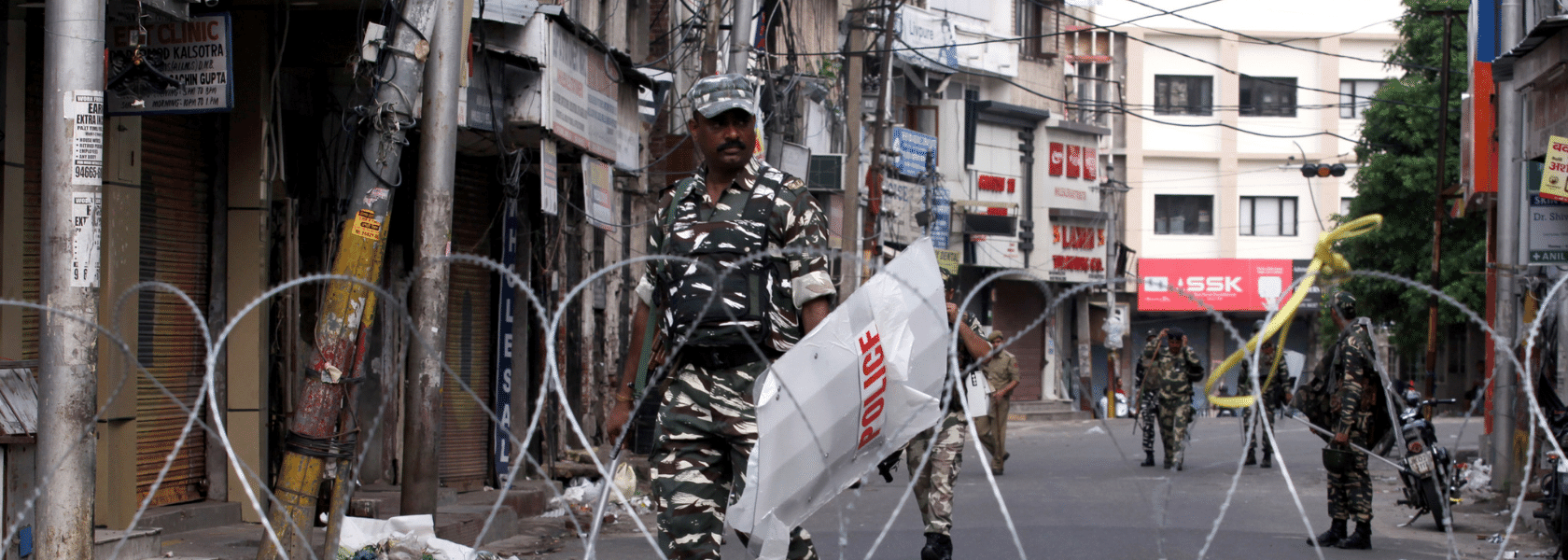
Again, it is not up to the UN or anyone else to impose a solution on the parties. The current situation is rooted in a highly complex mix of history and politics, and any viable settlement must reflect Kashmir’s unique circumstances. A major issue to be addressed is the “line of control” separating Indian- and Pakistani-administered Kashmir, which hinders the free movement of people, divides families, and impedes business and trade. And, of course, Kashmir’s future status is the main question that must be resolved. During my last visit to Kashmir, I saw firsthand the level of violence and the severity of human-rights violations. Conditions have deteriorated further since India repealed Jammu and Kashmir’s special status in October 2019, dissolved it as a state, and reorganized it as two “union territories” – all enforced by the security forces with a wave of arrests, a ban on assembly, and an Internet and media blackout.At a time of war in Syria and Yemen, and heightened tensions between the United States and Iran, it is difficult to get the international community to focus on Kashmir. But it is crucial that the conflict not be allowed to spiral out of control, especially given that both countries are nuclear powers. Above all, the people of Kashmir deserve a ceasefire, reconciliation, and stability, and it is the duty of the UN to advance this goal. I urge the UN to appoint a special envoy to Kashmir. And I appeal to UN Secretary-General António Guterres to seize the initiative and help deliver a long-overdue and lasting peace to this region…
“The Indian government must immediately end all draconian restrictions on fundamental freedoms in Jammu & Kashmir, and fully reinstate communications”, FIDHand its member organization People’s Watch urged on 5 February 2020. In conjunction with its call, FIDH released a briefing note that highlights some of the human rights concerns that have remained unaddressed since 5 August 2019. “For the past six months, the people of Jammu & Kashmir have been living under siege and denied their fundamental rights under the most draconian of measures. These grave violations of human rights must come to an end, and accountability must be established for the serious violations that have occurred since 5 August.” Adilur Rahman Khan, FIDH Secretary-GeneralSince the evening of 4 August 2019, internet communications, and initially telephone lines, have been cut in Jammu & Kashmir, effectively isolating residents from the rest of the world. Although phone lines were gradually reinstated and internet access restored in certain places, personal internet connections are limited to 301 government-approved websites through a very slow 2G connection. Although accurate figures are unavailable, thousands of arbitrary detentions have been reported since 5 August 2019, including hundreds of detentions under the abusive 1978 Public Safety Act (PSA). Many detainees, particularly youth and low-ranking political activists, have been transferred to jails outside of Jammu & Kashmir, the location of which is unknown in many cases. There have also been numerous reports of excessive use of force by army and police forces, including reports of deaths and injuries as a result of the improper use of pellet guns and teargas. The reorganization of Jammu & Kashmir has also resulted in a number of measures that will have long-term implications for the human rights situation in the region, including the disbanding of the State Human Rights Commission (SHRC) of Jammu & Kashmir – one of the few avenues for justice available to local people – at the end of October 2019. More than 500 cases of alleged enforced disappearances were pending before the SHRC at the time of its disbandment. [see also: https://humanrightsdefenders.blog/2019/03/17/fidh-dares-to-publish-a-report-on-key-human-rights-issues-of-concern-in-kashmir/]
“Human rights violations of the gravest nature are nothing new in Jammu & Kashmir, and have gone unpunished for decades. But taking away the little autonomy the state had will only make the situation worse, especially when the people most affected by these changes have been denied their right to express their opinions.” added Henri Tiphagne, People’s Watch Executive Director
On 5 February the Observatory for the Protection of Human Rights Defenders, a partnership of FIDH and the World Organisation Against Torture (OMCT), requested an urgent intervention in the case of Mr. Miyan Abdul Qayoom, a human rights lawyer and President of Jammu & Kashmir High Court Bar Association. Mr. Qayoom, 70, suffers from multiple health conditions, including diabetes, double vessel heart disease, and kidney problems.
According to the information received, during the evening of January 29, 2020, Mr. Qayoom’s family received a phone call from Agra Central Jail’s authorities, in Uttar Pradesh State, informing them that Mr. Qayoom had been transferred to Sarojini Naidu Medical College after complaining of chest pain, breathlessness and his pulse rate had significantly gone down to 44pm, and asking them to visit him. On January 30, 2020, upon reaching Agra Central Jail, Mr. Qayoom’s relatives discovered that Mr. Qayoom had been taken back to the jail’s dispensary, even though his health condition had not improved. On February 3, 2020, Jammu & Kashmir High Court Srinagar bench, after hearing the final arguments, reserved its judgement regarding Mr. Qayoom’s habeas corpus request. The scheduled date of the judgement was not known as of the publication of this Urgent Appeal…..
All prize winners will receive a diploma and a medal designed by artist Anna Martha Napp that was chosen by a Franco-German jury. The medal symbolises their active commitment to the defence of human rights.
KIOS is perhaps not the best-known human rights foundation in the world but that is surely mostly due to the fact that it operates from a small base: Finland. KIOS was founded by 11 Finnish human rights and development NGOs. The representatives of the founding NGOs form the Board of KIOS. In Finland, KIOS raises awareness on the significance of human rights and the work of human rights defenders in developing countries. It also advocates for the development of good practices in Finnish foreign and development policy in support ofHRDs. KIOS focuses its external support on 3 countries in East Africa (Kenya, Rwanda and Uganda) and 3 in South Asia (Nepal, Sri Lanka and to Tibetan civil society organizations in exile). Some long-term partner organizations of KIOS are also supported in Bangladesh, Burundi, Ethiopia and Pakistan. Ulla Anttila is the Executive Director.
On 17 December 2016 KIOS published four video links of interviews with human rights defenders from Asia and Africa (video links), available on You Tube:
International Human Rights Day commemorates the day on which, in 1948, the United Nations General Assembly adopted the Universal Declaration of Human Rights. In 1950, the Assembly passed resolution 423 (V), inviting all States and interested organisations to observe 10 December as Human Rights Day. The theme this year is: Stand up for someone’s rights today, in other words: be a human rights defender. .
There is a lot going on during this period, so I just give a small sample (10!) from different parts of the world: Read the rest of this entry »
The Asian Forum for Human Rights and Development (FORUM-ASIA), together with the Martin Ennals Award and the Right Livelihood Award, will host a panel discussion on the 25th Anniversary of its founding and 10th Anniversary of its presence in Geneva, entitled ‘50 Years of the International Bill of Human Rights and 10 Years of the UN Human Rights Council – What does this mean for Asia?’, on 16 November 2016 at 18:30 at the Ivan Pictet Auditorium, Maison de la Paix, in Geneva, Switzerland.
A regional update on Asia is based on a submission to United Nations’ Human Rights Council by the Asian Legal Resource Centre (15 February) and a report of the Regional Consultation of Citizens’ Voices held in Kathmandu (25/26 February) held under the aegis of South Asians for Human Rights (SAHR).
The Asian Legal Resource Centre directs the attention of the Human Rights Council to the critical situation of human rights defenders in China, Bangladesh, and Thailand, who are facing dire threats to their person and profession: Read the rest of this entry »
I have not referred to this excellent initiative for a while. The Asian Human Rights Commission (AHRC) continues it visual reporting, Now already episode 106!: Read the rest of this entry »




 Hans Thoolen on Human Rights Defenders and their awards
...After more than 70 years of terror, killings, torture, and disappearances, the international community must renew its efforts to end the conflict in Kashmir. In 2018 and 2019, the Office of the United Nations High Commissioner for Human Rights released reports that documented a wide range of abuses – including kidnappings, the killing of civilians, and sexual violence – perpetrated by both sides in the conflict. The UN needs to take the lead in stopping Kashmir’s torment. ……The conflict has consumed resources that should have been used for development; instead, they were channeled to arms purchases or a regional race to develop weapons of mass destruction. Everyone, regardless of age, religion, or ethnicity, has suffered, whether as a result of displacement, family separation, loss of property, the death or disappearance of friends and close relatives, grinding poverty, or simply the prospect of a future as bleak and constricted as the present.The international community has, at times, attempted to mediate between India and Pakistan. The UN has adopted resolutions demanding a referendum on Kashmir’s future status. But, even though it has long been evident that there is no military solution to the conflict – temporary ceasefire initiatives have never resulted in a lasting agreement – India to this day has resisted a plebiscite. In 2003, Pakistan’s then-president, Pervez Musharraf, formulated a four-step approach to a political solution. Without insisting on a referendum, India and Pakistan would begin a dialogue; recognize Kashmir as the main source of bilateral hostility; identify and eliminate what was unacceptable to each side; and strive for a solution acceptable to both countries – and especially to the people of Kashmir. Subsequently, a ceasefire was declared, and high-level meetings took place, but, following a terrorist attack, India terminated the talks. In 2012, Pakistani President Asif Ali Zardari and Indian Prime Minister Manmohan Singh tried unsuccessfully to revive the process.