Posts Tagged ‘activism’

New Guidelines on Environmental Protest and Civil Disobedience

October 20, 2025

During October 2025, new guidelines on Environmental Protest and Civil Disobedience were released by Michel Forst, UN Special Rapporteur on Environmental Defenders under the Aarhus Convention

The new guidelines aim to support states, civil society, environmental activists, and legal practitioners in understanding and implementing the rights guaranteed under the Aarhus Convention. The document underscores that individuals and groups have a recognised international right to engage in peaceful environmental demonstrations, even when challenging public or private actors whose practices may harm the environment.

The document outlines five guiding principles to help states ensure that peaceful environmental activism is respected, not repressed:

  1. Address the root causes of the protest: Governments should tackle the real reasons behind environmental protests, such as inaction on environmental protection, lack of transparency, or exclusion from decision-making.
  2. Reject criminalization of defenders: Authorities and media must stop portraying environmental activists as criminals and instead recognize their legitimate role in defending public interests.
  3. Protect civic space: Civil disobedience must not be used as a pretext to restrict fundamental freedoms or limit peaceful public expression.
  4. Ensure human rights–based policing: Law enforcement responses must be lawful, necessary, and proportionate — never arbitrary, excessive, or punitive.
  5. Uphold justice and civic freedom: Courts should avoid rulings or sanctions that discourage peaceful protest or shrink civic space.

Furthermore, the guidelines recognize that some environmental defenders may resort to civil disobedience when legal channels fail, and the guidelines set out conditions under which such acts may be tolerated (e.g., proportionality, non-violence, necessity, public interest). The guidelines stress the need for states to prevent and remediate retaliatory actions against protestors, such as legal harassment, surveillance, excessive use of force, or criminalisation of protest. The text encourages states to review and reform national laws, police protocols, and judicial practices to ensure that protest rights are respected, especially for environmental defenders, and it calls for transparent mechanisms to monitor how protests are handled, report abuses, and hold responsible persons and institutions to account.

The guideline highlights that public authorities (including political figures) should refrain from using language labelling protesters as threats, “eco-terrorists,” or “foreign agents”, and media (especially public or state media) should maintain factual accuracy, avoid derogatory language, and refrain from mischaracterising environmental defenders.

https://unipd-centrodirittiumani.it/en/news/un-rapporteur-michel-forst-issues-new-guidelines-on-environmental-protest-and-civil-disobedience

Guidelines on the Right to Peaceful Environmental Protest and Civil Disobedience – October 2025

About the MEA, human rights activism and me

May 1, 2025

This blog is supposed to be an about Human Rights Defenders, not about self promotion. I know!

However, this very long interview is both and therefore belongs here.

Three human rights defenders on why they refuse to be silent in older age

May 21, 2024

This week (20 May 2024), as the United Nations moves towards an international convention on the rights of older persons, Amnesty International is launching a new campaign: Age Loud! We demand a world where human rights last a lifetime, and where older voices are no longer ignored. [https://www.amnesty.org/en/latest/campaigns/2024/05/three-activists-on-why-they-refuse-to-be-silent-in-older-age/]

AI asked three older activists to reflect on their experiences, the changes they are campaigning for, and how being an older person gives them unique perspective and motivation.

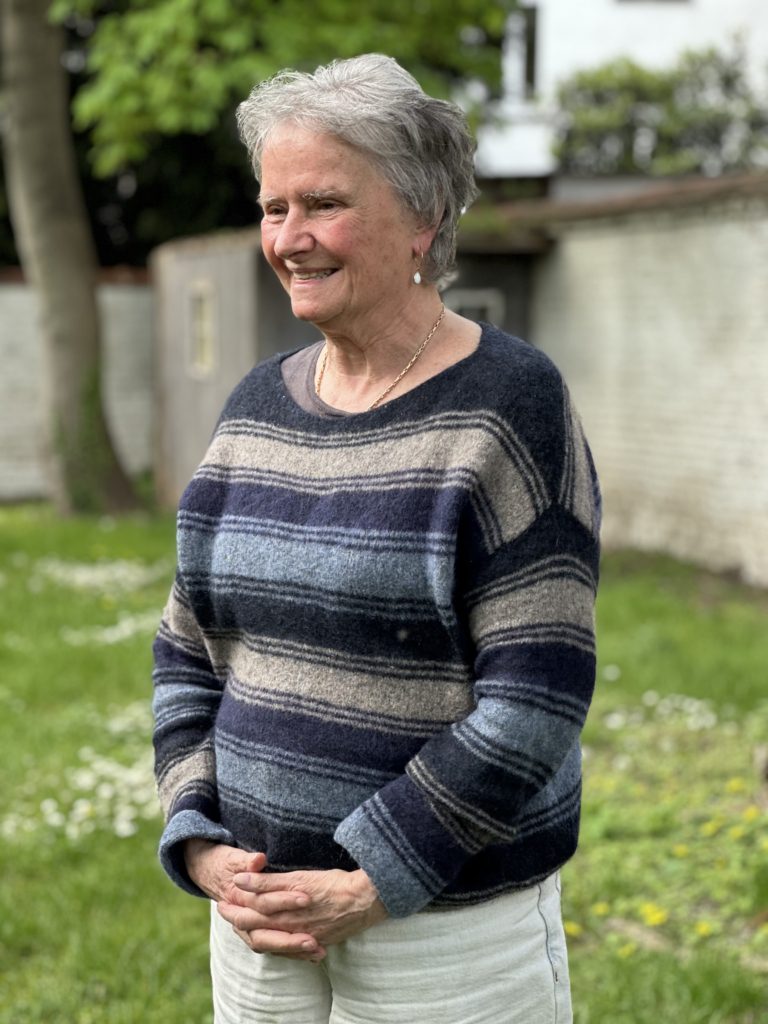
Cecile de Ryckel, 78, Belgium

Cecile is a lifelong activist working on anti-racism and climate change.

Why did you become an activist?

After a homelessness crisis amongst migrants in Belgium in 2015, my husband and I hosted two people from Ethiopia who the authorities had left to sleep in a city park. They told us that in Ethiopia they were small-scale farmers and grew food for their families. However, it was raining less frequently, and growing food was becoming more difficult. That was when I realized that climate change was one of the most important issues in the world today, and that it would have far-reaching consequences. Soon after that I participated in a citizens assembly discussing how best to address climate change and reduce carbon emissions. We learned how to mobilize people and change behaviours. I joined an advocacy collective, Grandparents for the Climate, and started working actively on the issue.

We have a responsibility to future generations to address this challenge today. It already has wide-ranging impacts on people of all ages. I remember when I was a child that we would joke that an older person was someone who “wouldn’t make it through the winter”, but today due to rising temperatures we sadly have to ask whether some older people can “make it through the summer”.

I recently saw how a group of older women won a landmark court case that the Swiss government’s weak climate change policy had violated their rights. This will help advance the cause greatly, for people of all ages.

Amina Musa, 72, Nigeria

Amina is an activist on behalf of victims of the armed conflict in north-east Nigeria and their families, including those who have been unlawfully killed or detained.

Why did you become an activist?

I became an activist nine years ago when Boko Haram forced us to leave our homes, and we found ourselves living in camps controlled by the Nigerian government. The military made baseless accusations that our sons were associated with Boko Haram. Our sons were blindfolded and arrested and held in dehumanizing conditions. I had no choice but to start campaigning for their release. As mothers, we came together and started a movement to seek justice. We are demanding that all those detained unlawfully be released immediately and that the government investigate the gross violations we have experienced. Some of our sons have been in detention for more than 10 years. We have had enough, we want justice.

I tell other older people that they should continue with their activism and bear with the challenges, and that our activism can also inspire younger people. I know it is not easy, but these causes are important. Age should not and will not deter us from making our society free from injustice.

Juan Jacobo Hernández, 82, Mexico

Juan is an activist on social issues and LGBTQ+ liberation.

Why did you become an activist?

In the 1960s, I was part of Mexican student movements. Then Stonewall happened: I had a boyfriend at the time who lived in New York, and he told me that I had to come and see it for myself. I witnessed the first LGBTQ+ rebellion: the first time gay men, trans people, lesbians were standing up and confronting the police. Coming back to Mexico, we started the Frente de Liberación Homosexual (Gay Liberation Front). I had learned a lot about how to make protests visible and how to make our voices heard. Finally, there was a space where we could be active, where we could do something. When I started my activism, we didn’t use the term “human rights” – but that’s what it has always been about. We held large demonstrations against political repression, for the abolition of the death penalty, and to fight restrictions on social protest. Persecution by the government was very real and close to us at the time – gay men and trans women were persecuted, raided by the police, extorted and beaten up.

Whenever we were out in the street, we felt that something bad could happen. We were struggling for our lives, for our security, for our right to be in the street without being beaten up, robbed or killed.

My whole life, I have never stopped being an activist. The AIDS epidemic collapsed the first phase of gay liberation. So many activists died and [as I grew older], I recognised the need to transmit my experience, knowledge and values [to the younger generation]. Since 1981 I’ve been part of Collective Sol, where we work to build and strengthen the capacity of small, grassroots organizations that are working on the most pressing LGBTQ+ issues they see today.

My life as an activist means I can look back and say I have witnessed three great moments in LGBTQ+ liberation. The first was when we formed political organizations, coming out of the shadows and breaking the silence. The second was the HIV/AIDS epidemic, the way it created a connection between LGBTQ+ liberation and people living with HIV, irrespective of whether they were LGBTQ+. This connection was powerful and drove the movement forward.

Young Right Livelihood Laureates in Geneva panel

May 15, 2024

Right Livelihood Laureates illuminated the struggles and triumphs facing youth activists in a panel discussion organised by its Geneva office in March 2024. With speakers including Laureates from Belarus, Cambodia, and Egypt, as well as the UN Special Rapporteur on human rights defenders, the event painted a vivid picture of the evolving landscape of youth activism.

Natallia Satsunkevich, representing Belarusian Laureate organisation Human Rights Center “Viasna”, shared her journey, beginning as a civil rights summer school attendee to becoming an activist with Viasna to shed light on the abuses of Belarus’s repressive regime.

“I realised that I have this power to monitor and control the government,” she said. “This is obviously the aim of civil society in each country.”

She has faced backlash for her work: her apartment was searched and her mother was questioned by authorities. Eventually, Satsunkevich had to flee Belarus to avoid criminal prosecution. Five of her Viasna colleagues, including founder and Right Livelihood Laureate Ales Bialiatski, are imprisoned for their work.

“Nevertheless, I think the decision to become a human right activist and joining Viasna was one the best decisions of my life,” she said, pointing to the close friendships and working relationships she has developed. “The most important point is that I feel like I am doing the right thing, I know that I am making this world better.”

She called on young people around the world to “check your rights”: keep an eye on leaders and make sure that all human rights are respected.

Ratha Sun, from the Laureate organisation Mother Nature Cambodia, highlighted the innovative approaches of young activists. Despite facing legal challenges and imprisonment, the group’s viral campaigns and grassroots mobilisation have sparked significant environmental advocacy.

“For all our videos and campaigns, we … think about creativity and technical ideas to get more involvement from young people,” Sun said. “We also work closely with the local community that is being affected by the project [we’re fighting].”

The group’s activism has stopped damaging construction and extraction projects such as a hydropower dam and sand mining.

Their successes have resulted in more attention from the Cambodian public and, at the same time, also drew the ire of the government.

“Between 2015 and now, 11 members of Mother Nature Cambodia have been in jail, and now, six of us still have charges against us from the court,” Sun said, noting that the charges include insulting the king and plotting against the government. Sometimes, they are also accused of being members of the CIA.

“Even though we are facing 10 years in prison, our activists, who are young, are still standing to fight the government,” Sun said.

2016 Laureate Mozn Hassan, the founder of Nazra for Feminist Studies and the Doria Feminist Fund, talked about the double bind of being a young female activist in the Global South. Battling stereotypes and systemic challenges, Hassan emphasised the importance of expressing feminism and fighting gender-based discrimination creatively.

“Being a woman in these contexts is so problematic and has all these barriers from the private and the public – and all of them are affecting us,” Hassan said. “Especially if they are young: … it is also about resources, accessibility and acceptance.”

She noted that in the Middle East and North Africa region, the stigma for young feminist activists working on gender issues has been increasing, and they are targeted more often.

“For example, in Iraq, it’s not allowed to name any of the activity as something relating to gender,” she said, noting that this was especially the case for young activists expressing their femininity or sexuality in non-traditional ways.

When it comes to the tools young activists are using, in many countries, such as Egypt, they are being targeted and imprisoned for social media posts.

Having just finished a report on youth and child human rights defenders, Mary Lawlor, UN Special Rapporteur on human rights defenders, provided a global perspective. She highlighted the unique contributions of youth and child activists, drawing attention to their innovative use of social media, decentralisation, and creativity in campaigning.

“Young people face the same challenges as all other human rights defenders, and they often use the same approaches as other human rights defenders,” Lawlor said. “But where they differ is that they are very creative, and they have novel tools and methods.”

She noted their “extremely clever use of social media” that can garner attention.

However, she also pointed out the challenges they face, including exclusion from formal decision-making.

“Ageism is a frequent barrier to young and child activism: Young defenders feel they are not being heard, not being taken seriously, and their views are not being taken into account,” Lawlor said. “Even when their participation in public and political decision-making has been increased, it’s usually a tokenistic box-ticking exercise.”

Young activists also face rampant online harassment, requiring strengthened protection and security for human rights violations perpetrated online. Lawlor’s new report aims to address these challenges and enhance protections for young activists. See: https://humanrightsdefenders.blog/2024/03/07/mary-lawlors-new-report-focusses-on-youth-human-rights-defenders/

Willie Oeba, Kenyan artivist

April 3, 2024

“The idea is not to change the world, but to spark the mind that will change the world, because leadership is in delegation.

Willie Oeba is an African poet who empowers young people to fight inequality and foster social justice through spoken word. He currently leads a team of 24 young “artivists” in his community who use their creativity to create social change. Through his own poems, he has also reached millions of people worldwide.

As CEO of ISM Academy, an organization that trains young leaders to create art that combats inequality, Willie develops the tools for marginalized artists to champion social justice, economic equity, and democracy. In 2021, he was awarded the Upcoming Human Rights Defender award by the Defenders Coalition, a national human rights organization in Kenya. He also won the East Africa Spoken Word Battle in 2018.

Willie works to bridge the poverty gap within the arts by empowering artists from marginalized communities and by championing economic structures that allow artists from every background to achieve financial independence. He believes that activism through art requires people to stand in the gap between what is real and what is possible, and to respond to challenges by expanding whose stories get told.

https://www.fordfoundation.org/fellows/willie-oeba

State repression of environmental defenders ‘a major threat’ to human rights

March 4, 2024

In a landmark paper, the UN Special Rapporteur on Environmental Defenders under the Aarhus Convention warns that the continued State efforts to repress and criminalise environmental protests, including direct action and civil disobedience, are a threat to fundamental freedoms and democracy itself.

The world is currently facing a triple planetary crisis and despite this alarming and unprecedented situation, States are failing to meaningfully address it. In response to this, environmental human right defenders (EHRDs), Indigenous Peoples, peasants movements and civil society from around the world have exercised their right to peacefully protest and participate in demonstrations to pressure their governments into taking concrete actions.

Some of these demonstrations have taken the form of civil disobedience which has been disproportionately repressed by governments and law enforcement officials.

On 28 February 2024 Michel Forst, the UN Special Rapporteur on Environmental Defenders, published a position paper highlighting a trend towards the repression and criminalisation of defenders engaging in environmental protests and civil disobedience in Europe, as well as an alarming toughening of stances against them in political discourse and the law enforcement and judicial practices. [The UNECE Convention on Access to Information, Public Participation in Decision-making and Access to Justice in Environmental Matters – known as the Aarhus Convention – was adopted in 1998. It aims to protect every person’s right to live in an environment adequate to his or her health and well-being.] See also: https://humanrightsdefenders.blog/tag/aarhus-convention/]

Forst also points to legislative attempts to ban specific organisations – citing France’s Soulèvements de la Terre, Spain’s Futuro Vegetal, or Letze Generation in Germany and Austria. These moves come alongside new or updated laws – including the UK’s ‘2022 Police, Crime, Sentencing and Courts Act’ and Italy’s 2024 ‘eco vandalism’ law -, which the paper says have virtually prohibited certain kinds of protests. 

The Special Rapporteur flags how politicians demonise environmental movements engaging in civil disobedience, while national or pan-European intelligence services no longer hesitate to label peaceful groups or individuals as potential or genuine terrorist threats.

The paper also recognises that European States have been disproportionately and increasingly used criminal, administrative and civil measures against environmental human rights defenders recurring to civil disobedience. This includes excessive and disproportionate use of force against them and extensive investigation and surveillance measures. 

Other takeaways include the use of social media by State and non-state actors that have contributed to creating negative narratives against EHRDs and the challenges that defenders and activists face to access to justice.

While civil disobedience tactics have been recently used in protests related to climate justice, they have been constantly used to advocate for other legitimate causes including international solidarity, where States have also criminalised such moves.

This paper also comes shortly after the 25th anniversary of the UN Declaration of Human Right Defenders and it is a good reminder that civil disobedience is and should be recognised as a legitimate form of exercising the rights to freedom of expression and peaceful assembly.

States must stop criminalising human right defenders exercising these rights and focus on addressing the root causes of their mobilisation.

https://ishr.ch/latest-updates/state-repression-of-civil-disobedience-on-environment-a-major-threat-to-human-rights

“to the streets” – the new battlecry of the human rights movement?

December 22, 2019

The Economist of 14 November 2019 contains a timely article on “Economics, demography and social media only partly explain the protests roiling so many countries today“. Two pieces published more or less simultaneously this month go into this question in relation to the human rights movement. Is #TakeToTheStreets the ‘new’ tool for human rights defenders?

The first is by Cate Brown in Open Democracy of 11 December “The era of state mobilization is over: Welcome to the streets”, – ss civilian protesters take to the streets to demand their rights, human rights leaders consider a future of citizen-led activism.

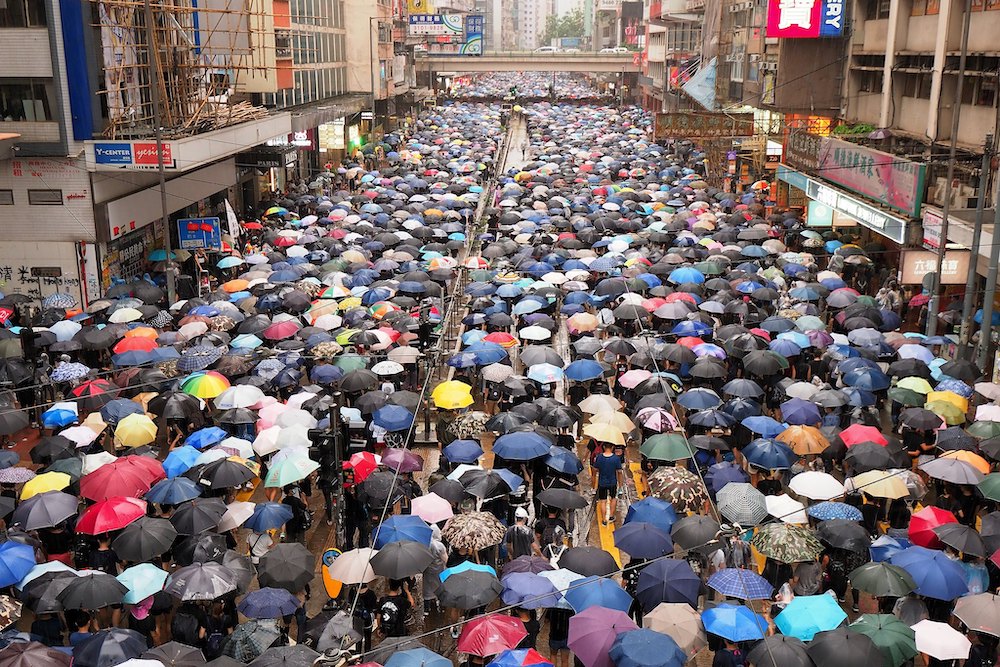
Protestors in Hong Kong gather against emergency anti-mask legislation, passed in response to months of demonstrations. Photo: Etan Liam/Flickr (CC BY-ND 2.0).

States are no longer trusted as representatives of popular interests or reliable guarantors of human rights, even in democracies. In response, civilian protesters have flooded the streets of major global capitals to demand immediate government action.

In Baku, demonstrators rallied for their right to assembly. In Beirut, citizens are calling for an end to government corruption. In Baghdad, protesters demand electoral reform, despite the deadly response of Iraqi security forces. In Santiago, dissent against a four percent increase in metro fares became a rallying cry for larger social reforms. And in Hong Kong, citizens have vowed to make ‘weekday chaos’ the new normal, adapting their tactics after six months of unanswered calls for political autonomy. Search the trending hashtag #TakeToTheStreets and you’ll find citizen-led anti-Trump and anti-Brexit movements in the United States and the UK. Search the #GiletsJaunes and you’ll find France’s infamous Yellow Vest movement celebrating their protest anniversary one year on.

…..quick concessions have failed to quiet broader calls for political reform. Instead, the single-issue protest movements have metastasized, gained momentum, and demonstrated staying power in the streets. Social media videos, like clips of Madi Karimeh, Lebanon’s ‘DJ of the Revolution’, or of the 170,000-person human chain linking protesters from Lebanon’s northern capital in Tripoli to its southern capital in Tyre, have helped build a sense of unity and vision among city-level protest movements…“Citizens are again claiming their rights in the streets, but there’s an important difference this year,” says Blavatnik School Professor of Practice of Public Integrity Chris Stone. “Citizen protesters are asking a new question: can we create a notion of rights enforcement that doesn’t depend on states?” It’s important for human rights organizations to consider this question. For years, the human rights movement has relied on parallel actions by frontline human rights defenders and global advocacy organizations like Human Rights Watch and Amnesty International. Frontline activists have played a central role in documenting incidents of abuse, convening civil society and amplifying messages across social networks. Groups like Human Rights Watch and Amnesty International then strengthened their campaigns with rigorous investigation and documentation, and provided an important bridge to pliable state leaders and UN representatives.

But with a cadre of autocratic leaders like Turkey’s President Recep Tayyip Erdogan, or populist leaders like US President Donald Trump, Russia’s President Vladimir Putin, and Brazil’s President Jair Bolsonaro leading some of the world’s most influential states, Human Rights Watch Executive Director Kenneth Roth suggests a tactical pivot towards nontraditional human rights allies and coalitions of smaller or midsize states.

“We used to look towards Geneva, New York, DC, and Brussels,” confirms a senior researcher at the Egyptian Initiative for Personal Rights (EIPR), “But the allies that we used to take for granted are no longer there.” Without reliable allies at the state level, the fundamental architecture of the human rights movement could be forced to change. “We need to invest in networks that are more grassroots-oriented,” continues the EIPR research lead, speaking on account of anonymity. “Local networks will help us diversify our allies and introduce us to arenas of mobilization that the Egyptian human rights movement knows nothing about.”

My generation of millennial protestors needs to recognize this opportunity: in the absence of reliable state allies, global rights organizations are ready to partner with us. Of course, groups like Amnesty International and Human Rights Watch have always worked with frontlines activists, but young civilian protesters may have a new opportunity to lead the way.

First, protesters need to invest in relationships that will strengthen their movements and amplify their demands. Next, protesters must look beyond the trending hashtags and the size of the crowds in the street: In a 2017 op-ed, Turkish scholar Zeynep Tufekci, author of Twitter and Tear Gas: The Power and Fragility of Networked Protest, warns that social media networks may make it much easier to pull off a large protest than it used to be, but “the significance of a protest depends on what happens afterwards.”

Protesters gathered in Beirut, Baghdad, Santiago, Port au Prince, Barcelona and Hong Kong must organize their crowds and identify next steps for collective action. With an agenda in hand, international rights organizations can extend their support. And together, we can push for more participatory, safe and inclusive states. For now, the hashtag #TakeToTheStreets is still trending. We’ll see how far people-power can go.

https://www.openglobalrights.org/era-of-state-mobilization-is-over-welcome-to-the-streets/

—–

The second piece is by in Foreign Policy in Focus of 10 December 2019: “As the Decade Closes, the Power of Protest Endures” –Despite the dashed hopes of the early 2010s, social movements are still winning important fights — and building a framework for human survival.

..as we mark the final Human Rights Day of this decade, we are ending the way we began — in the streets. In Hong Kong, Nicaragua, in Algeria, Sudan, Lebanon, Iran, and elsewhere, people have been on the march, facing bullets, beatings, and prison to demand an end to repressive and unaccountable government, to reject corrupt elites, and secure their rights. Are they naïve? Or do they know something important and powerful?

And what of the lawyers and communities challenging injustice in court, the investigators building meticulous records of human rights crimes, the journalists dragging into public view the buried facts, the advocates and activists pressuring and cajoling governments, companies, and other powerful actors to defend human dignity? They persist because they know the power of protest and resistance, and the efficacy of the human rights ideal, even if the tally of the past decade offers little encouragement.

From 2010 through 2012, protest movements swept across Iran and much of the Arab world. But in 2019, Tunisia stands alone among the countries of the Arab Spring in making the transition to democracy, and among its neighbors renewed repression and brutal wars have followed the uprisings. Hundreds of thousands have died, millions have been injured, and tens-of-millions have been displaced. The cost in lives, resources, and squandered potential is incalculable. Ten years ago, the smart phones and social platforms that helped to enable the protests were celebrated as vectors of positive change, opening avenues for speech and organizing beyond the control of authoritarian governments. They are now more often seen as fueling division, empowering surveillance, invading our privacy, and eviscerating the economic underpinnings of a free press.

Those who have sought refuge from obliterating violence and repression have met a rising tide of xenophobia, as politicians long confined to the margins of power ride a narrative of cultural, economic, and security threat, often focused on Muslims, refugees, LGBT people — anyone  seen as the “other” — to its center. They have sometimes been buoyed by hyper-partisan and often fraudulent media operations.

In the world’s biggest democracies — India, Brazil and the United States — the gravest threats to human rights and democracy come from elected presidents who openly praise dictators, demonize minorities, and undercut the rule of law, putting vulnerable populations at even greater risk. It would be easy to make a longer list of reversals: the promise of South Sudan, newly independent in 2011, now mired in war; Myanmar, where the pro-democracy icon Aung San Suu Kyi has emerged as an apologist for ethnic cleansing and crimes against humanity; Tanzania, where the media and civil society face ever tighter controls, arrests, and killings. And in Russia, a protest movement in 2011 held out hope for change, but instead Vladimir Putin increased his grip domestically, and enhanced his influence globally. Perhaps nowhere exemplifies the retreat more starkly than China, where once some Western analysts breezily promised that rising prosperity would bring progress on human rights and democracy. Instead, President Xi Jinping has put the fruits of development to work to build an algorithmically enhanced authoritarianism unrivaled in the scope of its ambition for control.

And yet. The protesters taking to the streets in Lebanon and elsewhere are not looking to a global scoresheet and calculating their chances. They are demonstrating that power without legitimacy can be checked in local struggles rooted in the demand for accountability, and ultimately for human rights. Ethiopia’s initial opening toward greater democratic space under President Abiy Ahmed tells us that some leaders appear to have learned this lesson, despite the crowing autocrats on the world stage.

And it isn’t only in street protest or in national struggle that we see the tools and values of human rights successfully at work. The millions of women and girls who bravely stepped forward to publicly shared their stories in response  to Tarana Burke’s #MeToo call built a global movement demanding an end to sexual violence. Persistent journalists turned accounts of Harvey Weinstein’s predation from Hollywood gossip into international news, and across the world, investigative reporting exposed the misogynistic abuses of other powerful figures.

They did so in the face of a U.S. president whose misogyny is proudly on display. Trade unions and women’s rights groups successfully fought for a new international treaty protecting against violence and harassment at work. Unevenly perhaps, but unstoppably, court cases, new regulations, a resetting of workplace norms, and sustained activism are creating new protections for women’s basic right to be free of harassment and violence. Spurred by litigation, culture change, and legislators responding to social movements, the rights of LGBT people are expanding around the world. A rearguard action by opponents in Russia and the United States decrying “gender ideology” and battling the spread of both women’s reproductive rights and LGBT rights is meeting both energized defense, and deep shifts in public opinion.

In a thousand smaller struggles, the embedding of human rights standards in domestic and international law is helping to bring the perpetrators of war crimes to justice, to secure land and environmental rights for communities threatened by development, and forcing companies to respect their human rights responsibilities. Local human rights defenders around the world don’t rely solely on the courage of their own conviction, or even the force of local law, rooted in their own experience, cultures and struggles, they are also part of a global ecosystem of shared norms, institutions, strategic collaboration, and communication that forms a resilient mesh that should be fostered and sustained. …

But a new global social movement is growing, in schools and on the streets. And existing norms around water, health, humanitarian disasters, and livelihoods offer a rich framework for building the accountability that is needed to spur action from wanton governments and companies. If we are back where we started the decade, we know the task, we have the tools — and like the protesters, we know the value of sticking to it.

Colin Kaepernick receives Amnesty International’s Ambassador of Conscience Award

April 22, 2018

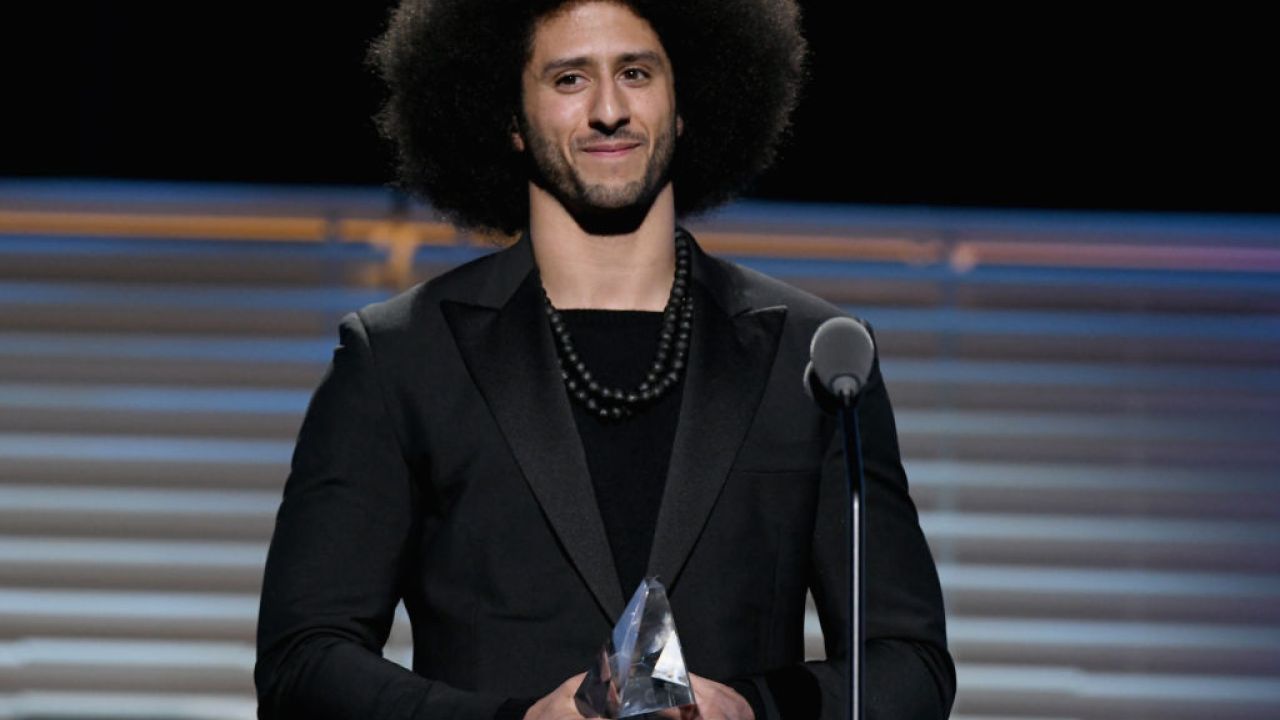
SPORTS ILLUSTRATED 2017 Sportsperson of the Year Show on December 5, 2017 at Barclays Center in New York City.

USA athlete and activist Colin Kaepernick has been honoured with Amnesty International’s Ambassador of Conscience Award for 2018. The award was officially presented at a ceremony in Amsterdam, Netherlands, on 21 April 2018, to coincide with the 50th anniversary of AI Netherlands.

“The Ambassador of Conscience award celebrates the spirit of activism and exceptional courage, as embodied by Colin Kaepernick. He is an athlete who is now widely recognised for his activism because of his refusal to ignore or accept racial discrimination,” said Salil Shetty, Secretary General of Amnesty International. [for more on this and other human rights awards see: http://trueheroesfilms.org/thedigest/awards/ambassador-of-conscience-award]

[During the 2016 pre-season of the American National Football League, Colin Kaepernick knelt during the US national anthem, as a respectful way of calling for the country to protect and uphold the rights of all its people. The bold move was a response to the disproportionate numbers of black people being killed by police. It sparked a movement that follows a long tradition of non-violent protests that have made history. While the polarised response to the “take-a-knee” protest has ignited a debate about the right to protest and free speech, Colin Kaepernick has remained focused on highlighting the injustices that moved him to act. His charity, the Colin Kaepernick Foundation, works to fight oppression around the world through education and social activism, including through free “Know Your Rights” camps which educate and empower young people.]

I would like to thank Amnesty International for the Ambassador of Conscience Award. But in truth, this is an award that I share with all of the countless people throughout the world combating the human rights violations of police officers, and their uses of oppressive and excessive force. …said Colin Kaepernick. “While taking a knee is a physical display that challenges the merits of who is excluded from the notion of freedom, liberty, and justice for all, the protest is also rooted in a convergence of my moralistic beliefs, and my love for the people.
See also: https://humanrightsdefenders.blog/2016/05/07/ais-ambassador-of-conscience-award-2016-shared-by-angelique-kidjo-and-african-youth-groups/

https://www.amnesty.org/en/latest/news/2018/04/colin-kaepernick-ambassador-of-conscience/

https://thinkprogress.org/colin-kaepernick-receives-humanitarian-prize-a1b3ca0460cc/

Donors should work jointly against the wave of civil society repression

July 10, 2015

The Newsletter of the International Service for Human Rights of 5 June 2015 carried an interesting piece written by two representatives of donors that are very active in the area of protection human rights defenders.  Julie Broome, Director of Programmes with the Sigrid Rausing Trust, and Iva Dobichina, Programme Manager with the Open Society Foundation‘s Human Rights Initiative, wrote jointly about much-needed efforts to “turn the tide against the wave of civil society repression”.  The piece follows in toto below, but some of the key points are: Read the rest of this entry »

Young human rights defenders honored by awards in Bangladesh

January 28, 2015

Recipients of the honorary awards given by Manusher Jonno Foundation, standing behind, with the guests sitting in front, in the capital's Bangla Academy yesterday, at the award giving ceremony marking Human Rights Day. Photo: Star

Recipients of the honorary awards given by Manusher Jonno Foundation, standing behind, with the guests sitting in front, in the capital’s Bangla Academy yesterday, at the award giving ceremony marking Human Rights Day. Photo: Star

A nice little item left-over from Human Rights Day 2014. How human rights awards play at the local level:

Ten human rights defenders from the grassroots level, two eminent social workers with international recognition, and a female football player were given honorary awards by Manusher Jonno Foundation (MJF) yesterday. The works of the activists focused on land rights, prevention of violence against women, child rights, and the rights of the indigenous people. The 10 grassroots activists were Jharna Ray, Madhobilata Chakma, and Nomita Chakma of Khagrachhari, Birendra Sangma of Mymensingh, Shafique Ullah of Noakhali, Kachhim Uddin of Tangail, Kananbala Gupta of Narail, Umme Kulsum Ranjana of Bogra, Kalpana Tirki of Rajshahi, and Rahela of Dinajpur.

Two social workers Jharna Dhara Chowdhury, chief of Noakhali’s Gandhi Ashram, and Angela Gomes, executive director of Bachte Shekha, were also honoured along with Bipasha Mali, a young footballer who was recently called to play on the national women’s football team.

Speaker Shirin Sharmin Chaudhury said, “They don’t work for recognition. Yet when we value their contributions, it makes us proud and we get inspiration to work.

MJF honours 10 grassroots human rights defenders | Two social workers, a young female footballer also receive the honorary awards.