On 14 May 2014 Amnesty International published a new campaign video on torture. It is specially interesting as a very short summary – in images – of the history of the anti-torture campaigns started by AI under the leadership of Martin Ennals more than 40 years ago. Read the rest of this entry »
Archive for the 'UN' Category
New AI video clip on Torture
May 28, 2014One of Bahrain’s most prominent human rights defenders, Nabeel Rajab, released today
May 24, 2014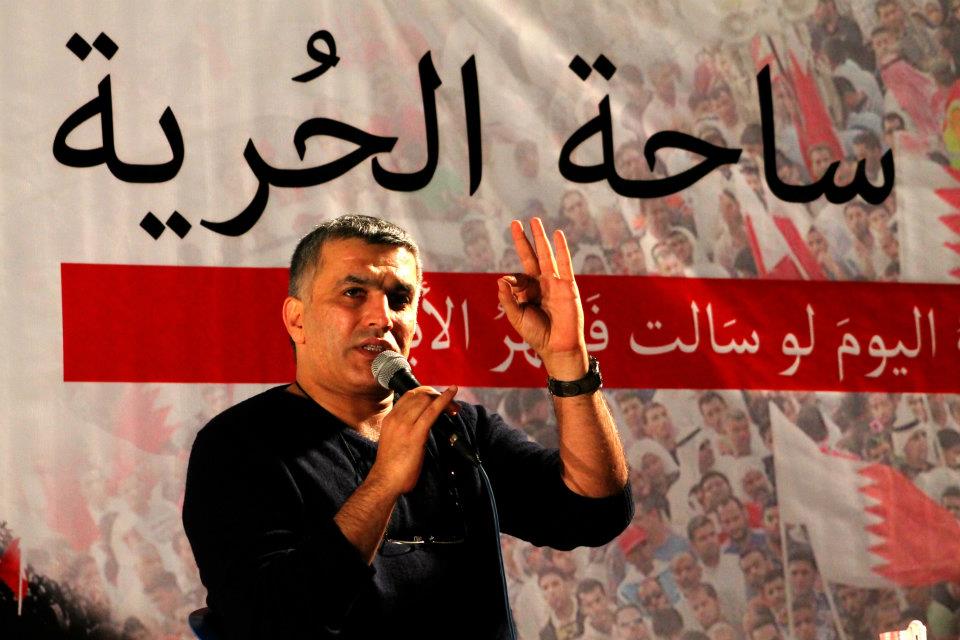
Nabeel Rajab, Final Nominee MEA 2012
According to AhlulBayt News Agency prominent human rights defender Nabeel Rajab has been released in Bahrain today, 24 May 2014. The Bahrain Centre for Human Rights (BCHR) and the Gulf Centre for Human Rights (GCHR) welcome back their – respectively – President of the BCHR and General Secretary of the GCHR, free after a detention that lasted approximately two years. The two organisations warn that thousands of others continue to be imprisoned including BCHR and GCHR founder Abdulhadi Al-Khawaja and Naji Fateel. It is to be noted that Nabeel Rajab is being released because he served the full length of his arbitrary detention sentence.
Nabeel Rajab was initially sentenced on 16 August 2012, to three years in prison for advocating peaceful demonstrations to defend the civil and human rights of all the citizens in the country. On 11 December 2012, the Court of Appeal reduced the sentences to two years in prison. During his detention, he faced dire conditions and was subjected to ill-treatment and torture. The United Nations Working Group on Arbitrary Detention (WGAD) found that Nabeel’s detention was arbitrary as it resulted from the exercise of his universally recognized human rights. Despite this decision by the WGAD, all requests submitted to the authorities for an early release were summarily rejected.
For the older posts that tell the story more in detail see: https://thoolen.wordpress.com/tag/nabeel-rajab/
Treaty Bodies add ammunition to struggle against reprisals
May 20, 2014Thanks to Theo van Boven, who alerted me, I am happy to report another small step in the war against reprisals. On 21 April 2014 the UN General Assembly adopted a resolution on the Strengthening on the Treaty Bodies in which operative paragraph 8 strongly condemns intimidation and reprisals against human rights defenders and others who coöperate with the treaty bodies. (A/RES/69/268). For text of resolution: http://www.un.org/en/ga/search/view_doc.asp?symbol=A/RES/68/268
for more posts on reprisals: https://thoolen.wordpress.com/tag/reprisals/
African Commission leads way in designating a high-level focal against reprisals
May 19, 2014On 16 May 2014 the International Service for Human Rights [ISHR] reports that the African Commission on Human and Peoples’ Rights has designated a high-level focal point to document and follow up on cases of intimidation and reprisals against human rights defenders that cooperate with the African human rights system. The spokesperson of the ISHR, Clement Voulé, welcomed the move and said: ‘The UN and its Member States should take note of the African Commission’s initiative and approve the designation of a high-level UN focal point’…‘Delegations in New York should also heed the call led by Botswana and joined by 56 States in Geneva in March to expedite this process and ensure a comprehensive, system-wide response to reprisals.’ While this is in itself good news and a step in the right direction, some caution is needed:
(1) The tasks of documenting, monitoring and encouraging effective Commission follow up on reprisals has been delegated to the existing African Special Rapporteur on Human Rights Defenders, Reine Alapini-Gansou [‘By designating me as a focal point, the Commission has acted on the need to strengthen its response to reprisals by monitoring cases and working with States to prevent recurrence and promote accountability’]. However, there is no indication that Commissioner Alapini-Gansou is given additional powers or resources.
(2) Almost all the African countries (except Chad and Morocco) supported the UN Resolution in the General Assembly last year that in fact blocked the creation of a focal point against reprisals in the United Nations. Courageous little Botswana may well have led a large group of countries with a statement in March 2014 at the Human Rights Council [http://www.ishr.ch/news/human-rights-council-has-duty-strengthen-response-reprisals] which favors such a UN-wide focal point, but how the African group will vote next time is far from clear. See more on: https://thoolen.wordpress.com/2014/01/08/un-general-assembly-indeed-defers-un-focal-point-on-human-rights-defenders/
Still, I hope we can all share the ISHR’s passionate statement that “Any other outcome will signal support for impunity for the perpetrators of reprisals and a betrayal of human rights defenders and others who engage with the human rights system”.
via African Commission designates high-level focal point to combat reprisals | ISHR.
Burma: human rights defenders arrested again for expressing political opinions
May 13, 2014Nobel Laureate Aung San Suu Kyi, must sometimes be doubting her power: on 5 May 2014, human rights defender Mr Ko Htin Kyaw was arrested by the police for distributing pamphlets in Yangon, Burma. On 9 May 2014, two of his colleagues were also arrested when they attended the trial against him. Ko Htin Kyaw is director of the Movement for Democracy Current Force (MDCF), a community-based organisation working to promote development and democracy. Read the rest of this entry »
Finally it is final: Michel Forst the new Rapporteur on Human Rights Defenders
May 8, 2014It took a lot of wrangling but finally the President of the Human Rights Council has transmitted the list of candidates for mandate holders to be appointed on 8 May 2014 at the organizational meeting of the Human Rights Council. Michel Forst will succeed Margaret Sekaggya as Special Rapporteur on Human Rights Defenders. To see the letter and list of all mandate holders: https://drive.google.com/file/d/0B6XUJ0SW4C68V0pTN25LdDhDTlk/edit
For previous posts in the saga see: https://thoolen.wordpress.com/tag/un-special-rapporteur-on-human-rights-defenders/, with a picture of Michel Forst in the post of 13 March.
UN High Commissioner condemns disappearance of Billy in context of retaliation against environmentalist in South East Asia
May 6, 2014The disappearance of Karen activist “Billy” has prompted the United Nations High Commissioner for Human Rights UNHCHR to condemn the “pattern of killings and forced disappearances of environmental activists in Southeast Asia” and to urge authorities to conduct thorough and independent investigations. “We are concerned about the lack of progress with an investigation into the disappearance of a prominent human rights defender in Thailand,” UNHCHR spokesman Rupert Colville said in a statement released on Friday 2 May. Read the rest of this entry »
The outcome of the treaty body strengthening process: workshop on 9 May 2014 in Geneva
May 6, 2014While not directly about Human Rights Defenders, this workshop organised by the Permanent Mission of Switzerland to the UN and others (see below) is of great importance to HRDs as they are the ones who provide most of the information to the Treaty Bodies, and are often the victims of the violations reported, including reprisals against them for having cooperated. Thus, this meeting on “The outcome of the treaty body strengthening process: Lessons learnt, implications and implementation” should be of interest to all. It takes place on 9 May 2014, 9.30am to 1pm in Room XXII, Palais des Nations, Geneva. Read the rest of this entry »
International Service for Human Rights rings alarm bell over composition of UN Committee on Civil society
May 1, 2014“Civil society loses as repressive States win election to regulate NGO access to UN” is the headline of a rightly alarming report on 23 April 2014 by the New York desk of the International Service for Human Rights [ISHR]. It calls on States that value and respect a vibrant civil society should do more to support non-governmental organisations to have their voices heard at the United Nations. The call comes after very few such States stood for election to an important UN committee that regulates civil society access to the UN, leaving the field to repressive States whose intolerance for civil society at home looks set to further restrict NGO access to the UN. Read the rest of this entry »

