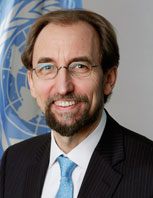
The 5th Theo van Boven lecture was given by Hinah Jilani on 11 November 2014 in Maastricht. As a primeur here is a report written by Daan Bronkhorst (1953) who has been at the staff of Amnesty International Netherlands since 1979. He has written on refugees, transitional justice, history and other issues, and produced a Dutch-language encyclopedia of human rights. He is now writing a PhD study on human rights defenders.
Hinah Jilani on human rights defenders
Observations on a lecture
by Daan Bronkhorst
At the law faculty of Maastricht University, the 5th Theo van Boven Lecture was presented on 11 November 2014 by Hinah Jilani. From 2000 to 2008, she was the United Nations Special Representative on Human Rights Defenders. She is in various respects an emblematic human rights defender herself. Already in 1980, with her sister Asma Jahangir she founded the Legal Aid Cell in Lahore. She was co-founder of the Human Rights Commission of Pakistan and the Women’s Action Forum. She was the target of arrests and death threats, once narrowly escaping a gunman who killed the woman she was counseling at that time.
In the lecture, she described human rights defenders as those who bring to the fore information on the abuses to be addressed by governments and organizations. They contribute to relief and protection, they provide a measure of accountability, they inform governments on possible actions and help ensure a measure of justice. In conflict situations, they have a critical role in promoting peace and peace building. They prompt recognition of participatory democracy and transparency. ‘Human rights defenders are not just making human rights violations visible, they confront states with their duty to protect’, she said. For their work, defenders are considered a threat in most parts of the world. They experience vilification, unfair trials, acts of violence, self-imposed exile and reprisals.
Jilani said that ‘time and again, I was pressured by governments to define human rights defenders. I was wondering why there was this insistence. Then I understood then that when you define, you can make it easy to exclude people.’ Among human rights defenders, Jilani includes professionals as well as peasants, workers, teachers, doctors, judges, MPs and many others. ‘Actually anyone who undertakes any activity for the promotion and protection of human rights, and is harmed becomes of that, comes under the protection of the [1998 UN] Declaration on Human Rights Defenders.’ Quoting examples from her native country, Pakistan, she described the threats that befall the defenders not just from state oppression, but also coming from the ‘lack of judicial independence, social biases, traditional and religious practices, economic interests and political privileges.’ Women are targeted and ostracized by the elders of their communities. There is a positive note as well: ‘Until not so long ago judges used to honour honour killings in Pakistan. Today that has become unthinkable.’
Jilani pictures the defending of the defenders as ‘often a story of one step forward and two steps backwards’. Leaders of indigenous communities, representatives of migrants and refugees, trade unionists: they are all increasingly targeted. More and more reports of attacks now come from Africa. In an increasing number of countries law and policies are leading to the shrinking of civil society space. Meetings are dispersed for alleged security reasons, the defenders are called insurgents or anti-state elements, or simply terrorists. In the UN Declaration, Jilani said, civil society was explicitly given a role in safeguarding democracy and human rights. ‘The defenders initiated programs for institution building, education and the enforcement of the rule of law. But it is impossible for them to achieve those aims if civilians are not allowed to live their normal lives.’ She also cracked a nut with the media: ‘The media have been the first to attack human rights defenders. They have not taken the effort to understand their work. They hit back at the very people who stand up for them when freedom of the press and freedom of opinion are threatened.’
Jilani’s opinions and convictions can be considered as leading in the field. Her observations, I think, also give rise to a number of questions. I mention three.
First, the concept. That the UN Declaration offers no definition has the advantage of greater inclusion, but the risk of confusion and erosion. There are conspicuous inconsistencies in the UN Declaration with later commentaries and explanations issued by the Office of the High Commissioner for Human Rights. Is the term meant to denote only those who are at risk, or also those working from safe offices in say Geneva? That the very concept of the human rights defender is still in the air even at the UN is testified by the November 2013 debate that led to a resolution on women human rights defenders. In the last-minute final text some of the draft’s references, such as to violence against women and to the refraining from invoking customs and religion, were left out, even though shortly before having been adopted in UN General Assembly resolutions.
Second, the scope of the work of human rights defenders. It is one thing to state that human rights work contributes to processes such as that of peace building and social justice, it is another to imply that their actual work is in those fields. There is much consensus about human rights including protection from torture or equality before the law, but not on such issues as the human rights scope of poverty. What is the dividing line between what is injustice and what is a human rights violation? This ties in with a larger present-day debate on the position and foundations of human rights. Will human rights defenders get lost in this debate and become one more bone of contention? Or can a somehow limited purview of their work strengthen human rights’ position?
And third, the empirical data that support the call for better protection and underpinning of the human rights defenders’ work. Jilani’s statement that the space for human rights defence is shrinking on a worldwide scale and that attacks on human rights defenders are increasing, is reflected in reports by international defenders organizations. Simultaneously these organizations report greatly expanding international networks, much success in training, rising awareness of the international community. Is there a discrepancy here? Is the image of increasing threats perhaps self-serving the (donor) organizations? To the perceived rise of menaces one can argue that not long ago in most non-Western countries there was no civil society space at all. Also, since so many more individuals and groups are now labeled ‘human rights defenders’, the absolute number of those victimized may grow even if their proportion decreases. If there is indeed progress, this may prompt emphasizing the effectiveness of programs and using this as leverage for work on situations where the threats persist or newly occur.