Archive for the 'UN' Category

Burundi: what more ‘early’ warning does one need?

November 10, 2015
Pierre Claver Mbonimpa is President of the Association for the Protection of Human Rights and Detained Persons (APRODH) in Burundi. He was the Laureate of the MEA 2007 and on 27 October 2015 he received the Pan African Human Rights Defenders Network’s East Africa Shield Award. What happened to him in the last months is telling (for earlier items see: https://thoolen.wordpress.com/tag/pierre-claver-mbonimpa/):

MEA Laureate Mbonimpa, Burundi

MEA Laureate Mbonimpa, Burundi

  • On 3 August 2015, prominent human rights defender Pierre Claver Mbonimpa – laureate of the MEA 2007 – was shot in the face and neck. He was forced to seek medical treatment abroad.
  • His son-in-law, Pascal Nshimirimana, was shot dead outside his home in Bujumbura on 9 October.
  • On 6 November, the body of Welly Nzitonda, the son of Mbonimpa, was found dead a few hours after he was arrested in the Mutakura neighborhood of Bujumbura where protests have taken place.
  • Just before that – on 3 November – Mbonimpa spoke out on a video message from the place where is recovering: https://www.defenddefenders.org/2015/11/voices-that-cannot-be-silenced-pierre-claver-mbonimpa-speaks-out-on-burundi/

On 9 November 2015 eleven leading human rights NGOs addressed an Open Letter to the UN Human Rights Council urging them to organize a special session to prevent (further) atrocities in Burundi.

Read the rest of this entry »

New website devoted to mandate UN Rapporteur on Human Rights Defenders

October 24, 2015

The UN Special Rapporteur on Human Rights Defenders, Michel Forst, has taken the initiative to set up a website devoted to his mandate. Check out: https://www.protecting-defenders.org.

You can subscribe to a newsletter to be kept informed.

Reprisals against children of Human Rights Defenders in UAE

October 11, 2015

The second case concerning children of human rights defenders is a more general category as described by Rebecca Sheff in a blog on Human Rights First: “Reprisals Against Children of Human Rights Defenders in UAE“.

She reports that on 8 October 2015, the U.N. Committee on the Rights of the Child released a report expressing “concern” about the United Arab Emirates’ treatment of human rights defenders and their families. It noted that the government has been persecuting the children of defenders, restricting their “rights to education, identity documents, to freedom of movement and to keep contact with their detained parents.” The Convention on the Rights of the Child requires the UAE to protect children against discrimination or punishment on the basis of the status, activities, expressed opinions, or beliefs of their parents. The UAE’s acts of intimidation violate children’s fundamental rights and inhibit the work of defenders. Dozens of political prisoners in the UAE are serving long prison sentences after being convicted in a mass unfair trial in 2013.  ….The Committee on the Rights of the Child also expressed concern “about the reported continuous harassment of human rights defenders in the State party, which greatly undermines the emergence of a vibrant civil society as well as the protection and promotion of children’s rights.” The lack of a robust civil society in the UAE means that children’s rights issues are neglected and violations go unaddressed. Ahmed Mansoor, a prominent human rights defender in the UAE, recently received the 2015 Martin Ennals Award for Human Rights Defenders.

Indeed one of the most moving scenes in the film on the work of MEA Laureate Mansoor was when he told how his own child did not recognize him after a stay in detention: (minutes 5.20)


Source: Reprisals Against Children of Human Rights Defenders in UAE | Human Rights First

Mutabar Tadjibayeva wins landmark case in UN Human Rights Committee against Uzbekistan

October 8, 2015

Mutabar Tadjibayeva is remarkable, even among human rights defenders. Her story is well-known in human rights circles: arrested, detained and tortured in Uzbekistan’s prisons, she was released on medical grounds and allowed to leave the country in 2008. That year she came to Geneva to receive in person the Martin Ennals Award for Human Rights Defenders [see: http://www.martinennalsaward.org/index.php?option=com_content&view=article&id=73&Itemid=116&lang=en and https://thoolen.wordpress.com/tag/mutabar-tadjibayeva/].OLYMPUS DIGITAL CAMERA

But she does not just live quietly in exile in Paris. She continues fight for her rights, lodged a complaint to the UN Human Rights Committee in 2012 and this body found on 6 October 2015 that there had been “multiple violations” of her rights, according to a press release issued by three human rights NGOs on 8 October (the Fiery Hearts Club, Redress and FIDH).   Read the rest of this entry »

Nansen Refugee Award to Afghan refugee teacher

October 6, 2015

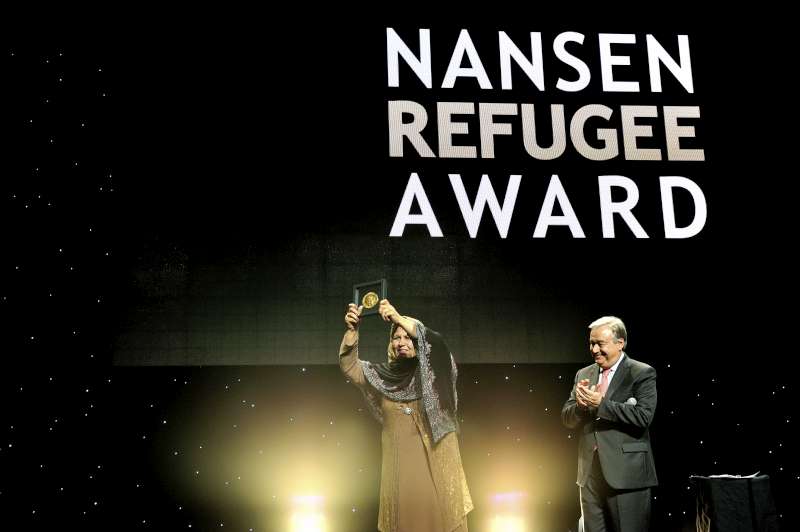
October seems to be very much the season of awards. Tonight is the MEA announcement and yesterday UNHCR presented the 2015 Nansen Refugee Award to Afghan refugee teacher Aqeela Asifi:

© UNHCR/M Henley
Aqeela Asifi made it her mission over more than 20 years in exile to bring education to refugee girls in a remote community in Pakistan. Asifi has been recognised for her tireless dedication to education for Afghan refugee girls in the Kot Chandana refugee village in Mianwali, Pakistan  while herself overcoming the struggles of life in exile. Despite minimal resources and significant cultural challenges, Asifi has guided a thousand refugee girls through their primary education.

When I first set up my school I was not very optimistic. This success is beyond my expectations. Let the dove of peace be our messenger, let us shun the culture of war and weapons and let us promote the culture of pen and education. That’s the only way, my dear brothers and sisters, that we can bring peace and prosperity to our country.” Asifi said.

The Award ceremony, in Geneva’s Bâtiment des Forces Motrices, featured performances from UNICEF Goodwill Ambassador and two-time Grammy winner, Angelique Kidjo, and UNHCR Honorary Lifetime Goodwill Ambassador, Barbara Hendricks.


More about the Nansen award: http://www.brandsaviors.com/thedigest/award/nansen-medal

To learn more about Aqeela’s story: here

Source: UNHCR – UNHCR presents Nansen Refugee Award to Afghan refugee teacher

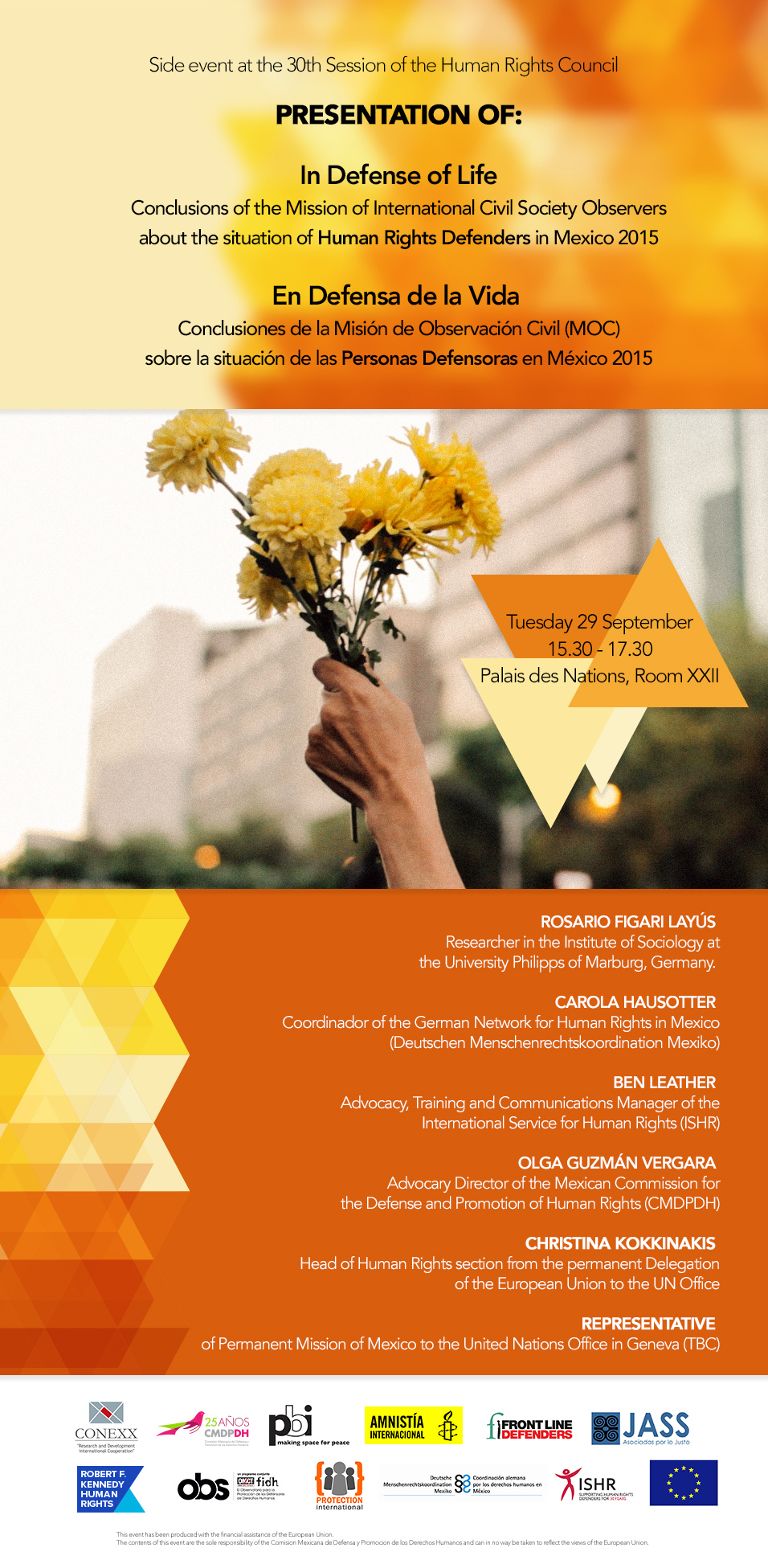
“In Defense of Life”: observer mission report to Mexico at side event Geneva

September 25, 2015

On Tuesday 29 September (15h30 – 17h30, Palais des Nations, Room XXII, Geneva), the CMDPDH,  Asociación Civil and ISHR organise a side event about the situation for human rights defenders in Mexico. [A Mission of International Observers visited Mexico in November 2015 and will present its conclusions – under the title “In Defense of Life” – to the Mexican Government within the framework of the 30th session of the Human Rights Council.]

Panelists in the event are::

  • Rosario Figari Layús – Researcher in the Institute for Interdisciplinary Research on Conflict and Violence (IKG) at the University of Bielefeld, Germany.
  • Carola Hausotter – Coordinador of the German Network for Human Rights in Mexico (Deutschen Menschenrechtskoordination Mexiko)
  • Ben Leather – Advocacy, Training and Communications Manager of the International Service for Human Rights (ISHR)
  • Olga Guzmán Vergara – Advocary Director of the Mexican Commission for the Defense and Promotion of Human Rights (CMDPDH)
  • Ambassador Jorge Lomónaco Tonda – Permanent Representative of Mexico to the UN in Geneva (TBC)
  • Christina Kokkinakis – Head of Human Rights section from the Permanent Delegation of the European Union to the UN in Geneva

Download the flyer: HUMAN RIGHTS IN MEXICO

see previous posts: https://thoolen.wordpress.com/tag/mexico/


Reprisals against Human Rights Defenders continue says UN report

September 17, 2015

Reprisals against human rights defenders continue and the UN High Commissioner for Human Rights (fortunately) continues to give it prominence. A newly released United Nations report names 20 nations that have taken action against rights defenders and activists over the past year. Here the version of the New York Times (Nick Cumming) of 15 September 2015:

Those who give evidence to United Nations human rights investigators are facing increasingly severe reprisals, the United Nations Human Rights Council said Tuesday in a report naming 20 countries that took action against rights defenders and activists in the past year. The instances included intimidation and reprisals against the council’s commissions of inquiry on Eritrea and the 2014 war in Gaza, as well as people cooperating with United Nations investigators and staff monitoring human rights developments, the council’s president, Joachim Rücker, reported. “The types of acts reported seem to have become more varied and severe over time, targeting not only the individuals or groups concerned, but also their families, legal representatives, nongovernmental organizations and anyone linked to them,” he said in the report, which covers events in the year up to the end of May. The penalties it cited ranged from threats and travel bans to imprisonment, torture, sexual violence and disappearance. The list was not exhaustive, leaving out cases where naming individuals might endanger them.

In a statement to the council, Zeid Ra’ad al-Hussein, the United Nations’ High Commissioner for human rights, expressed concern on Monday about China’s detention of more than 100 lawyers and Russia’s stigmatization of nongovernment organizations getting overseas funding, but the report includes only one example of intimidation in each country.

It describes the torture of Sadriddin Toshev, a prisoner in Tajikistan, beaten in front of other inmates by prison officials who cited his interaction with a United Nations investigator on torture. Mr. Toshev was later charged with fraud, accused of deliberately wounding himself to discredit prison officials and of distributing false information, the report said.

Among other cases, the report cites a five-year prison sentence which it says was imposed in Iran on Mohammad Ali Taheri for cooperating with the United Nations expert monitoring human rights there. It also describes the violent arrest of a human rights defender in Myanmar by 10 plainclothes security men as he was on his way to provide evidence to the council-appointed expert assessing developments there.

“Such acts not only show a complete disregard for the functioning of the United Nations as a whole but also highlight the fact that, despite repeated calls for action by states to end all such violations, impunity continues to surround them,” the report said.

Having written so often about this topic, a link to previous posts is all this is needed: https://thoolen.wordpress.com/tag/reprisals/ 

Source: Retribution Increases Against Those Aiding Human Rights Inquiries – The New York Times

The remarkable crackdown on lawyers in China in July 2015

July 29, 2015

On 10 July 2015 over 250 lawyers and support staff were detained or questioned by the police in China in one of the largest crackdowns in recent years. Many newspapers and NGOs have reported on this phenomenon. This is the situation on 29 July: Read the rest of this entry »

Human rights defender Khalef Khalifa from Kenya in the spotlight

July 9, 2015

Frontline NEWlogos-1 condensed version - cropped in its July 2015 Newsletter puts the spotlight on Khalef Khalifa, Executive Director of the NGO MUHURI in Kenya.


On 8 April 2015, the official Gazette notice listed 85 companies and organisations, including MUHURI and Haki Africa, as suspected of having links to terrorism and linking them as specified entities. On 20 and 21 April, the police raided the offices of both organizations, disabling their servers, carrying away hard disks and documents, allegedly to determine whether they had been involved in tax evasion. On 28 May, the Non-Governmental Organisations’ Coordination Board announced through the media that they had de-registered the organizations. On 12 June the court dismissed all charges against MUHURI and Haki Africa on the basis that there was no evidence against them.

Khalef Khalifa (KK): As you know, on the 12th June was a good day for us as both MUHURI and Haki Africa, were entirely vindicated in court. The judge dismissed all the charges against us and said that there was absolutely no evidence to link us to terrorism in any form and specifically forbade the police or even the Minister to make any such reference in the future. However the outstanding difficulty is that he refused to unfreeze our bank accounts on the basis that we had failed to include the Central Bank in our case against the state. They have now agreed to join our case calling for the accounts to be freed but we have to wait for another hearing before the judge makes his ruling and we can begin getting back to normal.

FLD: Given the various lines of attack that were opened against MUHURI it seems as though the government was out to get you?

KK: ...we were targeted on three fronts: by the police, the Revenue Commissioners and by the NGO Board. So while the government accused us of terrorism, the Revenue Commissioners descended on our office and took away all out financial documentation to look for evidence of tax avoidance and the NGO Board lodged a complaint that we had not kept them properly informed of our activities, and in particular that we had not informed them of new appointments to our board, as required by the NGO Law. In the final verdict, while the judge said there was no evidence of involvement in terrorism, both the Revenue Commissioners and the NGO Board had to concede that we were 100% compliant with the regulations. The only thing the NGO Board could trip us up on was that while we had notified the NGO Board of the new appointments, we had not used the appropriate, and newly introduced, form. What is interesting is that in the early stages of the case the government was totally focused on pursuing a case on the basis of terrorism, but they quite quickly changed tack and started looking for any small technical failures they could find to try and make a case against us. But they failed because we have always operated in an entirely open and transparent way.

KK: The real reason for their animus against MUHURI is that we are critical of the police and have investigated their involvement in extrajudicial executions and forced disappearances. There have been at least 52 such killings and disappearances in the Mombasa region in the last two years. The police claim to be fighting terror but in fact terror is a more accurate description of the way the police themselves work. In one incident 8 people were shot dead in a church. The police claimed that it was an attack by Al Shabaab. However when the perpetrators were arrested it was clear that they were not Muslims and in fact had no affiliation to any particular group. The police then hid the names and tried to maintain the fiction of an Al Shabaab attack.

FLD: Will the work of MUHURI get back to normal now?

KK: ...As soon as the accounts are unfrozen we will continue out work as normal. For us it is clear that the government wants to intimidate and frighten MUHURI but we will not be intimidated – we will not give up.

for full interview see: HRD Spotlight: Khalef Khalifa, Kenya | Front Line Defenders.

The more general backdrop can be found in earlier Front Line messages, the 5 June appeal by the Observatory [http://www.omct.org/human-rights-defenders/urgent-interventions/kenya/2015/06/d23190/] and the statements made by NGOs on 26 June 2015 at the adoption by the UN Human Rights Council of the report of the Universal Periodic Review [UPR] of Kenya:

– International Service for Human Rights (ISHR) : Kenya should create an enabling environment for the work of human rights defenders – including repealing restrictions on NGO access to foreign funding and amending or repealing the Information Communication Amendment Bill and Media Council Bill. The statement also emphasised the risks faced by LGBTI people and organisations in Kenya as a result of the criminalisation of same-sex conduct. ‘It is crucial that the voices of human rights defenders are safeguarded and encouraged. This assists to create a vibrant, independent and diverse civil society which is essential to protect human rights, democracy and the rule of law’ said Michael Ineichen of ISHR.

http://www.ishr.ch/news/kenya-safeguard-and-encourage-essential-voices-human-rights-defenders

AllAfrica.com reports on Human Rights Watch comments: “We note Kenya’s acceptance of some important recommendations such as commitments to investigate torture and extrajudicial killings, including the killing of activist Hassan Guyo, and to fully cooperate with the International Criminal Court. But we remain concerned that there has been little tangible progress in many key areas. The ongoing abuses and recent threats to civil society illustrate a lack of commitment to implement these recommendations.

http://allafrica.com/stories/201506260835.html


Human rights defenders and their organizations are at the heart of the protection of natural resources

June 19, 2015

The link between human rights defenders and the exploitation of natural resources was the focus of this year’s report (18 June 20150 by the United Nations Special Rapporteur on the rights to freedom of peaceful assembly and of association, Maina Kiai. He called for a new treaty binding businesses to respect fundamental human rights, and for States and corporations to fully engage with civil society organizations in the context of natural resource exploitation.

Corporations play an outsized role in the decision-making processes about exploitation of natural resources. But they are not subject to legally binding human rights obligations,” Mr. Kiai told the UN Human Rights Council during the presentation of his latest report. “It is time to address this issue more robustly; corporations must not escape responsibility to safeguard human rights.

I am aware that some would rather strengthen compliance with the Guiding Principles than have a binding treaty. But this should not be an either/or matter: Both should be pursued to protect human rights.”

The Special Rapporteur also highlighted States’ responsibility to recognize civil society organizations, including affected communities, as key actors in the context of natural resource exploitation.  “Authorities endeavour to silence individuals and associations that express opposition to natural resource exploitation processes,” the independent expert said.

In his report, the Special Rapporteur argues that States’ and corporations pervasive disregard of communities and associations’ input in the natural resources sector is counterproductive and divisive, and is likely contributing to an erosion of confidence in the world’s prevailing economic system.

The rights to freedom of peaceful assembly and of association are instrumental in achieving sustainable and mutually beneficial exploitation of natural resources,” he said. “These rights help foster increased transparency and accountability in the exploitation of resources and inclusive engagement throughout the decision-making chain.”

During his presentation, Mr. Kiai also warned that authorities have increasingly sought to stifle expressions of criticism and opposition by cracking down, often with unnecessary force, on peaceful protests; arresting, harassing, prosecuting and imprisoning human rights defenders; enacting restrictive legislation on associations; and interfering with the operations of civil society organizations.

Peaceful protests are banned from sites where natural resource exploitation takes place and the situation is not any better in relation to the right to freedom of association,” he noted. “Individuals and associations who express opposition to natural resource exploitation processes are vilified as ‘anti-development’, ‘unpatriotic’, and even as ‘enemies of the State’”.

“This intolerance is reflected in countries in the global North, and the global South,” the Special Rapporteur said. “Nevertheless, I remain optimistic because of the incredible courage and determination of activists and ordinary people who refuse to be cowed or defeated, even if it means paying with their lives.”

The Special Rapporteur’s full report (A/HRC/29/25/Add.3) is at: http://ap.ohchr.org/documents/dpage_e.aspx?m=189

For the UN Guiding Principles on Business and Human Rights: http://www.ohchr.org/EN/Issues/Business/Pages/Tools.aspx


Natural resources sector: UN expert calls for binding human rights treaty for corporations.