Anneliese Mcauliffe in Al Jazeera on 6 December 2015 reported that two Chinese human rights defenders recognised as UN refugees were forcibly deported from Thailand to China last month and have appeared on Chinese state-run television and confessed to human-trafficking offenses. CCTV reported that Jiang Yefei was arrested for “assisting others to illegally cross the national border”, and Dong Guangping was charged with using a trafficking network to flee China while awaiting trial on sedition charges. It was the first time the two men were seen since being taken from a detention centre in the Thai capital Bangkok in November and deported to China.
Archive for the 'UN' Category
Thailand returns recognized refugees to China (and falsely claims they did not know about their status)
December 8, 2015Follow up on the Human Rights Defenders Resolution in the UN
December 5, 2015Last week I wrote about how the UN Resolution on HRDs did in the 3rd Committee of the UN General Assembly [https://thoolen.wordpress.com/2015/11/26/unfortunately-the-un-voted-on-the-resolution-on-human-rights-defenders/] and how South Africa has turned around [https://thoolen.wordpress.com/2015/11/30/south-africa-does-about-turn-on-un-resolution-on-human-rights-defenders/]. The date of the vote in the Plenary is not yet confirmed but is likely to be 18 or 21 December. The voting record is available: http://www.un.org/en/ga/third/70/docs/voting_sheets/L.46.Rev.1.pdf
Fourteen States voted no on the resolution (China, Russia, Syria, Burundi, Kenya, Myanmar, Nigeria, Saudi Arabia, Zimbabwe, North Korea, South Africa, Iran, Pakistan, and Sudan). In some of these countries civil society has expressed disappointment. e.g.
In Pakistan the Human Rights Commission of Pakistan (HRCP) in a statement issued on Tuesday, said: “At the same time, HRCP must express alarm and great disappointment that Pakistan chose to be one of the 14 nations that voted against the resolution.“ “While regretting Pakistan’s decision to oppose the resolution, the civil society is entitled to ask what rights defenders have done to deserve this step-motherly treatment. It is unfortunate that the government wishes to see civil society as an adversary. The civil society cannot, and must not, surrender its role as a watchdog for people’s rights because that constitutes an entitlement, by virtue of citizens’ social contract with the state, and not as a concession” “The HRCP also stresses people’s right to know through an explanation in parliament the reason why the government chose to deny the need for protection for HRDs, who include, besides human rights groups, journalists, lawyers, political and social activists.” Read the rest of this entry »
Former Amnesty staff appointed deputy UN Human Rights Commissioner
December 2, 2015 Kate Gilmore. UN Photo/Amanda Voisard

On 1 December 2015 Secretary-General Ban Ki-moon announced the appointment of Kate Gilmore of Australia as Deputy High Commissioner for Human Rights, succeeding Flavia Pansieri of Italy. Ms. Gilmore, is currently Deputy Executive Director of the UN Population Fund (UNFPA) and before 2012 she was Deputy Secretary General of Amnesty International and National Director of AI Australia. Ms. Gilmore started her career as a social worker and policy officer for the Australian Government, establishing the country’s first Centre Against Sexual Assault. She was a member of Australia’s first national committee on violence against women.
Closing Civil Society Space – a euphemism for Killing Human Rights Defenders
November 30, 2015The Huffington Post of 29 November 2015 carried a good piece by Brian Dooley (Human Rights First) under the title “When Closing Civil Society Space Means Killing Human Rights Defenders”. He states that “what sometimes gets overlooked in the discussion around “shrinking civil society space” are direct, violent attacks on human rights defenders.”
He refers to this year’s Report of the UN Special Rapporteur on the situation of human rights defenders (HRDs) which details killings of HRDs in Africa, the Americas, Asia-Pacific, Europe and the Middle East. And a Note by the UN Secretary-General in July this year included how “defenders also describe their sense that they are often on their own, with the media showing little interest in reporting acts of aggression against them and with little support from political figures…”
Business and Human Rights: where to go in the UN
November 19, 2015from Special Issue on Business and Human Rights by the ISHR, October 2015
For human rights defenders interested to find their way in the myriad of procedures and soft law surrounding the issue of business and human rights:

The UN established in June 2011 a Working Group on the issue of human rights and transnational corporations and other business enterprises.
The key mandate of the Working Group is to promote the effective and comprehensive dissemination and implementation of the Guiding Principles on Business and Human Rights, using the usual range of tools available to Special Procedures of the Human Rights Council (country visits, thematic reports, and individual communications).In order to discuss the trends and challenges in the implementation of those Guiding Principles and to promote dialogue and cooperation on issues linked to business and human rights, a Forum on Business and Human Rights has been held every year since 2012 and is open to all relevant stakeholders, including in particular human rights defenders. There is an increasing focus on human rights defenders in the agenda of the Forum, with two specific panels dedicated to human rights defenders in 2015 focusing on women human rights defenders and on the role of business in protecting defenders respectively.
The Special Rapporteur on the situation of human rights defenders and the Special Rapporteur on the rights to freedom of peaceful assembly and of association have both expressed concern about human rights defenders working on these issues, with the previous Special Rapporteur on human rights defenders devoting a report to the issue of human rights defenders working on major development projects and the Special Rapporteur on the rights to freedom of peaceful assembly and of association devoting a report to the issue of freedom of association and the extractive industries.
In June 2014, the Human Rights Council mandated an Intergovernmental Working Group (IGWG), tasked with commencing work towards the drafting of an international legally binding treaty on business and human rights. In July 2015 the IGWG had their first session, more information and reports can be found here.
Finally, the UN Global Compact initiative, is intended as a practical framework for the development, implementation, and disclosure of sustainability policies and practices by businesses that are committed to aligning their operations and strategies with ten universally accepted principles.
MEA Laureate Mbonimpa has message of hope at his son’s funeral
November 12, 2015Since I published my post about MEA Laureate Pierre Claver Mbonimpa two days ago (https://thoolen.wordpress.com/2015/11/10/burundi-what-more-early-warning-does-one-need/) the situation has not improved and the hope is that the UN will find the muscle to impose itself. In the meantime, the Huffington Post of 12 November carries a long piece on Mbonimpa and his Burundi by Charlotte Alfred under the title “Burundi’s Human Rights Legend Urges Hope After His Son’s Killing“.

Pierre Claver Mbonimpa founder and president of the APRODH in Burundi (CARL DE SOUZA/AFP/GETTY IMAGES)
Pierre Claver Mbonimpa wasn’t able to attend his son’s funeral. Instead, he sent a message from Belgium, which was read out at the funeral of his son, Welly Nzitonda, on Tuesday, according to independent journalist network SOS Médias Burundi: “Do not lose courage … The tragedies we face will end with a resolution of the conflict in Burundi.”
……..
“The problem that plagues the country is not ethnicity, but politics,” Mbonimpa told the Oslo Freedom Forum in 2010. “It is politicians who manipulate the population in pursuit of power.”
For the full article, worth reading, see: Burundi’s Human Rights Legend Urges Hope After His Son’s Killing
Filippo Grandi new United Nations High Commissioner for Refugees
November 12, 2015On 11 November 2015 the Secretary-General of the United Nations, following consultations with the regional groups, announced that Filippo Grandi of Italy is to be the new United Nations High Commissioner for Refugees (UNHCR). 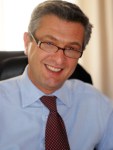
This is good news for the organization and the millions of refugees as Filippo brings enormous humanitarian experience with him: He was Commissioner-General of the United Nations Relief and Works Agency for Palestine Refugees in the Near East (UNRWA) from 2010 to 2014 and it’s Deputy Commissioner-General from 2005 until 2010. He served as the Secretary-General’s Deputy Special Representative with the United Nations Assistance Mission in Afghanistan (UNAMA) and has a long-standing career with UNHCR (1988-2004), notably as Chief of Mission in Afghanistan and Chief of Staff in the High Commissioner’s Executive Office. His vast field experience includes various positions in Sudan, Syria, Turkey and Iraq, having also led emergency operations in Kenya, Benin, Ghana, Liberia, the Great Lakes region of Central Africa, Democratic Republic of Congo and Yemen.
Filippo Grandi was born in Milan in 1957. He has a bachelor’s degree in philosophy from the State Universities of Venice and Milan, and from the Gregorian University in Rome.
No more ‘business as usual’ when it comes to business and HRDs
November 11, 2015On 19 October Michel Forst, UN Special Rapporteur on Human Rights Defenders, wrote a piece for the Monitor of the ISHR under the title “No more ‘business as usual’ when it comes to business and human rights defenders”. Read the rest of this entry »
 Hans Thoolen on Human Rights Defenders and their awards