Archive for the 'UN' Category
May 4, 2016
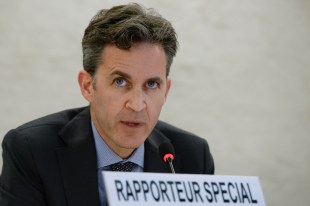
Special Rapporteur on the promotion and protection of the right to freedom of opinion and expression David Kaye. UN Photo/Jean-Marc Ferré
On World Press Freedom Day, 3 May 2016, David Kaye, UN Special Rapporteur on freedom of expression, signalled concern that efforts to counter “violent extremism” may be construed as the “perfect excuse” for democratic and authoritarian governments to restrict free expression and control access to information. “By ‘balancing’ freedom of expression and the prevention of violence, the programmes and initiatives aimed at countering ‘violent extremism’ have – often purposely, sometimes inadvertently – put at risk or curtailed the independence of media”
Mr. Kaye and his counterparts from the African Commission on Human and Peoples’ Rights (ACHPR – Pansy Tlakula), the Inter-American Commission on Human Rights (IACHR – Edison Lanza) and the Organization for Security and Co-operation in Europe (OSCE – Dunja Mijatovic) raised concerns in their annual Joint Declaration that programmes to prevent or and/combat violent extremism risk undermining freedom of expression. “Some governments target journalists, bloggers, political dissidents, activists and human rights defenders as ‘extremists’ or ‘terrorists,’ criminalizing and detaining them, using legal systems to counter broad and unclear offences,” Mr. Kaye warned. “The harm is felt not only by journalists but also by their audiences, the public that deserves the right to know and to access information of public interest.” The Joint Declaration is available here.
The EU on this day wishes to recall the principle that “the establishment, maintenance and fostering of an independent, pluralistic and free press is essential to the development and maintenance of democracy in a nation, and for economic development”….The EU is committed to continue promoting and protecting freedom of opinion and expression worldwide, not only offline but also in relation to the cyberspace and other information communication technologies, as highlighted by the adoption in 2014 of the EU Human Rights Guidelines on Freedom of Expression Online and Offline. ..It condemns the increasing level of intimidation and violence that journalists, Human Rights Defenders, media actors and other individuals face in many countries across the world when exercising the right to freedom of opinion and expression online and offline.
 on World Press Freedom Day 2016, Front Line Defenders lists 6 human rights defenders persecuted for bravely demanding rights for their communities:
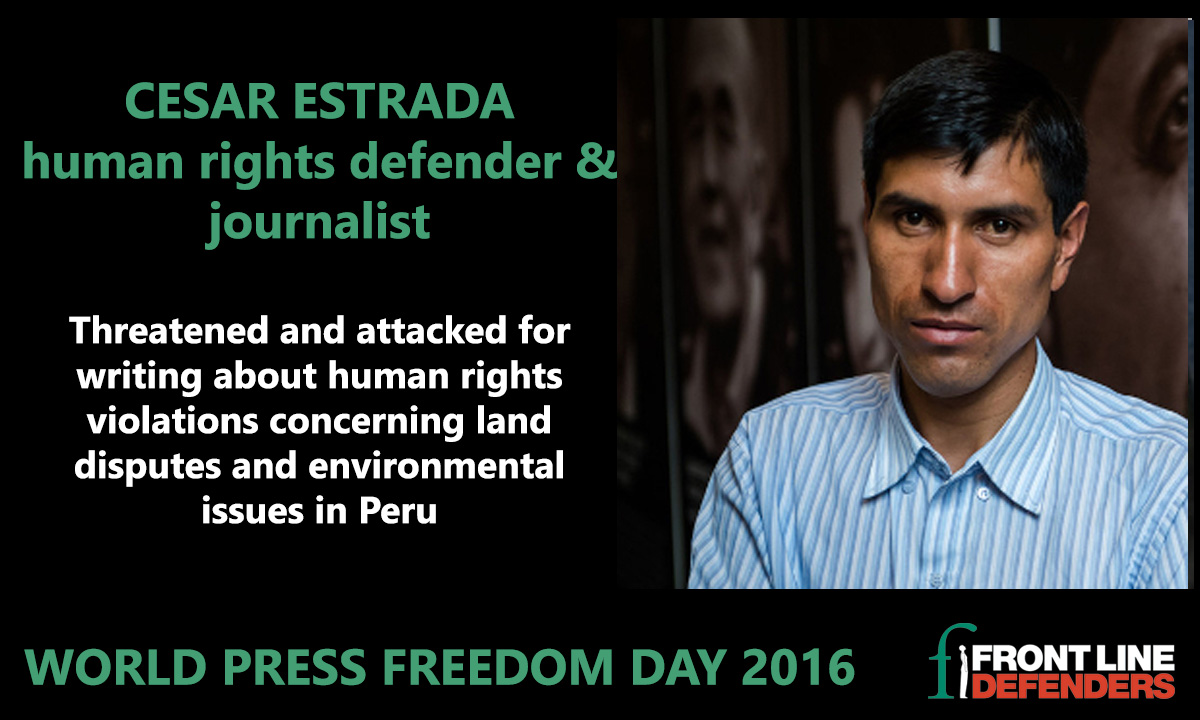
CESAR ESTRADA, PERU
Cesar Estrada Chuquilin is a journalist and member of the Red de Comunicadores Indigenas del Perú – REDCIP (Network of Indigenous Communicators in Peru). He has reported on several human rights violations concerning land disputes in the region and environmental issues related to the Conga Mining Project in the region of Cajamarca. In September 2015 Cesar survived an assassination attempt. He has also suffered severe persecution, intimidation, defamation, harassment, threats, attacks and thefts as a result of his peaceful and legitimate human rights work.
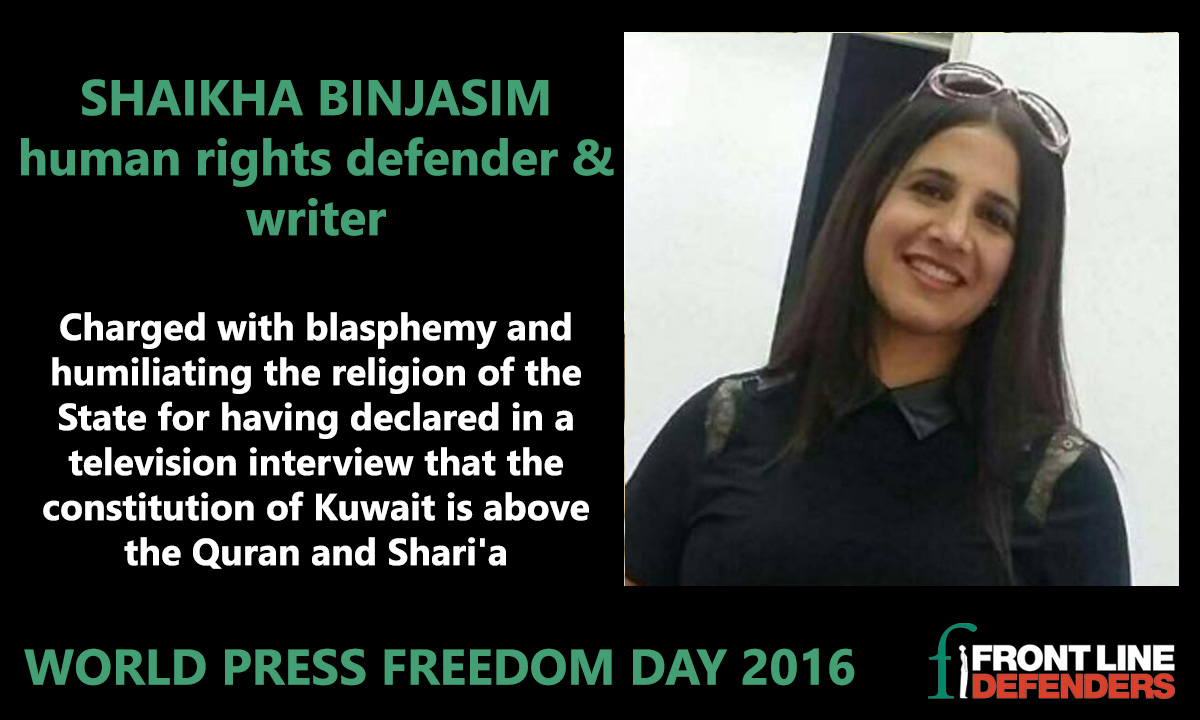
SHAIKHA BINJASIM, KUWAIT
Ms Shaikha Binjasim is a Kuwaiti human rights defender, writer and professor of philosophy at Kuwait University. She has been advocating on social media for freedom of conscience and freedom of speech in Kuwait. On 14 April 2016 she appeared before the public prosecutor, who charged her with blasphemy and humiliating the religion of the State for having declared in a television interview on the Kuwaiti channel Al-Shahed, that the constitution of Kuwait is above the Quran and Shari’a.
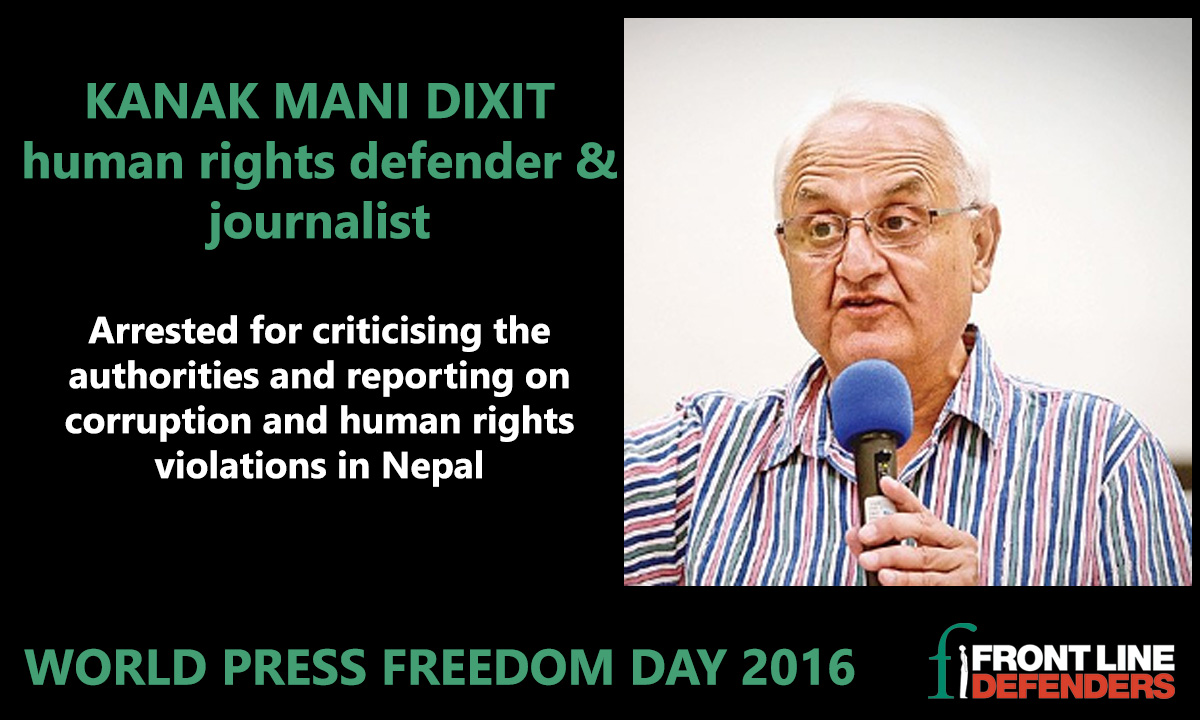
KANAK MANI DIXIT, NEPAL
Kanak Mani Dixit is a well-known journalist and human rights defender actively promoting the establishment of a democratic and secular government in Nepal. On 22 April 2016, Mr Lok Man Singh Karki, chairman of the Commission of Investigation on Abuse of Authority (CIAA), ordered his arrest. In 2013, Kanak Mani Dixit had published several articles criticising the appointment of Lok Man Singh Karki as Chairman, who had been found guilty of committing a series of brutal human rights violations when he was serving as Chief Secretary of the government.
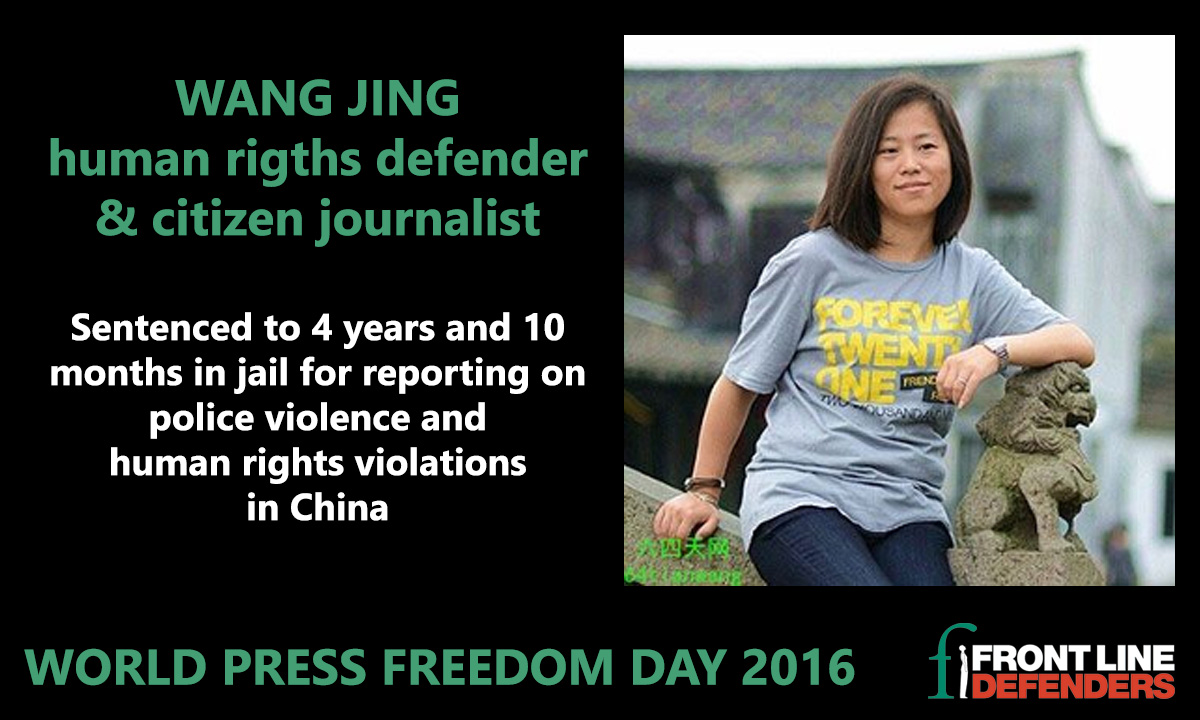
WANG JING, CHINA
Wang Jing is a citizen journalist who, amongst other reporting, has contributed articles to 64Tianwang, an independent human rights website operating in mainland China. On 24 April 2016 she was sentenced to four years and ten months in prison, for providing information about a self-immolation attempt which she witnessed in Tiananmen Square in March 2014. She was accused of sending pictures of the self-immolation to websites abroad, circulating them on social media and giving interviews to overseas media. It was also alleged that she reported on incidents where police had harassed, beaten and detained protesters and that such reports were defamatory.
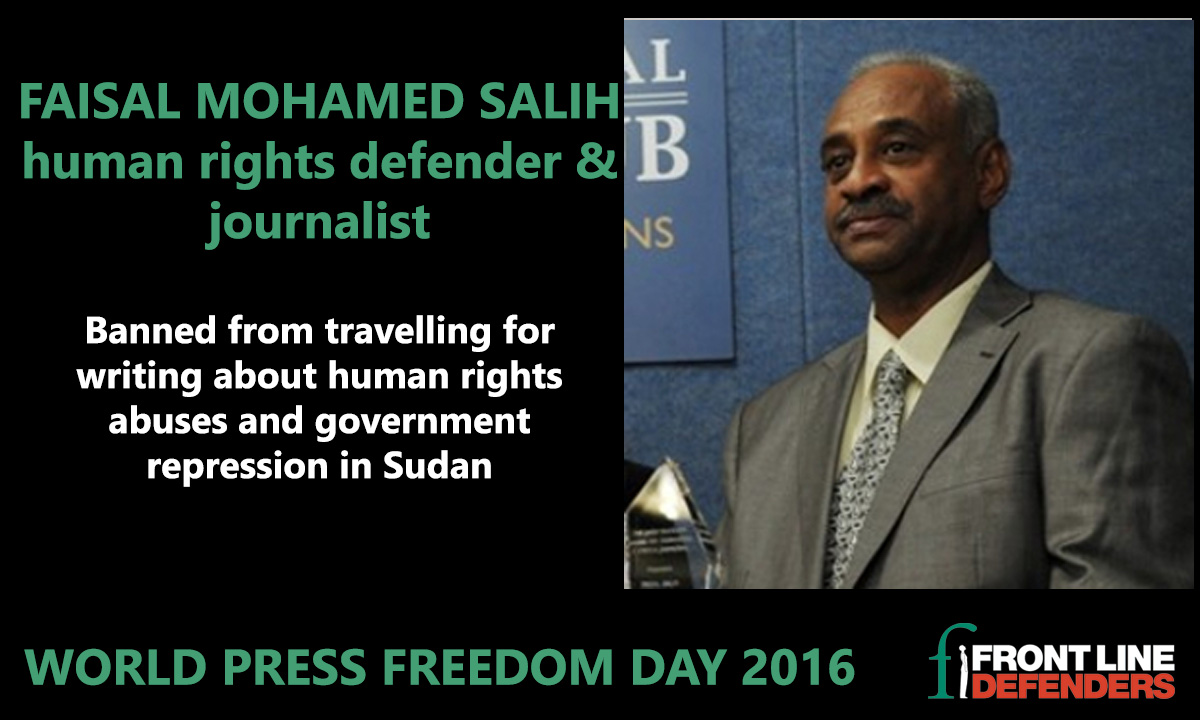
FAISAL MOHAMED SALIH, SUDAN
Faisal Mohamed Salih is a prominent Sudanese human rights journalist. He has extensively written about human rights abuses and government repression in Sudan, and also works on the promotion of freedom of expression and freedom of the press. On 25 March 2016, security agents from the National Intelligence and Security Services (NISS) prevented him from traveling from Khartoum International Airport to London. His passport was confiscated without any information being provided as to whether it shall be returned to him.
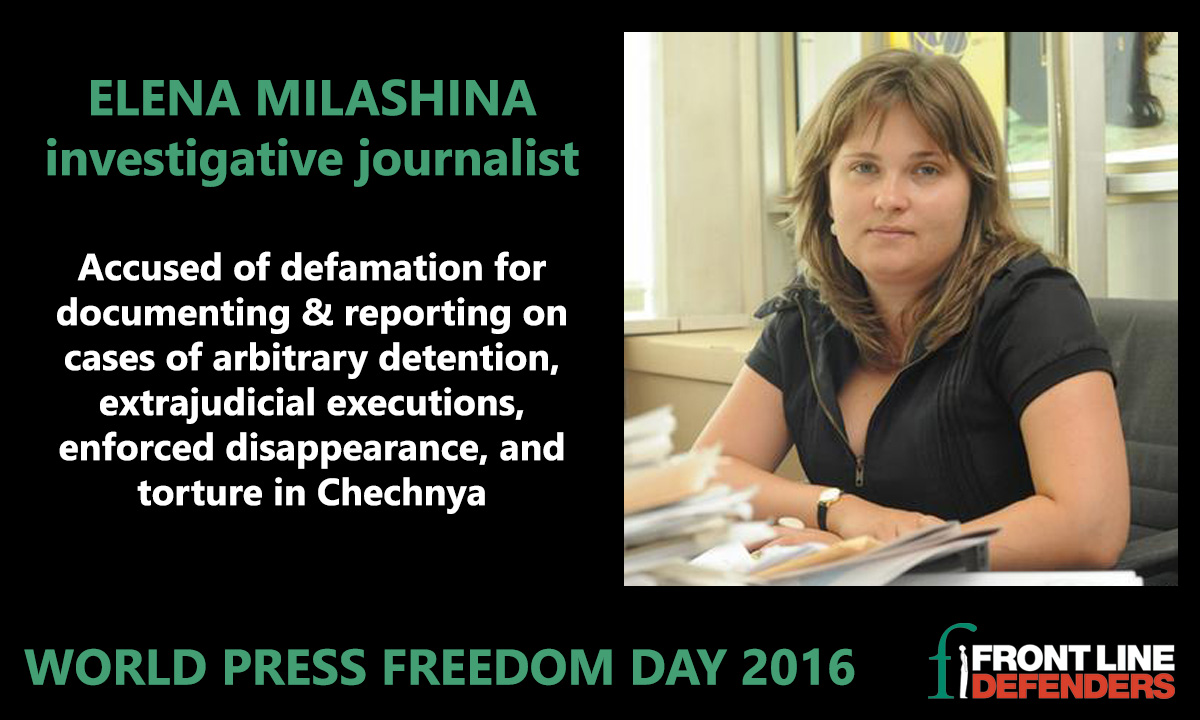
ELENA MILASHINA, RUSSIA
Elena Milashina is a human rights defender and an investigative journalist working for Novaya Gazeta, an independent Russian newspaper. Through her research and reports she has drawn international attention to the Russian government’s crackdown on civil society, as well as gross human rights abuses continuing in the Northern Caucasus. On 16 March 2016, the Ombudsman of the Chechen Republic announced that he had requested the Investigation Committee of the Russian Federation to initiate a criminal case against Ms Elena Milashina. She was accused of spreading false information, for an article where she described an attempt by the Chechen police to abduct a member of the human rights organisation “Committee for Prevention of Torture” on 22 February 2016.
Sources:
United Nations News Centre – UN expert warns combat against violent extremism could be used as ‘excuse’ to curb free speech
http://www.consilium.europa.eu/en/press/press-releases/2016/05/02-hr-declaration-world-press-freedom-day-3-may/
https://www.frontlinedefenders.org/en/statement-report/world-press-freedom-day-2016
Posted in EU, Front Line, human rights, Human Rights Defenders, UN | Leave a Comment »
April 25, 2016
Posted in Front Line, HRF, human rights, Human Rights Defenders, UN | 2 Comments »
Tags: Abdel Fattah el-Sisi, Bahey eldin Hassan, Ban Ki-moon, Brian Dooley, Cairo Institute for Human Rights Studies, demonstrations, Egypt, FCO, foreign funding, Gamal Eid, Giulio Regeni, Hossam Bahgat, Malek Adly, Nazra for Feminist Studies, Sanaa Seif, Yasser El-Qot
April 19, 2016
Who will be the next secretary-general? The field is still wide open but thanks in part to the 1 for 7 Billion campaign, campaigning for the job is – for the first time in UN history – mostly public, even if the decision is ultimately made by General Assembly upon the recommendation of the Security Council. There are strong arguments in favor of a woman (first time ever, see link below) and someone from Eastern Europe (‘their turn’ in the informally agreed regional rotation). Of the nine candidates currently in the running, UN insiders and others close to the process see UNESCO head Irina Bokova, UNDP Administrator Helen Clark, former High Commissioner for Refugees António Guterres and former Slovenian President Danilo Türk as the frontrunners (if the bookmakers are right).
Last week, for the first time ever, nine candidates presented their visions for the UN to the General Assembly in New York Read the rest of this entry »
Posted in human rights, UN | Leave a Comment »
Tags: Candidate, Eastern Europe, global leadership, international human rights and humanitarian law, IRIN, Irina Bokova, mass atrocities, New York, prevention, refugees, Secretary-General of the United Nations, UN, women
April 14, 2016
I have had quite a few post on Navi Pillay as UN High Commissioner for Human Rights [https://thoolen.wordpress.com/tag/navi-pillay/] before and after her term [https://thoolen.wordpress.com/2014/07/09/navanethem-pillay-finishes-her-term-as-un-high-commissioner-for-human-rights-a-great-lady/]. So when the Toronto Star (Nicholas Keung Immigration reporter) did an interview with this remarkable woman on 12 April 2016, I am happy to bring it to your attention. She was the recipient of the 2003 Gruber Prize for Women’s Rights and the 2010 Stockhom Human Rights Award.
“Navi Pillay reflects on 50 years as a champion for human rights”

Navi Pillay, who grew up under apartheid in South Africa, is the former United Nations High Commissioner for Human Rights.
Read the rest of this entry »
Posted in human rights, Human Rights Defenders, OHCHR | Leave a Comment »
Tags: apartheid, Canada, Discrimination, High Commissioner for Human Rights, Navanethem Pillay, Navi Pillay, profiles, South Africa, Toronto Star, UN
March 28, 2016
At the latest session of the Human Rights Council, States and NGOs reacted to the new compilation of advise and recommendations on how to protect the right to assembly (‘freedom to demonstrate’). UN human rights experts have launched a major new report on the proper management of assemblies. The compilation of practical recommendation, which seeks to ensure that the management of assemblies and protests comply with international law through which to apply international law, was drafted by the Special Rapporteurs on Freedom of Association and Assembly (Maina Kiai) and on Extrajudicial Executions (Christoph Heyns), after a series of consultations with multiple stakeholders including civil society.
An interactive dialogue with the Rapporteurs followed the report’s presentation, and several States – including Norway, Egypt and Ireland – reiterated the responsibilities of business. Whilst a broad range of States – including Costa Rica, Turkey and Tunisia – acknowledged the report’s importance, others used their interventions to emphasise the responsibilities of protesters. In response to Russia, Botswana and Cuba amongst others, Mr Heyns was clear: ‘Rights come before responsibilities. The report does not challenge that responsibilities are an inherent component of human rights, but one must come before the other.’ Maina Kiai underlined that ‘requiring authorisation for a protest dilutes a right to a mere privilege’.
ISHR’s statement reiterated that free assembly is a vital component of a safe and enabling environment for human rights defence, and highlighted how vague laws such as the Ley de Tumulos in Guatemala, repressive clampdowns on protest such as in Gezi Park in Turkey, and the imprisonment of protesters such as the Bahrain 13 are being used to hamper the work of human rights defenders.
ISHR welcomed the report’s emphasis on the responsibilities of business. ‘We hear increasingly of abuses by private security firms against protesters, as well as strategic lawsuits against public participation brought by companies and the enactment, by States, of laws which specifically target and restrict protests against business operations,’ said ISHR’s Ben Leather. ‘States should take heed of the recommendations made in the report to reverse these trends’.
For other posts on this topic: https://thoolen.wordpress.com/tag/freedom-to-demonstrate/
Source: UN experts launch practical advice on management of protests | ISHR
Posted in human rights, Human Rights Council, Human Rights Defenders, ISHR | Leave a Comment »
Tags: Bahrain, Christof Heyns, freedom of assembly, freedom to demonstrate, Guatemala, ISHR, legal restrictions, Maina Kiai, protests, recommend, Turkey, UN Human Rights Council, UN Special Rapporteurs
March 25, 2016
The Norwegian-led resolution was adopted by a vote of 33 Member States of the Human Rights Council to just 6 against. Eight States in the 47-seat Council abstained. Over 150 NGOs from all over the world united to call on Member States of the Council to adopt the resolution and reject a series of 30 hostile amendments proposed by Russia, China, Egypt, Cuba and Pakistan, designed to undermine the protection of defenders and to deny their legitimacy and very existence.
The 6 States that voted ‘No’ on the resolution were not surprisingly Burundi, China, Cuba, Nigeria, Russia and Venezuela. States that abstained were Bolivia, El Salvador, Kenya, Namibia, Qatar, Saudi Arabia, the United Arab Emirates, and Viet Nam. Interesting and positive to note that some of the States that had supported hostile amendments (including Ecuador, Indonesia and India) in the end voted in favour of the resolution.
[The resolution affirms the legitimate and essential role of human rights defenders in promoting, protecting and contributing to the realisation of economic, social and cultural rights – including indigenous rights and the right to development – and condemns restrictions and attacks against them by both States and business enterprises. It also underscores the fact that exercise of the rights to freedom of expression, association, assembly and public participation can be essential to the promotion, protection and realisation of ESC rights, and that restrictions or violations of these democratic rights may lead and amount to violations of the ESC rights for which defenders are advocating.
The resolution also provides invaluable guidance to States and business as to obligations and good practices in the protection of defenders. For States, such obligations and good practices include developing specific human rights defender protection laws and mechanisms, investigating and ensuring accountability for attacks and reprisals against them, and facilitating access to information and participation in policy and decision-making processes. For businesses, the resolution reinforces the obligation to respect and not interfere with the work of defenders, and to consult closely with defenders to identify, avoid, mitigate and remedy human rights risks and violations associated with business activities and development projects.]
‘We particularly recognise the principled leadership of Norway in leading the development of this timely resolution,’ Mr Ineichen of the ISHR said.
‘The systematic but ultimately unsuccessful efforts by a small group of States to undermine the human rights defender resolution paradoxically demonstrate the vital importance and potential impact of this resolution,‘ said ISHR Director Phil Lynch.
Source: Human Rights Council adopts historic resolution on protection of defenders of economic, social and cultural rights | ISHR
Posted in human rights, Human Rights Council, Human Rights Defenders, ISHR, UN | 2 Comments »
Tags: ESC rights, Geneva, Human Rights Defenders, ISHR, Michael Ineichen, NGOs, Norway, reprisals, Resolution, social economic and cultural rights, UN Human Rights Council
March 23, 2016

It is usually Norway that leads the negotiations on the resolution on human rights defenders as is the case this year at the 31st session of the UN Human Rights Council. The resolution this year takes account of the severe risks that human rights defenders face when defending economic, social and cultural rights, including as they relate to environmental, land and development issues, corporate responsibility, anti-corruption, transparency and accountability issues. The draft resolution calls on States to take effective and practical steps to address the continuing violations of the rights of defenders.
During the first week of this session of the Human Rights Council, Norwegian State Secretary Tore Hattrem stated that “Threats and attacks against human rights defenders who are exercising their right to freedom of speech to advocate economic, social and cultural rights, severely hamper the realisation of these rights”. Also Ambassador Steffen Kongstad raised this important topic during the interactive dialogue with the UN Special Rapporteur on Human Rights Defenders, Michel Forst, stating that “Threats and attacks against human rights defenders may hamper the realization of economic, social and cultural rights, undermining social cohesion, and ultimately stability and development”.
The resolution has been discussed in several open informal consultations in Geneva, taking into account a number of suggestions from different countries. Norway formally tabled the resolution on 16 March full text see website. There are currently around 50 countries from all regional groups that will co-sponsor the resolution. Still, this is far from won as earlier this week a number of countries (including the serial offenders Russia, China, Egypt, Cuba and Pakistan) have put forward 31 adverse amendments to the text. These amendments include proposals which have the purpose or would have the effect of:
Posted in human rights, Human Rights Council, Human Rights Defenders, UN | 4 Comments »
Tags: China, Cuba, draft resolution, Egypt, ESC rights, Geneva, hostile amendments, Human Rights Defenders, NGOs, Norway, Pakistan, Resolution, Russia, Tore Hattrem
March 18, 2016
During the adoption of the Universal Periodic Review (UPR) report of Rwanda at the UN Human Eights Council, Laurent Munyandilikirwa, former President of the Ligue Rwandaise pour la Promotion et la Défense des Droits de l’homme, delivered on 16 March 2016 a statement (on behalf of CIVICUS: World Alliance for Citizen Participation and East and Horn of Africa Human Rights Defenders Project):.
Mr President, for the vast majority of my professional and personal life, I have proudly dedicated myself to protecting and promoting fundamental human rights in Rwanda. As the former President of LIPRODHOR, one of Rwanda’s only independent human rights monitoring organisations, I had the great privilege of supporting my fellow citizens to secure and claim their rights. However, despite the severe human rights deficits which continue to undermine Rwanda’s democratic consolidation, the important work LIPRODHOR and other human rights groups undertook in Rwanda is now largely untenable and fraught with danger.
Since Rwanda’s last UPR examination in 2011, the government has strengthened its long-term and systematic campaign to completely stifle freedom of association, by replacing the leadership of human rights organisations with those sympathetic to the government. As a result, there are now very few freely functioning and entirely independent human rights organisations left that can meaningfully challenge government policies and advocate for reforms, without well-founded fear of reprisals. In addition, since Rwanda’s last examination, independent civil society organisations, NGOs, and individual human rights defenders have continued to face escalating intimidation and reprisals in the course of their work. A number of defenders, including myself, have either been imprisoned or forced into exile. Increasingly, human rights defenders and the NGOs for which they work have been subjected to administrative harassment smear campaigns and public denouncement in pro-government media.
We therefore strongly urge the Government of Rwanda to take effective and meaningful steps to operationalize the important recommendations put forward during this examination in support of the creation of a safe and enabling environment for civil society and human rights defenders.
This is line with e.g. Front Line Defenders’ report of 10 September 2015 about the Rwandan police disrupting the general assembly organised by LIPRODHOR . [On 5 September 2015, Rwandan police officers disrupted a general assembly that had gathered several dozen members of the League for the Promotion and Defence of Human Rights in Rwanda. The purpose of the general assembly was to elect a new independent board of directors.[LIPRODHOR is one of the few human rights organisations in Rwanda, which has continuously endeavoured to hold the government accountable for a wide range of human rights abuses. After numerous human rights groups based in Rwanda were either co-opted or forced into silence, LIPRODHOR stood out as the sole Rwandan organisation committed to being independent. In 2004, the government targeted its leaders and accused them on fabricated charges of “propagating genocide ideology.” The outgoing members of the board of directors of LIPRODHOR have allegedly been acting on behalf of the government. The general assembly which took place on 5 September 2015 had been convened by the outgoing board, whose term ended in July 2015, in order for a new board to be elected. During the assembly, participants elected three board members, namely the chair, the vice-chair and the secretary general. Following this, a number of participants, led by the chair of the outgoing board, reportedly stood up and caused a commotion as they claimed that the vote had been rigged. Soon after the incident, these participants reportedly called the police, who intervened and disrupted the assembly. A senior police officer informed the participants who had remained inside that he had to put an end to the meeting as it was “causing insecurity”. Members of the organisation have contacted the authorities about the incident, but, to date, no measures have been taken to assure the organisation’s rights to conduct its activities. It remains unclear whether LIPRODHOR’s members will be allowed to convene again and complete the election of the new board which will allow them to carry out their legitimate human rights work without restriction.
In November 2014, several members of LIPRODHOR attempted to convene a similar assembly in order to address the ongoing problem. However, local authorities thwarted the initiative, informing them that the gathering would be deemed illegal. Thereafter, Messrs Evariste Nsabayezu and Daniel Uwimana, respectively LIPRODHOR’s vice chair and provincial representative at the time, were arrested and detained over allegations that they were involved in organising the assembly using what the police claimed were “falsified documents.” They were later released without trial. Several other members of LIPRODHOR were also reportedly threatened with arrest.]
Posted in Front Line, Human Rights Council, Human Rights Defenders | Leave a Comment »
Tags: CIVICUS, Civil society, East and Horn of Africa Human Rights Defenders Project, Front Line (NGO), intimidation, Laurent Munyandilikirwa, LIPRODHOR, reprisals, Rwanda, UPR
March 17, 2016
An update on the situation human rights defenders in Russia is unfortunately needed too frequently. Recently the Martin Ennals Foundation condemned the attacks on its 2013 Laureate, the Joint Mobile Group (JMG) which is known for its courageous work in opening legal cases on behalf of victims of torture in Chechnya. On March 9th, they were travelling together with journalists and the group was physically attacked, their confidential notes stolen, and the vehicles they were in burned. Their offices in Ingushetia were also attacked. The international and local media have reported (see list at bottom of the post). This is part of an ongoing pattern of threats and intimidation directed against JMG.
Now, Human Rights Watch and others report that yesterday (16 March) Igor Kalyapin, head of the Committee for the Prevention of Torture, one of the founders and participants of the Joint Mobile Group, was attacked as he was leaving his hotel in Grozny. They also pelted him with eggs, and threw flour and bright antiseptic liquid on him, which stained his face and clothes. “The attack on Igor Kalyapin shows again that it’s open season on human rights defenders in Chechnya,” said Hugh Williamson, of Human Rights Watch. “The authorities’ utter failure to hold anyone to account for a series of vicious attacks in recent years is like a bright green light for further attacks.”
Read the rest of this entry »
Posted in AI, FIDH, Front Line, HRW, human rights, Human Rights Defenders, MEA, Observatory for the Protection of Human Rights Defenders, OHCHR, OMCT | 4 Comments »
Tags: attack, Chechnya, closing, Committee against Torture, Elena Shakhova, foreign agent law, Human Rights Defenders, Igor Kalyapin, Joint Mobile Group, Maria Razumovskaya, Martin Ennals Award, MEA Laureate 2013, Observatory for the Protection of Human Rights Defenders, Olga Nikolaenko, Russia, Vladimir Putin
March 16, 2016
Further to my post of today about human rights defenders in the area of economic, social and cultural rights, here the profile of such a defender, Allo Awol from Ethiopia.
Allo is a voice for human rights defenders in Ethiopia; a voice for those on the ground who resist oppressive Government policies and struggle to bring about progressive change and transformation in the face of adversity. ‘Under current circumstances, being outside Ethiopia presents both an opportunity and a responsibility to speak out against the Government’s authoritarian policies, particularly the increasing abuse of the constitutional order, the judicial system, discourses around development and counter-terrorism. I speak for the victims of human rights violations in Ethiopia, the victims of the State.’..
Read the rest of this entry »
Posted in human rights, Human Rights Council, Human Rights Defenders, ISHR | Leave a Comment »
Tags: "Zone 9” bloggers, Allo Awol, bloggers, economic social and cultural rights, ESC rights, Ethiopia, freedom of expression, human rights mechanisms, independence of the judiciary, ISHR, minorities

 on World Press Freedom Day 2016, Front Line Defenders lists 6 human rights defenders persecuted for bravely demanding rights for their communities:

