On 29 May the Committee to Protect Journalists and fourteen other organisations have urged Pakistan to immediately halt deportation of Afghan journalists and other vulnerable Afghan migrants. The fifteen advocacy groups expressed deep concern over Pakistan’s ongoing deportation plan, first announced on 3 October 2023, which targets undocumented Afghan nationals. The joint statement highlights the heightened risks faced by Afghan journalists, writers, artists, human rights defenders, and others who fled Taliban persecution and are now at risk of being forcibly returned.
Among the signatories are prominent international organisations such as PEN Germany, CPJ, Unlimited Free Press, Front Line Defenders, International Cities of Refuge Network (ICORN), Nai – Supporting Open Media in Afghanistan, and Reporters Without Borders (RSF).
The organisations also called on the international community to provide safe resettlement opportunities for these individuals, recognising the dangers they face if returned to Taliban-controlled Afghanistan. Pakistan’s deportation policy has faced sharp criticism from local and international bodies, including the Pakistan Human Rights Commission, the United Nations High Commissioner for Refugees (UNHCR), and the International Organisation for Migration (IOM). These entities have urged Pakistan to uphold its international obligations and provide protection to those fleeing conflict and persecution.
Despite repeated calls for restraint, the Pakistani government has accelerated forced returns in recent months. In April alone, more than 300,000 Afghans were deported, drawing further condemnation from human rights organisations.
——
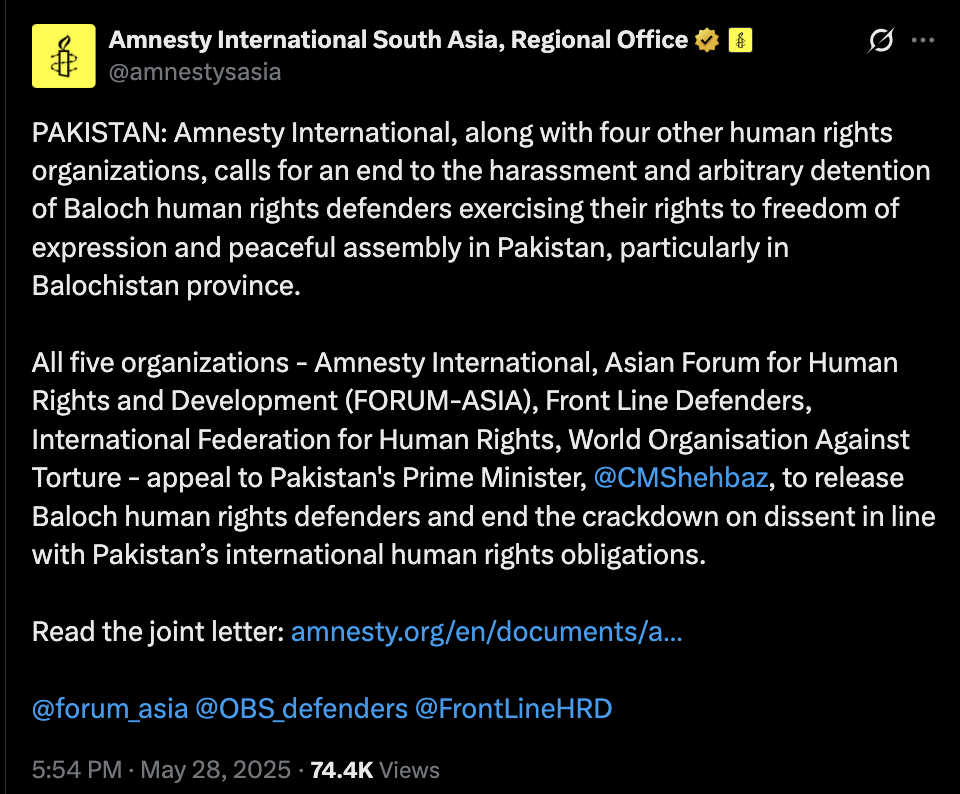
On 28 May Amnesty International along with four other human rights organizations wrote to the Pakistani prime minister, calling for an end to the “harassment and arbitrary detention” of Baloch human rights defenders (HRDs) exercising their rights to freedom of expression and peaceful assembly, particularly in Balochistan province.
The letter comes in the wake of Dr. Mahrang Baloch, one of the leading campaigners for the Baloch minority and the leader of the Baloch Yakjehti Committee (BYC), and a number of other activists, being arrested in March on charges of terrorism, sedition and murder. ..
The five organizations — Amnesty International, Asian Forum for Human Rights and Development (FORUM-ASIA), Front Line Defenders, International Federation for Human Rights, World Organization Against Torture — appeal to Pakistan’s Prime Minister to release Baloch human rights defenders and end the crackdown on dissent in line with Pakistan’s international human rights obligations;
A dozen UN experts called on Pakistan in March to immediately release Baloch rights defenders, including Dr. Baloch, and to end the repression of their peaceful protests. UN special rapporteur for human rights defenders Mary Lawlor said she was “disturbed by reports of further mistreatment in prison.”
Balochistan is the site of a long-running separatist movement, with insurgent groups accusing the state of unfairly exploiting Balochistan’s rich gas and mineral resources. The federal and provincial governments deny this, saying they are spending billions of rupees on the uplift of the province’s people.
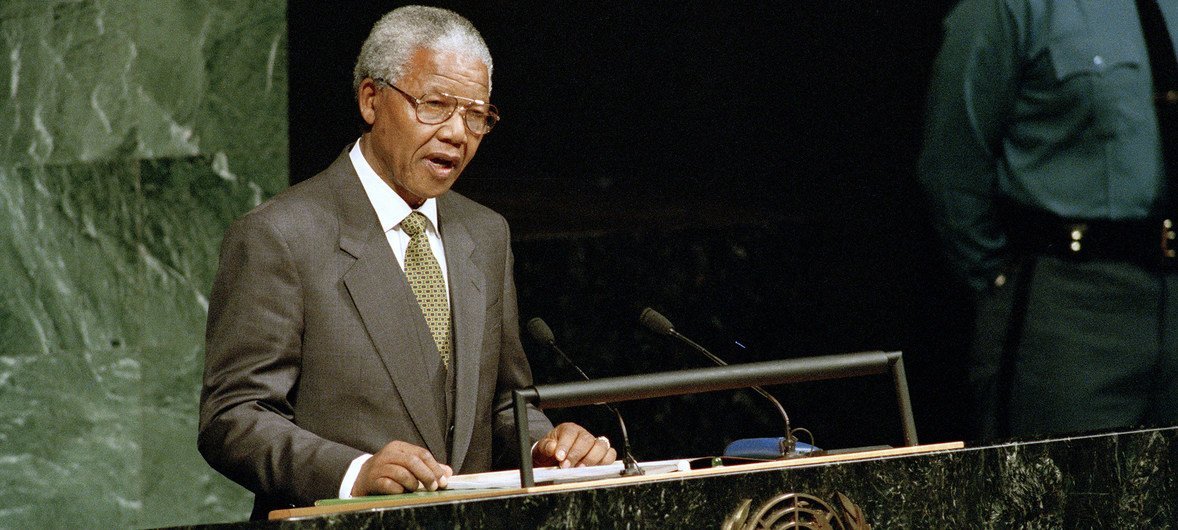
UN Photo/Evan Schneider President Nelson Mandela addresses the 49th session of the General Assembly October 1994.
An Indigenous social worker from Canada and a social entrepreneur from Kenya are the laureates of the 2025 Nelson Rolihlahla Mandela Prize, the United Nations announced on28 May 2025.
Secretary-General António Guterres will present the award to Brenda Reynolds and Kennedy Odede on 18 July, Nelson Mandela International Day. “This year’s Mandela prize winners embody the spirit of unity and possibility – reminding us how we all have the power to shape stronger communities and a better world,” said Mr. Guterres.
A Status Treaty member of the Fishing Lake Saulteaux First Nation in Saskatchewan, Canada, Brenda Reynolds has spent decades advancing Indigenous rights, mental health, and trauma-informed care. In 1988, she supported 17 teenage girls in the first residential school sexual abuse case in Saskatchewan. Later, she became a special adviser to the Truth and Reconciliation Commission (TRC), helping shape survivor support and trauma responses. She is most recognised for her key role in Canada’s court-ordered Indian Residential Schools Settlement Agreement and her subsequent development of the Indian Residential School Resolution Health Support Program—a national initiative offering culturally grounded mental health care for survivors and families. In 2023, she was invited by the UN High Commissioner for Human Rights and the European Union to share her expertise on trauma and cultural genocide.
Kennedy Odede
Living in Kenya’s Kibera Slum for 23 years, Kennedy Odede went from living on the street at 10 years old to global recognition when he was named one of TIME magazine’s 2024 100 Most Influential People. His journey began with a small act: saving his meagre factory earnings to buy a soccer ball and bring his community together. That spark grew into Shining Hope for Communities (SHOFCO), a grassroots movement he now leads as CEO. SHOFCO operates in 68 locations across Kenya, empowering local groups and delivering vital services to over 2.4 million people every year. Mr. Odede is also a New York Times bestselling co-author and holds roles with USAID, the World Economic Forum, the Obama Foundation, and the Clinton Global Initiative.
——-
Also interesting to note that according to the Sahara Press Service of29 May 2025 an unexpected and high-profile controversy led to the elimination of Moroccan nominee Amina Bouayach President of CNDH from the shortlist. Bouayach’s candidacy sparked a wave of international protest, with letters, petitions, and statements of condemnation sent to the selection committee from both Sahrawi organizations and Moroccan human rights defenders, who denounced the nomination as a betrayal of Mandela’s legacy.
The opposition was led by victims of human rights abuses—Sahrawis, Rifians, journalists, and former political prisoners—who expressed deep outrage that a figure associated with the whitewashing of Morocco’s ongoing violations could be considered for a prestigious prize meant to honor defenders of dignity and freedom.
In a series of forceful statements, the Sahrawi National Council and the Sahrawi Human Rights Commission described Bouayach’s nomination as “an insult” to Mandela and accused her of legitimizing repression in Western Sahara and within Morocco. Notably, Moroccan activists also voiced rare public criticism, calling the nomination a distortion of both the United Nations’ credibility and Mandela’s ideals…
Her leadership at the Moroccan National Human Rights Council has been, and still is marked not by independent advocacy, but by efforts to legitimize state atrocities even as reports of abuses against Sahrawis, Rifians, journalists, and peaceful dissidents have continued to mount. ..
According to sources close to the selection process, the committee was “taken aback” by the level and breadth of resistance, especially the coordinated objections from across the political and geographic spectrum. This pressure ultimately led to Bouayach’s exclusion from consideration.
Some States are using travel bans to punish and silence human rights defenders who dare to speak out at the United Nations. These acts of reprisal — from confiscating passports to unjustly labeling activists as terrorists — are designed to isolate, intimidate, and silence voices demanding accountability and justice. A travel ban may be less visible than a prison cell, but its impact is no less damaging. It prevents defenders from attending UN meetings, carrying out their work, reuniting with loved ones, or seeking safety.
Mohamed El-Baqer (Egypt), who, though pardoned after being unjustly detained for 5 years, is still listed on a terrorist list and barred from travelling.
Anexa Alfred Cunningham (Nicaragua), an Indigenous leader who was banned from returning to her country and her land.
These are not isolated cases — they are part of a pattern of reprisals meant to silence dissent and deter others from engaging with the UN.
What the International Service for Human Rights demand is:
The lifting of travel bans and restrictions against Loujain, Mohamed, Anexa, and Kadar.
The inclusion of their cases in the UN Secretary-General’s annual report on reprisals. This is the first step to recognise they are cases of reprisals which need to be addressed and resolved.
Concrete action from States to publicly condemn and raise these cases at the Human Rights Council and General Assembly. According to our research, we found that more publicity and peer-pressure bring more probability for the reprisal case to be resolved (i.e. here, for the bans to be lifted).
The establishment of clear UN protocols to prevent and respond to acts of reprisal.
You can help us achieve our goals:
The first step, is for the Secretary-General to include these cases in his reprisals report. You can contribute by:
👉 Signing our petition to the UN Secretary-General to ensure Loujain, Mohamed, Anexa, and Kadar are included.
UN independent experts on 26 May 2025 expressed grave concern over the continued detention of Anar Mammadli, a prominent Azerbaijani human rights defender who was arbitrarily detained on 29 April last year. “Defending human rights should never be considered a crime,” the experts said.
Anar Mammadli, Chair of the Election Monitoring and Democracy Studies Centre (EMDS), was arrested on 29 April 2024 amid what experts describe as a growing clampdown on critical voices and independent election observers in Azerbaijan. His arrest came shortly after EMDS reported irregularities during the February 2024 presidential elections, and after he participated in events at the UN Human Rights Council.
On 28 June 2024, the experts wrote to the Azerbaijani authorities to raise serious concerns about Mammadli’s alleged arbitrary detention, warrantless searches, restricted access to legal counsel, deteriorating health conditions in detention and a smear campaign reportedly targeting him in retaliation for his legitimate human rights work.
“There are serious concerns that Mammadli’s detention and prosecution may be in retaliation for his human rights work and his engagement with UN mechanisms,” they said.
The Azerbaijani Government responded by denying the allegations, stating that Anar Mammadli was under investigation for smuggling and money laundering. According to their response, he has been provided with all necessary legal rights and medical care during his detention.
The experts are still concerned about the legal proceedings, especially given Mammadli’s previous imprisonment in 2013, which the European Court of Human Rights deemed unlawful and politically motivated. Despite the Court’s 2018 judgment requiring Azerbaijan to quash the conviction and restore Mammadli’s civil and political rights, these remedies have allegedly not been implemented.
The experts will continue to monitor the case, particularly with regard to any potential connection to reprisals for engagement with UN human rights mechanisms.
The value of human rights awards was once again demonstrated by the reaction of the Nicaraguan Government which withdrew from the UN cultural body. The Nicaraguan authorities justified their decision by denouncing the award as the “diabolical expression of a traitorous anti-patriotic sentiment” of La Prensa, which they accuse of promoting “military and political interventions by the United States in Nicaragua.” The Nicaraguan government denounced UNESCO’s decision, saying it gives prominence to “the traitors, slaves and lackeys of colonialism and imperialism,” adding the organization “totally abandons any sense of objectivity.
UNESCO director-general Audrey Azoulay said on Sunday that she “regrets” the country’s decision, adding that it would “deprive the people of Nicaragua of the benefits of cooperation, particularly in the fields of education and culture.” The organization is “fully within its mandate” of defending freedom of expression and freedom of the press, Azoulay said.
In the past weeks and months, Russian and Ukrainian human rights activists have been focusing on negotiations to end the war in Ukraine. Back in January, human rights activists and the People First campaign raised several issues to parties involved in ongoing negotiations in the hopes that the negotiations would prioritise those affected by the conflict, particularly prisoners of war, detained Ukrainian citizens, Ukrainian children which have been taken to Russia, and Russian political prisoners.
The invasion of Ukraine was only possible thanks to a system of political repression Russia has inflicted on its own people for decades.
In February, on the third anniversary of Russia’s full-scale invasion of Ukraine, a group of UN special rapporteurs and experts called for parties involved in negotiations to put legal and humanitarian issues at the forefront of discussions. They stressed that the Russian government must be held accountable for its aggression and war crimes in Ukraine committed, and its repressive policies towards its own citizens.
The invasion of Ukraine was only possible thanks to a system of political repression Russia has inflicted on its own people for decades. According to experts, over 3,000 individuals have been persecuted by Russian authorities for political reasons. Despite recent efforts by human rights activists to advocate for person-centred negotiations, it seems more and more doubtful that the focus will be on human rights
—
Russia’s aggression against Ukraine has challenged the established system of international relations, which has now proven to be woefully fragile. Most countries see Putin’s decision to unleash outright war on Ukraine as unacceptable. While many democratic countries have continued to provide Ukraine with assistance, this has at times proven insufficient in the face of Russian violence.
Since January, the rejection by the US of legal norms in place since the two world wars has unleashed a new crisis in international politics.
US tactics to repeal basic human rights seem eerily familiar for Russian activists, who have been fighting similar state tactics for the past 25 years.
The new American administration’s policy is increasingly similar to Putin’s own tactics. Both favour the “right of the strong”, whereby great powers can decide the fate of others and dictate conditions. The US has shown itself to be less interested in international law, making it increasingly easy for norms to be overlooked.
US tactics to repeal basic human rights seem eerily familiar for Russian activists, who have been fighting similar state tactics for the past 25 years. Russians knew a world without regard for international human rights or legal norms long before 2025, or the invasion of Ukraine in 2022.
For 25 years, Putin’s government has created a country which prioritises the interests of the state and denies basic human rights.
What is happening in the US is recognisable to many Russians.
By wanting to end the war in Ukraine and find a quick solution, the US president is effectively equating the aggressor with the victim of aggression.
Negotiations thus far suggest Trump is more likely to ensure Russian interests that are detrimental both to the safety of the Ukrainian people, who have been subjected to aggression and occupation, and to justice and a sustainable peace.
Russia’s full-scale invasion of Ukraine was the result of years of human rights violations within Russia and the lack of a response from the international community to these violations.
An unfair peace — a “deal” that contradicts the norms of international law — sets a dangerous precedent. It normalises the war against Ukraine, thereby giving Russia the green light to repeat its aggression and to enact even harsher repressive policies inside Russia.
Such a “deal” is a signal to the whole world, a move towards dangerous instability, reminiscent of the brink of the outbreak of the world wars. Departing from the principles of human rights and international law in peacekeeping practices encourages impunity and will inevitably lead to new wars of aggression. Democracy in many countries will also be at risk, as the new rules of the game will open up opportunities for autocrats and dictators to violate human rights in their countries without regard for international institutions and their international obligations.
No peace without rights
We call on the leaders of all democratic countries, all politicians for whom human rights are not merely empty words, and civil society to take a stand and bring human rights back into international politics.
This is the only way to create reliable conditions for long-term peace in Europe and prevent the emergence of new-large scale military conflicts globally. Otherwise, the world will find itself in a situation where the fate of countries and the people living in them will be decided through wars unleashed by imperialist predators.
We call on all parties taking part in peace negotiations in Ukraine to prioritise the human aspect: the fate of prisoners of war and the protection needed for civilians, including in Russian-occupied areas of Ukraine.
We insist that negotiations be based on the fundamental norms of international legal agreements, including the UN Charter and the Helsinki Final Act, as they define aggression, protect the principle of territorial integrity and sovereignty, and link military and political security with human rights. Without this, it will be impossible to achieve a just and sustainable peace.
The appeal was drafted and signed by members of the the Council of Russian Human Rights Defenders: Galina Arapova, Sergey Davidis, Yury Dzhibladze, Leonid Drabkin, Sergey Krivenko, Sergey Lukashevsky, Karinna Moskalenko, Oleg Orlov, Lev Ponomarev, Alexander Cherkasov, and Yelena Shakhova.
The names of the other Council members who signed the appeal are not given for security reasons.
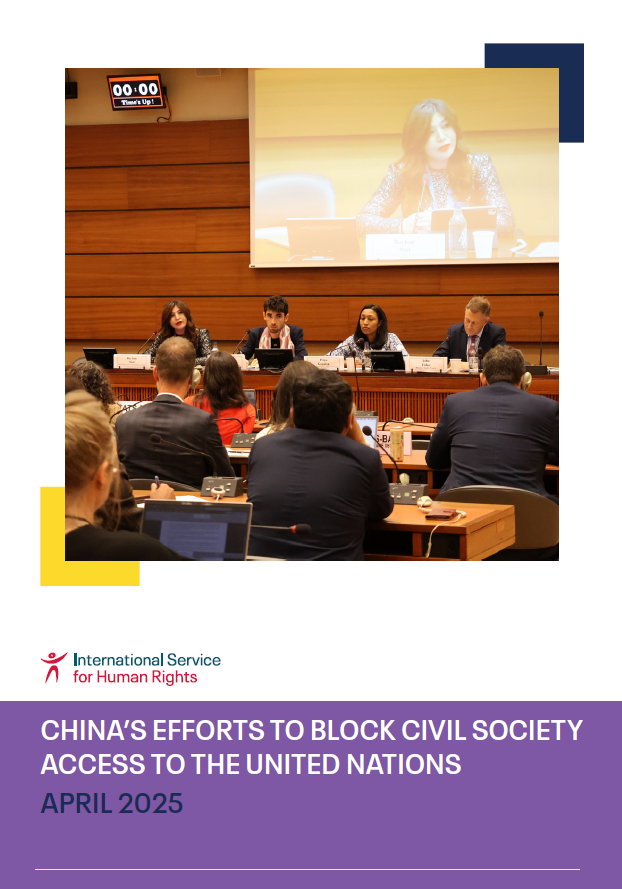
In a new report, ISHR analyses China’s tactics to restrict access for independent civil society actors in UN human rights bodies. The report provides an analysis of China’s membership of the UN Committee on NGOs, the growing presence of Chinese Government-Organised NGOs (GONGOs), and patterns of intimidation and reprisals by the Chinese government.
In the report, published on 28 April 2025 the International Service for Human Rights (ISHR) uncovers the tactics deployed by the Chinese government to restrict access to UN human rights bodies to independent civil society actors and human rights defenders, and intimidate and retaliate against those who do so.
These tactics include using its membership of the UN Committee on NGOs to systematically defer NGO applications, increasing the presence of GONGOs to limit space for independent NGOs and advance pro-government narratives, systematically committing acts of intimidation and reprisals against those seeking to cooperate with the UN, weaponising procedural tactics to silence NGO speakers and threatening diplomats not to meet with them, and opposing reform initiatives and efforts at norm-setting on safe and unhindered civil society participation at the Human Rights Council.
These tactics strongly contrast China’s stated commitment to being a reliable multilateral leader. They stem from the Chinese Party-State’s primary foreign policy objective of shielding itself from human rights criticism and enhancing its international image by restricting and deterring critical civil society voices, crowding out civil society space with GONGOs, and stalling and diverting reform initiatives.
While China is the focus of this report, the issues addressed are systemic. Based on this report’s findings, ISHR puts forward a set of targeted recommendations to UN bodies and Member States, aimed at protecting civil society space from interference and restrictions. The recommendations are designed to strengthen UN processes and prevent any State from manipulating international mechanisms to suppress independent voices. These include:
Reforming the Committee on NGOs to increase transparency, limit abuse of deferrals, and ensure fair access to UN bodies for independent NGOs;
Strengthening protection mechanisms against reprisals, including rapid response to incidents inside UN premises, public accountability for perpetrators, and consistent long-term follow-up on unresolved cases;
Curbing the influence of GONGOs by distinguishing clearly between independent and State-organised NGOs, and better documenting their presence and impact; and,
Strengthening measures at the Human Rights Council and other UN bodies to make civil society participation safer, more inclusive, and less vulnerable to obstruction
The report has been featured prominently in a global investigation by the International Consortium of Investigative Journalists (ICIJ) launched on 28 April 2025.
The 58th regular session of the UN Human Rights Council ran from February 24 to April 4, 2025, resulting in 32 Resolutions and 14 Universal Period Review adoptions.
The session included a high-level segment attended by over 100 dignitaries, thematic panels addressing the rights of specific vulnerable groups, interactive dialogues, and debates on country-specific reports. This session also marked key anniversaries of the Beijing Declaration and the Convention on the Elimination of All Forms of Racial Discrimination. The Human Rights Council plays a crucial role in addressing global violations and continues to serve as a platform for activists and victims of violations. In the face of multiple intersecting crises and conflicts, democracy erosion, and authoritarianism on the rise, Council decisions continue to wield considerable power to improve civil society conditions, particularly in fragile contexts where civic actors are particularly affected by widespread human rights violations and abuses, while offering unique opportunities for the negotiation of higher human rights standards.
I have on the past used other such reports by the ISHR and the UHRG (see below) but thought that this time I should highlight other NGOs:
CIVICUS contributed to the outcomes of the Council session through engagement on key Resolutions, delivery of statements, and organisation of events. We sounded the alarm on the global erosion of civic space and the growing repression of civil society across multiple regions.
Regional Developments: Africa
A strong Resolution on South Sudan was adopted, extending the mandate of the Commission on Human Rights in South Sudan (CHRSS).
Regional Developments: Asia Pacific
A Resolution on Myanmar’s human rights situation was adopted by consensus amid escalating violence and widespread impunity.
Regional Developments: Americas
The Resolution on Nicaragua renewed the mandate of the Group of Human Rights Experts (GHREN) on Nicaragua.
Regional Developments: Europe
Key resolutions were adopted on Ukraine and Belarus, continuing international monitoring mechanisms.
Regional Developments: Middle East
Resolutions on Iran and Syria were adopted, with mixed results on addressing severe human rights concerns.
Several important thematic resolutions were adopted during the session.
Civil Society Challenges
Ahead of the 58th session, CIVICUS raised attention on the increasing restrictions imposed on civil society. CIVICUS engaged in key side events during HRC58, spotlighting democracy, child human rights defenders, and intersectional approaches to civic space.
A detailed post-session report is available via this link.
The International Commission of Jurists (ICJ):
The International Commission of Jurists (ICJ), together with partner organizations, participated actively in the 58th session. Civil society’s critical engagement is essential in calling on the Council and its member States to respond to the plight of victims of human rights violations. In this regard, the ICJ was pleased to ensure that our partner from the African Albinism Network delivered our joint statement on the tenth anniversary of the mandate of the Independent Expert on the enjoyment of human rights by persons with Albinism. Maintaining effective access to the UN in Geneva for civil society is key to ensure that people can themselves participate or be represented in the discussions at the Council that concern them directly. With regard to this, the ICJ denounces all attempts to undermine civil society participation, including the intimidation of human rights defenders during side events, observed again at this HRC session.
At the outset, the ICJ welcomes the adoption of a number of important resolutions renewing, extending or creating mandates under the HRC purview, among which the following were adopted without a vote:
a resolution extending the mandate of the Independent International Commission of Inquiry on the Syrian Arab Republic for a period of one year;
a resolution establishing an open-ended intergovernmental working group for the elaboration of a legally-binding instrument on the promotion and protection of the human rights of older persons;
a resolution renewing the mandate of the Special Rapporteur on the promotion and protection of human rights and fundamental freedoms while countering terrorism for a period of three years;
a resolution renewing the mandate of the Special Rapporteur on the right to food for a period of three years;
a resolution extending the mandate of the Special Rapporteur on the situation of human rights in Myanmar for a period of one year;
a resolution renewing the presence of the Office of the High Commissioner in Seoul, for a period of two years with the same resources and extending the mandate of the Special Rapporteur on the situation of human rights in the Democratic People’s Republic of Korea(DPRK) for a period of one year.
While regretting the failure to adopt them by consensus, the ICJ also welcomes the adoption of other important resolutions by a majority of the votes:
a resolution extending the mandate of the Commission of Inquiry on Ukraine for a period of one year;
a resolution renewing the mandate of the Special Rapporteur on the situation of human rights in Belarus for a period of one year and extending the mandate of the Group of Independent Experts on the Situation of Human Rights in Belarus for a period of one year;
a resolution renewing the mandate of the Group of Human Rights Experts on Nicaragua for a period of two years;
a resolution extending the mandate of the Special Rapporteur on the situation of human rights in the Islamic Republic of Iran for a period of one year and deciding that the Independent International Fact-Finding Mission on the Islamic Republic of Iran should continue for one year with an updated mandate to address the recent and ongoing violations of human rights; and
a resolution extending the mandate of the independent human rights expert tasked with undertaking the monitoring of the human rights situation in Haiti, for a renewable period of one year.
This session discussed armed conflicts whose intensity had continued to increase, including in Gaza, Ukraine, the DRC and Myanmar.
……Unsurprisingly, the situation in the Occupied Palestinian Territory was one of the most-discussed throughout the 58th session. Many countries voiced strong support for the Palestinian people and their human rights, with many calling for a two-State solution based on Israel’s withdrawal to its pre-1967 borders and with East Jerusalem as Palestine’s capital. The ICJ commends the many States who intervened during the negotiations and adoption of the resolutions on the situation in the OPT to emphasize the need for accountability, and who voiced their support for the International Criminal Court and the International Court of Justice and their respective recent decisions on Israel/Palestine. The resolution adopted at this session titled “the human rights situation in the Occupied Palestinian Territory, including East Jerusalem, and the obligation to ensure accountability and justice” invited the General Assembly to consider establishing an ongoing international, impartial and independent mechanism to assist in the investigation and prosecution of persons responsible for the most serious crimes under international law committed by all parties in the Occupied Palestinian Territory, including East Jerusalem, and Israel since 2014.
Earlier in the year, on 7 February 2025, the Council had already held a special session to discuss the human rights situation in the east of the Democratic Republic of the Congo, where armed clashes between Congolese forces and the Rwanda-backed M23 movement had been ongoing, and had escalated since January 2025. The special session had resulted in the adoption of a resolution requesting the High Commissioner to urgently establish a fact-finding mission to report on events since January 2022. The resolution had also established an independent COI composed of three experts appointed by the HRC President to continue the work of the fact-finding mission. At the 58th session, the ICJ and many countries expressed grave concern about the human rights situation in the DRC, and during the Enhanced Interactive Dialogue with the High Commissioner and the Team of Experts at the end of the session many of the same themes and concerns heard during the special session were raised again.
Threats to Multilateralism
This 58th session took place in the context of increasing threats against multilateralism. In particular, this session started in the aftermath of the United States and Israel announcing that they would boycott the Council by not engaging with it. In addition, on 27 February – the day before the interactive dialogue with the Group of Human Rights Experts on Nicaragua, when the HRC was scheduled to discuss the serious human rights violations committed by the State apparatus, including executions, torture and arbitrary detentions – Nicaraguaannounced its decision to withdraw from the Council.
Accountability
The ICJ regrets the attempts by some countries at this session to undermine accountability mechanisms by presenting them as political tools purportedly interfering in the internal affairs of the States concerned and encroaching upon their sovereignty. The human rights organization recalls that such spurious arguments contradict the international human rights law obligations freely agreed upon and undertaken by States and disregard the fact that, as the 1993 Vienna Declaration states, “the promotion and protection of all human rights is a legitimate concern of the international community”.
With regards to the situation in Syria following the fall of the Assad regime, the need for accountability was high on the HRC’s agenda throughout the 58th session. ….In this regard, the ICJ particularly welcomes the adoption of the resolution on the situation in Syria, which encouraged the interim authorities to grant the COI necessary access throughout the country and to cooperate closely with the Commission. The ICJ also notes the authorities’ declared commitment to investigating the recent spate of violations and abuses, including through the newly established fact-finding committee to investigate the events in the west of the Syrian Arab Republic in March 2025. In this connection, the human rights organization called for investigations to be demonstrably independent, prompt, transparent and impartial…
As usual, a number of country situations were not on the agenda of the Council but would actually require much greater scrutiny. At the 58th session, the ICJ expressed particular concern on the situation in Tunisiaand Eswatiniamong others, where attacks on independent judges and lawyers are a key manifestation of deepening authoritarianism in these countries…
The impact of the liquidity crisis and the withdrawal of critical support was also discussed during informal negotiations on the resolution renewing the mandate of the Special Rapporteur on the promotion and protection of human rights and fundamental freedoms while countering terrorism. While in the end the resolution is short, there was much debate about specific phrasing concerning the resources provided to the mandate. The ICJ participated in the interactive dialogue with the Special Rapporteur, stressing the need for coordination and cooperation between civil society and regional systems to address counterterrorism laws that violate human rights and fundamental freedoms of civil society actors, highlighting in particular the situations in Venezuela and Eswatini. The ICJ reiterated the importance of the Special Rapporteur being adequately resourced in order to fully address these challenges.
Dr. Sabiha Baloch is a woman human rights defender and member of the Baloch Yakjehti Committee (BYC), a network focused on advocating for the human rights and interests of the Baloch people in Pakistan. Dr. Sabiha Baloch has faced reprisals due to her work, including attacks against her family. Notably, her work as a woman human rights defender has led to the abduction of her brother and relative, who were subsequently released after several months in detention. Dr. Sabiha Baloch has been an integral part of peaceful campaigns against extra judicial killings, enforced disappearances and arbitrary arrests in Balochistan. She was part of the Baloch Long March and the Baloch National Gathering in 2024, which faced severe State reprisals, including violence and arrests. Since March 2025, following the arrest of several leading human rights defenders and members of the BYC, Dr. Sabiha Baloch has continued to document and highlight violations, and demand the release of detained colleagues and protesters.
On 5 April 2025, Pakistani authorities arrested the father of Baloch woman human rights defender Beebow Baloch. He is currently detained at the Hudda District Prison in Balochistan under Section 3 of the Maintenance of Public Order Act (MPO). The woman human rights defender Beebow Baloch has also been held at the same prison under the MPO since her arrest on 22 March 2025.
On 7 April 2025, Pakistani authorities arrested woman human rights defender Gulzadi Baloch in Quetta, Balochistan, with disturbing reports of excessive violence being used during the arrest. For several hours following her arrest, there was no information about her fate or whereabouts, causing serious concerns for her physical and mental safety. She is presently held at the Hudda district prison under the regressive Maintenance of Public Order (MPO) Act, which severely restricts access to bail.
The NGO Frontline demands that Baloch human rights defenders in Pakistan are protected from reprisals, and end their ongoing persecution and punishment in the State, including for exercising their right to free expression and peaceful dissent, under the guise of national security.
Led by Norway, the resolution crucially covers new grounds and further develops States’ obligations to protect human rights defenders in the digital age. It also considers the needs expressed by human rights defenders during the consultative process leading to its negotiation and approval.
For the first time and in a major win for the human rights defenders movement, the resolution includesa reference to the Declaration +25 and is very much in line with its content.
‘The Declaration +25 is a ground-breaking initiative,’ said Phil Lynch, Executive Director at ISHR. ‘Civil society organisations worldwide have united to produce this authoritative articulation of the international legal framework for the protection of human rights defenders. We are very pleased that the Human Rights Council recognised it,’ Lynch added.
For example, the resolution calls on States to forgo the use of biometric mass surveillance and to refrain from or cease the use or transfer of new and emerging technologies, including artificial intelligence applications and spyware to actors that are not liable to operating these in full compliance with international human rights law.
Initially, the resolution included a reference to transnational repression but this was removed in the final version.
‘While we welcome the reference to types of transnational repression referred to in the resolution, we stress that transnational repression is not only about actions taken by a State, but also its proxies, to deter, silence or punish people and groups who engage in dissent, critique or human rights advocacy from abroad, in relation to that State,’ said ISHR’s Lynch and civil society partners in their end of session statement.
Indeed, transnational repression includes acts targeted directly against human rights defenders, journalists or activists, as well as acts targeting them indirectly by threatening their families, representatives or associates. Particularly vulnerable are nationals or former nationals, members of diaspora communities and those living in exile. ISHR will continue to push for States to publicly recognise and acknowledge this form of harassment.
Another lost opportunity is the lack of explicit recognition of the positive role of child human rights defenders in promoting human rights and fostering change in societies, including their active role in the digital space. The resolution also doesn’t tackle the specific challenges and risks they face because of their age and their civic engagement, as highlighted by the Special Rapporteur on human rights defenders in her 2024 report.
The resolution fell short of reaffirming States commitments from UNGA A/RES/78/216, to enhance protection measures for child defenders and to provide a safe, enabling and empowering environment for children and young people online and offline.
The negotiation of the resolution was a hard and long process: 12 informal sessions were needed to agree on a text. In a regrettable move, some States presented amendments to the tabled text trying to undermine and weaken it. The text was finally adopted without a vote.
OHCHR is now mandated to convene three regional workshops and a report to assess risks created by digital technologies to human rights defenders and best practices to respond to these concerns.



 Hans Thoolen on Human Rights Defenders and their awards