Based on the as usual excellent preview by the ISHR: “HRC45 | Key issues on the agenda of September 2020 session”, I am able to provide an overview of issues that are specially relevant for human rights defenders:
Summary: The Human Rights Council’s 45th session will take place from 14 September to 6 October 2020. The Council will consider issues including reprisals, rights of indigenous peoples and people of African descent, arbitrary detention, and enforced disappearances, among others. It will present an opportunity to address grave human rights situations in States including Yemen, China, the United States of America, Saudi Arabia, Libya, the Philippines, Venezuela, Burundi and Myanmar, among many others. Here’s an overview of some of the key issues on the agenda.
If you want to stay up-to-date: Follow @ISHRglobal and #HRC45 on Twitter, and look out for our Human Rights Council Monitor.
Modalities for civil society participation in HRC45
NGOs in consultative status with ECOSOC, with active designations in Geneva, will be given the opportunity to deliver video-statement insofar as interactive dialogues are concerned, pending further decision from the Council at the opening of HRC45 on 14 September, and additionally for panels and the adoptions of UPR outcomes as set out in HRC decision 19/119. It won’t be possible to hold “official” side events during the 45th session (online or in-person). Any events happening on the sidelines of the session will be considered independent events and won’t be publicised in the Bulletin of Informal meetings by the Secretariat. Read here the information note by the Secretariat which is updated according to the latest information, and an additional explainer by HRC-net.
Thematic areas of interest
Reprisals
On 25 September, the new Assistant Secretary General for Human Rights, Ilze Brands Kehris, will present the Secretary General’s annual report on Cooperation with the United Nations, its representatives and mechanisms in the field of human rights (also known as ‘the Reprisals Report’) to the Council in her capacity as UN senior official on reprisals. The presentation of the report will be followed by a dedicated interactive dialogue, as mandated by the September 2017 resolution on reprisals.
ISHR remains deeply concerned about reprisals against civil society actors who engage or seek to engage with UN bodies mechanisms. We call for all States and the Council to do more to address the situation. [see also: https://humanrightsdefenders.blog/2020/08/31/ishrs-2020-report-on-reprisals-to-the-un-secretary-general/]
The dedicated dialogue provides a key opportunity for States to raise concerns about specific cases of reprisals, and demand that Governments provide an update on any investigation or action taken toward accountability. An increasing number of States have raised concerns in recent sessions about individual cases of reprisals, including in Egypt, Nicaragua, Cuba, Saudi Arabia, Malaysia, Bahrain, Yemen, Burundi, China and Venezuela.
During the 42nd session, the Council adopted a resolution which listed key trends, such as the patterns of reprisals, increasing self-censorship, and the use of national security arguments and counter-terrorism strategies by States as justification for blocking access to the UN. The resolution also acknowledged the specific risks to individuals in vulnerable situations or belonging to marginalised groups, and called on the UN to implement gender-responsive policies to end reprisals. The Council called on States to combat impunity and to report back to it on how they are preventing reprisals, both online and offline.
Other thematic issues
At this 45th session, the Council will discuss a range of civil, political, economic, social and cultural rights and issues through dedicated debates with Special Procedure mandate holders, including interactive dialogues with the:
- Working Group on Enforced or Involuntary Disappearances
- Special Rapporteur on truth, justice, reparation and guarantees of non-recurrence
- Special Rapporteur on the implications for human rights of the environmentally sound management and disposal of hazardous substances and wastes
- Special Rapporteur on contemporary forms of slavery, including its causes and consequences
- Working Group on Arbitrary Detention
In addition, the Council will hold dedicated debates on the rights of specific groups including with the:
- Special Rapporteur on the rights of indigenous peoples and the Expert Mechanism on the Rights of Indigenous Peoples
- Working Group of Experts on People of African Descent
- Independent Expert on the enjoyment of all human rights by older persons
Country-specific developments
China (Hong Kong and Uyghur regions)
In light of worsening restrictions in Hong Kong and ongoing repression against Uyghur, Tibetan and other ethnic groups and those defending them, ISHR welcomes the joint statement from July and urges countries to step up action at HRC45 to improve the UN’s monitoring and reporting on China. This echoes the unprecedented press release by over 50 Special Procedures experts calling for urgent and ‘decisive measures’. ISHR expects opportunities for States to increase scrutiny, and for civil society who seek to keep the UN informed, to include:
- interventions in dialogue with the UN WGAD and UN WGEID
- responses to the Secretary General’s reprisals report, where China is regularly a ‘top violator’
- reactions to the findings of the UN Independent Expert on Older Persons, following her December 2019 country visit
USA
The High Commissioner will present her first oral update to the Council on the preparation of the report on systemic racism and police brutality, especially those incidents that resulted in the death of George Floyd and of other Africans and people of African descent, as well as government responses to anti-racism peaceful protests. The High Commissioner will also provide an update on police brutality against Africans and people of African Descent.
ISHR joined 144 families of victims of police violence and over 360 civil society organisations to endorse this letter sent on 3 August to the UN High Commissioner, detailing expectations from the report and the process for its preparation, including an “inclusive outreach to communities of colour and the creation of meaningful, safe, and accessible opportunities for consultation”. On 19 August 2020, the High Commissioner responded to the letter. Read the response here.
ISHR urges all States to support the five recommendations presented by families of victims of police violence and civil society to the High Commissioner, in their national and joint statements at the Council under General Debate Item 9.
Background information: The report was mandated by the resolution adopted following the urgent debate at the Council in June 2020 on current racially inspired human rights violations, systemic racism, police brutality and violence against peaceful protests in the US and elsewhere. Though the urgent debate prompted by the African group initially called for the establishment of an international commission of inquiry on the US and other countries, due to acute diplomatic pressure from the US and its allies, the Council finally decided to instead mandate the High Commissioner with preparing the report, and to include updates on police brutality against Africans and people of African descent in all her oral updates to the Council.
In June 2020, ISHR joined the calls made by the families of George Floyd, Breonna Taylor, Philando Castile and Michael Brown and over six hundred human rights organisations from over 60 countries in requesting the Council to mandate a commission of inquiry for the situation of racism and police brutality in the United States. The UN Special Rapporteur on contemporary forms of racism, racial discrimination, xenophobia and related intolerance and the UN Working Group on Experts on People of African Descent had also voiced their support for the international commission of inquiry. They have urged the Council to ensure the following outcomes from the debate:
- the creation of an international commission of inquiry to investigate systemic racism in law enforcement in the United States; and
- the creation of a thematic international commission of inquiry to investigate systemic racism in law enforcement globally, with a focus on systemic racism rooted in legacies of colonialism and transatlantic slavery.
They stressed that “both measures described above are necessary and cannot be substituted for one another”. The experts “expressed serious concern that extreme pressure by certain powerful and influential countries—including countries that publicly voiced support for the need to take action in the face of systemic racism—has operated to dilute the strength of the planned consensus resolution of the Urgent Debate.”
Saudi Arabia
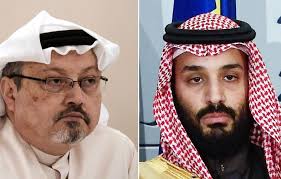
Women human rights defenders have been in prison for over two years, only because they demanded that women be treated equally as men. No one has been held accountable for their torture. While the Council has sustained pressure on Saudi Arabia in 2019, it is essential that this scrutiny continues as the situation on the ground has not improved. ISHR calls on all States to jointly call on Saudi Arabia to immediately and unconditionally release the WHRDs and drop the charges against them; and implement the bench-marks set out in the two joint statements delivered by Iceland and Australia in 2019, underlining that should these benchmarks not be met, more formal Council action would follow.
Saudi Arabia is running for Human Rights Council elections in October 2020 and hosting the G20 in November 2020. These all provide windows of opportunity to push for the immediate and unconditional release of the women human rights defenders and all those detained for exercising their rights. [see also: https://humanrightsdefenders.blog/2020/09/02/vloggers-selling-their-souls-to-boost-image-of-arab-regimes/]
Venezuela
The time has come for the fact-finding mission on Venezuela, created by the Human Rights Council last September, to report to the Council. ISHR has joined 85 national, regional and international organisations calling for the renewal and strengthening of the mandate, to keep the pressure on Venezuela. National NGOs have highlighted the ongoing human rights violations in the country as evidence that the new mandate should include an exploration of the root causes of these violations; a preservation of evidence to allow for processes to hold individual perpetrators to account, and a focus on gender-based violence. Oral statements from OHCHR will also be presented this session as will – potentially – a second resolution focusing on technical cooperation. The fact-finding mission’s report is due to be published on 15 September, with the interactive dialogue with States due the following week.
Philippines
The Anti-Terrorism Law passed earlier this month complements the Duterte Administration’s arsenal of tools, giving it the ability to label, detain and eliminate government critics using a vague definition of ‘terrorism’. In the prevailing climate of impunity and attacks against human rights defenders, this law granting the government excessive and unchecked powers will further jeopardise the safety of defenders.
This law passed in the context of ongoing violations against defenders in the country, with recent instances of judicial harassment of defenders and targeting defenders with smear campaigns. It is the most recent example of the government’s worsening human rights record. The recent report of the UN High Commissioner highlights widespread and systematic killings and arbitrary detention in the context of the war on drugs, silencing of independent media and critics, and stark and persistent impunity.
ISHR joined the calls by civil society and UN Special Procedures for an independent investigation mechanism into the human rights situation in the Philippines.
Burundi
ISHR joined more than 40 partners in a civil society call made public ahead of the 45th session, urging States to support the renewal of the mandate of the Commission of Inquiry (CoI) on Burundi.
Burundi is in a period of potential transition, following the 20 May 2020 presidential, legislative and local elections resulting in the election of a new President, Évariste Ndayishimiye and after the death of former President Nkurunziza. At this moment and in this context, there are signs of promise as well as of significant concern. Despite promising remarks by President Ndayishimiyeduring at his inauguration, as well as the authorities’ new, more transparent approach to tackling the COVID-19 pandemic, observers also raised concerns, notably over the fact that several newly appointed members of the Ndayishimiye administration are subject to international individual sanctions for their alleged responsibility in human rights violations. Nonetheless, the political transition represents an opportunity to open a new chapter for the Burundian people and for Burundi’s relationship with the UN human rights system.
As of today, the Commission of Inquiry remains the only independent mechanism mandated to monitor and document human rights violations and abuses, and publicly report on the situation in Burundi, with sufficient resources and experience to do so. At its 45th session, the Council should avoid sending the Government of Burundi signals that would disincentivise domestic human rights reforms, such as terminating the CoI’s mandate in the absence of measurable progress. It should avoid a scenario where re-establishing the CoI’s mandate would be necessary after a premature discontinuation, because of a renewed escalation of human rights violations and abuses. The Council should rather ensure continued investigations, monitoring, public reporting, and public debates on Burundi’s human rights situation.
Egypt
The ‘Terrorism Circuit courts’ in Egypt are enabling pre-trial detention as a form of punishment including against human rights defenders and journalists, such as Ibrahim Metwally, Mohamed El-Baqer and Esraa Abdel Fattah, Ramy Kamel, Alaa Abdel-Fattah, Patrick Zaky, Ramy Shaat, Eman Al-Helw, Solafa Magdy and Hossam El-Sayed. All of the individuals that the Special Procedures and the High Commissioner have written about since September 2019 are still in pre-trial detention by these courts.
ISHR urges States to call on Egypt to immediately and unconditionally release all those detained for exercising their human rights, to stop using pre-trial detention as a punishment, and to take immediate measures to guarantee their rights to contact their families on a regular and continuous basis and to ease sending and receiving letters, food and medical supplies to them.
Background information: Seven UN experts have expressed concern about the collective and corrosive effects of Egypt’s counter-terrorism laws and practices on the promotion and protection of human rights. They stated that “Despite [] repeated communications by UN experts over arbitrary detention of individuals, human rights defenders and activists, the Egyptian Government has not changed its laws of practice”. The government’s response to the UPR in March 2020 demonstrated its lack of political will to address key concerns raised by States and to engage constructively with the Council. For example, the government refused to acknowledge the systematic and widespread attacks against defenders, the practice of torture and ill-treatment in detention centres, and to receive visits by Special Rapporteurs on torture and human rights defenders. The government claimed that no one is detained for exercising their rights, despite the fact that the UN Working Group on Arbitrary Detention found that arbitrary detention is a systematic problem in Egypt and could constitute a crime against humanity.[see also: https://humanrightsdefenders.blog/2020/08/27/egypt-15-year-term-for-human-rights-defender-bahey-el-din-hassan/]
Other country situations
The High Commissioner will provide an oral update to the Council on 14 September 2020. The Council will consider updates, reports on and is expected to consider resolutions addressing a range of country situations, in some instances involving the renewal of the relevant expert mandates. These include:
- Oral update by the High Commissioner on the human rights situation in Nicaragua
- Oral updates by the High Commissioner, and an Interactive Dialogue on the report of the independent international fact-finding mission on the Bolivarian Republic of Venezuela
- Enhanced Interactive Dialogue on the report of the HC on the situation of human rights in Myanmar, including of Rohingya Muslims and other minorities, an interactive dialogue on the report of on the Independent Investigative Mechanism on Myanmar, and an Interactive Dialogue with the SR on the situation of human rights in Myanmar
- Interactive Dialogue with the Commission of Inquiry on Burundi
- Interactive Dialogue with the Commission of Inquiry on the Syrian Arab Republic
- Enhanced Interactive Dialogue with the Commission on Human Rights in South Sudan
- Interactive dialogue with the Group of Eminent International and Regional Experts on Yemen
- Interactive Dialogue with the High Commissioner on the situation of human rights in Ukraine
- Interactive Dialogue with the Special Rapporteur on the situation of human rights in Cambodia
- Enhanced Interactive Dialogue with the High Commissioner on the situation of human rights in the Democratic Republic of the Congo and on the final report of the team of international experts on the situation in Kasai
- Interactive Dialogue with the Independent Expert on the situation of human rights in Somalia
- Enhanced Interactive Dialogue with the Independent Expert on the situation of human rights in the Sudan
- Interactive Dialogue with the Fact-finding mission on Libya
- Interactive Dialogue with the Independent Expert on the situation of human rights in the Central African Republic
- Presentation of the High Commissioner’s report on cooperation with Georgia
Council programme, appointments and resolutions
Appointment of mandate holders
The President of the Human Rights Council will propose candidates for the following mandates:
- Special Rapporteur on the rights of persons with disabilities
- Working Group on Arbitrary Detention, member from African States and member from Latin American and Caribbean States
- Working Group on discrimination against women and girls, member form Latin American and Caribbean States
- Working Group on Enforced or Involuntary Disappearances, member from African States
- Working Group on the use of mercenaries as a means of violating human rights and impeding the exercise of the right of peoples to self-determination, member from Asia-Pacific States
- Independent Expert on the situation of human rights in the Sudan (if renewed).
Resolutions to be presented to the Council’s 45th session
At the organisational meeting on 31 August the following resolutions were announced (States leading the resolution in brackets):
- Special Rapporteur on hazardous waste mandate renewal (African Group)
- Working Group of Experts on People of African Descent mandate renewal (African Group)
- From rhetoric to reality – a global call for concrete action against racism, racial discrimination, xenophobia and related intolerance (African Group)
- Technical assistance and capacity building in Sudan (African Group)
- Human rights and indigenous peoples (Mexico, Guatemala)
- Human rights and terrorism (Egypt, Mexico)
- The human rights to safe drinking water and sanitation (Germany, Spain)
- Technical assistance and capacity building in Yemen ((Yemen)
- Local government and human rights (Chile, Egypt, South Korea, Romania)
- The human rights situation in Yemen (the Netherlands, Belgium, Canada, Ireland, Luxembourg)
- Independent expert on the human rights situation in Somalia (Somalia and the United Kingdom)
- Technical cooperation and capacity building in the field of human rights (Brazil, Honduras, Indonesia, Morocco, Norway, Qatar, Singapore, Thailand, Turkey)
- Accountability for ensuring women’s and girls’ full enjoyment of human rights in humanitarian settings (Canada, Fiji, Georgia, Uruguay, Sweden)
- Human rights and the regulation of civilian acquisition, possession and use of firearms (Ecuador, Peru)
- Rights of the Child (EU, GRULAC)
- Human rights situations in Burundi (EU)
- IGWG Private military and security companies mandate renewal TBC (South Africa)
- Elimination of discrmination against women and girls in sport (South Africa)
- Inequalities in and amongst States in the realization of human rights (South Africa)
- National human rights institutions (Australia)
- Contribution of Human Rights Council to prevention of human rights violations (Norway, Sierra Leone, Switzerland, Uruguay)
- Safety of journalists (Austria, Brazil, France, Greece, Morocco, Qatar, Tunisia)
- Special Rapporteur on the promotion of truth, justice, reparation and guarantees of non-recurrence mandate renewal (Switzerland, Argentina, Morocco)
- Enforced disappearances mandate renewal (France, Argentina, Morocco, Japan)
- Women, peace and security (Spain, Argentina, Azerbaijan, Namibia, Tunisia, Finland)
Adoption of Universal Periodic Review (UPR) reports
During this session, the Council will adopt the UPR working group reports on Kyrgyzstan, Guinea, the Lao People’s Democratic Republic, Lesotho, Kenya, Armenia , Guinea-Bissau, Sweden, Grenada, Turkey, Kiribati and Guyana. ISHR supports human rights defenders in their interaction with the UPR and publishes briefing papers regarding the situation facing human rights defenders in some States under review and advocate for the UPR to be used as mechanism to support and protect human rights defenders on the ground. This session of the Council will provide an opportunity for Turkey and Guinea to accept recommendations made in relation to human rights defenders, as proposed in ISHR’s briefing papers.
Panel discussions
During each Council session, panel discussions are held to provide member States and NGOs with opportunities to hear from subject-matter experts and raise questions. Three panel discussions are scheduled for this upcoming session:
- Annual half-day discussion on the rights of indigenous peoples. Theme: Protection of indigenous human rights defenders
- Biennial panel discussion on the right to development. Theme: COVID-19 and the right to development: we are all in this together
- Annual discussion on the integration of a gender perspective throughout the work of the Human Rights Council and that of its mechanisms. Theme: Gender and diversity: strengthening the intersectional perspective in the work of the Human Rights Council
https://www.ishr.ch/news/hrc45-key-issues-agenda-september-2020-session


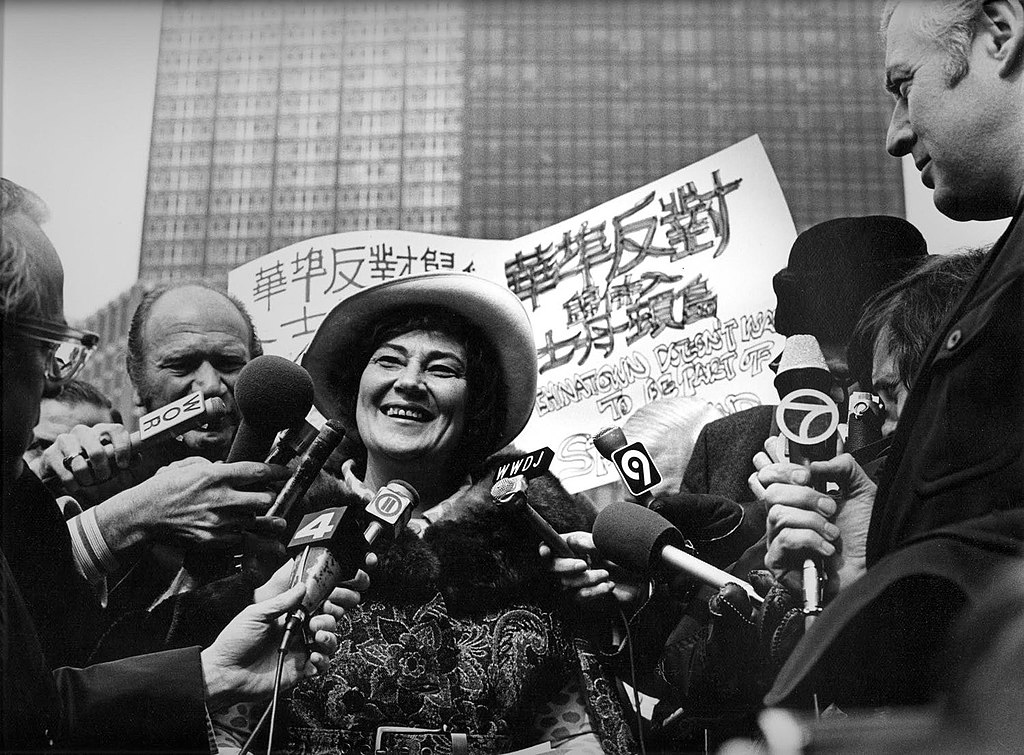 Since Beijing in 1995, feminists have not stopped advocating for gender justice, and in facing current realities, have turned toward each other to build power, speak truth, and renew commitments to the promise of Beijing—to the promise of a just and healthy world. (
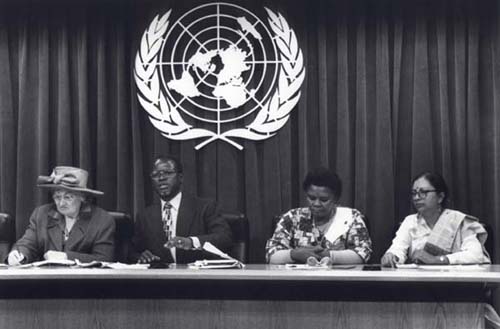 Bella Abzug on a panel at the United Nations. (