More must be done to thwart neo-Nazis and white supremacists who are using the COVID-19 pandemic to target minorities, increase their ranks and re-write history, the UN Secretary-General has said. António Guterres made the appeal in a video message for the International Day of Commemoration in Memory of the Victims of the Holocaust, observed on Wednesday 27 January, which honours the six million Jews and millions of others murdered by the Nazis during the Second World War.
As this year’s anniversary is taking place under the shadow of the pandemic, he noted that the crisis has exposed longstanding injustices and contributed to a renewed rise in antisemitism and xenophobia.
“Today, white supremacists and neo-Nazis are resurgent, organizing and recruiting across borders, intensifying their efforts to deny, distort and rewrite history including the Holocaust”, the UN chief said.
The UN High Commissioner for Human Rights, Michelle Bachelet, has also voiced concern over the “frightening” increase in hate crimes, and “sharp rise” in antisemitism online, over the past year.
“With renewed vigour, conspiracy theorists increasingly link extreme political ideologies and antisemitic delusions – weaving elaborate lies and falsehoods that lay responsibility for every kind of government failing on individual Jews or the Jewish community as a whole”, she said. “We need to push back against lies. We need to ensure that public discourse is based on facts, which objectively reflect truth – including the fundamental truth of our equal rights and dignity as human beings”, she said.
Global church leaders such as Pope Francis and the head of the World Council of Churches have joined international leaders on World Holocaust Remembrance Day, calling for decisive action against antisemitism and warning of its danger to morph into other hate. “Remembering is an expression of humanity. Remembering is a sign of civilization,” said Francis. “Remembering is a condition for a better future of peace and fraternity.”
Join us and light a candle: Share a message of solidarity with the Jewish community by tweeting a photo of your candle with the hashtags #LightTheDarkness #WeRemember and #MuslimsAgainstAntisemitism
Learn more: Find out more about the Holocaust and educate others around you
Join us: Get involved with MAAS and volunteer to help us in the fight against antisemitism!
Let’s all light a candle this Holocaust Memorial Day – let’s all stand up against antisemitism. Note that this blog was first published by Muslims Against Antisemitism (27/01/2021).
The human rights organization Amnesty International published a scathing report on 25 January 2021 decrying the inhumane conditions in Egyptian prisons. The report comes a decade after the Arab Spring uprising.
The report detailed the experiences of 67 individuals in detention, 10 of whom died in custody and two who died shortly after being released. It was carried out primarily between February 2020 and November 2020 and focused on 16 prisons. It found that:
Prisoners were kept in squalid conditions and received unhealthy food;
There was no proper access to health care, which may have resulted in death;
Overcrowding, poor ventilation and limited access to water and toilets led inevitably to outbreaks of coronavirus.
The report also found that some prisoners were deliberately denied access to health care due to their political affiliations. Activists, politicians and human rights defenders were denied basic treatments available to other inmates. There was also evidence of prison authorities “targeting prisoners critical of the government and denying them adequate food or family visits,” Markus Beeko, Secretary General of Amnesty International in Germany, asserted. According to UN estimates, there are 114,000 people incarcerated in the north African country.
On 22 January 2021 Mary Lawlor also deplored the arrest and prolonged pre-trial detention of human rights defenders and bloggers, and their accusation of being members of a terrorist organisation, continuing Egypt’s practice to intimidate and criminalise human rights defenders, journalists and their families.
“I am extremely concerned by the seemingly unrelenting efforts of the Egyptian authorities to silence dissent and shrink civic space in the country, despite repeated calls from UN mechanisms and the international community,” said Mary Lawlor, UN Special Rapporteur on the situation of human rights defenders.
The Special Rapporteur said she was disturbed by the detention since 2018 of human rights defender and blogger Mohamed Ibrahim Radwan, also known as ‘Mohamed Oxygen’, on charges of “membership of a terrorist organisation” and “misuse of social media” in retaliation for his posts and videos reporting on human rights issues. He was granted conditional release by the Cairo Criminal Court in November last year but was attached to a new case on charges of joining a terrorist organisation and kept in detention. He remains in pre-trial detention in Al-Aqrab Prison, south of Cairo.
Lawlor said that human rights defenders such as researcher and post-graduate student Patrick Zaki, who was arrested in February last year, have endured repeated renewals of detention without trial. “Pre-trial detention should only be used as the exception to the rule, rather than the default approach,” said Lawlor.
“Not only are these human rights defenders, journalists and other civil society actors unduly targeted for their legitimate and peaceful defence of human rights and fundamental freedoms, they are wrongfully accused of belonging to terrorist organisations and portrayed as a national security threat under vague legal provisions,” the Special Rapporteur said. “This is an issue which I and a number of UN experts have previously communicated our concern about to the Egyptian authorities.”
Ten years after the Tahrir square protests in Cairo, Egypt’s human rights record is disastrous. On the occasion of the anniversary of the 2011 revolution, several international campaigns are calling for the release of imprisoned activists writes Sofian Philip Naceur in Qantara.de Violent, authoritarian and extremely paranoid: since his bloody takeover in 2013, Egypt’s President Abdul Fattah al-Sisi has restored a regime whose brutality far outstrips even the reign of long-term ruler Hosni Mubarak. Hopes for real political and social change after the mass uprising that forced Mubarak out of office after 30 years in power have faded away, leaving a disillusionment that is omnipresent.
Egyptian opposition figures are using the current media attention around the tenth anniversary of the “25 January Revolution” to highlight the fate of those currently in prison for their political engagement. Some have been sentenced to heavy jail terms, while others are subjected to pre-trial detention lasting years by the Egyptian security forces and the country’s judiciary. European opposition politicians are also participating in corresponding campaigns.
Eight politicians from Germany’s left-wing party – Die Linke – have signed a solidarity statement calling for the immediate release of all political detainees, which explicitly highlights the fate of six detained leftist activists, journalists and trade unionists. Although the campaign specifically highlights six individual cases, it expresses solidarity not only with Egyptian leftists, but with all those “who are resisting Sisi’s dictatorship”. In addition to journalist Hishem Fouad, who advocated for striking workers and independent trade unions long before 2011, the German politicians are also calling for the release of novelist Ayman Abdel Moati, lawyer and trade union activist Haitham Mohamadeen and trade unionist Khalil Rizk. All four are detained on flimsy, terrorism-related charges.
On 8 January, 2021 RFE/RL’s Tatar-Bashkir Service reports on a worrying development in Russia: On 28 December, Russia said it had placed five people — three journalists who contribute to RFE/RL and two human rights activists — on the Justice Ministry’s registry of “foreign mass media performing the functions of a foreign agent.” Previously, only foreign-funded NGOs had been placed on the registry, in keeping with Russia’s passage of its controversial “foreign agents law” in 2012. The law was later expanded to include media outlets and independent journalists [SEE: https://humanrightsdefenders.blog/2019/11/19/russias-foreign-agents-bill-goes-in-overdrive/]
The three listed individuals affiliated with RFE/RL are Lyudmila Stavitskaya and Sergei Markelov, freelance correspondents for the North Desk of RFE/RL’s Russian Service; and Denis Kamalyagin, editor in chief of the online news site Pskov Province and a contributor to RFE/RL’s Russian Service.
On December 29, the ministry expanded the list again, adding the Nasiliu.net human rights center, which deals with domestic violence cases. The additions bring the total number of individuals or entities listed to 18, the majority of them affiliated with RFE/RL.
Two international rights organisations have expressed concerns:
“The UN Human Rights Office regrets the inclusion of the five individuals in the foreign agents list, which targets human rights defenders and journalists and appears to be aimed at limiting their freedom of expression and speech,” Liz Throssell, a spokeswoman for the UN Human Rights Office, said in a comment to RFE/RL on January 8.
The Office of the OSCE Representative on Freedom of the Media added in a separate comment that the move “narrows the space for freedom of expression, freedom of the media, and free flow of information in the Russian Federation.“
The Justice Ministry did not explain on what grounds it included the recent additions of the five individuals and one entity to the registry.
In 2017, Human Rights Watch, a U.S.-based rights group, called the law “devastating” for local NGOs, saying more than a dozen had been forced to close their doors.
RFE/RL has said it is “reprehensible” that professional journalists were among the first individuals singled out by Russia as “foreign agents.”
The Council of Europe also has expressed concerns over situation, saying that the foreign agent law in general — “stifles the development of civil society and freedom of expression.”
On Wednesday morning 6 January 2021 an Israeli military court convicted Palestinian Human Rights Defender Issa Amro for peacefully protesting and civil disobedience. The Israeli military judge announced the verdict in a hearing attended by representatives of British, European, EU and Canadian consulates. Amnesty International issued a statement calling to drop all the “politically motivated” charges.
“Today Israel announced that Palestinians are not allowed to peacefully protest the Israeli occupation without a permit from the occupier,” Amro stated. “This conviction is the military system against the Palestinian nonviolent resistance. It aims to suppress my voice and end all activism against the Israeli occupation.” Amro’s Israeli lawyer Gaby Lasky added that “The military court is just an organ of occupation. The [indictment for nonviolent protest] is an example of how the courts are used in order to deter the important voices of human rights defenders.”
Amro is a founder of the Youth Against Settlements group in Hebron, which organises non-violent activism against the illegal Israeli settlements in Hebron and the discriminatory restrictions placed on Palestinians by the Israeli authorities in the city. Amro first appeared in an Israeli military court in 2016 on 18 charges, ranging from “insulting a soldier” to “participating in a march without a permit”. Some of the charges dated back to 2010.
The indictment, first presented in 2016, included 18 charges related to Amro’s community organizing deemed “baseless,” “politically motivated” or “physically impossible” by Amnesty. The military judge convicted Amro on six counts: three counts of “participating in a rally without a permit,” two counts of “obstructing a soldier,” and one count of “assault.” These surround Amro’s participation in the peaceful “Open Shuhada Street” demonstration in 2016; Amro’s participation in the nonviolent “I Have a Dream” demonstration from 2013 in which participants wore masks of Obama and Martin Luther King; one count of obstruction relates to a nonviolent sit-in protest in 2012 calling to re-open the old Hebron municipality building; one count of “assault” by “shoving someone” related to a previously-closed case from 2010, an incident for which the indictment had included an obstruction charge (acquitted) for Amro yelling “I am being assaulted” in the Israeli police station prior to Amro being carried out to an ambulance on a stretcher.
In 2019, UN Special Rapporteurs called for Amro’s protection and expressed “concern” over the charges. In 2017[see: https://humanrightsdefenders.blog/2019/04/11/un-rapporteurs-intervene-again-for-palestinian-human-rights-defender-issa-amro/]; thirty-five U.S. House Representatives and four Senators including Bernie Sanders sent letters highlighting that some charges were not internationally recognizable offenses and that Amnesty would consider Amro a “prisoner of conscience” if convicted. Issa Amro is the co-founder and former coordinator of the Hebron-based Youth Against Settlements initiative. In 2010, he was declared “Human Rights Defender of the year in Palestine” by the UN OHCHR and he is formally recognized by the European Union. He won the One World Media Award in 2009 for his involvement in B’Tselem’s camera distribution project. He was a guest of the U.S. State Department in 2011 and has spoken at the UN Human Rights Council on numerous occasions. The sentencing is scheduled for 8 February.
Saleh Higazi, Amnesty International’s Middle East and North Africa Deputy Director, said: “The Israeli authorities must end their campaign of persecution against Palestinian activist Issa Amro, who is a prominent voice against Israel’s regime of discrimination and systematic human rights violations against Palestinians in the Occupied Palestinian Territories, particularly in Hebron.”
Thai authorities on 1 January 2021 made their 38th arrest of a pro-democracy activist in recent weeks under the country’s tough lèse majesté law as authorities crack down on the country’s unprecedented protest movement. That law, Section 112 of the Thai criminal code, forbids defamation of the king and provides for three to 15 years’ imprisonment for violations.The law had been dormant since King Maha Vajiralongkorn succeeded his father, King Bhumibol Adulyadej, who died in 2016. The Thai government, though, is now using it to try to stamp out continuing protests calling for the government to resign, a new constitution and reform of the monarchy
Thailand’s authorities must stop targeting pro-democracy protesters with draconian legal action and instead enter into dialogue, according to the UN’s special rapporteur for freedom of assembly, who warned the country risks sliding into violence. Clément Voule said he had written to the Thai government to express alarm at the use of the fierce lese-majesty law against dozens of protesters, including students as young as 16.
“It is legitimate for people to start discussing where their country is going and what kind of future they want,” Voule said of the protests. “Stopping people from raising their legitimate concerns is not acceptable.”
So far, 37 people face charges of insulting the monarchy for alleged offences ranging from wearing traditional dress deemed to be a parody of the royals to giving speeches arguing that the power and wealth of the king should be curbed.
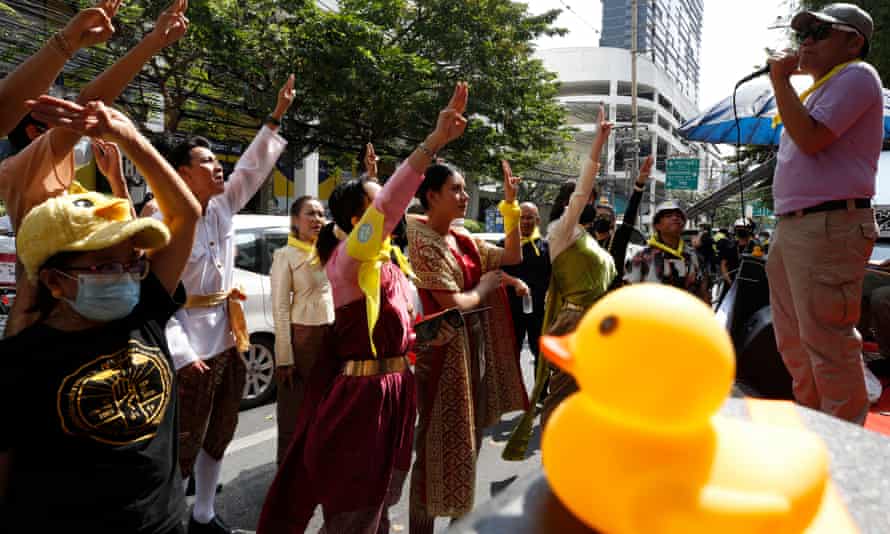
Anti-government protesters flash a three-finger salute – a gesture used adopted by protesters from the Hunger Games films – as they gather in support of people detained under the lese-majesty law at a police station in Bangkok. Photograph: Narong Sangnak/EPA
Prominent protest leaders face an unusually high number of charges. This includes the student activists Parit Chiwarak, also known as Penguin, (12 charges) and Panusaya Sithijirawattanakul (six charges) and the human rights lawyer Anon Nampa (eight charges), who have given speeches calling for the power of the royals to be curbed.
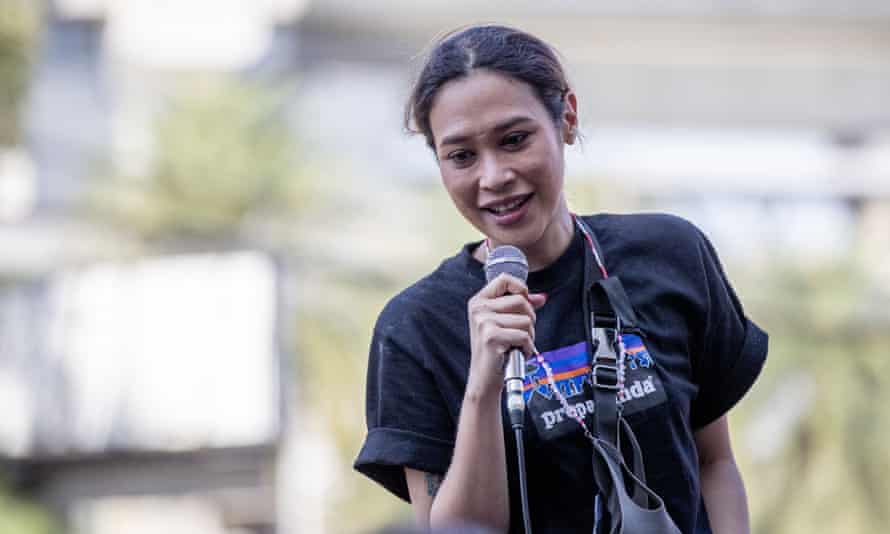
The pro-democracy protest fundraiser Inthira Charoenpura speaks from a stage outside Bang Khen police station in Bangkok. Photograph: Gemunu Amarasinghe/AP
Protesters – who have faced various other charges over recent months, including sedition – declined to participate in a government reconciliation panel in November, rejecting it as an attempt to buy time. The recent cases come after months of demonstrations in which protesters have made unusually frank and public calls for reform to the monarchy.
Benja Apan, 21, one of 13 people facing charges over a demonstration outside the German embassy in Bangkok, said legal action was unlikely to deter protesters from coming out in the new year. “I actually think it will bring more people out, because it is not fair,” she said.
The human rights group Amnesty International has launched a campaign calling on PM Prayut Chan-o-cha to drop charges pressed on a number of activists for their role in the pro-democracy movement and to repeal, or at least amend, Thailand’s draconian lèse majesté law. According to the campaign, at least 220 people, including minors, face criminal charges for relating to their actions in the pro-democracy movement. Activists are calling on government and monarchy reform, raising issues considered taboo and unprecedented in Thai society. Thailand must amend or repeal the repressive laws it is using to suppress peaceful assembly and the expression of critical and dissenting opinions.
Amnesty International is calling on people to take action and send a letter to the prime minister, calling on the Thai government to change their approach when handing the ongoing protests to protect human rights. Sample letter by AI’s campaign calls on Prayut to:
Immediately and unconditionally drop all criminal proceedings against protesters and others charged solely for exercising their rights to freedom of peaceful assembly and expression
Cease all other measures, including harassment, aimed at dissuading public participation in peaceful gatherings or silencing voices critical of the government and social issues
Amend or repeal legislation in order to ensure it conforms with Thailand’s international human rights obligations on freedom of peaceful assembly and expression, and to train state officials to carry out their duties confirming to Thailand’s obligation to respect, protect and fulfil the peaceful exercise of the rights to freedom of peaceful assembly and expression.
On Saturday 19 December 2020 Maya Taylor in The Thaiger had already reported that the United Nations High Commission for Human Rights has expressed shock and dismay at Thailand’s use of its strict lèse majesté law against a 16 year old pro-democracy activist. The UN High Commissioner for Human Rights’ spokesperson Ravina Shamdasani has called on Thailand to refrain from using the law against those exercising their right to freedom of speech, as she expressed alarm that a minor was being charged under the law. “It is extremely disappointing that after a period of 2 years without any cases, we are suddenly witnessing a large number of cases, and – shockingly – now also against a minor. We also remain concerned that other serious criminal charges are being filed against protesters engaged in peaceful protests in recent months, including charges of sedition and offences under the Computer Crime Act. Again, such charges have been filed against a minor, among others.”
“The UN Human Rights Committee has found that detention of individuals solely for exercising the right to freedom of expression or other human rights constitutes arbitrary arrest or detention. We also urge the government to amend the lèse majesté law and bring it into line with Article 19 of the ICCPR on the right to freedom of expression.”
Thailand’s Foreign Ministry spokesman has played down the UN High Commissioner for Human Rights’ criticisms over the kingdom’s enforcement of the Lese Majeste law.
The Hong Kong Free Press comes on 17 December 2020 with the AFP story that the UN Special Raporteur Mary Lawlor slammed a years-long crackdown on rights defenders and lawyers in China, highlighting the case of one attorney who disappeared after revealing he was tortured in detention.
Mary Lawlor, the UN Special Rapporteur on the situation of human rights defenders, warned in a statement endorsed by seven other UN rights experts, that a clampdown that began more than five years ago aimed at courtroom critics of Communist authorities was continuing unabated.
In her statement, Lawlor pointed to the recent arrest and “enforced disappearance” of activist and attorney Chang Weiping as emblematic of Beijing’s efforts to silence lawyers who speak out about the deterioration of human rights in the country.
He was held on suspicion of “subversion of state power” and his licence was annulled, she said. Just days after he posted a video online in October describing the torture and ill-treatment he was allegedly subjected to during his detention, he was detained again and returned to RSDL in retaliation for his video. “Since then, the defender’s whereabouts remain unknown, his lawyers have been unable to contact him and no charges have been brought against him,” Wednesday’s statement said.
“Fundamental human rights are not a threat to any government or society, and neither are the individuals who defend those rights,” she added. “I urge the Chinese authorities to release at once Chang Weiping and all other detained and disappeared human rights defenders.”
Not surprisingly The reaction by China was swift and tough: “By using misinformation, relevant (UN) mandate holders blatantly smear China,” Liu Yuyin, a spokesman at the Chinese mission in Geneva, said in a statement issued 16 December. As for Chang’s case, Liu insisted his “legitimate rights were fully protected.” Chang “was subject to criminal coercive measures by the public security organ in Shanxi Province on October 22, 2020, on suspicion of criminal offences.”
The remarks by Lawlor and other UN experts about the lawyer’s case, Liu warned, “seriously (violate) the spirit of the rule of law and fully exposes their bias against China.”
“I believe in the power of music to inspire us, to connect our hearts, to give voice to feelings for which words alone won’t suffice, to wake us up out of complacency, to galvanize and fuel social movements,” the singer said upon accepting his award. “Artists have a rich tradition of activism. We have a unique opportunity to reach people where they are, beyond political divisions, borders, and silos. And it’s been my privilege to use my voice and my platform to advance the cause of equity and justice.” See: <a href="http://<iframe src="//content.jwplatform.com/players/Ge9Alkkq-zFOPDjEV.html" width="640" height="360" frameborder="0" scrolling="auto">//content.jwplatform.com/players/Ge9Alkkq-zFOPDjEV.html
Over his 20-year career, Legend has been closely involved with a variety of causes. In 2007, he started the Show Me Campaign to improve access to education, while the Bail Project has advocated for ending mass incarceration and making it easier for released prisoners to find work by removing criminal background checks from job applications. In his High Note Global Prize speech, he touched on his most recent campaign, #FreeAmerica, which is aimed at broad criminal justice reform.
He went on to highlight his most recent campaign, #FreeAmerica, which works toward criminal justice reform. “As a citizen of the United States, and of the world, I know that for far too long our most essential systems have served to perpetuate inequity and injustice,” he shared. “In order for us to create a just world those systems need to change.”
“With this award we celebrate a multitude of advocates, generations of movement leaders who have put their shoulder to the wheel of progress,” he concluded. “I don’t stand here absorbing these accolades for myself. I stand here grateful for their ideas and their energy and honored that I can amplify their voices by using my platform.”
With a special release on Youtube on the Playing for Change channel on Thursday, December 10th at 12 pm PST / 3 pm EST, Peace Through Music: A Global Event for Social Justice will feature artists and public figures like Aloe Blacc, Angélique Kidjo, Becky G, Brandi Carlile with Mike McCready of Pearl Jam, Carlos Santana and Cindy Blackman Santana, Gabi Melim, Gary Clark Jr., Jack Johnson, Mavis Staples, Peter Gabriel, Rhiannon Giddens, Ringo Starr, Robbie Robertson, Run The Jewels with Josh Homme, Sheila E., Skip and Cedella Marley, The War and Treaty, Yo-Yo Ma and more. Billie Eilish, Killer Mike, Megan Rapinoe and Sue Bird, Norman Lear and Sara Bareilles among others are scheduled to make special appearances.
The event, a collaboration between Playing For Change, an organization that aims to connect the world through music, and the United Nations Population Fund (UNFPA), presented by Corning® Gorilla® Glass and co-produced by Blackbird Presents, calls for equality, the recognition of human rights and an end to racism and discrimination.
“The things in life that divide us disappear when the music plays,” says Mark Johnson, PFC Co-Founder, “and that’s something we hope you see and feel during this event.”
A unique global broadcasting event, to coincide with UN Human Rights Day on 10 December, will promote a message of unity through music with the first-ever radio broadcast of Max Richter’s VOICES, incorporating text from the historic 1948 Declaration of Human Rights.
This special performance, produced by BBC Radio 3 and co-conceived by Richter and his creative partner Yulia Mahr, will be broadcast by 37 EBU radio channels from 34 countries, the EBU announced on 7 December 2020.
VOICES is inspired by the opening statement from the Declaration: “All human beings are born free and equal in dignity and rights.” A decade in the making, the piece premiered in London in February 2020, weeks before the pandemic brought unprecedented changes to the lives of citizens worldwide. With months of uncertainty still on the horizon, the recording’s uplifting messages of community and hope have particular resonance.
Max Richter and Yulia Mahr said, “Thinking back now to the premiere of VOICES in February feels like visiting another world. In these strange and anxious times, it is a great privilege to be able to mark Human Rights Day by presenting the work again, despite the pandemic. We are thrilled about the partnership with the UN Human Rights office and the collaboration with BBC Radio 3 and the EBU, which have made it possible to perform our work once more. In this challenging time in human history, the text of the Declaration is more important than ever.”
Víctor Fernández, Chief, Communications Section, Office of the United Nations High Commissioner for Human Rights, said, “Collaborating with Max Richter, BBC Radio 3 and the EBU on Human Rights Day was a natural way for the United Nations Human Rights Office to promote the global human rights message through high quality music.
“VOICES is a musical interpretation of the Universal Declaration of Human Rights, and music, like human rights, is universal. Both have the power to unite, to inspire and to promote peace and understanding. This concert on BBC Radio 3, broadcast via the EBU, helps ensure that the principles enshrined in the Declaration reach a wide audience.”
This is the second time that the EBU has collaborated with Richter. During Easter 2020, as the world was closing down, EBU radio channels across Europe presented the composer’s eight-hour work – Sleep – to audiences in 20 countries as a moment of hope in unprecedented times. VOICES will continue that tradition.
The BBC Radio 3 broadcast of VOICES will be presented by Elizabeth Alker and features soprano Grace Davidson; violinist Viktoria Mullova as soloist; British actor Sheila Atim as the narrator; the Tenebrae choir; the Max Richter ensemble – with Richter himself on keyboards and electronics; and conductor Robert Ziegler.
Neil Gaiman launches a crowdsourced animated film to help raise funds for Syrian refugees battling freezing temperatures and icy winds amid threat of Covid-19.
Neil Gaiman – celebrated author and Goodwill Ambassador for UNHCR – has joined forces with hundreds of fans and artists to release a new animated version of his poem What You Need To Be Warm.
The animated film aims to raise much needed funds for UNHCR’s Winter Appeal providing vital support for refugees in the Middle East including Syrian and Iraqi refugees, many of whom are battling their ninth winter away from home. This year is the hardest yet as refugees face snow, rain and freezing temperatures, as well as the impact of Covid-19 which has dramatically affected vulnerable families, put health at risk, devastated livelihoods, and pushed more refugees out into the cold.
Neil Gaiman said: “This animated film was a chance for people to come together to help raise awareness and life-saving funds to protect these families. I was blown away by the response and quality of drawings submitted online. People really care and want to help and they still can by making a donation“

.jpg?t=thumbnail_352)
 Hans Thoolen on Human Rights Defenders and their awards