Archive for the 'OHCHR' Category
September 26, 2014

The United Nations human rights High Commissioner for human rights today condemned the recent brutal, cold-blooded slaying by the Islamic State of Iraq and the Levant (ISIL) of Iraqi human rights defender Sameera Salih Ali Al-Nuaimy, as well as the continuing detention, sexual exploitation and sale of hundreds of women and girls in areas captured by the militant group. Read the rest of this entry »
Posted in human rights, Human Rights Defenders, OHCHR, UN | Leave a Comment »
Tags: arbitrary execution, conflict, High Commissioner for Human Rights, Human Rights Defenders, human rights of women, Iraq, ISIL, killing, Middle East, Mosul, repression, Sameera Salih Ali Al-Nuaimy, UN, WNN, woman human rights defender, Zeid Ra'ad Al Hussein
September 8, 2014
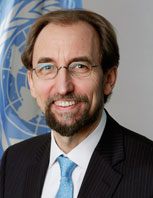
 On 8 September 2014 the new UN High Commissioner for Human Rights, Zeid Ra’ad Al Hussein, addressed for the first time the Human Rights Council, and many will have been listening for clues about where he stands on key issues, how ‘activist’ he is likely to be etc. As the speech was rather long and covered a huge variety of issues, it is not easy to draw any conclusions yet. The fist half addressed issues of war and violence and in particular the humanitarian crises of today.
The role of the individual is beautifully worded: “courage is the first human virtue, revered the world over, the very virtue we value the most as human beings. The courageous individual is not he or she who wields great political power or points a gun at those who do not – that is not courage. The courageous individual is he or she who has nothing to wield but common sense, reason and the law, and is prepared to forfeit future, family, friends and even life in defence of others, or to end injustice. In its most magnificent form, the courageous individual undertakes this exertion, without ever threatening or taking the life of someone else, and certainly not someone defenceless.”..”the Takfiris [IS] who recently murdered James Foley and hundreds of other defenceless victims in Iraq and Syria – do they believe they are acting courageously? “…
“Navi Pillay was one of the greatest senior officials the UN has ever had, and one of the most able, formidable High Commissioners for Human Rights. That she could annoy many Governments – and she did – was clear; but she believed deeply and movingly in the centrality of victims, and of those who are discriminated against. They needed her vocal chords, her lungs and her pen, and she made everyone listen. I pledge to continue along the same path: to be as firm, yet always fair; critical of states when necessary, and full of praise when they deserve it.”
“A ministerial-level meeting will be held in New York on 25 September, on the need for a code of conduct to be adopted by the permanent members of the UN Security Council regarding use of veto, in situations where atrocities are ongoing and where those facts are well founded. This is not a call to have the UN Charter rewritten, but a call for the permanent members to exercise a moratorium in very specific circumstances involving atrocity crimes. I applaud the Government of France for taking the lead over this, and thank it for inviting me to participate on the 25th. When the veto is exercised for the sole purpose of blocking action by the Security Council, with no alternative course of action offered, and when people are suffering so grievously – that is also a form of cruelty.”
After briefly describing his priorities:
- halt the increasingly conjoined conflicts in Iraq and Syria. In particular, dedicated efforts are urgently needed to protect religious and ethnic groups, children – who are at risk of forcible recruitment and sexual violence – and women, who have been the targets of severe restrictions.
- ensure accountability and stop impunity
- to take a step back and look at how and why these crises erupted,
the UN High Commissioner touched on a number of current situations and mentioned the importance of the different mechanisms and bodies. Finally he came to the civil society with the following words:
“But the work done by OHCHR, by the Special Procedures, by Treaty Bodies, this Council itself, and indeed, by Member States, could never be achieved without the greater efforts of civil society actors. We need their continuing support and contributions to realise progress. I encourage the Council to strengthen its constructive engagement with civil society actors, and to ensure that their voices can be raised safely and without reprisals. Freedoms of expression, association and peaceful assembly are rights that enable people to share ideas, form new thinking, and join together with others to claim their rights. It is through the exercise of these public freedoms that we make informed, considered and intelligent decisions about our development. To restrict them undermines progress. We must acknowledge the value of civic contribution, build the capacity of marginalised voices, ensure a place at the table for civil society actors, and safeguard their activities – including the activities of those who cooperate with this Council, its Special Procedures and Commissions of Inquiry. I take this opportunity to echo the Secretary-General’s condemnation of acts of reprisal against individuals by reason of their engagement with the United Nations.”
At the end of this speech, he paid significant attention to the issue of migration: “The treatment of non-nationals must observe the minimum standards set by international law. Human rights are not reserved for citizens only, or for people with visas. They are the inalienable rights of every individual, regardless of his or her location and migration status. A tendency to promote law enforcement and security paradigms at the expense of human rights frameworks dehumanises irregular migrants, enabling a climate of violence against them and further depriving them of the full protection of the law.”
See full text at: Media Centre.
Posted in human rights, Human Rights Council, Human Rights Defenders, OHCHR, UN | Leave a Comment »
Tags: Al Hussein, Al'Hussein, Civil society, Human Rights Council, Human Rights Defenders, humanitarian, Navi Pillay, reprisals, Takfiris, the Office of the UN High Commissioner for Human Rights, UN High Commissioner, UN High Commissioner for Human Rights, war, Zeid Ra'ad Al Hussein
August 11, 2014
Posted in Human Rights Defenders, ISHR, OHCHR, UN | Leave a Comment »
Tags: anti-reprisals focal point, civil society organisations, Human Rights Defenders, international protection, ISHR, legal protection, Phil Lynch, Pillay, Prince Zeid Raad Zeid al-Hussein, reprisals, retaliation, UN, UN High Commissioner for Human Rights, Zeid
August 11, 2014
My reference last week to an interview with the new Special Rapporteur on Human Rights Defenders [https://thoolen.wordpress.com/2014/08/05/michel-forst-new-special-rapporteur-on-human-rights-defenders-gives-indication-of-his-priorities/] seemed well appreciated judging from the number of views. Therefore I now refer you to a piece by the Director of the ISHR, Phil Lynch, of 16 July, who addresses the incoming UN High Commissioner for Human Rights, Zeid Ra’ad Zeid al-Hussein as the “human rights defender-in-chief “, saying that he has a particular responsibility to protect human rights defenders, especially so when they face intimidation and reprisals for their efforts to seek accountability at the UN for human rights violations. Read the rest of this entry »
Posted in human rights, Human Rights Defenders, ISHR, OHCHR, UN | Leave a Comment »
Tags: anti-reprisals focal point, Cao Shunli, civil society organisations, Ford Foundation, Human Rights Defenders, ISHR, Phil Lynch, Prince Zeid Raad Zeid al-Hussein, reprisals, reprs, retaliation, UN High Commissioner for Human Rights, woman human rights defender
July 9, 2014

In September 2014, Navanethem (Navi) Pillay will finish her term as the UN High Commissioner for Human Rights. Since her appointment in 2008, she has been a principled and dedicated advocate for universal human rights, the protection of human rights defenders, accountability for perpetrators of human rights violations, and access to justice for victims. She has encouraged her staff to speak out and has done so herself courageously. Unanimity about her performance should not be expected – for that the topics she had to deal with are too controversial – but the human rights world generally has seen her as a ‘champion’ and one of them.
Read the rest of this entry »
Posted in Human Rights Defenders, ISHR, OHCHR | Leave a Comment »
Tags: High Commissioner for Human Rights, High Commissioner for Human Rights Navi Pillay, honor, Human Rights Defenders, human rights violations, International Service for Human Rights, Navi Pillay, UN, UN High Commissioner for Human Rights
June 7, 2014
Yesterday, 6 June 2014, the UN and media reported that the U.N. Secretary-General Ban Ki-moon has proposed that Jordans U.N. ambassador, Prince Zeid Raad Zeid al-Hussein, as the new United Nations High Commissioner for Human Rights (to replace Navi Pillay who leaves in August after serving a second term). The General Assembly still has to approve, but usually no announcement is made unless there is already agreement.
Prince Zeid is generally well-liked as a diplomat and has established a solid reputation. He is a graduate of Johns Hopkins University and Cambridge University, has previously served as Jordans ambassador to the United States and Mexico. He was also a political affairs officer in UNPROFOR, the U.N. peacekeeping mission in the former Yugoslavia during the Balkan conflict.
Still, after a two women High Commissioners with broad experience in human rights and proven independence as judges before their appointments, it is fair to ask what human rights defenders can expect from this shift back towards a High Commissioner chosen for more diplomatic skills (as was the first one José Ayala-Lasso in 1994). Anyway, the only thing is to wait and see how he works out in practice. After all, another Prince, Sadruddin Aga Khan served as United Nations High Commissioner for Refugees from 1966 to 1978, and was excellent.
Posted in human rights, Human Rights Defenders, OHCHR, UN | 2 Comments »
Tags: appointment, Ban Ki-moon, Navanethem Pillay, Navi Pillay, Prince Zeid, Prince Zeid Raad Zeid al-Hussein, Sadruddin Aga Khan, the new United Nations High Commissioner for Human Rights, UN, UN High Commissioner for Human Rights
May 6, 2014
The disappearance of Karen activist “Billy” has prompted the United Nations High Commissioner for Human Rights UNHCHR to condemn the “pattern of killings and forced disappearances of environmental activists in Southeast Asia” and to urge authorities to conduct thorough and independent investigations. “We are concerned about the lack of progress with an investigation into the disappearance of a prominent human rights defender in Thailand,” UNHCHR spokesman Rupert Colville said in a statement released on Friday 2 May. Read the rest of this entry »
Posted in human rights, Human Rights Defenders, OHCHR, UN | 1 Comment »
Tags: Billy, Cambodia, Chut Wutty, disappearances, environmental activists, environmental issues, Human Rights Defenders, indigenous groups, Karen, killings, Land issues, Laos, Philippines, Pholachi Rakchongcharoen, Rupert Colville, Sombath Somphone, South-east asia, Thailand, the Office of the UN High Commissioner for Human Rights
April 13, 2014
On 12 April Dan Harrison, in the Australian newspaper ‘Daily Life”, recalls how the famous Toonen case – decided 20 years ago – had a tremendous impact: “The fax arrived from Geneva on a Saturday almost exactly 20 years ago. The message on United Nations letterhead that landed on the fax machine at the Tasmanian Gay and Lesbian Rights Groups office in Hobart’s Battery Point would change the lives of millions. It carried the UN Human Rights Committees finding that Tasmanian laws, which made consenting sex between adult men in private a criminal offence punishable by up to 21 years jail, were in violation of Australia’s international obligations.” Read the rest of this entry »
Posted in human rights, Human Rights Defenders, OHCHR, UN | Leave a Comment »
Tags: Australia, Human Rights Defenders, international obligations, LGBT, LGBT rights, Remedy Australia, Tasmania, Toonen, Toonen case, treaty bodies, treaty obligations, United Nations Human Rights Committee
March 28, 2014
While two weeks ago I was a bit too quick in announcing Michel Forst‘s appointment as the new UN Special Rapporteur on Human Rights Defenders [https://thoolen.wordpress.com/2014/03/13/margaret-sekaggya-succeeded-as-hrd-rapporteur-by-michel-forst-reassuring/], a letter from the Chair of the Human Rights Council of 27 March 2014 fortunately confirms that he is the sole candidate and most likely to be endorsed by this session of the Council.
Posted in Human Rights Council, OHCHR, UN | Leave a Comment »
Tags: announcement, Human Rights Council, Margaret Sekaggya, Michel Forst, news, Special Procedures, special rapporteurs, UN Human Rights Council, UN Special Rapporteur on Human Rights Defenders
March 27, 2014
“Civil society actors must be able to do their work freely, independently, safe from fear, retaliation or intimidation. This requires collective action to denounce reprisals and defend free voices and protect those targeted,” said the UN Secretary-General Ban Ki-Moon, referring to civil society as “an indispensable part of the United Nations”. “We must expand the space for civil society to meaningfully participate and contribute,” he added in a video statement screened at a discussion on the promotion and protection of civil society space, in the context of the Human Rights Council’s 25th session.
“Civil society actors around the world face risks ranging from threats and intimidation to horrible reprisals, even killings”, said UN Human Rights Deputy, Flavia Pansieri at a discussion on the promotion and protection of civil society space. “From the NGO who is prohibited from receiving funding to the whistle-blower who is imprisoned for revealing corruption… we must work to protect civil society from such practices,” she said.
Hina Jilani, Read the rest of this entry »
Posted in films, human rights, Human Rights Defenders, OHCHR, UN | Leave a Comment »
Tags: Ban Ki-moon, Civil society, civil society organizations, Deeyah Khan, empowering civil society, Flavia Pansieri, Frank LaRue, FUUSE productions, Geneva, Hina Jilani, Human Rights Council, Human Rights Defenders, Mokhtar Trifi, OHCHR, Secretary-General of the United Nations, side event, Tunisia, UN, UN Human Rights Council, United Nations, video