Archive for the 'organisations' Category
February 13, 2014
Here two recent examples of non-cooperation in relation to requests for access by international human rights mechanisms:
- On 11 February 2014 five international human rights organisations issued a statement decrying Algeria’s lack of cooperation in allowing UN human rights experts and international human rights organizations to visit the country. Algeria may have joined the UN Human Rights Council in January 2014, but it has not agreed to visits by the UN Special Rapporteur on Torture and the Working Group on Enforced or Involuntary Disappearances, despite their repeated requests. Similarly the Algerian authorities have refused to grant visas to nongovernmental human rights organizations for several years. “Algeria remains the only country among its neighbors that generally restricts access to human rights organizations,” said Eric Goldstein, of Human Rights Watch. [The 5 NGOs making the appeal are Amnesty International, Euro-Mediterranean Human Rights Network, Human Rights Watch and the Observatory for the Protection of Human Rights Defenders, a joint program of the International Federation for Human Rights FIDH, and the World Organization Against Torture OMCT].
- Today, 14 February it became known that the European Union Special Representative for Human Rights, Stavros Lambrinidis, was denied a request to visit prisoners during his visit to Egypt [he announced this on Twitter after meeting with Prosecutor General Hisham Barakat.] Lambrinidis described the refusal as a “direct contradiction” to the Ministry of Interior’s “press release promising greater openness to such visits”. Only two days earlier – amid mounting allegations of torture inside places of detention – the Ministry of Interior had issued a statement welcoming requests from NGOs wishing to visit prisons. [Lambrinidis held an open discussion with 30 human rights defenders from local and international NGOs earlier this week, stating that the Egyptian government must respect peaceful free expression and human rights communities.]
via:
http://www.dailynewsegypt.com/2014/02/13/eu-human-rights-envoy-denied-access-prisoners/#sthash.hEciHx9r.dpuf
Algeria: Allow Rights Groups to Visit – No Response from Algiers to Requests from UN Bodies / February 11, 2014 / Urgent Interventions / Human rights defenders / OMCT.
Posted in AI, EMHRN, FIDH, HRW, human rights, Human Rights Council, Human Rights Defenders, Observatory for the Protection of Human Rights Defenders, OMCT, UN | Leave a Comment »
Tags: access, AI, Algeria, Egypt, EU, EU Special Representative for Human Rights, Euro-Mediterranean Human Rights Network, FIDH, HRW, human rights, human rights mechanisms, human rights organizations, Lambrinidis, NGOs, non-cooperation, OMCT, prison visits, special rapporteurs, UN Human Rights Council
February 13, 2014
As this blog is very fond of human rights films, I am copying the programme almost in full. Morever, one the five themes in London this year is: Human Rights Defenders!
The 18th edition of the Human Rights Watch Film Festival in London will be presented from 18 to 28 March, 2014, with a programme of 20 award-winning documentary and feature films. The festival will take place at the Curzon Mayfair, Curzon Soho, Ritzy Brixton and for the first time at the Barbican cinemas.
This year’s programme includes ten UK premieres and three exclusive previews organised around five themes:
- Armed Conflict and the Arab Spring;
- Human Rights Defenders, Icons and Villains;
- Lesbian, Gay, Bisexual and Transgender (LGBT) Rights;
- Migrants’ Rights; and
- Women’s Rights and Children’s Rights.
“This year’s programme demonstrates the risks filmmakers take to capture the stories behind the headlines, and our centrepiece film, the E-Team, reveals the tenacity and heroic efforts of human rights activists to bring war crimes to the world’s attention,” said John Biaggi, film festival director at Human Rights Watch. Read the rest of this entry »
Posted in films, HRW, human rights, Human Rights Defenders | Leave a Comment »
Tags: Big Men, E-team, films, Human Rights Defenders, human rights film festival, human rights films, Human Rights Watch, images, John Biaggi, London, Nelson Mandela: The Myth and Me, premiere, Watchers of the Sky
February 13, 2014
 expressed its concern that the whereabouts of human rights defender and lawyer Roshdy El Sheikh Rasheed remain unknown ten days after his disappearance from the city of Tadmor on 31 January 2014. Mr Roshdy El Sheikh Rasheed is the vice-president of the Arab Organization for Human Rights (AOHR) in Syria, an international organisation with UN consultative status whose objective is to promote adherence to human rights principles in Arab states. The human rights defender was taken from his home to an unknown location by plain-clothes individuals on 31 January 2014. As Tadmor is under control of government forces, it is considered very likely that state actors are involved in the disappearance. Roshdy El Sheikh Rasheed fled from Homs to Tadmur in 2013 in order to seek medical attention for an injury he sustained whilst documenting human rights violations during armed battles in Homs. [The human rights defender had been previously detained twice by authorities in Homs.]
The Syrian conflict has been marked by the targeting and abductions of other human rights defenders, to mention just: Razan Zaitouna, Wael Hamada, Nazem Hamaadi and Samira Khalil, Khalil Matouk (or Matouq).
See earlier: https://thoolen.wordpress.com/2014/01/27/human-rights-defender-razan-zaitouneh-still-missing-in-syria-after-one-month/
https://thoolen.wordpress.com/2013/06/05/impressive-coalition-of-ngos-urges-action-for-arbitrarily-detained-human-rights-lawyer-khalil-matouq-in-syria/
Posted in Front Line, Human Rights Defenders | 1 Comment »
Tags: Arab Organization for Human Rights, disappearances, Forced disappearance, Front Line (NGO), Homs, human rights, Human rights defender, Human Rights Defenders, Khalil Ma’touq, Khalil Matouk, Razan Zaitouna, Roshdy El Sheikh Rasheed, Syria, Tadmor, women human rights defenders
February 13, 2014
While most attention is focused on the demonstration in Ukraine, a recent report by the respected International Commission of Jurists [ICJ] casts light on alarming trend of disbarments and suspensions of lawyers. The report casts light on a conflict in the legal profession, which has led to apparently arbitrary disciplinary action against a significant number of lawyers. The report reveals the escalating dispute in the legal profession following the implementation of a new law, signed by the President on 5 July 2012, which significantly changed the organization of the profession and provides for the establishment of a new bar association. The law, Read the rest of this entry »
Posted in books, human rights, Human Rights Defenders, ICJ | Leave a Comment »
Tags: bar association, disciplinary, ICJ, Independence of Lawyers, International Commission of Jurists, lawyers, legal profession, Temur Shakirov, Ukraine, UN Basic Principles on the Role of Lawyers
February 12, 2014
The family of Uyghur professor Ilham Tohti has had no news of his whereabouts since he was arrested at his home in Beijing on January 15, 2014. Tohti is a leading academic and one of the most prominent commentators on basic rights issues affecting the Uyghur people. The Uyghurs are a predominantly Muslim ethnic minority—in a country that is 91.6% Han Chinese—that live primarily in the Xinjiang region of China and have been repressed by the government. The Chinese authorities raided Tohti’s home on January 15, arresting him and confiscating his computer. The public security bureau in the capital of Xinjiang released a statement accusing Tohti of inciting separatism, but refused to inform his family where he is being held.
On 21 March 2013 Tohti had been put already under house arrest: https://thoolen.wordpress.com/tag/ilham-tohti/
via:
http://www.frontlinedefenders.org/node/24684
China: HRF Condemns the Arrest and Disappearance of Uyghur Professor Ilham Tohti | News | The Human Rights Foundation.
Posted in Front Line, human rights, Human Rights Defenders, Human Rights Foundation | 1 Comment »
Tags: arrest, China, Forced disappearance, freedom of expression, Front Line (NGO), Human rights defender, Human Rights Foundation, Ilham Tohti, illegal detention, minorities, minority rights, Uyghur
February 12, 2014
Howe complex the situation in post-Morsi Egypt is can be illustrated by the letter sent to Al-Monitor by Neil Hicks, one of the most experienced international human rights workers to be found today. As a member of the independent US-based Working Group on Egypt he responds to Wael Nawara’s criticism of the this Working Group’s recommendations on US policy toward Egypt, published on 4 February. Neil Hicks – who works for Human Rights First – in his reply of 7 February neatly outlines the views from an international human rights perspective, under the title: “The US Working Group is right on Egypt”: “One of the most perplexing aspects of the months of instability in Egypt that have followed the removal of President Mohammed Morsi from office on July 3, 2013, is the number of prominent Egyptian liberals who have shown themselves to have a somewhat selective commitment to liberal principles, Read the rest of this entry »
Posted in HRF, human rights, Human Rights Defenders | Leave a Comment »
Tags: Al-Monitor, Constitution, Egypt, fair trial, Foreign Policy of the USA, freedom of expression, human rights, Human rights defender, liberal, Neil Hicks, peaceful protest, Wael Nawara, Working Group on Egypt
February 12, 2014
(Martha Díaz at the 2013 FLD Platform for Human Rights Defenders)
Death threats abound again in Colombia:
Front Line Defenders report that on 9 February 2014, human rights defender
Martha Díaz received the fifth text message to declare her a military target and threaten her with death within three days. All five threats have come from the same phone number. Martha Díaz is the director and legal representative of the
Asociación de Familiares Unidas por un Solo Dolor (Association of Relatives United by a Single Sorrow – AFUSODO), an organisation for family members of victims of extrajudicial killings, particularly false positives. She is also the technical secretary of the Atlantic chapter of
MOVICE (National Movement of Victims of the State).On Wednesday 12 February, the President of Parliamentarians for Global Action
Ross Robertson has expressed his concern and condemnation of the death threats against a well-known Colombian parliamentarian,
Ivan Cepeda is a well-respected Colombian MP and human rights defender as well as against Bogota Mayor
Gustavo Petro and human rights defender
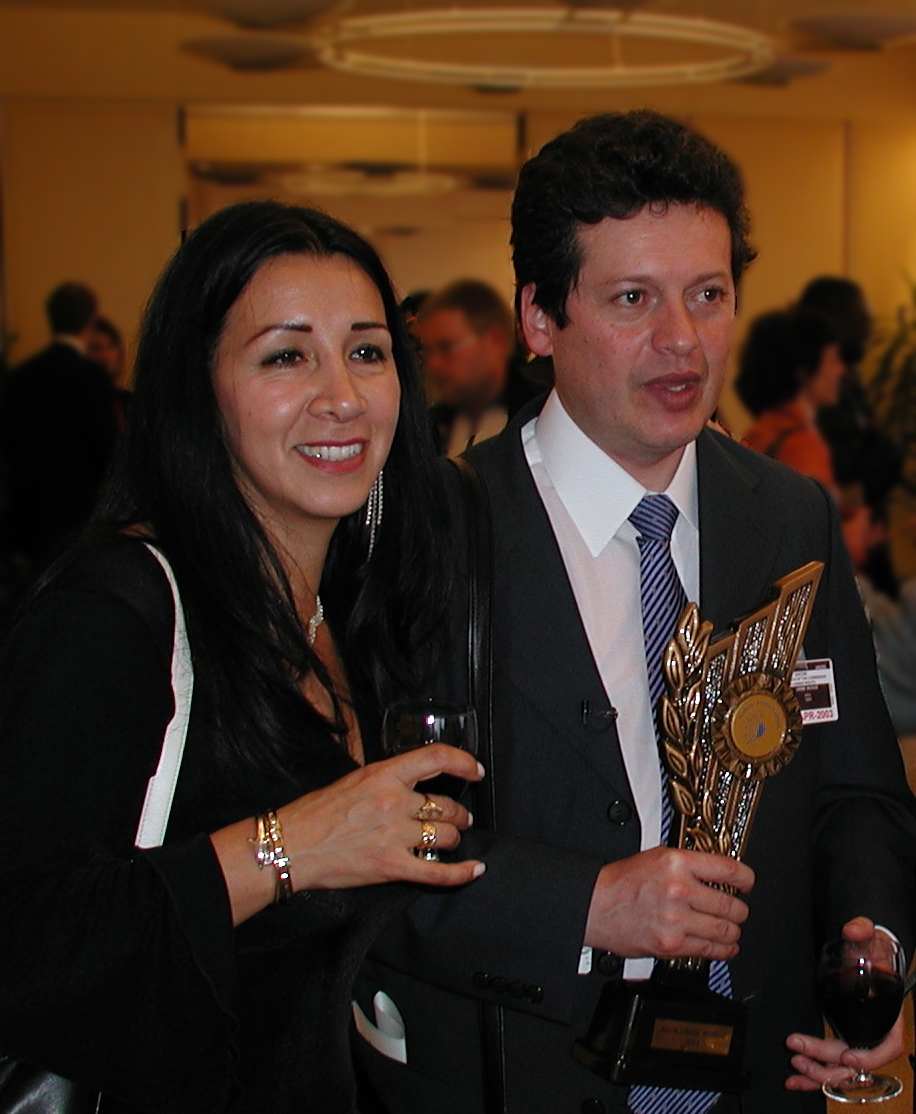
Alirio Uribe Muñoz (the latter is the 2003 Laureate of the Martin Ennals Award for Human Rights Defenders, portrayed here with his wife in 2003).

via:
Colombia: Series of death threats against human rights defender Martha Díaz | Front Line.
MP deplores death threats against Colombian MP | Voxy.co.nz.
Posted in awards, Front Line, human rights, Human Rights Defenders | 1 Comment »
Tags: AFUSODO, Alirio Uribe Munoz, Bogota, Colombia, death threats, extrajudicial killings, Front Line (NGO), Gustavo Petro, Human Rights Defenders, intimidation, Ivan Cepeda, Martha Diaz, Martin Ennals Award for Human Rights Defenders, MEA 2003, MOVICE, parliamentarians, Parliamentarians for Global Action, Ross Robertson, woman human rights defender
February 11, 2014
Just now I received – via HURIDOCS – from the Odhikar Team in Bangladesh this update: “Today, 11 February 2014, at around 12:30 in the afternoon, the man who drives Saira Rahman Khan’s car, [Adilur Rahman Khan is Secretary of the human rights NGO Odhikar], received a phone call from 01822924228. The man who called him said he was Sub-Inspector Shahid from the intelligence agency. He told the driver that he must give him regular updates on Adilur Rahman Khan’s whereabouts. The driver said that he did not work for Adilur Rahman Khan and did not know where the latter went everyday and he could not give that kind of information. The man hung up. After that at 12:57 the same man, from a different phone number (01678046854) called the driver again and threatened him that if he did not give the information he wanted, he would face grave physical harm. The driver went to Odhikar and told the fact finders that he feared for his safety.”
With this message, the Odhikar Team attached the photograph (below) of members of the intelligence agencies in the lane outside the Odhikar office. Notice that the motorcycle has no license plate, which is apparently rather typical for the intelligence agency. Read the rest of this entry »
Posted in films, Human Rights Defenders, HURIDOCS | Leave a Comment »
Tags: Adilur Rahman Khan, Bangladesh, death threats, harassment, HURIDOCS, intelligence agency, NGO, Odhikar, Odhikar Team, photos, police intimidation, Saira Rahman Khan
February 11, 2014


today joins the worldwide campaign against mass surveillance. It its newsletter is states why: “Privacy is a human right: People need it, governments have to protect it and business has to respect it. Too often, this is not the case.Today is the day we fight back. Thousands of individuals, international experts and a coalition of NGOs from all around the globe demand an end to unchecked mass surveillance. Privacy is dear to everyone of them: It enables them to speak freely. To meet others without being watched. To know that it is their decision to share information about themselves.They are people like you.These people will take the streets in protest in the Philippines, Copenhagen, Stockholm and San Francisco. They will call or write their elected representatives in United Kingdom, Canada, Colombia and Poland. They will hold news conferences or join the online protest in Uganda, Mexico, Brazil and Australia. And they will endorse the Necessary and Proportionate Principles demanding the protection of human rights and an end to mass surveillance.Do you want to join them? Spread the word. Tell your family and friends about the day we fight back. Make them care as you do. Sign the 13 Principles, join a global movement. Call your legislators, email them – ask them what they are doing. Join a protest near you. Be creative, blackout your website, create memes, make others laugh – and take action.”
via Privacy Is A Right – Today Is The Day We Fight Back.
to sign the campaign go to: https://necessaryandproportionate.org/take-action/privacyinternational
Posted in human rights, Human Rights Defenders, HURIDOCS | Leave a Comment »
Tags: campaign, electronic surveillance, HURIDOCS, international campaign, mass surveillance, right to freedom of expression, right to privacy, Today Is The Day We Fight Back, worldwide campaign
February 11, 2014
It sounds almost like a joke but it truly happened. On 9 February 2014 Ukrainian border officials barred a Russian human rights defender from entering the country, according to Human Rights Watch: Andrei Yurov, a member of Russia’s presidential human rights council and the Head of its permanent commission on human rights outside Russia, was deported to Russia upon his arrival at Borispyl airport in Kiev. Yurov was to meet in Kiev with Council of Europe Human Rights Commissioner Nils Muiznieks, and to work within the International Human Rights Defenders’ Group on the Situation in Ukraine, which was founded on December 1, 2013, in response to the November 30 police violence against peaceful protesters in Kiev.
“Yurov’s expulsion is an unprecedented and wholly regrettable step,” said Rachel Denber, deputy Europe and Central Asia director at Human Rights Watch. “Instead of driving out human rights defenders the Ukrainian government should be open to scrutiny of its human rights record during this crisis.”
via Ukraine: Russian Rights Defender Expelled | Human Rights Watch.
Posted in HRW, human rights, Human Rights Defenders | Leave a Comment »
Tags: Andrei Yurov, barring, Council of Europe, expulsion, HRW, Human rights defender, Human Rights Defenders, Human Rights Watch, International Human Rights Defenders’ Group on the Situation in Ukraine, Kiev, Nils Muižnieks, non-cooperation, Russia, Ukraine, visa denial