This blog has had many occasions to be negative about Azerbaijan [https://thoolen.wordpress.com/tag/azerbaijan/], but this time some good news: President Ilham Aliyev of Azerbaijan signed a decree yesterday (17 March 2016) for the Novruz holiday, pardoning 148 prisoners, among them thirteen journalists, human rights defenders and activists.
The list includes: human rights campaigner Rasul Jafarov; the head of a local election monitoring group Anar Mammadli; youth activists from NIDA movement Rashad Hasanov, Rashadat Akhundov, Mammad Azizov, and Omar Mammadov; human rights defenders Taleh Khasmamedov and Hilal Mammadov; opposition Musavat party deputy chair Tofig Yagublu; journalists Parviz Hashimli and Yadigar Mammadli; also a blogger Siraj Karimov. Also today, the Baku Appeals Court converted a six-year prison sentence imposed on journalist Rauf Mirgadirov to a five-year suspended term, and released him from the courtroom.
While this is a great moment for those released, among those still behind bars on bogus charges are: political analyst Ilgar Mammadov, in defiance of the European Court of Human Rights decision on his case and the repeated calls by the Council of Europe Committee of Ministers to free him; human rights lawyer Intigam Aliyev; and Azerbaijan’s prominent investigative journalist, Khadija Ismayilova. Also youth activist Ilkin Rustamzadeh and journalist Seymur Hazi.
“We are overjoyed for the journalists, human rights defenders, and activists who were released today after being imprisoned for exercising their basic rights of free speech and free assembly,” said Nenad Pejic, Radio Free Europe editor in chief. “But Khadija should have been among them”. [https://thoolen.wordpress.com/2015/12/18/azerbaijan-khadija-ismayilova-remains-in-jail-but-council-of-europe-takes-exceptional-step/] In recent correspondence with RFE/RL, international human rights lawyer Amal Clooney, who will represent Ismayilova before the European Court of Human Rights, said that “the case involved a politically motivated prosecution to restrict [Ismayilova’s] freedom of speech… This is about a government that is abusing its power to silence journalists like Khadija, as well as other critics of the ruling regime.”
An update on the situation human rights defenders in Russia is unfortunately needed too frequently. Recently the Martin Ennals Foundation condemned the attacks on its 2013 Laureate, the Joint Mobile Group (JMG) which is known for its courageous work in opening legal cases on behalf of victims of torture in Chechnya. On March 9th, they were travelling together with journalists and the group was physically attacked, their confidential notes stolen, and the vehicles they were in burned. Their offices in Ingushetia were also attacked. The international and local media have reported (see list at bottom of the post). This is part of an ongoing pattern of threats and intimidation directed against JMG.
Now, Human Rights Watchand others report that yesterday (16 March) Igor Kalyapin, head of the Committee for the Prevention of Torture, one of the founders and participants of the Joint Mobile Group, was attacked as he was leaving his hotel in Grozny. They also pelted him with eggs, and threw flour and bright antiseptic liquid on him, which stained his face and clothes. “The attack on Igor Kalyapin shows again that it’s open season on human rights defenders in Chechnya,” said Hugh Williamson, of Human Rights Watch. “The authorities’ utter failure to hold anyone to account for a series of vicious attacks in recent years is like a bright green light for further attacks.”
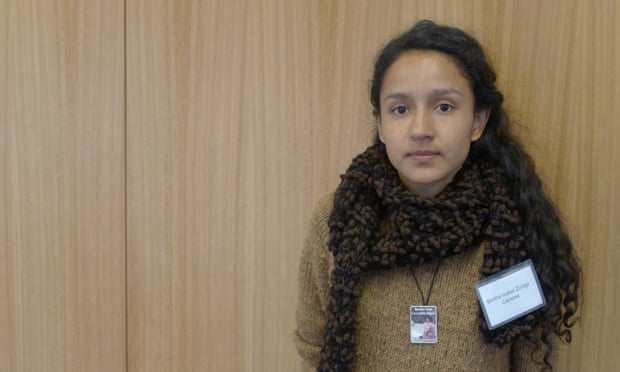
Bertha Cáceres, daughter of murdered Honduran environmental activist Berta Cáceres. Photograph: Liz Ford for the Guardian
This week, Bertha, who is studying for a masters degree in Latin American studies in Mexico, was in New York to speak at side events during the annual Commission on the Status of Women. Here she said “… I will talk about the situation in Honduras. This is not the first assassination, but one of a series of assassinations of human rights defenders … I don’t want another human rights defender to be assassinated”. Even while she spoke with the Guardian journalist a call came through from COPINH’s lawyer (the NGO her mother worked for) to say another member of the organisation had been shot dead ….
According to a statement by Front Line Defenders today, this human rights defender, Nelson Garcia, was returning home following a violent eviction conducted by the Public Order Military Police and the Cobras Special Force in the municipality of Río Lindo when he was intercepted by unidentified men who shot him in the face four times. Read the rest of this entry »
reports on the use of fabricated charges against human rights defender Joel Ogatain Kenya. The story serves as a perfect illustration of how extractive industries (or the States on their behalf) keep human rights defenders tied up in court proceedings through judicial harassment and even manage to get them detained. Read the rest of this entry »
Further to my post of today about human rights defenders in the area of economic, social and cultural rights, here the profile of such a defender, Allo Awol from Ethiopia.
Allo is a voice for human rights defenders in Ethiopia; a voice for those on the ground who resist oppressive Government policies and struggle to bring about progressive change and transformation in the face of adversity. ‘Under current circumstances, being outside Ethiopia presents both an opportunity and a responsibility to speak out against the Government’s authoritarian policies, particularly the increasing abuse of the constitutional order, the judicial system, discourses around development and counter-terrorism. I speak for the victims of human rights violations in Ethiopia, the victims of the State.’..
On 7 March 2016 the ISHR held a joint side event on the protection needs of human rights defenders working on economic, cultural and social (ESC) rights [http://wp.me/pQKto-1ZJ]. Here a report and some more:
Panellists spoke about the crucial work of ESC rights defenders in their countries, including defenders in Ethiopia protesting illegal land grabs to prevent the displacement of communities; defenders in Malaysia working towards inclusive and sustainable development and to oppose corruption; and defenders in Guatemala working to protect indigenous rights and ensuring that companies consult with affected communities.
Yesterday, 14 March 2016 was the second anniversary of the death of Cao Shunli, a Chinese human rights defender who was detained and denied adequate medical treatment in police custody for five months, before dying in a military hospital in Beijing in 2014. This happened shortly after she was shortlisted for the Martin Ennals Award in that year. [see also https://thoolen.wordpress.com/2016/02/12/cao-shunli-a-profile-and-new-award-in-her-name/]. Has the situation improved…? Read the rest of this entry »
A major new report by the UN Special Rapporteur on human Rights Defenders,Michel Forst, documents good practices and policies in the protection of defenders and makes concrete recommendations to States, business enterprises, national human rights institutions, donors, civil society organisations and other stakeholders to ensure a safe and enabling environment for defenders’ work (A/HRC/31/55).
Key among these is a recommendation that, in consultation with civil society, States should develop and implement specific national laws and mechanisms to protect defenders and to investigate and ensure accountability for threats and attacks against them. [ISHR’s work to develop a model national law on the recognition and protection of human rights defenders is specifically referenced in this regard.] [see also: https://thoolen.wordpress.com/2014/03/05/two-more-side-events-on-human-rights-defenders-on-10-and-12-march/]
In addition to enacting laws, the Special Rapporteur recommends that States establish and adequately-resourced protection mechanisms, in consultation with civil society.
Through the report, the Special Rapporteur endorses a ‘holistic’ approach to the protection of defenders, engaging the responsibility of a range of actors. Key insights and recommendations included in the report include that:
States should publicly recognise the vital and legitimate work of human rights defenders, disseminate and raise awareness about the Declaration and actively respect and protect ‘the right to defend rights’.
National human rights institutions should develop concrete action plans to support and protect defenders and establish focal points to ensure effective implementation and evaluation of such plans.
Business enterprises have an important and influential role to play in protecting defenders and should be engaged in this regard: ‘The condemnation of violations by members of the business community not only legitimises defenders’ concerns but also builds opposition to bad business practices,’ the report says. ‘In addition, due to their economic and political influence, the support of business leaders can draw in wider support of society.’
Donors should provide long-term, sustainable, flexible financial support to defenders and their organisations and networks, providing for their ‘holistic protection’.
The UN itself should strengthen the protection of defenders and prevent violations against them, including through the ‘Rights Up Front’ initiative and the Sustainable Development Goals, and by strengthening its institutional response to cases of reprisals against those who for cooperate with UN human rights mechanisms. The need to prevent and ensure accountability for reprisals is particularly important given the Special Rapporteur’s finding that international and regional human rights mechanisms are increasingly being turned to and relied upon by defenders either to complement and strengthen domestic advocacy efforts, or because democratic institutions and the rule of law are weak or non-existent at the national level. [see also my ‘old’ post: https://thoolen.wordpress.com/2014/03/13/zero-tolerance-for-states-that-take-reprisals-against-hrds-lets-up-the-ante/]
In addition to making concrete recommendations, the Special Rapporteur also articulates 7 key principles for all stakeholders that he considers should inform and underpin all policies and practices namely:
Principle 1: They should adopt a rights-based approach to protection, empowering defenders to know and claim their rights.
Principle 2: They should recognise that defenders are diverse and come from different backgrounds, cultures, and belief systems.
Principle 3: They should recognise the significance of gender in the protection of defenders and apply an intersectionality lens to the assessment of risks and to the design of protection initiatives.
Principle 4: They should focus on ‘holistic security’ of defenders, including physical security, digital security, and psychosocial wellbeing.
Principle 5: They should not focus on the rights and security of individual defenders alone, but also include the groups, organisations, communities, and family members who share their risks.
Principle 6: They should involve defenders in the development, choice, implementation and evaluation of strategies and tactics for their protection. The participation of defenders is key to their security.
Principle 7: They should be flexible, adaptable, and tailored to the specific needs and circumstances of defenders.
Here follows the text of the statement that the World Organisation Against Torture (OMCT) and FIDH, within the framework of the Observatory for the Protection of Human Rights Defenders, would have delivered:


 reports on the use of fabricated charges against human rights defender