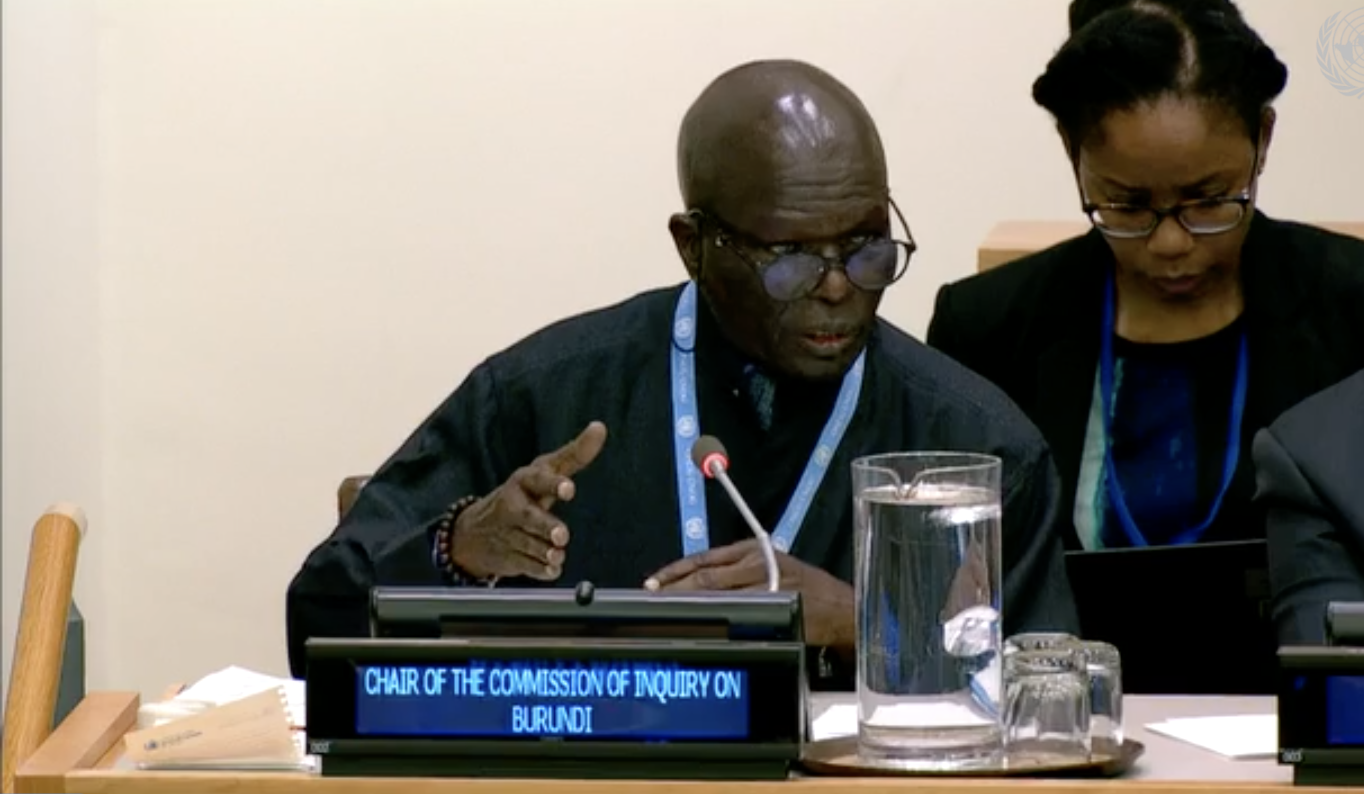
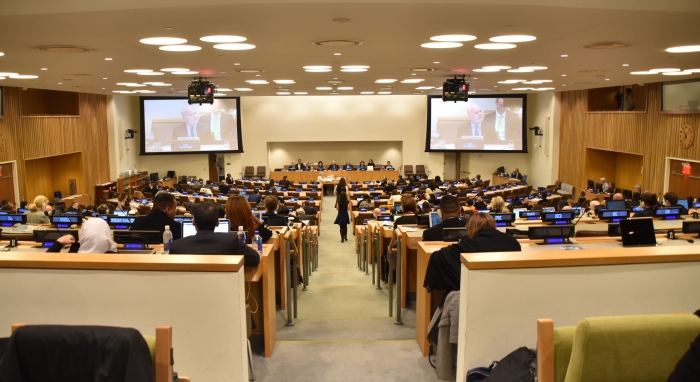
There are many different approaches States employ to keep critical voices out of multilateral spaces. ISHR’s new report of 30 May 2018 [The Backlash Against Civil Society Access and Participation at the United Nations] outlines what these are and provides a road map for States and UN representatives to prevent and counter reprisals and restrictions on civil society participation in UN processes.
Civil society has the right to ‘unhindered access to and communication with international bodies’. However, that right is not being respected. ISHR’s new report, ‘The Backlash Against Civil Society Access and Participation at the United Nations‘ documents a broad range of obstacles faced by human rights defenders, from opaque bureaucracies and procedures to physical threats and attacks.
‘States decide who gets through the door,’ said ISHR’s Eleanor Openshaw. ‘States that fear calls for accountability and justice do what they can to prevent civil society access to and participation in UN spaces’. Opaque practices and procedures provide covers for States seeking to block NGO entry. An NGO seeking to participate in a UN high-level event can be a victim of the ‘no-objection’ procedure. This is the means by which any State can veto their participation without being named or providing any justification. ‘The no-objection procedure is poorly defined, and provides no formal criteria for objections to NGO participation,’ said ISHR’s John Indergaard. ‘It’s carte blanche to exclude legitimate NGOs for illegitimate reasons.’
Even when civil society representatives make it into an actual UN building, they have been thrown out without explanation or asked to leave while events were ongoing. At some high-level events and committee meetings, NGO representatives have been barred from giving statements or bringing in documents related to their work. Physical attacks and intimidation against those seeking to coöperate with the UN are well documented.
‘These restrictions and reprisals are all aimed at dissuading civil society participation,’ said Openshaw. ‘They need to be challenged in each and every case.’
Joe Odell (press officer for the International Campaign for Freedom in the UAE) wrote on Wednesday 6 June 2018 a long piece in the Middle East Eye about the “UAE‘s shameful imprisonment of Ahmed Mansoor“. As the last dissident voice in the Emirates is silenced, it remains to be seen who is left to speak out about injustice in the UAE, he states rightly. As I have posted regularly on him (see e.g. https://humanrightsdefenders.blog/2018/04/13/update-on-mansoor-in-uae-after-one-year-detention-appears-in-court/), will only refer to a few highlights in Odell’s article:
“Last week Abu Dhabi’s Supreme Court sentenced the awarded-winning Emirati human rights activist Ahmed Mansoor to 10 years in prison after finding him guilty of using his social media account to “defame the nation” by spreading “rumours and lies about the UAE” and promoting “sectarian feelings and hatred” among its citizens. It is a ruthless ruling for one of the region’s most prominent rights campaigners, who in 2015 won the prestigious Martin Ennals Award for Human Rights Defenders after his tireless struggle for basic political and civil rights in the UAE.……
It was almost as if the UAE wanted to get this news out in a way that created as little fanfare as possible. Many hours were to pass before the UAE state-owned publication the National confirmed that this was indeed Ahmed Mansoor; international media promptly picked up the story within minutes – no doubt to the ire of the UAE government. Emirati authorities, however, are yet to give an official comment on the court decision. More pertinently, Mansoor’s exact whereabouts remains unknown, leaving the 48-year-old father of four at grave risk of torture and other forms of ill-treatment.
…..Perhaps, in his heart, Ahmed knew this day would come. But he always refused to place himself above the struggle, telling journalist Bill Law prior to his arrest: “The only way to counter repression is by revealing it. And, yes, there is always that possibility that I will go back to jail. But if activists do not talk, who will?”
This knock-on effect has already begun. In the UK, pressure is now mounting on Manchester mayor Andy Burnham to issue a statement on Ahmed’s case after a coalition of 34 NGOs, including Amnesty International and the European Centre for Democracy and Human Rights, demanded intervention. This is a sensitive and fought over issue in a city whose council have burgeoning commercial links with the UAE, and whose football club is owned outright by the Emirates’ deputy prime minister, Sheikh Mansoor bin Zayed al-Nahyan. [see below]
…….Meanwhile, in north London, Arsenal supporters are now questioning their club’s links with the UAE, which began with their move to the Emirates Stadium more than 10 years ago. In response to Ahmed’s sentence, leading Arsenal fan website the Daily Cannon published an editorial calling for a review of the club’s sponsorship deal with Emirates Airline. Perhaps for the first time the UAE’s soft-power project in the UK now lies on contested ground, not only from regional foes, but increasingly from ordinary people across Britain….[ see also my: https://humanrightsdefenders.blog/2015/09/15/fly-emirates-if-the-emirs-let-you/]
And indeed on Friday 3 June 2018, campaigners in Manchester, UK, held a “street renaming” ceremony for Ahmed Mansoor and to highlight the city’s close links with the UAE government. Activists raised a banner saying “Ahmed Mansoor Street” in Manchester, to pressure the city’s council to bring up the case of the blogger who was sentenced to a decade in jail by UAE authorities this week.
The protest took place on Thomas Street, in the city’s fashionable Northern Quarter district. Supporters of Mansoor in the UK have asked Manchester Mayor Andy Burnham to help secure the release of the free-speech activist. The campaigners believe one way that could help is for Burnham to name a street after the 2015 Martin Ennals Award for Human Rights Defenders laureate.
“As the first directly-elected Mayor of Greater Manchester you are in a unique position to show leadership on this issue,” a letter by Mansoor’s supporters to Burnham stated. “Your public support for a street named after Ahmed Mansoor – and calling for his immediate and unconditional release – would demonstrate your commitment to this heritage and these ideals.”
Manchester has deep ties with the Gulf state, including companies and investment groups tied to Abu Dhabi Crown Prince Mohammed bin Zayed al-Nahyan, the de-facto ruler of the UAE. The football club, Manchester City, is also owned by leading Emirati royal Sheikh Mansour bin Zayed al-Nahyan.
On 7 June 2018, one week before the opening of the FIFA World Cup in Russia, Amnesty Internationalcomes with a marvelous contribution: a team of 11 Russian human rights champions who routinely put their lives on the line to defend human rights in Russia. A new campaign, Team Brave, will profile a human rights defender from each of the 11 regions hosting World Cup matches to raise awareness of their important work, and you can send messages of solidarity to show these brave individuals that they are not alone.
“As World Cup excitement builds, we want to highlight the work of the inspiring men and women who risk their lives and freedom to fight for human rights in Russia. The lineup of Team Brave includes activists who have fought to end torture in police stations, protect the environment, defend LGBTI rights and sex workers’ rights, and support victims of domestic violence – they are the real champions in Russia,” said Inga Kelekhsaeva, Russia Campaigner at Amnesty International.
The lineup of Team Brave includes activists who have fought to end torture in police stations, protect the environment, defend LGBTI rights and sex workers’ rights, and support victims of domestic violence – they are the real champions in Russia:
Grozny: Oyub Titiev, the head of the NGO Memorial’s office in Chechnya imprisoned under bogus charges since January 2018
Sochi: Andrei Rudomakha, an environmental human rights defender who was brutally attacked in 2017
St Petersburg: Irina Maslova, who founded a movement to defend the rights of sex workers.
Volgograd: Igor Nagavkin, who worked on fighting torture and corruption in the Volgograd region until he was arbitrarily detained in October 2016.
Rostov-on-Don: Valentina Cherevatenko, a women’s rights activist
Kaliningrad: Igor Rudnikov, an independent journalist investigating cases of corruption until his arbitrary detention in 2017.
Samara: Oksana Berezovskaya, who runs an LGBTI rights organization
Nizhny Novgorod:Igor Kalyapin, who founded the Committee Against Torture
Kazan: Yulia Fayzrakhmanova, an environmental human rights defender
Yekaterinburg: Aleksei Sokolov, who fights torture and other abuses in the prison system
Saransk: Vasiliy Guslyannikov, the founder of the NGO Mordovian Republic Human Rights Centre
Many of these human rights defenders have faced harassment, intimidation, physical attacks, smear and in some cases have been arbitrarily detained simply for carrying out their vital work.
As part of the Team Brave campaign, Amnesty International is asking supporters to take action for three of the human rights defenders featured, who remain in prison to date or whose assailants remain at large.
Oyub Titiev has been detained for almost six months on fabricated charges because of his human rights work. Environmental human rights defender Andrei Rudomakhawas brutally assaulted in 2017 by unknown assailants for documenting illegal construction work on the Black Sea coast, and his attackers still walk free. Igor Nagavkin has spent more than a year and a half in pre-trial detention on trumped-up charges for his work defending prisoners’ rights and combatting torture and corruption.
“The Russian authorities cannot continue to intimidate and harass every critic into silence. With the eyes of the world on Russia, they must decide what they want the legacy of this World Cup to be. There can be no winners in Russia until human rights defenders are recognized, protected and free to do their important work unobstructed and without fear of reprisals.”
[On 29 May, FIFA took the important step of launching a complaints mechanism for human rights defenders and media representatives to report rights violations and committed to supporting human rights defenders and freedom of the press in relation to FIFA’s activities. With the 2018 World Cup taking place amidst a crackdown on human rights by the Russian authorities, FIFA commitments and mechanisms will be put to the test. Amnesty International has urged the Football’s governing body to be ready to confront the Russian authorities and use all of its leverage to effectively protect human rights defenders and stop the 2018 World Cup providing the backdrop for a renewed wave of oppression.] See also: https://humanrightsdefenders.blog/2018/05/24/fifa-expresses-concern-about-chechen-human-rights-defender-but-to-whom/
Khoi is an independent artist who is shaping public discourse in Vietnam. She reached stardom in 2010, when she won the highest award for songwriting in Vietnam. As a celebrity, Mai advocated for women’s rights, LGBT rights, and to end violence against women. More recently, she became the focal point of public discourse after nominating herself to run in the 2016 parliamentary elections. Her pro-democracy campaign sparked a nationwide debate about political participation and ultimately led to a meeting with then-U.S. President Barack Obama. Since running for parliament, Mai has had her concerts raided, has been evicted from her house twice, and is effectively banned from singing in Vietnam. In March 2018, she was detained at Hanoi airport on suspicion of “terrorism” after returning from a European tour.
Despite this harassment, Mai continues to find creative ways to spark conversation on art, human rights, and democracy. In February 2018, she released a new album, “Mai Khoi Chem Gio – Dissent.” In a review of the album, The Economist commented, “If music alone could break chains, this would be the music to do it.” Mai’s work aims to counter the authoritarian ways of thinking that justify social control. She is currently the subject of a feature-length documentary that is scheduled to air on Netflix in 2019.
“Mai Khoi is outstanding in her commitment to human rights,” said Havel Prize Committee Chairman Thor Halvorssen. “Through her music and her campaigns, she has put civil liberties and democracy on the forefront of public conversation in Vietnam.”
The Havel Prize ceremony will be broadcast live at oslofreedomforum.com at 3:00 p.m. Oslo time (GMT+2) on Wednesday, May 30.
The soul-searching of the human rights movement continues unabated in a climate of growing hostility towards some of the basic tenets which the international human rights movement assumed were widely accepted. Now this can no longer be taken for granted as shown in action by some major players (China, Russia) and inaction(USA, EU) and by a worrying number of middle-sized states (such as Turkey, Hungary, Philippines, Venezuela) where backsliding on human rights is underpinned by populist leaders.
In this context the Martin Ennals Award for Humans Rights Defenders (MEA) is organising its 25th Anniversary event on 30 May in Geneva with a public event “Human Rights in a Changing World”. The leaders of the 10 international NGOs on the MEA Jury and several laureates come together for this occasion. In the morning they meet in private session on the same topics.
Panel 1 (35 Min)- The rising influence of autocratic states
Speakers: Kenneth Roth, Executive Director, Human Rights Watch Debbie Stothard, Secretary-General, International Federation for Human Rights Sam Zarifi, Secretary-General, International Commission of Jurists
Panel 2 (35 Min)- Populism as a threat to human rights
Speakers: Elisa Massimino, President and CEO, Human Rights First Gerald Staberock, Secretary-General, World Organization Against Torture Friedhelm Weinberg, Executive Director, HURIDOCS Julie Verhaar, Senior Director, Amnesty International
Panel 3 (35 Min)- Effective human rights action in today’s environment
Speakers: Julia Duchrow, Head of Human Rights, Brot Für die Welt Andrew Anderson, Executive Director, Front Line Defenders Vincent Ploton, Director, Treaty Body Advocacy, Int’l Service for Human Rights.
This blog has devoted several posts to these developments and here is a small selection that may help prepare for the meeting:
Saudi authorities detained seven women human rights defenders since 15 May 2018, say Human Rights Watch (HRW) and the Gulf Centre for Human Rights. “Crown Prince Mohammad bin Salman’s ‘reform campaign’ has been a frenzy of fear for genuine Saudi reformers who dare to advocate publicly for human rights or women’s empowerment,” HRW Middle East Director, Sarah Leah Whitson, said in a statement. Among the detained women are Eman al-Nafjan, a Saudi blogger, and Lujain al-Hathloul, a women right’s activist who had been arrested previously and held for 75 days for attempting to drive back into Saudi Arabia from neighbouring United Arab Emirates (UAE).
Rothna Begum, a women’s rights researcher at Human Rights Watch, said the government is trying to silence critics, particularly those who champion women’s rights reforms. “While it’s not clear why they were arrested, today we have seen Saudi press reports come to suggest that these women are traitors and have been arrested because they are undermining the national unity of the country,” Begum told Al Jazeera.
Amnesty International condemned the commentary of the arrests as a “chilling smear campaign” and an “extremely worrying development for women human rights defenders” in the country.
[Since 2011, nearly 30 activists and dissidents have been convicted in Saudi courts, many of whom received sentences of up to 15 years, according to HRW.]
“The defenders we’re honouring today work in some of the most dangerous areas of the world, sacrificing their own security to peacefully demand justice and human rights for their communities,” said Andrew Anderson, Executive Director of Front Line Defenders, as he announced the winners in Dublin.
—-
Nurcan Baysal, Turkey – Regional Winner for Europe & Central Asia & Global Laureate
Nurcan is a Kurdish journalist and human rights defender based in Diyarbakir. When the government launched a military offensive in the south-east in 2016, Nurcan spent months visiting Kurdish villages under bombardment, documenting human rights violations, and stopping to help families who’d lost everything in the conflict. Her writings are known for their critical focus on voice women living under the bombardment. When the authorities launched a military operation in Afrin, Nurcan took to social media to demand peace and condemn the violent assault. She was detained for speaking against the violence, and although later released she now faces up to 3 years in jail in a separate case related to her writing. Nurcan, according to authorities’ absurd claims, had “spread propaganda for armed terrorist organizations … and a call for provocative actions.” In addition to her reporting, Nurcan has also co-founded several NGOs, set up a camp to help Yazidi women fleeing the Islamic State, and been a key voice in countless reconciliation programs in the region. [see also: http://bianet.org/english/human-rights/197288-kurdish-journalist-baysal-wins-frontline-defenders-human-rights-prize]
Soni Sori, India – Regional Winner for Asia
Soni Sori is an indigenous and women’s rights defender in the militarised Bastar region of Chattisghar, India, where state-backed paramilitary forces are waging a violent campaign against local Adivasi tribes in the name of combating an armed Maoist insurgency. Soni documents and advocates against violence perpetrated by the paramilitary and police forces, which includes razing villages, burning homes, raping local women, and torturing and sexually assaulting tribes people detained without cause. Soni has also defended a number of educational centres from destruction by Maoist groups. In retaliation for her work, security forces detained and tortured Soni, pushing stones inside of her body and assaulting her for hours. Years later, men attacked her with acid and threatened to do the same to her daughter if she did not cease her advocacy on behalf of tribeswomen raped by the security forces. She has refused to stop her work, and continues to travel into the Maoist regions to speak with survivors of the ongoing conflict. [see also: https://feminisminindia.com/2018/05/18/soni-sori-wins-front-line-defenders-award/] and https://humanrightsdefenders.blog/2016/02/23/human-rights-defenders-in-india-democracy-is-not-enough/
Peaceful Resistance of the Micro-Region of Ixquisis, Guatemala – Regional Winner for the Americas
La Resistencia Pacífica de la Microregión de Ixquisis formed in response to grave rights violations committed in the name of economic advancement in Guatemala. The government has authorised destructive mining and hydroelectric mega-projects in the region despite the widespread opposite from the 59 villages and 7 communities in the municipality. HRDs in the Peaceful Resistance risk their lives to defend the territory. In 2016 alone, there were more than 75 reported attacks against HRDs in the Peaceful Resistance including killings, shootings, harassment, and defamation campaigns.
LUCHA, DRC – Regional Winner for Africa
LUCHA is a non-partisan youth movement formed in eastern Democratic Republic of Congo that struggles against chronic corruption and impunity in the DRC. Initially focused on
local issues like access to drinking water, electricity, and youth unemployment, in just 6 years the movement has developed into an extensive national-level network of powerful social organisers. Peaceful protests and demonstrations led by LUCHA are routinely attacked by authorities. In October 2017, 5 young protests were killed during a LUCHA-organised demonstration, and many of their members and leaders having been arrested and detained during peaceful assemblies. The Congolese national intelligence agency has detained several members, who have endured physical and psychological abuse in detention.
Hassan Bouras – Regional Winner for the Middle East & North Africa
Hassan Bouras is a journalist, blogger, leading member of the Algerian League of Human Rights, and founding member of the Rejection Front, a coalition against fracking to extract shale gas in Algeria. His reporting on both corruption and torture in Algeria spans more than two decades and because of this work he has been repeatedly targeted by Algerian authorities. He has continued his writing and advocacy despite years of judicial harassment, arbitrary detentions, violent raids on his home, and imprisonment.
Activists in Pakistan are under threat from a targeted campaign of digital attacks, which has seen social media accounts hacked and computers and mobile phones infected with spyware, a four-month investigation by Amnesty International reveals.
In a report titled ‘Human Rights Under Surveillance: Digital Threats against Human Rights Defenders in Pakistan’, released on Tuesday, 15 May 2018, Amnestyreveals how attackers are using fake online identities and social media profiles to ensnare Pakistani human rights defenders online and mark them out for surveillance and cyber crime.
“We uncovered an elaborate network of attackers who are using sophisticated and sinister methods to target human rights activists. Attackers use cleverly designed fake profiles to lure activists and then attack their electronic devices with spyware, exposing them to surveillance and fraud and even compromising their physical safety, Sherif Elsayed-Ali, Director of Global Issues at Amnesty International, said. “Our investigation shows how attackers have used fake Facebook and Google login pages to trick their victims into revealing their passwords. It is already extremely dangerous to be a human rights defender in Pakistan and it is alarming to see how attacks on their work are moving online,” he said.
On 9 May 2018, Hungary’s (remaining) civil society issued the Professors Solidarity Call below, signed by 77 professor until now and asking for more signatories. It concerns the so-called “Stop Soros” bill, to be voted by the Hungarian parliament very soon, which will have a devastating impact on both Hungarian civil society and the asylum seekers and refugees that are already in a dire state. That Victor Orban is behind an ‘anti-Soros bill’ is the more remarkable as he himself was the beneficiary of a Soros scholarship [in 1988 a dissident Hungarian university graduate wrote a letter to George Soros, a billionaire philanthropist, asking for help obtaining a scholarship to Oxford University. In the letter, which has recently resurfaced, the young Viktor Orban said he wanted to study the “rebirth of civil society”. He got the scholarship.– the Economist 7 April 2018].
PROFESSORS’ SOLIDARITY DECLARATION AND CALL FOR ACTION IN DEFENCE OF THE HUNGARIAN HELSINKI COMMITTEE AND THE HUNGARIAN CIVIL SOCIETY
We, 77 university professors and academics from 28 countries around the world, express our solidarity with the Hungarian Helsinki Committee and the independent Hungarian civil society, which currently faces an imminent existential threat.
The so-called “Stop Soros” bill, to be voted by the Hungarian Parliament in mid-May 2018, will have a devastating impact on both Hungarian civil society and those vulnerable human beings that cannot count on anyone else’s support. The new legislation will allow the government to simply ban the activities of organizations assisting refugees and migrants in a fast and arbitrary process. Activities such as legal aid to asylum-seekers, reporting to the UN or the EU, holding university lectures about refugee law or recruiting volunteers will be rendered illegal, if these are performed by civil society actors who dare to criticise government practices. Practices, which are equally condemned by the EU and the international community.
The Hungarian Helsinki Committee (HHC) is an outstanding human rights organization, well-known and respected for its professionalism around the world, not only by civil society, but by academia, state authorities and the judiciary as well. The HHC has massively contributed to the promotion of refugee law education and legal clinics on various continents. We all personally know and highly respect their work. States should be proud of such NGOs, instead of aiming to silence them.
Strong and independent civil society organisations are as indispensable for democracy and the rule of law as strong and independent universities. If NGOs such as the Hungarian Helsinki Committee are threatened, democracy is threatened. If a prestigious organization, winner of various international human rights awards, can simply be banned from providing legal aid to refugees, if a globally reputed voice of human rights can be silenced with an administrative measure in an EU member state, then further dramatic anti-democracy measures are likely to follow. There is a real risk that the Hungarian example will be increasingly copied elsewhere, and soon it may be too late to stop the domino effect.
We call on our governments to express, without delay, their vivid discontent with Hungary’s legislation aiming at annihilating independent civil society. We call on universities around the world to do the same and actively demonstrate their solidarity with the Hungarian Helsinki Committee and the entire threatened Hungarian civil sector. We call on the European Union to prove to the world its credibility as a guardian and global promoter of fundamental rights, and immediately take action to prevent this flagrant human rights violation from happening on its own territory.
Signatures (in alphabetical order) at the end of the document: https://www.helsinki.hu/wp-content/uploads/Professors-solidarity-call-HHC-HU-NGOs-2018.pdf
For those who think that muzzling human rights defenders is an exclusively non-western affair, look at these examples: Poland and Israel.
On 9 May 2018 Katharina Rall, environment researcher at Human Rights Watch, critically looks at Poland‘s efforts to hamper the freedom of expression and demonstration by human rights defenders at the forthcoming climate summit, known as the COP24. It will bring together state parties to the UN Framework Convention on Climate Change (UNFCCC), and thousands of experts, journalists, businesses and nongovernmental groups. UN experts cite concerns about the ban on spontaneous assemblies in Katowice during the talks, which will make it difficult for groups to respond to developments at the negotiations. In a letter sent to the Polish government last month they said that by “curtail[ing] the possibility of spontaneously expressing views about the unfolding of the climate talks and organizing peaceful assemblies to this effect”, the new law appears to go beyond the rights restrictions necessary to ensure security and safety at the conference. The UN experts also noted that the law “appears to give sweeping surveillance powers to the police and secret services to collect and process personal data about all COP24 participants”. This is a serious issue for the safety of climate activists at the summit. [The Polish government has yet to respond to the UN rights experts. But a reply from the Polish environment minister to similar concerns raised by the Bureau of the Aarhus Convention, a regional human rights and environmental body, has done little to dispel them.]
Just the day before, 8 May 2018, AP reported that Israel’s Interior Minister, Arieh Deri, has ordered the head of the local office of Human Rights Watch to leave the country within 14 days for allegedly supporting boycotts of Israel. HRW responded that it stands by Omar Shakir, a U.S. citizen of Iraqi descent, and accused Israel of trying to muzzle criticism of its human rights record. It says neither it nor Shakir support boycotts, and that it will challenge the decision in court. Iain Levine, a Human Rights Watch official, says Israel’s actions, such as compiling a dossier on Shakir, and “deporting human rights defenders is a page out of the Russian or Egyptian security services’ playbook.” [In April last year his appointment had already let to controversy, see: https://humanrightsdefenders.blog/2017/04/27/human-rights-watch-granted-israeli-work-permit-in-the-end/]