On 22 October 2019 ISHR published this interview with Marisa Hutchinson, Board member of the Association EQUALS in Barbados
share information on human rights defenders, with special focus on human rights awards and laureates
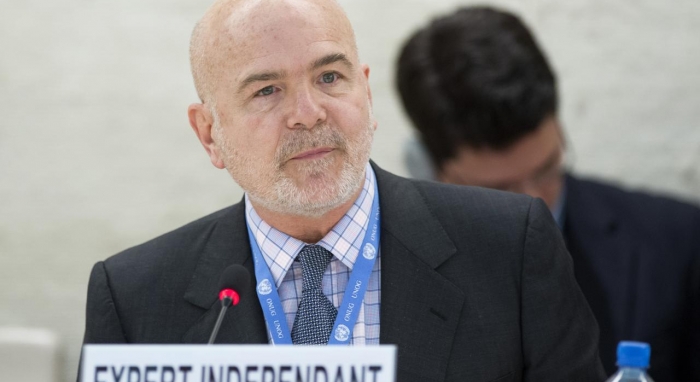
On 15 October 2019, the Special Rapporteur on Human Rights Defenders Michel Forst presented his report (A/74/159) to the UN General Assembly’s Third Committee on the issue of impunity for attacks and reprisals against human rights defenders. This was followed by an interactive dialogue with States. This is the last time Forst will address the Third Committee in the capacity of Special Rapporteur. Forst voiced specific concern about digital attacks against youth and women human rights defenders, and expressed the need to protect them. He also expressed concern at specific attacks on human rights defenders living in isolated environments, as well as those working on sexual and reproductive rights and on sexual orientation and gender identity issues.
‘Impunity is used as a weapon by those who wish to undermine the rule of law and silence those struggling to uphold human rights. I echo Forst’s comment that impunity is a political choice, otherwise how do we explain that around 98 percent of killings of human rights defenders in certain countries remains unpunished?’ asked ISHR’s Tess McEvoy.
The Special Rapporteur – and the United States – highlighted individuals and groups from various countries who are victims of reprisals. These included:
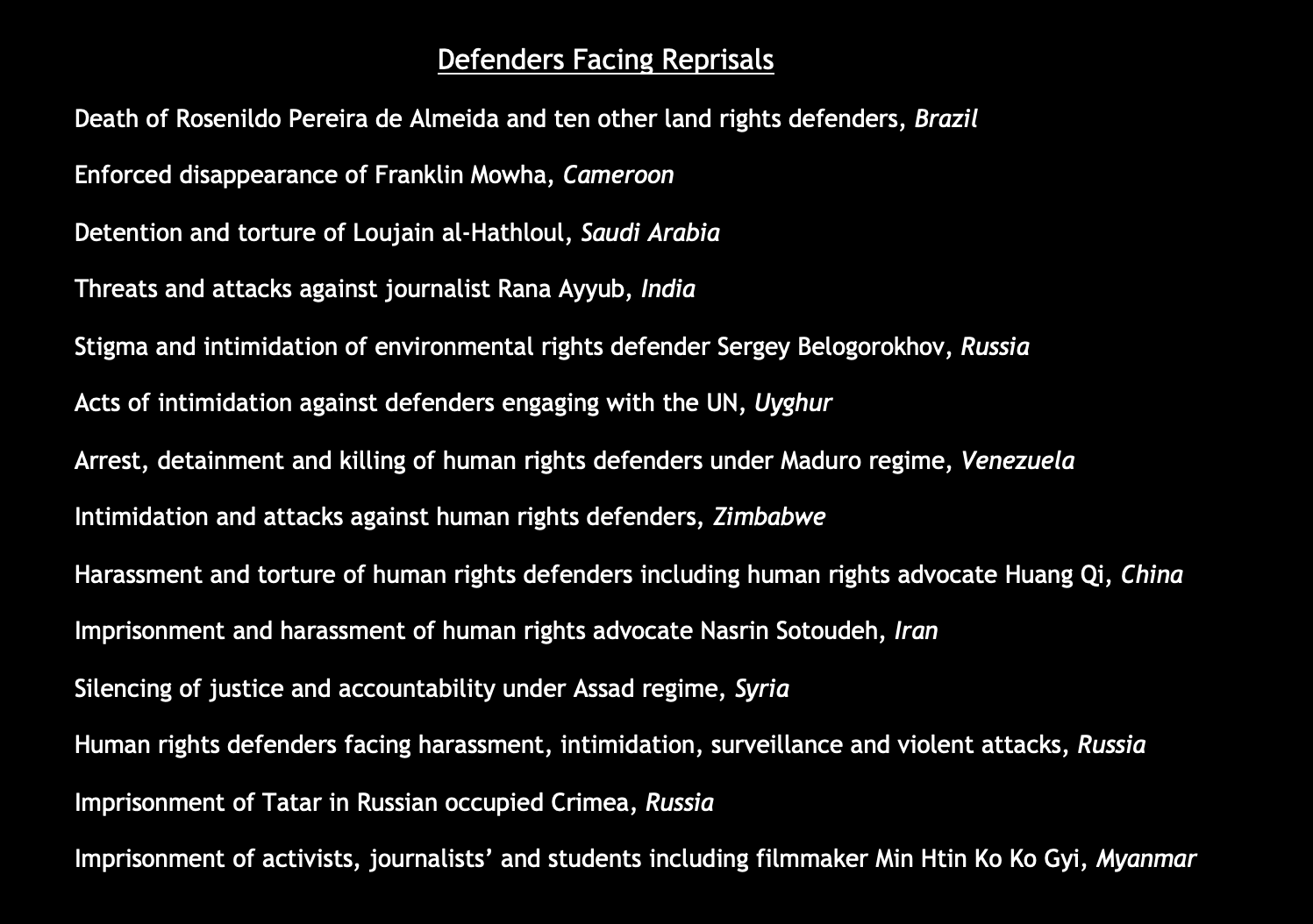
The Special Rapporteur’s report made recommendations to States on ways to effectively combat impunity. These included:
These recommendations were echoed in a side event organised by ISHR and Amnesty International on 16 October, where women human rights defenders from Yemen and Myanmar provided harrowing accounts of attacks they face in their respective contexts.
Several States voiced their support for the report and the mandate, including Norway who called on all States to support this year’s resolution on Human Rights Defenders currently being negotiated. Notwithstanding the adoption by consensus of a definition of human rights defenders in the 1998 Declaration on Human Rights Defenders, the usual detractors – including Russia and China – sought to delegitimise the work of human rights defenders by questioning whether the term is universally recognised. China went further to suggest that individuals were using the ‘flag of defending human rights’ to violate the law.
Notwithstanding the primary responsibility of States to combat impunity for attacks against defenders, the Special Rapporteur again emphasised his call for non-State actors to protect human rights defenders, and concluded by referencing his 2017 report on Business and Human Rights (A/72/170).
https://www.ishr.ch/news/unga-74-states-must-put-end-impunity-reprisals-against-defenders
The UN General Assembly’s Third Committee will run for eight weeks from 1 October to 21 November this year. The International Service for Human Rights, which follows the UN human rights bodies diligently, put out an Alert for this 74th Session on 1 October 2019.
The Third Committee brings together a wide array of Special Procedures mandate holders, including Special Rapporteur, independent experts, and chairs of working groups that are mandated by the Human Rights Council to discuss some of the most pressing human rights concerns and present findings and recommendations to the Third Committee. These findings should in turn play a role in shaping the focus of resolutions negotiated at this session.
Third Committee is expected to consider approximately 60 resolutions on a range of topics, including:
ISHR will be closely monitoring the work of the Third Committee as well as relevant developments in the plenary of the General Assembly and will report on key developments. Follow them on Twitter at @ISHRglobal using #UNGA74 for the latest updates.
Overview of Key Resolutions
Several country resolutions are expected again this session. For the 17th year, Canada will present a draft resolution on the Situation of human rights in the Islamic Republic of Iran spotlighting the continued dismal human rights situation and lack of progress over the last year. The European Union will again lead on a resolution on the Democratic People’s Republic of Korea, similarly underlining the lack of human rights progress. Ukraine will again present a draft resolution condemning Russia’s activities in Crimea. Resolutions on the human rights situation in Myanmar and Syria are also expected to be led by the Organisation of Islamic Cooperation and Saudi Arabia respectively.
ISHR remains concerned that China will again attempt to insert the seemingly harmless language of ‘win/win’ language in resolutions, which in fact focuses only on intergovernmental dialogue and cooperation, rather than actual human rights violations or accountability. This language risks shrinking space for civil society and roll back human rights norms across a number of resolutions.
Several resolutions are expected to become battle grounds regarding references to gender, and sexual and reproductive health and rights, including resolutions on the Improvement of the situation of women and girls in rural areas, Violence against women migrant workers, Rights of the Child, The girl child, The human rights to safe drinking water and sanitation,
Elections for the Human Rights Council are set to take place in mid-October as part of the General Assembly. ISHR is once again disappointed that this year a number of regions have presented closed slates. ISHR has published ‘scorecards‘ for each of the States seeking membership. These provide a brief overview of their human rights records, cooperation with civil society, past roles in the Council, and past engagement with UN human rights mechanisms.
Overview of Reports and Dialogues with UN Experts:
The UN Special Procedures – Special Rapporteurs, independent experts, and working groups – will report to the Third Committee and hold interactive ‘dialogues’ with member States. Several of this year’s reports reflect concerns about increased attacks on human rights defenders and emphasise the critical importance of creating and maintaining space for civil society. Click here for a list and schedule of dialogues.
ISHR Events
Ending impunity for violations against Human Rights Defenders: see https://humanrightsdefenders.blog/2019/10/09/panel-against-impunity-for-abuses-against-human-rights-defenders-new-york-on-16-october/
https://www.ishr.ch/news/alert-ga-74th-session-third-committee
The 65th Ordinary Session of the African Commission on Human and Peoples’ Rights will be held in Banjul, The Gambia from 21 October to 10 November 2019. The African Commission session will be preceded by the NGO Forum and 39th African Human Rights Book Fair, which will take place from 17 to 19 October 2019. The ISHR gives a preview:

The NGO Forum
Like every year, ahead of this session of the NGO Forum, a training on advocacy particularly focused on regional and international mechanisms will be organised. This year’s training is organised by CIVICUS and will be held from 15 to 21 October 2019. It will consist of three different elements:
The Forum on the Participation of NGOs in the Ordinary Sessions of the African Commission, also known as the ‘NGO Forum’ is an advocacy platform coordinated by the African Centre for Democracy and Human Rights Studies (ACDHRS) to promote advocacy, lobbying and networking among and between human rights NGOs, for the promotion and protection of human rights in Africa. The NGO Forum shares updates on the human rights situation in Africa by the African and international NGOs community with a view of identifying responses as well as adopting strategies towards the promotion and protection of human rights on the continent.
Issues such as:
The 65th ordinary session of the African Commission on Human and Peoples’ Rights
During every session, special mechanisms from the African Commission present their activity report. These reports catalogue the activities and initiatives undertaken by each mechanism inter-sessionally and includes one by the Special Rapporteur on Human Rights Defenders and Focal Point on Reprisals in Africa. For the full programme, click here.
ISHR will also organise side events, such as Ending intimidation and reprisals against those cooperating with regional mechanisms in Africa on 22 October 2019, 17.30-19.00 in the Kairaba Hotel, Banjul, The Gambia. This side event aims at providing more visibility and clarity on the Special Rapporteur’s mandate on reprisals, to share some lessons learned from efforts to address reprisals and intimidation at the international level, and to hone in on what more can be done at the regional level. In particular, the event will be an opportunity for the Special Rapporteur to share key information on how to engage with the reprisal’s aspect of his mandate through the presentation of the mandate’s working documents in this regard.
Panellists:
ISHR will monitor and report on key developments at the 65th ordinary session of the African Commission. Follow them on Twitter at @ISHRglobal, @ISHR_fr and at #ACHPR65.
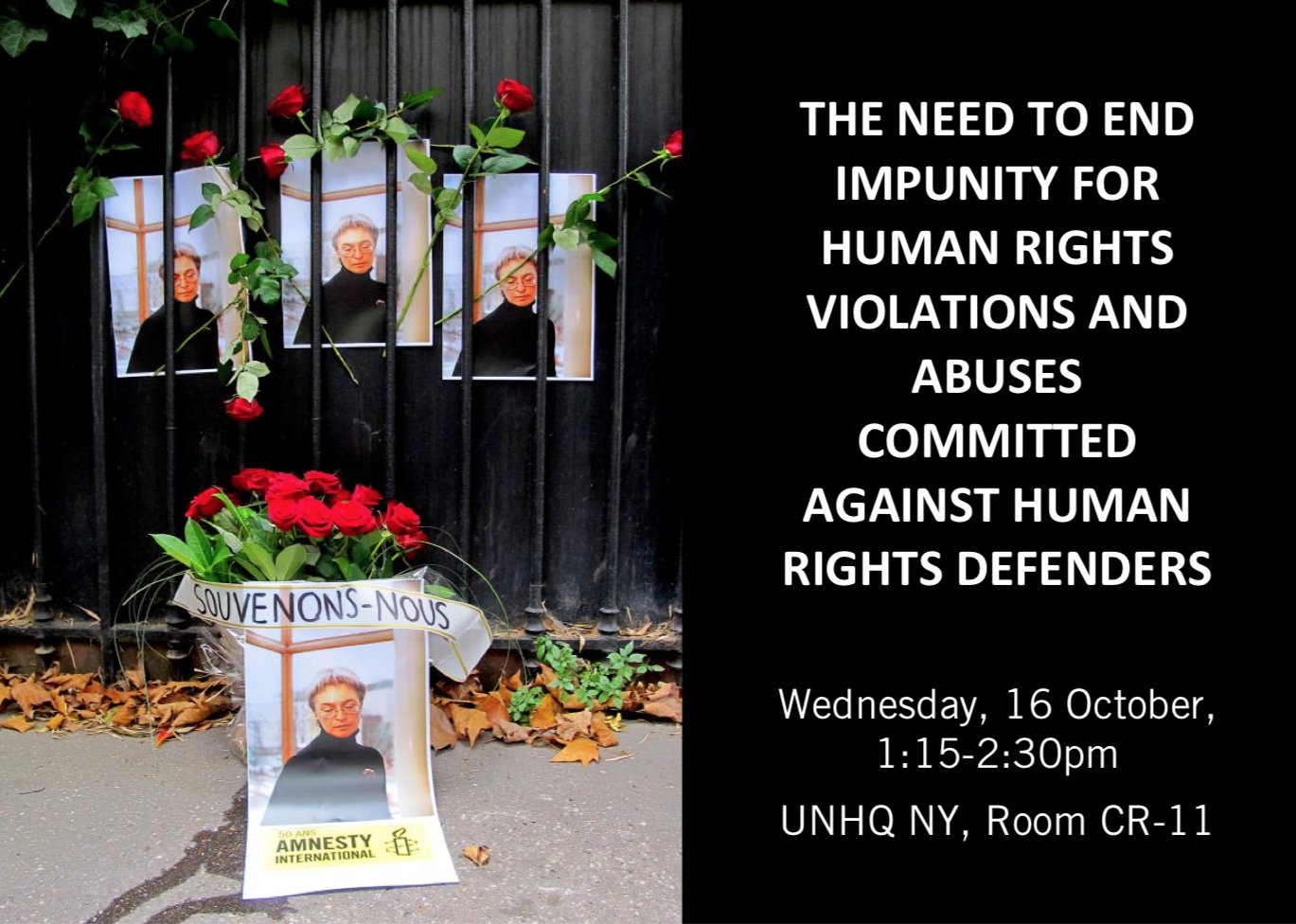
Wednesday, 16 October 2019
1:15 pm – 2:30 pm
UN Headquarters, New York
Room CR-11
This event is organised by Amnesty International and the International Service for Human Rights with the kind sponsorship of the Permanent Mission of Norway to the United Nations.
Event with panellists:
Moderated by:
Welcoming remarks by:
Please RSVP by 11 October.
On 27 September 2019 a group of civil society organisations welcomed significant outcomes of the HRC’s 42nd session, including reaffirming its condemnation of reprisals and extending its scrutiny over Yemen, Venezuela, Cambodia, Burundi, Myanmar, and Sudan. This session witnessed heightened scrutiny of Council members by shedding light on the situation in Saudi Arabia, but it missed an opportunity to ensure scrutiny over situations in China, Kashmir and Egypt. [see also: https://humanrightsdefenders.blog/2019/09/05/human-rights-defenders-issues-at-the-42nd-session-of-the-un-human-rights-council/]
The 42nd session also advanced standards on several issues including the right to privacy, administration of justice and the death penalty, but failed to defend the mandate of the Special Rapporteur on counter-terrorism against attempts to dilute and distract its focus. The High Commissioner failed again to present the database on companies facilitating Israel’s illegal settlements.
The Council reaffirmed that reprisals can never be justified. Council members rejected attempts to weaken the text including deleting the references to the roles of the Assistant Secretary-General and the Human Rights Council Presidents. [https://humanrightsdefenders.blog/2019/09/23/andrew-gilmours-2019-report-on-reprisals-it-gets-worse-but-response-remains-mostly-rhetoric/] The resolution listed key trends such as the patterns of reprisals, increasing self-censorship, the use of national security arguments and counter-terrorism strategies by States as justification for blocking access to the UN, acknowledged the specific risks to individuals in vulnerable situations or belonging to marginalized groups, and called on the UN to implement gender-responsive policies to end reprisals. The Council called on States to combat impunity and to report back to it on how they are preventing reprisals, both online and offline.
They welcome the creation of a Fact-Finding Mission (FFM) on Venezuela as an important step towards accountability for the grave human rights violations documented by the High Commissioner.
They welcome the renewal and strengthening of the mandate of the Group of Eminent Experts on Yemen, sending a clear message to parties to the conflict – and to victims – that accountability is at the center of the mandate, and providing a crucial and much-needed deterrent to further violations and abuses. States should support the recommendations made by the GEE in their recent report, including prohibiting the authorization of transfers of, and refraining from providing, arms that could be used in the conflict to such parties; and clarifying the GEE’s role to collect and preserve evidence of abuses.
They welcome the renewal of the mandate of the Special Rapporteur on Cambodia, but regret that calls to strengthen the mandate of the OHCHR to monitor and report on the situation have been ignored. We regret that the resolution fails to accurately depict the continuing crackdowns on civil society and the severity and scale of recent attacks on the political opposition.
They welcome the renewal of the mandate of the Commission of Inquiry on Burundi. Its work is vital as the country heads towards elections in 2020. The Burundian Government should desist from denial and insults, and should cooperate with the Commission and other UN bodies and mechanisms.
They welcome that the EU and OIC have jointly presented a resolution on Myanmar requesting the High Commissioner to report on the implementation of the recommendations of the Fact-Finding Mission at HRC 45. However, the international community needs to take stronger action to ensure accountability for and cessation of grave international crimes, in particular by referring Myanmar to the ICC and imposing a global arms embargo – and by acting on the FFM’s reports, including those on economic interests of the military and on sexual and gender-based violence in Myanmar and the gendered impact of its ethnic conflicts.
On terrorism and human rights, they are deeply disappointed that Mexico and other States have partially acquiesced in attempts by Egypt to dilute or distract the work of the Special Rapporteur on counter-terrorism away from its appropriate focus on human rights violations while countering terrorism and human rights of victims of terrorism. We regret that States have asked the Special Rapporteur to spend the limited time and resources of the mandate, to comment on the overbroad concept of the “effects” of terrorism, by which Egypt and some other States seem primarily to mean macroeconomic, industrial, and investment impacts, rather than the human rights of individual victims. The length to which States seem willing to put the existing Special Rapporteur’s mandate at risk, in the name of protecting it, while failing even to incorporate stronger consensus text on human rights issues included in the most recent merged parallel resolution at the General Assembly, suggests that the merger of the previous Mexican and Egyptian thematic resolutions no longer holds any real promise of positive results for human rights.
They welcome the Council’s renewed attention to the protection of the right to privacy in the digital age: fully integrating human rights into the design, development and deployment of Artificial Intelligence, machine learning technologies, automated decision-making, and biometric systems, is essential to safeguard not only the right to privacy, but also to freedom of expression, peaceful assembly, and association, and economic social and cultural rights.
On human rights in the administration of justice, we welcome the focus in this year’s resolution on concrete measures to prevent and respond to violence, death and serious injury in situations of deprivation of liberty, which illustrates the potential of thematic resolutions to set out specific practical, legal and policy steps that can be drawn on by governments, civil society, and other stakeholders to have real positive impact at the national level.
They commend Australia for its leadership on Saudi Arabia, as well as the other States who stood up for women’s rights activists and accountability. They urge more States to live up to their commitment to defend civil society and sign the statement in the coming 2 weeks.
For five years since the last joint statement in March 2014, the Council has failed to hold Egypt accountable for continuing systematic and widespread gross human rights violations. In the latest crackdown on peaceful protests, reports indicate that more than 2000 people have been arrested in the past week. When will the Council break its silence and convene a Special Session to address the grave and deteriorating human rights situation in Egypt?
Signatories:
—————
Below the fulll list of 38 texts adopted:
Resolutions
Action on Text under Agenda Item 1 on Organizational and Procedural Matters
In a Presidential Statement (A/HRC/42/L.32) on the reports of the Advisory Committee, adopted without a vote, the Human Rights Council takes note of the reports of the Advisory Committee on its twenty-second and twenty-third sessions.
Action on Texts under Agenda Item 2 on the Report of the High Commissioner and Reports of the Office of the High Commissioner and the Secretary-General
In a resolution (A/HRC/42/L.6) on the composition of staff of the Office of the United Nations High Commissioner for Human Rights, adopted by a vote of 30 in favour, 13 against and four abstentions, the Council requests the United Nations High Commissioner for Human Rights to continue her efforts with a view to redress the current imbalance in the geographical composition of the staff of her Office and requests her to submit a report at the Council’s forty-fifth session.
In a resolution (A/HRC/42/L.16) on the human rights situation in Yemen, adopted by a vote of 22 in favour, 12 against and 11 abstentions, the Council decides to renew the mandate of the Group of Eminent International and Regional Experts for a further period of one year to, inter alia, monitor and report on the situation of human rights and carry out comprehensive investigations into all alleged violations and abuses of international human rights law and all alleged violations of international humanitarian law committed by all parties to the conflict since September 2014. The Council requests the Group of Eminent International and Regional Experts to present a comprehensive written report to the Human Rights Council at its forty-fifth session.
In a resolution ( A/HRC/42/L.21/Rev.1 ) on the situation of human rights of Rohingya Muslims and other minorities in Myanmar, adopted by a vote of 37 in favour, two against and seven abstentions, the Council requests the United Nations High Commissioner for Human Rights to follow up on the implementation of the recommendations made by the independent international fact-finding mission, including those on accountability, and to continue to track progress in the situation of human rights in Myanmar, including of Rohingya Muslims and other minorities, and to present a written report thereon to the Human Rights Council at its forty-fifth session.
In a resolution (A/HRC/42/L.38/Rev.1) on strengthening cooperation and technical assistance in the field of human rights in the Bolivarian Republic of Venezuela, adopted by a vote of 18 in favour, six against and 23 abstentions, the Council welcomes the permanent presence of the Office of the High Commissioner in Venezuela under the terms established in the memorandum of understanding signed on 20 September 2019, including unlimited access to all region and detention centres, and requests the High Commissioner to present to the Council, at its forty-third and forty-fifth sessions, as well as before the end of 2019, an oral update on the situation of human rights in Venezuela. The Council also requests the High Commissioner to submit a comprehensive written report on the situation of human rights in Venezuela at its forty-fourth session, including the outcome of the investigation on the ground into allegations of possible human rights violations to ensure the accountability of perpetrators and redress for victims.
Action on Texts under Agenda Item 3 on the Promotion and Protection of All Human Rights, including the Right to Development
In a resolution (A/HRC/42/L.1) on the human rights to safe drinking water and sanitation, adopted without a vote, the Council decides to extend the mandate of the Special Rapporteur on the human rights to safe drinking water and sanitation for a period of three years and requests the Special Rapporteur to compile good practices at the local, national, regional and international levels in order to promote the progressive realization of the human rights to safe drinking water and sanitation, and to report thereon to the Human Rights Council at its forty-fifth session.
In a resolution (A/HRC/42/L.2) on the role of prevention in the promotion and protection of human rights, adopted without a vote, the Council affirms the importance of effective preventive measures as a part of overall strategies for the promotion and protection of all human rights, and requests the Office of the High Commissioner to prepare a study, to be presented to the Human Rights Council at its forty-fifth session, on the contribution of the special procedures in assisting States and other stakeholders in the prevention of human rights violations and abuses.
In a resolution (A/HRC/42/L.5) on the World Programme for Human Rights Education: adoption of the plan of action for the fourth phase, adopted without a vote, the Council adopts the plan of action for the fourth phase (2020–2024) of the World Programme for Human Rights Education and decides to convene at its forty-eighth session a high-level panel discussion to mark the tenth anniversary of the United Nations Declaration on Human Rights Education and Training, on the theme “The tenth anniversary of the United Nations Declaration on Human Rights Education and Training: good practices, challenges and the way forward”.
In a resolution (A/HRC/42/L.7) on the promotion of a democratic and equitable international order, adopted by a vote of 25 in favour, 14 against and eight abstentions, the Council invites the Independent Expert on the promotion of a democratic and equitable international order to examine the impact of financial and economic policies pursued by international financial institutions on a democratic and equitable international order, in particular those of the World Bank and the International Monetary Fund, and to submit the report to the Human Rights Council at its forty-fifth session.
In a resolution (A/HRC/42/L.8) on the use of mercenaries as a means of violating human rights and impeding the exercise of the right of peoples to self-determination, adopted by a vote of 29 in favour, 14 against and four abstentions, the Council renews for a period of three years the mandate of the Working Group on the use of mercenaries as a means of violating human rights and impeding the exercise of the right of peoples to self-determination, and requests the Working Group to report its findings to the Human Rights Council at its forty-fifth session and to the General Assembly at its seventy-fifth session.
In a resolution (A/HRC/42/L.9) on the Special Rapporteur on contemporary forms of slavery, including its causes and consequences, adopted without a vote, the Council renews the mandate of the Special Rapporteur on contemporary forms of slavery, including its causes and consequences, for a period of three years, and requests the Special Rapporteur to submit reports on the implementation of the mandate to the Human Rights Council and the General Assembly in accordance with their annual programmes of work.
In a resolution (A/HRC/42/L.11) on human rights in the administration of justice, including juvenile justice, adopted without a vote, the Council invites States to take into consideration the issue of human rights in the administration of justice in the context of the Universal Periodic Review and requests the High Commissioner to submit to the Human Rights Council, at its forty-seventh session, an analytical report on human rights in the administration of justice, in particular on current and emerging challenges in the protection of persons deprived of their liberty, including judicial oversight.
In a resolution (A/HRC/42/L.13) on the human rights of older persons, adopted without a vote, the Council decides to extend the mandate of the Independent Expert on the enjoyment of all human rights by older persons for a period of three years, and requests the Secretary-General to ensure that the reports of the Independent Expert are brought to the attention of the Open-ended Working Group on Ageing.
In a resolution (A/HRC/42/L.14) on the right to social security, adopted without a vote, the Council decides to convene, before its forty-fifth session, an intersessional full-day panel discussion on the right to social security in the changing world of work with a view of identifying challenges and best practices. It also requests the High Commissioner for Human Rights to prepare a summary report on the panel discussion and to submit it to the Human Rights Council at its forty-sixth session.
In a resolution (A/HRC/42/L.17) on marking the twenty-fifth anniversary of the Beijing Declaration and Platform for Action, adopted without a vote, the Council decides to convene, during the high-level segment at its forty-third session, a high-level panel discussion to commemorate the twenty-fifth anniversary of the Fourth World Conference on Women, with a particular focus on the implementation of the Beijing Declaration and Platform for Action and the outcome documents of its review conferences, as well as on achievements, best practices and challenges in this regard.
In a resolution (A/HRC/42/L.18) on the right to privacy in the digital age, adopted without a vote, the Council requests the United Nations High Commissioner for Human Rights to organize, before its forty-fourth session, a one-day expert seminar to discuss how artificial intelligence, including profiling, automated decision-making and machine-learning technologies may, without proper safeguards, impact the enjoyment of the right to privacy, to prepare a thematic report on the issue, and to submit it to the Council at its forty-fifth session.
In a resolution (A/HRC/42/L.19) on the right of everyone to the enjoyment of the highest attainable standard of physical and mental health, adopted without a vote, the Council decides to extend the mandate of the Special Rapporteur on the right of everyone to the enjoyment of the highest attainable standard of physical and mental health, as established by the Human Rights Council in paragraph 1 of its resolution 6/29, for a further period of three years.
In a resolution (A/HRC/42/L.20) on human rights and transitional justice, adopted without a vote, the Council requests the Office of the United Nations High Commissioner for Human Rights to examine in a report how addressing a legacy of gross violations and abuses of human rights and serious violations of international humanitarian law through transitional justice measures can contribute to sustaining peace and the realization of Sustainable Development Goal 16, and to present the report to the Human Rights Council at its forty-sixth session.
In a resolution (A/HRC/42/L.23) on terrorism and human rights, adopted without a vote, the Council strongly condemns terrorist acts and all acts of violence committed by terrorist groups and the continued systematic and widespread abuses of human rights perpetrated by such groups, and requests States to refrain from providing support to entities or persons involved in terrorist acts, including support in establishing propaganda platforms advocating hatred that constitutes incitement to discrimination, hostility or violence, including through the Internet and other media.
In a resolution (A/HRC/42/L.24) on human rights and indigenous peoples, adopted without a vote, the Council decides to hold an intersessional round table on possible steps to be taken to enhance the participation of indigenous peoples’ representatives and institutions in meetings of the Human Rights Council on issues affecting them, with the full and effective participation of indigenous peoples’ representatives and institutions from the seven indigenous sociocultural regions represented at the thirteenth session of the Expert Mechanism on the Rights of Indigenous Peoples.
In a resolution (A/HRC/42/L.25) on human rights and indigenous peoples: mandate of the Special Rapporteur on the rights of indigenous peoples, adopted without a vote, the Council decides to renew the mandate of the Special Rapporteur on the rights of indigenous peoples for a period of three years to, inter alia, examine ways and means of overcoming existing obstacles to the full and effective protection of the rights of indigenous peoples, to pay special attention to the human rights and fundamental freedoms of indigenous children and women, and to take into account a gender perspective in the performance of the mandate.
In a resolution (A/HRC/42/L.27) on the protection of the rights of workers exposed to hazardous substances and wastes, adopted without a vote, the Council encourages States, business enterprises and other actors to implement the 15 principles presented by the Special Rapporteur on the implications for human rights of the environmentally sound management and disposal of hazardous substances and wastes through their respective legal and policy frameworks, as well as through initiatives and programmes to strengthen the coherence between human rights and occupational health and safety standards with regard to the exposure of workers to toxic substances.
In a resolution (A/HRC/42/L.34/Rev.1) on arbitrary detention, adopted without a vote, the Council decides to extend the mandate of the Working Group on Arbitrary Detention for a further period of three years, and requests the Working Group to prepare a study on arbitrary detention related to drug policies to ensure that upholding the prohibition thereon is included as part of an effective criminal justice response to drug-related crimes, and that such a response also encompasses legal guarantees and due process safeguards, and to submit to the Council at its forty-seventh session a report thereon, and to bring the report to the attention of the Commission on Narcotic Drugs as the policymaking body of the United Nations with prime responsibility for drug-control matters.
In a resolution (A/HRC/42/L.36) on the right to development, adopted by a vote of 27 in favour, 13 against and 7 abstentions as orally revised, the Council decides that, at its twenty-first session, the Working Group on the Right to Development will commence the elaboration of a draft legally binding instrument on the right to development on the basis of the draft prepared by the Chair-Rapporteur. The Council further decides to extend for a period of three years the mandate of the Special Rapporteur on the right to development, and to organize a biennial panel discussion on the right to development, starting at its forty-fifth session. It also decides to establish a subsidiary expert mechanism to provide the Council with thematic expertise on the right to development that shall consist of five independent experts who shall serve for a three-year period. The expert mechanism shall report annually to the Human Rights Council on its work and shall meet once annually for three days in Geneva and once annually for three days in New York.
In a resolution (A/HRC/42/L.37) on the question of the death penalty, adopted by a vote of 26 in favour, 14 against and 6 abstentions, the Council decides that the upcoming biennial high-level panel discussion to be held at the forty-sixth session of the Human Rights Council will address the human rights violations related to the use of the death penalty, in particular with respect to whether the use of the death penalty has a deterrent effect on crime rate, and requests the Office of the High Commissioner to prepare a summary report on the panel discussion and to submit it to the Human Rights Council at its forty-eighth session.
Action on Resolutions under Agenda Item 4 on Human Rights Situations that Require the Council’s Attention
In a resolution (A/HRC/42/L.4/Rev.1) on the situation of human rights in the Bolivarian Republic of Venezuela, adopted by a vote of 19 in favour, seven against and 21 abstentions, the Council requests the United Nations High Commissioner for Human Rights to prepare a comprehensive written report on the situation of human rights in Venezuela and to present the report to the Council at its forty-fourth session. The Council decides to establish, for a period of one year, an independent international fact-finding mission and to dispatch that mission urgently to Venezuela to investigate extrajudicial executions, enforced disappearances, arbitrary detentions and torture and other cruel, inhumane or degrading treatment since 2014, with a view to ensuring full accountability for perpetrators and justice for victims. The Council requests the mission to present a report on its findings during an interactive dialogue at its forty-fifth session.
In a resolution (A/HRC/42/L.10/Rev.1) on the situation of human rights in Burundi, adopted by a vote of 23 in favour, 11 against and 13 abstentions, the Council decides to extend the mandate of the Commission of Inquiry on Burundi in order for it to deepen its investigations, including into respect for and observance of political, civil, economic and social rights in the electoral context, until it presents a final report to the Human Rights Council during an interactive dialogue at its forty-fifth session and to the General Assembly at its seventy-fifth session. The Council requests the Commission to present an oral briefing to the Council at its forty-third and forty-fourth sessions during an interactive dialogue.
In a resolution (A/HRC/42/L.22) on the human rights situation in the Syrian Arab Republic, adopted by a vote of 27 in favour, six against and 13 abstentions, the Council deplores the fact that the conflict in the Syrian Arab Republic continues in its ninth year with its devastating impact on the civilian population, and urges all parties to the conflict to abstain immediately from any actions that may contribute to the further deterioration of the human rights, security and humanitarian situations. The Council demands that the Syrian authorities cooperate fully with the Human Rights Council and the Commission of Inquiry by granting the Commission immediate, full and unfettered access throughout the Syrian Arab Republic, and expresses deep concern about the grave humanitarian situation in the country and at the plight of the 11.7 million people in need of full, timely, immediate, unhindered and safe humanitarian assistance.
The Council welcomes the work of the International, Impartial and Independent Mechanism to Assist in the Investigation and Prosecution of Persons Responsible for the Most Serious Crimes under International Law Committed in the Syrian Arab Republic since March 2011 and its close cooperation with the Commission of Inquiry and Syrian civil society, and invites Member States to actively support the Mechanism and to provide adequate financial means for its functioning. The Council further welcomes the steps taken by Member States to prosecute the most serious crimes under international law committed in the Syrian Arab Republic in national courts under the principles of universal jurisdiction and extraterritorial jurisdiction as an important contribution to end impunity and ensure justice for victims.
Action on Resolution under Agenda Item 5 on Human Rights Bodies and Mechanisms
In a resolution (A/HRC/42/L.33/Rev.1) on cooperation with the United Nations, its representatives and mechanisms in the field of human rights, adopted by a vote of 36 in favour and 11 against, with no abstentions, as orally revised, the Council calls upon States to combat impunity by conducting prompt, impartial and independent investigations and pursuing accountability for all acts of intimidation or reprisal by State and non-State actors against any individual or group who seeks to cooperate, cooperates or has cooperated with the United Nations, its representatives and mechanisms in the field of human rights, and by condemning publicly all such acts, underlining that these can never be justified.
Action on Resolution under Agenda Item 9 on Racism, Racial Discrimination, Xenophobia and Related Intolerance
In a resolution (A/HRC/42/L.28/Rev.1) From rhetoric to reality: a global call for concrete action against racism, racial discrimination, xenophobia and related intolerance, adopted without a vote as orally revised, the Council requests the Office of the United Nations High Commissioner for Human Rights to organize, before the eleventh session of the Ad Hoc Committee on the Elaboration of Complementary Standards to the International Convention on the Elimination of All Forms of Racial Discrimination, a two-day expert seminar to consider the elements of a draft additional protocol to the Convention. It further requests the Group of Independent Eminent Experts on the Implementation of the Durban Declaration and Programme of Action to convene its seventh session for five working days during 2020 and to submit a report to the General Assembly at its seventy-fifth session.
Action on Resolutions under Agenda Item 10 on Technical Assistance and Capacity Building
In a resolution (A/HRC/42/L.3) on promoting international cooperation to support national mechanisms for implementation, reporting and follow-up, adopted without a vote, the Council requests the Office of the High Commissioner to organize five regional consultations to exchange experiences and good practices relating to the establishment and development of national mechanisms for implementation, reporting and follow-up, and their impact on effective implementation of human rights obligations and commitments.
In a resolution (A/HRC/42/L.12) on technical assistance and capacity-building for Yemen in the field of human rights, adopted without a vote, the Council requests the United Nations High Commissioner for Human Rights to continue to provide substantive capacity-building and technical assistance to the Government of Yemen and technical support to the National Commission of Inquiry to ensure that it continues to investigate allegations of violations and abuses committed by all parties to the conflict in Yemen, and requests the High Commissioner to present a written report on the implementation of technical assistance at the Council’s forty-fifth session.
In a resolution (A/HRC/42/L.15) on the enhancement of technical cooperation and capacity-building in the field of human rights, adopted without a vote, the Council decides that the theme of the annual thematic panel discussion under agenda item 10, to be held during its forty-fourth session, will be “Upholding the human rights of prisoners, including women prisoners and offenders: enhancing technical cooperation and capacity-building in the implementation of the Nelson Mandela Rules and the Bangkok Rules”.
In a resolution (A/HRC/42/L.26/Rev.1) on assistance to Somalia in the field of human rights, adopted without a vote as orally revised, the Council decides to renew the mandate of the Independent Expert on the situation of human rights in Somalia for a period of one year and requests the Independent Expert to report to the Human Rights Council at its forty-fifth session and to the General Assembly at its seventy-fifth session.
In a resolution (A/HRC/42/L.29/Rev.1) on technical assistance and capacity-building in the field of human rights in the Democratic Republic of the Congo, adopted without a vote, the Council requests the United Nations High Commissioner for Human Rights to present an oral update on the situation of human rights in the Democratic Republic of the Congo at its forty-third session and a comprehensive report at its forty-fifth session.
In a resolution (A/HRC/42/L.30) on technical assistance and capacity-building to further improve human rights in the Sudan, adopted without a vote as orally revised, the Council decides to renew the mandate of the Independent Expert on the situation of human rights in the Sudan for period of one year recognising the intention to phase out the mandate and requests the Independent Expert to present a report on the implementation of his mandate to the Human Rights Council at its forty-fifth session. The Council requests the Government of the Sudan and the Office of the High Commissioner to present their oral reports on progress towards the opening of a country office during an enhanced interactive dialogue at the Council’s forty-forth session.
In a resolution (A/HRC/42/L.31) on technical assistance and capacity-building in the field of human rights in the Central African Republic, adopted without a vote, the Council decides to renew, for one year, the mandate of the Independent Expert on the human rights situation in the Central African Republic and to organize, at its forty-third session, a high-level interactive dialogue to assess the evolution of the human rights situation on the ground, placing special emphasis on preventing the recruitment and use of children in the armed conflict and protecting their rights through their demobilization and reintegration.
In a resolution (A/HRC/42/L.35/Rev.1) on the advisory services and technical assistance for Cambodia, adopted without a vote, the Council decides to extend for two years the mandate of the Special Rapporteur on the situation of human rights in Cambodia, and requests the Special Rapporteur to report on the implementation of her mandate to the Human Rights Council at its forty-fifth and forty-eighth sessions.
http://ishr.ch/news/hrc42-civil-society-presents-key-takeaways-human-rights-council
The ISHR published a media release on 23 September 2019 about Australia delivering a joint statement on behalf of a cross-regional group of States expressing their concern over the persecution and intimidation of activists, including women human rights defenders, reports of torture, extrajudicial killings, enforced disappearances, unfair trials, arbitrary detention and impunity. It calls on the Saudi government to end impunity including for the murder of Saudi journalist Jamal Khashoggi, accept visits by UN experts, end the death penalty and ratify international human rights treaties. [see: https://humanrightsdefenders.blog/2019/03/08/saudi-arabia-for-first-time-openly-criticized-in-un-human-rights-council/]
During the same debate, the sister of woman human rights defender Loujain Al-Hathloul, Lina Al-Hathloul called on the UN Human Rights Council to help her hold those who tortured her sister accountable, and secure her immediate and unconditional release. Since March 2019, the Council has increased its scrutiny of Saudi Arabia, when Iceland delivered the first ever joint statement on the country. In June 2019, the Special Rapporteur on extrajudicial and summary executions Dr. Agnes Callamard presented to the Council her investigation which found the State of Saudi Arabia responsible for the murder of Saudi journalist Jamal Khashoggi in the Saudi consulate in Turkey in October 2018. The UN expert urged States to act immediately to ensure accountability for Khashoggi’s murder and guarantee non-repetition.
‘Australia, leading a cross-regional group of States, has stood up today for human rights despite the political and economic costs’, said Salma El Hosseiny, ISHR’s Human Rights Council advocate. ‘The international community sent a strong and clear message to the government of Saudi Arabia that its crimes won’t go unanswered and that as a Council member, it will be held to heightened scrunity’. [The States who signed on the joint statement are: Belgium, Canada, Croatia, Denmark, Estonia, Finland, Germany, Iceland, Ireland, Latvia, Liechtenstein, Lithuania, Luxembourg, Monaco, Montenegro, Netherlands, New Zealand, Norway, Peru, Slovakia, Slovenia, Sweden, The United Kingdom].
ISHR, as part of the Coalition of Free Saudi Women Human Rights Defenders has been advocating for the immediate and unconditional release of Saudi women’s rights activists. The statement has set out a list of measures that Saudi Arabia should take to demonstrate its political will to engage in good faith with the Council and improve its human rights record. They include:
[see also: https://humanrightsdefenders.blog/2019/09/16/rsfs-press-freedom-award-2019-goes-to-three-women-journalists/]
‘If Saudi Arabia does not meet any of the benchmarks, the Council should follow up with a resolution establishing a monitoring mechanism over the human rights situation in the country in the upcoming session in March 2020′, concluded El Hosseiny. Read the joint statement here and watch Lina Al-Hathloul’s statement here.
In response the Saudi delegation has accused the Australian government of racism and of supporting anti-Islamic terrorists like the alleged Christchurch shooter.
https://mailchi.mp/ishr/alert-to-the-human-rights-councils-35th-session-32317?e=d1945ebb90
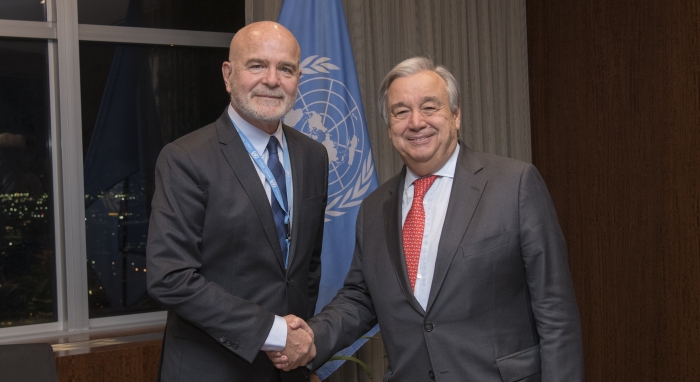
An exceptionally large group of 131 national and international NGOs (for list see: http://www.ishr.ch/sites/default/files/documents/190909_criteria_jt_letter_sr_on_hrds_signatories.pdf) have set out the criteria that should be at the heart of the selection of the next UN Special Rapporteur on the situation of human rights defenders. As Michel Forst’s term as mandate holder comes to an end, candidates have until 17 October 2019 to submit their applications for the position. (If your organisation would like to endorse the criteria, please sign on here)
The document sets out the skills and expertise that should be taken into account in the appointment of the next expert in March 2020. These fit under 4 priorities:
The document also provides information on the application process, and underlines the importance of independence and impartiality, as well as experience or knowledge of the realities faced by human rights defenders.
ISHR’s Programme Manager Helen Nolan stated: ‘Human rights defenders who are most at risk around the world are often persons with discriminated identities or from communities that are marginalised, so the Special Rapporteur should be able to consider the particular contexts and challenges faced by these individuals and groups with the benefit of insights from the mandate holder’s personal experience’.
The checklist is available here.
As usual the International Service for Human Rights has come out with an excellent preview of key issues on the agenda of the 42nd session of the UN Human Rights Council, starting on Monday 9 September 2019. And – also as usual – I provide here an extract of the key elements affecting human rights defenders more directly. The 42nd session will consider issues such as reprisals, indigenous peoples, death penalty, arbitrary detention and enforced disappearances. To stay up-to-date on the whole session: follow @ISHRglobal and #HRC42 on Twitter. Side events will the subject of a separate post.
On 18 September, the ASG for Human Rights will present his annual Reprisals Report (report on the cooperation with the United Nations) in his capacity as UN senior official on reprisals. [see https://humanrightsdefenders.blog/2016/10/05/assistant-secretary-general-andrew-gilmour-appointed-as-the-uns-focal-point-to-combat-reprisals-against-human-rights-defenders/]
It will be interesting to see the difference with the first such interactive dialogue in September 2018 [https://humanrightsdefenders.blog/2018/10/05/no-naming-and-shaming-on-reprisals-at-39th-human-right-council-session/]. Ghana, Fiji, Hungary, Ireland and Uruguay will present a draft resolution at this session which aims to strengthen the responses by the UN and States to end to acts of intimidation and reprisals.
The ISHR states that reports of cases of reprisals against those cooperating or seeking to cooperate with the UN not only continue, but grow. [see in this context one of my earliest posts, still sadly relevant: https://humanrightsdefenders.blog/2014/03/13/zero-tolerance-for-states-that-take-reprisals-against-hrds-lets-up-the-ante/]..
The Council will consider on 13 September two reports on the death penalty: the report of the UN Secretary General on capital punishment and the implementation of the safeguards guaranteeing protection of the rights of those facing the death penalty, and the summary report of OHCHR on the biennial high-level panel discussion on human rights violations related to the use of the death penalty, in particular with respect to the rights to non-discrimination and equality. The Council will also consider a resolution on the issue.
The Council will hold dedicated debates and consider the reports of several mandates relating to civil, political, economic, social and cultural rights, such as:
China: The harassment, surveillance, and mass detention of more than one million Uyghurs and other Turkic Muslims in the People’s Republic of China continues to be the most pressing issue with regards to China for the international community to address.
At the same time, China has continued its crackdown on human rights activists: Jiang Tianyong a victim of reprisals for his engagement with UN experts, has been ‘free’ for six months, but remains under heavy-handed surveillance. Citizen journalist Huang Qi was sentenced to 12 years, despite serious health concerns.[https://humanrightsdefenders.blog/2019/07/30/chinas-cyber-dissident-huang-qi-get-12-years-jail/]. Grassroots activist Ji Sizun died in custody [https://humanrightsdefenders.blog/2019/07/15/in-memoriam-chinese-human-rights-defender-ji-sizun/] while Chen Jianfang, recipient of the Cao Shunli award, is being held incommunicado in an unknown location. [https://humanrightsdefenders.blog/2016/02/12/cao-shunli-a-profile-and-new-award-in-her-name/]
Saudi Arabia: The September session provides an invaluable opportunity for the Council and States to follow up on the joint statement delivered on behalf of 36 States by Iceland [https://humanrightsdefenders.blog/2019/07/22/why-iceland-led-the-un-resolution-on-the-philippines/] During the June session, a broad range of cross-regional States called for accountability and guarantees of non-recurrence during the discussion of the Special Rapporteur on extrajudicial, summary or arbitrary executions’ report on the killing of Saudi journalist Jamal Khashoggi.
ISHR calls on States to advancing a HRC resolution establishing a monitoring mechanism over the human rights violations in the country and calling explicitly for the immediate and unconditional release of the detained Saudi women human rights defenders and to drop all charges against them.
Egypt: ISHR remains deeply concerned about the situation of human rights defenders in Egypt ..ISHR recalls that defenders who engaged with Egypt’s UPR in 2014 have since then faced travel bans, closure of NGOs, assets freezing, and are facing up to 25 years imprisonment in the ‘NGO Foreign Funding case no. 173.’ ISHR also recalls that individuals and communities who engaged with the Special Rapporteur on the right to housing during her visit in September 2018 faced systematic reprisals. [see also: https://humanrightsdefenders.blog/2019/08/21/un-pulls-anti-torture-conference-from-egypt-to-seek-other-regional-venue/]
Venezuela: Several Venezuelan human rights organisations and international NGOs think are calling on States to create an investigation. On 10 September, the High Commissioner is scheduled to provide an update to the Council, as a follow up to her report delivered in July. She is expected to outline further deterioration in the situation in the country.
Burundi: The Commission of Inquiry on Burundi will present its oral briefing on 17 September. Burundi continues to refuse to cooperate with the Council’s mechanisms. ISHR calls on States to renew the mandate of the Commission of Inquiry.
The Burundian Government suspended one of the last remaining independent civil society organisations (PARCEM), suspended the operating license of the Voice of America, revoked the license of the BBC, and forced at least 30 international non-governmental organisations to cease their activities. On 17 July 2019, the Ntahangwa Court of Appeal upheld the 32-year prison sentence against HRD Germain Rukuki. [see also: https://humanrightsdefenders.blog/2019/03/29/ngo-statement-condemns-new-irregularities-in-the-case-of-germain-rukuki-burundi/]
Interactive dialogue with the Special Rapporteur on Myanmar and the international fact-finding mission on the situation of human rights of Rohingya Muslims and other minorities in Myanmar on 17 September as well as the presentation of the report of the Independent Investigative Mechanism on Myanmar on 10 September. Among other things, the FFM sheds light on the economic interests of Myanmar’s military and the strong connections between the Tatmadaw and businesses and investors.
Enhanced interactive dialogue on the report of the High Commissioner on the human rights situation in Nicaragua on 10 September
Interactive dialogue on the oral update by the Commission on Human Rights in South Sudan on 16 September
Interactive dialogue on the updated written report of the Commission of Inquiry on Syria on 17 September
Interactive dialogue with the High Commissioner on the situation of human rights in Ukraine on 24 September
Interactive dialogue with the High Commissioner on the situation of human rights in Libya on 25 September
Adoption of Universal Periodic Review (UPR) reports: During this session, the Council will adopt the UPR working group reports on – inter alia – Albania, Côte d’Ivoire, the Democratic People’s Republic of Korea, the Democratic Republic of the Congo, Equatorial Guinea, Ethiopia, Nicaragua, and Qatar. ISHR supports human rights defenders in their interaction with the UPR. It publishes briefing papers regarding the situation facing human rights defenders in some States under review. This session of the Council will provide an opportunity for the Democratic Republic of the Congo and Côte d’Ivoire to accept recommendations made in relation to human rights defenders, as proposed in ISHR’s briefing papers.
The President of the Human Rights Council has proposed a candidate for the mandate of the Independent Expert on the situation of human rights in the Central African Republic.
At the organisational meeting the following resolutions were already announced (States sponsoring the resolution in brackets) which are especially relevant to HRDs :
——
https://www.ishr.ch/news/hrc42-key-issues-agenda-september-2019-session

