Archive for the 'FIDH' Category

Rich palette of side events at 41st Session of the UN Human Rights Council

June 21, 2019

The 41st session of the UN Human Rights Council is to start soon. In addition to items of the agenda [see https://humanrightsdefenders.blog/2019/06/14/guide-to-human-rights-defenders-issues-at-the-41st-human-rights-council-starting-on-24-june/] there are – as usual – many side events in Geneva, both by States and NGOs, that relate to human rights defenders. You can download the list of NGO events here.

Here a selection:

  • Launch of ISHR joint report on strengthening HRC membership on 1 July at 13:00 at the UN Delegates restaurant. Speakers will introduce the report and highlight some of the key challenges, opportunities and practical recommendations, including with regard to good practice relating to candidacy and membership of the HRC.
  • Promoting and Protecting Civic Space for Migrants and Refugees is organised by CIVICUS and Solidarity Center and will take place on 24 June at 12:00. This event will examine findings on civic space barriers for migrant/refugees in Germany, Jordan, Kenya, Malaysia and Mexico from a new report by Solidarity Center and CIVICUS; provide an analysis of some of the civic space trends for migrants/refugees across the five countries; and hear from civil society activists on the ground.
  • Health impacts for US Asylum is organised by Physicians for Human Rights (PHR) and will be held on 26 June at 10:00 in Room VIII. PHR will present findings from two reports about the asylum crisis in the United States with research based on forensic evaluations of more than 180 child asylum seekers regarding their trauma exposure in country of origin and reasons for fleeing, and documentation of cases where US immigration enforcement has impeded migrants access to emergency health care.
  • Defending rights online: Challenges facing human rights defenders and a free and open Internet is organised by Article 19 and will be held on 26 June at 15:30 in Room VIII. It will discuss what more States at the Human Rights Council can do to bolster safeguards for the protection of human rights online, while also holding States accountable for violations of those rights. The panelists include the Special Rapporteur on freedom of opinion and expression and human rights defenders from Russia, Mexico, Tanzania and Tajikistan. https://www.article19.org/resources/event-defending-online-civic-space-challenges-facing-human-rights-defenders/
  • Freedoms of expression, assembly, and association in Asia organised by Forum-Asia and will be held on 26 June 2019 at 15:00. This side event aims to discuss issues related to freedoms of expression, assembly, and association in Asian states.
  • Ending Impunity for Murdered Journalists: Enhancing the role and impact of the UN is organised by Article 19 and will be held on 27 June at 11:30 in Room VIII. The panelists include the Special Rapporteur on extrajudicial, summary or arbitrary executions, the Special Rapporteur on freedom of opinion and expression, and Hatice Cengiz, Fiancée of Jamal Khashoggi. It will examine how the UN’s response to cases of murdered journalists might be enhanced.
  • Criminalisation of solidarity in migration organised by the International Commission of Jurists (ICJ) and OHCHR, and will be held on 27 June in  Kazakh Room – Cinema XIV. The event will feature the screening of the movie “The Valley” by Nuno Escudeiro, documenting the situation of human rights defenders and migrants in South of France, with an introductory panel and a discussion session after the movie (THE VALLEY is a coproduction Point du Jour (France), Miramonte Film (Italy) and was awarded the Emerging international filmmaker at the HOT DOCS film festival, Toronto).
  • Women’s rights under attack: the case of Poland, organised by the International Federation for Human Rights (FIDH) and Human Rights Watch, will take place on 27 June, at 13:00 in Room XV. This side event will expose attempts to erode sexual and reproductive health and rights, campaigns against women’s rights organisations, and targeting of women’s rights activists – against the backdrop of a decline in the rule of law in the country. It will explore how international and regional organisations should address this concern in Poland and in the rest of the continent.
  • Needs, best practices and risks of research and data collection on sexual orientation and gender identity, organised by COC Nederland and sponsored by ISHR will be held on June 27 at 15:30 in Room V.
  • Human Rights in Kashmir is organised by the International Commission of Jurists and will be held on 28 June at 13:00 in Room XXI.
  • The human rights problem of political marginalisation is organised by Salam for Democracy and Human Rights (Bahrain) and CIVICUS, and will take place on 2 July at 12:00. Despite steadily rising levels of social and political marginalization in Bahrain, the government has sought to convey the appearance of political stability. In a context where freedoms of expression, peaceful assembly and association are severely restricted, what strategies can civil society – in Bahrain and in other countries around the world – bring into play to reduce political marginalisation?
  • The situation of migrants and refugees rights in Brazil is organised by Conectas and will be held on 2 July at 14h in Room VIII. The event will discuss the rights of migrants and refugees in Brazil focusing on the situation of Venezuelans refugees coming to the country, the reasons why they are leaving Venezuela and how Brazil is responding to this situation.
  • Human rights in Myanmar is organised by Physicians for Human Rights, and will be held on 1 July at 12:00 in Room VIII. PHR will provide an in-depth briefing on new research findings that reveal a painful, long-term legacy of the Rohingya Crisis and underscore the urgent need for accountability.
  • Human rights in Myanmar is organised by Forum Asia and will be held on 1 July 2019 at 14:30 in Room VIII. Human rights defenders and the Special Rapporteur on Myanmar will provide updates on the situation in the country since the last Council session.
  • Upholding the rule of law: The UN database on businesses operating in the OPT is organised by the Cairo Institute for Human Rights Studies and will be held on 5 July at 14:00 in Room VIII. More than three years following the establishment of the Database mandate pursuant to Human Rights Council Resolution 31/36– the results of this process are not being transmitted with the necessary transparency. The side event will focus on the importance of releasing the database as a public online platform of business enterprises engaged in business activities related to Israeli settlements.
  • Human rights in Sudan is organised by DefendDefenders and Physicians for Human Rights. It will be held on 8 July at 13:00 in Room XXIV. This event will bring Sudanese voices to the Council to speak about the situation in Sudan and the ongoing crackdown.
  • Human Rights in Venezuela is organised by the International Commission of Jurists and will be held on 8 July at 14:30 in Room IX.

Any others that come to my attebtion will be reported later.


NGO joint letter to UN Human Rights Council about Belarus

June 16, 2019
Five international human rights organisations (see below), urge the UN Human Rights Council to maintain scrutiny on the human rights situation in Belarus, including by ensuring the renewal of the mandate of the Special Rapporteur and seeking preventive measures to ensure against an increase in human rights violations ahead of upcoming Parliamentary and Presidential elections in Belarus.

NGOs urge Putin not to sign Russia’s “Sovereign Internet Bill”

April 28, 2019
Participants in an opposition rally in central Moscow protest against tightening state control over the internet in Russia, 10 March 2019
Participants in an opposition rally in central Moscow protest against tightening state control over the internet in Russia, 10 March 2019  Igor Russak/SOPA Images/LightRocket via Getty Images

On 24 April 2019 nine major human rights, media and Internet freedom NGOs, called on Russian President Vladmir Putin, not to sign the so-called “Sovereign Internet Bill” as it will lead to further limitations of already restricted Internet and media freedoms in the country.

The bill (No. 608767-7) amends the laws “On Communications” and “On Information, Information Technologies and Information Protection” and states its aim as enabling the Russian Internet to operate independently from the World Wide Web in the event of an emergency or foreign threat. On 16 April 2019, the Russian State Duma approved the bill in the third reading amid widespread domestic criticism, protests and online campaigning around the country, and on 22 April, the Federation Council, the upper house of the Russian parliament, approved it. If signed by President Vladimir Putin, the bill would enter into force on 1 November 2019.

The bill creates a system that gives the authorities the capacity to block access to parts of the Internet in Russia, potentially ranging from cutting access to particular Internet Service Providers (ISPs) through to cutting all access to the Internet throughout Russia.

The bill gives control over Internet network routing to the state regulator for Telecommunications, Information Technologies and Mass Communications, Roskomnadzor. It provides that the ISPs should connect with other ISPs, or “peer,” at Internet exchange points (IXes) approved by the authorities, and that these IXes should not allow unapproved ISPs to peer. The bill would also create a centralised system of devices capable of blocking Internet traffic. The bill requires ISPs to install the devices, which the government would provide free of charge, in their networks.

Under this system, Roskomnadzor would monitor threats to Russia’s Internet access and transmit instructions to ISPs through the special devices about countering these threats. Cross-border Internet traffic would be kept under close state control. The draft does not specify what the range of instructions would be, but they could potentially include partially or fully blocking traffic both between Russia and the rest of the World Wide Web, and within Russia. Nor does the draft explain how the new equipment will work, or what specifically it will do. It is clear, however, that blocking would result from direct interaction between the government and the ISP and that it will be extrajudicial and nontransparent. The public would not know what has been blocked and why.

The bill states that the new measures will be activated in the event of a ‘security threat’. The draft does not define security threats, and instead gives the government full discretion to decide what would constitute a security threat and what range of measures would be activated using the new system to address a threat.

The bill also states that Russian ISPs remain obligated to filter and block content in accordance with existing Russian law.

Further, the bill creates a national domain name system (DNS) – a system that acts as the address-book for the Internet by allowing anyone to look up the address of the server(s) hosting the URL of a website they are looking for. The bill would require Internet providers to start using the national DNS from 1 January 2021. Forcing ISPs to use the national system will give Russian authorities the ability to manipulate the results provided to the ISP outside the ISP’s knowledge and control. Authorities will be able to answer any user’s request for a website address with either a fake address or no address at all. This not only allows them to conduct fine-grained censorship but will also let the national DNS to redirect users to government-controlled servers in response to any DNS requests instead of to a website’s authentic servers.

These proposals are very broad, overly vague, and vest in the government unlimited and opaque discretion to define threats. They carry serious risks to the security and safety of commercial and private users and undermine the rights to freedom of expression, access to information and media freedom.

The bill contravenes standards on freedom of expression and privacy protected by the International Covenant on Civil and Political Rights (ICCPR) and the European Convention on Human Rights (ECHR), to which Russia is a party. Both treaties allow states to limit freedoms to protect national security but impose clear criteria for such limitations to be valid. The UN Special Rapporteur on freedom of expression, commenting on the ICCPR, has reiterated that these limits should be “provided by law, which is clear and accessible to everyone,” and be predictable and transparent.

Human Rights Watch, ARTICLE 19 and other undersigned organisations are extremely concerned that the changes introduced in the bill threaten human rights and freedoms in Russia. Open, secure and reliable connectivity is essential for human rights online, including the rights to freedom of expression, information, assembly, privacy and media freedom. The bill could pose a threat to the Internet’s rights-enabling features if access to the World Wide Web is wholly or partially cut off, or if arbitrary blocking and filtering of content is carried out. It would facilitate state surveillance and curb anonymity online. It also risks severely isolating people in Russia from the rest of the world, limiting access to information and constraining attempts at collective action and public protest. The Bill’s negative impact on the freedom of expression will also affect the rights of journalists and media to work freely.

The adoption of the bill should be seen in the context of other Russian legislation that severely undermines protection of freedom of expression and privacy online and fails to meet international human rights standards. These include:

. The 2016 ‘Yarovaya Law,’ which requires all communications providers and Internet operators to store metadata about their users’ communications activities, to disclose decryption keys at the security services’ request, and to use only encryption methods approved by the Russian government. It was adopted to allegedly counter ‘extremism’ but in practice, it creates a backdoor for Russia’s security agents to access Internet users’ data, traffic, and communications.

. In 2017, Federal Law 327-FZ made amendments to the ‘Lugovoi Law’ (Federal Law FZ-398, 2013) that gave the General Prosecutor or his/her deputies a right to block access to any online resource of a foreign or international NGOs designated ‘undesirable’; and, to ‘information providing methods to access’ the resources enumerated in the ‘Lugovoi Law’, i.e. including hyper-links to old announcements on public rallies not approved by local authorities.

. The recent March 2019 bills mandate blocking and penalizing websites that publish what authorities deem to be “fake news” and “insult” to authorities, state symbols, and what the legislation vaguely describes as Russian “society.”

The President of the Russian Federation should reject the bill. The Russian Government should also review other Internet related legislation, abolish the above listed laws and bring its legal framework to full compliance with international freedom of expression standards.

ARTICLE 19

Civil Rights Defenders

Committee to Protect Journalists

Human Rights Watch

International Federation for Human Rights (FIDH)

International Media Support

International Partnership for Human Rights

Norwegian Helsinki Committee

PEN International

Reporters without Borders

https://www.ifex.org/russia/2019/04/24/sovereign-internet-bill/

https://www.hrw.org/news/2019/04/24/joint-statement-russias-sovereign-internet-bill

FIDH dares to publish a report on ‘key human rights issues of concern’ in Kashmir

March 17, 2019

On 15 March 2019 the International Federation for Human Rights and its partner organizations Association of Parents of Disappeared Persons (APDP) and Jammu Kashmir Coalition of Civil Society (JKCCS) published a briefing note detailing key human rights issues of concern in Indian-administered Jammu & Kashmir. I use the term dare in the title as wading in to the issue of Jammu and Kashmir is always tricky and leads to furious reactions from governments and media.

Human rights violations began to be formally reported in Indian-administered Jammu & Kashmir in 1990 in the midst of counter-insurgency operations by the Indian Army to contain an armed struggle against Indian rule. These military operations were marked by excessive and disproportionate use of force. Since 1990, more than 70,000 people have been killed, more than 8,000 have been subjected to enforced disappearances, several thousands have been arrested and detained under repressive laws, and torture and other acts of inhuman and degrading treatment against protestors and detainees have been routinely used by Indian security forces.

ILLUSTRATION: MIR SUHAIL QADRI.

The NGOs have demanded full and unfettered access to Jammu & Kashmir to UN bodies and representatives, foreign and domestic human rights organizations, and foreign and local journalists. The groups also called for establishing a Commission of Inquiry to investigate allegations of all human rights violations perpetrated in Jammu & Kashmir, as recommended in the report by the UN Office of the High Commissioner for Human Rights (OHCHR) and the establishment of a mechanism to monitor the human rights situation in Jammu & Kashmir through diplomatic missions in New Delhi and Islamabad.

The note details “continuing crime of enforced disappearance, extrajudicial killings, torture used as punitive action, systematic impunity for grave crimes, use of arbitrary and administrative detentions to curb dissent, military operations threatening human rights, rights to freedoms of expression, freedom of association, and freedom of religion or belief being curbed, human rights defenders under threat, sexual violence used a tool of repressions, lack of safeguards continue to place children in danger,” among other crimes.

See also: https://humanrightsdefenders.blog/2017/09/30/parveena-ahangar-and-parvez-imroz-in-kashmir-awarded-rafto-prize-2017/

Duterte: there is no ‘war’ on human rights defenders – only on criminals

March 2, 2019

Gillan Ropero, ABS-CBN News, reported on 28 February 2019 that the Malacañang Palace on Thursday slammed as a “rehash of old issues” the latest report of The Observatory for the Protection of Human Rights Defenders alleging that President Rodrigo Duterte was waging war against human rights defenders: While it is true that the President’s words may be hurtful to some quarters, including human rights defenders, they are actually zeroed in on those who mock and derail the President’s efforts towards creating a society free from drugs, crime and corruption,” ,,,,”We reiterate that there is no such thing as a war against human rights defenders. There is only one against criminals, including drug pushers, and their protectors.”

In its 40-page report, the Observatory said at least 76 land and environmental rights defenders, 12 journalists, and 8 labor rights activists were murdered from July 2016, when Duterte ascended to power, to November 2018. The title is: “Philippines: I’ll kill you along with drug addicts – President Duterte’s war on human rights defenders in the Philippines”. [see also https://humanrightsdefenders.blog/2018/03/10/there-seems-to-be-no-limit-to-what-duterte-is-willing-to-say-and-may-get-away-with/]

The report also cited government’s alleged harassment of the Commission on Human Rights and the justice department’s pursuit of criminal charges against a number of Duterte’s political opponents who have taken strong pro-human rights views, such as Sen. Leila de Lima, currently detained on drug charges.

Spokesperson Panelo urged the International Federation for Human Rights (FIDH) and World Organization Against Torture (OMCT) to file their cases against the Philippine government to “settle this matter once and for all.” “File all cases and let’s be done with it. In the absence of this, the allegations will remain unfounded and politically motivated untruths aimed at shaming the Philippine government before the international community,” he said. “Sans this, the report is but recycled rubbish based on information peddled by the usual critiques of government, such as Karapatan, who must do so to remain relevant and to generate funds to exist from gullible sources abroad.

The President is facing complaints at the International Criminal Court over the drug war killings. He has ordered the country’s withdrawal from the tribunal.

http://www.omct.org/human-rights-defenders/reports-and-publications/philippines/2019/02/d25257/

:https://thedailyguardian.net/opinion/red-tagging-a-vicious-form-of-fake-news/

https://news.abs-cbn.com/news/02/28/19/palace-no-such-thing-as-war-vs-human-rights-defenders

https://aliran.com/civil-society-voices/casualties-rise-in-dutertes-war-on-rights-defenders-new-report/

Iranian Human Rights Defenders in trouble

September 27, 2018
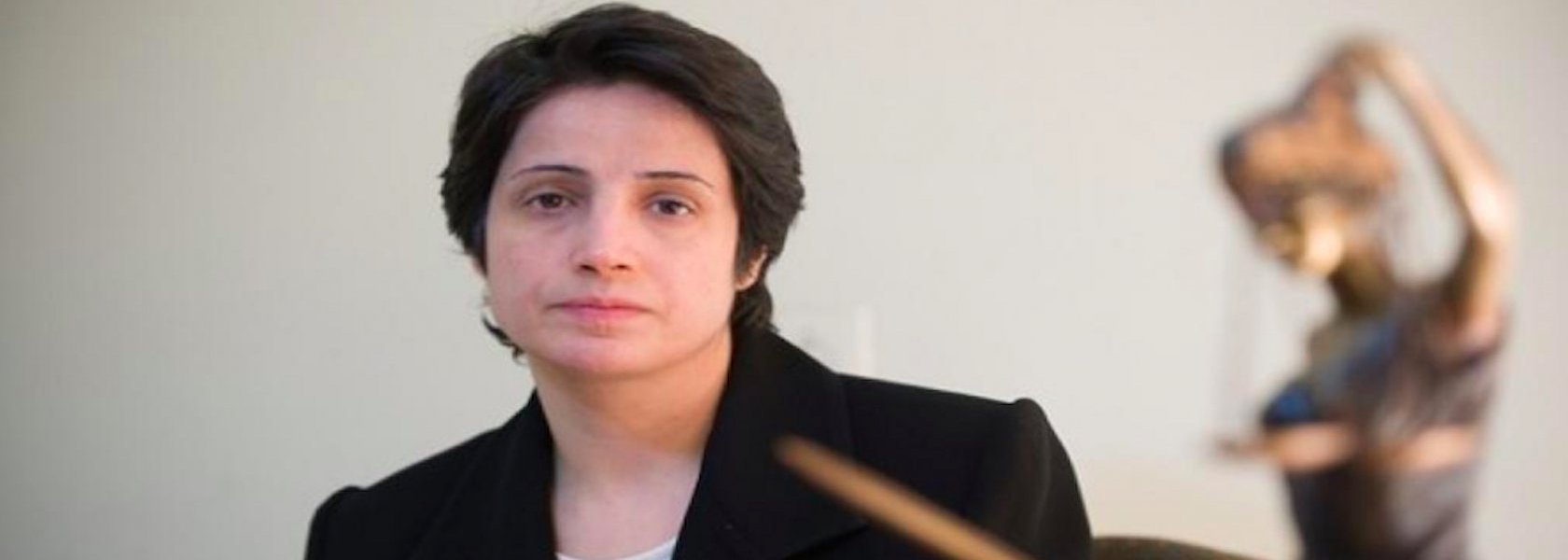
On 21 September 2018 the Observatory for the Protection of Human Rights Defenders (FIDH/ OMCT) petitioned the United Nations Working Group on Arbitrary Detention (WGAD) to seek the release of Iranian human rights lawyer Ms. Nasrin Sotoudeh. Ms. Nasrin Sotoudeh, a prominent defender and 2012 laureate of the European Parliament’s Sakharov Prize, was arrested on June 13, 2018 at her home in Tehran. [see: https://humanrightsdefenders.blog/2018/08/30/human-rights-defender-nasrin-sotoudeh-on-hunger-strike-in-iran/ ].. On September 16, 2018, Ms. Sotoudeh was informed that she would be denied her family visitation rights if she and her female visitors – including her daughter – did not wear a full hijab. Ms Sotoudeh has refused the condition and was denied the right to see her daughter on September 17, 2018.
The Observatory urges the Iranian authorities to immediately and unconditionally release Ms. Sotoudeh and to cease all acts of harassment and other abuses against her and all human rights defenders in Iran, in accordance with the provisions of the United Nations Declaration on Human Rights Defenders and with international human rights standards and international instruments to which Iran is a State party.

The semi-official ISNA news agency reported on Thursday 27 September that another human rights defender, Narges Mohammadi, has been granted a three-day leave from prison to visit her ailing father.

However, the recent terror attack in Iran may be expected to prompt the Guards to compensate by cracking down on domestic detractors and perceived opponents of their mission of defending and principles of the Islamic revolution. Certainly, some prominent figures within the Iranian activist and expatriate communities have been quick to raise alarms about the likelihood of this outcome. For instance, the Center for Human Rights in Iran quoted the Iranian human rights activist and Nobel Peace laureate Shirin Ebadi as saying of last Saturday’s attack, “Such actions lead to the justification of state violence and the arrest of many opponents in the name of fighting terrorism.” Meanwhile activists echoed the sentiment, saying, “Terrorism and violence in any form should be condemned in the strongest terms [but] such acts of violence should not become an excuse for state violence to suppress peaceful opposition.

FIDH collected Russia’s 50 anti-democracy laws

March 18, 2018
 

Since re-election in 2012, the Russian president has overseen the creation of 50 laws designed to strangle opposition voices and raise the level of fear and self-censorship in society. FIDH with its Russian member organizations released a table of the latest 50 new anti-democracy laws since 2012. It explains the impact of each of them on the fundamental freedoms of Russian citizens, cutting down every day a little bit more the free exchanges with the outside world. It also provides some, far from exhaustive examples of the legal abuses it provokes in the every day life of citizens.

Not only the present but also the past gets filtered and controlled.

The laws and regulations range from increased surveillance and censorship powers, to laws banning “questioning the integrity of the Russian nation” – effectively banning criticism of Russia’s presence in Eastern Ukraine and the Crimea – broad laws on “extremism” that grant authorities powers to crack down on political and religious freedom, to imposing certain views on Russian history forbidding to think differently.

CHECK OUT THE TABLE OF LAWS

FIDH looks back at 2017 with its annual comic strip

February 1, 2018

On 30 January 2018, FIDH publishes the comic strip version of its Annual Report created by graphic artist Romain Ronzeau and the graphic artists from Cartooning for Peace. Illustrating some of the victories and battles of 2017, the artists eloquently convey the essential: in times of crises, defending human rights is more necessary than ever. [for last year’s see: https://humanrightsdefenders.blog/2017/03/28/fidh-looks-back-at-2016-in-comic-strip/]. Good to see that the tradition is being kept up!

On the occasion of the comic strip Annual Report’s release, FIDH reaffirms its support for all graphic artists and caricaturists who are subjected to threats and attacks on a daily basis.


for the full version see: https://www.fidh.org/en/impacts/fidh-looks-back-at-2017-in-our-traditional-comic-strip

Side event on human rights defenders working on Business and Human Rights issues

November 23, 2017

This side event will take place during the UN Forum on Business and Human Rights. The event will bring together multiple stakeholders to discuss how to remedy, redress and prevent attacks against human rights defenders working on business and human rights.

Antoine Bernard has left FIDH after 26 years

October 12, 2017

For those of you (like me) who missed the rather sudden departure of Antoine Bernard as head of the FIDH (International Federation for Human Rights), here is the 12 September statement called “Farewell Antoine” as seen on the FIDH website:

“Antoine Bernard is stepping down as Chief Executive Officer of the FIDH International Secretariat on September 15 after serving the organisation for 26 years. Antoine established and steered the International Secretariat, playing a fundamental role in the development and expansion of FIDH. Under his guidance, the organisation engaged in innovative and pioneering operations in the world of defending human rights. 
The numerous victories he contributed to include the 1998 adoption of the United Nations Declaration on Human Rights Defenders; the 2002 establishment of the International Criminal Court (ICC) and the mobilisation that led to the ICC sentencing of Jean-Pierre Bemba in 2016, which was the first verdict to recognise rape as a crime against humanity and to hold those effectively in command responsible; the identifying of corporate responsibility on the part of economic players and their criminal prosecution as well as dialogue with some companies to encourage them to develop and assume their social responsibility; lastly, his work at FIDH, including in recent months, to usher in digital communication, to counter attacks aimed at delegitimising human rights, to organise the decentralisation of our organisation and to create transparent and faithful partnerships. FIDH is immensely grateful to Antoine for his tireless optimism, his audacity and tenacity, and the passion that he has for our organisation, serving and supporting FIDH member organisations and their defenders. 
He is an iconic figure in the worldwide human rights movement. He embodies the patience that is needed for universal, steadfast commitment to practical and concrete progress, as well as a single-minded pursuit of justice and the audacity that this requires. 
Following the departure of Antoine, a transition management team is being set up headed by Juliane Falloux, FIDH Executive Director.”

Source: Farewell Antoine