Hans Thoolen on Human Rights Defenders and their awards

share information on human rights defenders, with special focus on human rights awards and laureates


Archive for the 'AI' Category

« Older posts
Newer posts »

Afghanistan: human rights defenders targeted but fearless

November 26, 2019
On 25 November 2019 Amnesty International said that Afghanistan’s top intelligence agency must immediately release two human rights defenders it detained after they exposed alleged sexual abuse against children. Musa Mahmudi and Ehsanullah Hamidi, both well-known human rights defenders from Logar province, were arbitrarily detained by the National Directorate of Security (NDS) on 21 November 2019 when they were on their way to meet with the European Union ambassador in Kabul.

The two human rights defenders began receiving threats, including from local officials in Logar, on Facebook after they gave interviews to The Guardian and Afghanistan’s TOLO News about the existence of a paedophile ring in the area. The human rights defenders uncovered more than 100 videos of the alleged abuse. Some of the victims of abuse have been murdered, according to The Guardian. “This is the latest case where human rights defenders have been targeted by the authorities for carrying out their important work. Faced with threats from both the state and non-state actors, they are operating in some of the most hazardous conditions anywhere in the world. There is impunity for attacks on these brave defenders, who have little to no protection.”

One day before he disappeared, Musa Mahmudi told a fellow Afghan human rights defender that he feared for his safety and that the NDS was planning to arrest him. He added that he was worried that he was under surveillance. Musa Mahmudi said that he had also received death threats, accusing him of “dishonouring the people of Logar.” In August 2019, Amnesty International published a briefing entitled, “Defenceless Defenders: Attacks on Afghanistan’s Human Rights Community,” where the organization detailed how the Afghan government has persistently failed to investigate attacks on human rights defenders – sometimes accusing them of ‘fabricating’ their claims, declining to offer them protection; telling them to arm themselves instead. [on 26 november: https://www.rferl.org/a/afghan-president-orders-probe-into-alleged-pedophile-ring/30293787.html] and then; https://www.rferl.org/a/afghanistan-releases-activists-who-exposed-alleged-pedophile-ring/30294906.html

The same day AI continued with its series of 16 omen human rights defenders from Afghanistan in the context of the “16 Days of Activism against Gender-Based Violence” campaign [see: https://humanrightsdefenders.blog/2019/11/19/16-days-of-activism-against-gender-based-violence-start-on-25-november-2019/]. Untill December 10, their stories will be published one a day.

Day two: Maria Raheen

I am the director of the Journalism and Mass Communication Unit at Balkh University. I also head a non-governmental organization that works on human rights. For 20 years, as a women’s rights activist, I have pushed to address issues that prevent women from accessing their rights, not only in Balkh but also in other neighbouring provinces such as Samangan, Jowzjan, and Faryab.

One of my achievements is the establishment of the first private university in Balkh – Taj Higher Education Institute, which offers medicine, economy and law. Similar to Kabul, Herat and Kandahar, Balkh has some developments and achievements in terms of women’s rights. However, the province is still well known for the presence of armed groups, the local mafia and warlords, who have no respect for human rights. Due to existing challenges and the weak rule of law, self-censorship is embedded in the day-to-day lives of people in Balkh.

I am no stranger to tolerating injustices, especially when it is a matter of saving my life and my family’s lives. It gets challenging especially when it involves former war commanders who are now elected representatives of the area and, who would not hesitate to exert their power to commit crimes.

I hope in future like-minded women will join hands for the women’s revolution in Afghanistan, to reclaim the rights that we are entitled to.

Day one: Khawar Amiri

I am the Head of the Literacy Department of the Directorate of Education in Khost Province and have worked for many years as a mediator for women’s issues. As most women of Khost Province are illiterate, and some districts are yet to establish schools for girls, through the Literacy Department, I have conducted courses for women and girls above the age of 14 to enable their basic reading and writing skills. As a well-known human rights defender, I have worked in solving many of women’s issues through the Committee on Elimination of Violence against Women and tribal Jirgas (councils), with help of the police.

Women in Khost are exposed to discrimination and violence. Girls’ education is till grade six, after which they are sent off to marriage or asked to stay home. Forced marriages, being sold off, physical violence, lack of access to inheritance rights are some of the issues women face on daily basis.  Women don’t work in government posts in Khost, as most of the positions are held by men. Women are discouraged from applying for government positions as their posts are given to men and justified with unlawful reasons for not being appointed.

I have intervened in many cases of women being abused, sometimes solving the case with the help of local elders and at times through direct mediation. One of my biggest successes is organizing a Master’s Degree programme for women in Khost to study in India, funded by the US Embassy. Despite being threatened and attacked, I am continuing my activism.

I hope women are independent, have security, and have equal opportunities for studies, get to live a life free from violence. 

You can send a solidarity message to all of the 16 WHRDs in Afghanistan, or any one of them, and let them know that they are not alone. Please email your thoughts in a personal message to AfghanDefenders@amnesty.org and AI will share them with the activists.

https://www.amnesty.org/en/latest/news/2019/11/afghanistan-release-hrds-now/

https://www.amnesty.org/en/latest/news/2019/11/16-days-of-activism-afghanistan-whrds/

Posted in AI, Amnesty international, EU, Human Rights Defenders | 2 Comments »
Tags: 16 Days Campaign Against Gender Based Violence, Afghanistan, Amnesty International, arbitrary arrest, attacks, Ehsanullah Hamidi, EU, international campaign, Maria Raheen, Musa Mahmudi, sexual abuse against children, threats, women human rights defenders

How human-rights defender Idris Khattak went ‘missing’ in Pakistan

November 25, 2019

On 23 November 2019 Francesca Marino, in a personal blog post in the New Kerala wrote a short story “How human-rights activist Idris Khattak went ‘missing’ in Pakistan“. It reads like the scenario for a film but it is the horrible truth:

November 13, on the Islamabad-Peshawar motorway. It is around five o’clock in the afternoon, there’s a long queue at the toll plaza. The man and his driver are stuck in the queue like many others. An ordinary afternoon in an ordinary day, it seems. But there’s nothing ordinary in what’s going to happen. The moment the car stops at the toll plaza to pay the fare, a couple of guys in plain clothes approach the car forcing the two men to go out. The man and his driver are handcuffed, their faces covered with masks and they are thrown into another car. Nobody complains nobody says anything. The people at toll plaza let the car go without any payment. An ordinary afternoon, in an ordinary day. In a couple of minutes, the void replaces the space occupied by the two men. The void, an ordinary entity in today’s Pakistan. The man taken by the ‘unknown’ people in plain clothes is Idris Khattak, and is not an ordinary man. Because fighting for the rights of citizens, in Pakistan, is not an ordinary thing to do. Not anymore.

Idris had worked for Amnesty International and for Human Rights Watch on various human rights issues including, ironically, the issue of enforced disappearances in the country. His last post on Facebook, before he disappeared, was in fact on disappearances that, according to Amnesty International and other international organisations has become a common practice in Pakistan in the last few years.

Idris is an easy target. He has been an active member of left-wing politics and progressive circles since his student days and an important member of the Democratic Student Federation. Lately, he joined the National Party, serving as its General Secretary in Khyber Pakhtunkhwa. The usual ‘unknowns’ had called him many times in the past threatening him and ‘gently advising’ him not to cross the limits in criticising the military.

A couple of days later, another lot of people in plain clothes shows up at Idris’ house. They tell the family they are children of Idris’ friends and need to take his laptop and his hard disk. They call a number Idris is on the phone, telling his family to give laptop and hard disks to the guys. Just this and the call is cut.

Meanwhile, after three days, the driver reappeared. He is shaken and terrified. He has been kept for three days in a basement, with his warden telling him he was clear and would be released soon. During those three days, he never saw Idris and has no idea of what happened to him.

An FIR and a habeas corpus have been filed in Peshawar High Court by Latif Afridi Advocate, but unfortunately is not going to make any difference. The rule of law, in this case like in many other cases before Idris, counts nothing.
 Reading from the latest Amnesty Report “The groups and individuals targeted in enforced disappearances in Pakistan include people from Sindhi, Baloch, Pashtun ethnicities, the Shia community, political activists, human rights defenders, members and supporters of religious and nationalist groups, suspected members of armed groups, and proscribed religious and political organisations in Pakistan. In some cases, persons are openly taken into custody by the police or intelligence agencies, and families trying to find out where they are held are denied information by the authorities. Some victims are eventually released or their whereabouts are disclosed to their families but they continue to be held in arbitrary detention including in internment camps. Those forcibly disappeared are also at risk of torture and death during captivity.”

The bloggers, who disappeared a few years ago, have been brutally tortured and still carry physical and mental symptoms related to their detention. According to Amnesty International “The disappeared are at risk of torture and even death. If they are released, the physical and psychological scars endure. Disappearances are a tool of terror that strikes not just individuals or families, but entire societies. Enforced disappearance is a crime under international law and, if committed as part of a widespread or systematic attack, they constitute a crime against humanity”.

Defence of Human Rights, a non-governmental organisation working for the recovery of disappeared people, laments that more than 5,000 cases of enforced disappearance have remained unresolved till date in Pakistan.
 According to the International Commission of Jurists (ICJ), the Commission of Inquiry on Enforced Disappearance established in 2011 under international pressure hasn’t made any significant progress. The ICJ says the practice of enforced disappearances in Pakistan is no longer restricted to conflict zones alone. “It has become a tactic for suppressing dissenting voices wherever they are present.” Adding that “The practice has now become a national phenomenon” in Naya Pakistan.

Ironically, Imran Khan had committed to criminalise the practice of enforced disappearances under his government; useless to say, nothing has been done. And to add insult to irony, the Minister for Human Rights Shireen Mazari has stated that the government wants to sign the International Convention for Protection of All Persons from Enforced Disappearances. Meanwhile, the practice continues and the impunity and the arrogance of ISI and its thugs grow every day. Grows like the void, the void left where they were people once. And dreams, and hopes. The dreams and hopes to live in a civilised country, where dissent and protests are part of the democratic process and citizens have civil and human rights. An ordinary country.

https://www.newkerala.com/news/read/252635/how-human-rights-activist-idris-khattak-went-missing-in-pakistan.html

Posted in AI, Human Rights Defenders, ICJ | 1 Comment »
Tags: AI, disappearance, Francesca Marino, Human rights defender, ICJ, Idris Khattak, New Kerala, Pakistan, unlawful arrest

Amnesty’s Write for Rights Campaign 2019 – launched today – focuses on youth activists

November 18, 2019
On 18 November 2019 Amnesty International launched its Write for Rights campaign which this year champions children’s rights and youth activists. “This year Write for Rights, Amnesty’s flagship human rights campaign, champions youth activists who are taking on the world’s biggest crises,” said Kumi Naidoo, Secretary General of Amnesty International. “From those campaigning for climate and environmental justice, to those challenging inequality, poverty, discrimination and political repression, young people have emerged as a powerful force for change who deserve the world’s support.”

Every December people around the world write millions of letters, emails, tweets, Facebook posts and postcards for those whose human rights are under attack, in what has become the world’s biggest human rights event.  Amnesty International is hoping to break last year’s Write for Rights record of nearly six million messages of support for activists and individuals from 10 countries whose human rights are under attack. [for last year’s campaign see: https://humanrightsdefenders.blog/2018/11/24/amnesty-starts-again-its-write-for-rights-campaign/]

Write for Rights 2019 features youth human rights defenders and individuals from in Belarus, Canada, China, Egypt, Greece, Iran, Mexico, Nigeria, Philippines and South Sudan.

Launching two days ahead of Universal Children’s Day on 20 November, a day to promote children’s rights, several of the featured activists had their rights violated as children.

They include José Adrián, who was 14 when he was brutally beaten by police on his way home from school in Mexico. He is now demanding reparations for his treatment and for the police to stop arbitrary detentions in the state of Yucatán. Among the other cases are:

  • Grassy Narrows Youth, a group of youth activists from an Indigenous community in north-western Ontario who have suffered one of Canada’s worst health crises. Their community has been devastated by 50 years of mercury contamination of their fish and river system. The Grassy Narrows youth are urging the government to address the mercury crisis once and for all, including by providing specialized health care and compensation for all;
  • Sarah Mardini and Seán Binder, two volunteer rescue workers from in Lesvos, Greece, who face up to 25 years in prison for their humanitarian work helping spot refugee boats in distress;
  • Yasaman Aryani, who defied her country’s discriminatory forced veiling laws and now must serve 10 years behind bars. Amnesty is campaigning for her immediate release;
  • Marinel Ubaldo, a youth activist from the Philippines who is urging her government to declare a climate emergency and protect future generations from the devastating impacts of climate change after her home was destroyed by typhoon Haiyan.

“The Write for Rights campaign epitomizes the ideals that Amnesty International was founded on – it’s about individuals helping other individuals. We are urging people to get behind these incredible young people who are campaigning for justice, equality and freedom,” said Kumi Naidoo.

“As we know from our work over the past five decades, writing letters works. Not only can it help free prisoners of conscience, but it makes a huge emotional difference to the people we support and to their loved ones.”

Monica Benício, the partner of Marielle Franco, a local politician in Brazil who was killed last year and was featured as part of the last Write for Rights, said of the campaign: “It helps me to get up in the morning and see some meaning, knowing that there is this big global network of affection.  All these demonstrations of love and affection are helping us to mobilize, to demand justice, to pressure for investigation and above all to fight so that there will be no more Marielles.”

https://www.amnesty.org/en/latest/news/2019/11/write-for-rights-2019-puts-youth-activism-in-the-spotlight/

Posted in AI, Amnesty international, Human Rights Defenders | 2 Comments »
Tags: Amnesty International, Canada, children, Grassy Narrows Youth, international campaign, José Adrián, Kumi Naidoo, Marielle Franco, Marinel Ubaldo, Mexico, Monica Benício, Philippines, Universal Children’s Day, Write for Rights campaign, Yasaman Aryani, youth

Celebrity endorsements and the Dubai Expo: on the one hand and the other

October 26, 2019

The New Arab Logo  of 24 October 2019 carries an interesting post written by Lyndon Peters, a specialist on UK – Middle East relations.

Why will.i.am and Mariah Carey should say 'no' to Dubai Expo 

Serial sinner, Mariah Carey [see e.g.: https://humanrightsdefenders.blog/2019/07/10/nicki-minaj-did-the-right-thing-and-cancelled-her-performance-in-saudi-arabia/] performed this week at the one-year countdown to Dubai Expo 2020.  Lyndon Peters argues that celebrities, businesses and governments still have time to take a stand against UAE’s human rights record, and pull their support from Dubai Expo 2020.

Sheikh Khalifa bin Zayed Al Nahyan proclaimed 2019 as the ‘Year of Tolerance’, but for many it has been the Year of Intolerance. So far this year, the situation for human rights defenders and political prisoners in the UAE has deteriorated. Over 135 human rights organisations issued a joint call last week for the release of human rights defender Ahmed Mansoor in solitary confinement at Al-Sadr prison, Abu Dhabi [https://humanrightsdefenders.blog/2019/10/01/ahmed-mansoor-goes-on-second-hunger-strike-after-severe-prison-beating/ ].

Nevertheless it seems “The World’s Greatest Show” will go on and with the help of Mariah Carey, will.i.am and Lionel Messi; Dubai Expo 2020 is not short of celebrity endorsements!

That the issue of celebrity endorsements is not an easy is clear [see also: https://humanrightsdefenders.blog/2019/07/11/star-power-and-human-rights-food-for-thought-by-kate-allen/] is clear considering that:
– The rapper will.i.am provides the voiceover on an Expo 2020 promotional video in which he reels off a series of great accomplishments in the history of human civilisation. On the other hand, in 2007 ‘will.i.am’, as part of the Black Eyed Peas, recorded a song for a charity album called Instant Karma: The Amnesty International Campaign to Save Darfur. Darfuris suffered massacres at the hands of Janjaweed militias. Rebranded as the RSF, former Janjaweed militias, are now a key ally of the UAE within Sudan itself, and have fought as mercenaries for the UAE and Saudi Arabia in Yemen and Libya.

– Meanwhile Lionel Messi is “Proud to be an Expo 2020 Dubai ambassador” and he features in a promotional video for the event. Still, in 2016 he donated $72,000 to the NGO Medicins Sans Frontieres (MSF). MSF have provided medical services in various parts of Yemen during the ongoing conflict, and their hospitals have been hit by the airstrikes of the Saudi coalition of which the UAE is a member.That Lionel Messi and will.i.am would promote an event on behalf of the UAE government is unfathomable, especially considering their previous support for Medecins Sans Frontieres and Amnesty International respectively, states Peters.

….

With one year until Dubai Expo 2020, there is still time for trade delegations to reconsider their attendance and for businesses to consider their human rights policies. There is also time for the UAE to stop violating the rights of their own citizens, enforce protections for migrant workers and cease the harmful interventions in Yemen, Libya and Sudan.

https://www.alaraby.co.uk/english/comment/2019/10/24/will-i-am-mariah-carey-should-say-no-to-dubai-expo

Posted in AI, Human Rights Defenders | 3 Comments »
Tags: Ahmed Mansoor, AI, Black Eyed Peas, Business and human rights, celebrities, Dubai Expo 2020, Lionel Messi, Lyndon Peters, Mariah Carey, MSF, music, star power, UAE, will.i.am

The State of the African Regional Human Rights Bodies and Mechanisms

October 21, 2019

This new Amnesty International report, to be published annually, will serve as a regular audit of the performance of the three regional human rights institutions in Africa: the African Commission; the African Child Rights Committee; and the African Court. Beginning with this inaugural review, it will be published every 21 October in commemoration of the adoption of the African Charter on this day in 1981.

African rights bodies are frustrated at every turn by the lack of cooperation and support from African Union (AU) member states who desperately try to undermine their independence and autonomy, according to a new report published by Amnesty International. The new report, The State of African Regional Human Rights Bodies and Mechanisms, found that the continent’s rights bodies are working in harsh conditions whereby their decisions are blatantly ignored and their pleas for proper funding and human resources persistently fall on deaf ears.

[see also: https://humanrightsdefenders.blog/2019/10/11/the-ngo-forum-and-the-65th-session-of-the-african-commission-on-human-and-peoples-rights/]

“Africa’s human rights bodies are being wilfully subverted. The African Union’s Executive Council must resist these efforts and take its responsibility to monitor and enforce compliance with the decisions of the human rights mechanisms seriously,” said Netsanet Belay, Amnesty International’s Director for Research and Advocacy.

The report offers an assessment of the performance of three of Africa’s regional human rights institutions between January 2018 and June 2019: the African Commission on Human and Peoples’ Rights (African Commission); the African Child Rights Committee; and the African Court.

It found that out of the continent’s 54 countries, five (Comoros, Equatorial Guinea, Guinea Bissau, Sao Tome and Principe and Somalia) have not submitted a single report on the human rights situation in their countries since they ratified the Africa Charter for Human and People’s Rights. Many countries that submitted their human rights reports to the African Commission during the reporting period did so after delays in excess of a decade. Gambia and Eritrea set records by submitting their reports 21 and 19 years late respectively.

In the timeframe in review, the African Commission sent 83 urgent appeals to states over concerns of human rights violations. Of these only 26 (31 percent) received a written response. The African Commission further requested 27 country visits, of which only 13 were authorized in principle, and just five materialized.

Despite facing many stubborn challenges, African human rights bodies registered a relatively impressive record in developing new norms and standards including developing a draft treaty on the rights to social protection and social security. The African Commission also published seminal studies on transitional justice and on human rights in conflicts. The African Court on Human and Peoples’ Rights (African Court) issued 25 decisions. However, only Burkina Faso had fully complied with the court’s decisions by the end of the reporting period. Some countries, including Tanzania, partially complied, while Cote d’Ivoire, Kenya, Libya and Rwanda didn’t comply at all.

“Both the African Commission and the African Court face a chronic backlog problem because of a slow pace in determining cases. They must urgently develop plans to speed up determinations and ensure strict adherence to time limits for parties, especially state parties,” said Netsanet Belay.

The report also highlights an onslaught on human rights defenders in Africa. Between January 2018 and June 2019, appeals for protection of HRDs accounted for 71 percent of all appeals issued to state parties by the African Commission. HRDs in the Democratic Republic of Congo (DRC) and Egypt were the worst hit, the Africa Commission issuing 11 and 10 urgent appeals respectively to their governments. These were closely followed by Burundi with seven urgent appeals, Cameroon and Algeria each with six, and Uganda and Sudan, each with five appeals.

It is extremely alarming that governments across Africa have singled out human rights defenders to try to silence them and bring an end to their activism through brutal attacks, harassment, unlawful arrest and detention. Attacks on human rights defenders are an attack on the rights of all the people whose freedoms they are fighting for.
Netsanet Belay, Amnesty International’s Director for Research and Advocacy

—–

https://www.amnesty.org/en/latest/news/2019/10/africa-states-frustrate-continental-rights-bodies-efforts-to-uphold-human-rights/

Posted in AI, books, human rights, Human Rights Defenders | 1 Comment »
Tags: African Commission on Human and Peoples' Rights, African Court on Human and Peoples Rights, african region, African Union, AI, Amnesty International, annual report, Netsanet Belay, regional court, regional mechanisms, reporting, The State of African Regional Human Rights Bodies and Mechanisms

Signatures for human rights: AI Indonesia partners with advertising company

September 14, 2019

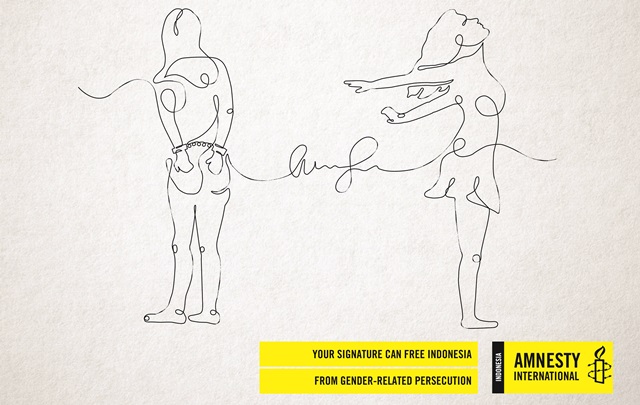
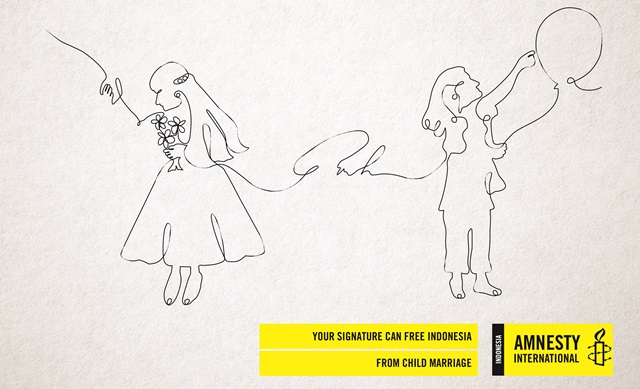
Human rights organisation Amnesty International Indonesia has launched a campaign to spread awareness about how a single signature can make a big contribution to ending human rights violations.

According to a press release, it has partnered Grey Indonesia to produce a series of posters that utilise the simplicity of single line illustrations to visually communicate the strength of signatures. The series highlight three human rights issues that “really matter” to Indonesia’s millennial segment – child marriage, gender-related persecution, and the suppression of freedom of expression.

“We at Amnesty International have witnessed how signatures can change people’s lives all over the world. With this campaign, we are hoping that Indonesian youth will recognise its power and start to take action for human rights,” said Sadika Hamid, Amnesty International Indonesia communications manager.

The posters are situated in the Amnesty International office and its immediate vicinity (Menteng, which is a popular hangout spot amongst the youth). They will also be placed near other touch points and locales familiar to Indonesian millennials, such as trains stations, art galleries and coffee shops, over the next few weeks.

Grey Indonesia ECD Patrick Miciano said: “Grey Indonesia believes in what Amnesty International stands for. It is a humbling experience to be able to collaborate with one the world’s biggest defenders of human rights.”

https://www.marketing-interactive.com/human-rights-body-amnesty-spotlights-the-power-of-signatures-through-illustrations/

Posted in AI, human rights, Human Rights Defenders | Leave a Comment »
Tags: advertisement, AI indonesia, Amnesty International, art, audiovisual communication, corporate activism, corporate social responsibility, drawings, Grey Indonesia, Indonesia, national campaign, Sadika Hamid

Zimbabwe: two years Emmerson Mnangagwa have shown little difference from Mugabe

August 26, 2019
Anna Chibamu, writing in the New Zimbabwe of 26 August 2019, summarises the latest report of Amnesty International which shows that President Emmerson Mnangagwa has shown little difference with his predecessor Robert Mugabe and his near-two year reign has been replete with human rights abuses. In a statement, AI deputy director for Southern Africa Muleya Mwanawanda said Mnangagwa’s administration, since taking charge following the removal of Mugabe and the subsequent general elections last year, has been marred by a systematic and brutal crackdown on human rights and a decline in socio-economic conditions. “What we have witnessed in Zimbabwe since President Emmerson Mnangagwa took power is a ruthless attack on human rights, with the rights to freedom of expression, peaceful assembly and association increasingly restricted and criminalised,” said the group.

Amnesty International said it has documented at least 15 killings by police when nationwide protests erupted mid-January this year and last week, 128 protesters were reportedly arrested with 400 having been convicted in the disturbances that rocked the country early this year. To date, the human rights organisation said 22 people including Evan Mawarire, a well-known local cleric and activist, and trade union leader Peter Mutasa – still face trumped-up subversion charges in connection with the protests. Some of the activists and human rights defenders were arrested at Robert Mugabe International Airport in May as they returned from a capacity-building workshop on non-violent protest tactics in the Maldives [https://humanrightsdefenders.blog/2019/05/21/four-zimbabwe-human-rights-defenders-detained-at-at-the-mugabe-airport-on-their-return-from-foreign-trip/]

On 24 August the Zimbabwean made similar statements.
That not everyone agrees is obivious and in a long anti-opposition rant in the Sunday Mail of 25 August one can find gems like:
“The joint statement by the EU member states and the unashamed US was as condescending as it was patronising. Stripped to its bare essentials, the August 20 statement, without an iota of evidence, accuses Government of “intimidation, harassment and physical attacks” of hooligans disguised as human rights defenders.“…
and :“..they overly concerned with the rights of those who want to demonstrate — purportedly under the guise of freedom of assembly, association and expression, or any such gobbledygook — while ignoring the rights of those still nursing sutured, serrated and weeping wounds from the recent orgies of violence? Have these Excellencies, so besotted with human rights, ever lent an ear or a measly penny to those still counting losses and smarting from the recent violence, which destroyed their businesses and sources of livelihood? Is it not Mr Government who is picking up the tab? Hypocrites! But no sooner had the ink on the statement of these meddlesome Excellencies dried than we began discovering wholesale abductions, all played out to an excitable Twitter audience. Dear reader, it all happens on Twitter.”

For the diplomatic statement see: https://humanrightsdefenders.blog/2019/08/21/statement-by-western-diplomats-in-zimbabwe-on-human-rights-defenders/

———
https://www.newzimbabwe.com/ai-mnangagwas-horror-first-year-in-office-marked-by-repression/
https://www.thezimbabwean.co/2019/08/violence-in-zimbabwe-is-escalating/
https://www.sundaymail.co.zw/when-excellencies-grace-chitungwiza-shebeen

Posted in AI, Human Rights Defenders | Leave a Comment »
Tags: Amnesty International, Emmerson Mnangagwa, Human Rights Defenders, killings, Muleya Mwanawanda, New Zimbabwe, Robert Mugabe, Sunday Mail (Zimbabwe), violence, Zimbabwe

Following threats to NGO offices in Israel, human rights defenders demand investigation

August 1, 2019
On Wednesday, death threats were found spray-painted outside the offices of Amnesty International in Tel Aviv and ASSAF, an organization which advocates for refugees and asylum seekers in Israel. (Photo: @AmnestyIsrael/Twitter)

Julia Conley, staff writer of Common Dreams wrote on 31 July 2019 about the threats against three NGOs in Israel. Human rights defenders in Israel linked recent threats at three civil society organizations to the rhetoric and policies of the country’s government, which has worked to intimidate and suppress groups critical of its treatment of Palestinians and other marginalized people. Staff members at Amnesty Israel in Tel Aviv and the Aid Organization for Refugees and Asylum Seekers in Israel (ASSAF) on Wednesday found death threats written in spray paint on walls outside the organizations’ offices. A box containing death threats and a dead mouse was found around the same time at the Elifelet Children’s Activity Center, which cares for refugee children.

“We have filed a complaint with the police and we see this as the result of the ongoing campaign of incitement against aid and human rights organizations, led by the government,” tweeted Amnesty Israel. Amnesty International denounced the threats as “deplorable and malicious acts” which must be investigated and unequivocally condemned by the government.

“The Israeli authorities should take a strong stand by publicly condemning these acts and making clear that attacks against NGOs will not be tolerated,” said Philip Luther, the group’s research and advocacy director for the Middle East and North Africa. “The Israeli authorities must also take steps to ensure that human rights defenders and civil society organizations more generally are effectively protected and can carry out their work free from threats, intimidation, or harassment.”

[see also: https://humanrightsdefenders.blog/2019/04/18/israel-deportation-of-human-rights-watchs-staff-member-again-on-the-table/ ]

…………”This is not the first time we are being threatened,” ASSAF wrote in a post on Twitter. “This is the result of the ongoing incitement campaign against aid and human rights organizations in Israel—with the encouragement and backing of politicians and public figures.” “You have to make sure this is the last time,” the group added, addressing authorities.

Posted in AI, HRW, Human Rights Defenders | 1 Comment »
Tags: AI, Aid Organization for Refugees and Asylum Seekers in Israel (ASSAF, Common Dreams, Elifelet Children's Activity Center, freedom of association, Israel, NGOs, Philip Luther, refugees, threats

China’s cyber-dissident Huang Qi get 12 years jail

July 30, 2019

Quite a few mainstream media have paid attention on 29 July 2019 to the sentening of human rights defender Huang Qi, often referred to as the country’s “first cyber-dissident”, to 12 years in jail. Huang Qi is the founder of 64 Tianwang, a news website blocked in mainland China that covers alleged human rights abuses and protests. See: https://humanrightsdefenders.blog/2018/11/06/14-major-ngos-call-for-immediate-release-of-chinese-human-rights-defender-huang-qi/

He had been found guilty of intentionally leaking state secrets to foreigners. The statement, from Mianyang Intermediate People’s Court, added Mr Huang would be deprived of his political rights for four years and had also been fined $2,900. Huang has kidney and heart disease and high blood pressure. And supporters have voiced concern about the consequences of the 56-year-old remaining imprisoned.

“This decision is equivalent to a death sentence, considering Huang Qi’s health has already deteriorated from a decade spent in harsh confinement,” said Christophe Deloire, the secretary-general of Reporters Without Borders. The press-freedom campaign group has previously awarded Huang its Cyberfreedom Prize. It has now called on President Xi Jinping to “show mercy” and issue a pardon.

Amnesty International has called the sentence “harsh and unjust”. “The authorities are using his case to scare other human rights defenders who do similar work exposing abuses, especially those using online platforms,” said the group’s China researcher Patrick Poon.

And in December 2018, a group of the United Nations’ leading human rights experts also pressed for Huang to be set free and be paid compensation. According to Reporters Without Borders, China currently holds more than 114 journalists in prison.

https://www.jurist.org/news/2019/07/chinese-journalist-huang-qi-sentenced-to-12-years-for-allegedly-leaking-state-secrets/

https://www.bbc.com/news/technology-49150906

Posted in AI, Human Rights Defenders, OHCHR, RSF | 1 Comment »
Tags: 64 Tianwang, China, citizen journalists, cyber-dissident, Cyberfreedom Prize, Huang Qi, independent journalists, prison sentence, RSF, UN Rapporteurs

FOR SAMA also wins award at Durban International Film Festival 2019

July 25, 2019

On 25 July 2019 the Durban International Film Festival (DIFF) announced that the Amnesty International Durban Human Rights Award 2019 has gone to: For Sama directed by Edward Watts and Waad al-Kateab. The film earlier won Galway’s: https://humanrightsdefenders.blog/2019/07/16/31st-galway-film-festival-honors-for-sama-as-best-human-rights-film/

https://www.screenafrica.com/2019/07/25/film/business/40th-durban-international-film-festival-award-winners-2019/

Posted in AI, films | Leave a Comment »
Tags: Documentary film, Durban International Film Festival (DIFF), Edward Watts, film festival, For Sama (film), human rights film, Syria, Waad al-Kateab

« Older posts
Newer posts »
  • Enter your email address to subscribe to this blog and receive notifications of new posts by email.

    Join 1,785 other subscribers
  • Recent Posts

    • Interpol leaked files reveal states abuse red notices to target dissidents
    • FIDH seeks Representative to EU office in Brussels
    • Online roundtable discussion about the next Special Rapporteur on human rights defenders
    • Unprecedented 1,000 American NGOs ask Congress halt funding for ICE
    • Iran – enough attention?
    • Joint NGO Statement on the Day of the Endangered Lawyer (24 January)
    • Human rights lawyers couple Imaan Mazari and Hadi Ali Chattha sentenced to jail in Pakistan
    • FairSquare and Human Rights Watch have filed complaints re the selection process for FIFA’s peace prize”
Blog at WordPress.com.
Entries and comments feeds.Valid XHTML and CSS.
  • Subscribe Subscribed
    • Hans Thoolen on Human Rights Defenders and their awards
    • Join 440 other subscribers
    • Already have a WordPress.com account? Log in now.
    • Hans Thoolen on Human Rights Defenders and their awards
    • Subscribe Subscribed
    • Sign up
    • Log in
    • Report this content
    • View site in Reader
    • Manage subscriptions
    • Collapse this bar