Our shared quest for equality, dignity and a healthy planet continues
On 20 October 2020Phil Lynch, who as director of the International Service for Human Rights has enormous experience, reflects on the important role the UN still plays in making the world a better and fairer place:
We are all part of the one human family. We share a common humanity and strive to meet common needs – we all want to learn, to have peace and good health, to provide for our families and loved ones, and to live free and dignified lives, without discrimination on any grounds. We might not always agree on how to achieve these things, but there is far more that unites us than divides us.
That’s why it’s so important that we have places like the United Nations, where we can come together to talk, work through our differences and find solutions to our shared challenges.
This week marks the 75th anniversary of when the UN Charter entered into effect and the United Nations officially came into being.
In the decades that have followed, the UN has played a vital role in maintaining peace and security by helping to resolve conflict and harnessing our collective knowhow to confront everything from health and humanitarian emergencies to gender inequality. The UN has also been a vital space for civil society and communities to testify against injustice, confront power, challenge impunity, demand accountability, and push for change.
It’s by no means a perfect organisation, but without a shadow of a doubt the world today is a far better, fairer, healthier and safer one than it would be without the UN. This is due in no small part to the importance the UN places on the protection and promotion of human rights.
No matter who we are or where we live, our lives are better when we treat each other fairly and with respect. That’s what human rights are all about – making sure that values like freedom, equality and solidarity are at the heart of our decisions and are reflected in behaviours and laws around the world.
Unfortunately, sometimes laws passed by governments are repressive or not sufficiently protecting us, in particular the most vulnerable among us. And companies may act in ways that put their profit first, at the expense of human rights. . Often it takes people and communities to hold powerful politicians and corporations to account and make sure that everyone can benefit from the human rights and freedoms that we are all meant to share.
Human rights defenders are the people that work to make this happen.
These are the people that speak out against injustices like systemic racism, sexism or the climate crisis and who work on the frontlines with communities to find solutions and advocate for better ways of doing things. These are the people who make sure that, as humanity advances, no one is left behind.
It’s of the utmost importance that human rights defenders have a seat at the table so they can give voice to the concerns and ideas of the people impacted by the very policies, practices and objectives being discussed at the UN.
Unfortunately, some governments – concerned about facing criticism – try to lock human rights defenders out of the conversations. Worse still, in some countries, the government or groups with powerful vested interests harass or discredit people who defend human rights. In some countries, they are beaten up, imprisoned and even killed.
As the UN’s Secretary-General, Antonio Guterres, recently told the General Assembly, the UN is only as strong as its members’ commitment to its ideals and each other.
There is no way we can advance the UN’s noble aims if we continue to let members get away with human rights violations and reprisals against people who defend human rights. The duty falls to all member States and their diplomats to uphold the very principles at the heart of the UN’s mission – peace, equality, dignity and healthy planet – and the promise that their country has made to support that mission.
At the International Service for Human Rights, we help human rights defenders access the UN system so their voices are heard. We build their capacity on the frontlines and at the UN. We work to strengthen the UN’s human rights systems and we seek justice and accountability for human rights violations.
As we celebrate 75 years of the UN, we know the world is facing many challenges, but as we’ve done so many times in the past, we can, we must and we will find our way through them – and that is always done best when we do it together acting with care and solidarity.
The pursuit of peace, equality, dignity and a healthy planet continues. Thanks for being a part of it.
European Parliament is deciding its position on what an EU law on corporate due diligenceshould look like. Richard Gardiner (a Senior Campaigner for Corporate Accountability at Global Witness) on 2 September 2020 explains more and more recently (11 November 2020) a group of 87 organisations and media freedom groups call on the EU to to protect journalists against gag lawsuits (SLAPPs)
As the European Parliament begins developing proposals for a new – and momentous – law to hold business to account for its impact on people and planet, Richard Gardiner sets out how this process came about and what needs to happen now to ensure this really delivers results.
Where are we now?
Following the publication of the European Commission study on due diligence requirements through the supply chain earlier this year, in April, European Commissioner for Justice Didier Reynders announced to the European Parliament Responsible Business Conduct Working Group that he will introduce EU rules on corporate accountability and corporate due diligence in early 2021.
In response to this announcement, Members of the European Parliament are now starting work to develop a European Parliament position on what an EU law on corporate due diligence could look like. This work will take place within the European Parliament Legal Affairs Committee and will be led by MEP Lara Wolters.
The goal of this work is to influence the final Commission legislative proposal and ensure that the Commissioner follows through on his commitment to present an ambitious framework for this law.
Potential to be a real game changer?
Global Witness has long advocated for mandatory corporate accountability rules to tackle corporate abuse against people and planet.
Our recently published report ‘Defending Tomorrow’ shows that while land and environmental defenders continue to act as the first line of defence against climate breakdown, far too many businesses, financiers and governments either fail to protect them or – in the worst examples – can be complicit in the violence they face.
These brave people play a vital role challenging companies operating recklessly, rampaging unhampered through virgin forests, protected wetlands, indigenous territories and biodiversity hotspots. They are on the frontline of our global, collective fight against climate change. However, despite their importance to the preservation of our planet, our report shows that 212 land and environmental defenders were murdered in 2019 – the bloodiest on record, with the deadliest sectors for this violence being mining, agribusiness and logging.
There is clearly a legislative gap when governments and citizens have no legal means to hold corporations accountable for their human rights and environmental abuses. As the world’s largest trading bloc, the EU is now looking to lead the global debate on corporate accountability and this new law will shape not only corporate behaviour within the EU but also globally.
What needs to be in this new law?
Civil society united in their calls for the EU to introduce legislation on corporate due diligence. We have consistently pointed to the fact that voluntary measures have proved to be vastly insufficient and new legislation is urgently needed to establish clear, robust and enforceable cross-sectoral requirements on all business enterprises, including financial institutions, to respect human rights and the environment.
As the European Parliament begins to discuss the details of corporate accountability legislation, Global Witness is part of a coalition of NGOs that has published its call to action for the key elements needed to hold businesses to account:
The new law must apply to all businesses, including finance, of all sizes and sectors acting in the EU.
Business must have a duty to address all the adverse human rights, environmental and governance impacts in their global supply chains.
Businesses must conduct Responsible Business Conduct (RBC) Due Diligence to identify, cease, prevent, mitigate, monitor and account for their adverse risks.
Businesses must engage and consult with all relevant stakeholders, including human rights defenders and indigenous peoples, as part of their RBC due diligence.
Businesses must be made liable for the human rights, environmental and governance adverse impacts in their global value chains.
The months between now and the end of the year promise to be extremely interesting on the topic of corporate accountability across all the EU institutions. Firstly, the European Parliament will aim to finalise its advice to the Commission by end 2020 in order to ensure that it can be taken into account in the Commission proposal. Secondly, the Commission has draft plans to release a public consultation on the new due diligence legislation in Autumn 2020 to get public input on how to draft their proposal.
And finally, the German Presidency of the European Council have indicated that due diligence is a key political priority for their Presidency and they will aim to have Council conclusions on this topic by the end of the year. At Global Witness, we will continue to engage with all the European institutions to ensure that EU policy makers live up to their commitments to introduce a meaningful and impactful new law.
SLAPPs: More and more journalists and civil society organisations are being sued by powerful businessmen and politicians. The International Press Institute (IPI) has joined a group of 87 organisations and media freedom groups calling on the EU to ensure those with a watchdog role are protected from gag lawsuits.
This scrutiny is the lifeblood of healthy democratic societies. The European Court of Human Rights and other national and regional courts have consistently and explicitly recognised in their judgments the important role a free press, and more broadly civil society, plays in holding the powerful to account. Their judgments reaffirm the obligation states have to create an environment that is conducive to free speech. Because without this, democracy weakens and dies.
The holes in our laws that allow powerful people to hammer their critics into submission are a hole in European democracy. Cases of abuse pepper the continent. Poland’s second-biggest daily newspaper, Gazeta Wyborcza, has received over 55 legal threats and lawsuits by a number of actors, including from Poland’s ruling party, since 2015.
French businessman Vincent Bolloré and companies affiliated with the Bollore Group have blanketed journalists and NGOs in libel suits to stop them covering his business interests in Africa. In Spain, meat producer Coren is demanding €1 million in damages from an environmental activist for criticising its waste management practices, having previously threatened activists and scientists who were researching nitrate levels in its local waters.
The people we depend on for information about what is happening around us are being distracted, impeded, or entirely blocked from pursuing their work by these costly and resource-intensive legal attacks. The situation is becoming skewed beyond recognition. When it comes to certain people, governments, companies and topics, it’s not writers, film makers or journalists who decide what we read, watch and talk about.
It’s not even the courts, for SLAPPs rarely make it to a hearing, let alone a court judgment. Rather, it’s the oligarchs and their associates in politics, through the lawyers they pay, who are shaping the narrative and preventing the truth from emerging.
We’ve seen a worrying pattern emerge in Europe of government officials or beneficiaries of large public contracts adopting the tactics of celebrities and oligarchs to shield themselves from the heightened level of scrutiny that their positions or financial links to government warrant. The fact that the threats are often cross-border ratchets up the costs for journalists and activists, who find themselves summoned to court far from home in Europe’s most expensive legal jurisdictions.
Awareness of this problem is growing. European Commission Vice-President Věra Jourová has promised to ‘look into all possible options’ to counter the threat SLAPPs pose to European democracy. One promising solution lies in the institutions of the European Union, and it could help realter the balance between pursuers of SLAPPs and the public’s right to be informed of matters in the public interest.
EU-wide legislation should be adopted to protect people across the European Union from SLAPPs. This has to be a priority. As in other parts of the world, rules should be in place across the EU to allow SLAPP suits to be dismissed at an early stage of proceedings, to sanction SLAPP litigants for abusing the law and the courts, and to provide measures to allow victims to defend themselves.
When we consider the importance of public watchdogs such as investigative journalists, activists, and whistleblowers to the rule of law and the fight against corruption, the absence of safeguards is a threat not only to press freedom but to the proper functioning of Europe’s internal market and, increasingly, to Europe’s democratic life.
The reality is that for every journalist or activist threatened with violence in Europe, a hundred more are silenced discreetly by letters sent by law firms, perverting laws meant to protect the reputations of the innocent from attacks by the powerful.
SLAPPs are a far less barbaric means of silencing someone than a car bomb or a bullet to the head, but their silencing effect is often just as destructive.
On 16 November 2020, Amnesty International denounces the arbitrary arrest of Mohamed Basheer, the Administrative Manager at the Egyptian Initiative for Personal Rights (EIPR), over bogus charges.
“By arresting Mohamed Basheer, a member of staff at one of Egypt’s most prominent independent human rights organizations, the Egyptian authorities have yet again shown their intolerance of any scrutiny of their abysmal human rights record, sending a chilling message to the embattled human rights community in Egypt that they remain at risk.” said Philip Luther, Amnesty International’s Middle East and North Africa Research and Advocacy Director.
“Amnesty International strongly condemns Basheer’s arrest and detention and believes he is being targeted solely for his organization’s legitimate human rights work, including for meeting with Western diplomats. Members of the international community, and especially the states whose representatives were part of that visit, must now show that they won’t accept this reprisal and urge the Egyptian authorities to immediately and unconditionally release Basheer, drop all charges against him, and end the persecution of Egyptian civil society and human rights defenders. ”
EIPR is an independent human rights organization whose work covers a variety of political, civil, economic and social rights in Egypt. According to Gasser Abdel-Razek, the Executive Director of EIPR, plainclothes security forces raided Basheer’s home in the early hours of 15 November. They took him to a National Security Agency building, where they detained him for more than 12 hours and questioned him without a lawyer present about the visit on 3 November by Western ambassadors and diplomats to the EIPR’s office. He was then taken to the Supreme State Security Prosecution (SSSP), where a lawyer who attended his questioning by prosecutors there, said the questions had focused on EIPR’s publications and legal assistance to victims of human rights violations.
EIPR researcher Patrick George Zaki remains detained pending investigations by the SSSP over unfounded “terrorism”-related charges since his arrest in February 2020.
Dana Walters, in Harvard Law Today of 16 November 2020 describes how Salma Waheedi partners with gender justice coalitions to advance legal equality in Muslim communities. I repeat the article in full as it contains lots of interesting details:
Since joining Harvard Law School, Salma Waheedi, a clinical instructor and lecturer on law in the International Human Rights Clinic, has devoted a major part of her teaching and clinical legal practice to training students to become effective international women’s rights advocates. A native of Bahrain and a U.S.-trained attorney with a background in constitutional and Islamic Law, Waheedi has led advocacy and social justice-oriented legal projects in partnership with women’s rights activists in Muslim communities. To change the lived experiences of women most acutely, Waheedi and her partners have focused on family law reform.
Salma Waheedi joined Harvard Law School in 2016 as a joint fellow in Islamic Legal Studies and the International Human Rights Clinic. Today, she is a clinical instructor and lecturer in law in the International Human Rights Clinic and associate director of the Program on Law and Society in the Muslim World.
“Despite its huge impact on women’s lives, it’s an area that receives relatively little attention in human rights circles,” Waheedi said. “We are talking about a system of laws that govern all aspects of women’s private lives, including marriage, divorce, child custody, matrimonial property, inheritance, as well as freedom of movement and work and protection from violence.”
..Waheedi’s practice focuses on lending legal support to women’s rights advocates working with their local communities, as well as international coalitions working to foster cross-regional collaborations. One key example is Musawah, a global movement advocating for justice and equality in the Muslim family. Musawah takes strong positions against child marriage, forced marriage, and polygamy and calls for equality in spousal rights, custody rights, access to divorce, and inheritance rights. It advocates for these changes through a holistic framework that integrates progressive Islamic legal interpretations, human rights principles, local constitutional guarantees of equality and non-discrimination, and the lived experiences of Muslim women.
“Many current legal provisions are no longer tenable given the lived realities of Muslim women today,” Waheedi said. “Muslim feminist scholarship aims to create a paradigm shift by emphasizing the need to return to the core principles of the Quran, such as justice, equality, and dignity for all, as a basis for an alternative rights-based reading of Islamic legal sources that responds to the contemporary needs of the Muslim family.”
To help conceptualize current reforms and outdated laws, Musawah and Waheedi’s student teams have put together a comprehensive Muslim family law mapping project. The project is a resource for researchers and academics to look comparatively across 31 countries with Muslim majorities or minorities. Importantly, the initiative also outlines positive developments for women’s rights in the Muslim world, celebrating successes, as well as marking lessons for how to continue to advocate for change.
In Fall 2018, Samantha Lint ’20 (middle) traveled to Geneva with Waheedi to work with women’s rights advocates to present a report on Mauritius to UN committees. Lint is seated between advocates Narghis Bundhun (left) and Anushka Virahsawmy (right).
Over the years, Waheedi’s student teams have also collaborated with international coalitions, local organizations, and grassroots activists to develop legal reform proposals and strategic advocacy reports to address gender discrimination in countries including Jordan, Nigeria, Kuwait, Oman, Qatar, Kenya, Mauritius. Salomé Gómez Upegui LL.M. ’18, who worked with Waheedi in 2017-2018, said working on such advocacy reports required “creative thinking,” asking students to learn and rely on comparative law, alternative interpretations of Islamic law, and human rights standards. After working on the reports, students often worked closely with activists to develop engagement strategies with their local legislatures or at the international level with United Nations mechanisms.
In fall 2018, International Human Rights Clinic alumna Samantha Lint ’20 worked with Waheedi, Musawah, and Mauritian family law expert, Narghis Bundhun, to document gaps in legal protection for married Muslim women. After working on the report, Lint traveled with Waheedi to present the findings to the U.N. Committee on the Convention on the Eliminations of All Forms of Discrimination Against Women. Lint, who had come to law school after working in women’s empowerment and global reproductive health, learned a tremendous amount about how to “support NGO advocacy in a U.N. treaty review process.” Importantly, she noted, working on the project demonstrated how change is possible within a large and bureaucratic organization like the U.N.
“After presenting our report to the CEDAW Committee, several members focused on the issues we raised when questioning the government of Mauritius. The government seemed a bit taken aback, and the committee really emphasized the problems with the lack of clear codified rights for Muslim religious marriages,” Lint said. “I saw that civil society advocates are a huge resource to the Committee, and are key in elevating issues that may otherwise go overlooked.”
Moreover, after presenting the report to the U.N., Lint and her team learned that the “the review process served as a catalyst for on-the-ground discussions and change [in Mauritius].”
Waheedi emphasized that she teaches her students that, as international lawyers, their role is to amplify the voices of local communities and grassroots activists.
She added, “local activists know the situation on the ground best. They are very clear about their priorities and needs. But many of these activists don’t always have the capacity or the resources to manage a full advocacy campaign at the international level. That’s where we come in,” she said. “In those cases, we have been able to work with the advocates to distill issues of concern, articulate proposals for legal reform, formulate advocacy strategies, and help them figure out where to put pressure on certain priority points to make change happen. But at the end, their voices are the ones that must be heard.”
Tarek Zeidan, executive director of the LGBT rights organization, Helem, was a cross-registered Harvard Kennedy School student in the International Human Rights Clinic. Zeidan worked with Waheedi on a project advocating for legal equality and protection of women from violence in Kuwait and Oman, gathering testimonies from local women and learning how to weave such first-hand evidence into documentation for advocacy purposes.
Working on the project gave Zeidan professional insight into how to structure human rights documentation and link it to “existing international legislatures to make the strongest case for equality-oriented legal reforms.”
Zeidan still draws on the lessons he learned with Waheedi as he now leads Helem in Lebanon: “I based a lot of our engagement plans with international organizations like the Office of the High Commissioner for Human Rights or the United Nations Development Programme on what I learned about appealing to international organizations in the clinic.”
“One of my main objectives is to train lawyers and advocates who would listen mindfully, set aside their assumptions and preconceptions, and work in collaboration with local activists and communities to develop solutions that correspond to their needs and priorities. Strengthening students’ cross-cultural sensitivity and the competency to translate between contexts are key learning goals in all these projects,” Waheedi said.
In 2018, Waheedi was named associate director of the Program on Law and Society in the Muslim World, a research program at Harvard Law School, which has enabled her to foster stronger engagement with scholars and policy experts and to bring contemporary debates on gender, feminism, and legal advocacy in Muslim contexts to HLS.
In late November, Waheedi will participate in Musawah’s global convening on Muslim family law reform, which will bring together activists, scholars, and policy makers from over thirty different countries to strengthen networks of mutual learning and support. Advocates will hold consultations over the course of five days to identify key barriers and challenges to reform in national contexts, share good practices, and work to develop key messaging to build public support for advancing equality and justice and to challenge Islamist and Islamophobic narratives.
The meeting will also celebrate and build upon the recently launched Musawah initiative, the Global Campaign for Justice in Muslim Family Laws. In early October, Waheedi curated a webinar for the Program on Law and Society in the Muslim World to highlight the campaign and the voices of Muslim women activists campaigning for egalitarian reform. The webinar, titled, “Muslim Women Creating New Futures,” featured Zainah Anwar, executive eirector of Musawah; Marwa Sharafelden, Musawah’s MENA region senior expert; and Hala Al-Karib, regional director of the strategic initiative for women in the Horn of Africa, and was moderated by International Human Rights Clinic alum Upegui.
Today, the COVID-19 pandemic has made “the work more relevant and urgent,” says Waheedi. As the UN has observed, the virus has been associated with a “a shadow pandemic,” a rise in violence against women and girls, and has exacerbated inequalities faced by women in the realm of marriage and the family. Musawah’s campaign and Waheedi’s advocacy for women’s rights operate within this context.
“It is important to recognize that there are no quick wins in this line of work, yet my students and I are always motivated and inspired by the dedication and perseverance of our partners in the most challenging of circumstances. We are energized by positive changes that are achieved through the relentless work of grassroots activists and organizers—from family law reforms in Jordan and Morocco to passing a law against domestic violence in Kuwait this year to banning triple talaq in India in a 2017 Constitutional Court victory. Change is not only possible; it is inevitable.”
For itsoffice in Nairobi, Kenya, Article 19 seeks a Senior Programme Officer for Media and Protection. The Senior Programme will work to enhance the safety and security of individuals and organizations working to protect and promote freedom of expression and information, as reflected in our strategy, bringing strong project management skills, serving as the primary focal point on our “Media and Protection” thematic areas across the organization.
In collaboration with relevant teams, this Senior Programme Officer will identify new strategic areas for ARTICLE 19 Eastern Africa’s consolidation and growth as a leading advocate organization for free expression, effective protection of activists and organizations, particularly journalists, bloggers, whistleblowers, social communicators and human rights defenders.
Leading in advancing media and protection standards at global and regional fora, in collaboration with relevant teams, the Senior Programme Officer will be a primary force in ensuring effective coordination externally with key INGOs working on media and protection of FoE/I and internally within the organization. This Senior Programme Officer will facilitate programmatic work in the Eastern Africa regional office and programmes, with a particular focus on supporting the monitoring of attacks on communicators and human rights defenders.
Requirements:
Masters Degree level or equivalent with post-graduate qualification in human rights, law, African studies, international relations, political science, media, communication, or other relevant field being an added advantage.
At least 7 years experience in policy work, monitoring, advocacy and/or campaigning work in the human rights sector;
At least 2 years experience of managing budgets and projects;
Experience of working with partner organisations;
Experience of working in a cross-cultural environment.
A group of eminent personalities in South Africa, among whom Arnold Tsunga, Chairperson of the Southern Africa Human Rights Defenders Network have addressed an open letter to the nation saying “Every child needs a birth certificate“:
Dear South Africans,
More than a million children are born in our country each year and are issued birth certificates. But estimates are that another 100 000 children are not registered at birth in South Africa, setting them up for a lifetime of exclusion, disadvantage, and de facto statelessness.
Our progressive constitution provides the right to a name and nationality from birth for every child. It also ensures the right to primary education, to healthcare and other social services, to protection from exploitation and abuse — among numerous other important human rights. A birth certificate is key to a nationality, identity, and to the opportunities and obligations that will be part of what it means to be South African for the rest of their lives. We can take pride in these provisions for our children, and the steps and progress made by our leaders to put them in place.
Without a birth certificate, a child is at risk of being stateless, which means no country will recognize him/her as a citizen. Often, such children are excluded from accessing the fundamental rights and opportunities we take for granted, and stateless children may be joining a long line of family members before them. Because their parents and grandparents lacked identity documents, they are unable to prove their child’s right to a birth certificate, and with it, a nationality.
As supporters of UNHCR’s #IBelong Campaign to End Statelessness, we call on our leaders and communities to remove barriers for these children. Let us streamline and simplify birth registration processes. Let us make sure that cost or distance from civil registration centres are not factors that condemn a child to be marginalised, and ultimately stateless.
Let us make sure that all parents understand their children’s rights and are supported to complete the steps needed to register their birth, regardless of their documentation status.
Let us ensure that safeguards against statelessness are in place to protect orphans and children found abandoned in South Africa. Above all, let’s fulfil the promise to all children throughout this country that is laid out in our constitution.
South Africa’s future prospects lie with its children, and how well we prepare them for tomorrow. By making sure that every child’s birth is registered, we can give them the best start in life: to seek health care, to be educated, to work legally, to pursue justice under the law, to vote, to marry, to provide for a family, and one day to register the birth of their own child.
By doing so, we make it possible for them to play for their national sports team, to lead a municipality, a congregation, or a nation. To become scientists, artists, writers, teachers, journalists or performers, with the potential to influence thought, or to shape our country’s history for the better, and ultimately that of our continent and the world.
Through birth registration, we have the opportunity to end one of the causes of statelessness forever. Together, let’s do so.
Bulatlat of 10 November 2020 reports that Neri Colmenares, one of the country’s most prominent public interest lawyers, has won the human rights award of the International Bar Association (IBA) for his “extensive contribution to human rights, and his continuing determination and advocacy, in the face of great adversity.”
Himself a victim of unrelenting red-baiting by military, police and government officials for his human rights advocacy and activism, Colmenares is a former three-term member of the Philippine House of Representatives and is currently the national chairperson of the National Union of People’s Lawyers (NUPL). He is also a leader of the Concerned Lawyers for Civil Liberties and adviser for advocacy of the Integrated Bar of the Philippines.
Colmenares’ human rights advocacy began when he became the Western Visayas regional chairperson of the Student Catholic Action of the Philippines during martial law in the 1970s. While campaigning for the return of student councils in schools ordered closed by then President Ferdinand Marcos, Colmenares was arrested and tortured by the military.
He spent four years in jail as one of martial law’s youngest political prisoners at 18. After his release from prison, Colmenares earned his BA Economics degree from San Beda University (SBU), his law degree from the University of the Philippines and his Master of Laws degree from the University of Melbourne in Australia on scholarship.
As a human rights lawyer, Colmenares has argued a number of cases before the Supreme Court and championed causes in the legislature in support of marginalized sectors, including the following:
* The Party List Election Case in 2000, which led to the High Court ordering that 20 per cent of the seats in Congress be reserved for the marginalized and underrepresented poorer .
* The Pork Barrel Case during the Gloria Macapagal-Arroyo administration that led the Supreme Court to declare the Congressional practice as unconstitutional.
* In 2017 Mr Colmenares, alongside fellow human rights lawyers, constitutionalists and several law students, established Manlaban sa EJK that campaigns against the continuing extra judicial killings under President Rodrigo Duterte.
* Colmenares is also acting as co-counsel in a complaint against President Duterte for crimes against humanity, filed to the International Criminal Court (ICC) by families of extrajudicial killing victims.
* Colmenares is a counsel-complainant in one of the 37 petitions questioning the constitutionality of the Anti-Terrorism Act of 2020
As a parliamentarian, Colmenares advocated for the democratic rights of those with disabilities and the elderly, such as special election precincts to assist them in voting, as well as introducing the Early Voting Law for media personnel who would be covering the election on the day.
He also authored the law mandating the Philippine government to issue early warning to citizens during disasters and calamities as well as an increase of benefits given to social security system pensioners, among many other pieces of legislation.
In 2005, Colmenares helped organize the Counsels for the Defense against Attacks on Lawyers, a group of lawyers and law students advocating against the unlawful killings and arrests of their colleagues under then President Arroyo.
Colmenares (second from left) denouncing extra-judicial killings. (Photo from Neri Colmenares’s Facebook account)
In bestowing him the award, IBA Human Rights Law Committee co-chairperson Federica D’Alessandra said Colmenares has drawn on every tool in the legal toolbox, from legislation, to litigation, to advocacy in order to advance human rights and the rule of law for the protection of the Filipino people.
“With this award the IBA recognizes [Colmenares’] incredible accomplishments, and celebrates his great resolve as he continues to fight for media freedom, and stand against extrajudicial killings, forced disappearances and unlawful detention in the Philippines,” D’Alessandra said.
“It could not have come at a better time than now that human rights lawyers and defenders in the Philippines are under attack especially in the form of vicious vilification commonly referred to as red-tagging,” the NUPL said.
Colmenares said the award is both an honor and an inspiration to human rights lawyers like them to continue their work with the people despite the threats and difficulties. He said awards from established international institutions like the IBA serves as a mantle of protection to threatened lawyers worldwide.
“Fifty (50) lawyers and judges have been killed in the Philippines since 2016 and this award will also provide a mantle of protection for human rights lawyers like me,” Colmenares said.
Jackie Abramian, contributor of ForbesWomen of 5 November 2020, gives a voice to Chilean-American poet, novelist, and human rights activist Marjorie Agosin. The piece is too rich to summarize, so here it is in full:
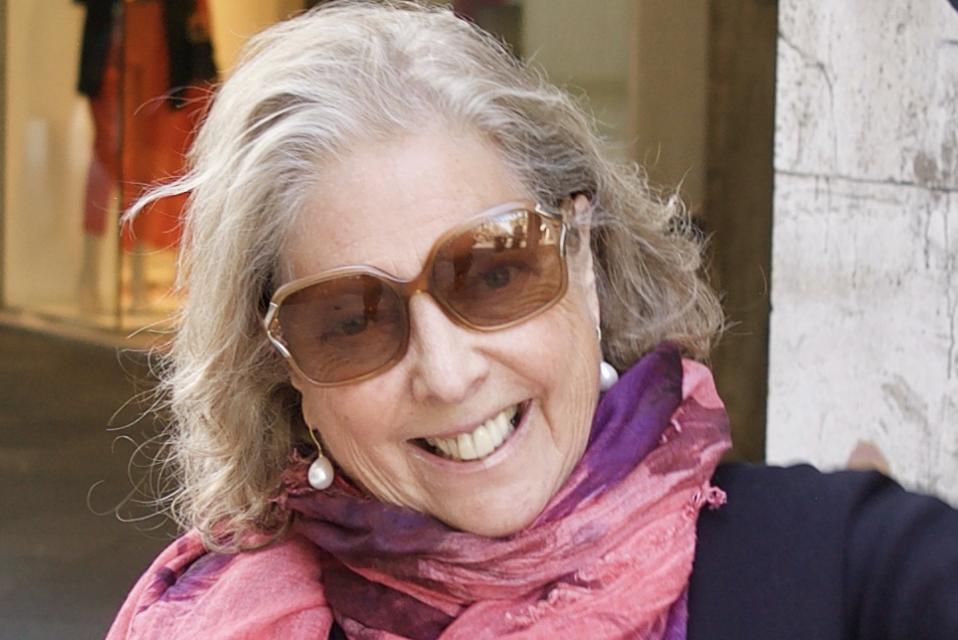
Chilean American Poet, Marjorie Agosin. John Wiggins
Like a beam of light piercing through the darkest tunnels of human destitute, Chilean-American poet, novelist, and human rights activist, Marjorie Agosin unveils the misery of the marginalized, weaving Latin America’s brutal history with her own Jewish traditions of survival and endurance. Memory and remembrance surface and resurface as a constant in Agosin’s writing. She flirts with her ancestral ghosts to unveil universal pain, desperation of loss and exile, and a yearning to belong.
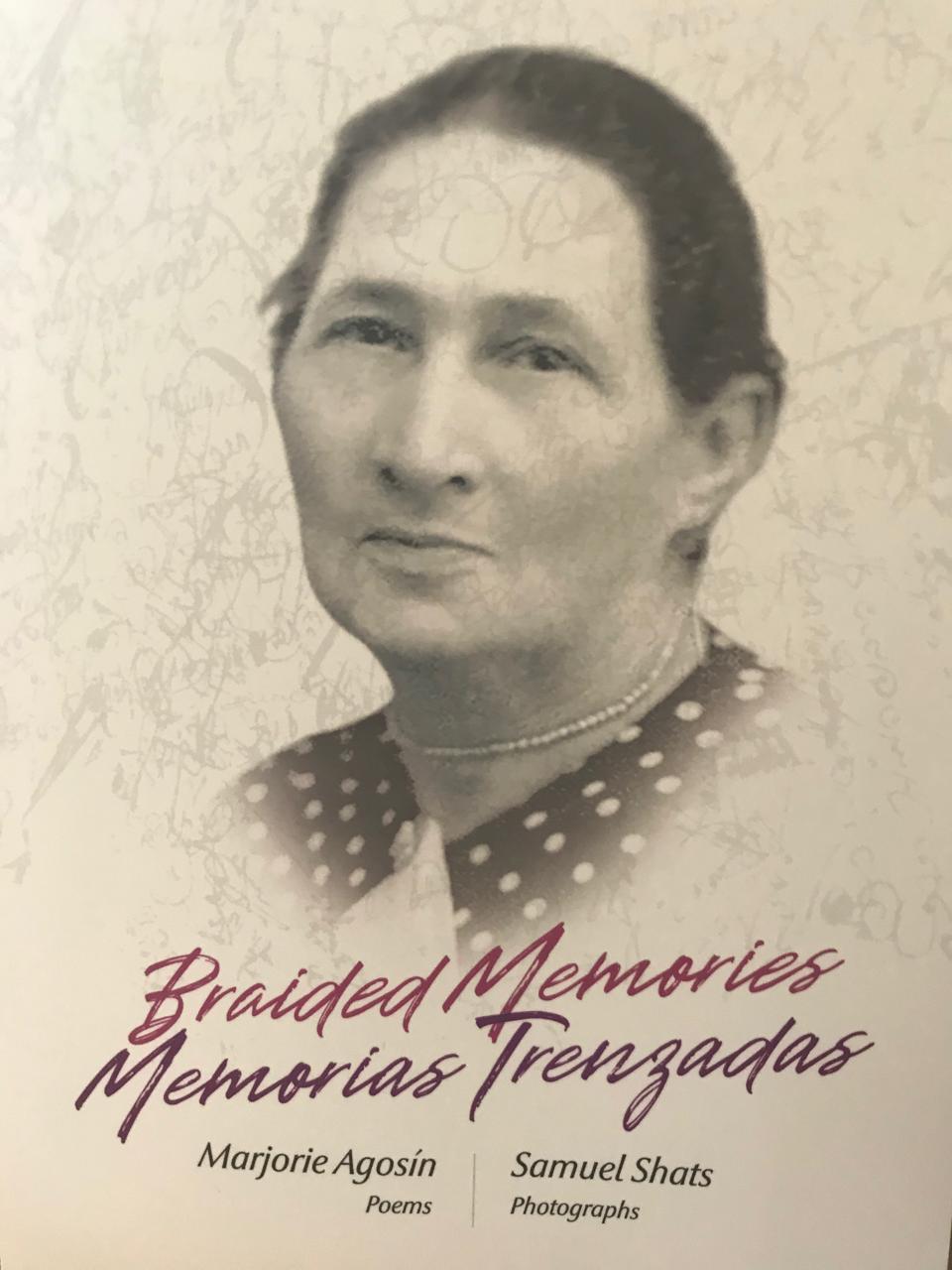
In Braided Memories (Solis Press, 2020), Marjorie Agosin awakens her great-grandmother, Helena … [+] Marjorie Agosin
Her most recent poetry collection, Braided Memories (Solis Press, 2020), with photographer Samuel Shats, awakens her great-grandmother, Helena Broder’s memory, and escape from Vienna for Chile after the 1938 “Night of Broken Glass.” Agosin journeys to Prague and Vienna to shed light on her ancestors–finding their Stolperstein–stumbling stones of brass plate inscriptions of Holocaust victims’ name and life dates, set before their homes. Her great grand cousins’ spirits fly over Vienna “like a Chagall dream.” In Helena’s imprisoned “silent gaze” she imagines her train ride from Vienna with strangers “familiar in the knowledge of certain escape.” We learn how Helena taught Agosin to “leave glasses of wine before the vacant places” of the dead, how she “acquired the blessing of forgetfulness” and left to “roam on the other side of imaginary spaces.” Agosin, grateful for the remembering gift, becomes Helena’s “tranquil memory.
“The hand that writes knows before the actual writing foreshadows. I hear a voice, a spirit that comes to me—call it intuition or God. You either suppress it or follow it for the magic of discovery,” speaking in her gentle Chilean accent, Agosin is alone with her creative thoughts in spaces that make poetry happen. “Poetry is the soul of life, the language of sentiments. Poetry is not in a hurry—the world is in a hurry and that’s why we fail to see the most important problems of our civilization.”
As a human rights activist, Agosin’s 84 works of poetry, fiction, and literary criticisms have earned her the Pura Belpré Award, Letras de Oro Prize, Latino Literature Prize, Jeannette Rankin Award in Human Rights, U.N. Leadership Award for Human Rights, the Gabriela Mistral Medal for Lifetime Achievement from the Chilean government, and the Fritz Redlich Human Rights Award by the Harvard Program on Refuge and Trauma. She holds a BA from the University of Georgia, an MA and a Ph.D. from Indiana University–and has been a Professor in Latin American studies and Spanish at Wellesley College for over 30 years.
Born in the U.S., Agosin spent her childhood in Chile before the rumbles of a U.S.-backed coup sent her family fleeing the país de poetas (land of poets) to settle in the U.S. The coup overthrew the democratically elected socialist leader, Salvador Allende and on September 11, 1973 brought Augusto Pinochet to power. During the 17-year rule, Pinochet imprisoned, tortured and killed some 130,000 Chileans–and thousands “disappeared.”
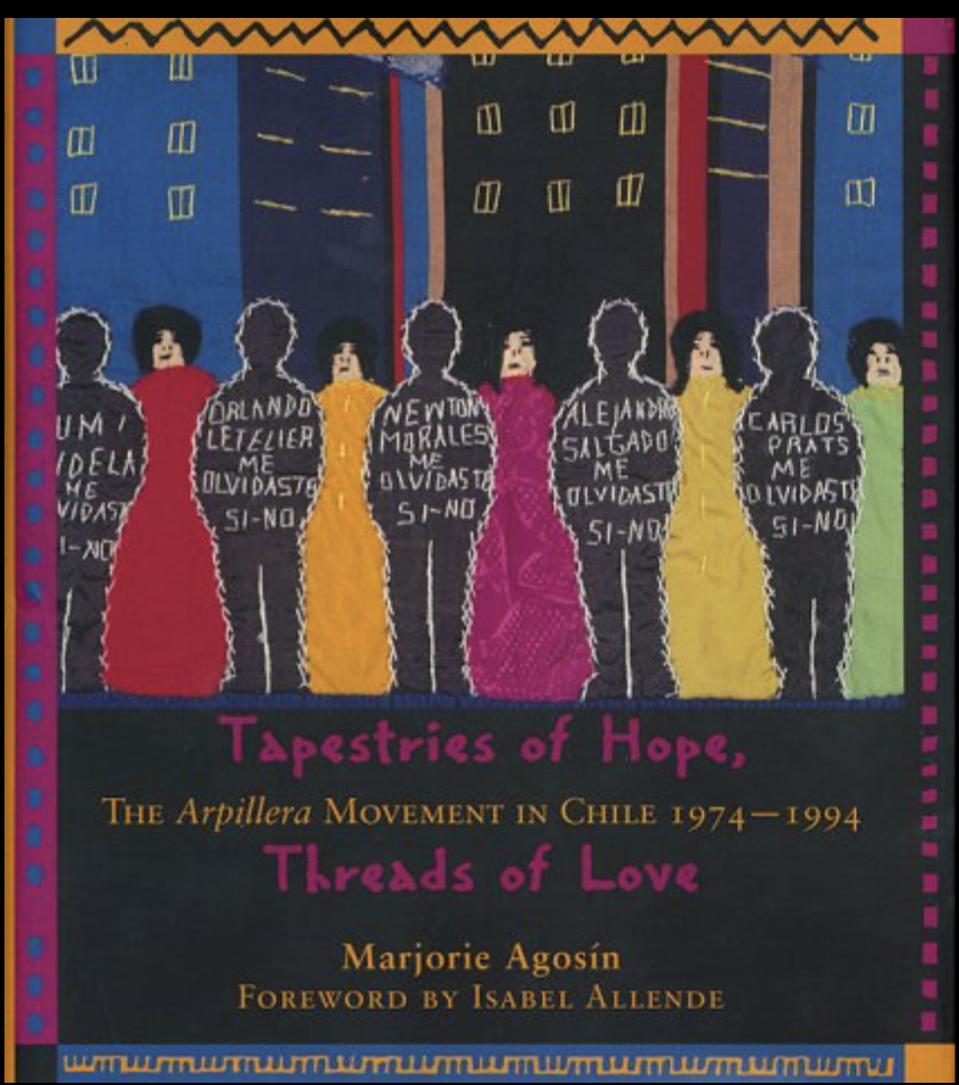
Tapestries of Hope, Threads of Love (U. of New Mexico Press, 1996) is Agosin’s landmark work with a … [+] Marjorie Agosin
Tapestries of Hope, Threads of Love (U. of New Mexico Press, 1996) is Agosin’s landmark work with a foreword by Isabel Allende. It spans 30-years of interviews with members of Latin America’s most influential women’s resistance the Arpilleras (burlapin Spanish) movement. The tapestries of embroidered cloth scraps made by impoverished women memorialize the “disappeared” loved ones under Pinochet’s rule. Agosin worked with the initial group of 12 women and brought their stories to the world. They were part of the anti-Pinochet art workshops, funded by Vicarâia de Solidaridad human rights organization of the Chilean Catholic Church. The embroideries, smuggled and sold abroad, provided income for the destitute women. {see also: https://humanrightsdefenders.blog/2020/02/22/arpilleras-making-a-come-back-as-blankets-that-protect/]
“As a woman and a mother, this is the most important work I’ve done–it changed my life,” Agosin was 24 when she first saw an Arpillera shown by the Chilean National Literature Prize-winning writer, Antonio Skármeta–whose book Ardiente paciencia inspired Academy Award-winning movie on Neruda, “IL Postino”.
Arpillera, means burlap in Spanish, a patchwork picture made by the women, became popular in Chile … [+] Marjorie Agosin
Like poetry, women’s distinct resistance movement reaches the core of what it means to be human, Agosin believes. The tapestries reveal an innate grief, immortalize memory, unfulfilled yearning to reunite with loved ones, and the trauma of lifelong scars.
In her most favorite poem The Most Unbelievable Part, Agosin explores how power corrupts and turns ordinary people into torturers. How in 1973 Pinochet designated La Esmeralda, the 1400 feet-long Chilean navy training vessel, into a detention and torture center for the “disappeared.”..
“Poetry is the intimacy of memory–it transcends history. The poem wrote the story of the tortures on La Esmeralda, not the other way around,” explains Agosin. “Torture is a metaphor for how power works—how a woman of privilege treats her maid.”
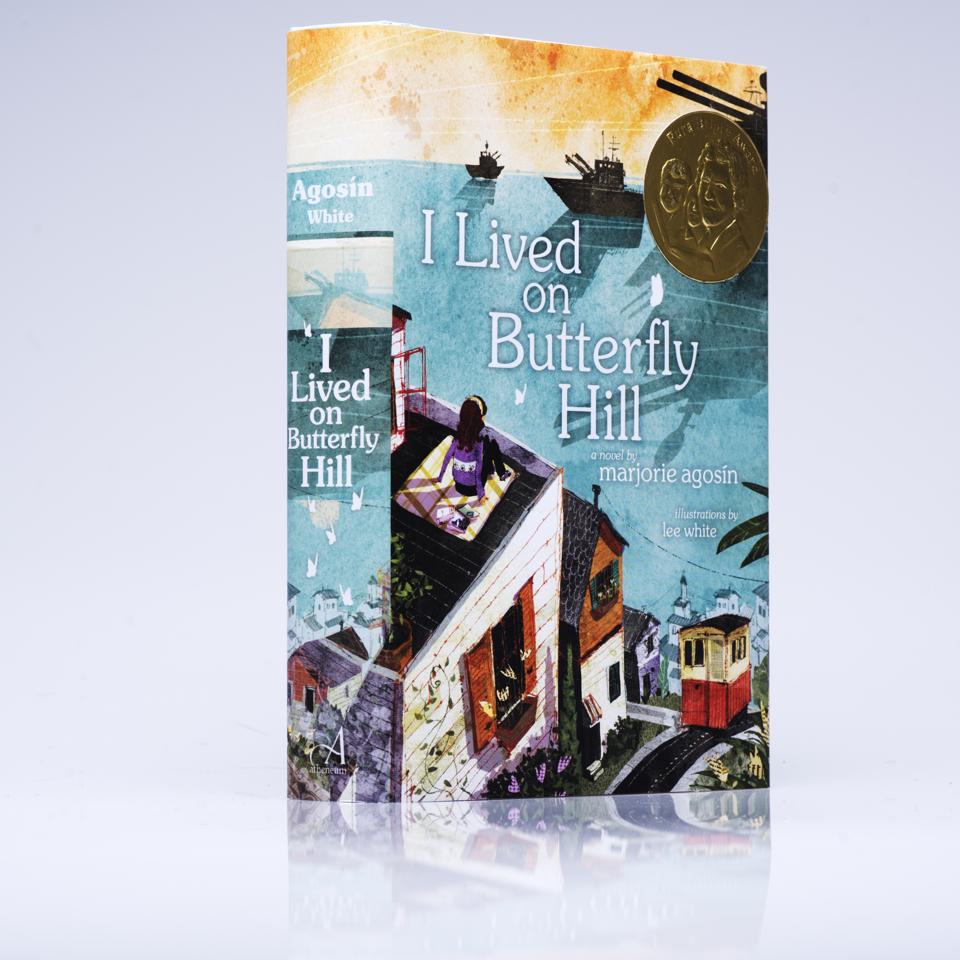
Considering Chile her home that gave her “a beautiful language” (she still writes in Spanish), and refuge to her family when they came on ships from war-torn Europe, Agosin’s exilic yearning of the familiar stranger expresses the constant pangs of un-belonging. In her Pura Belpré Award–winning young adult novel, I Lived on Butterfly Hill (Atheneum Books 2014)
WASHINGTON DC – JUNE 01: I Lived on Butterfly Hill by author Marjorie Agosin is one of the Kids … [+] The Washington Post via Getty Images
and its sequel, The Maps of Memory: Return to Butterfly Hill (Atheneum Books2020), Agosin recreates her happy childhood in Chile through the 11-year-old Celeste Marconi’s life. Her peaceful life, extended family, deep ties with the sea and the pelicans of the hill-town of Valparaiso unravel with the political shift to dictatorship. Celeste goes into exile to Maine and returns years later to find her country scarred by the brutality of dictatorship, and is determined to find her displaced classmates, re-build and heal her town and country. Like Celeste, Agosin is not totally at home in Chile.
“I’m home in books, poems, writings, friendships, history, travels–in places where Jews lived, and among trees and nature–human beings are not exiled from the beauty of the world,” Agosin immerses herself in her seacoast Maine home–which reminds her of Chile– surrounded by her garden dotted with quaint alcoves that invite the visitor to stop, rest, and embrace nature. “I’m at home in sacred places, from mosques to churches to synagogues.”
In A Cross and a Star: Memoirs of a Jewish Girl in Chile (Feminist Press, 1997)and Always from Somewhere Else: A Memoir of My Chilean Jewish Father (Feminist Press, 2000)–Agosin meets her parents at history’s crossroads. Her father, as an infant with chickenpox, was hidden, crossed the ocean and was named Moisés. He became a medical doctor in Chile and later emigrated to the U.S., becoming a foreigner once again. Her blond, blue-eyed mother could only attend an impoverished rural school–not a Catholic school because she wasn’t baptized, nor the German school run by the Nazis.
“My mother’s story explains what’s it like to be a minority in south of Chile when the Nazi’s arrived–how Chile denied and marginalized its minorities and its indigenous people,” Agosin wonders why vast majority of Chile’s Jewish community stood in silence against Pinochet’s atrocities as she explores human rights abuses from Latin America to the unfair partition of Israel which offered a refuge for the Jewish people displaced by the Holocaust–and in process displaced the Palestinians.
“Unfortunately Israel continues to suppress the Palestinian people that deserve the right of self-determination. To continue with the occupation of their lands violates the spirit of Israel as a vibrant democracy. Only a two state solution will allow Israelis and Palestinians to live in peace and with the dignity each one deserves,” Agosin states.
Agosin is inspired by her “amazing group of politically engaged” students at Wellesley College whose worldview, commitment to academic learning, open expression, and internships across the world to engage with the vulnerable reflects in their “gratitude for the possibility of learning as they face economic and emotional challenges amidst a pandemic.” Her immense empathy and loyalty to amplify all injustices reveals an undeniable allegiance to the spiritual and universal values of preserving memory.
“Memory is the active cause. Memory will not remember itself, like the Stolperstein tiles. Memory is a process, a constant commitment; without it we won’t remember the future. Memory is the future of the past,” Agosin confirms.
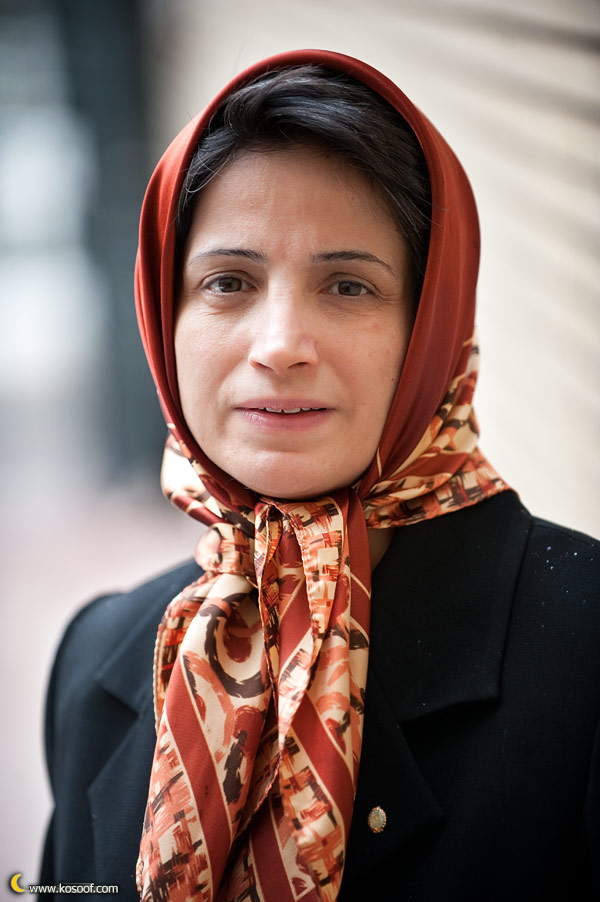
Many media outlets (here the Guardian) reported on Saturday 7 November 2020 that Iran has temporarily released Nasrin Sotoudeh, a prominent human rights lawyer who was jailed two years ago on spying and propaganda charges. Sotoudeh’s release followed warnings last month by human rights groups that her health had severely deteriorated after she staged a six-week hunger strike to demand the release of political prisoners and rights activists.
“Nasrin Sotoudeh … went on furlough with the agreement of the assistant superintendent of the women’s prison,” the judiciary’s Mizan news agency said, without giving further details.
Sotoudeh, 57, who has represented opposition activists including women prosecuted for removing their headscarf, was arrested in 2018 and charged with spying, spreading propaganda and insulting Iran’s supreme leader.
Sotoudeh has been recognised widely with seven major human rights awards.
On 18 October 2020 the Week published an interesting interview with Ahmer Khan, an award winning multimedia journalist under the title: “Covering other humanitarian stories helped me process the trauma of J&K, my homeland’’
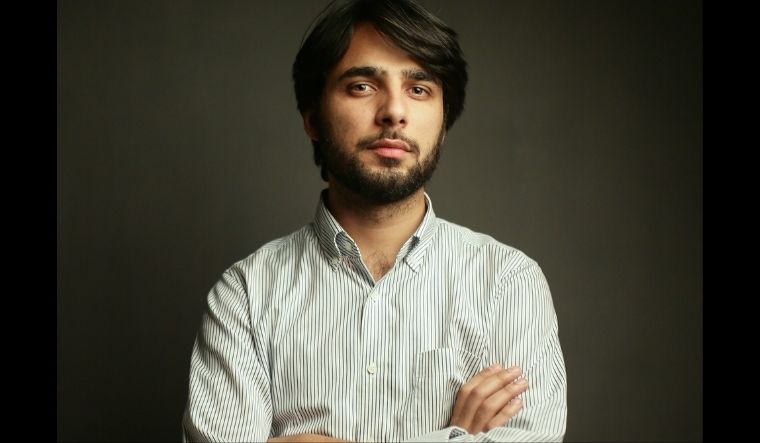
Ahmer Khan, multimedia journalist from Kashmir
Ahmer Khan is an award-winning, multimedia journalist from Kashmir. He was nominated for the Emmys 2020 for the Vice News film, India Burning, which focused on the plight of the 200 million Muslims in the country after the rise of Hindu nationalism. Khan is also the recipient of numerous awards, including the Lorenzo Natali Media Prize by European Commission 2018, AFP Kate Webb Prize 2019, and the Human Rights Press Award 2020. He is also among the finalists for the Rory Peck Award 2020. He has contributed to major international publications such as The New York Times, The Guardian, TIME, Al-Jazeera, Radio France International,, The Christian Science Monitor and Vice News, among others. Khan talks to THE WEEK about his career and what it is to be a journalist in Kashmir.
Edited excerpts:
Was it the camera or telling stories through visuals that you were attracted to?
Well, it was a little bit of both. Kashmir and photography are directly proportional to each other. First, I used to click pictures with a Sony Ericson handset. But I always knew what I was going to do in future. So I studied journalism and worked simultaneously.
What exactly did your work consist of in ‘India Burning’?
..I was a local producer of the film and I shot some parts of the film as well. My responsibility was to take care of everything in Assam. From set-up to the execution.
Is there a reason why you work with international media rather than the national media?
Yes, of course. I have never worked with any Indian organisation purposely. I did not want my stories to get distorted and manipulated the way editors of most of the Indian organisations do. I am grateful that I have found work elsewhere because there is too much saturation and it is hard for stories to get accepted anywhere now.
How did you establish your name in the industry?
I think I chose to report outside Kashmir from the beginning. I didn’t restrict myself to Kashmir or even India. I have reported from Nepal, Sri Lanka, Bangladesh and Afghanistan. That is something not everyone does.
Has living amidst the conflict in Kashmir, in any way, affected you as a person and as a journalist?
Our home is a dystopian state. We all have had encounters affecting our lives forever. My father passed away when I was 10 years old. I think every job/assignment in Kashmir is scary. The fear of uncertainty is always there.
You deal with more humanitarian stories, you are always in the middle of conflict and turbulence, you report on natural disasters and political disruptions. What is it that drives you to this beat?
It all comes from the basic human tendency of wanting to explore more of what you have grown up seeing. I grew up in the ’90s in Kashmir when the turmoil was at its peak and then I witnessed the uprising from 2008, 2010 and the following years. I, like any other Kashmiri, witnessed young Kashmiris being killed, tortured and extreme human rights violations on the streets. It is too much to handle and process, but when one looks at the other side of the world, we see pain everywhere and start being grateful for what we have. I think for me, covering other humanitarian stories helped me process the daily trauma of my own homeland.
How is covering stories in Kashmir different from other places in India?
In Kashmir, everything is way too personal. At times, we have to cover the stories while looking at the dead bodies of our own people. It is hard to keep aside your human side. But covering other human rights stories elsewhere and in mainland India, including Assam and Delhi has surely strengthened me more. Although, in Kashmir, it is getting extremely difficult to work freely as days pass. There is a constant fear of being muzzled for telling the truth. And, I think it’s happening across the South Asian countries.
You deal with a lot of life-threatening situations, you have also been harassed by the authorities. How does that make you feel?
Most people in the media in Kashmir have faced harassment and intimidation by the state. We have recently seen journalists being booked in stringent terror laws. We are living through one of the most dangerous periods of all times for the Kashmiri press to work. It is natural to feel worried. There is a continuous fear of life for all of us. ..
You identify yourself as a multimedia journalist. How is covering a story through writing, photography and videography different?
I am quintessentially a photographer and videographer. I started writing because I know the media nowadays is shrinking into one multimedia space. One skill isn’t enough. So the work adds. When you go to cover the story, you have to shoot, take quotes, video interviews and also make sure that you have got all aspects of the story in terms of text, video and photos. It is hard work but satisfactory in many ways. I also do radio stories. In fact, my Lorenzo Natali Media award was for my first radio story for Radio France International. Being a freelance journalist, you have to keep up with the demands of editors as there is a lot of uncertainty.
What do you have to say about the mainstream journalism that is turning blasphemous?
What they are doing is not journalism. It is dangerous and authoritarian. If a journalist does not report about the oppressed, undermined or underprivileged, he or she is just doing PR. …



 Ahmer Khan, multimedia journalist from Kashmir
 Hans Thoolen on Human Rights Defenders and their awards