The conflict in Ukraine with all these absurd symbols (Vladimir Kazanevsky for Nebelspalter)
Ukrainian Vladimir Kazanevsky and Hungarian Gabor Papai were announced as the winners of the Kofi Annan Courage in Cartooning Award at a ceremony at the Maison de la Paix in Geneva and presented by the Freedom Cartoonists Foundation. Jury : Kenneth Roth, Human Rights Watch (president), Sami Kanaan, City of Geneva and cartoonists Ann Telnaes (USA), Kak (France) and Chappatte (Switzerland). The portraits below were done by True Heroes Films (THF)
Vladimir Kazanevsky
Vladimir Kazanevsky, Ukraine’s leading cartoonist, was working in his studio early in the morning of 24 February when he heard loud explosions near the airport in Kyiv. He and his wife fled to western Ukraine, along with a huge wave of families fleeing the bombings. From there they went to Presov, a town in Slovakia with a community of artists.
Deprived of his drawing materials, catalogues and books, which he had to leave behind in Kyiv, Kazanevsky continues to draw relentlessly: Putin in action, on a tank or on the bow of the Titanic. “Autocrats and dictators are afraid of our cartoons, and they are right, because our drawings are powerful weapons,” he says.
Fiercely determined to continue the fight against Russian aggression, the 71-year-old sees his work as an act of resistance. An act of defence of freedom of expression against war propaganda.
Gábor Pápai
For several years, Hungarian cartoonist Gàbor Pàpai and his newspaper Népszava – the only opposition daily still alive in Budapest – have been the subject of attacks and legal proceedings by the authorities – even though Hungary is part of the European Union.
This cartoon, “The Chronicle” by Gábor Pápai, published in Hungary’s daily newspaper Népszava on 28 April shows the Hungarian National Public Health Centre’s chief doctor looking at Jesus on the cross and suggesting that many people who had deceased from the coronavirus had already been likely to die because they had suffered from pre-existing conditions.
It was intended to ridicule Hungary’s chief health figure for having tried to minimise the number of deaths solely attributable to the coronavirus in Hungary and, by extension, to mock the government’s handling of the crisis.
“Its depiction and use of Jesus on a cross sparked an outcry from the representatives of the Christian Democrat Party, an ally of the ruling Fidesz, to the point that the Secretary of State for persecuted Christian communities, Tristan Azbej, accused Gábor Pápai of blasphemy and threatened to sue him or Népszava,” as Reporters Without Borders, who came to the defense of Papai, explains.
The Catholic religion, the fight against Covid or simply Hungarian history are all pretexts for prosecution in a country ranked 92nd in the world press freedom index by Reporters Without Borders (RSF). This shameful ranking has been deteriorating ever since Viktor Orbán became Prime Minister, putting all independent media in great difficulty. Some, like Népszava, are directly threatened with extinction. Gàbor Pàpai, far from being intimidated, continues to critically observe and draw all political actors in Hungary.
On 5 May 2022 Robert F. Kennedy Human Rights announced Cameroonian human rights defenders Maximilienne C. Ngo Mbe and Felix Agbor Nkongho (Balla) as the 2022 recipients of its annual Human Rights Award. A ceremony honouring the two laureates will take place Tuesday, 7 in Washington, D.C.
A Cameroonian human rights defender with over 30 years of experience, Ngo Mbe is Executive Director of the Central African Human Rights Defenders Network (REDHAC). Since 2010, she has led REDHAC in its efforts to promote civic space and protect fundamental freedoms throughout Central Africa through investigations of human rights abuses, advocacy before regional human rights bodies, monitoring of democratic processes, and demanding state accountability. She was previously named an International Woman of Courage in 2021 by the U.S. Department of State [see: https://humanrightsdefenders.blog/2021/03/09/state-department-hands-out-21-international-women-of-courage-awards-2021/] and received the Franco-German Prize for Human Rights and the Rule of Law in 2016.
“Receiving the RFK Human Rights Award 2022 still feels like a dream,” said Ngo Mbe. “I am humbled by this recognition and dedicate it to my family, my colleagues at REDHAC, the members of the REDHAC Board of Directors, in particular Me Alice Nkom, and the Human Rights Defenders who have been my source of strength over the years. I look forward to working alongside Robert F. Kennedy Human Rights as we continue our struggle for justice, human rights, and peace in Cameroon and Central Africa.“
Nkongho is a Cameroonian lawyer and human rights defender. He is the director of the Centre for Human Rights and Democracy in Africa (CHRDA) and a leading advocate for human rights of Cameroonians in the conflict-stricken Anglophone region. Nkongho’s work focuses on the promotion of democracy, good governance, access to justice, and rule of law. His reputation as a devoted human rights defender is evidenced by his tireless work for human rights in Cameroon and throughout Africa, despite state sanctioned pushback, including his arbitrary detention in 2017. In 2019 he won the African Human Rights Defenders Shield Award.
“When I got news of the award, I was staring at portraits of my late parents and crying tears of joy. This is the best gift I could ever offer them, and I am sure they will be celebrating in heaven,” said Nkongho. “I am truly honored, and I sincerely thank Robert F. Kennedy Human Rights for considering me worthy of this award. It is dedicated to all those who advocate for the promotion and protection of human rights, to all the human rights defenders who continue to put their lives and liberty on the line to fight against injustice.“
This day is one on which the world stands still to think about press freedom and journalists who are persecuted. I want to start with some quotes from an excellent piece in the Economist on 2 May by Indian reporter Rana Ayyub who wonders whether plaudits such as “brave” normalise their persecution:
“When a journalist is killed or incarcerated or assassinated, obituaries scream bravado, editorials claim courage. Have such plaudits normalised the persecution of journalists? Why does a journalist have to be brave to report facts as they are? Why does she need to be persecuted for her story to reach the world? Consider Gauri Lankesh, Daphne Caruana Galizia and Jamal Khashoggi—all journalists with a profile, all brazenly killed in broad daylight. Their murders dominated the front pages of international publications. But their killers, men in power, remain unquestioned not just by the authorities but often by publishers and editors who develop a comfortable amnesia when meeting those in power. They do not want to lose access to them.“
“Journalists are the new enemy of the state; we are going through one of the toughest phases in the history of the profession. We document the truth at a time marked both by a voracious demand for news and by the persecution of minorities, genocide and war crimes. We witness savage attacks on minorities in India, Myanmar, China, Palestine or Ukraine even as bumbling editors still frame arguments and narratives through the prism of “‘both sides”. For example attacks on Palestinians, even during Ramadan, are often referred to as “clashes”. Despite one side having grenades thrown at them, and pelting stones in defence, the lens of the mainstream media remains firmly aligned with the oppressor. In India attacks on Muslims by Hindu nationalists often are reported as “riots” or “clashes”, too. The distinction between oppressor and oppressed can be blurred as convenient“….
“Journalism was never a nine-to-five profession. We knew it was an unconventional calling, and one where we might not leave the office for days, or where our families might have no communication from us as we report on crucial investigations, wars and undercover operations. Journalism schools taught us the ethics of our profession, but they did not warn us about nervous breakdowns, or about spending more time in courtrooms than newsrooms. We owe it to the next generation of journalists to create a safer environment in which to work. They should fear only the distortion of truth, never reporting the truth itself.“
At the Global Conference for World Press Freedom Day, May 2-5 in Uruguay, DW Akademie hosted a panel on digital authoritarianism. International media experts (Nanjala Nyabola, Laís Martins, Vladimir Cortés Roshdestvensky and Annie Zaman) discussed fighting disinformation and censorship.
Digital authoritarianism – when governments assert power and control information using digital tools and the internet – disrupts journalism and can endanger reporters and human rights defenders.
Regardless of recognition of press freedom under international legislations and under state constitutional provisions, the attack on journalists and ultimately on access to information remains a growing concern. According to the UN, 55 journalists were killed in 2021, while 62 of them were killed in 2020. A number of global networks of journalists have led the work of advocating press freedom and provide a platform for journalists to fight such state and non-state actors in unison.
The NWMI is a network of over 600 women journalists across India providing a space or a forum for women in Indian media to come together and share information, exchange ideas, discuss media ethics and promote gender equality in media. The collective aims to provide a holistic system to support women journalists in terms of space, resources and access to justice in case of rights violations. It also works for getting recognition, fair pay and decent working conditions for women independent journalists in the country. https://nwmindia.org/
International Federation of Journalists (IFJ)
IFJ is a Paris-based organisation representing as many as 6,00,000 media professionals across 140 countries. The collective works to strengthen labour rights of journalists and advocates for their fair pay, decent working conditions and gender equality in media recruitment at a global level. One can access records and data documented by IFJ through their campaigns focusing on violence against journalists, impunity to the perpetrators and countries where media freedom is curbed through state laws or private entities.
Reporters Sans Frontiers or Reporters without Borders (RSF)
With 115 correspondents across the world, RWB is a non-profit organisation started by four journalists and headquartered in Paris. RWB is known for its annual Press Freedom Index, one of the most credible indicators of the status of media freedom in over 180 countries of the world. In addition to this, RWB also tracks censorship activities and various kinds of abuse that journalists are subjected to and communicates the information in five different languages. RWB works in cooperation with international rights based organisations to further recommendations to the state in order to provide legal and material resources for journalists and advocate their safety as media personnel.
CPJ is known for its Global Impunity Index analysing the state impunity provided to murderers of journalists in democracies as well as in war-torn countries. As an independent and non-profit organisation based in New York City, CPJ documents attacks on journalists and the subsequent press freedom violations and works with the state actors to provide rapid response assistance, legal support and other resources to journalists in danger.
Article 19 mainly works to improve access to information, protect the civic spaces to discuss and dissent and strengthen human rights in the digital space too. Its key areas of work include information, censorship, gender and sexuality, freedom of religion and belief, equality and hate speech and media freedom among others. In line with its objectives to create a safe space for free flow of information, the organisation channelises its resources for the protection of journalists and human rights defenders. Article 19’s annual Global Expression Report and GxR metric provides a detailed picture of the condition of freedom of expression across the world. https://www.article19.org/about-us/
Media Defence
Media Defence’s focus lies on providing legal advice, support and resources to journalists, independent journalists and citizen journalists, who are under threat for their reportage and enable them to carry out reporting on issues of larger public interest. An international human rights organisation, in addition to documenting cases, it also intervenes to provide legal recourse to the journalists undergoing trial. https://www.mediadefence.org/legal-resources/
And of course – marking World Press Freedom Day, Reporters Without Borders (RSF) published their 2022 World Press Freedom Index that indicates a two-fold increase in polarization exacerbated by information disorder — that is, media polarization fuelling divisions within countries, as well as polarization between countries at the international level. See: https://rsf.org/en/index
“Within democratic societies, divisions are growing as a result of the spread of opinion media following the ‘Fox News model’ and the spread of disinformation circuits that are amplified by the way social media functions,” the watchdog said in a statement.
At the same time, the disparity between open societies and autocratic governments that dominate their media and online platforms while waging propaganda campaigns against democracies is eroding democratic institutions around the world. Therefore, the polarization on different levels is fuelling increased tensions, according to RSF.
Assessing the state of journalism in 180 countries and territories worldwide, the World Press Freedom Index showed how the crisis in the world reflects on the media.
In the face of the multiple crises of our time, ECCHR continues to stand for human rights and climate justice. To outline the scope of our aims, Joshua Castellino, a member of the ECCHR Advisory Board, authored a piece for its Annual Report that clearly emphasizes how we must think collectively about the future. For us, “collectively” means that our actions as human rights lawyers are to be guided by global solidarity and cooperation.
In her series Contagion – Colour on the Front Line (whose pieces she and the Autograph Gallery allowed us to reproduce in this report), Aida Silvestri uses cocoa, tea, tobacco, sugar and coffee to draw a connection between colonial exploitation and those who were carelessly exposed to danger during the pandemic while providing largely low-paid services with almost no protection.
• Most of the victims are targeted because they clash with the interests of illegal armed groups, including drug trafficking gangs, according to Colombia’s human rights ombudsman.
• The victims include 28 land rights and community rights activists, nine indigenous activists and four farming activists, Colombian newspaper El Tiempo reports.
A total of 52 Colombian human rights activists and community leaders have been killed in the first three months of this year, authorities say.
It is a significant increase from 2021, which saw 145 murders all year.
Most of the victims are targeted because they clash with the interests of illegal armed groups, including drug trafficking gangs, according to Colombia’s human rights ombudsman.
The country is one of the world’s most dangerous for activists, monitors say.
The victims include 28 land rights and community rights activists, nine indigenous activists and four farming activists, Colombian newspaper El Tiempo reports. Of the victims, 48 were men and four were women.
One of the most shocking cases was that of Breiner David Cucuñame, a 14-year-old indigenous activist who was shot dead in January while on patrol with an unarmed group that seeks to protect indigenous lands.
Colombia is officially at peace after signing a deal with the largest rebel group, the Revolutionary Armed Forces of Colombia (Farc), in 2016. But other armed gangs continue to operate in the country, the world’s largest cocaine producer.
Violence started increasing towards the end of last year due to disputes over territory and resources involving dissident Farc rebels and members of another Marxist guerrilla group – the National Liberation Army (ELN) – as well as right-wing paramilitary groups and criminal gangs such as the Gulf Clan.
“The homicides against social leaders and human rights defenders seriously affect the foundations of democracy,” said Carlos Camargo, the human rights ombudsman.
Oiwan Lam on 26 April 2022 reported that Hong Kong’s Foreign Correspondents’ Club has canceled its Human Rights Awards for fear of “legal risks”
Image created by Oiwan Lam.
The Foreign Correspondents’ Club, Hong Kong (FCC HK), a press freedom watchdog, announced they would cancel their 2022 Human Rights Press Awards (HRPA) on April 25. Eight members of the Club’s Press Freedom Committee have resigned in protest over the decision.
Many foreign correspondents were shocked by the decision. Launched in 1995, the HRPA has been one of the most important platforms to celebrate and honour human rights journalism from around Asia. The Club normally announces the winners on May 3, World Press Freedom Day.
Hong Kong Free Press (HKFP) quoted sources from FCC HK that the cancellation was related to the legal risks in presenting awards to the now-defunct Stand News. Two former senior staff members of the independent news outlet have been charged with conspiring to publish “seditious publications” pending trial.
Stand News was forced to shut down last December after security police raided its office. The police authorities accused the news site of publishing “seditious materials” with the intent to cause hatred towards the government and the judiciary.
An FCC member told the HKFP that Stand News would receive four awards and five merits in this year’s award, but “certain items” would pose a legal risk.
In a letter to the Club’s members, the president of FCC HK Keith Richburg said the decision was made in the organization’s board meeting on April 23:
Over the last two years, journalists in Hong Kong have been operating under new “red lines” on what is and is not permissible, but there remain significant areas of uncertainty and we do not wish unintentionally to violate the law. This is the context in which we decided to suspend the Awards.
The letter also says that “recent developments might also require changes to our [FCC HK’s] approach” in the promotion of press freedom.
As the city’s incoming Chief Executive John Lee has vowed to apply the “strictest measures” to clamp down on “anyone who tries to use journalistic work as a shield to engage in crimes endangering national security” in response to the crackdown on Apple Daily, FCC HK’s anticipation of legal risks is valid.
Yet, as a press freedom watchdog, many see the choice to ax the awards as an act of self-censorship antithetical to the organization’s purpose, as independent journalist Ilaria Maria Sala wrote on Twitter:
The Belarusian Association of Journalists (BAJ) has been named as the laureate of the 2022 UNESCO/Guillermo Cano World Press Freedom Prize — a $25,000 award for “outstanding contributions to the defense or promotion of press freedom especially in the face of danger,” UNESCO announced on 27 April 2022.
“For twenty-five years, the UNESCO/Guillermo Cano Prize has been calling the world’s attention to the bravery of journalists around the world who sacrifice so much in the pursuit of truth and accountability. Once again, we are inspired by their example and reminded of the importance of ensuring the right of journalists everywhere to report freely and safely,” Audrey Azoulay, UNESCO’s director-general, said in the statement. See: https://www.trueheroesfilms.org/thedigest/awards/8F8DB978-CD89-4CFB-1C26-D5FEE5D54855
BAJ, a non-governmental association of journalists, has operated in Belarus since 1995 and is the country’s largest NGO, with over 1,300 members. It has won a number of prestigious awards for standing up for press freedom. [See: https://www.trueheroesfilms.org/thedigest/laureates/D57318BE-B37F-4F34-12E3-886668FEAB9F] The country’s Supreme Court ordered it to liquidate last August as part of the government’s unprecedented crackdown on dissent that engulfed the ex-Soviet nation following months of mass protests.
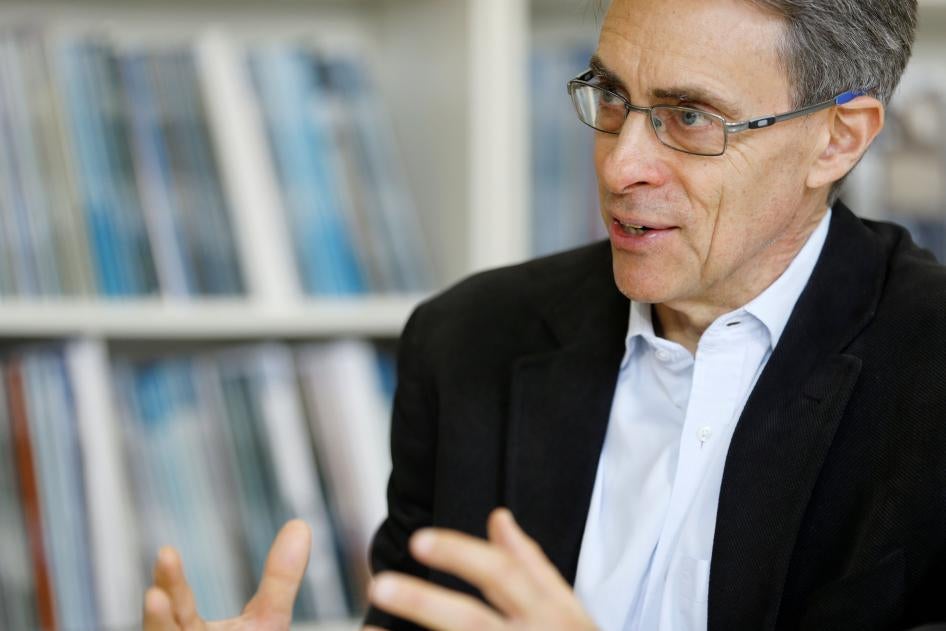
Human Rights Watch Executive Director Kenneth Roth has announced that he plans to step down at the end of August 2022, Human Rights Watch said on 26 April. Roth has led the organization since 1993, transforming it from a small group of regional “watch committees” to a major international human rights organization with global influence.
“I had the great privilege to spend nearly 30 years building an organization that has become a leading force in defending the rights of people around the world,” Roth said. “I leave Human Rights Watch with confidence that a highly talented and dedicated staff will carry on that defence with great energy, creativity, and effectiveness.”
Under Roth’s leadership, Human Rights Watch grew from a staff of about 60 with a $7 million budget, to 552 covering more than 100 countries and a nearly $100 million budget.
Roth began his human rights career as a volunteer, working on nights and weekends while serving as an attorney and a federal prosecutor. He joined Human Rights Watch in 1987 as deputy director. At the time, the organization consisted of Helsinki Watch, formed in 1978 to support dissident movements in Eastern Europe; Americas Watch, founded in 1981; and Asia Watch, formed in 1985. Shortly after Roth joined, the organization created Middle East Watch and Africa Watch. Early in his tenure, Roth moved the organization toward a single identity as Human Rights Watch…
Roth recognized the need for real time documentation of atrocities to generate immediate pressure to end them. That led to the creation of a group of specially trained researchers who could provide a surge capacity to the organization’s regular country researchers.
Roth also embraced new possibilities to bring perpetrators to justice. As Human Rights Watch researchers meticulously documented abuses, the organization pressed the United Nations Security Council, then in a more cooperative moment, to create international war crimes tribunals for the former Yugoslavia and Rwanda. Human Rights Watch research was used to build some of the cases, and staff testified at both UN tribunals. Human Rights Watch also played a prominent role in establishing the International Criminal Court, fending off pressure from the US government seeking to ensure immunity for its own forces.
“Ken’s fearless passion for justice, his courage and compassion towards the victims of human rights violations and atrocity crimes was not just professional responsibility but a personal conviction to him,” said Fatou Bensouda, former chief prosecutor of the International Criminal Court. “He has indeed been a great inspiration to me and my colleagues.”
Today, amid the horrific abuse taking place in Ukraine, an infrastructure is in place to hold perpetrators accountable.
Roth also created special teams to address the needs of certain marginalized people, including women, children, lesbian, gay, bisexual and transgender (LGBT) people, refugees, people with disabilities, and older people. He also oversaw the development of specialized programs on poverty and inequality, climate change, technology, and corporate social responsibility. In addition, he initiated a program to address human rights in the United States.
Roth changed the way that Human Rights Watch directed its advocacy. The organization began focusing mainly on US foreign policy. Roth globalized the organization’s advocacy, establishing offices in Brussels, London, Paris, Berlin, Stockholm, Tokyo, Sao Paolo, Johannesburg, and Sydney. He also spearheaded the organization’s work with the United Nations, with dedicated advocates in New York and Geneva.
After the 9/11 attacks, Human Rights Watch documented and exposed the use of “black sites” where US officials interrogated and tortured terrorism suspects. Under Roth, Human Rights Watch pressed the US government to investigate and prosecute those responsible for issuing the orders. Eventually the US Senate issued the Torture Report confirming Human Rights Watch’s findings and denouncing the Central Intelligence Agency’s use of torture.
“Ken Roth turned Human Rights Watch into a juggernaut for justice,” said Anthony Romero, executive director of the American Civil Liberties Union. “He has inspired a generation of human rights defenders to fight for a better world. During the so-called ‘war on terror,’ Ken went to Guantanamo and brought to bear his acumen and stature in exposing the farce of the military commission process. No organization and no leader have had a greater impact in human rights on a global scale.”
Human Rights Watch’s communication strategy evolved dramatically under Roth. The organization began by writing reports. Over time, it also began producing shorter and quicker reports and built a strong multimedia capacity, so that videos, photos, and graphics now routinely accompany the organization’s publications and sometimes are the publication itself. The organization also embraced social media. The organization has amassed nearly 14 million followers on the major social media platforms. Roth himself has more than half a million Twitter followers.
In his nearly 30 years at the helm of Human Rights Watch, Roth traveled the world, pressing government officials of all stripes to pay greater respect to human rights. He met with more than two dozen heads of state and government along with countless ministers and made investigative or advocacy trips to more than 50 countries. Whenever he could, he also met with communities affected by human rights violations. During his early years with the organization, he conducted fact-finding investigations himself, including in Haiti, Cuba, Israel-Palestine, Kuwait after the Iraqi invasion, and Serbia after the US bombing. In recent years, he has been especially concerned with addressing atrocities during the Syrian war as well as Chinese government repression in Xinjiang.
Roth inevitably earned many enemies. Despite being Jewish (and having a father who fled Nazi Germany as a 12-year-old boy), he has been attacked for the organization’s criticism of Israeli government abuses. The Rwandan government was particularly vitriolic in its criticism of Roth after Human Rights Watch, which had issued a definitive account of the genocide, also reported on atrocities and repression under President Paul Kagame.
The Chinese government imposed “sanctions” on him and expelled him from Hong Kong when he traveled there to release the annual World Report in January 2020, which spotlighted Beijing’s threat to the global human rights system. Roth responded to these and many other criticisms by noting that the organization employs the same fact-finding methodology and applies the same human rights principles in every country where it works.
Roth has written extensively on a range of human rights issues. In addition to writing the introduction to the World Report since 1990, he has published more than 300 articles including in the New York Times, The Washington Post, The Guardian, The New York Review of Books, Foreign Policy, and Foreign Affairs. I quoted him often in this blog: see e.g. : https://humanrightsdefenders.blog/tag/kenneth-roth/
Roth plans to write a book drawing on his personal experiences about the most effective strategies for defending human rights. “I am leaving Human Rights Watch but I am not leaving the human rights cause,” Roth said.
Human Rights Watch will conduct an open search for Roth’s successor. Tirana Hassan, chief programs officer, will serve as interim executive director.
On 25 April 2022 many media reported (here Associated Press) on the shocking news that a Turkish court has sentenced prominent Turkish civil rights activist and philanthropist Osman Kavala to life in prison without parole.
A Turkish court on Monday sentenced prominent Turkish civil rights activist and philanthropist Osman Kavala to life in prison without parole, finding him guilty of attempting to overthrow the government with mass protests in 2013. Western governments and rights groups strongly criticized the ruling, with one calling it “a travesty of justice of spectacular proportions.” See also: https://humanrightsdefenders.blog/2022/01/18/kavala-saga-continues-turkish-court-keeps-philanthropist-in-prison/
The court in Istanbul also sentenced seven other defendants, including 71-year-old architect Mucella Yapici, to 18 years in prison each for “aiding” the attempt. It ordered that the activists, who were not in custody, be immediately arrested, the state-run Anadolu Agency reported.
The verdict, which is likely to harm Turkey’s ties with Western nations, comes as Europe’s top human rights body, the Council of Europe, launched infringement procedures against Turkey for refusing to abide by a ruling by the European Court of Human Rights, which in 2019 called for Kavala’s release on grounds that his rights had been violated.
Kavala, 64, has been jailed in Silivri prison, on the outskirts of Istanbul, since he was detained Oct. 18, 2017, accused of financing the protests. He and other defendants denied all the accusations and are expected to appeal the verdicts.
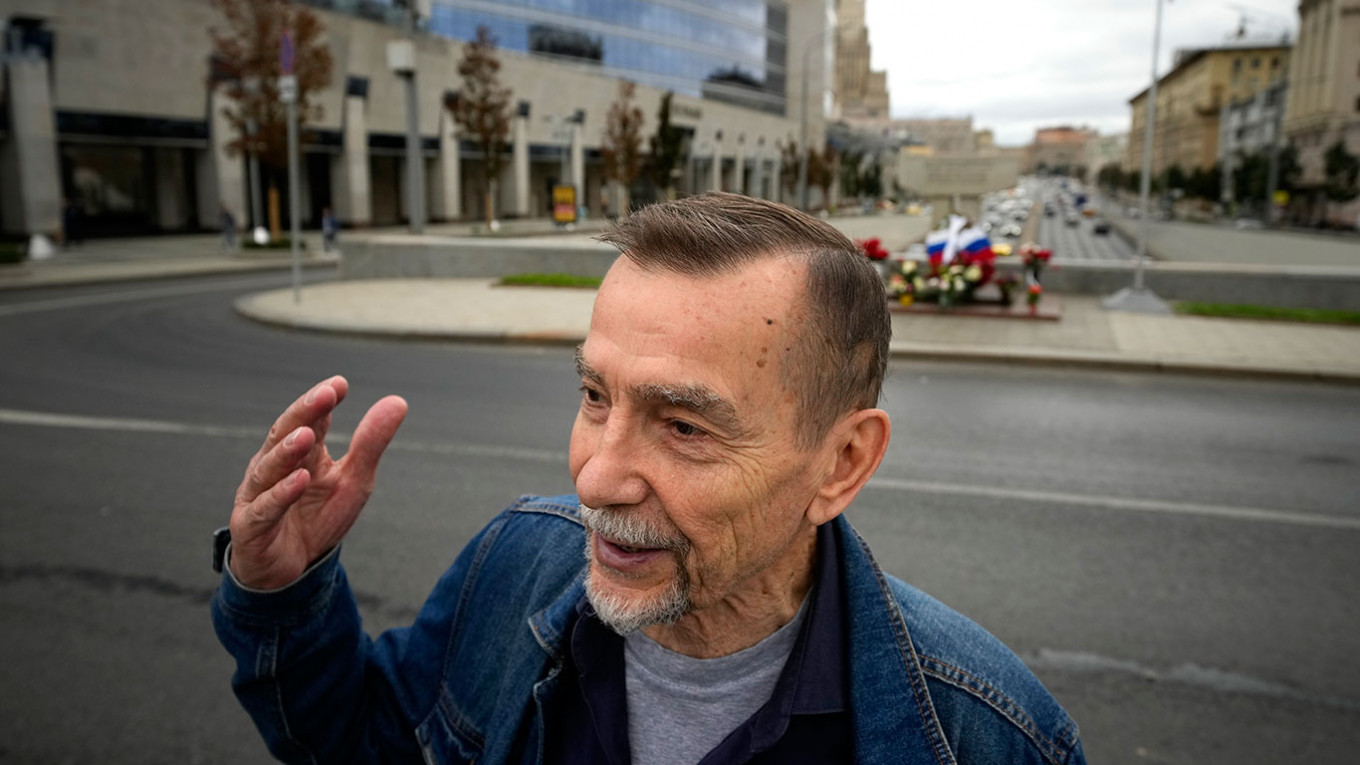
The 80-year-old former parliament member has been engaged in activism since the last years of the Soviet Union, helping create the now-dissolved Memorial organization in 1988. He said in a statement on Friday that worries about his personal safety, including “shadowy information about what they intended to do to me,” have forced him to take a break abroad.
“I doubt that my leave of absence will last long,” said Ponomarev, whose name has been added to Moscow’s list of “foreign agents” in Russia.
Ponomarev did not disclose his new location, saying only that he continued to closely follow the “worrying” news in Russia.
The charge, which falls under a new law introduced after Russia’s Feb. 24 launch of the campaign, could see Kara-Murza, 40, jailed for up to 15 years. Kara-Murza was due to appear in a Moscow court later Friday, Interfax said.


 Hans Thoolen on Human Rights Defenders and their awards