While the world received with great satisfaction the announcement of Bangladeshi human rights defender Adilur as Final Nominee of the MEA, the Observatory for the Protection of Human Rights Defenders, a joint programme of the World Organisation Against Torture and the International Federation for Human Rights, draws attention to the strange and disquieting case of Mr. Abu Bakar Siddique, the husband of Ms. Rizwana Hasan, Executive Director of the Bangladesh Environmental Lawyer’s Association BELA. He had been abducted on 16 April by unidentified men while traveling to Dhaka from Narayanganj by car. The vehicle with the unidentified men hit Mr. Abu Bakar Siddique’s car in Fatulla. When Mr. Siddique and the driver of his car exited the car, the unidentified men sprayed something into the driver’s eyes, and took Mr. Siddique away. On April 17, 2014 – about 33 hours after his abduction – Mr. Abu Bakar Siddique was left by his abductors blindfolded in Mirpur. Read the rest of this entry »
Archive for the 'human rights' Category
Abu Bakar Siddique released but worries remain for human rights defenders in Bangladesh
April 27, 2014Thilaga Sulathireh, Malaysian LGBTI human rights defender, in the limelight
April 27, 2014Saudi Arabia: persecution of human rights defenders continues as usual
April 25, 2014
reported two more cases of persecution of human rights defenders in Saudi Arabia. On 17 April 2014, the Specialized Criminal Court in Riyadh sentenced human rights defender Mr Fadel Al-Manasef to 15 years’ imprisonment, issued a travel ban against him for 15 years and fined him €19,300. Fadel Al-Manasef is a writer and blogger, and a founding member of Al Adalah Center for Human Rights, a Saudi Arabian NGO that documents and monitors human rights violations and provides supports to victims. He has been in detention since his arrest on 2 October 2011.
[In the same hearing, the judge dismissed two more cases against the human rights defender dating from 2009 and 2013. During the trial, Fadel Al-Manasef declared to the court that he had been subjected to torture and other forms of ill treatment during interrogations, however the court failed to address the allegations.] For more information: <https://www.frontlinedefenders.org/node/16118> .
On 15 April 2014, human rights defender Mr Waleed Abu Al-Khair was arbitrarily detained, while at the premises of the Specialized Criminal Court in Riyadh. The human rights defender was attending the fifth session of an ongoing trial against him at that court. Neither Waleed Abu Al-Khair’s family nor his lawyer have been informed of the reasons for the arrest. Waleed Abu Al-Khair is a lawyer and head of the Monitor of Human Rights in Saudi Arabia. The application to register the organisation as a human rights NGO was rejected.
[29 October 2013, the human rights defender was sentenced to 3 months in prison by a Jeddah court on charges including “organising illegal gatherings” and “insulting the judiciary”. Waleed Abu Al-Khair had been waiting to be informed of when the sentence would be carried out. In addition, in Riyadh, the human rights defender faces charges including: “striving to overthrow the state and the authority of the King”; “criticizing and insulting the judiciary”; “assembling international organizations against the Kingdom”; “creating and supervising an unlicensed organization, and contributing to the establishment of another”; and, “preparing and storing information that will affect public security”. see: <https://www.frontlinedefenders.org/node/25289> ]
UN Committee on Enforced Disappearances weighs in on the issue of reprisals
April 25, 2014In the crucial battle for better protection of human rights defenders who give information to the UN, there is a small victory. The Committee on Enforced Disappearances has responded to the issue of intimidation and attacks against human rights defenders by creating a rapporteur on reprisals. This comes after other UN treaty bodies, including the Human Rights Committee, the Committee against Torture and the Sub-Committee on the Prevention of Torture also took some steps to better protect human rights defenders who contribute to their work.
In its message of 22 April 2014 the Geneva-based International Service for Human Rights refers to its submission – together with Child Rights Connect, the Center for Legal and Social Studies, FIACAT, the International Movement Against all forms of Discrimination and Racism and Al-Karama – identifying ways in which the Committee could better facilitate access and engagement by NGOs. ‘ISHR welcomes this development, which sends a clear signal that the Committee takes the danger of reprisals seriously and understands the need to address this threat,’ said ISHR’s Heather Collister, but she rightly points out that cases of reprisal will continue to occur as long as there is no means of holding States accountable for the safety of the defenders who engage with regional or international human rights systems. See my earlier post advocating stronger measures against States that take reprisals: https://thoolen.wordpress.com/2014/03/13/zero-tolerance-for-states-that-take-reprisals-against-hrds-lets-up-the-ante/
via UN Committee on Enforced Disappearances appoints focal point on reprisals | ISHR. or contact Heather Collister on: h.collister[at]ishr.ch
For all my earlier posts on reprisals see: https://thoolen.wordpress.com/tag/reprisals/
Security Firm Rift Recon teams up with Human Rights Foundation at Oslo Freedom Forum
April 25, 2014RIFT RECON announced on 16 April that it will join forces with the Human Rights Foundation to present a comprehensive security workshop at the 2014 Oslo Freedom Forum ‘OFF’ from 12-14 May 2014. Read the rest of this entry »
Human rights defenders call for release political prisoners during Ice Hockey World Championship in Belarus
April 25, 2014Libereco, a Swiss-German human rights organisation, called on Lukashenka to grant amnesty to the Belarusian political prisoners on the occasion of the Ice Hockey World Championship, The statement on Libereco’s website reads that nine people remain under arrest for political reasons in Belarus. They are former presidential candidate Mikalai Statkevich, Ales Bialiatski, activists Ihar Alinevich, Mikalai Dziadok, Andrei Haidukou, Eudard Lobau, Vasili Parfiankou, Artsiom Prakapenka and Yauhen Vaskovich.
Interesting to note that the appeal to Lukashenka was signed by Christoph Strässer, the German Federal Government Commissioner for Human Rights Policy; Read the rest of this entry »
China sentences four more human rights defenders for demonstrating
April 24, 2014The same day it was announced that Cao Shunli had been selected as one of the Final Nominees for the MEA 2014, Front Line reports the sentencing of 4 other human rights defenders in China. On 18 April 2014, human rights defenders Messrs Ding Jiaxi and Zhao Changqing were sentenced to 3.5 years and 2.5 years’ imprisonment respectively, while Messrs Li Wei and Zhang Baocheng were both given prison sentences of 2 years. The four human rights defenders were convicted of “illegal assembly” over their role in small-scale demonstrations associated with the New Citizens Movement. Read the rest of this entry »
Lawyers for Lawyers raises the alarm: Filipino lawyers at risk
April 24, 2014
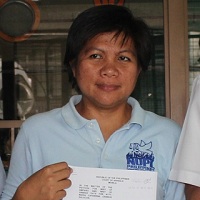
Cathy Salucon, Philippines via L4L
On 23 April 2014 Amsterdam-based Lawyers for Lawyers (L4L) and Lawyers’ Rights Watch Canada (LRWC) warn in an open letter to President Aquino of the Philippines for the continued labeling of lawyers as enemies of the state by the military. Since March, Atty. Maria Catherine L. Dannug-Salucon has been the subject of death threats, labeling, surveillance and verbal intimidation by military officers. Mrs Dannug-Salucon is reportedly on the Filipino military’s Watch List of so-called ‘Communist Terrorist’ supporters providing legal services. She has also been under the surveillance of the Intelligence Services of the Armed Forces. The surveillance is particularly worrisome in view of the killing – reportedly by members of the Intelligence Services – on 25 March 2014 of Mr. William Bugatti, a human rights defender who was also working as a paralegal for Atty. Dannug-Salucon.
Read the rest of this entry »
Breaking news: the 2014 MEA Final Nominees are…
April 23, 2014It was just announced that the following three Human Right Defenders have been selected as the Final Nominees for the Martin Ennals Award 2014: Read the rest of this entry »
 Hans Thoolen on Human Rights Defenders and their awards