High Commissioner for Human Rights Zeid Ra’ad Al Hussein (second left) at a roundtable discussion during his mission to Burundi.Photo: UN Electoral Observation Mission in Burundi (MENUB)
The UN High Commissioner for Human Rights left Burundi on 15 April with a final exhortation that “Burundian parties must choose the path to democracy and the rule of law“. Only a week later the authorities increased their crackdown on dissent to silence those who oppose a third term for the President.
“This is a critical moment in Burundi’s history,” said UN High Commissioner for Human Rights Zeid Ra’ad Al Hussein during his mission to Burundi. “Its future may well depend on which path is chosen by individual politicians and their supporters, as well as various key authorities, over the next few weeks.”… “And history – and possibly national or international courts – will judge those who kill, bribe or intimidate their way to power.”
He pointed out that recent events were of great concern, with tensions rising sharply over the past few months as the elections approach, reportedly stoked by an increase in politically motivated harassment, intimidation and acts of violence, as well as a reported rise in hate speech. He pointed to “extreme examples of hate speech” heard at a pro-Government political rally in Bujumbura and several examples of attacks on and intimidation of journalists, human rights defenders and opposition politicians.
“I will put it bluntly,” he said “As I prepared for this mission, I talked to many knowledgeable people, within and outside the UN, in Geneva and New York. They were all, without exception, alarmed about the direction the country appears to be taking. The Secretary-General has signalled his concerns, and so has the Security Council.”
He cited the main cause for concern as the pro-Government militia called the Imbonerakure, which he said appeared to be operating increasingly aggressively and with total impunity. People were fleeing the country, with up to 1,000 people per day crossing into Rwanda, and many of those leaving telling UN officials that their reason for leaving is fear of the Imbonerakure.
Mr. Zeid said the Government needed to send a clear message that extremism and impunity would no longer prevail and he added that all political demonstrations needed to be treated equally and in accordance with international laws and standards relating to freedom of assembly. Opposition politicians needed to play a part, too, refraining from inflation or exaggeration of facts to whip up anti-Government support and feed a climate of fear. They also needed to ensure that their supporters protest peacefully, and do not indulge in hate speech or react violently to perceived provocations. He said he had held several meetings since arriving in Burundi on Sunday, including with the country’s top officials, as well as civil society organizations, the National Human Rights Institution (CNIDH), foreign diplomats, opposition politicians, and key State institutions such as the Truth and Reconciliation Commission, the Independent National Electoral Commission, and the President of the Constitutional Court. “During the course of these meetings and discussions, it was very clear that many people here are also extremely worried,” …. “Ultimately, it is the authorities who have the obligation to protect all citizens and residents from intimidation and violence committed by any individual or group. They must also accept that criticism is a vital element of democracy, not a threat that must be crushed.”
A week later Front Line Defendersand the African defenders network EHAHRDP reported inter alia:
a clampdown on human rights defenders and journalists by Burundian authorities in connection with ongoing protests against President Nkurunziza’s bid for a third term widely deemed unconstitutional by Burundi’s civil society (with AP reporting 6 people killed at demonstrations over the weekend)
on 27 April 2015, human rights defender Pierre Claver Mbonimpa was arrested and released a day later without charge after being held in police custody approximately 48 hours [Pierre Claver Mbonimpa, Laureate of the MEA 2007, is the President of the Burundi Association for the Promotion of Human Rights (APRODH). He is also a member of the coalition “Halt to Nkurunziza’s third term”, a peaceful campaign which was launched in January 2015 by several civil organisations to oppose a third presidential term]. In May 2014, Pierre Claver Mbonimpa was also arrested and much later released [https://thoolen.wordpress.com/2014/09/30/news-from-burundi-release-of-human-rights-defender-pierre-claver-mbonimpa/].
an arrest warrant seems also to have been issued against human rights defenders Messrs Pacifique Nininahazwe and Vital Nshimirimana from the Forum for the Strenghtening of Civil Society (FORSC), who are perceived as leading organisers of the campaign against the Nkurunziza’s third term.
state authorities forcibly closed the Bujumbura and Ngozi offices of the African Public Radio (Radio Publique Africaine – RPA), a private radio station of Burundi known for dealing with human rights-related issues
0n Monday morning, police forcibly closed the Media Synergy Press Conference that was taking place at Maison de la Presse in Bujumbura.
“The risks facing human rights defenders in Burundi, as well as the wider civilian population, are now at critical proportions,” said EHAHRDP’s director Hassan Shire.
Brian Dooley, Director of the Human Rights Defenders Program at Human Rights First, wrote a good peace in the Huffington Post about the Emirates which he recently visited : “Trouble in Paradise: How U.S. Ally UAE Crushes Dissent” (28 April 2015). Here some excerpts:
Backed by an impressively lavish lobbying and PR machine — more expensive than any other middle eastern country — the United Arab Emirates (UAE) is eager to show that it’s a safe and stable business environment, and a dependable U.S. military ally….Abu Dhabi Crown Prince Sheikh Mohammed Bin Zayed Al Nahyan met with President Obama, Vice President Joe Biden, and Defense Secretary Carter in Washington last Monday to discuss, according to him, “new steps to enhance the already deep security between the U.S. and the UAE.”
Sheikh Mohammed ..is also head of the feared state security system and in recent months, the attacks on dissidents have intensified. In November 2014 the UAE cabinet announced a list of 83 “terrorist organizations.” (these included two American NGOs: the Council on Islamic-American Relations and the Muslim American Society.}
Previously tolerated local civil society organizations have been disbanded, including the Association of Teachers and the Association of Jurists, whose former head, Dr. Mohammed al Roken, is now in prison after being convicted in a mass unfair trial in 2013. Only a tiny handful of dissidents are currently in the country and out of jail including Ahmed Mansoor, just announced as a Final Nominee for the Martin Ennals Human Rights Defender Award 2015. Nearly all peaceful dissent in the UAE is silenced, both on and offline. Abuse of migrant workers’ rights persists, and no labor union is allowed to exist to protect them.
Meeting me in secret this week in the UAE, human rights activists told me there is now a zero tolerance policy for peaceful criticism of the Emirati regime. “It’s got so much worse in the last few years,” said one. “Ten years ago arrests without warrants or disappearances happened but they were rare. Now they’re common.” Even relatives of political prisoners have been targeted in recent months, some hit with arbitrary travel bans that prevent them from leaving the country.
They blame Sheikh Mohammed’s state security for tampering with official government files holding their ID and other information. They said that dates of birth have been changed so that adults are officially registered as children, or other details modified, making it impossible for them to get drivers licenses and other essential documents. This administrative harassment has sent people into an endless bureaucratic loop, preventing them from getting or renewing passports, applying for school, opening bank accounts, and generally operating normal lives. The denial of a security clearance amounts to a denial of a job. Many activists are unable to support themselves financially, some are sleeping rough.
“It’s a soft repression but very effective,” one activist told me. “State security basically runs the country, no matter who the official government is. It’s unaccountable, omnipotent, and scares everyone.“
Three sisters who were summoned to a police station in Abu Dhabi in mid-February have not been heard from since. The three women are sisters of Issa Khalifa al-Suwaidi, a political prisoner who is serving 10 years in jail. …Crushing dissent in the UAE is typically done in the name of anti-terrorism.
When they meet next month, President Obama should look beyond UAE’s fancy PR campaign and ask Sheikh Mohammed why peaceful critics are in jail, why their lawyers are intimidated from representing them and their witnesses harassed, and why the UAE thinks the best way to fight terrorism is with repression.
Azerbaijan plays the game: Under pressure from a variety of sources to reduce its widespread repression of human rights defenders in the run up to the European Games [see my latest post: https://thoolen.wordpress.com/2015/04/21/azerbaijan-a-formula-for-combining-sports-and-repression/], the authorities seems to have decided to give in a tiny bit (see two examples below) and continue for the rest with heavy-handed sentencing of human rights defenders:
– On 18 March 2015, Azerbaijan President Ilham Aliyev pardoned 101 prisoners, including Bashir Suleymanli, co-founder of the Election Monitoring and Democracy Studies Centre (EMDSC). Whilst welcoming Suleymanli’s release, on 19 March, the Observatory for the Protection of Human Rights Defenders (FIDH-OMCT) remains deeply concerned by the ongoing arbitrary detention of other prominent human rights defenders in Azerbaijan, including Anar Mammadli, chairman of the EMDSC, arrested on the same day, who remains currently detained. The EMDSC – which Azeri authorities have always refused to register – has been leading electoral monitoring activities in Azerbaijan since 2008.
– On 24 April 2015, the head of the United Nation’s Subcommittee on Prevention of Torture (SPT), Aisha Shujune Muhammad, announced that her four-member delegation had successfully conducted investigations of Azerbaijani prisons, police stations and investigative isolation units. “The Azerbaijani Government this time enabled unhindered access to places of deprivation of liberty,” said a statement published by the Office of the U.N. High Commissioner for Human Rights. While welcoming the government’s cooperation, Muhammad added, “[The] State party has yet to guarantee all fundamental legal and procedural safeguards to persons deprived of their liberty, including access to a lawyer, a medical doctor, and to contact his or her family.” [As a state party to the Optional Protocol to the Convention Against Torture, Azerbaijan is obliged to allow independent experts full access to sites of detention, but last September the SPT was forced to suspend its visit after being prevented from inspecting some sites and barred from completing its work at others, “in violation of Azerbaijan’s treaty obligations”]
But then – if you think it finally goes in the right direction – on the 22 April a Court in Baku sentenced human rights defender Mr Intigam Aliyev to seven and a half years imprisonment on trumped-up charges. For more on Intigam Aliyev see: https://thoolen.wordpress.com/tag/intigam-aliyev/]. Many NGOs and governments condemned the sentencing including the EU (“The sentence of seven and a half years imprisonment and a further three-year ban on holding public office handed down to prominent human rights lawyer Intigam Aliyev by an Azerbaijani Court is a further demonstration of the increasingly difficult situation faced by human rights defenders in Azerbaijan. This harsh sentence is disproportionate to the alleged offences, while serious shortcomings witnessed by international monitors during the trial raise fundamental questions as to the legality of these procedures.“)
Several important NGOs, including Amnesty International,Human Rights Watch, the Observatory on Human Rights Defenders (FIDH/OMCT) and Front Line Defenders, have pointed out that serious rights allegations have been escalating since 2012 as Azerbaijan is gearing up to host the first-ever European Games under the auspices of the Olympic Movement. [Over 6,000 athletes representing 50 countries from 12-28 June 2015; according to the London-based Business News Europe, the games are budgeted at an estimated eight billion dollars, and billed as the “most spectacular show in Azerbaijan’s history.”]
While the government of President Ilham Aliyev hopes to use the games to spotlight his country’s economic development, rights groups are pushing the European Olympic Committees and key National Olympic Committees to instead shift the focus onto human rights abuses and political prisoners. The Sports and Rights Alliance, urged the IOC to use its leverage with Azerbaijan to, among other things, demand the immediate and unconditional release of rights activists like Khajida Ismayilova, Leyla Yunus, Arif Yunus, Intigam Aliyev, Rasul Jafarov, Rauf Mirgadirov, Anar Mammadli, Ilgar Mammadov, and Tofig Yagulblu.
“Those participating in the European games being funded by the Azerbaijani government have a real obligation to speak out,” Buchanan of Human Rights Watch stressed.
Since November 2014, student organizations including the All Burma Federation of Student Union (ABFSU) have been protesting against the National Education Bill, which student activists claim restricts academic freedom. Enacted by Parliament on 30 September 2014, the National Education Law was intended to reform the country’s education system, but the ABFSU claim the government did not seek adequate student input in its formation. The new restrictions outlaw independent student and teacher unions, and erase ethnic languages, cultures and literatures from university syllabi.
Students opposed to the National Education Law staged a peaceful protest in Letpadan on 10 March 2015. Police responded violently to the movement. They arrested approximately 126 students, including student leaders Po Po, Nanda Sitt Aung and Phyo Phyo Aung. Three others, Myat Thu Aung, Kyaw Ko Ko (the Chairman) and Ye Yint Kyaw (spokesperson), managed to escape in March, but today they face criminal charges of unlawful assembly, rioting, incitement, and causing harm to a public servant. The charges carry penalties of up to three years in prison. Robert San Aung, who leads the Myanmar Lawyers’ Network team and is one the 3 Final Nominees of the MEA this year, said he believes the Court would not begin hearing the charges against those students currently detained, until police had apprehended those still in hiding.
The ABFSU is a student union with a long tradition and as far back as 2001 it won the Norwegian Student Peace Prize.
As reported by many newspapers including Al-Jazeera (Asad Hashim on 25 April) Sabeen Mahmud, a prominent Pakistani human rights defender, has been shot dead, shortly after hosting an event on Balochistan’s “disappeared people”, in the southern city of Karachi. Mahmud, 40, was the director of T2F [The Second Floor], a café and arts space that has been a mainstay of Karachi’s activists since it opened its doors in 2007. She was one of the country’s most outspoken human rights advocates. Mahmud was shot four times at close range and pronounced dead on arrival at the National Medical Centre hospital on Friday 24 April at 9.40pm.
Mahmud and her mother were on their way from an event (“Unsilencing Balochistan,” hosted at T2F, with Baloch human rights activists Mama Qadeer, Farzana Majeed and Muhammad Ali Talpur) when her car came under fire from unidentified gunmen, according to police. Her mother was also shot twice, but was out of immediate danger, hospital officials said.
The Voice of Baloch Missing Persons organisation, which both activists belong to, says that more than 2,825 people have “disappeared” in this way since 2005. They allege the disappearances, which are mostly of Baloch rights activists and students, have been carried out by the Pakistani government and its powerful ISI intelligence agency, a charge the agency denies.
“Sabeen was a voice of reason, pluralism and secularism: the kind of creed that endangers the insidious side of constructed Pakistani nationalism,” Raza Rumi, a rights activist who escaped an assassination attempt in March 2014 and now lives in the United States out of fear for his life, told Al Jazeera.
Jeremy Hance – writing in Mongabay on 20 April, under the title “Killings of environmental activists jumped by 20 percent last year“ confirms again the terrible truth that it is in the countryside, away from monitors, and in disputes over land issues that the most gruesome repression takes place and the leader is..Brazil! [for last year’s report see: https://thoolen.wordpress.com/2014/04/16/environment-deadly-for-human-rights-defenders-says-global-witness/]
Soy field in the Brazilian Amazon. Photo by: Rhett A. Butler.
The assassination, murder, and extrajudicial killing of environmental activists rose by 20 percent last year, according to a new grim report by Global Witness. The organization documented 116 killings in 2014 across 17 countries with the highest number in Brazil, which saw 29 environmental and land defenders killed. Still, the report is a major understatement of the problem as data across much of Africa, China, the Middle East, and Central Asia remains scarce to non-existent.
“Across the world environmental defenders are being shot dead in broad daylight, kidnapped, threatened, or tried as terrorists for standing in the way of so-called ‘development’,” said Billy Kyte, a campaigner with Global Witness. “The true authors of these crimes—a powerful nexus of corporate and state interests—are escaping unpunished. Urgent action is needed to protect citizens and bring perpetrators to justice.”
Most of the deaths last year—116 of them—were related to disputes over land. But mining was linked to 25 deaths, and hydroelectric dams and agribusiness to 14 each. Indigenous people also remain among the most targeted.
“In 2014, 47 indigenous people were killed defending their natural resources, 40 percent of the total deaths of environmental and land defenders,” reads Global Witness’s new report, entitled How Many More?. This year’s report follows a landmark document last year that tracked environmental activist killing—all 908 of them—over a dozen years.
Environmental activist killings by sector. Image courtesy of Global Witness.
Human rights defenders are stigmatized (as ‘anti-development’) and criminalized in order to silence their opposition.
While Brazil had the highest number of environmental activist murders in 2014, the most dangerous place to be an environmental activist was actually Honduras, according to Global Witness. During the last five years (2010-2014), Honduras lost 101 activists, giving it the highest rate of environmental activist killings per capita.
“A UN Human Rights Council resolution addressing the heightened risk posed to environmental and land defenders would be a start,” Kyte said. “But, in the end, governments themselves have to take responsibility and ensure impartial, exhaustive investigations into killings of these activists. And they have to bring perpetrators to account. Many targeted assassinations of activists are being passed off as ‘common’ murders and are going unnoticed.”
Environmental activist killings by country. Those in red were indigenous people. Image courtesy of Global Witness.
An example of how (making) film can teach young people to become human rights defenders. This comes Essex county in the USA.
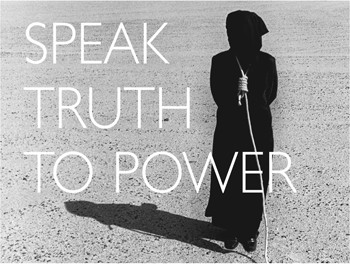
The Speak Truth To Power student video competition encourages school students to become engaged in human rights. The video contest is sponsored by New York State United Teachers and the Robert F. Kennedy Center for Justice and Human Rights and is based on Kerry Kennedy’s book Speak Truth To Power. Students who participate in the contest must choose one of the individuals identified by the RFK Center Human Rights and create a three- to five-minute short film. The contest is looking for student films that utilize creative storytelling to teach others about a human rights issue. The format is open to documentary, stop motion, narrative, digital photo essay or other innovative explorations that involve filmmaking components.
Two Bloomfield Tech students, Christopher A. Rodriguez and Julio Villegas, won the first place in the video contest with a five-minute film about genocide and focused on Holocaust survivor and human rights activist Elie Wiesel. This feat was proudly reported in the local media on 21 April:
“Essex County Executive Joseph N. DiVincenzo, Jr. and the Essex County Vocational Technical School District …… are all very proud of Chris and Julio for winning the top prize in the RFK Human Rights Center’s student film contest. ……..It was important to share their film with our Essex County audience to raise awareness of this emotional issue and to highlight the exceptional work of our students”.
The first public premiere of the film was made Tuesday, April 21st during the afternoon celebration in Newark. In addition, the will be shown at the Tribeca Film Festival in New York City on Thursday, April 23rd.
Elected and school officials shared their pride about the students’ accomplishment:
“I want to thank our students for their courage and their hard work,” Essex County Vocational Technical School Board President Father Edwin Leahy said. “Every time you speak the truth, you don’t get a crowd like this. You have to continue to do what is right even if you don’t have a lot of support”.
“Today is an amazing celebration of education,” said Bloomfield Tech Social Studies Teacher Jennifer DaSilva, who gave the students’ the assignment. “Both students have flourished in our Diaspora class. Their film is extraordinary and helps raise awareness about the tragedies taking place in the world today”.
Also sharing words of encouragement were Assemblywoman Sheila Oliver, Freeholder Patricia Sebold, Sheriff Armando Fontoura and Chief of Staff Phil Alagia.
The Hollywood Reporter (THR) of 20 April 2015 contains an interesting and detailed piece by Paul Bond who went with the Human Rights Foundation on a trip to South Korea, to see how defector send films, television shows, books, and offline versions of Wikipedia into North Korea. The experience inspired nine articles, all of them published on THR’s website, but the centerpiece is this one: ‘The Interview’ Sequel: Inside the Frightening Battle Raging on the North Korean Border’. The articles all together give an interesting picture of the powerful role that film can play in the case of closed societies where there is hardly any internet (here North Korean), but also how the South Korean authorities out of fear for retaliation limit the human rights defenders’ actions.
Left: U.S. resident Thor Halvorssen filled bags with The Interview,leaflets and American music to be ballooned into North Korea but was stopped April 9 by South Korean police. Right: Lee Min Bok prepared a balloon with Interview,Zero Dark Thirtyand U.S. dollars but was prevented from launching it by two guards.
To trick North Korean authorities, Interview begins with state propaganda clips before switching abruptly to a 12-minute subtitled edit of Interview — a bit from the beginning, middle and end, with the more vulgar parts removed.
Lewis Hamilton has just won the Bahrain Grand Prix [which was canceled in 2011 amid violent clashes after an uprising demanding political reforms]. It was the occasion for F1 chief Bernie Ecclestone to says that the Azerbaijan “Baku European Grand Prix” will make its début in 2016, despite concerns over the country’s human rights record. Earlier this week, the sport’s official website carried a notice stating that “The Formula One Group is committed to respecting internationally recognized human rights in its operations globally.” Asked if the human rights situation in Azerbaijan had been checked out with a view to hosting next year’s race, Ecclestone said “We have” before adding “I think everybody seems to be happy. There doesn’t seem to be any big problem there.”
One wonders where he got this idea as the Human Rights Watch report (and that of other NGOs, such as FIDH/OMCT, see link below) on Azerbaijan for 2015 was damning:




 Hans Thoolen on Human Rights Defenders and their awards