Archive for the 'human rights' Category

2017 (4): Canada’s year of real human rights action?

January 23, 2017

Alex Neve and Beatrice Vaugrante (Amnesty International Canada) wrote in the Ottawa Citizen (23 January 2017) a piece entitled: “Why 2017 must be Canada’s year of human rights action”.

Referring to Trump’s election and a number of human rights ‘anniversaries’ they say that there “is no better way to mark 2017’s many anniversaries, and keep a clear Canadian identity, than to make it a year devoted to advancing a strong human rights agenda, at home and abroad. That is the theme of Amnesty International’s most recent Human Rights Agenda for Canada, released today: A Year to Get It Right.”

The need is certainly great….a deeply troubling current of populism, racism, xenophobia and misogyny that has dominated election and referendum campaigns in numerous countries, most notoriously in the United States. The world collectively holds its breath in worried apprehension about the human rights implications of Trump’s presidency. And what of Canada?

Important Canadian government policy changes last year point to a renewed commitment to human rights; not consistently, but certainly sorely needed after years of diminished world standing. That is particularly so when it comes to gender equality, refugee protection and diversity. We have significantly re-engaged with the UN human rights system, including support for institutions that we once helped established, such as the International Criminal Court.

On the home front, the government’s talk of a new relationship with Indigenous peoples is welcome. It has laid the ground for the long-overdue National Inquiry into Missing and Murdered Indigenous Women and Girls, which faces challenges and misgivings but is nonetheless underway. However, it is disappointingly evident that inspirational words and gestures are not translating into the concrete measures needed to truly address the decades of human rights abuse at the heart of Canada’s legacy of colonialism. Nowhere is that more obvious than when major resource development projects – be it pipelines, mines or hydroelectricity – are at stake. This is well-evidenced in the continued federal support for British Columbia’s Site C Dam despite a scathing environmental impact assessment, vocal opposition from First Nations, and the government’s own acknowledgement that its Treaty obligations have been sidelined.  …..

It adds up to a year of considerable human rights responsibility and expectation for Canada. Responsibility: to make sure that 2017 is a turning point for Indigenous rights in Canada. No more excuses.  Governments, institutions and Canadian society more broadly must sincerely commit to profound action to ensure that violations against Indigenous peoples will at long last be brought to an end and justice done for those who have borne the burden of this terrible history.

Expectation: to stand up for human rights around the world.  There will be much pressure on Prime Minister Justin Trudeau to appease new counterparts, south of the border and elsewhere, who have come to power having fuelled discrimination and division. But there can be no room to waiver. Respect for human rights must be at the heart of what Canada seeks to advance around the world, as never before. 2017 must be a year for human rights.  

Alex Neve is Secretary General of Amnesty International Canada’s English Branch. Béatrice Vaugrante is Director General of Amnesty International Canada’s Francophone Branch.

Source: Why 2017 must be Canada’s year of real human rights action | Ottawa Citizen

2017 (3): HRW reminds world of continuing repression of minorities and their defenders

January 20, 2017

On 12 January 2017, Human Rights Watch (HRW) released its World Report on global human rights violations in 2016 and on the dangers the world will be facing in 2017. HRW shines its spotlight on the global rise of authoritarian populism and the concomitant toughening and broadening of anti-terrorism legislation around the world, which endangered throughout 2016 – and must be expected to keep challenging in 2017 – the very foundations of human rights law and the personal dignity inherent in every human being just as much as the despicable extremist attacks, to which they are a direct reaction.

Below the UNPO‘s (stand for the UNREPRESENTED NATIONS AND PEOPLES ORGANIZATION) reading of the report which notes with satisfaction that HRW does not neglect to emphasize in its country reports the persisting human rights abuses directed against indigenous peoples and ethnic and religious minorities around the world, but also sees some shortcomings (from its own perspective): Read the rest of this entry »

KIOS Foundation in Finland publishes video interviews with four human rights defenders from Asia and Africa

January 19, 2017

KIOS is perhaps not the best-known human rights foundation in the world but that is surely mostly due to the fact that it operates from a small base: Finland. KIOS was founded by 11 Finnish human rights and development NGOs. The representatives of the founding NGOs form the Board of KIOS. In Finland, KIOS raises awareness on the significance of human rights and the work of human rights defenders in developing countries. It also advocates for the development of good practices in Finnish foreign and development policy in support ofHRDs. KIOS focuses its external support on 3 countries in East Africa (Kenya, Rwanda and Uganda) and 3 in South Asia (Nepal, Sri Lanka and to Tibetan civil society organizations in exile). Some long-term partner organizations of KIOS are also supported in Bangladesh, Burundi, Ethiopia and Pakistan. Ulla Anttila is the Executive Director.

Ulla Anttila

On 17 December 2016 KIOS published four video links of interviews with human rights defenders from Asia and Africa (video links), available on You Tube:

Read the rest of this entry »

The killing of Oscar Romero – El Salvador’s ‘turbulent priest’ – written up after 36 years

January 18, 2017

Tom Sandborn wrote in the Vancouver Sun of 7 January 2017 review  of the book “Assassination of a Saint: The Plot to Murder Oscar Romero and the Quest to Bring His Killers to Justice“, by Matt Eisenbrandt, published by University of California Press.

Sainthood and civil torts
Book cover: Assassination of a Saint: The Plot to Murder Oscar Romero and the Quest to Bring His Killers to Justice

It took a single bullet to kill Oscar Romero, but his legacy has outlived many who plotted his murder and he may soon be officially named a saint by the Catholic Church. Assassination of a Saint is an exciting, dramatically paced account of his murder by a right wing death squad and the painstaking and eventually successful efforts to expose some of the men behind the Archbishop’s death.

In El Salvador in 1980, Romero, the Archbishop of San Salvador, had been elevated to his position in part because the cabal of land owners and politicians that controlled the tortured Central American state saw him as unlikely to pose uncomfortable moral challenges to their power. But Romero was fast becoming a problem for the elites…. he was condemning the war of right wing terror being waged against the Salvadoran people by the army, police and paramilitary death squads, all of whom took orders and funding from the country’s ruling class and inspiration from a particularly bloody minded brand of Cold War anti-Communism….

During the three years he spent as Archbishop, Romero was gradually radicalized by the suffering inflicted on the poor of his country by the official and unofficial death squads. In the end, he condemned the state and ruling class sponsored murders and called on soldiers and policemen to refuse the orders to turn their guns on Salvadorans standing up for their freedom. “No soldier,” he thundered from the altar, “is obliged to obey an order contrary to the law of God.” That call for conscientious disobedience was the last straw. The decision was made that the “turbulent priest” must die.

On March 24, 1980, a sniper in a van parked outside the church fired a rifle once, striking Romero in the chest as he said mass and killing him. The assassination made the Archbishop a beloved martyr among the poor, and kicked off a new round of civil war and bloodshed. For decades, no one was held to account for the public murder.

The Assassination of a Saint is the compelling story of how a rag-tag band of idealistic lawyers collaborated with Salvadoran exiles to identify one of the killers, Alvaro Saravia. Because the assassin was found to be living in the United States, the legal team, working out of the San Francisco offices of the Center for Justice and Accountability, was able to file a civil suit against him under an obscure American law, the Alien Torts Act, for damages incurred by Romero’s killing. In the course of that effort, they brought to light much of the hidden history of the Romero murder, meeting with witnesses and accomplices in the crime and uncovering much more about the archbishop’s death than had been known before.

Matt Eisenbrandt was a member of the legal team, and he has written a fast paced, informative and dramatic account. …Before they were successful in that effort in 2004, the crusading lawyers experienced a series of dramatic meetings with perpetrators and potential witnesses, tense moments, mysterious phone calls, frightening visits to El Salvador and years of exhaustive research. Their win was a triumph for human rights defenders, and this book is a powerful account of how that victory was won. 

Tom Sandborn lives and writes in Vancouver. He has been involved in human rights activism for over five decades. He welcomes feedback and story tips at tos65@telus.net.

Source: Sainthood and civil torts

DefendDefenders seeks Project Coordinator for the Great Lakes region

January 17, 2017
DefendDefenders (the East and Horn of Africa Human Rights Defenders Project) is the secretariat to a network of more than 75 member organisations drawn from eleven countries in the sub-region. Additionally, DefendDefenders acts as the secretariat for the Pan-African Human Rights Defenders Network, which brings together five sub-regional networks from North, Central, West, Southern and the East and Horn of Africa. Further information can be found on the website.
DefendDefenders is in the process of recruiting a Project Coordinator for its work in supporting human rights defenders in the Great Lakes region.
Key responsibilities:
  • Coordinate the implementation of our Great Lakes region project, including project design and planning, implementation, coordination of activities, budget management, evaluation and reporting to ensure that the project is effectively and efficiently managed in accordance with the strategy of DefendDefenders and the parameters of its partner regulations and procedures;
  • Ensuring high quality, integrity, transparency and accountability of key processes in the project, including: project design, development, and budgeting; project approval process; financial management; and reporting;
  • Ensure swift communication and collaboration with the Great Lakes region project partners for the effective implementation of the project;
  • Establish or reinforce partnerships with other organizations in the field, to create synergies for raising awareness on human rights compliance and protection in the Great Lakes region ;
  • Undertake regular visits to countries of the Great Lakes;
  • Monitoring the human rights legislations, issues and development in the Great Lakes region;
  • Support network of human rights defenders and organization in the Great Lakes region;
  • Engage in strategic advocacy activities, including press releases and statements in conjunction with the advocacy team.
Competencies include:
  • Strong interpersonal and communication skills (spoken/written), including the ability to listen to and incorporate the views of stakeholders;
  • Ability to engage with project partners, donors and state authorities clearly and effectively, both orally and in writing;
  • Proven ability to operate effectively across organizational boundaries;
  • Ability to establish and maintain effective working relationships in a multi-cultural, multi-ethnic environment with sensitivity and respect for diversity.
  • Ensure all personnel related issues for the staff are carried out in accordance with DefendDefenders guidelines;
  • Strong time management and coordination skills.
  • Ability to foresee risks and allow for contingencies when planning;
  • Ability to identify beneficiaries’ needs and suggest appropriate solutions;
  • Strong comfort with usage of information and internet technologies;
  • Ability to follow digital security protocols.
Education and experience
  • A master’s degree in human rights, law, social sciences, political science or a related field from an accredited academic institution with a minimum of three years of relevant professional experience on project management;
  • A solid understanding of human rights and protection mechanisms;
  • Familiarity with the Great Lakes region and previous experience working in the region ;
  • Good conceptual and analytical capacity;
  • Very good budgeting, project management and report writing skills;
  • Ability and willingness to travel.
Languages
  • Fluency in English and French (both spoken and written) is a must, and fluency in Kirundi and/or Kinyarwanda a strong asset. As part of the recruitment process, short-listed candidates will be tested on their knowledge of both English and French.
The position will be based in Kampala, Uganda with frequent travels within and out of the country. Applicants should be eligible to work in Uganda without restriction. Applicants should send a letter of motivation, CV and contacts of three references to: jobs@defenddefenders.org by 25 January 2017.  The subject line of the email should read “Application for Project Coordinator Great Lakes Region position”

Source: – East and Horn of Africa Human Rights Defenders Project

Amila Sampath: the man behind the video service of “Just Asia”

January 16, 2017

I have on many occasions referred to the admirable initiative of the AHRC to try and bring visual aspects to human right work [https://humanrightsdefenders.blog/2016/01/21/just-asia-just-continues-with-its-human-rights-television/]. So, I was glad to come across the story by Nilantha Ilangamuwa in the Sri Lankan Guardian of 3 November 2016 about the “The Man behind the video service Just Asia”!

amila_sampath_srilanka
Amila Sampath: “I make videos, that’s my tool, I believe this is one of the significant ways to raise the voice of the voiceless

Read the rest of this entry »

Front Line reminder of deadline for its 2017 award

January 16, 2017

Front Line Defenders issued a second call for nominations for the 2017 Front Line Defenders Award for Human Rights Defenders at Risk (if you have already submitted a nomination you should have received a confirmation email). Deadline remains:  Friday, 3 February 2017.  Seehttps://humanrightsdefenders.blog/2016/12/14/call-for-nominations-for-two-important-human-rights-awards-deadline-february-2017/Frontline NEWlogo-2 full version - cropped

‘FOR THOSE WHO DIED TRYING’ Photo Exhibit on human rights defenders in Thailand by Protection International

January 16, 2017

exhibit 2

Protection International opened the photo exhibition, ‘For those who died trying’ on the Place des Nations in Geneva on Monday, 9 May 2016. The exhibition run from 9-11 May and presented the photographs of 37 murdered or abducted human rights defenders in Thailand. It has toured or will be touring various countries (e.g. Thailand, Brussels, Pamplona) and as from 22 January 2017 a small town in the Netherlands, Dordrecht (www.defendersindordrecht.org), houses the images.

The project looks to remember those who died defending human rights and protecting the environment by placing a portrait of the human rights defender, where possible, at the exact place he or she was murdered or abducted. It is vital, for the victims and their families, that their fight and their death is not forgotten and left un-recognised. Ultimately, those responsible must be brought to justice. Recognising those who died trying as HRDs and a better administration of justice are critical steps to end these killings.

More information can be downloaded here: ‘For those who died trying’ photo exhibition.

see related: https://humanrightsdefenders.blog/2016/12/02/new-on-line-memorial-to-remember-killed-human-rights-defenders/amp/


2017 (2): Why the Space for Civic Engagement Is Shrinking

January 11, 2017

This is the second item addressing the world of human right defenders in 2017. I do this with an ‘old piece’ by Chris Stone, President of the Open Society Foundations, dating back to 21 December 2015 saying that across the globe, governments are shutting down spaces for civic engagement. Something that indeed has become evident.

It starts with the short video clip above in which George Soros, Binaifer Nowrojee, Mburu Gitu, and other experts discuss why this is happening—and how civil society can unite to prevent it.

All around the world, active citizenship is under attack and the space for civic engagement is closing—not just in countries that have struggled under repressive or autocratic governments, but also in democracies with longstanding traditions of supporting freedom of expression. There are many different reasons for this shrinking of the public space.

In some countries, especially newer democracies or countries undergoing political transitions, those in power are fearful of civic activism. Seeing its power, officials in governments with no previous experience regulating political protests or public debates have come down with a heavy hand, erring on the side of preventing change rather than encouraging it.

In other countries, including France and the United States—partly in response to the fear of terrorism—well-established civil liberties have been suspended or cast aside in the name of security. Such measures, from mass surveillance to martial law, reduce the space for civic life, the space where citizens do the work of improving our communities and societies.

Civil society is enormous in its size and diversity. We are members of the media, for-profit businesses, volunteer associations, political parties, trade unions, faith communities, private foundations, and nonprofit organizations. If we are united at all, we are united by our work outside of government and the state to advance the common good—even though we have different ideas of what that looks like.

Because the space we need for this work is closing, we must come together, understand our mutual dependence and interrelatedness, and support each other in this work. We must forge a new solidarity.

Source: Why the Space for Civic Engagement Is Shrinking

see other posts:https://humanrightsdefenders.blog/tag/civil-society-organisations/ 

2017 (1): Are we heading towards a ‘post human rights world’?

January 11, 2017

The start of a new year is often the occasion to make some broader analysis. So it is with the issue of human rights defenders. I have collected some of the more interesting and will report on these in the days to come.

The first is an article (30 December 2016) by ith more states seemingly reluctant to honour human rights treaties – whether we are “heading towards a ‘post human rights world‘?:

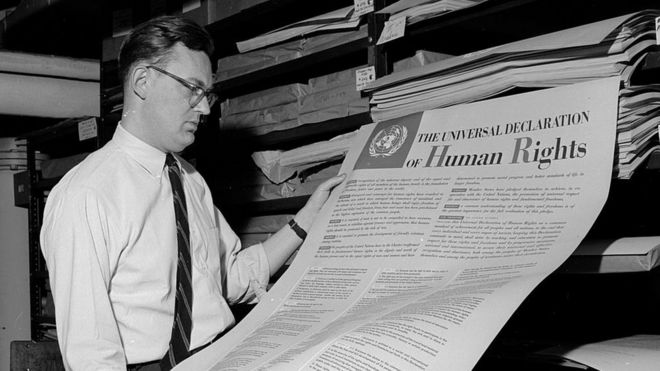
A man looks at one of the first documents published by the United Nations, The Universal Declaration of Human Rights
Image copyright THREE LIONS/GETTY IMAGES

With an increasing number of states seemingly reluctant to honour human rights treaties, is there a future for this type of international agreement? “We stand today at the threshold of a great event both in the life of the UN, and in the life of mankind.” With these words, Eleanor Roosevelt presented the Universal Declaration of Human Rights to the United Nations. It was 1948 and UN member states, determined to prevent a repeat of the horrors of World War Two, were filled with idealism and aspiration…… Mrs Roosevelt’s prophecy that the declaration would become “the international magna carta of all men everywhere” appeared to have been fulfilled.

But fast forward almost 70 years, and the ideals of the 1940s are starting to look a little threadbare. Faced with hundreds of thousands of migrants and asylum seekers at their borders, many European nations appear reluctant to honour their obligations to offer asylum. Instead, their efforts, from Hungary’s fence to the UK’s debate over accepting a few dozen juvenile Afghan asylum seekers, seem focused on keeping people out. Meanwhile across the Atlantic, president-elect Donald Trump, asked during the election campaign whether he would sanction the controversial interrogation technique known as “waterboarding”, answered ‘I’d do much worse… Don’t tell me it doesn’t work, torture works… believe me, it works.” And in Syria, or Yemen, civilians are being bombed and starved, and the doctors and hospitals trying to treat them are being attacked.

Donald Trump
 Image copyrightDREW ANGERER/GETTY IMAGES

 Little wonder then, that in Geneva, home to the UN Human Rights Office, the UN Refugee Agency, and the International Committee of the Red Cross (ICRC), the guardian of the Geneva Conventions, there is talk of a “post human rights” world. “There’s no denying that we face enormous challenges: the roll-back that we see on respect for rights in western Europe, and potentially in the US as well,” says Peggy Hicks, a director at the UN Human Rights Office. Just around the corner, at the ICRC, there is proof that those challenges are real. A survey carried out this summer by the Red Cross shows a growing tolerance of torture. Thirty-six per cent of those responding believed it was acceptable to torture captured enemy fighters in order to gain information. What’s more, less than half of respondents from the five permanent members of the UN Security Council, among them the US and the UK, thought it was wrong to attack densely populated areas, knowing that civilians would be killed. More than a quarter thought that depriving civilians of food, water and medicine was an inevitable part of war.

For ICRC President Peter Maurer these are very worrying figures. “Even in war, everyone deserves to be treated humanely,” he explains. “Using torture only triggers a race to the bottom. It has a devastating impact on the victims, and it brutalises entire societies for generations.” But how many people are listening, outside the Geneva beltway? Peggy Hicks attempts an explanation as to why attitudes to human rights may be changing.

“When confronted with the evil we see in the world today, it doesn’t surprise me that those who might not have thought very deeply about this [torture] might have a visceral idea that this might be a good idea.” But across Europe and the United States, traditional opinion leaders, from politicians to UN officials, have been accused of being out of touch and elitist. Suggesting that some people just haven’t thought deeply enough about torture to understand that it is wrong, could be part of the problem. “I do think the human rights community, myself included, have had a problem with not finding language that connects with people in real dialogue,” admits Ms Hicks. “We need to do that better, I fully acknowledge that.”

What no one in Geneva seems to want to contemplate, however, is that the principles adopted in the 1940s might just not be relevant anymore. They are good, so Geneva thinking goes, just not respected enough. “We aren’t looking for an imaginary fairytale land,” insists Tammam Aloudat, a doctor with the medical charity Medecins sans Frontieres. “We are looking for the sustaining of basic guarantees of protection and assistance for people affected by conflict.” Dr Aloudat is concerned that changing attitudes, in particular towards medical staff working in war zones, will undermine those basic guarantees. He was recently asked why MSF staff do not distinguish between wounded who are civilians, and those who might be fighters, who, if treated, would simply return to the battlefield.

“This is absurd, anyone without a gun deserves to be treated… We have no moral authority to judge their intentions in the future.” Extending the analogy, he suggested that doctors or aid workers could end up being asked not to treat, or feed, children, in case they grew up to be fighters. “It’s an illegal, unethical and immoral view of the world,” he says. “Accepting torture, or deprivation, or siege, or war crimes as inevitable, or ok if they get things done faster is horrifying, and I wouldn’t want to be in a world where that’s the norm.”

And Peggy Hicks warns against hasty criticism of current human rights law, in the absence of any genuine alternatives. “When we look at the alternatives there really aren’t any,” she said. “Whatever flaws there may be in our current framework, if you don’t have something to replace it with, you better be awfully careful about trying to tear it down.”

Source: Are we heading towards a ‘post human rights world’? – BBC News