Archive for the 'human rights' Category

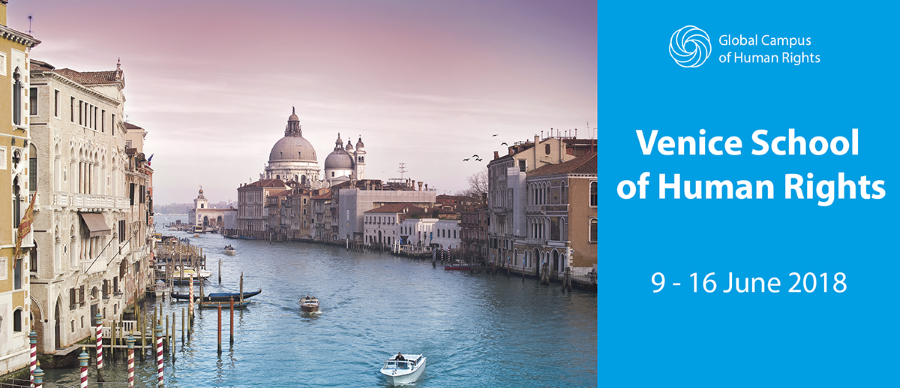
Venice School Of Human Rights: program for 9-16 June 2018

February 23, 2018
Banner Venice School PCDN

The Venice School of Human Rights (created in 2010) wants to highlight that the respect for human rights is the responsibility of all, that “Human Rights are our responsibility”.

THE PROGRAMME

After a first joint session, participants will be divided in the three thematic clusters following the choice made upon enrollment. Clusters will focus on Business & Human Rights, Human Rights Defenders and Women, Peace and Security.

Cluster on Business & Human Rights: recent trends and developments

Under the leadership of Giulia Di Tommaso, an international lawyer with over twenty years of global experience in Legal and Public Affairs on a wide range of business issues, the course explores the interdisciplinary components of the Business and Human Rights agenda and provides thoughtful insights on the most recent developments from experts representatives from Academia, International Organizations and Institutions (EU, UN, FAO, OECD), and the private sector

Cluster on Human Rights Defenders

Under the responsibility of George Ulrich, Program Director of the European Master in Human Rights and Democratization (EMA), the cluster on Human Rights Defenders will review a cross-section of instruments, policies and coordination mechanisms that have been devised to protect and facilitate the work of human rights defenders. It will also explore possibilities for reinforcing the work of human rights defenders through a targeted engagement with international, regional and national human rights mechanisms as well as civil society organisations operative in areas intersecting with the work of local human rights defenders giving particular attention to contexts of imminent threat to human rights, notably conflict and post-conflict situations and situations of repressive governance, as well as sexual and gender-based violence.

Cluster on Women, Peace and Security in a growing extremist and militarised world: Agenda, implementation gap and the transformative approach & potential of CEDAW

The cluster under the leadership of Kalliope Agapiou-Josephides, Chairperson of the European Institute for Gender Equality (EU Agency) and former Vice-President of the European Inter University Centre for Human Rights and Democratisation will provide a state of the art critical appraisal on the Women, Peace and Security agenda in a growing extremist and militarised world and stimulate reflection on achievements, key challenges and ways ahead. Participants will have the opportunity to refine their knowledge on both empirically and theoretically informed analyses and highly benefit from discussions with experienced field activists, leading scholars and world-class decision-makers.

Opening and Closing Lectures

The Opening Lectures of the School will be held by Manfred Nowak, EIUC Secretary General and Dalia Leinarte, Chairperson of the CEDAW Committee. Manfred Nowak, Professor of international law and human rights at the University of Vienna, has been the United Nations Special Rapporteur on Torture and member of the United Nations Working Group on Enforced or Involuntary Disappearances. Dalia Leinarte, Professor of Family History at Vilnius University is the Director of the Gender Studies Centre at Vilnius University and  Member of the working group for Action Plan for the Implementation of UN Security Council Resolution 1325 on Women, Peace and Security.

The Closing Lecture of the School will be held by Ambassador Mara Marinaki, the Principle Gender EEAS Advisor on the Implementation of UNSCR 1325 on Women, Peace and Security. Ambassador Mara Marinaki is a law graduate from the University of Athens, and holds an LL.M in International Law from the Aristotelian University of Thessaloniki.

Dates: 9 – 16 June 2018

Application deadline: 23 April 2018

For any query about the Venice School of Human Rights you can drop a mail to veniceschool@eiuc.org or visit https://eiuc.org/school

https://pcdnetwork.org/blogs/venice-school-of-human-rights-4/
Amnesty’s Annual report 2017 is out: depressing but rays of hope

February 22, 2018

Amnesty International´s annual report, The State of the World’s Human Rights 2017, assesses the human rights situation in 159 countries and delivers a most comprehensive analysis of the state of human rights in the world today. Here follow some summaries form the media:

AI itself highlights in the launch on 22 February 2018, the deepening human rights crisis in the Americas.  “People across the Americas faced a deepening human rights crisis fuelled by growing government intolerance of dissent and increasing demonization in political rhetoric that cemented its status as one of the most violent and unequal regions in the world“, Amnesty International warned. Nevertheless, the organization found that a growing resistance movement of both first-time and seasoned activists provides real hope of reversing the slide towards oppression and fear.

The report highlights alarming trends for the state of human rights in the Americas, including:

  • High levels of violence that continued to ravage the region, with waves of unlawful killings, enforced disappearances and arbitrary detentions. In Mexico, more than 34,000 people remained missing, and extrajudicial executions were rife. A year on from Colombia’s historic peace agreement, violence was still a daily part of life, and an estimated 60,000 people were forcibly displaced due to armed conflict in 2017 alone, according to official numbers.
  • Venezuela continues to face a serious human rights crisis, fuelled by the escalation of government-sponsored violence to respond to the increasing social discontent created by rising inflation and a humanitarian crisis. Thousands of people were arbitrarily detained and there were many reports of torture and other ill-treatment.
  • Latin America and the Caribbean remained as the most violent regions in the world for women and girls, despite strict laws aimed at addressing the crisis. The region has the world’s highest rate of non-intimate partner violence against women, and the second highest rate of intimate partner violence.
  • Ongoing intimidation and attacks against community leaders, journalists and activists who stood up for human rights. Environmental defenders were among the most at risk. Of the 188 environmental defenders killed in 2017, 110 took place in the Americas, according to the NGO Front Line Defenders.
  • Deepening discrimination and neglect of the rights of rural communities and Indigenous Peoples, including their rights to their ancestral territory and to free, prior and informed consent on projects affecting them. From Peru to Nicaragua, national and transnational corporations sought to take control of land away from Indigenous Peoples and peasant farmers, affecting their livelihoods and contaminating their basic resources.
  • A rapidly out of control yet largely invisible refugee crisis as hundreds of thousands of people from some of the world’s most violent countries, including El Salvador and Honduras, were denied urgent asylum.

Yet these injustices have also inspired many more people to join long-standing struggles, and the report details many important achievements that human rights activists helped to secure. These include lifting the total ban on abortion in Chile and the approval of a law to help victims of enforced disappearances in Mexico find their missing loved ones. [see also my: https://humanrightsdefenders.blog/2017/12/31/2017-a-year-to-forget-for-human-rights-defenders-but-dont-forget-the-human-rights-defenders/]

Last year proved that however disenfranchised people were, they refused to resign themselves to a future without human rights. Emerging social discontent inspired people to take to the streets, stand up for their rights and demand an end to repression, marginalization and injustice,” said Erika Guevara Rosas, Americas Director at Amnesty International The Americas was at the hub of this new wave of activism. The “Ni Una Menos” (“Not one woman less”) movement denounced violence against women and girls across the region, while survivors of gender-based and sexual violence in Argentina, Mexico, Jamaica, Peru, and many other countries took to the streets to protest against impunity for such crimes.

Protesters and refugees bear the brunt of ‘normalized’ violence: Hundreds of activists were killed last year as authorities sought to repress civil society and muzzle the media, the report says. Human rights defenders faced threats, harassment and attacks in most countries in the region, while states failed to protect them and acknowledge the importance of their work.

The injustice of President Trump’s cruel pledge to build a wall along the USA-Mexico border was emphasized by Central America’s ongoing refugee crisis. More than 50,000 people from Honduras, Guatemala and El Salvador sought asylum in other countries, thousands of whom were then apprehended at the US border. Mexico received a record number of asylum applications but repeatedly failed to provide protection to those who needed it – instead pushing people back to highly dangerous situations.

The numbers of people fleeing Venezuela rocketed as it faced one of the worst human rights crises in its recent history, fuelled by an escalation of government-sponsored violence. When the country’s crippling shortage of food and medical supplies sparked protests, the security forces’ heavy-handed response lead to more than 120 deaths.

Instead of trying to suppress people when they speak out, governments should address their concerns, said Amnesty International.

We are witnessing history in the making as people rise up and demand justice in greater numbers. If leaders fail to discern what is driving their people to protest, then this ultimately will be their own undoing. People have made it abundantly clear that they want human rights: the onus now is on governments to show that they are listening,” said Salil Shetty, Secretary General of Amnesty International.

[for last year see: https://humanrightsdefenders.blog/2017/02/24/2017-10-need-to-reset-for-human-rights-movement/]

Interesting to note the different emphasis placed on the report such as in the Al-Jazeera article: “World leaders abandoning human rights: Amnesty

World leaders are undermining human rights for millions of people with regressive policies and hate-filled rhetoric, but their actions have ignited global protest movements in response, a rights group said. US President Donald Trump, Russian leader Vladimir Putin, and China’s President Xi Jinping were among a number of politicians who rolled out regressive policies in 2017, according to Amnesty International’s annual human rights report published on Thursday. The human rights body also mentioned the leaders of Egypt, the Philippines and Venezuela. “The spectres of hatred and fear now loom large in world affairs, and we have few governments standing up for human rights in these disturbing times,” Salil Shetty, Amnesty’s secretary-general, said. “Instead, leaders such as el-Sisi, Duterte, Maduro, Putin, Trump and Xi are callously undermining the rights of millions.”  [see also my https://humanrightsdefenders.blog/2018/01/19/ai-welcomes-resistance-to-trumps-human-rights-policies/]

Radio Free Europe/Radio Liberty also focuses on the US angle: Amnesty International has taken aim at U.S. President Donald Trump and other world leaders the global watchdog says are abandoning human rights, accusing them of setting a “dangerous precedent” for other governments to follow. And then gives a useful summaries of countries in its region:

Central Asia

Afghanistan

Armenia

Azerbaijan

Belarus

Bosnia-Herzegovina

Georgia

Moldova

Russia

Ukraine

Adding  Iran and Pakistan.


Euronews obviously also focus on Europe:  Between eastern Europe’s “hostile discourse to human rights” and the rights of freedom of association and assembly put at risk in the entire continent, this year’s Amnesty International World Report warned that “space for civil society continued to shrink in Europe” and gives then a thematic overview of the key takeaways for Europe from the report.

https://www.amnesty.org/en/latest/news/2018/02/deepening-human-rights-crisis-spurs-new-era-of-activism-in-the-americas/
http://www.aljazeera.com/news/2018/02/world-leaders-abandoning-human-rights-amnesty-180221174518140.html
https://www.rferl.org/a/amnesty-international-trump-other-leaders-setting-dangerous-precedent-abandoning-human-rights/29055935.html
http://www.euronews.com/2018/02/21/-space-for-civil-society-continued-to-shrink-across-europe-report-says

Michel Forst: “Empowering defenders on the move is crucial to the prevention of further tragedy”

February 20, 2018

The ISHR in a piece of 16 February 2018 draws attention to tow complementary reports on the situation of human rights defenders in a migration context. They fit admirably with the outcry of 250 NGOs concerning Hungary referred to in my earlier post of today [https://humanrightsdefenders.blog/2018/02/20/250-ngos-address-letter-to-hungarian-parliament-regarding-restriction-on-the-work-of-human-rights-defenders/].

The first is the report, by UN Special Rapporteur Michel Forst, which examines the many ways in which human rights defenders are impacted by the current environment related to migrant and refugee flows. For example, defenders may become migrants or refugees as a result of the harassment and violence they face in their own communities or countries. ‘Empowering defenders on the move is crucial to the prevention of further tragedy‘.

The second is the OHCHR Principles and Practical Guidance for the protection of the Human Rights of Migrants in Vulnerable Situations, especially Principle 18 which states that ‘States must respect and support the activities of human rights defenders who promote and protect the human rights of migrants’.

Both document will be considered at the upcoming session of the UN Human Rights Council.

The two documents are fully complementary’, Sarah Brooks of the ISHR says. ‘The recommendations of the OHCHR and the UN expert have no daylight between them – their message is quite simple. In order for lives to be saved, States must ensure that human rights defenders and civil society can operate safely and without hindrance.’

Migrants – including migrant workers – who seek to stand up for their rights and those of others face unique threats, including deportation.  The case of Sujana Rana and Rose Limu Jee, two migrant domestic workers from Nepal who were detained and deported after advocating for freedom of association in Lebanon, is a prime example. And defenders in countries of destination – whether the Gulf, the United States, or many Member States of the European Union (e.g. Hungary) – find that their own governments may rollback protections or even funding for civil society and defenders when migration-related issues are the focus, or in the worst cases criminalise assistance to migrants and refugees.

Main challenges

  • Limits on access to migrant and refugee populations. This can appear as overt limits on physical presence in border areas or due to the remote nature of some areas where populations on the move are concentrated. This includes securitised border zones and offshore facilities.  In both cases, the real impact is to increase physical and financial barriers to access, preventing people on the move from accessing independent services and much-needed legal counsel.
  • Criminalisation. Some defenders struggle against risks of criminal prosecution both nationally and as a result of local bylaws, particularly registration requirements (based on geographic areas of work, for example). The overzealous application of existing law has also been sued to accuse people of harbouring or smuggling, when in reality the individual was engaged in humanitarian activity. This threat of criminal charges has a chilling effect, as does the decrease in funding for organisations working in this area (both anti-racism work and traditional legal aid centres).
  • The growing role of non-state actors.  Especially in some parts of Latin America, organised crime poses significant threats to defenders, as well as to States should they try to protect them. Businesses are also implicated, as the report notes particular types of private employment contracts which ‘gag’ service providers and impose outsized fines or criminal penalties for discussing the situation.  Finally, in cases where governments have outsourced certain services, tools like access to information requests (normally directed at public authorities) are no longer available.

http://www.ishr.ch/news/hrc37-global-community-must-recognise-defenders-people-move-says-un-expert

Click to access 201802_ohchr_principles_and_practical_guidance.pdf

South African human rights defender turned teacher among the last ten nominees for the Teacher Prize

February 16, 2018
, a Forbes contributor on Africa, reports that Marjorie Brown, a South African teacher has been named a top 10 finalist for the Varkey Foundation Global Teacher Prize 2018, which was announced today by Microsoft founder and philanthropist Bill Gates at globalteacherprize.org.

Now in its fourth year, the US$1 million award is the largest prize of its kind. In a special video message announcing the top ten finalists, Bill Gates paid a glowing tribute to the work of teachers around the world. “When you think about what drives progress and improvement in the world, education is like a master switch—one that opens up all sorts of opportunities for individuals and societies….and research has shown that having a great teacher can be the most important factor that determines whether students get a great education,” he said.

Marjorie Brown is a former human rights defender who teaches history to female students at Roedean School, Johannesburg, whilst encouraging critical thinking and global citizenship. Her students have gone on to represent South Africa at youth forums, the Paris Climate Talks and various Ivy League universities.

Italian tenor Andrea Bocelli (L) performs during the Global Teacher Prize ceremony in Dubai on March 19, 2017. Photo credit should read KARIM SAHIB/AFP/Getty Images)

She is widely credited with bringing the New Zealand originated Kids Lit Quiz programme, devoted to improving children’s literacy, to South Africa. This global quiz programme now has more than 100 South African schools participating, which has boosted the stocks of books in libraries throughout the land and mobilized teachers to act as coaches and reading champions with students. Marjorie also founded the Phendulani literacy quiz, which will have spread to over 100 schools this year, while the South African Department of Education plans to introduce it to 45 reading clubs involving over 225 pupils, with publishers Pan Macmillan aiming to start a Phendulani quiz in a poor area near Johannesburg.

Marjorie Brown and the other finalists were selected from over 30,000 nominations and applications from 173 countries around the world. The top ten were subsequently narrowed down from a top 50 shortlist that was announced in December 2017… The other nine finalists for the Global Teacher Prize 2018 come from turkey, Brazil Norway, Belgium and the United States among other countries.

 https://www.forbes.com/sites/mfonobongnsehe/2018/02/14/1-million-global-teacher-prize-2018-south-african-teacher-marjorie-brown-makes-top-ten/#262cf2594901

Trailer for Human Rights Watch Film Festival 2018 in London

February 15, 2018

Trailer for Human Rights Watch Film Festival in London. From 7-16  March, 2018, in London.

For information and tickets: https://ff.hrw.org/

https://humanrightsdefenders.blog/2016/05/27/trailer-of-the-human-rights-watch-film-festival-new-york-10-june/

Human Rights Accountability of Non-State Actors – lecture in Leuven

February 14, 2018

The Leuven Centre for Global Governance Studies is organising the SPRING LECTURE SERIES 2018 under the theme: UNDER SIEGE: HUMAN RIGHTS AND THE RULE OF LAW.

On Monday 26 February 2018 – from 11h00 – 13h00 – (Tiensestraat 41, LeuvenDr. Kasey McCall-Smith will speak about “Human Rights Accountability of Non-State Actors (MNEs, NGOs, …): the Next Frontier”.

[The negative impact on human rights by business activity has been the focus of much academic and public policy debate. In no other field of law has the stubbornness of the public and private international law divide been exposed more starkly and with such devastating effects for individuals. Human rights law discourse has spent the last two decades debating the impact of business activity on human rights and the UN Guiding Principles on Business and Human Rights was hailed as a great victory. But, as rightly noted by the Special Rapporteur on Business and Human Rights, the UN Framework and Guiding Principles was simply the end of the beginning of the debate. International law has yet to catch up with the realities of business activity and its impact on human rights and the environment. This lecture will look at the key soft law developments of the past decade, the push to ‘harden’ these soft law initiatives, and examine a case study on smartphone supply chain management to elaborate the difficulties of reconciling human rights accountability and abuse by non-state actors. The legal issues raised in respect to multinational enterprises will also be considered in light of increasing pressure to hold other non-state actors to account, such as international organisations and NGOs. Ultimately, the lecture will contribute ideas about how to move forward on the next human rights frontier.]

Dr. McCall-Smith is a lecturer in Public International Law and programme director for the LLM in Human Rights. She is a US qualified lawyer and holds a BA in Architectural Studies (1998) and Juris Doctor (2001) from the University of Arkansas. Dr McCall-Smith was awarded an LLM (2002) and a PhD (2012) for her thesis on ‘Reservations to Human Rights Treaties’ by the University of Edinburgh. She is currently the Chair of AHRI, the Association of Human Rights Institutes. McCall-Smith’s research focuses primarily on treaty law and how treaties are interpreted and implemented at the domestic and supranational levels. Ensuring clarity in the law of treaties, specifically in reference to reservations to human rights treaties, is a major theme that she has pursued. She interested in the role of the UN human rights treaty bodies as generators of law. The increasingly blurred distinction between public and private international law in terms of human rights protection is another of her research interests.

Participation is free, but register by Friday 23 February at the latest

see also: https://humanrightsdefenders.blog/2016/06/07/leuven-centre-for-global-governance-studies-organizes-new-mooc-on-human-rights-as-from-21-june/

https://mailchi.mp/kuleuven/event-414449?e=bf340a3bd5

Another one bites the dust…the future of the UN High Commissioner for Human Rights

February 13, 2018

David Petrasek, Associate Professor at the Graduate School of Public and International Affairs, University of Ottawa, wrote on 8 February 2018 an interesting piece under the title: “Another one bites the dust—what future for the UN High Commissioner for Human Rights?” (Openglobalrights.org) and wondered whether the early departure—yet again—of a UN High Commissioner for Human Rights doesn’t suggests it’s time to re-think the office’s priorities and strengthen its mandate (rather than more activism).

After the announcement in December 2017 by Prince Zeid Ra’ad al-Hussein of Jordan that he would not seek a second term as UN High Commissioner for Human Rights, I wrote that “while most high level United Nations officials serve as long as their mandate allows, no single Human Rights Commissioner has served a full four-year second term” [https://humanrightsdefenders.blog/2017/12/22/bound-to-happen-but-still-high-commissioner-zeid-announces-he-will-not-seek-second-term/].

The piece is worth reading and poses well the difficult dilemma:

Petrasek states: Zeid’s untimely departure therefore begs the question—is the job do-able? In fulfilling the mandate, must the UN’s top human rights official so annoy governments that they cut short her or his tenure? Is that a price worth paying? It would certainly strengthen the High Commissioner’s position if they were given a single six or seven-year term, getting out from under the Damoclean sword of renewal at four years.

Zeid has been a prominent and eloquent spokesperson in defense of human rights,..Clearly, this won him few friends among powerful countries, the US included. But it’s less clear that his outspokenness made much difference. It’s worth asking: should the High Commissioner prioritize speaking out even if the cost of doing so is to lose the political support necessary to fulfil her or his full mandate? The High Commissioner is not only the UN’s human rights conscience. She or he is also tasked with co-ordinating the UN’s myriad human rights activities, pursuing an active—and perhaps less public—human rights diplomacy, and leading efforts to reform often overlapping, outdated and cumbersome UN procedures.

The idea for a UN High Commissioner for Human Rights was put forward by civil society in the lead up to the Vienna World Conference on Human Rights in 1993. Many functions were suggested for inclusion in the High Commissioner’s mandate, but the non-negotiable core demand was simple—the High Commissioner must have an overarching duty to promote and protect human rights anywhere.The High Commissioner was, therefore, a giant leap forward—personified in the post was the UN’s general human rights mandate, grounded in the UN Charter. She or he was now able to act whenever and wherever rights were at risk.

This general protection mandate has produced real results: High Commissioners have put neglected crises on the global agenda; there’s been a much-needed shift to the field of human rights staff, and the High Commissioner has amplified the voices of local human rights defenders.

Yet, today the High Commissioner’s voice is often only one amongst many. There are almost 60 independent human rights monitors (“Special Rapporteurs”) .. in 1993, there were barely a dozen. Similarly, today UN human rights inquiries are investigating crimes against humanity and war crimes in five countries, and eight investigations have concluded in the past decade. The Council regularly meets in emergency session, there is an International Criminal Court, and the UN Security Council often (if inconsistently) includes human rights concerns in its resolutions, a rare occurrence in 1993. The Security Council has also authorized the deployment of over 1,000 human rights staff to UN peacekeeping missions. They too issue reports and statements of concern, as increasingly does the UN Secretary-General.

In short, the gap identified in 1993 has narrowed considerably, at least as concerns the UN pointing a finger at human rights abusers.

But other gaps remain and widen. The growth in UN human rights mechanisms has not been accompanied by an obvious growth in their efficiency or effectiveness. Indeed, multiple and overlapping procedures are weighing down what should be a nimble and responsive system. Further, although at least since the late 1990s High Commissioners have prioritized putting staff in the field, more than half remain in Geneva and New York; in contrast, the UN Refugee Agency has 87% of its staff in the field. This imbalance seriously undermines the Office’s ability to pursue an effective human rights diplomacy. And the relative weakness and underfunding of the High Commissioner’s Office means it is hard-pressed to co-ordinate UN system-wide approaches. It has been over a decade since it has proposed any significant reforms.

The conclusion might seem obvious—the High Commissioner should spend less time speaking out and more time strengthening and reforming both his Office and the UN human rights system. A less public profile, in this view, might produce less resistance to much-needed reform—diplomacy succeeding where activism fails.

Flickr/UN Geneva (CC BY-NC-ND 2.0-Some Rights Reserved)


Of course, it’s not that simple. Many states are reluctant to see the UN’s human rights efforts strengthened, regardless of what the High Commissioner is saying or not. And though a more ‘diplomatic’ approach might suit some states, it will at the same time alarm civil society and activists who look to the High Commissioner for leadership. Even if states might ignore denunciations from Geneva or New York, an activist High Commissioner undoubtedly gives comfort and support to beleaguered human rights defenders.

There are no easy answers to the question posed. Perhaps it’s simply unfortunate but necessary that the High Commissioner’s mandate is a poisoned chalice—do the job well, and you’re unlikely to be re-appointed. However, given the many changes since 1993, it is worth reflecting more deeply on how this mandate might be credibly pursued so that High Commissioners depart when the job is done, not when states determine their time is up.

A single, lengthier term is one proposal, but others might be considered, including better co-ordination between the High Commissioner and the Council’s independent experts to leverage more diplomatic space. The current High Commissioner will depart in August and the key players are already politicking to appoint a successor. If she or he is not to meet a familiar fate, then now is the time to re-think priorities and strengthen the mandate.


(David Petrasek was formerly Senior Policy Director and Special Adviser to the Secretary-General of Amnesty International. David has worked on human rights and conflict resolution issues with the UN, foundations and NGOs for over 25 years.)

https://www.openglobalrights.org/another-one-bites-the-dust-what-future-for-the-un-high-commissioner-for-human-rights/?lang=English

Enough break-ins is enough say Ugandan human rights defenders

February 12, 2018
I wrote earlier about the suspiciously high rate of break-ins in the human rights community in Kampala [https://humanrightsdefenders.blog/2016/06/14/uganda-ngo-offices-regularly-ransacked-coincidence/]. The Ugandan Observer of 12 February writes: “Angry human rights workers camp at Old Kampala police

Police has called for calm and patience from furious staff of human rights awareness and promotion forum-Uganda (HRAPF), who’d staged a protest at Old Kampala police station following a second break-in into their offices last week. Nearly two years after the first break-in on May 22, 2016 – leading to the brutal murder of the security guard on duty Emmanuel Arituha; last week on February 9, HRAPF offices in Kampala were again broken into by unknown assailants.

Some of HRAPF staff and partners in a meeting with police station DPC

Armed with placards, HRAPF staff camped at Old Kampala police station to demand for the immediate conclusion of the investigations into the now rampant breaking into NGO offices. Following a meeting with senior police officials at the station, police acknowledged the need for quicker investigations and promised to provide armed guards to the NGO until the investigations are concluded. For the first break-in investigations, police officials reportedly said the file had been called to the CIID headquarters but will be recalled to the station to conclude investigations. 

A matrix organised by the by National Coalition of Human Rights Defenders Uganda (NCHRDU), shows that at least 24 premises of Non-governmental organisations and civil societies have been broken into since 2012.

…..

Organisations such as the Uganda Land Alliance, the Foundation for Human Rights Initiative, the Legal Aid Service Providers Network, Akina Mama Wa Afrika and the Anti-Corruption Coalition have suffered break-ins in similar fashion and, despite timely reports to the police on all occasions, investigations have been unsatisfactory and the follow up insufficient.

This is the latest in a series of attacks against civil society organisations which, regardless of the motivations of the assailants, points to the increasing lack of protection provided to human rights defenders in Uganda, said Jjuuko.

http://observer.ug/news/headlines/56884-angry-human-rights-workers-camp-at-old-kampala-police.html

https://76crimes.com/2018/02/09/unchecked-criminals-hit-ugandan-civic-groups/

Pakistan: summary justice by the police is widespread

February 10, 2018

On 4 February 2018 the Pakistani newspaper The News on Sunday carried the story “Punjab police has a history and reputation of staging fake police encounters. Has anything changed?

A solution for speedy justice
Fake police encounters are said to be more rampant in Punjab province and some urban centres of Sindh, including Karachi. If one takes the case of Punjab, one finds such encounters to be a popular and preferred method of ‘dispensing justice’ adopted by the police. Police encounters have been staged for long but their number is said to have skyrocketed during the tenures of Shehbaz Sharif as the chief minister of Punjab. This has led to the perception that he has full trust in this method of controlling crime and patronises police officers known as encounter specialists. Prized postings and out-of-turn promotions for such officers strengthen this perception.

After tracing the history of police encounters in Punjab the article states that “Killings through police encounters got an exponential boost after Shehbaz Sharif came to power in Punjab in 1997. It was in July 1999 that BBC carried a news story that 850 suspected criminals had been killed by the police in encounters since the PML-N government had taken over in the province. The fact that 20 of them had been killed in just one week in May 1999 had disturbed human rights defenders all over the world. This killing spree was also observed during his second tenure that started in 2013. In 2015 alone, 440 suspects were killed in police encounters in Punjab.

Ejaz Butt, a crime reporter based in Lahore, recalls the time when he says police was said to have been asked by the Shehbaz Sharif government to decimate the top 10 gangsters of the city. He says police would stage encounters without any fear and hold press conference a day before with the criminals in handcuffs. “The officers would tell reporters to ask questions from criminals, saying they would be killed in shootout the next day,” he adds. The need for this clean-up operation was felt when the trader community of the city became fed up with excessive demands for extortion money and paid assassins who were operating everywhere.

Butt says the encounter experts are very much clear about who to shoot down. “The criminals who have fired at policemen, raped female inmates during robberies, killed abducted children even after getting ransom, molested minors, indulged in multiple murders, including those of witnesses are not spared,” he adds. He says they opt for this method as it is difficult to establish these crimes in courts and letting them go will make them commit the same crime again.

Every time there is an encounter there is a judicial inquiry but most of the time fake encounters are hard to establish. Why is it so? Butt explains the reason is that “encounter specialists are also expert in making the encounter plan and executing it. They prepare a sketch of the crime scene beforehand and fire bullets at police van with unlicensed weapons, claimed to be owned by the criminals. Besides, there is no eyewitness because all the roads and pathways leading to the venue of the encounter are blocked for public before it is carried out.”

Sarmad Saeed Khan says the fake encounters are not probed properly because they are done at the behest of the government. “Not even a single fake encounter can be staged by a police officer on his own”. He says not “every police officer is ready to take these orders and only those agree who get the blessings of the government”.

Though these police officers got out-of-turn promotions, he says, “the Supreme Court reversed these which is a good step. But despite this, these officers obey unlawful orders from the government to kill people in encounters. These dreaded officers are also used to pressurise political opponents whenever needed,” he adds.

If there are any demands for investigation, complainants are warned that they can be taken as those attackers if they keep on demanding an inquiry. Moreover “The problem unfortunately is that even the blood relatives disassociate themselves from such cases and disown the deceased due to the stigma attached to them.”

http://tns.thenews.com.pk/solution-speedy-justice/#.Wnni02Z7GV4


The saga of the “anti-NGO” committee in the UN continues

February 9, 2018

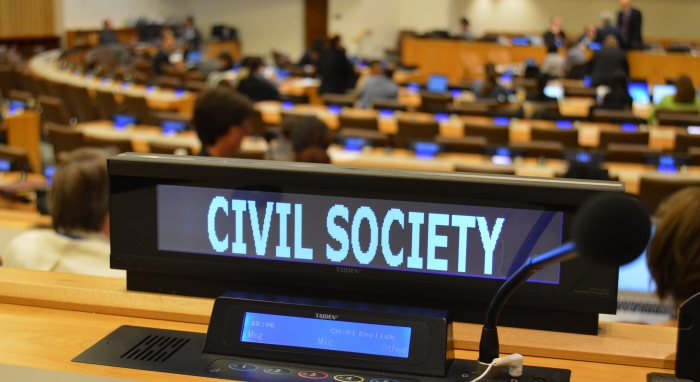
This blog has several times paid attention to the rather weird situation that the UN “NGO Committee” (at NY level) has a rather negative attitude towards the very NGOs that it is supposed to assist. See e.g.:

https://humanrightsdefenders.blog/2016/06/01/ngo-committee-of-the-un-shows-its-bizarre-bias-against-human-rights-ngos/

https://humanrightsdefenders.blog/2016/05/04/ishr-starts-campaign-to-monitor-committee-that-throttles-ngo-access-to-the-un/

https://humanrightsdefenders.blog/2016/02/08/un-committee-on-ngos-denies-ngo-the-right-to-speak/

https://humanrightsdefenders.blog/2015/06/07/uns-ngo-committee-seems-not-very-fond-of-ngos/

https://humanrightsdefenders.blog/2015/05/04/jean-daniel-vigny-hopes-to-improve-ngo-participation-at-the-un/

Now, on 29 January 2018, the International Service for Human Rights (ISHR) came out with the video above as well as the following statement:

A group of regional and international human rights NGOs was blocked from making a statement at the UN NGO Committee session today.  Despite a precedent set two years ago for the delivery of a general statement, all requests since have been refused.  Read here the NGOs’ call for leadership and reform:

Today a group of NGOs sought to deliver a general statement  urging the Committee to embrace the principles of transparency, accountability and accessibility in its work to ensure its practice is fair, expeditious and apolitical. The ECOSOC NGO Committee reviews applications for accreditation, providing a gateway for NGOs into the UN.  It has been much criticised – by States, UN officials and NGOs – for practices including repeated questioning of applicants and multiple deferrals of applications for no good reason. The NGOs’ attempt to speak was blocked.

ISHR along with Amnesty International, Civicus, Conectas Diretos Humanos, Human Rights Watch, Jacob Blaustein Institute for the Advancement of Human Rights, International Commission of Jurists and Outright Action International came with two key calls for Committee and observer States, related to participation and membership.

1/  The NGO Committee must provide for remote participation by accredited NGOs:

ECOSOC recently requested the NGO Committee to institute regular meetings with accredited NGOs in regard to the ‘evolving relationship’ between NGOs and the UN. Despite the fact that these have been required since 1996, the meeting scheduled to take place in the next months, will be the first. The NGOs urge that provision be made for remote participation by accredited NGOs unable to travel to New York for the meeting. ‘Clearly, access to UN conversations should not be limited to those who have resources to travel to New York or Geneva or other major UN hubs.  A diversity of voices should be heard,’ they note.  ‘We hope that States will ensure that the principle of accessibility to UN processes will be applied when defining working methods for the upcoming meeting.’

2/  States with good records on key freedoms should stand for membership of Committee:

Safeguarding civil society space at the UN is an essential component in the struggle to protect civil society space globally.  With this in mind, the NGOs call on all States with a commitment to defending the work of civil society to put themselves forward as candidates for the elections to the Committee in April. ‘Action to defend civil society space at the UN starts here at this very Committee’, say the NGOs.

Uruguay invokes ‘right to be heard’ as statement is blocked:

In response to China and Russia’s objections to the presentation of the NGO statement, Uruguay spoke forcefully in favour of hearing from civil society.  Opposition to the NGOs’ ‘right to be heard’ went against the principle of transparency in Committee practice, Uruguay said.  It also represented a step back by a Committee whose very mandate speaks to strengthening links between NGOs and the UN system.

Through their statement, civil society could provide insights that contribute to improving the work of the Committee,’  Uruguay noted. Hearing the statement ‘would allow the Committee to understand civil society’s ideas, experiences and expectations.’ The EU, UK and US also made statements of support.  These were not enough to overcome the opposition.

As we were not permitted to deliver our statement to the Committee today, we shall now request a written version be circulated to all ECOSOC members,‘ said ISHR’s Eleanor Openshaw, reflecting on the morning’s events. ‘We shall also look into ways to ensuring NGOs can make general statements at the Committee in future.

https://www.ishr.ch/news/ngo-committee-ngos-blocked-delivering-statement