Archive for the 'Human Rights Defenders' Category

Report on the 51st session of the Human Rights Council

October 14, 2022

The International Service for Human Rights (ISHR) and 12 other NGOs gave a joint assessment of the 51st session of the Human Rights Council which was held from Monday 12 September to Friday 7 October 2022. [see also: https://humanrightsdefenders.blog/2022/09/20/human-rights-defenders-at-the-51st-session-of-the-un-human-rights-council/]

We welcome that for the first time, the Council heard from two representatives of directly impacted communities from the podium in the enhanced interactive dialogue with the High Commissioner and the International Independent Expert Mechanism to Advance Racial Justice and Equality in Law Enforcement: Collette Flanagan of Mothers against Police Brutality (MAPB) whose son was killed by United States‘ police in 2013; and Jurema Werneck, director of Amnesty International in Brazil. As highlighted in the HC’s report, States are continuing to deny the existence and impact of systemic racism, especially institutional racism. Our view is that States actively protect the interests of police institutions in order to maintain the status quo which is designed to oppress Africans and people of African descent.  We call on States to fully implement the Durban Declaration and Programme of Action (DDPA), to fully cooperate with the International Independent Expert Mechanism to Advance Racial Justice and Equality in the context of Law Enforcement including accepting country visits, implement the recommendations from their report and the High Commissioner’s Agenda towards Transformative Change for Racial justice and Equality.

We welcome the ‘from rhetoric to reality: a global call for concrete action against racism, racial discrimination, xenophobia and related intolerance’ resolution. The resolution, interalia,  strongly condemns the discriminatory treatment, unlawful deportations, excessive use of force and deaths of African migrants and migrants of African descent, including refugees and asylum-seekers, at the hands of law enforcement officials engaged in migration and border governance. It calls on States to ensure accountability and reparations for human rights violations at borders and to adopt a racial justice approach, including by adopting policies to address structural racism in the management of international migration. It reiterates that the Transatlantic Trade in Enslaved Africans and colonialism were grave violations of international law that require States to make reparations proportionate to the harms committed and to ensure that structures in the society that are perpetuating the injustices of the past are transformed, including law enforcement and administration of justice and to dispense reparatory justice to remedy historical racial injustices…..

We welcome the resolution on the “human rights implications of new and emerging technologies in the military domain” and its request for a study examining these implications. The adoption of the resolution adds to the growing attention that UN human rights mechanisms are paying to the negative human rights impacts of arms, including new technologies that can be weaponised.  It is undoubtable that concerns relating to the military domain should not be seen as only relevant to disarmament fora. In response to comments from some States on whether international humanitarian law (IHL) falls within the remit of HRC, we recall that international human rights law and IHL are complementary and mutually reinforcing, as the HRC itself has reiterated on several occasions in past resolutions. We welcome the inclusion of paragraph on the responsibility to respect human rights of business enterprises, and in this regard, we recall the Information Note by the UN Working Group on Business and Human Rights on the Arms Industry (“Responsible business conduct in the arms sector: Ensuring business practice in line with the UN Guiding Principles on Business and Human Rights”) published in August 2022. While we welcome the reference in the resolution to the role of human rights defenders and civil society organisations in raising awareness about the human rights impacts of the use of new and emerging technologies in the military domain, we regret that it does not include a specific mention of the risks that the use of these technologies can pose for human rights defenders and civil society organisations.

We welcome the resolution on arbitrary detention and especially the inclusion of a new paragraph on the necessity to fully implement the Declaration on Human Rights Defenders. The resolution recognises the role of HRDs, peaceful protesters, journalists and media workers in safeguarding the prohibition of arbitrary deprivation of liberty and calls upon States to make sure that they are not arbitrarily detained as a result of their activities. We further commend the main sponsor, France, for having rejected any language that could have weakened the resolution, especially on the right to legal assistance.

We welcome the adoption of the safety of journalists resolution. It has now been a decade since the first resolution on this topic, and the HRC has since created an elaborate and robust set of international standards to protect journalists. This iteration of the resolution adds new strong commitments on multiple new and emerging issues affecting journalists, from strategic lawsuits against public participation to extraterritorial attacks. It also strengthens language on investigations into attacks against journalists, calling on authorities to exhaust lines of enquiry that determine whether such attacks are linked to their journalistic work. We now urge States to implement these commitments to their full extent.

We welcome the approval by consensus by the Council of the resolution on terrorism and human rights, that has been updated with important paragraphs related to the centrality of the rule of law and human rights to counter terrorism, international human rights obligations in transfers of terrorist suspects, profiling of individuals, detention, the right to a fair trial and other due process guarantees, the right to privacy and freedom of expression, and in relation to children rights and civil society. We regret that paragraphs stemming from security based concerns have increased even though they are unrelated to the competence of the Council to promote human rights.

We warmly welcome the adoption of the resolution on the human rights situation in the Russian Federation, mandating a Special Rapporteur on Russia for the first time. …The Russian Federation’s growing repressive policies, combined with the country’s exclusion from the Council of Europe – victims of new human rights violations committed by the Russian Federation from 17 September lost protection under the European Convention on Human Rights– and its diplomatic isolation from those States which have been supportive of human rights and civil society in Russia, have made it increasingly difficult for Russian human rights defenders, activists, and civil society organisations to engage with the international community. Russian civil society had been vocal in calling for a Special Rapporteur’s mandate, strongly believing it will help to create a bridge between the United Nations and Russian civil society and the wider general public in Russia at an acute moment of widespread domestic human rights violations, both ensuring their voice is heard at an international level, and that the United Nations can further develop its understanding and analysis of the deterioration in Russia’s domestic human rights situation and the implications that has had – and continues to have – for Russia’s foreign policy decisions.

We welcome the extension and strengthening of the OHCHR capacity to collect, consolidate, analyse and preserve evidence and information and to develop strategies for future accountability, as well as to extend the mandate for enhanced monitoring and reporting by the OHCHR on Sri Lanka. Given the complete lack of any credible avenues for accountability at the national level, the OHCHR’s Sri Lanka Accountability Project remains the only hope of justice, more than thirteen years after the war, for thousands of victims of war time atrocities and their families.

We welcome the UN Secretary General’s report on missing people in Syria; and urge States to support and implement the report’s findings, in line with resolution A/HRC/51/L.18 which underscored “the report’s finding that any measure towards addressing the continuing tragedy of missing persons in the Syrian Arab Republic requires a coherent and holistic approach going beyond current efforts, which must be inclusive and centered on victims”. Addressing the issue of missing persons in Syria requires a “new international institution” mandated to clarify the fate and whereabouts of missing persons, to “work in cooperation and complementarity with existing mechanisms”, the body having “a structural element that ensures that victims, survivors and their families […] may participate in a full and meaningful manner in its operationalization and work” as recommended in the study of the Secretary General.

The Council has taken a vitally important step in renewing the mandate of the Fact-Finding Mission on Venezuela and of the reporting mandate of OHCHR for a further two years. In its most recent report, A/HRC/51/43, the Fact-Finding Mission deepened its investigation of alleged crimes against humanity, making clear that alleged perpetrators remain in power. The ongoing accountability drive through the work of the Mission allied with the work of OHCHR, is key to providing victims of violations with hope for justice. It is also key to the prevention of ongoing violations, particularly in the context of upcoming elections, and of encouraging political processes that respect human rights.

We regret that the Council failed to respond adequately to several human rights situations including Afghanistan, China, Philippines, and Yemen.

We welcome the extension and strengthening of the mandate of the Special Rapporteur on Afghanistan. However, this in no way makes up for the Council’s repeated failure to respond to the calls from Afghan human rights defenders, especially women human rights defenders, and civil society for an independent accountability mechanism with a mandate and resources to investigate the full scope of violations abuses that continue to be committed in Afghanistan by all parties and to preserve evidence of these violations for future accountability. It is particularly concerning that despite the overwhelming evidence of gross violations and abuses in Afghanistan that the Council failed to muster consensus on even the bare minimum.

We deplore that this Council was unable to endorse the proposal for a debate on Xinjiang, after the UN identified possible crimes against humanity committed by the Chinese government against Uyghurs and Turkic peoples. Dialogue is a pillar of multilateralism, and is fundamental, even on the hardest issues. Despite the leadership of the core group and all 18 States who voted in favour, this Council looked the other way. We strongly condemn the 19 countries who blocked this proposal, and regret all the abstentions that enabled it. We particularly regret that leading OIC States Indonesia and Qatar, as well as Kazakhstan, Uzbekistan, Pakistan, the UAE, Côte d’Ivoire, Mauritania, Sudan, Gabon, Cameroon and Eritrea, decided to abandon Uyghurs and Muslim minorities in China. We command Somalia for being the only Muslim Council member to stand up for Muslim minorities. Uyghur and international human rights groups won’t give up efforts to hold China accountable. We urgently call on current and future Council members to support efforts to prevent the continuation of atrocity crimes in Xinjiang, and uphold this Council’s credibility and moral authority. [see: https://humanrightsdefenders.blog/2022/10/05/uyghur-issue-at-the-un-human-rights-council-will-there-be-even-a-debate/]

We are deeply disappointed that despite the High Commissioner’s clear recommendation and demands by victims and their families as well as civil society from the Philippines, the Council has failed to put forward a resolution mandating the High Commissioner to continue monitoring and reporting on the situation, allowing the Philippines to use the rhetoric of cooperation and the UN Joint Programme for Human Rights to window-dress its appalling human rights record without any tangible progress or scrutiny.

We are dismayed by an Item 10 resolution that will not allow for reporting to the HRC on the human rights situation in Yemen.   Despite a truce that now looks in danger of collapsing, the humanitarian and human rights crisis in Yemen has not ended.  …Lasting peace in Yemen requires a sustained commitment by the international community to ensure accountability and redress for the millions of victims in Yemen. We call on UN member states to give meaning to the pledges they have made and begin to work toward the establishment of an international independent investigative mechanism on Yemen.

On 10 October 2022 a Blog post of the Universal Rights NGO gave the following quick summary of this session of the Human Rights Council

With Ms. Michelle Bachelet’s mandate as the UN High Commissioner for Human Rights having come to an end on 31 August 2022, and the incoming UN High Commissioner, Mr. Volker Türk, not taking up his official functions until 17 October 2022, Ms. Nada Al-Nashif, opened, as Acting High Commissioner, by presenting a global update on the situation of human rights around the world.

Four new Special Procedures mandate-holders were appointed to the following mandates: the Special Rapporteur on contemporary forms of racism, racial discrimination, xenophobia and related intolerance (India), the Special Rapporteur on the human rights of internally displaced persons (Colombia), the Special Rapporteur on the independence of judges and lawyers (United States of America), and one member of the Working Group on Arbitrary Detention (from Eastern European States).

9 expert members were elected to the Human Rights Council’s Advisory Committee (from Algeria, Angola, China, Qatar, Slovenia, Spain, Uruguay, Bahamas, Brazil).

42 texts (39 resolutions, one decision, and one statement by the President) were considered by the Council. This represents a 52% increase in the number of adopted texts compared to one-year prior (HRC48). Of the 41 adopted texts, 30 were adopted by consensus (73%), and 11 by a recorded vote (27%).

The Council rejected a draft decision to hold a debate on the situation of human rights in the Xinjiang Uyghur Autonomous Region, China by vote (17 votes in favour, 19 against, and 11 abstentions).

Following the adoption by vote of a draft resolution on the situation of human rights in the Russian Federation (17 votes in favour, 6 against, and 24 abstentions), the Council created a new Special Procedure mandate on the situation of human rights in the Russian Federation for a period of one year, and requested the mandate holder to make recommendations and to present a comprehensive report to the Council at its 54th session and to the General Assembly at its 78th session, while calling upon the Russian authorities to cooperate fully with the Special Rapporteur.

The Council further extended the mandates of 8 thematic Special Procedures (i.e., the Independent Expert on older persons; the Special Rapporteurs on the right to development, on contemporary forms of slavery, on the rights to water and sanitation, on Indigenous Peoples, and on the right to health, as well as the Working Groups on arbitrary detention, and on mercenaries), and 7 country-specific mechanisms (i.e., the Special Rapporteurs on Afghanistan, and on Burundi; the International Commission of Human Rights Experts on Ethiopia; the Independent International Fact-Finding Mission on the Bolivarian Republic of Venezuela, the International Team of Experts on the Democratic Republic of the Congo; the Independent Expert on the situation of human rights in the Central African Republic; and the mandate of the Independent Expert on the situation of human rights in Somalia).

25 written amendments were tabled by States ahead of the consideration of texts by the Council but 14 were withdrawn by the main sponsor prior to voting. The remaining 11 amendments were rejected by a vote. Additionally, one oral amendment was brought forward by China during voting proceedings.

31 of the texts adopted by the Council (79%) had Programme Budget Implications (PBI) and required new appropriations not included in previous Programme Budgets. 

https://ishr.ch/latest-updates/hrc51-civil-society-presents-key-takeaways-from-human-rights-council/

https://www.universal-rights.org/urg-human-rights-council-reports/report-on-the-51st-session-of-the-human-rights-council/

The 2022 “Human Rights Defenders Movement at a Crossroad” video report published

October 11, 2022

In September 2022, more than thirty human rights defenders from all over the world took the floor in a moment of a global backlash against the grass-roots movement for human rights and democracy. See: https://humanrightsdefenders.blog/2022/04/20/2021-protectdefenders-eu-annual-report/

The conference “The Human Rights Defenders’ Movement at a Crossroad“ featured the testimonies and experiences of a great diversity of grassroots activists coming from all backgrounds, including Yvette Mushigo (Synergie des Femmes pour la Paix et la Réconciliation des Peuples des Grands Lacs d’Afrique, DRC); Ukei Muratalieva (Nazik Kyz, Kyrgyzstan); Rocío Walkiria Santos Reyes (CEHPRODEC, Honduras); Yasmine Shurbaji (Families for Freedom, Syria); and Monika Maritjie Kailey (Komunitas Masyarakat Adat Marafenfen, Aru Islands, Indonesia).

With the participation of the United Nations Rapporteur on the situation of Human Rights Defenders, Mary Lawlor; the French Ambassador at Large for Human Rights, Delphine Borione; the Inter-American Commission on Human Rights Rapporteur on the Rights of Human Rights Defenders and Justice Operators, Commissioner Joel Hernández García; the Human Development, Migration, Governance, and Peace Unit Acting Director at the European Commission, Chiara Adamo.

“We call on the EU and the Member States to ensure the effective, timely, relevant and comprehensive implementation of the EU Guidelines on Human Rights Defenders”.

Read the keynote by Cristina Palabay (KARAPATAN Alliance, The Philippines)

Look around this room and you will see so many different nationalities full of patient, committed, resilient people working to defend human rights. That is hope” – UNSR on HRDs, Mary Lawlor.

You can see all the photos of the conference “The Human Rights Defenders Movement at a Crossroad” in the gallery here.

https://mailchi.mp/protectdefenders/bulletin-pdeu-conference-2022?e=ccacd47b1a

Angela Merkel wins UNHCR’s Nansen Award for protecting refugees at height of Syria crisis

October 11, 2022

Angela Merkel, the former Federal Chancellor of Germany, accepted the 2022 UNHCR Nansen Refugee Award at a special ceremony in Geneva on Monday night, 10 October, saying the prize was in honour of “the countless people who lent a hand” when large numbers of refugees arrived in Europe in 2015 and 2016.  

She has won several other human rights awards: see: https://www.trueheroesfilms.org/thedigest/laureates/582C2D4E-FDD9-9C1D-40F3-64DE01C2F46E

Merkel had been selected as the latest recipient of the Nansen Refugee Award for her efforts to welcome more than 1.2 million refugees and asylum seekers into Germany between 2015 and 2016, at the height of the conflict in Syria and amid deadly violence in countries around the world. The selection committee hailed Merkel’s “leadership, courage and compassion in ensuring the protection of hundreds of thousands of desperate people” as well as her efforts to find “viable long-term solutions” for those seeking safety.

By helping more than a million refugees to survive and rebuild, Angela Merkel displayed great moral and political courage,” Grandi the UN high commissioner for refugees, said. Presenting the award to Angela Merkel, United Nations High Commissioner for Refugees Filippo Grandi told the former Chancellor: “You demonstrated indeed vision, courage and fortitude. And you demonstrated a moral compass which not only guided your work and the actions of your country, but it showed the way for so many of us in Europe and in the world.”

Speaking at the time, the then chancellor said it was a situation “which put our European values to the test as seldom before. It was no more and no less than a humanitarian imperative.”

For more the Nansen Refugee Award and similar awards for refugee work see: https://www.trueheroesfilms.org/thedigest/awards/CC584D13-474F-4BB3-A585-B448A42BB673

Also honoured during the ceremony in Geneva’s Haute école d’art et de design (HEAD) were the four regional winners for 2022. For Africa, the leader of the Mbera Fire Brigade in Mauritania, Ahmedou Ag Albohary, accepted the award in recognition of the refugee volunteers’ bravery in fighting bushfires and protecting the local environment, while former midwife Vicenta González was honoured for nearly 50 years of service to displaced and vulnerable people in Costa Rica.

https://www.unhcr.org/news/stories/2022/10/6345384a4/merkel-says-nansen-prize-honours-welcome-refugees.html

Criticizing Kremlin leads to treason charges

October 8, 2022
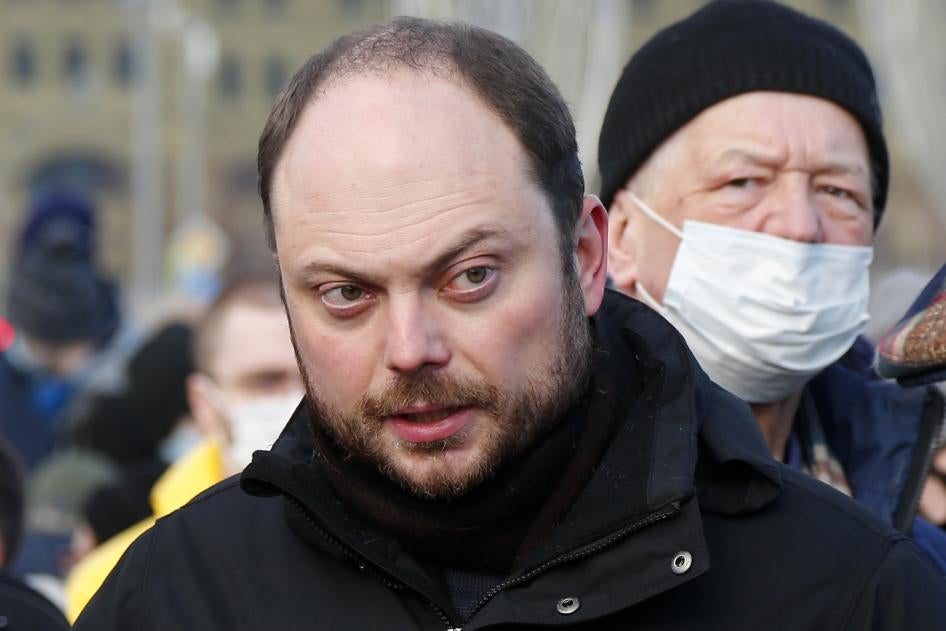
Opposition activist Vladimir Kara-Murza in Moscow.
Opposition activist Vladimir Kara-Murza in Moscow. © 2021 AP Photo/Alexander Zemlianichenko

On 7 October 2022 Human Rights Watch criticised sharply the Russian charge of high treason against an opposition politician, Vladimir Kara-Murza. It is “a blatant attempt to quash any criticism of the Kremlin and deter contact with the international community“, Human Rights Watch said. 

This is the third baseless criminal charge against Kara-Murza since he was detained in April 2022. He has already been indicted for spreading “fake news” about the Russian Armed Forces because he publicly criticized Russia’s invasion of Ukraine, and for alleged involvement with an “undesirable” foreign organization. He now risks an additional sentence of up 20 years if convicted on high treason charges. [see also: https://humanrightsdefenders.blog/2022/04/14/human-rights-defender-vladimir-kara-murza-arrested-in-russia/]

Vladimir Kara-Murza is a longstanding proponent of democratic values and has been a vocal opponent of Vladimir  Putin and Russia’s war on Ukraine,” said Hugh Williamson, Europe and Central Asia director at Human Rights Watch. “It is painfully obvious that the Kremlin sees Kara-Murza as a direct and imminent threat.  These charges against him and his prolonged detention are a travesty of justice. Russian authorities should immediately and unconditionally free Kara-Murza and drop all charges against him.” See also: https://www.trueheroesfilms.org/thedigest/laureates/34e43b60-3236-11ea-b4d5-37ffeeddd006

Vadim Prokhorov, Kara-Murza’s lawyer, said the high treason charges relate to Kara-Murza’s  public criticism of the Russian authorities in international forums.

Kara-Murza has called for sanctions against the Kremlin and has spoken in person before national political bodies throughout Europe and in the United States, and at many international and intergovernmental forums, including at the United Nations. He was a key figure advocating for the US Magnitsky Act that gave rise to the Global Magnitsky sanctions regime for serious human rights violations.

Kara-Murza was also a close friend of the murdered Russian opposition politician Boris Nemtsov. He survived two near-fatal poisonings, in 2015 and 2017, which Bellingcat investigative journalists reported was most likely orchestrated by the Russian Federal Security Service and which the Russian authorities have failed to investigate. 

Since the full-scale invasion of Ukraine started in February, the Russian authorities have expanded their repressive toolbox. In March, Russian authorities criminalized calls for sanctions against Russia, and in July also criminalized “confidential cooperation” with foreign states, international or foreign organizations as well as public calls for action that are “against national interests.”

These new provisions cannot be applied retroactively to the years of advocacy by Kara-Murza, Human Rights Watch said, and so he is being charged with high treason under Russia’s criminal code, which was expanded in November 2012. The definition was expanded to include consultations or any other assistance to a foreign state or international or foreign organizations…

Russia’s rules on prosecution and trial of treason cases also breach human rights safeguards, in particular fair trial guarantees. For example, the criminal case materials in such proceedings are classified so that the defense team may not have access to key pieces of evidence, and the trial takes place behind closed doors, preventing public scrutiny.

Ivan Safronov, a journalist, was recently convicted of high treason and sentenced to 22 years in maximum security prison and given a substantial fine for his journalistic investigations of defense contracts, spotlighting how treason cases are handled.  He was tried behind closed doors, key evidence obtained by fellow journalists was not accepted by the court, and his defense team came under immense pressure. Two of his lawyers had to flee the country, and a third was detained on accusations of spreading false information and remains in detention.

“Sadly, it is unrealistic to expect that fair trial standards will be observed in Kara-Murza’s case,” Williamson said. “By jailing leaders like him, Russian authorities are attempting to instill fear in the Russian people and eradicate any opportunity for civil society to mobilize and oppose the Kremlin and its war.” 

https://www.hrw.org/news/2022/10/07/russia-first-treason-charges-criticizing-kremlin

Meet Ales Bialiatski, Nobel Peace Prize 2022

October 8, 2022

True Heroes Films (THF) has published a timely portrait of Ales Bialiatski, winner of the Nobel Peace Prize 2022, drawn from an in-depth interview with him at the Paris Summit for Human Rights Defenders in Paris, October 2018.

See also: https://humanrightsdefenders.blog/2022/10/07/nobel-peace-prize-2022-goes-to-well-recognised-human-rights-defenders/

Nobel Peace Prize 2022 goes to well-recognised human rights defenders

October 7, 2022

On 7 September 2022 The Norwegian Nobel Committee decided to award the Nobel Peace Prize for 2022 to one individual and two organisations, who represent civil society in their home countries. They have for many years promoted the right to criticise power and protect the fundamental rights of citizens. They have made an outstanding effort to document war crimes, human right abuses and the abuse of power. Together they demonstrate the significance of civil society for peace and democracy.

This year’s Peace Prize is awarded to human rights advocate Ales Bialiatski from Belarus, the Russian human rights organisation Memorial and the Ukrainian human rights organisation Center for Civil Liberties. The first two are well-known and received many important human rights awards.

Ales Bialiatski was the winner of 11 other awards, see: https://www.trueheroesfilms.org/thedigest/laureates/72682FFF-628F-4A5D-B6B3-52A776FF0E47, while Memorial got 7 awards earlier [see: https://www.trueheroesfilms.org/thedigest/laureates/BD12D9CE-37AA-7A35-9A32-F37A0EA8C407], Oleksandra Matviichuk, the chair of the Ukrainian Center for Civil Liberties received a few days ago the Right livelihood award [see: https://www.trueheroesfilms.org/thedigest/laureates/75690f04-7a51-4591-8e18-0826b93959b3]

Ales Bialiatski founded the organisation Viasna (Spring) in 1996 in response to the controversial constitutional amendments that gave the president dictatorial powers and that triggered widespread demonstrations. In the years that followed, Viasna evolved into a broad-based human rights organisation that documented and protested against the authorities’ use of torture against political prisoners. Government authorities have repeatedly sought to silence Ales Bialiatski. He was imprisoned from 2011 to 2014. Following large-scale demonstrations against the regime in 2020, he was again arrested. He is still detained without trial. Despite tremendous personal hardship, Mr Bialiatski has not yielded an inch in his fight for human rights and democracy in Belarus. See also: https://humanrightsdefenders.blog/tag/viasna-human-rights-centre/

The human rights organisation Memorial was established in 1987 by human rights activists in the former Soviet Union who wanted to ensure that the victims of the communist regime’s oppression would never be forgotten. Nobel Peace Prize laureate Andrei Sakharov and human rights advocate Svetlana Gannushkina were among the founders. Memorial is based on the notion that confronting past crimes is essential in preventing new ones. After the collapse of the Soviet Union, Memorial grew to become the largest human rights organisation in Russia. In addition to establishing a centre of documentation on victims of the Stalinist era, Memorial compiled and systematised information on political oppression and human rights violations in Russia. Memorial became the most authoritative source of information on political prisoners in Russian detention facilities. The organisation has also been standing at the forefront of efforts to combat militarism and promote human rights and government based on rule of law. During the Chechen wars, Memorial gathered and verified information on abuses and war crimes perpetrated on the civilian population by Russian and pro-Russian forces. In 2009, the head of Memorial’s branch in Chechnya, Natalia Estemirova, was killed because of this work. [see also: https://humanrightsdefenders.blog/2019/07/15/ngos-remember-10th-anniversary-of-natalia-estemirovas-murder/]

Civil society actors in Russia have been subjected to threats, imprisonment, disappearance and murder for many years. As part of the government’s harassment of Memorial, the organisation was stamped early on as a “foreign agent”. In December 2021, the authorities decided that Memorial was to be forcibly liquidated and the documentation centre was to be closed permanently. The closures became effective in the following months, but the people behind Memorial refuse to be shut down. In a comment on the forced dissolution, chairman Yan Rachinsky stated, “Nobody plans to give up.” [see also: https://humanrightsdefenders.blog/2021/12/29/russias-supreme-court-orders-closure-emblematic-memorial/]

The Center for Civil Liberties was founded in Kyiv in 2007 for the purpose of advancing human rights and democracy in Ukraine. The center has taken a stand to strengthen Ukrainian civil society and pressure the authorities to make Ukraine a full-fledged democracy. To develop Ukraine into a state governed by rule of law, Center for Civil Liberties has actively advocated that Ukraine become affiliated with the International Criminal Court. After Russia’s invasion of Ukraine in February 2022, Center for Civil Liberties has engaged in efforts to identify and document Russian war crimes against the Ukrainian civilian population. In collaboration with international partners, the center is playing a pioneering role with a view to holding the guilty parties accountable for their crimes.

By awarding this Nobel Peace Prize for 2022 the Norwegian Nobel Committee is honouring outstanding champions of human rights and consistent efforts in favour of humanist values, anti-militarism and principles of law.

https://www.nobelprize.org/prizes/peace/2022/press-release/

Uyghur issue at the UN Human Rights Council: will there be even a debate?

October 5, 2022

The controversial issue of the treatment of Uyghurs is continuing to play out at the UN Human Rights Council. A resolution is being considered this week to discuss the report’s findings awhich is being strongly resisted by China who is leaning heavily on smaller states to oppose it. If these efforts are successful, they could deal a severe blow to the legitimacy of the UN Human Rights Council. Groups such as CIVICUS, Human Rights Watch have been following this issue closely and are urging Member States to support a decision to AT LEAST discuss the report in the interests of transparency and accountability. But then the big disappointment: on Thursday 6 October at the Human Rights Council the motion was rejected in a tight vote of 19 states against, 17 in favour and 11 abstentions.

On 3 October 2022 CIVICUS is urging UN Human Rights Council member States to do the right thing by voting in support of a resolution to debate the human rights situation in the Xinjiang Uyghur Autonomous Region (XUAR).

The resolution follows the release of a major UN report which affirms that the rights of Xinjiang’s Uyghur Muslim population are being violated through an industrial-level programme of mass incarceration, systemic torture and sexual violence. The report attracted intense criticism from the Chinese government before it was released on 31 August 2022, minutes before the High Commissioner for Human Rights, Michelle Bachelet ended her term. SEE: See: https://humanrightsdefenders.blog/2022/09/01/finally-the-long-awaited-un-report-on-china/.

The report concludes that the actions of the Chinese government in XUAR including arbitrary detention, cultural persecution and forced labour may constitute international crimes, in particular crimes against humanity. Recommendations include the taking of prompt steps to release all individuals arbitrarily imprisoned in XUAR, a full legal review of national security and counter-terrorism policies, and an official investigation into allegations of human rights violations in camps and detention facilities.  

China’s government has rejected the findings and called into question the mandate of the Office of the High Commissioner for Human Rights.  The Office of the High Commissioner has asserted that the report is based on a rigorous review of documentary evidence with its credibility assessed in accordance with standard human rights methodology.

A proposed resolution to hold a debate on the report’s findings at the next session of the UN Human Rights Council is being resisted by China which is also said to be pressuring states that make up the 47-member Human Rights Council not to support the resolution.

The UN report affirms testimonies of victims belonging to the Uyghur community who have endured extreme forms of oppression. Human rights researchers and civil society groups have for years documented abuses and sounded the alarm to the international community about the situation in Xinjiang,” said Mandeep Tiwana, CIVICUS Chief Programmes Officer. “Yet the Chinese state is going to extraordinary lengths to suppress the findings and cover up its actions.

In June 2020, 50 UN Special Rapporteurs and human rights experts issued a joint statement, that catalogued concerns over the treatment of ethnic minorities in XUAR and Tibet, alleging excessive force against protesters, as well as in Hong Kong, and reports of retaliation against people voicing their concerns publicly over COVID-19 pandemic policies.  The experts urged the Human Rights Council to convene a special session on China; consider the creation of a Special Procedures mandate; and appoint a UN Special Envoy or a panel of experts to closely monitor, analyse and report annually on the human rights situation in China. 

Sophie Richardson of HRW stated: ‘This week the credibility of the United Nations Human Rights Council is on the line over an extraordinarily modest request: to hold a debate on a recent report from the UN high commissioner for human rights on abuses in the Xinjiang region of China. Member states would not be obliged to take a position on the issues at hand, the government in question, or even seek a particular outcome. But the debate is an opportunity to stand together to ensure the council fulfils its bare minimum mandate.

https://www.civicus.org/index.php/media-resources/media-releases/6070-global-civil-society-alliance-urges-human-rights-council-members-to-support-debate-on-uyghur-abuses-report

https://www.civicus.org/index.php/media-resources/op-eds/6072-uyghur-violations-a-litmus-test-for-global-governance-and-rules-based-international-order

https://www.hrw.org/news/2022/10/03/un-rights-body-should-debate-xinjiang-report

Global Witness report 2021: continued disaster

October 5, 2022

Stuti Mishra in the Independent of 29 September 2022 summarises and analyses the report “A Decade of Defiance: Ten years of reporting land and environmental activism worldwide” by Global Witness

More than 1,700 environmental defenders have been killed around the world in the last decade with one death reported every other day on average…The report titled A Decade of Defiance: Ten years of reporting land and environmental activism worldwide, released by Global Witness, reveals the increasing threats environmental activists are facing as the climate and biodiversity crisis worsens.

The research states that a total of 1,733 people have been killed over the past 10 years trying to protect their land and resources. That is an average of one defender killed approximately every two days over 10 years.

The report shows Brazil has been the deadliest country for environmental defenders with 342 lethal attacks reported since 2012 with over 85 per cent of killings within the Brazilian Amazon.

The data found within the report also shows that over half of the attacks over the 10-year period have taken place in three countries — Brazil, Colombia, and the Philippines — with around 300 killings reported in these countries.

Mexico and Honduras witnessed over 100 killings while Guatemala and India saw 80 and 79 respectively, remaining one of the most dangerous countries. The report also reports 12 mass killings, including three in India and four in Mexico.

Mexico was the country with the highest recorded number of killings in 2021, totalling 54 killings, up from 30 the previous year. Almost half of those killed were again Indigenous people while over a third were forced disappearances, including at least eight members of the Yaqui community.

The report also reveals that over three-quarters of the attacks recorded in 2021 took place in Latin America. In Brazil, Peru and Venezuela, a big majority of 78 per cent of these attacks occurred in the Amazon.

Meanwhile, the biggest increase in lethal attacks was witnessed in Brazil and India in 2021 with 26 deaths reported in Mexico, up from 20 and 14 in India, up from four.

Both Colombia and the Philippines saw a drop in killings to 33 in 2021 from 65, and 19 from 30 in 2021 respectively. Yet overall they remain two of the countries with the highest numbers of killings in the world since 2012.

2021 Highlights from Global Witness report

  • Around 200 Land and Environmental Defenders were killed in 2021 – nearly four people a week
  • Over three-quarters of the attacks recorded in 2021 took place in Latin America
  • Nearly 40 per cent of all attacks reported were against Indigenous people
  • Mexico recorded the highest number of killings in 2021
  • Brazil and India both saw a rise in lethal attacks in 2021
  • 50 of the victims killed in 2021 were small-scale farmers
  • Around 1 in 10 of the defenders recorded killed in 2021 were women, nearly two-thirds of whom were Indigenous [see also: https://humanrightsdefenders.blog/2021/09/13/global-witness-2020-the-worst-year-on-record-for-environmental-human-rights-defenders/]

In Africa, the Democratic Republic of Congo remained the country with the highest number of attacks — eight defenders were killed there in 2021. All eight of these killings were in Virunga National Park, which remains extremely dangerous for the park rangers protecting it.

The organisation began collecting data on attacks against those defending land and the environment in 2012 and found that the control and use of land and territory is a central issue in countries where defenders are threatened. Much of the increasing killing, violence and repression is linked to territorial conflicts and the pursuit of economic growth based on the extraction of natural resources from the land, it states. The research has also highlighted that Indigenous communities in particular face a disproportionate level of attacks — nearly 40 per cent — even though they make up only 5 per cent of the world’s population.

However, the research found that the figures also do not capture the true scale of the problem, as tightened control on media has led to severe underreporting in some countries where environmental defenders are most vulnerable. Research has also found that few perpetrators of killings are rarely ever brought to justice due to the failures of governments to properly investigate these crimes.

While a majority of these attacks are not properly investigated or reported on, a big proportion of these attacks were linked to sectors like mining and infrastructure, including large-scale agribusiness and hydroelectric dams.

Many authorities ignore or actively impede investigations into these killings often due to alleged collusion between corporate and state interests, the report says.

All over the world, Indigenous peoples, environmental activists and other land and environmental defenders risk their lives for the fight against climate change and biodiversity loss.

They play a crucial role as a first line of defence against ecological collapse, yet are under attack themselves facing violence, criminalisation and harassment perpetuated by repressive governments and companies prioritising profit over human and environmental harm.

a spokesperson for Global Witness said

With democracies increasingly under attack globally and worsening climate and biodiversity crises, this report highlights the critical role of defenders in solving these problems,” a spokesperson for Global Witness said, adding that the organisation makes an “urgent appeal for global efforts to protect and reduce attacks against them.”

Apart from killings, the report also reveals a number of tactics being used to silence them, like death threats, surveillance, sexual violence, or criminalisation – and that these kinds of attacks are even less well reported.

https://www.globalwitness.org/en/campaigns/environmental-activists/decade-defiance/

https://www.independent.co.uk/climate-change/news/global-witness-report-environment-defenders-threat-b2176247.html

25 Years EuroMed Rights

October 1, 2022

Wadih Al-Asmar, President, and Rasmus Alenius Boserup, Executive Director of EuroMed Rights write about the 25th anniversary of EuroMed Rights: Since its inception, EuroMed Rights has become one of the most prominent and most active actors in the Euro-Mediterranean region on human rights protection and democracy promotion. To mark this milestone, we asked members from North and South to tell us what EuroMed Rights meant to them and their organisation. Read the interviews below There is also a dedicated 25th anniversary webpage

What a journey it has been since the network was founded in 1997. “After the establishment of the Euro-Mediterranean Partnership, the initiators of EuroMed Rights felt that creating some sort of platform to monitor the Barcelona Process would enhance human rights work significantly.
Kamel Jendoubi, Tunisia

Sharing our experience gives us energy, it keeps us up and running!
“I think the greatest benefit of being a member is the exchange of experience with other human rights activists, including from the North. Being a human rights defender is tough and we may find solace in sharing our experience and our highs and lows, it gives us energy, it keeps us up and running!”

Eva Abu Halaweh, Jordan

It is fundamental to make the voice of the network heard! “We always tried to bring a certain dimension on European issues, to analyse them from a different perspective. It worked and that shows how important and impactful the work of the EuroMed Rights network can be!”

Catherine Teule, France

EuroMed Rights is more than a talking shop, it’s a practice shop!
“This is a network of people and not just a network of good intentions. It’s about understanding and feeling what a denial of human rights means in people’s lives, so we can do something about it together. Very few networks in the world offer this kind of activities.”
Tony Daly, Ireland
See what current and past members have to say in this video.

https://mailchi.mp/euromedrights/a-milestone-anniversary-lets-celebrate?e=1209ebd6d8

2022 Right Livelihood Laureates announced

September 30, 2022

Recipients of the 2022 Right Livelihood Award show that systems change is not only possible but outright necessary in the face of failing governance and the breakdown of international order. For more on this and other awards, see: https://www.trueheroesfilms.org/thedigest/awards/97238E26-A05A-4A7C-8A98-0D267FDDAD59

Hailing from Somalia, Ukraine, Venezuela and Uganda, the 2022 Laureates have each created new models for human and societal interactions that challenge the status quo. With crises stemming from authoritarian governance, international aggression, profit-seeking economic systems and political inertia to take action against a planetary climate breakdown, these change-makers have imagined a better world and work tirelessly to make it a reality.

The 2022 Laureates are:

Fartuun Adan and Ilwad Elman “for promoting peace, demilitarisation and human rights in Somalia in the face of terrorism and gender-based violence.” Among them they won quite a few awards, see: https://www.trueheroesfilms.org/thedigest/laureates/80cc3d15-775d-40bd-8591-fa921fc45f25 and https://www.trueheroesfilms.org/thedigest/laureates/9D4A093D-1276-6907-739B-23CABBB12158

Oleksandra Matviichuk and the Center for Civil Liberties (CCL) “for building sustainable democratic institutions in Ukraine and modelling a path to international accountability for war crimes.” See also: https://humanrightsdefenders.blog/2015/03/14/side-event-on-the-ukraine-on-17-march/

Cecosesola of Venezuela “for establishing an equitable and cooperative economic model as a robust alternative to profit-driven economies.”

Africa Institute for Energy Governance (AFIEGO) “for their courageous work for climate justice and community rights violated by extractivist energy projects in Uganda.”

The 2022 Right Livelihood Laureates are grassroots actors dedicated to strengthening their communities. In the face of failing governance and a breakdown of order – including wars, terrorism, extractivism, massive displacement and economic crises – they have established new, human-centric systems. Their successes demonstrate how we can build societies on the principles of justice rather than exploitation,” said Ole von Uexkull, Executive Director at Right Livelihood.

Find more information in our Press Kit.

Find more information on the Laureates here.

https://rightlivelihood.org/2022-announcement/