Archive for the 'Human Rights Defenders' Category

Deadline for nominations Right Livelihood Awards 2024

February 23, 2024

With the March 1 deadline swiftly approaching, the window to nominate for the 2024 Right Livelihood Award is closing fast! This is your opportunity to nominate individuals and organisations striving for social and environmental justice. The nomination process is open to the public— we invite you to elevate those making a significant impact through their courageous efforts.
While submissions are encouraged in English, we also welcome nominations in French and Spanish via our online form. If you have questions about the nomination process, do not hesitate to contact us via email at research@rightlivelihood.org or by phone at +41 (0)22 555 0943. NOMINATE NOW

Since 1980, Right Livelihood has celebrated the courageous and the visionary with its annual awards. It’s not just an award; it’s a global recognition of those who dare to envision and take action to create long-term social change. The Right Livelihood Award defies categories. This means the Laureates work in diverse fields across the world. Spanning from journalists who have brought truth to light to entomologists safeguarding biodiversity and poets who touch hearts and minds, the Award demonstrates that impactful work can come from anyone, anywhere.

To date, 194 Laureates from 76 countries have received the Award. See: https://www.trueheroesfilms.org/thedigest/awards/97238E26-A05A-4A7C-8A98-0D267FDDAD59

See also; https://wordpress.com/post/humanrightsdefenders.blog/25917

Report of a UN consultation on law enforcement’s role in peaceful protests

February 21, 2024

On 16 February, 2024 Sandra Epal Ratjen & Nicolas Agostini in Global Rights reported on a UN consultation on law enforcement’s role in peaceful protests which brought together practitioners and human rights defenders.

Over two days in Geneva, the UN special rapporteur on freedoms of peaceful assembly and association, Clément Voule, the UN Human Rights Office (OHCHR), and the UN Office on Drugs and Crime (UNODC) convened a consultation on the facilitation of peaceful protests by law enforcement. The event followed several regional workshops, organized in accordance with Human Rights Council resolution 50/21, which requested that the special rapporteur develop “technical and practical tools . . . to assist law enforcement officials in promoting and protecting human rights in the context of peaceful protests.” There was nothing unusual in this format—or in the event’s title. But despite its attractive feel (at least for human rights geeks), it ran the risk of turning into yet another academic discussion replete with theorizing but offering little in the way of practical solutions. 

It turned out to be one of the most refreshing, engaging, and action-oriented human rights dialogues we’ve attended.

It’s about the makeup

What made the event rather unusual was its makeup. In addition to civil society members (public assembly, law enforcement, torture, and rule of law specialists attended), the consultation brought together practitioners from all over the world. By “practitioners,” we mean not just police watchdogs (oversight bodies and disciplinary authorities) but police officers and commanders, all on active duty. 

While some activists would draw back with a wince, those human rights defenders and organizations who were present engaged with an open mind, as did law enforcement personnel. Participants weren’t going to talk amongst themselves or only preach to the converted. They were going to try to bring about an actionable outcome. After all, their aim was to devise how law enforcement can facilitate peaceful assemblies and protect rights in such contexts.

Peer pressure was minimal. On all sides, there was nothing to “prove”: no need to adopt an intransigent position, no need to show you’re smart, no need to cajole anyone—there were only incentives to share expertise and experience. 

Sure, there were precedents. Recent workshops brought together practitioners and outlined best practices. For instance, the “Istanbul Process” meeting on promoting religious tolerance held in Singapore was practitioner-centric. Since then, however, the Istanbul Process has collapsed as the Organization of Islamic Cooperation (OIC) revived the “defamation of religions” agenda.

Without naïveté but considering the “real-world” nature of the outputs of this process, we’re confident that the work done under the auspices of Clément Voule, OHCHR, and UNODC will, to some extent, enhance human rights compliance in police practice and benefit both peaceful protesters and law enforcement officials. Notably, the outcome documents are less technical than most human rights documents. 

It’s also about the substance

The consultation was also innovative because of its hands-on approach. In addition to the main working document, a “Model Protocol” for the law enforcement facilitation of peaceful protests, the project led by Clément Voule and his team, OHCHR, and UNODC will produce a “Handbook” and a “Checklist” for law enforcement professionals. The latter two will be practical documents guiding police practice. 

The magnitude and diversity of experiences in the room meant that discussions were light-years away from sterile sloganeering or divisive debates—the kind we see on social media. On civil society’s side, no one advocated “defunding the police.” On the police side, no one advocated for qualified immunity. All participants created a fertile ground for dialogue on how to ensure human rights-compliant, competent, and respected law enforcement that is able to facilitate, not hinder, public assemblies. 

Civil society participants recognized the need for well-funded, well-trained police. We kept in mind (and were reminded of) the realities of the job—what the average law enforcement officer faces daily. The challenges include understaffing, lack of adequate training, and, quite simply, fear (facing a crowd, even peaceful, will never feel like sitting on your sofa sipping a Whiskey Sour). Law enforcement participants, for their part, recognized the need for accountable police behavior and to confront discrimination and abuses of power. They kept in mind (and were reminded) that to be respectful is a sine qua non to be respected.

Also reviewed were “prior to protest,” “during protest,” and “after protest” issues, plus the situation of specific groups and accountability for violations. One section addressed police well-being, which is essential to human rights compliance, as strained police officers are much more likely to engage in misconduct. We didn’t shy away from addressing sensitive issues—police brutality, accountability, or budgeting. 

It wasn’t an echo chamber, but participants agreed on key points. Among others: the role of police vs. the role of prosecution; the need for effective communication between protesters and police, de-escalation, and adequate training for police officers; or the fact that a clear distinction must always be made between peaceful and non-peaceful elements of an assembly. 

It was a far cry from the way these conversations unfold online, and once again, one can see the toxicity of social media. Instead of fostering healthy discussions (differences aren’t that wide between most people), social media algorithms artificially promote simplistic views, entrench positions, and elevate the most divisive topics. This process distracts those seeking solutions from problem-solving. No one benefits from this situation—certainly not rights-holders. 

Don’t forget political will 

Assuredly, the outcomes of this consultation will go unheeded in many countries, where protests are rare or police have total impunity. Elsewhere, not much will happen without political will. 

But the beauty of this consultation is that political will to facilitate assemblies won’t need to come from the highest level. Once publicly available, the outcome documents—particularly the Handbook and Checklist, with their guidelines on communication, de-escalation, and risk assessment regarding protests—will be available for law enforcement agencies and officers at all levels to use. The ideal scenario, of course, will be governments publicly committing to using the outcome documents.

The final documents will stem from a dialogue that brought together people with hands-on experience who tried to build bridges and maximize their chances of having an impact on the ground. This model should inform future human rights dialogues.

The Protocol, Handbook, and Checklist will be presented at the next session of the UN Human Rights Council, February 26–April 5, 2024. Clément Voule will make his last appearance as special rapporteur. For his successor—and for all people of goodwill who want to see peaceful protests proceed without hindrance, as well as rights-compliant law enforcement, joint work will be needed to popularize, operationalize, and implement the documents. 

https://www.openglobalrights.org/sandra-Epal-Ratjen/Human-rights-dialogue-we-need

Cao Shunli, her legacy should not be silenced

February 16, 2024

Our impact may be large, may be small, and may be nothing. But we must try. It is our duty to the dispossessed and it is the right of civil society.’ Cao Shunli

Ten years ago, Chinese woman human rights defender Cao Shunli was a victim of deadly reprisals for engaging with the United Nations.

The International Service for Human Rights (ISHR) and partners invite you to attend a photo exhibition on 14 March 2024, at Place des Nations to honour her memory.

The photo exhibition will also display cases of Chinese, Tibetan, Uyghur, and Hong Kong human rights defenders who have been targeted for upholding the promise of the Universal Declaration of Human Rights. See: https://mailchi.mp/ishr/side-event-situation-guatemala-hrc55-7mar-34177?e=d1945ebb90

Who was Cao Shunli? 

Cao Shunli was a brave Chinese woman human rights defender and lawyer. She campaigned for the meaningful consultation and contribution of independent civil society to the Chinese government’s national reports for its first and second Universal Periodic Reviews (UPR). On 14 September 2013, one month before this review, while on her way to Geneva to attend a human rights training organised by ISHR and CHRD, she was detained and forcibly disappeared by Chinese authorities for five weeks. When she resurfaced in custody in October 2013, she had been charged with ‘picking quarrels and provoking trouble’, and  it was evident that she was experiencing serious medical issues in detention. Despite repeated international calls for her urgent release over months of being denied adequate medical treatment, Cao Shunli died of multiple organ failure on 14 March 2014, having been granted bail for medical reasons just days before her death. Cao Shunli was one of the finalists of the prestigious Martin Ennals Award for Human Rights Defenders in 2014. [see also: https://humanrightsdefenders.blog/tag/cao-shunli/ as well as https://www.martinennalsaward.org/hrd/cao-shunli/]

To this day, Chinese authorities have ignored appeals seeking accountability for Cao’s death, including repeated calls by UN Special Procedures experts in 2014 and 2019 for a full investigation into this ‘deadly reprisal’. Her case remains the longest-standing unresolved case in the UN Secretary-General’s annual reports on reprisals. March 2024 marks the 10th anniversary of Cao Shunli’s death. A decade ago, when ISHR and many other human rights groups sought to observe a moment of silence at the Human Rights Council in her memory, the Chinese delegation, together with other delegations, disrupted the session for an hour and a half. China is consistently one of the most frequent perpetrators of reprisals against individuals or groups engaging with the United Nations. Frequently mentioned alongside Saudi Arabia, it has the second highest number of reprisals cases and situations reported by the UN Secretary-General since 2010.

Cao Shunli’s story is a paradigmatic case of reprisals, not only because of her belief in the importance of civil society participation in UN mechanisms, but also due to the array of severe human rights abuses she endured because of this belief, ranging from being barred from exiting her own country, enforced disappearance, arbitrary detention, lack of due process, torture, ill-treatment, and denial of adequate medical care, to subsequent death in custody without any accountability for these abuses. 

https://ishr.ch/events/but-we-must-try-cao-shunli-the-unsilenceable-legacy

Kadar Abdi Ibrahim human rights defender from Djibouti.

February 16, 2024

Kadar Abdi Ibrahim is a human rights defender and journalist from Djibouti. He has drawn inspiration from iconic figures in the human rights movement in the hopes of building a genuine and lasting democracy in his country.

Speaking to ISHR, he shared his vision for a future where the youth of Djibouti would no longer see its dreams and aspirations stifled by fear and censorship, as well as his admiration for his fellow human rights defenders whose actions ‘pave the way for future generations’. see also: https://humanrightsdefenders.blog/2023/09/11/human-rights-defenders-at-the-54th-session-of-the-un-human-rights-council/

Kadar Abdi Ibrahim has also been the subject of acts of reprisals by his government for his engagement with international bodies. In 2018, days after returning from Geneva where he carried out advocacy work ahead of Djibouti’s Universal Periodic Review, intelligence service agents raided his house and confiscated his passport.

https://ishr.ch/defender-stories/human-rights-defenders-story-kadar-abdi-ibrahim-from-djibouti

Venezuela closes UN human rights office

February 16, 2024

On 15 February 2024 AP carried the story that Venezuela’s government has ordered the local UN office on human rights to suspend operations, giving its staff 72 hours to leave, after accusing the office of promoting opposition to the South American country. The UN office was established in Caracas in September 2019.

The foreign affairs minister, Yván Gil, announced the decision at a news conference in Caracas on Thursday. Gil’s announcement came on the heels of the detention of the human rights attorney Rocío San Miguel, which set off a wave of criticism inside and outside Venezuela.

The South American country’s government said it had made a decision “to suspend the activities of the technical advisory office of the UN high commissioner for human rights and carry out a holistic revision of the technical cooperation terms”.

The government said the UN human rights office must rectify its “colonialist, abusive and violating attitude”, accusing it of playing an “inappropriate role” in the country and supporting impunity for people involved in attempts at assassination, coups, conspiracies and other plots.

The Venezuelan government regularly accuses members of the political opposition of plotting takeovers or the assassination of President Nicolas Maduro, all accusations vehemently denied by opposing parties and their members.

We regret this announcement and are evaluating the next steps. We continue to engage with the authorities and other stakeholders,” said UN human rights office spokesperson Ravina Shamdasani. “Our guiding principle has been and remains the promotion and protection of the human rights of the people of Venezuela.”

Venezuelan state television on Wednesday harshly criticized comments by the UN’s special rapporteur on the right to food, Michael Fakhri, who just concluded a visit to Venezuela. Fakhri had said in a statement the government food program does not tackle the root causes of hunger and is susceptible to political influences.

San Miguel was taken into custody on Friday at the airport near Caracas while she and her daughter awaited a flight to Miami. Authorities did not acknowledge her detention until Sunday, and as of Wednesday her attorney had not been allowed to meet with her.

The attorney general, Tarek William Saab, earlier in the week said she was being held at the Helicoide prison, an infamous institution for political prisoners.

San Miguel’s daughter, ex-husband, two brothers and former partner were also detained following her arrest. Of them, only her former partner remains in custody.

https://www.theguardian.com/world/2024/feb/15/venezuela-closes-un-human-rights-office

Sweden’s new strategy places greater emphasis on Human Rights Defenders

February 13, 2024

On 5 February 2024, the Swedish Government adopted a new five-year strategy for development cooperation for human rights and freedoms, democracy and the rule of law. This strategy is an important part of the implementation of the Government’s new reform agenda for development assistance and contributes to free and inclusive democratic societies built on respect for human rights and freedoms.

Democracy, human rights and freedoms, and the rule of law are essential for freedom, security and the continued development of society. At the same time, we see storm clouds gathering. Democracy is in decline for the seventeenth consecutive year, which gives rise to increased oppression and conflicts. Russia’s full-scale invasion of Ukraine is a clear example of this. 

Another is the way authoritarian states are undermining fundamental human rights and freedoms and using new digital technology for oppression and to spread disinformation.  

With this strategy, the Government is placing greater emphasis on the individuals around the world who fight for their freedom every day. We want to help those living under oppressive systems. Unfortunately, we see that democracy is headed in the wrong direction. That’s why Sweden has to do its part. We will do what we can to support the positive forces that exist,” says Minister for International Development Cooperation and Foreign Trade Johan Forssell.

The strategy outlines the Swedish Government’s increased focus on supporting defenders of human rights and democracy, free elections and independent journalism, in comparison with the previous strategy. The allocated budget for the strategy in 2024 is SEK 900 million. This budget is set out by the Government each year.

https://www.einnews.com/pr_news/686383753/new-development-cooperation-strategy-increases-focus-on-defenders-of-democracy-and-independent-journalists

Film “Beyond Utopia” now available on streaming platforms

February 13, 2024

The Human Rights Foundation (HRF) announced that “Beyond Utopia,” a BAFTA-nominated and du-Pont-Columbia Award-winning film that follows the harrowing journeys of several individuals as they attempt to escape North Korea, is now available to stream on Amazon Prime, Apple TV, and YouTube. Pastor Seungeun Kim, who has made it his life’s work to rescue North Koreans. Over the past 23 years, he has saved more than 1,000 people through a network of smugglers and activists. As the film depicts, Pastor Kim frequently risks his own life by joining defectors on parts of their treacherous journey to safety, a trek that spans thousands of miles through jungles and rivers. Dubbed “an astonishing, real-life geopolitical thriller” by The Hollywood Reporter and “a staggering look at the nightmare of North Korea and the brave souls who tried to escape it” by Variety, the film has already received critical acclaim. It won the Audience Award for US Documentary at the 2023 Sundance Film Festival, received a du-Pont-Columbia Award, has been nominated for the 2024 British Academy Film Award for Best Documentary, and was shortlisted for the 2024 Oscar for Best Documentary. Stream “Beyond Utopia” today on Amazon Prime, Apple TV, and YouTube.

https://mailchi.mp/hrf.org/beyond-utopia-shortlisted-for-2024-oscars-290552?e=f80cec329e

Investigative journalism in Arab states: the threats to journalists

February 12, 2024

The Gulf Centre for Human Rights (GCHR) is working with journalists in the Middle East and Northern Africa to investigate various violations affecting the safety of journalists and their ability to do their work.

Investigative journalism: Unveiling the threats to journalists in Arab States

Shutterstock

I find myself wishing there was more protection [for investigative journalists], a sense of safety and even simply just hope. I watch in awe as they investigate crimes that they unfortunately know they could well be victims of in the future, or in some cases already have been.“ Zaynab Al-Khawaja, GCHR’s Journalists Protection Coordinator, working with journalists conducting the investigations

Supported by the Global Media Defence Fund, GCHR’s project Investigating impunity for crimes against journalists in the Arab States, while providing protection has identified a range of threats journalists face, such as arbitrary detentions and gendered threats.

With a strong gender focus, the GCHR ensures that the majority of the investigations are carried out by women, empowering them and shedding light on cases involving women.

One investigation highlights the story of an anonymous woman journalist who quit her job and relocated due to sexual harassment. She writes:

A large proportion of society is aware of widespread harassment in the streets, resulting from an exacerbated hypermasculinity. However, statements by several Iraqi women journalists confirm that this phenomenon did not spare women in press and media outlets, forcing a considerable number of them to quit journalism for good.

The investigation also reported that 41% of women journalists in Iraq have been victims of harassment, forcing 15% to leave their jobs and 5% to quit their profession for good.

This data aligns with UNESCO’s Chilling report, revealing increasing offline and online attacks against women journalists, including stigmatization, sexist hate speech, trolling, physical assault, rape and murder.

Another investigation looked into the imprisonment and silencing of journalists, some facing fabricated allegations of sexual harassment. GCHR collaborates with the NGO Vigilance and 40 partners on a joint appeal to end the persecution and detention of journalists and human rights defenders exercising their right to freedom of expression. GCHR also supported a journalist in the Middle East investigating the case of a disappeared journalist in Syria. 

Since 2022, GCHR and UNESCO have joined forces to support investigative journalism, reducing impunity for crimes against journalists and enhancing their safety through the Global Media Defence Fund. Established in 2019, this fund has supported over 120 projects globally, directly benefiting over 5,000 journalists, 1,200 lawyers and 200 non-governmental organizations.

In 2022, UNESCO published recommendations on addressing violence against women journalists, based on The Chilling, a global research project by UNESCO and the International Center for Journalists (ICFJ). All reports related to this project are available here on UNESCO’s website.

see also: https://humanrightsdefenders.blog/tag/journalist/

https://www.unesco.org/en/articles/investigative-journalism-unveiling-threats-journalists-arab-states

CIVICUS annual report 2023; PEOPLE POWER UNDER ATTACK: the good, the bad and the ugly:

February 12, 2024

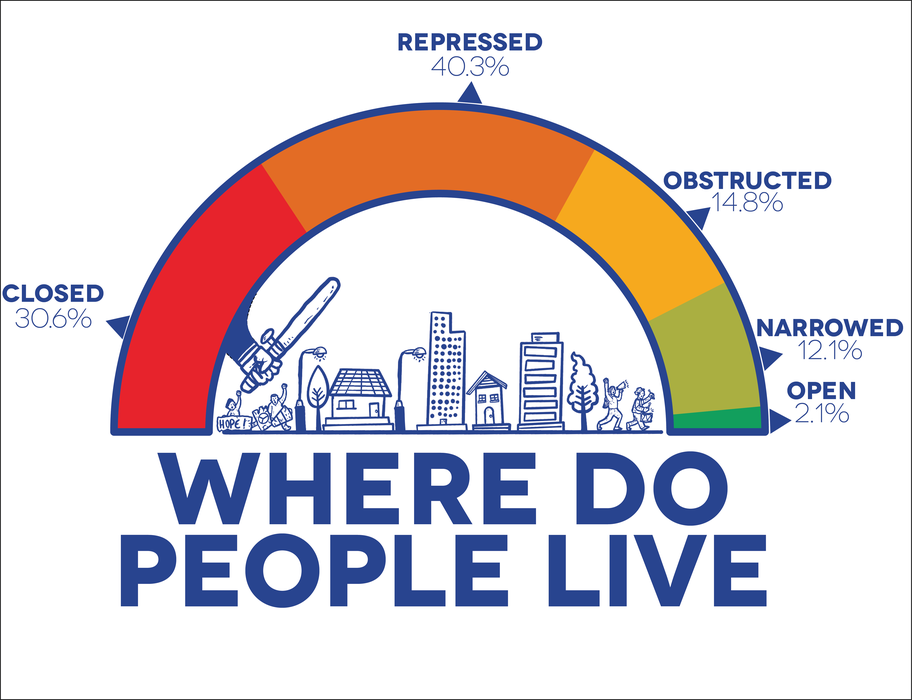
Almost a third of the world’s population now lives in countries with closed civic space. This is the highest percentage since 2018, when CIVICUS began systematically tracking civic space conditions around the world. This startling decline – from 26 per cent living in closed countries in 2018 to 30.6 per cent today – points to a major civic space crisis that requires immediate, global efforts to reverse. This year we also recorded the lowest percentage of humanity living in open countries, where civic space is both free and protected. Today, just two per cent of the world’s population enjoys the freedom to associate, demonstrate and express dissent without significant constraints, down from almost four per cent just five years ago.

Since the previous edition of this report, which covered 2022, civic space ratings have changed for 12 countries over the last year, worsening in seven countries and improving in five.

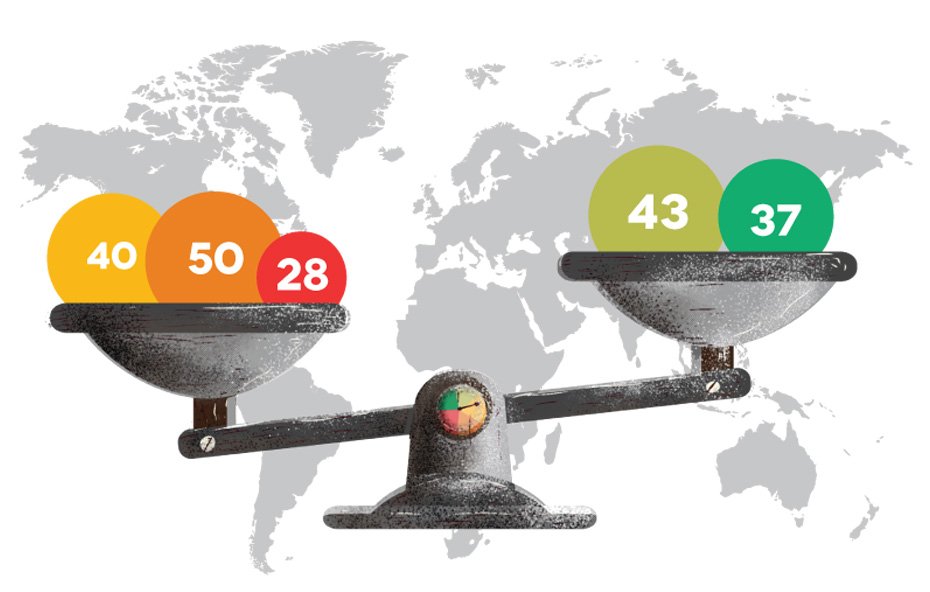
The latest CIVICUS Monitor country ratings update in December 2023 indicates that civil society faces an increasingly hostile environment. There are now 28 countries or territories with closed civic space, 50 with repressed civic space and 40 with obstructed civic space, meaning that 118 of 198 countries and territories are experiencing severe restrictions in fundamental freedoms. In comparison, 43 countries have narrowed civic space and just 37 have an open rating.

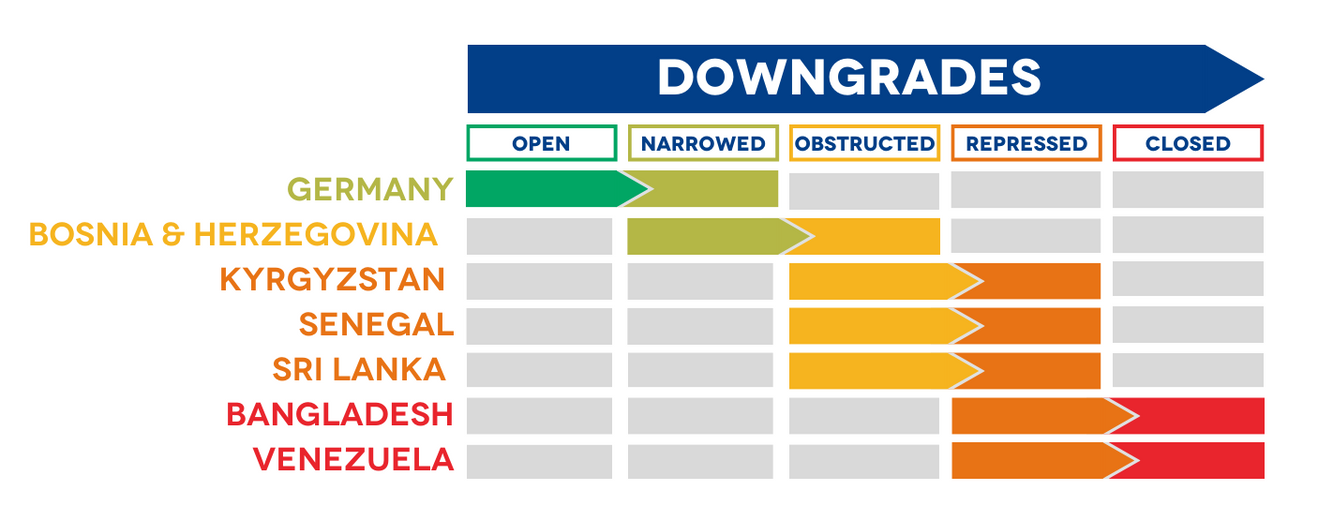
The severity of the civic space deterioration is exemplified by the number of countries moving to the repressed or closed category. Of the seven countries being downgraded, five moved to the two worst categories. Bangladesh and Venezuela are now rated as closed and Kyrgyzstan, Senegal and Sri Lanka are downgraded to the repressed rating as conditions for civil society continue to worsen.

Europe continues to add to the list of downgraded countries, with Bosnia and Herzegovina now placed in the obstructed category and Germany moving from an open to a narrowed rating. Over the past six years, 12 European countries have seen their ratings downgraded due to deteriorating civic space conditions.

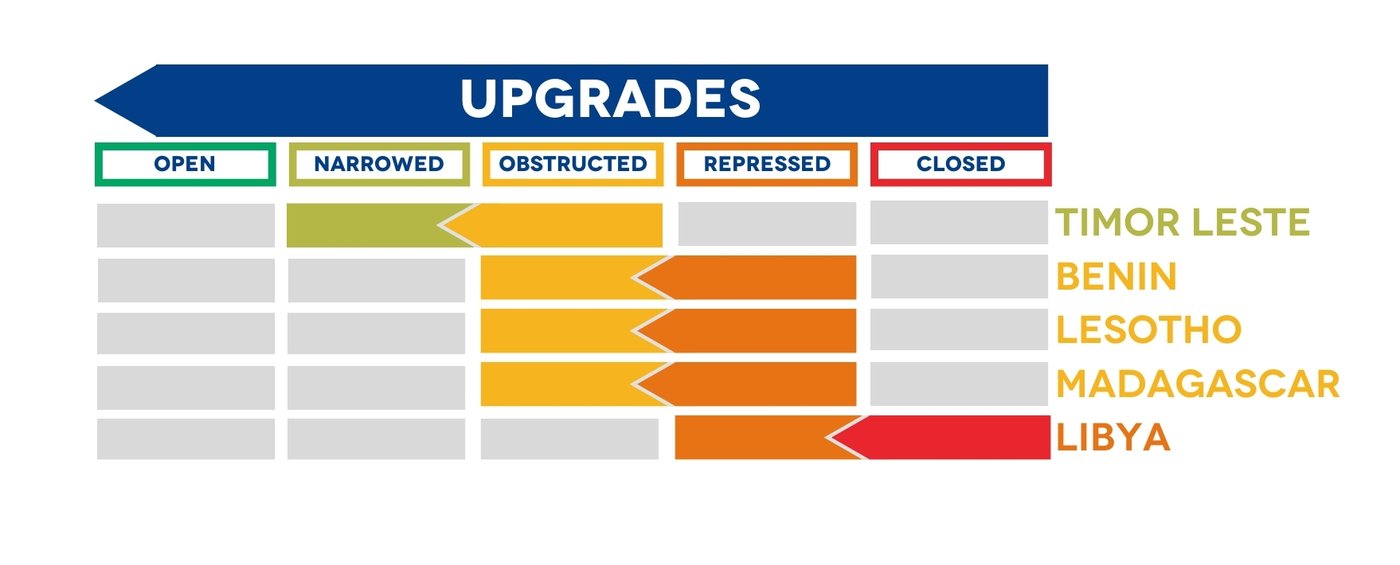
Five countries have upgraded ratings in 2023, although, as in previous years, the situation for civil society in these countries continues to be challenging. Libya moved from the closed to the repressed category. Benin, Lesotho and Madagascar have moved from the repressed to the obstructed category. Notably, Timor-Leste has joined the narrowed category. Regional sections describe the conditions that led to ratings changes.

Compare last year: https://humanrightsdefenders.blog/2022/06/29/civicus-state-of-civil-society-report-2022/

https://monitor.civicus.org/globalfindings_2023

Shelter City Netherlands is launching new call for applications for human rights defenders

February 9, 2024

Justice & Peace Netherlands is launching its new call for applications for human rights defenders at risk to participate in Shelter City Netherlands. The deadline for applications is 28 February 2024 . ­ ­ Shelter City is a global movement of cities, organizations and people who stand side by side with human rights defenders at risk. Shelter City provides temporary safe and inspiring spaces for human rights defenders at risk where they re-energize, receive tailor-made support and engage with allies. The term ‘human rights defender’ is intended to refer to the broad range of activists, journalists and independent media professionals, scholars, writers, artists, lawyers, civil and political rights defenders, civil society members, and others working to advance human rights and democracy around the world in a peaceful manner.  From June and September 2024 onwards, several cities in the Netherlands will receive human rights defenders for a period of three months. At the end of their stay in the Netherlands, participants are expected to return with new tools and energy to carry out their work at home.

Application forms must be submitted by 28 February 2024. An independent commission will select the participants. ­ Note that selected human rights defenders will not automatically participate in Shelter City as Justice & Peace is not in control of issuing the required visas to enter the Netherlands. For more information, please contact us at info[@]sheltercity.org.

https://7a2pv.r.a.d.sendibm1.com/mk/mr/sh/SMJz09SDriOHWo9lOH3CCxH3Sm28/rcrz5XA2FSoJ