Archive for the 'Human Rights Defenders' Category
February 2, 2013
Radhia Nasraoui, human rights defender and lawyer, is awarded the 2012 Olof Palme Prize, for her untiring work against torture and impunity for more than three decades. As a concerned and patriotic citizen, she has under severe pressure defended human rights in Tunisia and challenged authorities under the motto “We must use our voices. Not saying anything makes us accomplices of the oppression”.
Waleed Sami Abu al-Khair receives the 2012 Olof Palme Prize for his strong, self-sacrificing and sustained struggle to promote respect for human and civil rights for both men and women in Saudi Arabia. Together with like-minded citizens and colleagues, Waleed Sam Abu AlKhair does so with the noble goal of contributing to a just and modern society in his country and region.
THE OLOF PALME PRIZE, the Swedish labor movement’s most prestigious award since 1987 when the Olof Palme Fund’s Board decided to establish an annual prize for a particularly significant achievement in the spirit of Olof Palme. The prize consists of USD 75 000.
Posted in Human Rights Defenders | 1 Comment »
Tags: Advocacy Organizations, Human right, human rights advocates, Human Rights and Liberties, Human rights defender, labour movement, Middle East, Olof Palme, Radhia Nasraoui, Saudi Arabia, Sweden, Tunisia, Waleed Sami Abu al-Khair
February 2, 2013
Under the title “Urgent Appeals, theory and practice“, the NGO ‘Asian Human Rights Commission‘ reflects on the need and increasing practicality (especially thanks to IT) of conducting urgent appeals. The AHRC Urgent Appeals system was created to give a voice to those affected by human rights violations and it now concludes that “Patterns start to emerge as violations are documented across the continent, allowing us to take a more authoritative, systemic response, and to pinpoint the systems within each country that are breaking down. This way we are able to discover and explain why and how violations take place, and how they can most effectively be addressed. On this path, larger audiences have opened up to us and become involved: international NGOs and think tanks, national human rights commissions and United Nations bodies. The program and its coordinators have become a well-used tool for the international media and for human rights education programs. All this helps pave the way for radical reforms to improve, protect and to promote human rights in the region”.
for the full text of the reflection go to: http://www.humanrights.asia/news/urgent-appeals
To illustrate the point the AHRC comes at the same time with a call for action against what it calls a “witch hunt” by the Indian authorities against human rights defender Madhuri Krishnaswami of the Jagrat Dalit Adivasi Sangthan. In the most recent attack, the District Magistrate has written a letter to the Divisional Commissioner that found its way to Chief Secretary accusing the organisation to have links with Maoists and have demanded an inquiry into the issue. The attack is not a stray one but comes high on heels of an externment notice served on her by the same district administration in May, 2012 and subsequent attack on a JADS rally by the local goon with the administration looking away. Interestingly, the charge has been refuted by the police with the Inspector General of Police, categorically denying the presence of any Maoists activities in the reason.[The administration, evidently, is working on the behest of deeply entrenched vested interests whose corruption Madhuri and the organisation have continuously been exposing. The current attack, too, is an attempt to divert attention from the massive scam in the implementation of the Mahatma Gandhi National Rural Employment Guarantee Act in the area tipped to be worth more than 150 crore INR.]
At the same time the AHCR expresses great concern over the abduction of 4 human rights defenders in Pakistan by (probably) members of an outlawed religious organization. The unknown armed persons abducted six workers of a NGO including, two lady workers. However, after some time they threw the two women out of the vehicle. It is feared that the abducted workers would be assassinated as has happened in the past. Many health workers and human rights defenders have been killed after their abduction by such ‘religious groups’. The NGO, ‘HAND’, works under the UN programme. The abducted persons and female workers who were working in the Noor Mohammad Village Goth, Mauripur, Karachi, where they have been distributing medicines and rations to the residents for some time. The male abductees were Engineer Amjad Ali Siyal, Mohammad Ashfaq, dispenser, Khurram Ahmad Abbas, dispenser and driver Humayun Ahmad, driver. The released women, Miss. Shakila and Miss. Rashida told police that the kidnappers had taken the four abducted workers in a car towards Balochistan. The police claim that they were abducted by one of the banned Muslim extremist groups who are opposed to the polio vaccination programme and this incident due to the campaign against NGO volunteers. It is believed that the abductors are convinced that they are working for the interests of America or the West.
Posted in AHRC, human rights, Human Rights Defenders | 1 Comment »
Tags: AHRC, Asian Human Rights Commission, dalits, HAND, human rights, Human Rights and Liberties, Human Rights Defenders, India, Madhuri Krishnaswami, NGO, Non-governmental organization, Pakistan, United Nations, urgent action, urgent appeals
February 1, 2013
Two NGOs, Stockholm-based Civil Rights Defenders and Dublin-based Front Line Defenders, have expressed concern for the safety of two human rights defenders in the Transnistria, the internationally unrecognised separatist republic of Moldova. Stepan Popovsky andVladimir Maimust are the subject of judicial harassment and threats by the local administration.

On 9 January 2013, Stepan Popovsky, a private lawyer and chairperson of the Republican Social Movement for the Protection of Property and Social Rights of Peasants, held a meeting where he provided legal support to local peasants. The meeting was interrupted by police officers accusing him of trespassing on a private area, although the Criminal Code of Transnistria does not define trespassing as a criminal offense. One week after the incident, Stepan Popovsky was informed that a criminal case had been initiated against him. He responded with a letter of complaint to the local Minister of Internal Affairs. Since then, Stepan Popovsky has been repeatedly threatened by Transnistrian region’s law enforcement officers while performing his profession as a lawyer. A few months earlier, Stepan Popovsky was the subject of a defamatory media campaign that presented him as a foreign spy earning millions of dollars by buying local real estate.
The human rights lawyer Vladimir Maimust is also under pressure from the Transnistrian authorities. He is the lawyer of a person who was detained by the Transnistrian authorities on 23 June 2012 and who later died from suffocation in jail on 21 November 2012. Vladimir Maimust filed a complaint to the local Investigation Committee and to the Transnistrian leader Yevgeny Shevchuk, in which he accused the investigator of abuse of power and negligence that led to the death of his client. Vladimir Maimust was later threatened by KGB agents “to be included in the list of persons whose activity on the territory of the republic has to be undermined” and that criminal charges can be brought against him. During a working visit to the Investigation Committee on 11 January 2013, the human rights lawyer was beaten and injured by four men in police uniform who also tried to slip an unknown package into his pocket, accusing him of being drunk although medical expertise later confirmed that there was no sign of alcohol consumption. A criminal case has been recently opened against Vladimir Maimust for conspiracy. If found guilty, he may face up to 12 years in prison.
Civil Rights Defenders and Front Line Defenders believe that the threats and the fabricated criminal cases against Stepan Popovsky and Vladimir Maimust are directly related to their human rights work. The organisations urge the representatives of the Transnistrian administration to launch an immediate and impartial investigation into the threats against the human rights defenders, to protect them from any further threats or attacks, and to ensure that all human rights defenders in the region can carry out their legitimate human rights activities without fear of reprisals and free of all restrictions, including judicial harassment.
http://www.frontlinedefenders.org/node/21494
http://www.civilrightsdefenders.org/news/statements/threats-against-human-rights-defenders-must-be-condemned-and-investigated/
Posted in human rights, Human Rights Defenders | Leave a Comment »
Tags: Civil Rights Defenders, Front Line Defenders, harassment, human rights, Human Rights and Liberties, Human Rights Defenders, KGB, lawyers, Moldova, Stepan Popovsky, threats, Transnistria, Vladimir Maimust
January 31, 2013
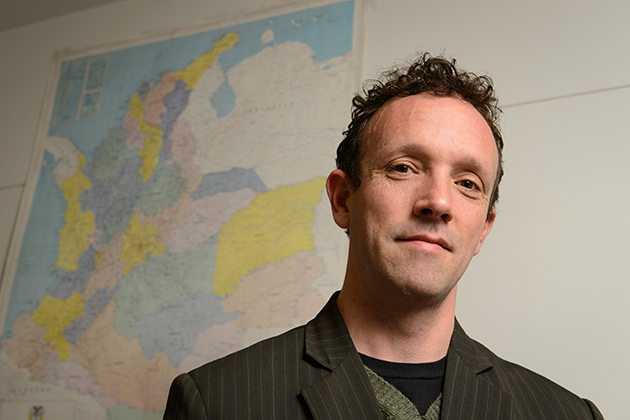
When writing about individual Human Rights Defenders the tendency is to give attention to those in the front line who are in immediate trouble. This time I want to refer to a HRD teaching at the University of Connecticut based on a blog post by Kenneth Best of 30 January 2013. It concerns Luis van Isschot, an assistant professor of history, who specializes in the study of human rights in Latin America ( photo by Peter Morenus/UConn Photo).

Conversation around the dinner table in the van Isschot home in Montreal was a bit different than in most Canadian homes. Growing up with a Spanish, Peruvian, and Dutch family heritage, Luis van Isschot listened to discussions about Latin American history and politics led by his father, a physician who treated families in a clinic based in Montreal’s Latino community…….
…His path to a doctoral degree developed from his volunteer work in Guatemala and later in Colombia, where he served as a human rights observer. It was during his time in Colombia that a friend who was a university professor and a historian told him that one of the most important books of Colombian history was written by a professor from his hometown of Montreal, Catherine Le Grand at McGill University, and that he should look her up. He did, and it led to his enrollment in the doctoral program. “She made it seem that you could be a wonderful teacher, a cutting-edge scholar, and have a balanced life of engagement in your community, and that the Ph.D. was a way of doing that,” van Isschot says. “The university is central to the community, not apart from it. That makes sense to me.”
He later became involved with MEA Laureate 2001 Peace Brigades International, a nonpartisan organization that sends international volunteers to areas of conflict to provide protective accompaniment to human rights defenders threatened by political violence in 11 nations, including in Asia, Africa, and Latin America. In addition to serving as a human rights observer in Colombia, he also traveled to the Great Lakes Region of Africa, doing research in the Democratic Republic of Congo, Rwanda, and Burundi.
“It was a really important experience for me to go somewhere where the language of human rights and social justice and the understanding of history really enriched my own understanding of what I was working on in Latin America,” he says. His experience in Colombia led him to focus his doctoral studies on human rights activities in that nation’s oil capital, Barrancabermeja, where he lived for a year. The city was the center of a major urban war between Colombian paramilitary groups and leftist guerillas. Between 1998 and 2002, in a city of 300,000 there were about 2,000 violent murders. “It was a devastating period. The relationships I made with Colombian human rights activists, teachers, and scholars convinced me that I needed to find some place to explore the issues,” he says.
His book, The Social Origins of Human Rights: Protesting Political Violence in Columbia’s Oil Capital, 1919-2010, is near completion, and scheduled to be published in early 2014. His new research project is titled “When the Courts Make History: the Impact of the Inter American Court of Human Rights in Latin America’s Conflict Zones,” and examines the historical changes set in motion by the pursuit of justice across borders.
http://today.uconn.edu/blog/2013/01/focusing-on-human-rights-with-a-latin-american-perspective/
Posted in human rights, Human Rights Defenders | Leave a Comment »
Tags: Africa, Canada, Colombia, Democratic Republic of Congo, Human rights defender, human rights education, human rights teaching, Latin America, Luis van Isschot, McGill University, PBI, Peace Brigades International, research, University of Connecticut, USA
January 31, 2013
On 29 January 2013 the Association for Progressive Communications(APC) released its new resource “Digital security first-aid kit for human rights defenders.”
It is an interactive website publication available online at http://rights.apc.org/infosec
In the face of increased human rights surveillance of ever-growing
online traffic and the multiplication of commercial interest in user
data, APC’s Connect Your Rights! campaign is today putting out tips and
tricks for human rights defenders to circumvent threats to their privacy
and their information.
The kit is meant to help people working to defend human rights to act
quickly to straighten-out situations in which their personal data is
compromised or in which they suspect they have fallen victim to online
wiretapping. Relying on eight different scenarios, information is
presented to users in-need using an accessible format. The digital
security first-aid kit advises on tactics such as how to access blocked
websites and how to encrypt electronic mail.
The Digital security first-aid kit is a living project – New topic areas
will be added to the kit in future. “We want to be sure that this toolkit will actually help human rights
activists wherever needed,” Mallory Knodel of APC says. “We are working
through our network of local technology groups in more than 40 countries
to achieve this”.
Connect Your Rights! – an awareness-building and advocacy campaign aimed
at framing internet rights as human rights – has produced issue papers,
infographics and many articles about internet rights violations. It monitors internet rights via its online platform. Please visithttp://rights.apc.org
*Digital security First Aid Kit* <http://rights.apc.org/infosec>
*Connect Your Rights!* <http://rights.apc.org>
The Association for Progressive Communications (APC) is an international
network and non-profit organisation founded in 1990: <http://www.apc.org>
Posted in Human Rights Defenders | Leave a Comment »
Tags: Advocacy Organizations, APC, Association for Progressive Communications, cyber activism, digital security, First aid kit, HRDs, human rights, Human Rights Defenders, intenet, protection, wiretapping
January 29, 2013
On 28 January 2013, a number of Brazilian civil society organisations and social movements addressed an open letter to the Coordinator of the National Programme for the Protection of Human Rights Defenders (NPPHRD) and the Presidency regarding the security situation for human rights defender Alexandre Anderson de Souza.
Alexandre Anderson de Souza is head of the Associação dos Homens do Mar – AHOMAR (Association of Seamen), an organisation set up to defend the rights of the fisherfolk working in Rio de Janeiro, and particularly those affected by the construction of a gas pipeline for Petrobras. AHOMAR argues that there are reports of environmental permit irregularities in the construction of the pipeline and it will have a negative impact on local flora and fauna as well as on the livelihood of those who fish in those waters in the Guanabara Bay.
Alexandre Anderson de Souza has suffered a number of threats to his life and has been under the NPPHRD since 2009, but the federal government has delegated the responsibility to authorities in the state of Rio de Janeiro, where he and his family live. However, the human rights defender and a number of Brazilian civil society organisations and social movements that support him, have been repeatedly expressing their discontent with the protection offered by the state programme and the conditions in which Alexandre Anderson de Souza, his wife Ms Daize Menezes and their children have been forced to live. As the situation has worsened the human rights defender and his family have had to relocate to different hotels in the city of Rio de Janeiro but the locations were highly insecure. The buildings did not have 24-hour reception personnel and the rooms they were accommodated in had no telephone. The protection programme has been unable to ensure Alexandre and his family’s return to their residence in Magé, and as a result the human rights defender remains unable to resume his work at AHOMAR. Four members of AHOMAR have been killed to date.
Another point of discontent with the state protection programme has been the unsatisfactory level of legal support provided to the human rights defender by the non-governmental organisation (NGO) Projeto Legal (Legal Project). Projeto Legal has signed an agreement with the government of the state of Rio de Janeiro, in the context of the state protection programme, to provide legal support and advice to the human rights defenders included in the programme. After repeated complaints about the NGO’s inaction in several instances, Alexandre Anderson de Souza received information from a reliable source that one of Projeto Legal’s main funders is Petrobras, the same oil company whose actions the human rights defender and his organisation AHOMAR have been trying to hold accountable for environmental damages. The information was confirmed on the websites of both Petrobras and the NGO, but neither they, nor the government of the state of Rio de Janeiro, have clarified the terms of the agreement, raising doubts over the impartiality of the organisation and a conflict of interests.
The open letter signed by several civil society organisation addressed the main concerns of Alexandre Anderson de Souza and other NGOs working with human rights defenders in the country. While welcoming the formal establishment of the state of Rio de Janeiro’s protection programme for human rights defenders through the Decree 44.038 signed on 18 January 2013, the letter asks for Alexandre and his wife Daize, as well as other human rights defenders who are currently under the protection of the state, to have their security ensured by the National Protection Programme until the state protection programme is fully operating and able to fully ensure the safety of human rights defenders in the territory of the state of Rio de Janeiro.
Front Line Defenders is gravely concerned following reports of the vulnerable security situation of human rights defender Alexandre Anderson de Souza and his family, and of other human rights defenders under the protection of the state of Rio de Janeiro. 
http://racismoambiental.net.br/2013/01/carta-aberta-ao-coordenador-nacional-do-programa-de-protecao-aos-defensores-de-direitos-humanos-sr-igo-martini/#more-85964
Posted in Front Line, human rights, Human Rights Defenders | 2 Comments »
Tags: Alexandre Anderson de Souza, Brasil, environmental issues, Front Line, Front Line Defenders, human rights, Human rights defender, Non-governmental organization, Petrobras, protection, threats
January 28, 2013
On 24 January 2013, human rights defender Martha Díaz was targeted again with a death threat.
On 24 January, a package in a manila envelope was delivered to the residence of Martha Díaz, which contained a mass card and note with letters cut from a newspaper. The letters stated: “You are dead, you are a collaborator of the guerilla, we are not joking, one of you is going to die”[translated from Spanish]. On 22 January, the human rights defender had already received a pamphlet sent by a group who identified themselves as “Los Rastrojos”.
Martha Díaz is Director of AFUSODO, an organisation of relatives of victims of extrajudicial executions and a member organisation of MOVICE (National Movement of the Victims of State Crimes). Since its creation, AFUSADO has received some 27 threats. Front Line Defenders issued an urgent appeal https://www.frontlinedefenders.org/node/20842 on death threats received by Martha Díaz on 14 November 2012, and has issued previous appeals on threats against human rights organisations in the Cauca and Valle del Cauca departments.
Posted in Front Line, Human Rights Defenders | Leave a Comment »
Tags: Colombia, Death threat, death threats, Front Line, human rights, Human rights defender, impunity, Martha Diaz, MOVICE
January 28, 2013

ShabanoYanomami.jpg (Photo credit: Wikipedia)
This 30-minute film, directed by Daniel Schweizer, is part of OMCT’s sponsorship project “Defend the Defenders”. The film follows a mission of OMCT in Brazil, accompanied by the sponsor and actress Noémie Kocher, showcasting human rights defenders of indigenous peoples rights, Megaron and Davi Yanomami Kopenawa. The documentary – available through VIMEO – illustrates the challenges and threats facing the indigenous Yanomami and Kayapo and their defenders on the construction of Belo Monte hydroelectric dam and illegal mining in Amazonia. http://protectionline.org/2013/01/23/documentary-by-omct-amazon-indians-on-borrowed-time/
For more information on the Sponsorship project “Defend the Defenders”, visit OMCT website:bit.ly/u8puEj
Posted in human rights, Human Rights Defenders | Leave a Comment »
Tags: Amazon rainforest, Brazil, Daniel Schweizer, documentary, human rights, Human Rights and Liberties, Human Rights Defenders, Indigenous People, OMCT, video, Vimeo, World Organisation Against Torture
January 26, 2013
The Association for Women’s Rights in Development (AWID) is seeking to hire a man-ager for its Women Human Rights Defenders Program (WHRD). Preferred location is Mexico (but flexible).
The application closing date is Sunday, February 24, 2012.
via Manager, Women Human Rights Defenders WHRD Program / Jobs at AWID / Get Involved / Home – AWID.
Posted in Human Rights Defenders | Leave a Comment »
Tags: AWID, job, job opportunity, manager, Mexico, vacancy, WHRD, women human rights defenders


 Hans Thoolen on Human Rights Defenders and their awards