Archive for the 'Human Rights Defenders' Category
March 12, 2013
In a case that was followed closely in this blog, a Bahraini human rights defender accused of sending out twitters with ‘false information’, there is finally some good news: a Bahraini court has acquitted Said Yousif Al-Muhafdah of the Bahrain Center for Human Rights (BCHR – 2012 Final Nominee of the MEA). “It’s a great relief that Said Yousif was acquitted today, bringing an end to three months of judicial harassment. Let’s hope this means the courts are beginning to show a better understanding of what freedom of expression means,” said Human Rights First’s Brian Dooley. Al-Muhafdah was arrested in December 2012 for “spreading false information on Twitter.”
His case is one in a string cases stemming from the Kingdom’s ongoing judicial harassment of human rights defenders. It followed last year’s jailing of Nabeel Rajab, President of the BCHR, and of human rights activist Zainab Al Khawaja in February 2013. “This is a small victory, but unfortunately there are many other cases of judicial harassment that continue to wind their way through Bahrain’s judicial system,” Brian Dooley noted. On March 21, the appeal of 23 medics, each sentenced to three months in prison after treating injured protestors in 2011, will continue. A verdict is expected at a date soon after. Dooley, who has authored four reports about the ongoing crackdown in Bahrain, has been forbidden access to the nation for more than a year. “This is not how a nation that wants to trumpet its human rights record treats monitors” Dooley added.
via Acquittal in Bahrain Twitter Case Comes as Dooley Denied Access Again | Human Rights First.
Posted in HRF, human rights, Human Rights Defenders | Leave a Comment »
Tags: acquittal, Bahrain, Bahrain Centre for Human Rights, BCHR, Brian Dooley, HRF, Human right, human rights, human rights activist, Human rights defender, Human Rights First, illegal detention, judicial harassment, MEA 2012 nominee, Middle East, Nabeel Rajab, Said Yousif Al-Muhafdah, trial observation, twitter, Zainab Al-Khawaja
March 11, 2013
What is apparent from this blog, which has featured many cases of environmental Human Rights Defenders, has now been clearly stated (on 7 March 2013) by the United Nations Independent Expert on human rights and environment, John Knox. In his report to the Council of Human Rights, he highlighted the urgent need to clarify the human rights obligations linked to the enjoyment of a safe, clean, healthy and sustainable environment. Such clarification, he said, “is necessary in order for States and others to better understand what those obligations require and ensure that they are fully met, at every level from the local to the global.”……………….In his report Mr. Knox also identifies rights whose implementation is vital to environmental policymaking, such as the rights to freedom of expression and association, rights to receive information and participate in decision-making processes, and rights to legal remedies. “The exercise of these rights, makes environmental policies more transparent, better informed and more responsive to those most concerned.” “States should recognize the important work carried out by human rights defenders working on land and environmental issues in trying to find a balance between economic development and environmental protection, should not tolerate their stigmatization and should ensure prompt and impartial investigations into alleged violations of their rights,” he said.
John Knox was appointed as the Independent Expert on human rights and the environment in July 2012 by the United Nations Human Rights Council.
Learn more: http://www.ohchr.org/EN/NewsEvents/Pages/DisplayNews.aspx?NewsID=13089&LangID=E
Knox’s full report: http://www.ohchr.org/Documents/HRBodies/HRCouncil/RegularSession/Session22/A-HRC-22-43_en.pdf
via Link between protecting the environment and human rights | Scoop News.
I would also like to refer now to an article by Lauri R. Tanner in the Oxford Press Journal of Human Rights Practice on the landmark environmental defenders cases by the Inter-American Court of Human Rights: the milestone case of ‘Kawas v. Honduras‘ and the so-called ‘Mexican Ecologists case‘. In its first-ever ruling on environmental defenders, the Court found a positive obligation on the part of member states in the Hemisphere to protect environmentalists who are in serious jeopardy from human rights violations. The Kawas case is a paradigmatic example of the constant threats these activists encounter, both in the Americas and internationally, and states in the region are now on notice to ensure special protection to those most in danger of harm. The Court arrived at the remarkable juncture of ‘making visible and potentially punishable what heretofore has been invisible and unpunished’. In an epilogue Tanner addresses the subsequent ruling in the ‘Mexican Ecologists’ case, and offers recommendations to human rights and environmental defenders and practitioners both regionally and internationally.
PDF to download:
http://jhrp.oxfordjournals.org/cgi/reprint/hur020?ijkey=TmPlvBcvZYHLh18&keytype=ref
Full Text online:
http://jhrp.oxfordjournals.org/cgi/content/full/hur020?ijkey=TmPlvBcvZYHLh18&keytype=ref
Posted in books, human rights, Human Rights Defenders, UN | 6 Comments »
Tags: climate, environment, environmental issues, Human right, human rights, Human Rights and Liberties, Human Rights Council, Human rights defender, Human Rights Defenders, Independent Expert on human rights and environment, Inter-American Court of Human Rights, John Knox, Journal of Human Rights Practice, Kawas v. Honduras, Knox, Land issues, Lauri Tanner, Mexican Ecologists case, United Nations, United Nations Human Rights Council
March 11, 2013
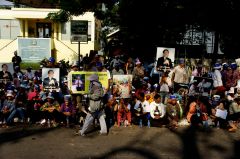
(800 people gathered in front of the Phnom Penh Court of Appeal to support Mam Sonando (c) Clothilde Le Coz)
Arrested on July 15th 2012, Beehive Radio journalist and director, Mam Sonando, was sentenced in the first instance to twenty years in prison in October 2012. He was charged with instigating villagers and peasants to protest against lands expropriation, in Kratie province. He was convicted and sentenced for “aggravating circumstances rebellion, unlawful interference in the performance of public functions, insurrection, inciting people to take arms against the state authority”. After spending already eight months in prison, his appeal started on 5 March 2013.
Read the rest of this entry »
Posted in human rights, Human Rights Defenders | 4 Comments »
Tags: AI, Amnesty International, Beehive Radio, Cambodia, France, freedom of expression, human rights, Journalist, Kratie, land rights, Lawyers without Borders, Luon Savath, Luon Sovath, Mam Sonando, MEA 2012, Phnom Penh, Protection on Line, radio, Radio broadcasting, radio journalist, trial observation
March 10, 2013
On 8 March 2013 – probably timed to coincide with the debate in the UN Human Rights Council – the U.S. Department of State published an overview of it support for Human Rights Defenders. It reads in part:
Protecting and supporting human rights defenders is a key priority of U.S. foreign policy. The Department’s objective is to enable human rights defenders to promote and defend human rights without hindrance or undue restriction and free from fear of retribution against them or their families. The work of these brave individuals and groups is an integral part of a vibrant civil society, and our investment in and support of them is likewise an investment in and support of the rule of law and democracy. Every day, around the world, many in civil society turn to us for assistance in emergency situations and to help them achieve longer-term goals that will make their countries more just and democratic.
After a short description of who are considered Human Rights Defenders and a quote from Hillary Rodham Clinton (as U.S. Secretary of State Krakow, Poland on July 3, 2010): “When NGOs come under threat, we should provide protection where we can, and amplify the voices of activists by meeting with them publicly at home and abroad, and citing their work in what we say and do.” The webpage sets out the way in which the State Department protects and supports human rights defenders, including:
Posted in books, human rights, Human Rights Defenders | 1 Comment »
Tags: Foreign Policy, Human right, human rights, Human rights defender, Human Rights Defenders, International Women of Courage Award, Non-governmental organization, protection, State department, UN Declaration, UN Human Rights Council, United Nations Human Rights Council, United States, US, USA
March 10, 2013
On 10 January 2013 I posted something on the largest ever trial of internet dissidents in Viet Nam. On 8 March this issue was continued in the UN:
“We call upon the Council to press Vietnam to put an end to this repression,” said Vo Van Ai, speaking on behalf of Vietnamese campaigners and the International Federation of Human Rights. In a speech to the UN body he said a total of 32 bloggers and other cyber-dissidents were behind bars in Vietnam, either sentenced or awaiting trial. They face prison terms of up to 16 years.

“Such repression does not serve to protect national security, as the Vietnamese authorities claim, but to stifle the voices of an emerging civil society speaking out on corruption, power abuse, the plight of dispossessed peasants and farmers, human rights and democratic reforms,” he said. He condemned Vietnam’s use of Ordinance 44, a 2002 ruling which authorises the detention of suspected national security offenders without due process of the law and which is increasingly deployed against bloggers, sometimes in psychiatric hospitals.
Fellow-campaigner Penelope Faulker, with the French-based group Work Together for Human Rights, noted that after a 2009 United Nations review (UPR), Hanoi had pledged to uphold freedom of information. “However, in the past year alone, scores of bloggers, online journalists and human rights defenders in Vietnam have been harassed, intimated, subjected to police abuse, or condemned to extremely harsh prison sentences simply for expressing their peaceful views on the Internet,” she told the Council. The southeast Asian country has been branded an “enemy of the Internet” by freedom of expression watchdog Reporters Without Borders.
via: http://www.rawstory.com/rs/2013/03/08/human-rights-activists-push-u-n-for-action-over-vietnams-treatment-of-cyber-protesters/
Posted in FIDH, human rights, Human Rights Defenders | Leave a Comment »
Tags: blog, cyber activism, dissidents, Human right, human rights, Human Rights Defenders, illegal detention, International Federation for Human Rights, National security, Penelope Faulker, Reporters without Borders, southeast asian country, United Nations, UPR, Viet Nam, Vietnam, Vo Van Ai
March 9, 2013
15 Zimbabwean Civil Society Organizations, on 9 March 2013 issued a joint statement condemning the sustained and escalating assault on non-governmental organisations (NGOs) involved in civic education, human rights monitoring, public outreach and service provision by the State. The cite as the latest example the charging of Jestina Mukoko on which AI issued a separate alert on 8 March: “Prominent Zimbabwe human rights defender hunted down through the media”.
The criminalization of the work of civil society by the Government of National Unity is in direct contradiction with the letter and Spirit of the Global Political Agreement. It appears to us that the persecution of Jestina, who is not at anytime a fugitive from justice, is a direct victimization of an individual, who has been a victim of abduction by State security agents. State actions against Jestina were condemned by the Supreme Court and her prosecution quashed. Read the rest of this entry »
Posted in AI, human rights, Human Rights Defenders | Leave a Comment »
Tags: Africa, Amnesty International, civil society organisations, civil society organizations, Human Rights Defenders, Jestina Mukoko, judicial harassment, media framing, Non-governmental organization, referendum, state media, Zimbabwe, Zimbabwe Congress of Trade Unions, Zimbabwe Lawyers for Human Rights, Zimbabwe Peace Project
March 8, 2013
The local NGO Samaj Chetna Adhikar Manch has been working in 20 villages in Madhya Pradesh, India, and has been in the forefront of the struggles to end malnutrition from the area as well as widespread corruption in welfare schemes that defeats all attempts of snatching the children away from the death trap of absolute poverty induced malnutrition. The organisation has earned the ire of the local goons because of its complaint to the National Commission for Protection of Child Rights (NCPCR) that led to an enquiry and consequent dismissal of those responsible for irregularities. The relatives of those dismissed are now harassing and threatening the activists with dire consequences.
The continuing harassment and brazen attacks on the activists of the organisation despite the local administration being aware of the threats is akin to criminal negligence and points to complicity with the accused. T
Posted in AHRC, human rights, Human Rights Defenders | Leave a Comment »
Tags: AHRC, Asia, Asian Human Rights Commission, Convention on the Rights of the Child, corruption, criminal negligence, death threats, Government, Human Rights and Liberties, India, Madhya Pradesh, malnutrition, National Commission for Protection of Child Rights, poverty
March 7, 2013

( Ane Tusvik Bonde of HRHF and Intigam Aliyev with the Homo Homini Award received on 4 March 2013)
In its intervention on 5 March 2013 at the Human Rights Council, the Human Rights House Foundation (HRHF) welcomed the reports of the Special Rapporteur on the situation of human rights defenders, including the one to the General Assembly on legislation affecting human rights defenders. HRHF stated that they are concerned, as is the Special Rapporteur, by the fact that more and more countries misuse or design legislation in order to impede or even criminalise the work of human rights defenders, or to label them as “foreign agents” such as in the Russian Federation.
HRHF especially welcomed the communications re Azerbaijan, as published in the addendum to the Rapporteur’s report, including the communication about the closure of the Azerbaijan Human Rights House on 16 March 2011 and the warnings against two NGOs threatened to be closed for their online publications on 5 March 2012. This communication has still not been answered. HRHF also regretted that Azerbaijan has not to date replied to the communication of the Special Rapporteur in relation to the arrest of photographer and blogger Mehman Huseynov, a case it already brought to the attention of the Council in July 2012.
Azerbaijan continues to use detention of human rights defenders as a tool to silence them. Most recently, on Saturday 26 January 2013, Intigam Aliyev was amongst 47 other demonstrators arrested for peacefully protesting in Baku. He was awarded the Homo Homini Award in Prague on 4 March, for his exceptional and courageous work in favour of human rights. Intigam Aliyev’s remains disbarred and his NGO blocked. In relation to this protest of 26 January, Emin Milli was sentenced to administrative detention for 15 days for promoting the protest on Facebook in violation of article 298.1 and 298.2 of the code of the Republic of Azerbaijan. Emin Milli was previously detained for 16 months along with Adnan Hajizade for publishing a critical video on Youtube. http://humanrightshouse.org/Articles/19109.html
Posted in human rights, Human Rights Defenders | 3 Comments »
Tags: Adnan Hajizade, Azerbaijan, Azerbaijan Human Rights House, disbarment, Emin Milli, facebook, freedom of expression, Homo Homini Award, HRHF, Human right, Human Rights Council, Human rights defender, Human Rights Defenders, Human Rights House Foundation, Intigam Aliyev, lawyer, Mehman Huseynov, Prague, Special Rapporteur, UN, video, You Tube
March 6, 2013
Just an example of how politics and elections interact with the role of human rights defenders, always a touchy subject:
After the Zambian Police arrested and charged Zambia’s opposition leader, Hakainde Hichilema, on 27 January 2013, seven 7 Civil Society Organisations in Zambia have called upon the Zambia’s Human Rights Commission, Southern African Development Community (SADC), the African Union, the Commonwealth and “other human rights defenders” to review Zambia’s human rights record and denounce the violations by the Zambian Government. The organisations have also called upon the Electoral Commission of Zambia to cancel by-elections in Livingstone and Mpongwe in accordance with Section 28 of the Electoral Act No. 12 of 2002. Reading the statement during the Press Briefing at FODEP House in Lusaka on behalf of the 7 organisations the Young African Leaders Initiative President Andrew Ntewewe, called on the Deputy Inspector General of Police to immediately resign for violating fundamental political rights which are guaranteed by the Constitution of Zambia when he banned political rallies in the Livingstone. With a strong sense of exaggeration the organisations have advised the Zambian Police Command to resist the temptation of “turning the Police Service into a unit similar to NAZIs Gestapo under Hitler in Germany”. The 7 organisations have lambasted the Zambia Police for their continued unprofessionalism in handling matters that border on freedom of expression, assembly, movement and association. The organisations that appended their signatures to the statement included; Foundation for Democratic Process (FODEP), Operation Young Vote (OYV), Anti-Voter Apathy Project (AVAP), Southern Centre for Construction Resolutions of Disputes (SACCORD), Young African Leaders Initiative (YALI), the Zambia Centre for Inter-party Dialogue (ZCID) and the Zambia National Womens Lobby Group (ZNWLG).
via allAfrica.com: Zambia: Civil Society Groups Request Review of Human Rights.
Posted in human rights, Human Rights Defenders | Leave a Comment »
Tags: African Union, allafrica com, civil society organisations, CSOs, Deputy Inspector General of Police, elections, electoral commission of zambia, freedom of assembly, freedom of demonstration, freedom of expression, Hakainde Hichilema, Human right, Human Rights Defenders, Lusaka, Mpongwe, police brutality, politics, Southern African Development Community, Zambia
March 6, 2013

Venezuelan President Hugo Chavez, Vice President Nicolas Maduro (right) and National assembly president Diosdado Cabello (left), on December 8, 2012. © 2012 Reuters
While all attention understandably is on the death of the Venezuelan President Hugo Chaves, indigenous rights defender Mr Sabino Romero Izarra was shot and killed while travelling on a road in the Sierra de Perijá, Zulia State on 3 March 2013. His wife survived but sustained injuries as a result of the attack. Sabino Romero Izarra was a prominent defender of the rights of the indigenous Yukpa community, including peacefully campaigning and mobilising against the expansion of large-scale mining developments on indigenous lands. Prior to his killing the human rights defender was continuously subject to acts of harassment, threats and criminalisation, as a result of his work to promote and protect land and indigenous rights in Venezuela.
As a result of his work, Sabino Romero Izarra was continuously threatened, harassed and judicially persecuted. In 2012, the 109 year-old father of Sabino Romero Izarra, Mr José Manuel Romero, was killed as a result of being severely beaten. To date, no-one has been brought to justice for this killing, believed to have been perpetrated by the owner of a local ranch. In 2009, following the occupation of a ranch in Chaktapa, Zulia State, by two communities, including that of Sabino Romero Izarra, the human rights defender was detained for 18 months, accused of being responsible for the killing of three indigenous persons during the occupation. On 14 October 2009, during a national radio programme, Deputy Minister for the Environment Sergio Rodriguez reportedly accused Sabino Romero Izarra of stealing cattle, burning the houses of Yukpa families and using the land title struggle “for his own benefit”. In addition, the human rights defender received a number of death threats, while his home was reportedly raided on a number of occasions by army officers.  Front Line (http://www.frontlinedefenders.org/) believes to be motivated by his legitimate and peaceful work as a land and indigenous rights defender and leader.
In the meantime New York based Human Rights Watch (HRW) on 5 March issued a general report on “Venezuela: Chávez’s Authoritarian Legacy” Read the rest of this entry »
Posted in books, Front Line, HRW, human rights, Human Rights Defenders | Leave a Comment »
Tags: censorship, Front Line Defenders, HRW, hugo chaves, Hugo Chávez, human rights, Human Rights Defenders, Human Rights Watch, Indigenous People, journalists, killing, land disputes, president hugo chavez, protection, Sabino Romero Izarra, Venezuela, venezuelan president hugo chavez, Yukpa people



 Hans Thoolen on Human Rights Defenders and their awards