Archive for the 'Human Rights Defenders' Category
May 8, 2014
On 7 May 2014, human rights defender Mr Raif Badawi was sentenced by a Jeddah Criminal Court in Saudi Arabia to 10 years in prison, 1000 lashes and a fine of 1 million Saudi riyals. The human rights defender is a co-founder of the “Free Saudi Liberals” website and was convicted of “insulting Islam”. As Raif Badawi’s page https://frontlinedefenders.org/RaifBadawi on Front Line Defenders explains, the human rights defender was originally sentenced to “ONLY” seven years’ imprisonment and 600 lashes. See also last year’s post: https://thoolen.wordpress.com/2013/07/30/saudi-website-founder-to-be-imprisoned-and-lashed-·-global-voices/
Posted in Front Line, Human Rights Defenders | 1 Comment »
Tags: corporal punishment, Free Saudi Liberals, freedom of expression, Front Line (NGO), Global Voices, Human rights defender, illtreatment, Islam, lashes, Raif Badawi, Saudi Arabia, website
May 8, 2014
 reports that yesterday, 7 May 2014, human rights defender Mr Rashid Rehman was shot and killed in an attack on his office in Kutchery Square, Multan, Pakistan. Two other people were injured in the shooting, which was carried out by two unknown men. Rashid Rehman was a human rights lawyer and a coordinator of the Punjab office of the Human Rights Commission of Pakistan (HRCP) in Multan. The human rights defender advocated against the misuse of blasphemy laws in Pakistan and, since February 2014, had been working on the case of Junaid Hafeez, a lecturer at Bahauddin Zakariya University who is accused of blasphemy. It is reported that no lawyer was willing to take the case for a year because of fear of reprisals from extremist religious groups. The human rights defender was shot several times and pronounced dead on arrival at Nishtar Hospital. Read the rest of this entry »
Posted in Front Line, Human Rights Defenders | 1 Comment »
Tags: blasphemy, Front Line (NGO), Human Rights Commission of Pakistan, Human rights defender, human rights lawyer, in memoriam, Junaid Hafeez, killing, Pakistan, Punjab, Rashid Rehman, threats
May 8, 2014
It took a lot of wrangling but finally the President of the Human Rights Council has transmitted the list of candidates for mandate holders to be appointed on 8 May 2014 at the organizational meeting of the Human Rights Council. Michel Forst will succeed Margaret Sekaggya as Special Rapporteur on Human Rights Defenders. To see the letter and list of all mandate holders: https://drive.google.com/file/d/0B6XUJ0SW4C68V0pTN25LdDhDTlk/edit
For previous posts in the saga see: https://thoolen.wordpress.com/tag/un-special-rapporteur-on-human-rights-defenders/, with a picture of Michel Forst in the post of 13 March.
Posted in human rights, Human Rights Council, Human Rights Defenders, UN | 1 Comment »
Tags: Geneva, Human Rights Council, mandate holders, Margaret Sekaggya, Michel Forst, Special Rapporteur on Human Rights Defenders, Special Rapporteur on the situation of human rights defenders, UN, UN Special Rapporteur
May 7, 2014

Having posted on the Natalia bracelet and the Panic Button recently as alarm systems for human rights defenders in danger, it is good to also draw attention to the dangers that are inherent in the ‘normal’ use of mobile phones. Tactical Tech has quite a bit to say about mobile phone security: Human Rights Defenders are exposed to many potential threats – from governments, private companies, organised groups – in the course of their work. Therefore, they should be aware of dangers and necessary security measures to be taken if deciding to communicate by mobile phone, which remains an easy-to-spy-on device. Tactical Tech has produced a number of resources about phone security.
Security in a Box has a chapter entitled “How to Use Smartphones as Securely as Possible” and one on using mobile phonesas securely as possible.
Me and My Shadow has a chapter on geolocation services for smartphones and the risks they carry, as well as tips for those using SMS and MMS.
Finally, have a look at the Guardian Project’s website, created by a group of activists dedicated to creating open source apps to increase security and privacy on smartphones.
via Mobile phone security | Exposing the Invisible.
https://thoolen.wordpress.com/tag/natalia-project/
https://thoolen.wordpress.com/2014/05/02/amnesty-releases-today-long-awaited-panic-button-for-human-rights-defenders/
Posted in human rights, Human Rights Defenders | Leave a Comment »
Tags: digital security, electronic surveillance, Human Rights Defenders, mobile phone security, mobile phones, Natalia bracelet, Panic Button, right to privacy, Security-in-a-box, SMS, Tactical Tech, Tactical Tech Collective
May 6, 2014
The disappearance of Karen activist “Billy” has prompted the United Nations High Commissioner for Human Rights UNHCHR to condemn the “pattern of killings and forced disappearances of environmental activists in Southeast Asia” and to urge authorities to conduct thorough and independent investigations. “We are concerned about the lack of progress with an investigation into the disappearance of a prominent human rights defender in Thailand,” UNHCHR spokesman Rupert Colville said in a statement released on Friday 2 May. Read the rest of this entry »
Posted in human rights, Human Rights Defenders, OHCHR, UN | 1 Comment »
Tags: Billy, Cambodia, Chut Wutty, disappearances, environmental activists, environmental issues, Human Rights Defenders, indigenous groups, Karen, killings, Land issues, Laos, Philippines, Pholachi Rakchongcharoen, Rupert Colville, Sombath Somphone, South-east asia, Thailand, the Office of the UN High Commissioner for Human Rights
May 6, 2014
While not directly about Human Rights Defenders, this workshop organised by the Permanent Mission of Switzerland to the UN and others (see below) is of great importance to HRDs as they are the ones who provide most of the information to the Treaty Bodies, and are often the victims of the violations reported, including reprisals against them for having cooperated. Thus, this meeting on “The outcome of the treaty body strengthening process: Lessons learnt, implications and implementation” should be of interest to all. It takes place on 9 May 2014, 9.30am to 1pm in Room XXII, Palais des Nations, Geneva. Read the rest of this entry »
Posted in human rights, Human Rights Defenders, UN | 1 Comment »
Tags: Andrew Clapham, Geneva, Geneva Academy of International Humanitarian Law and Human Rights, human rights, Human Rights Defenders, international human rights law, international human rights treaties, meeting, Permanent Mission of Switzerland to the UN, reprisals, the Office of the UN High Commissioner for Human Rights, treaty bodies, UN
May 5, 2014
On 2 May 2014 the Human Rights Foundation announced as the recipients of its 2014 Václav Havel Prize for Creative Dissent the Turkish performance artist Erdem Gunduz, Russian punk protest group Pussy Riot, and imprisoned Tibetan filmmaker Dhondup Wangchen. They will be honored at a ceremony during the Oslo Freedom Forum on Wednesday, May 14. Read the rest of this entry »
Posted in awards, films, human rights, Human Rights Defenders, Human Rights Foundation | 1 Comment »
Tags: awards, China, Dhondup Wangchen, digest of human rights awards, Erdem Gunduz, human rights awards, Leaving Fear Behind, on-line, Oslo, Pussy Riot, Russia, Standing Man, Tibet, Turkey, Václav Havel Prize for Creative Dissent
May 5, 2014
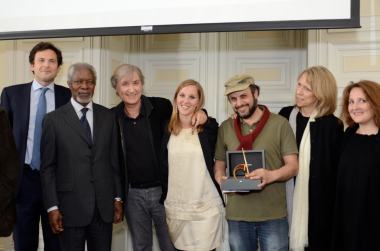
3 May 2014 Cartooning for Peace award, Geneva (c) THF
In case you noticed, my post of yesterday about the Cartooning for Peace Award came a day late; sorry. The award ceremony took place on Saturday 3 May, International Day for Press Freedom. To make up for the error here are the winners (Palestinian-Syrian Hani Abbasi, and Egyptian Doaa Eladl), in company of inter alia Kofi Annan and municipal councillor Guillaume Barazzone. The exhibit remains to be visited along the Quai Wilson in Geneva until 3 July 2014. Also present were the well-known cartoonists Chappatte, Plantu et Liza Donnelly. More information and links in my post of yesterday:
https://thoolen.wordpress.com/2014/05/04/cartooning-for-peace-international-award-and-exhibit-in-geneva-as-from-today/
Posted in awards, Human Rights Defenders | 1 Comment »
Tags: art, awards, Cartooning for Peace, Cartooning for Peace Award, cartoons, Chappatte, City of Geneva, Doaa Eladl, Egypt, Guillaume Barazzone, Hani Abbasi, human rights awards, Kofi Annan, Liza Donnelly, Palestinian, peace, Plantu, Press Freedom
May 2, 2014

(Erykah Badu performs onstage 15 March 2014 in Austin; Roger Kisby—Getty Images)
The misuse of star power by Erykah Badu referred to in an earlier post got a nice follow up according to the opinion piece posted by Thor Halvorssen and Alex Gladstein in TIME of 2 May 2014. After recalling in detail her singing for the Swazi absolute monarch [https://thoolen.wordpress.com/2014/04/30/another-case-of-misused-star-power-erykah-badu-performs-for-swaziland-dictator/], the authors describe Badu’s defensive and sometimes offensive comments in the social media: Read the rest of this entry »
Posted in human rights, Human Rights Defenders, Human Rights Foundation | 5 Comments »
Tags: Alex Gladstein, dictatorship, Erykah Badu, human rights, Jennifer Lopez, King Mswati, Mariah Carey, music, social media, star power, Swaziland, the Gambia, Thor Halvorssen, Time, twitter, Yahya Jammeh
May 2, 2014
The Sergio Vieira de Mello Foundation, in collaboration with the Graduate Institute of International and Development Studies, is organising its annual conference on Thursday 15 May 2014 at 18:30. The main speaker is Mr. José Ramos-Horta, Nobel Peace Prize Laureate, Special Representative of the UN Secretary General in Guinea Bissau, and Patron of the MEA on the theme of “Preventing conflicts, ending wars, building desirable peace.” The lecture is free and open to everyone at the Maison de la paix, Auditorium Ivan Pictet, Chemin Eugène-Rigot 2, 1202 Geneva.
via 2014 Annual Lecture.
Posted in human rights, Human Rights Defenders | 1 Comment »
Tags: conflict resolution, Geneva, Graduate Institute of International and Development Studies, human rights, lecture, peace, Sergio Vieira de Mello

 Hans Thoolen on Human Rights Defenders and their awards