I have posted extensively on the ‘foreign agents” law in Russia (and a few other countries that got inspired by this bad example) [see: https://thoolen.wordpress.com/tag/foreign-agent/] and the article below in the Moscow Times is an excellent piece that sums up the current repression AND the resilience of the human rights defenders. Election-monitoring watchdog Golos won a rare victory among Russian NGOs on Tuesday 9 September when a Moscow court ruled it should not after all be labeled a “foreign agent.” But rights activists warn that the battle against the “foreign agents” label is only the tip of the iceberg in a far broader pressure campaign being waged by the authorities. Read the rest of this entry »
Archive for the 'Human Rights Defenders' Category
Russia’s Human Rights Defenders continue the struggle against foreign agents law and other repression
September 11, 2014Death Threats to Human Rights Defenders linked to peace process in Colombia
September 11, 2014
(Alberto Yepes has been told he will be murdered for his human rights work. Photo: teleSUR)
Telesur News reports on 10 September that a paramilitary group historically linked to state agents in Colombia has issued death threats to 91 human rights defenders, in a move that could be linked to the advances made in the country’s ongoing peace process. Sent by email to various NGOs and social organizations, the threat was directed at the 91 people and their families and signed by the “Aguilas Negras” [Black Eagles].
According to Alberto Yepes, one of the human rights defenders named in the email, it is in the context of the peace process that the threats must be understood, because the powerful figures that stand behind the work of the country’s paramilitary groups are fearful of what may emerge from any truth commission set up following an agreement. “They sense the imminence of a peace process that will demand things be cleared up. These criminal organizations have been terrorizing the population and social organizations that will in some way have to discover who is behind all of that, and these groups see that as a threat,” said Yepes. Though the links between the threats and the peace process remain speculative, it appears emblematic that the 91 activists were told to leave the country by September 18 – the date set for a Senate debate into ties between paramilitary groups and elected officials.
via Death Threats to Activists Point to Fear Over Imminent Peace in Colombia | News | teleSUR.
Human Rights Defenders in Ivory Coast protest against Teen Pregnancy
September 10, 2014
Former participants of Equitas’ Regional Human Rights Training Session rallied in Gonzacqueville, Ivory Coast, to raise awareness of teen pregnancy which leads girls to cut their education short. The protest was held last Saturday, 30 August 30 and brought together people from all walks of life in the community. “We wanted to raise awareness of this growing phenomenon,” said the spokesperson of the campaign, Koné Tenin. Fourteen cases of teenage pregnancies have been reported recently at the Gonzacqueville Lycée.
The universality of human rights at a side event on 10 September
September 9, 2014Another interesting side event to take place in Geneva in the margins of the UN Human Rights Council is on the topic of The universality of human rights on Wednesday 10 September from 16h30 to 18h00, Palais des Nations, Room XXIV.
It is organised by ISHR, ARC International, Article 19 and the Association for Progressive Communications. The objective of the event is to ensure that the universality of human rights is not undermined at the national level and through initiatives at the UN Human Rights Council. Speakers:
- Nadine Moawad – Association for Progressive Communications
- Fulata Moyo – World Council of Churches
- Sunita Kujur – Creating Resources for Empowerment in Action CREA
- Andrew Smith – Article 19 moderator
For more information: Pooja Patel at: p.patel[at]ishr.ch
Human rights investigators in Qatar are now confirmed as detained
September 8, 2014On 6 September 2014, the Foreign Ministry of Qatar finally confirmed the arrest and detention of Krishna Upadhyaya and Ghimire Gundev, who were at first feared disappeared: https://thoolen.wordpress.com/2014/09/04/human-rights-investigators-in-qatar-being-followed-by-the-police-here-looks-like-they-will-give-me-troubles-now/
[Krishna Upadhyaya and Ghimire Gundev are British citizens working to investigate the conditions of migrant labourers who are constructing facilities for the 2022 World Cup in Qatar.]
New High Commissioner for Human Rights, Zeid Ra’ad Al Hussein, opens Human Rights Council
September 8, 2014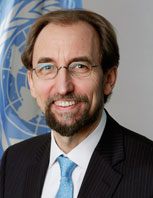 On 8 September 2014 the new UN High Commissioner for Human Rights, Zeid Ra’ad Al Hussein, addressed for the first time the Human Rights Council, and many will have been listening for clues about where he stands on key issues, how ‘activist’ he is likely to be etc. As the speech was rather long and covered a huge variety of issues, it is not easy to draw any conclusions yet. The fist half addressed issues of war and violence and in particular the humanitarian crises of today.
The role of the individual is beautifully worded: “courage is the first human virtue, revered the world over, the very virtue we value the most as human beings. The courageous individual is not he or she who wields great political power or points a gun at those who do not – that is not courage. The courageous individual is he or she who has nothing to wield but common sense, reason and the law, and is prepared to forfeit future, family, friends and even life in defence of others, or to end injustice. In its most magnificent form, the courageous individual undertakes this exertion, without ever threatening or taking the life of someone else, and certainly not someone defenceless.”..”the Takfiris [IS] who recently murdered James Foley and hundreds of other defenceless victims in Iraq and Syria – do they believe they are acting courageously? “…
“Navi Pillay was one of the greatest senior officials the UN has ever had, and one of the most able, formidable High Commissioners for Human Rights. That she could annoy many Governments – and she did – was clear; but she believed deeply and movingly in the centrality of victims, and of those who are discriminated against. They needed her vocal chords, her lungs and her pen, and she made everyone listen. I pledge to continue along the same path: to be as firm, yet always fair; critical of states when necessary, and full of praise when they deserve it.”
“A ministerial-level meeting will be held in New York on 25 September, on the need for a code of conduct to be adopted by the permanent members of the UN Security Council regarding use of veto, in situations where atrocities are ongoing and where those facts are well founded. This is not a call to have the UN Charter rewritten, but a call for the permanent members to exercise a moratorium in very specific circumstances involving atrocity crimes. I applaud the Government of France for taking the lead over this, and thank it for inviting me to participate on the 25th. When the veto is exercised for the sole purpose of blocking action by the Security Council, with no alternative course of action offered, and when people are suffering so grievously – that is also a form of cruelty.”
After briefly describing his priorities:
- halt the increasingly conjoined conflicts in Iraq and Syria. In particular, dedicated efforts are urgently needed to protect religious and ethnic groups, children – who are at risk of forcible recruitment and sexual violence – and women, who have been the targets of severe restrictions.
- ensure accountability and stop impunity
- to take a step back and look at how and why these crises erupted,
the UN High Commissioner touched on a number of current situations and mentioned the importance of the different mechanisms and bodies. Finally he came to the civil society with the following words:
“But the work done by OHCHR, by the Special Procedures, by Treaty Bodies, this Council itself, and indeed, by Member States, could never be achieved without the greater efforts of civil society actors. We need their continuing support and contributions to realise progress. I encourage the Council to strengthen its constructive engagement with civil society actors, and to ensure that their voices can be raised safely and without reprisals. Freedoms of expression, association and peaceful assembly are rights that enable people to share ideas, form new thinking, and join together with others to claim their rights. It is through the exercise of these public freedoms that we make informed, considered and intelligent decisions about our development. To restrict them undermines progress. We must acknowledge the value of civic contribution, build the capacity of marginalised voices, ensure a place at the table for civil society actors, and safeguard their activities – including the activities of those who cooperate with this Council, its Special Procedures and Commissions of Inquiry. I take this opportunity to echo the Secretary-General’s condemnation of acts of reprisal against individuals by reason of their engagement with the United Nations.”
At the end of this speech, he paid significant attention to the issue of migration: “The treatment of non-nationals must observe the minimum standards set by international law. Human rights are not reserved for citizens only, or for people with visas. They are the inalienable rights of every individual, regardless of his or her location and migration status. A tendency to promote law enforcement and security paradigms at the expense of human rights frameworks dehumanises irregular migrants, enabling a climate of violence against them and further depriving them of the full protection of the law.”
See full text at: Media Centre.
Human Rights Foundation intervenes for two prominent Human Rights Defenders
September 6, 2014To see and hear the HRDs speak at the the 2011 and 2010 Oslo Freedom Forums, click the link below:
Call for Nominations 2014 African Human Rights Defenders Awards
September 4, 2014Pan-African Human Rights Defenders Network (PAHRD–Net) has opened a call for nominations for the 2nd Edition of its human rights defenders awards. The awards will honor exceptional individuals who peacefully promote and protect universally recognized rights as stated in the Universal Declaration of Human Rights and the African Charter on Human and Peoples’ Rights. Altogether six awards will be presented, one overall award and five sub-regional awards:
– Pan-African Human Rights Defenders Award
– East and Horn of Africa Human Rights Defenders Award
– West Africa Human Rights Defenders Award
– Southern Africa Human Rights Defenders Award
– Central Africa Human Rights Defenders Award
– Northern Africa Human Rights Defenders Award
Both individuals and organizations are eligible for the award. Nominations should be received not later than 20 September 2014.
Please use the following forms [CONTROL/CLICK] : English | French
Submissions can be made in Arabic, French, English or Portuguese. Return your nomination to hrdawards@defenddefenders.org.
Awards include support to the human rights work of the winning individual or organisation. The winners will be selected by an independent jury and the awards will be presented to the winners at the occasion of the Ordinary Session of the Africa Commission on Human and People’s Rights
http://www.defenddefenders.org/
for more on human rights awards see: http://www.trueheroesfilms.org/thedigest/awards
Human rights investigators in Qatar: “being followed by the police here. Looks like they will give me troubles now”
September 4, 2014
Two British human rights workers investigating the plight of migrant labourers constructing facilities for Qatar’s 2022 World Cup have disappeared and are feared to be held incommunicado by the Gulf state’s security forces reports the Independent. Krishna Upadhyaya and Ghimire Gundev vanished on Sunday 31 August after sending texts to colleagues saying they were being followed by plain clothes police officers and feared they arrest as they tried to leave Qatar on flights that day. The two men, who are of Nepalese extraction and both carry British passports, had been in the Qatari capital Doha to record interviews with Nepali labourers and investigate conditions in accommodation camps. They were working in cooperation with Nepalese diplomats in the city.
The Global Network for Rights and Development (GNRD), employing the men, said it believed its employees were being held by the Qatari police and were at risk of maltreatment or torture: “We are deeply concerned that our employees, both British citizens, may have been subjected to enforced disappearance and are currently at risk of torture.”
[Qatar has been strongly criticised for the working conditions of its 1.4m migrant labourers as it races to spend £123bn on new infrastructure ahead of the 2022 World Cup. More than 400 Nepalese, the vast majority of them in Qatar to work on construction projects, died in the Gulf state between January 2012 and this May – a death rate of one worker per day. Qatar has insisted that none of the deaths occurred on World Cup sites. Qatar has been criticised for routinely holding detainees incommunicado for weeks or months at a time. Amnesty International has described the tactic as “standard practice” and said it can be followed by lengthy further detention without charge or trial.]
 Hans Thoolen on Human Rights Defenders and their awards