Two U.S. human rights lawyers were detained Sunday 29 April 2018 for 14 hours at Israel’s Ben Gurion International Airport before being deported back to the United States. Columbia University’s professor of law, gender and sexuality studies Katherine Franke and Center for Constitutional Rights’ executive director Vincent Warren were repeatedly questioned about their associations with groups critical of Israel. They were part of a delegation of American human rights defenders heading to Israel and Palestine to learn about the human rights situation and meet with local activists. They arrived back in New York City early Monday. Hear the interview with Vincent Warren and Katherine Franke via:
Archive for the 'Human Rights Defenders' Category
Israel bars human rights lawyers from the USA
May 4, 2018World Press Freedom Day: a good time for honoring journalists
May 4, 2018Yesterday, 3 May 2018, was World Press Freedom Day and many noteworthy activities took place. The Economist and many other newspapers of course paid attention with grisly statistics from the Committee to Protect Journalists and other sources. It was also a time to award courageous journalists and cartoonist; just to mention a few:
Musa Kart was announced as the 2018 laureate of the International Press Cartoon Prize by Cartooning for Peace.


The 2018 International Press Cartoon (or Drawing) Prize, presented biannually in Geneva, was awarded to the Turkish cartoonist who was recently sentenced to almost four years in prison for “aiding terrorism”. He is a 64-year-old artist working with the Turkish daily newspaper Cumhuriyet and was described as a “free spirit and a remarkable artist” by Swiss cartoonist Chappatte, a member of the jury.
It was also the day of the presentation of the first Ari Rath Prize for Critical Journalism (established to honour journalists who have rendered outstanding services to critical reporting on immigration, expulsion and asylum, committed to respect for human rights, in the spirit of the former editor-in-chief of the Jerusalem Post, who died in January 2017). Austrian journalist Alexandra Föderl-Schmid was the laureate.

Alexandra Föderl-Schmid who helped shape the daily newspaper “Der Standard” for almost three decades. / Picture: © Wikimedia Commons / Franz Johann Morgenbesser.
For more on the many human rights awards for the media and journalists see: http://trueheroesfilms.org/thedigest/
The Stockholm Center for Freedom (SCF) partnered with the London-based International Observatory of Human Rights (IOHR) to commemorate World Press Freedom Day in Stockholm with an event focused on Turkey, which leads the world in the highest number of journalists in jail. According to SCF data, 258 journalists and media workers were in jail as of today, with 59 of them already convicted on dubious charges of terrorism, defamation and coup plotting. In addition, 142 Turkish journalists who were forced to go into exile or still remain at large in Turkey are wanted for arrest by authorities.

Nine NGOs wrote on World Press Freedom Day a joint letter expressing deep concern over the continued arbitrary detention of Tashi Wangchuk, a Tibetan language advocate arrested in 2016 after giving an interview to the New York Times. Tashi Wangchuk has since been tried for “inciting separatism,” a politically motivated charge that violates his rights to freedom of expression and association. [Tashi Wangchuk began raising public concern for the lack of rightful Tibetan-language education …In late 2015, he spoke with the New York Times in an interview about his attempts to promote the teaching of Tibetan; he insisted the interview be on the record. A journalist from the New York Times also accompanied him to Beijing, where Tashi Wangchuk attempted to file a lawsuit to ensure local authorities guarantee the provision of Tibetan language education. The result was an article and video documentary featured in the New York Times in November 2015.
In his article, Tashi Wangchuk insisted that his language advocacy was peaceful and non-political. His attempts to persuade the Chinese government to guarantee Tibetan language instruction were conducted through official channels and he made it clear that he was not advocating Tibetan independence. Instead, his main focus was ending the destruction of Tibetan language and culture. Despite taking these precautions, Tashi Wangchuk was arrested on 27 January 2016, held in an unknown location and later stood trial in a closed session. See also:
https://humanrightsdefenders.blog/2018/03/07/china-and-the-un-human-rights-council-really-win-win/

And then there were many smaller events all around the globe that also deserves attention, such as Amnesty International Nepal voicing support to journalists as human rights defenders (such as Charan Kumar Prasai and Subodh Pyakurel and Rajan Prasad Kuikel).
———
ISHR Annual Report 2017: how the Service serves
May 2, 2018On 1 May 2018 the International Service for Human Rights (ISHR) published its 2017 annual report (“Time for ambition, cause for hope”), outlining its impacts during 2017 and vision for 2018 and the years ahead.

Here are just a few examples of major achievements:
- Through its Human Rights Defender Advocacy Programme, ISHR helped defenders from across the world develop networks of support and influence, build energy and resilience, and become even more effective advocates for national-level change.
- In consultation with LGBTI persons and organisations from all regions, and with input from eminent legal experts from across the world, ISHR developed and launched the Yogyakarta Principles Plus 10.
- Following a three year campaign undertaken in partnership with the Burkina Faso Coalition of Human Rights Defenders and the West African Human Rights Defenders Network, in June ISHR secured the adoption of a national law on the protection of defenders in Burkina Faso.
- ISHR provided human rights defenders with international and regional advocacy platforms by supporting them in giving evidence and testimony at the Human Rights Council in Geneva and the African Commission on Human and Peoples’ Rights in Banjul.
- ISHR provided defenders with comprehensive and practical guidance to leverage the UN, with a new manual on engaging with the Third Committee of the General Assembly in English, Spanish and French, and a fully revised manual on navigating the UN Committee on NGOs in Arabic, Spanish, French and English.
- ISHR also provided defenders with access to the most up-to-date information and advice via social media in Chinese, French, English and Spanish.
[for some of my earlier posts on the ISHR: https://humanrightsdefenders.blog/tag/ishr/]
For the future the ISHR says:
We’ll leverage the 20th anniversary of the Declaration on Human Rights Defenders to strengthen the recognition and protection of human rights defenders under international and regional law, and through the development and effective implementation of corporate policies on defenders.(eg, https://humanrightsdefenders.blog/2018/04/17/20th-anniversary-un-work-on-human-rights-defenders-assessed-by-ishr/) We’ll ensure that national mechanisms for the protection of defenders are adapted and respond to the particular risks faced by women human rights defenders. Our Human Rights Defender Advocacy Programme will substantially strengthen the skills, networks, resilience and impact of defenders working on women’s rights, LGBTI rights and in restrictive environments. Additionally we’ll provide human rights defenders from across the world with an innovative online e-learning platform, giving them access to training and tactical support and linking them with a community of practice and solidarity. And through our Human Rights Defender Fellowship Programme, we will provide at least three defenders at risk with up to six months of intensive training and strategic advocacy support.
TRIAL books success in two major cases against impunity
May 2, 2018Two major cases of universal jurisdiction – after years of work – have finally borne fruit in the month of April 2018: One verdict in Switzerland (Sperisen) and one in the Democratic Republic of the Congo (Colonel “Marocain”) make the case that the mobilization of human rights defenders and civil society can really make a change.
TRIAL is also organising on 18 June 2018 a round-table <http://tracking.etapestry.com/t/35021127/1307643942/76621378/0/96504/?x=04c6288b> in Geneva on the fight against wartime sexual violence. This event will also be the occasion to celebrate the organization’s 15th anniversary.[see also: https://humanrightsdefenders.blog/2016/06/13/trial-at-14-has-a-facelift/]
—-
Podcasting in Human Rights: an underestimated tool
May 2, 2018New Tactics is organizing podcast conversations on the potential of podcasting in human rights activism and the power of narrative storytelling. Hosted by Gianna Brassil. Podcasts are downloadable episodes of audio content, typically part of a series on a thematic topic. Over the past few years, podcasts have grown into a dynamic media form, with niche shows catering to listeners’ political, cultural, educational, musical, and technological audio palate. While podcasts are often produced by professional radio stations, they can also be created independent media creators. The freelance nature of podcasts makes them a unique tool for activists who want to broaden the audience of their message through a low-cost means.
New Tactics created its own podcast that explores issues of representation, the value of oral storytelling, and accessibility in creating independent media. The tension between a podcast’s entertainment value and the representation of human suffering is a topic that we grapple with in our podcast. We ask questions about how we can create stories that are honest and empathetic, meanwhile knowing that sometimes it is impossible to “create comprehensible stories out of the incomprehensible” (That the World May Know, James Dawes). Our podcast guests also discuss the uniqueness of voices and oral storytelling as tools to re-humanize conflicts and highlight the experiences of individual human lives. Finally, we discuss the accessibility of podcasts. With a microphone, simple audio editing software like Adobe Audition or Garageband, and an online platform such as Soundcloud to distribute episodes, activists can reach countless potential listeners. The power of becoming a media creator cannot be underestimated, and this episode seeks to demonstrate how media creators have the ability to reshape the landscape of representation, define for themselves what it means to be a human rights activist, and nuance an audience’s conception of how human rights stories can be told.
2018: Latin America still the graveyard for environmental human rights defenders
April 28, 2018This blog has on several occasions drawn attention to reports that show that Latin America is among the deadliest places to be a human rights defender [e.g. https://humanrightsdefenders.blog/2016/01/06/latin-america-philippines-most-dangerous-places-for-human-rights-defenders/]. An infographic – published on 27 March 2018 by Latin America Press – summarises criminalization of land & environmental rights defenders in Latin America.
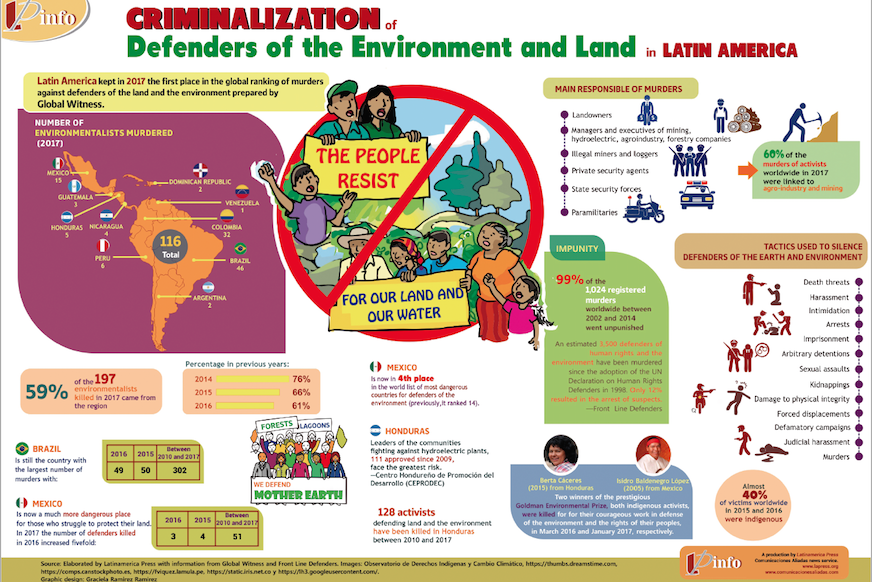
In 2016/17 an Amnesty International team took two trips to Peru and one to Paraguay and spoke with representatives of 10 human rights groups in Peru and 14 in Paraguay. AI concludes that environmental leaders are under constant threat. Authorities in Paraguay and Peru are unjustly criminalizing activists who speak out to protect their environment and land, an Amnesty International report released Thursday revealed. [see also: https://humanrightsdefenders.blog/2016/02/27/alarming-criminalisation-of-human-rights-defenders-in-latin-america/]
Annual reports 2017 by Front Line Defenders
April 28, 2018On 23 April 2018 Dublin -based NGO “Front Line Defenders” published two significant reports:
- Dispatches 2017 – the annual publication about the significant challenges confronting human rights defenders (HRDs) and efforts to provide the protection and support they so critically need;
- The Annual Report on Human Rights Defenders at Risk 2017, which documents hundreds of physical, legal, and social attacks on HRDs around the world in 2017.What stands out is the courage and resilience of the individual HRDs who tirelessly continue their work to build more just and equal societies despite increasingly repressive environments. Almost every day a HRD is killed because of her or his peaceful work.
Moreover, in October 2017, Front Line Defenders held its biannual Dublin Platform for Human Rights Defenders at Risk, bringing together over 110 HRDs from 99 countries. To read the Platform Report, view video testimonies of fellow HRDs and see some photos from the event, click the link below to access the Platform page:
In 2018, Front Line Defenders will be reviewing its work and setting priorities for the next four years, so please feel encouraged to send them any feedback on how you think it could be more effective.
—–
Dispatches- https://www.frontlinedefenders.org/en/resource-publication/dispatches-2017
Annual Report- https://www.frontlinedefenders.org/en/resource-publication/annual-report-human-rights-defenders-risk-2017
Dublin Platform – https://www.frontlinedefenders.org/en/2017-dublin-platform
Reporters Without Borders: 2018 World Press Freedom Index makes sobering reading
April 26, 2018Reporters Without Borders (better known under its French acronym RSF) published its WORLD PRESS FREEDOM INDEX 2018. The rankings you can find by clicking here READ MORE. The regional chapters below give a quick overview of the main trends, including the disturbing downward turn in the USA, the further sinking in ex-sovjet states and China’s nefarious example in Asia.
RSF INDEX 2018: JOURNALISM SORELY TESTED IN NORTH AFRICA
North Africa’s performance in the 2018 World Press Freedom Index reflects the different pressures to which journalists are exposed. Restrictive laws, reporting problems (especially at protests), and subjects that are off limits all prevent journalists from being free to provide independently reported and pluralist news and information.
RSF INDEX 2018: US FALLS AS CANADA RISES
Despite having strong constitutional protections to the contrary, the latest World Press Freedom Index findings on the US and Canada reveal two countries whose journalists and media workers face constant challenges to the very freedom to exercise their profession.
RSF INDEX 2018: MIXED PERFORMANCE IN LATIN AMERICA
The 2018 Index shows a slight overall improvement in respect for press freedom in Latin America but this should not divert attention from the continuing problems of violence, impunity, and authoritarian policies towards journalists in many Latin American countries.
RSF INDEX 2018: ASIA-PACIFIC DEMOCRACIES THREATENED BY CHINA’S MEDIA CONTROL MODEL
The Chinese model of state-controlled news and information is being copied in other Asian countries, especially Vietnam and Cambodia. North Asia’s democracies are struggling to establish themselves as alternative models. Violence against journalists is increasingly worrying in Afghanistan, India, Pakistan and the Philippines.
RSF INDEX 2018: THE DANGERS OF REPORTING IN AFRICA
SUB-SAHARAN AFRICA HAS MAINTAINED ITS THIRD PLACE IN THE RANKING BY GEOGRAPHICAL REGION, WITH A SLIGHTLY BETTER OVERALL INDICATOR THAN IN 2017. BUT THERE IS A WIDE RANGE OF SITUATIONS WITHIN THE REGION, AND JOURNALISTS ARE OFTEN THE VICTIMS OF INTIMIDATION, PHYSICAL VIOLENCE, AND ARREST.
RSF INDEX 2018: HISTORIC DECLINE IN PRESS FREEDOM IN EX-SOVIET STATES, TURKEY
THE FORMER SOVIET COUNTRIES AND TURKEY CONTINUE TO BE AT THE FOREFRONT OF THE WORLDWIDE DECLINE IN PRESS FREEDOM. ALMOST TWO-THIRDS OF THE REGION’S COUNTRIES ARE RANKED SOMEWHERE NEAR OR BELOW THE 150TH POSITION IN THE INDEX. THE REGION’S OVERALL INDICATOR HAS SUNK ALMOST AS LOW AS THAT OF MIDDLE EAST/NORTH AFRICA, THE REGION THAT IS LAST IN THE RANKING BY REGION.
RSF INDEX 2018: JOURNALISTS ARE MURDERED IN EUROPE AS WELL
The European model’s erosion, a trend visible in RSF’s most recent Indexes, has continued in the 2018 Index. The region has been shaken by two murders, as well as by threats to investigative reporters and unprecedented verbal attacks on the media. Even the countries at the top of the Index are affected by this alarming climate.
RSF INDEX 2018: MIDDLE EAST RIVEN BY CONFLICTS, POLITICAL CLASHES
The Middle East’s countries are yet again at the bottom of RSF’s World Press Freedom Index. Armed conflicts, terrorism charges against independent journalists and media, and growing online surveillance and censorship make reporting extremely dangerous for the region’s journalists.
https://rsf.org/en/rsf-index-2018-hatred-journalism-threatens-democracies
Goldman environmental prizes in 2018 go to women human rights defenders
April 23, 2018On 23 April the Guardian and other papers announced the laureates of the 2018 Goldman environmental prize and note that most of the winners are women. They are grassroots activists who have taken on powerful vested interests. For more on this award: http://trueheroesfilms.org/thedigest/awards/goldman-environmental-prize.
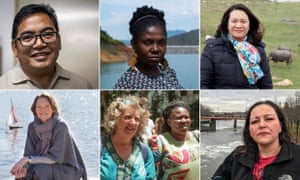
Goldman environment prize winners 2018: (clockwise from top left) Manny Calonzo, Francia Márquez, Nguy Thi Khanh, LeAnne Walters, Makoma Lekalakala and Liz McDaid, Claire Nouvian. Photograph: 2018 Goldman Environmental Prize
This year’s Goldman environmental prizes celebrate six remarkable success stories, five of them driven by women.
In Latin America, the winner is Francia Márquez, an Afro-Colombian community leader who led a 10-day, 350-mile march of 80 women from the Amazon to Bogotá that prompted the government to send troops to remove illegal miners who were polluting rivers with cyanide and mercury. [The dangers of environmental activism have been evident in the murder of two Goldman-prize recipients in the past two years: the 2015 winner Berta Cáceres and the 2005 winner Mexican activist Isidro Baldenegro López] “The first thing we need is to be more aware of the historical moment in which we find ourselves: the planet is being destroyed, it’s that simple, and if we do nothing to avoid it we will we will be part of that destruction,” Francia Márquez said. “Our time has come, we must act, we have a responsibility to future generations to leave a better world, in which taking care of life is more important than producing cumulative wealth.”
South African anti-nuclear activists Makoma Lekalakala and Liz McDaid, [see: anti-nuclear court ruling against former South African president Jacob Zuma]
Vietnamese clean-energy advocate Nguy Thi Khanh,
USA clean-water defender LeeAnne Walters, and
French marine-life champion Claire Nouvian.
Philippines anti-lead campaigner Manny Calonzo.
– see also: https://humanrightsdefenders.blog/2016/04/19/goldman-environmental-prizes-awarded-san-francisco-activists/
The three Child Rights Heroes for 2018 are announced
April 23, 2018Three Child Rights Heroes are honoured by the World’s Children’s Prize (WCP) 2018. Learn more about them by clicking their names below.
• Gabriel Mejía Montoya for his efforts over the course of more than 30 years to support Colombia’s street children, child soldiers and children in prison. Father Gabriel has suffered repeated attempts on his life because of his work.
• Rachel Lloyd for her 20-year fight against commercial sexual exploitation, CSEC, and domestic trafficking of girls and young women in the US. Rachel is a survivor of sexual and mental abuse during her childhood in England and exploitation in the sex industry in Europe.
• Valeriu Nicolae for his tireless struggle to protect the poorest and most vulnerable children in Romania’s Ferentari ghetto. Valeriu grew up in extreme poverty and was discriminated against because he was Roma.
The candidates were selected by a jury of children from 15 different countries. Rachel Lloyd has been elected Child Rights Hero by millions of young people. Gabriel Mejía Montoya from Colombia and Valeriu Nicolae from Romania get the World’s Children’s Honorary Awards.
For more information on this and other human rights awards: http://trueheroesfilms.org/thedigest/awards/worlds-childrens-prize-for-the-rights-of-the-child
 Hans Thoolen on Human Rights Defenders and their awards